 Sugar coating
 Film coating
 Compression coating
Regular coating
Coating for sustained release
Enteric coating
6. Printing
5. Polishing
4. Colouring
3. Smoothing
2. Sub coating
1. Seal tablet core
Traditionally sugar coatings formed the bulk of coated tablets
but today film coatings are the more modern technology in
tablet coating.
Description of tablets: Smooth, rounded and polished to a
high gloss.
Process: Multistage process involving 6 separate
operations
Brufen® POM
 Available in 200mg and
400mg strength
Premarin® POM
 Conjugated oestrogens
625mcg (maroon) and
1.25mcg (yellow)
Colofac ® P
 Mebeverine hydrochloride
100mg Round, white, sugar
coated
Kalms ® GSL
 45mg Hops powder,90mg
Gentian powdered extract,
and 135mg Valerian
powdered extract
Seal coating Sub coating Smooth coating Polishing
Shellac Acacia Calcium carbonate Carnauba wax
Propylene glycol Gelatin Corn starch Bees wax
Oleic acid Sugar powder Sugar powder Paraffin wax
PEG400 Corn syrup Syrup Naphtha
Methylene
chloride
Syrup Color Denatured spirit
Alcohol Distilled water Distilled powder
 Modern approaches to coating a tablets by surroundings them with a thin
layer of polymeric material.
Process: Single stage process, which involves a coating solution containing
the following :
1) Polymer
2) Solvent
3) Plasticizer
4) Colorants
Film coating is done primarily for two purposes:
 Immediate release
 Modified release
Polymer used for
Immediate released Enteric coating Sustained release
Hypromellose Hypromellose phthalate HPMC
Carboxymethyl cellulose Polyvinyl acetate
phthalate
Eudragit
Hydroxyethyl cellulose Cellulose acetate
phthalate
Ethyllcellulose
Hydroxyethylmethyl
cellulose
Polymethacrylates
Hydroxypropyl
cellulose
shellac
Polyethylene glycol
Ethylcellose
Hydroxypropylmethyl
cellulose
The technique involved in enteric coating is protection of the tablet
core from disintegration in the acidic environment of the stomach
by employing pH sensitive polymer, which swell or solubilize in
response to an increase in pH to release the drug.
Aims of Enteric protection:
 To mask taste or odour
 Protection of active ingredients, from the acidic environment of the
stomach.
 Protection from local irritation of the stomach mucosa.
 Release of active ingredient in specific target area within
gastrointestinal tract.
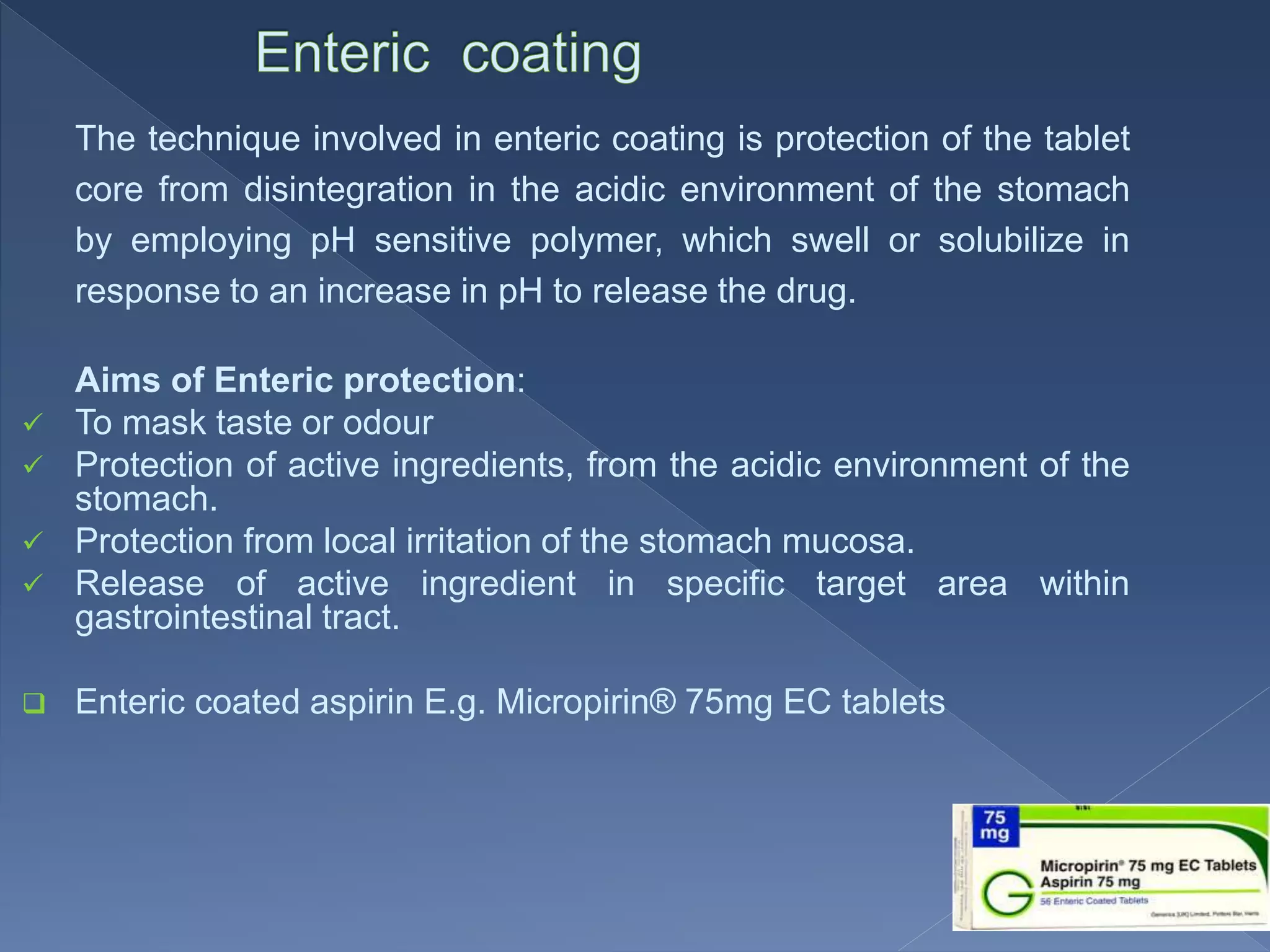
 Enteric coated aspirin E.g. Micropirin® 75mg EC tablets
1)Conventional pan process:
A)PELLIGRINI PAN
B)IMMERSION SWORD TYPE PAN
C)IMMERSION TUBE TYPE PAN
2) Perforated pan coating:
A)ACCELA COTA PAN
B)HI-COATER
C)DRIA COATER
D)GLATT PAN-COATING EQUIPMENT
E)HUTTLIN BUTTERFLY PAN
F)DUMOULIN IDA.X.COATING EQUIPMENT
3)Fluid bed coating process
1) Circular metal pan mounted at 40
degrees .
2) 8-60 inch diameter
3) Rotated on its horizantal axis by a
motor.
4) heated air is supplied by inlet air supply.
5) Exhaust by means of ducts.
6) coating soln are applied to tablets by
ladling or spraying .
7) use of atomizing system to produce
even distribution of coatins soln or
suspension .
1) PLG SYSTEM
Inlet hot air-by a sword.
exhaust air -by a plenum.
2) GS SYSTEM
Inlet hot air-by inlet
plenum.
exhaust air -by two perforated
swords.
1) Consists of long tube with a
spranozzle at its tip.
2) Hot air gets delivered through
this tube into tablet bed.
3) The drying air flows upward
& exhusted by a conventional
duct.
4) Relatively rapid processing
times have been reported for
both film & sugar coatings
with this system.
1) Consists of long tube with a spray
nozzle at its tip.
2) Hot air gets delivered through this
tube
into tablet bed.
3) The drying air flows upward
& exhusted by a conventional
duct.
4) Relatively rapid processing
times have been reported for
both film & sugar coatings
with this system.
A)ACCELA-COTA PAN
1) pan is fully perforated.
2) contains mixing blades.
3) inlet air is by a plenum in
contact with the top of the
pan.
4) air is exhausted by a plenum
located below the pan.
 1)consists of four perforated
segments which
are perpendicular to each other..
2) each of these perforations acts
as an opening for air outlet which
is fixed to the exterior of the pan
surface.
3) drying air is introduced into
pan through an opening
located on inside periphery
of top of the pan.
 1) introduces drying air through hallow perforated
baffles located on inside periphery of drum.
 2) exhaust is from back of the pan.
 3) different air flows
a)direct flow: air in at the top(through
perforated baffles and exhausted through baffles
located beneath tablet bed.
 b)reverse flow A: air in through baffles located
beneath tablet bed and exhausted via baffles at
top of pan.
 c)reverse flow B: air in through baffles
located beneath tablet bed and
exhausted via plenum connected to
opening at back of pan.
 1) similar to that of accela-cota.
 2) a divided air plenum located beneath
the moving tablet bed enables air to be
blown into or exhausted from the pan
through
either or both of the two sections.
 3) in addition , another air plenum ,
connected to an opening above the door
(similar to that in a hicoater) also allows air
to be blown into or exhausted from the
pan.
 4) quite expensive.
 1) It has a series of large ,angled
,slotted openings in the pan wall at
the junction of the cylindrical portion
with each of the front or back panels.
 2) these openings permit air to be
exhausted from the pan.
 3) drying air is applied to the surface
of the bed of the product being
coated by means of a slotted tube.
 4) front and back of the pan can
be disconnected from the
cylindrical ,central section and
hinged down.
 1) Fully perforated cylindrical central section.
 2) the two air plenums that function as both
inlet or exhaust air systems are located in
contact with the outside of the pan.
3) a third plenum , connected to a slotted
tube located inside the pan and above the
cascading product bed allows inlet air only to be
directed onto the surface of product being coated.
 4)air flows.
a)single flow
b)reversed single flow
c)double flow
d)direct double flow
 The Theory and Practice of Industrial
pharmacy by Leon Lachman, Herbert
lieberman, 3rd edition, page no.
 Industrial Pharmacy: A Comprehensive
approach by Dulal Tripathi, page no.128-132

Tablet coating

  • 2.
     Sugar coating Film coating  Compression coating Regular coating Coating for sustained release Enteric coating
  • 3.
    6. Printing 5. Polishing 4.Colouring 3. Smoothing 2. Sub coating 1. Seal tablet core Traditionally sugar coatings formed the bulk of coated tablets but today film coatings are the more modern technology in tablet coating. Description of tablets: Smooth, rounded and polished to a high gloss. Process: Multistage process involving 6 separate operations
  • 4.
    Brufen® POM  Availablein 200mg and 400mg strength Premarin® POM  Conjugated oestrogens 625mcg (maroon) and 1.25mcg (yellow) Colofac ® P  Mebeverine hydrochloride 100mg Round, white, sugar coated Kalms ® GSL  45mg Hops powder,90mg Gentian powdered extract, and 135mg Valerian powdered extract
  • 5.
    Seal coating Subcoating Smooth coating Polishing Shellac Acacia Calcium carbonate Carnauba wax Propylene glycol Gelatin Corn starch Bees wax Oleic acid Sugar powder Sugar powder Paraffin wax PEG400 Corn syrup Syrup Naphtha Methylene chloride Syrup Color Denatured spirit Alcohol Distilled water Distilled powder
  • 6.
     Modern approachesto coating a tablets by surroundings them with a thin layer of polymeric material. Process: Single stage process, which involves a coating solution containing the following : 1) Polymer 2) Solvent 3) Plasticizer 4) Colorants Film coating is done primarily for two purposes:  Immediate release  Modified release
  • 7.
    Polymer used for Immediatereleased Enteric coating Sustained release Hypromellose Hypromellose phthalate HPMC Carboxymethyl cellulose Polyvinyl acetate phthalate Eudragit Hydroxyethyl cellulose Cellulose acetate phthalate Ethyllcellulose Hydroxyethylmethyl cellulose Polymethacrylates Hydroxypropyl cellulose shellac Polyethylene glycol Ethylcellose Hydroxypropylmethyl cellulose
  • 8.
    The technique involvedin enteric coating is protection of the tablet core from disintegration in the acidic environment of the stomach by employing pH sensitive polymer, which swell or solubilize in response to an increase in pH to release the drug. Aims of Enteric protection:  To mask taste or odour  Protection of active ingredients, from the acidic environment of the stomach.  Protection from local irritation of the stomach mucosa.  Release of active ingredient in specific target area within gastrointestinal tract.  Enteric coated aspirin E.g. Micropirin® 75mg EC tablets
  • 9.
    1)Conventional pan process: A)PELLIGRINIPAN B)IMMERSION SWORD TYPE PAN C)IMMERSION TUBE TYPE PAN 2) Perforated pan coating: A)ACCELA COTA PAN B)HI-COATER C)DRIA COATER D)GLATT PAN-COATING EQUIPMENT E)HUTTLIN BUTTERFLY PAN F)DUMOULIN IDA.X.COATING EQUIPMENT 3)Fluid bed coating process
  • 10.
    1) Circular metalpan mounted at 40 degrees . 2) 8-60 inch diameter 3) Rotated on its horizantal axis by a motor. 4) heated air is supplied by inlet air supply. 5) Exhaust by means of ducts. 6) coating soln are applied to tablets by ladling or spraying . 7) use of atomizing system to produce even distribution of coatins soln or suspension .
  • 11.
    1) PLG SYSTEM Inlethot air-by a sword. exhaust air -by a plenum. 2) GS SYSTEM Inlet hot air-by inlet plenum. exhaust air -by two perforated swords.
  • 12.
    1) Consists oflong tube with a spranozzle at its tip. 2) Hot air gets delivered through this tube into tablet bed. 3) The drying air flows upward & exhusted by a conventional duct. 4) Relatively rapid processing times have been reported for both film & sugar coatings with this system.
  • 13.
    1) Consists oflong tube with a spray nozzle at its tip. 2) Hot air gets delivered through this tube into tablet bed. 3) The drying air flows upward & exhusted by a conventional duct. 4) Relatively rapid processing times have been reported for both film & sugar coatings with this system.
  • 14.
    A)ACCELA-COTA PAN 1) panis fully perforated. 2) contains mixing blades. 3) inlet air is by a plenum in contact with the top of the pan. 4) air is exhausted by a plenum located below the pan.
  • 15.
     1)consists offour perforated segments which are perpendicular to each other.. 2) each of these perforations acts as an opening for air outlet which is fixed to the exterior of the pan surface. 3) drying air is introduced into pan through an opening located on inside periphery of top of the pan.
  • 16.
     1) introducesdrying air through hallow perforated baffles located on inside periphery of drum.  2) exhaust is from back of the pan.  3) different air flows a)direct flow: air in at the top(through perforated baffles and exhausted through baffles located beneath tablet bed.  b)reverse flow A: air in through baffles located beneath tablet bed and exhausted via baffles at top of pan.  c)reverse flow B: air in through baffles located beneath tablet bed and exhausted via plenum connected to opening at back of pan.
  • 17.
     1) similarto that of accela-cota.  2) a divided air plenum located beneath the moving tablet bed enables air to be blown into or exhausted from the pan through either or both of the two sections.  3) in addition , another air plenum , connected to an opening above the door (similar to that in a hicoater) also allows air to be blown into or exhausted from the pan.  4) quite expensive.
  • 18.
     1) Ithas a series of large ,angled ,slotted openings in the pan wall at the junction of the cylindrical portion with each of the front or back panels.  2) these openings permit air to be exhausted from the pan.  3) drying air is applied to the surface of the bed of the product being coated by means of a slotted tube.  4) front and back of the pan can be disconnected from the cylindrical ,central section and hinged down.
  • 19.
     1) Fullyperforated cylindrical central section.  2) the two air plenums that function as both inlet or exhaust air systems are located in contact with the outside of the pan. 3) a third plenum , connected to a slotted tube located inside the pan and above the cascading product bed allows inlet air only to be directed onto the surface of product being coated.  4)air flows. a)single flow b)reversed single flow c)double flow d)direct double flow
  • 20.
     The Theoryand Practice of Industrial pharmacy by Leon Lachman, Herbert lieberman, 3rd edition, page no.  Industrial Pharmacy: A Comprehensive approach by Dulal Tripathi, page no.128-132