GOOD MORNING
Department Of Oral Medicine & Radiology PRESENTED BY: NEHA KAPOOR ROLL NO. 32 4th batch
SEMINAR ON ANALGESICS USED IN DENTISTRY
CONTENTS Introduction Classification NSAIDs References
INTRODUCTION ANALGESICS A drug that selectively relieves pain by acting in CNS or on peripheral pain mechanism, without significantly altering consciousness. ANAESTHESIA Anaesthesia means loss of sensation. Anaesthetic agent is one which bring about loss of all modalities of sensation, particularly pain, along with a reversible loss of consciousness. PAIN  (ALGESIA) An unpleasant sensory and emotional experience associated with actual or potential tissue damage or described in terms of such damage. -IASP
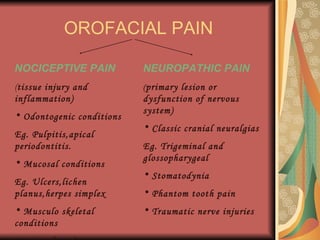
OROFACIAL PAIN NOCICEPTIVE PAIN ( tissue injury and inflammation) Odontogenic conditions Eg. Pulpitis,apical periodontitis. Mucosal conditions Eg. Ulcers,lichen planus,herpes simplex Musculo skeletal conditions Eg. Myofacial pain,temporo mandibular joint capsulitis,arthritis. NEUROPATHIC PAIN ( primary lesion or dysfunction of nervous system) Classic cranial neuralgias Eg. Trigeminal and glossopharygeal Stomatodynia Phantom tooth pain Traumatic nerve injuries
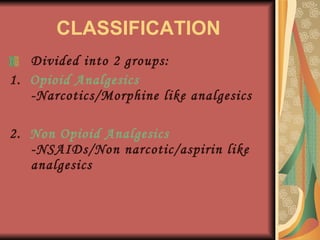
CLASSIFICATION Divided into 2 groups: 1.  Opioid Analgesics  -Narcotics/Morphine like analgesics 2.  Non Opioid Analgesics  -NSAIDs/Non narcotic/aspirin like analgesics
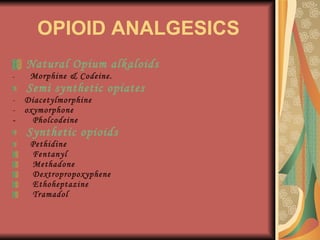
OPIOID ANALGESICS Natural Opium alkaloids   -   Morphine & Codeine. Semi synthetic opiates  Diacetylmorphine oxymorphone -   Pholcodeine Synthetic opioids Pethidine Fentanyl Methadone Dextropropoxyphene Ethoheptazine Tramadol
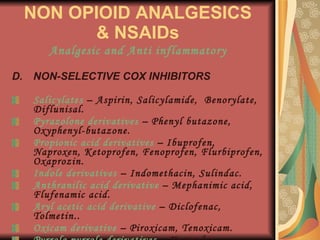
NON OPIOID ANALGESICS & NSAIDs Analgesic and Anti inflammatory NON-SELECTIVE COX INHIBITORS Salicylates  – Aspirin, Salicylamide,  Benorylate,  Diflunisal. Pyrazolone derivatives  – Phenyl butazone, Oxyphenyl-butazone. Propionic acid derivatives  – Ibuprofen, Naproxen, Ketoprofen, Fenoprofen, Flurbiprofen, Oxaprozin. Indole derivatives  – Indomethacin, Sulindac. Anthranilic acid derivative  – Mephanimic acid, Flufenamic acid. Aryl acetic acid derivative  – Diclofenac, Tolmetin.. Oxicam derivative  – Piroxicam, Tenoxicam. Pyrrolo pyrrole derivatives  – Ketorolac, Feprazone.
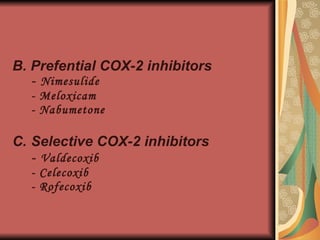
B.   Prefential COX-2 inhibitors -  Nimesulide - Meloxicam - Nabumetone C.   Selective COX-2 inhibitors -  Valdecoxib - Celecoxib - Rofecoxib
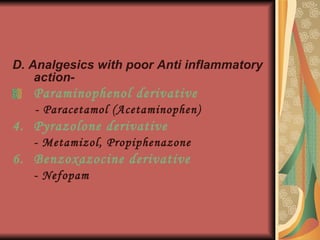
D. Analgesics with poor Anti inflammatory action- Paraminophenol derivative   - Paracetamol (Acetaminophen) Pyrazolone derivative - Metamizol, Propiphenazone Benzoxazocine derivative - Nefopam
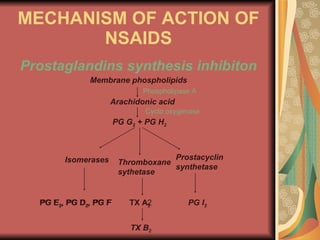
MECHANISM OF ACTION OF NSAIDS Prostaglandins synthesis inhibiton Membrane phospholipids Phospholipase A Arachidonic acid Cyclo oxygenase PG G 2  + PG H 2 Isomerases Thromboxane sythetase Prostacyclin synthetase PG E 2 , PG D 2 , PG F TX A2 TX B 2 PG I 2 PG E 2 , PG D 2 , PG F TX A 2
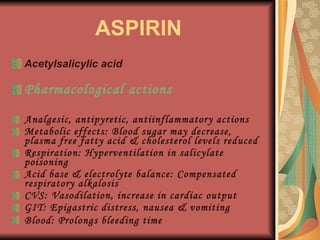
ASPIRIN Acetylsalicylic acid Pharmacological actions Analgesic, antipyretic, antiinflammatory actions Metabolic effects: Blood sugar may decrease, plasma free fatty acid & cholesterol levels reduced Respiration: Hyperventilation in salicylate poisoning Acid base & electrolyte balance: Compensated respiratory alkalosis CVS: Vasodilation, increase in cardiac output GIT: Epigastric distress, nausea & vomiting Blood: Prolongs bleeding time
ADVERSE EFFECTS :  Nausea, vomiting, epigastric distress, increased blood loss in stools Rashes, fixed drug eruptions, urticaria, rhinorrhea, angioedema, asthma, anaphylactoid reaction Salicylism – dizziness, tinnitus, vertigo, impairment of hearing & vision, excitement & mental confusion, hyperventilation & electrolyte imbalance Acute salicylate poisoning: Fatal dose in adults 15-30g, lower in children
USES : Analgesic Antipyretic Acute rheumatic fever Rheumatoid arthritis Osteoarthritis Postmyocardial infarction Patent Ductus Arteriosus Familial colonic polyposis Prevention of colon cancer Treatment of Bartter’s syndrome
Precautions & Contraindications : Peptic ulcer Bleeding tendencies Children with chicken pox or influenza Chronic liver disease Diabetics Pregnancy Breast feeding mothers G6 PD deficient individuals : Hemolysis Dose -  0.3-0.6 g 4-6 hrly orally
Commercially available as: Aspirin :   350 mg tab. Disprin:  350mg tab. Colsprin:  100, 325,650mg tab. Ecosprin:  75, 150, 325mg tab.
Dental consideration in a patient who is on aspirin therapy   BT CT PT INR
INDOMETHACIN Indole derivative Potent inhibitor of PG synthesis & suppresses neutrophil motility Well absorbed orally & t ½ is 2-5 hrs Adverse effects:   Gastric irritation, nausea, anorexia, gastric bleeding & diarrhoea, frontal headache, dizziness, ataxia, mental confusion, depression, psychosis, leukopenia, rashes, increased risk of bleeding Contraindicated in machinery operators, drivers, psychiatric patients, epileptics, kidney disease, pregnant women & children Dose: 25-50mg BD-QID Commercially available as-  Idicin, Indocap, Indoflam :  25mg, 75mg tab
IBUPROFEN Propionic acid derivative Adverse effects: Gastric discomfort, nausea & vomiting Headache, dizziness, blurring of vision, tinnitus & depression Avoided in pregnancy, peptic ulcer patient & asthmatic patients
USES: Analgesic & Antipyretic Rheumatoid arthritis, osteoarthritis, musculoskeletal disorders Soft tissue injuries, fractures, vasectomy, tooth extraction Postpartum & postoperatively : suppress swelling & inflammation Dose: 400-800 mg TDS Comercially available as-  Brufen, Emflam, Ibusynth  : 200, 400, 600mg tab. Ibugesic  : 100mg, 400 mg tab.
MEPHENAMIC ACID Anthranilic acid derivative Adverse effect:  Diarrhoea, skin rashes, dizziness & other CNS manifestation Orally absorbed & t ½ is 2-4 hrs Uses:  Analgesic in muscle, joint & soft tissue pain, dysmenorrhoea, rheumatoid & osteoarthritis Dose: 250-500 mg TDS Commercially available as: Medol, Meftal  - 250, 500 mg tab.
DICLOFENAC SODIUM Aryl-acetic acid derivative Well absorbed orally Plasma t ½ - 2 hrs Adverse effects:  Epigastric pain, nausea, headache, dizziness, rashes Uses:  Rheumatoid arthritis, ankylosing spondylitis, dysmenorrhea, post traumatic & post inflammatory conditions Dose: 50mg TDS, then BD oral, 75mg deep i.m Commercially available as: Voveran, Diclonac, Movonac :  50 mg tab. Diclomax :  25, 50 mg tab.
PIROXICAM Oxicam derivative Long acting potent NSAID Good analgesic-antipyretic action Metabolised in liver ; excreted in urine & bile Plasma t ½ is 2 days Side effects :  heart burn, nausea & anorexia Use as short term analgesic & long term anti inflammatory drug – rheumatoid & osteo arthritis, ankylosing spondylitis, acute gout, musculoskeletal injuries,dysmenorrhoea etc Dose: 20mg BD for 2 days followed by 20mg OD Commercially available as- Dolonex, Pirox, Piricam  : 10, 20 mg cap.
KETOROLAC Pyrrolo-pyrrole derivative Potent analgesic & modest anti inflammatory Rapidly absorbed after oral & i.m administration Plasma t ½ is 5-7 hrs Adverse effects:  Nausea, abdominal pain, dyspepsia, ulceration, loose stools, drowsiness, headache, dizziness, nervousness, pruritis, pain & fluid retention Not be given to patients on anticoagulants
USES: Postoperative & acute musculoskeletal pain: 15-30 mg i.m or i.v every 4-6 hrs Used for renal colic, migraine, pain due to bony metastasis Orally in a dose of 10-20 mg 6 hrly. Commercially available as – Ketorol, Zorovon, Ketanov, Torolac  : 10mg tab.
NIMESULIDE Preferential COX-2 inhibitors Used for short lasting painful inflammatory conditions like sports injuries, sinusitis, ear nose throat disorders, dental surgery, bursitis, low backache, dysmenorrhoea, post operative pain, osteoarthritis & for fever Completely absorbed orally, excreted in urine, t ½ of  2-5 hrs
Adverse effects: - Epigastralgia, heart burn, nausea, loose motions, rash pruritus. - Hematuria & fulminant hepatic failure in few cases Useful in asthmatics, bronchospasm or intolerance to aspirin & other NSAIDs Dose: 100 mg BD Commercially available as- Nimulid, Nimegesic, Nise, Nobel, Nimodol  : 100mg tab.
ROFECOXIB Selective COX-2 inhibitor. Effective in osteoarthritis, rheumatoid arthritis, dysmenorrhoea, dental, post operative & acute musculoskeletal pain at dose of 12.5-25 mg OD daily Side effects   mild g.i complaints, headache & dizziness Well absorbed orally & t ½ of 17 hrs Avoided in presence of severe hepatic or renal disease Dose: 12.5-25 mg OD Commercially available as- Rofact, Rofegesic, Rofibax  : 12.5, 25 mg tab.
PARACETAMOL Para-amino phenol derivative Actions:  Good & promptly acting antipyretic Well absorbed orally Plasma t ½ is 2-3 hrs Safe & well tolerated Nausea & rashes occur occasionally Analgesic nephropathy- years of heavy ingestion
Acute paracetamol poisoning: -  In small children with glucuronide conjugating ability Nausea, vomiting, abdominal pain, liver tenderness Centrilobular hepatic necrosis accompanied by renal tubular necrosis & hypoglycemia, may progress to coma Jaundice after 2 days Treatment:  Vomiting induced, activated charcoal given, N-acetylcystein 150mg/kg infused iv over 20hrs, alternatively, 75mg/kg orally every 4-6 hrs for 2-3 days.
USES: First choice analgesic for osteoarthritis Best drug to be used as antipyretic Over the counter analgesic for headache, musculoskeletal pain, dysmenorrhoea, etc Much safer than aspirin Does not prolong bleeding time Used in all age groups, pregnant & lactating women, in other disease states & in patients in whom aspirin is contraindicated No significant drug interactions
DOSE:   0.5-1g TDS; infants 50mg; children 1-3 yrs 80-160mg 4-8 yrs 240-320mg 9-12 yrs 300-600mg Commercially available as- Crocin  : 0.5, 1 gm tab. Ultragin, Pyrigesic, Calpol  : 500mg. tab
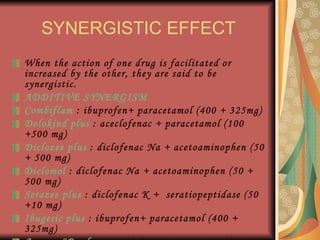
SYNERGISTIC EFFECT When the action of one drug is facilitated or increased by the other, they are said to be synergistic. ADDITIVE SYNERGISM Combiflam  : ibuprofen+ paracetamol (400 + 325mg) Dolokind plus  : aceclofenac + paracetamol (100 +500 mg) Diclozee plus  : diclofenac Na + acetoaminophen (50 + 500 mg) Diclomol  : diclofenac Na + acetoaminophen (50 + 500 mg) Serazee plus  : diclofenac K +  seratiopeptidase (50 +10 mg) Ibugesic plus  : ibuprofen+ paracetamol (400 + 325mg) Asonac-SR  plus  : aceclofenac + paracetamol  +  seratiopeptidase  (100 + 500 + 15mg )
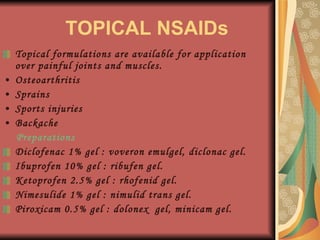
TOPICAL NSAIDs Topical formulations are available for application over painful joints and muscles. Osteoarthritis Sprains Sports injuries Backache Preparations Diclofenac 1% gel : voveron emulgel, diclonac gel. Ibuprofen 10% gel : ribufen gel. Ketoprofen 2.5% gel : rhofenid gel. Nimesulide 1% gel : nimulid trans gel. Piroxicam 0.5% gel : dolonex  gel, minicam gel.
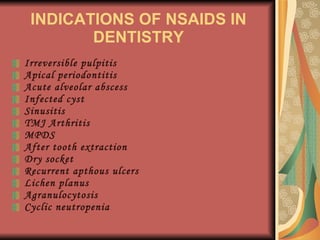
INDICATIONS OF NSAIDS IN DENTISTRY Irreversible pulpitis Apical periodontitis Acute alveolar abscess Infected cyst Sinusitis TMJ Arthritis MPDS After tooth extraction Dry socket Recurrent apthous ulcers Lichen planus Agranulocytosis Cyclic neutropenia
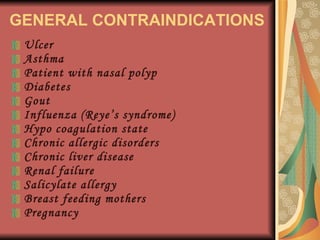
GENERAL CONTRAINDICATIONS Ulcer Asthma Patient with nasal polyp Diabetes Gout Influenza (Reye’s syndrome) Hypo coagulation state Chronic allergic disorders Chronic liver disease Renal failure Salicylate allergy Breast feeding mothers Pregnancy
CONCLUSION Nature of problem along with consideration of risk factors in an individual patient directs the initial selection Drugs differ quantitatively in producing different side effects Large inter individual differences
REFERENCES Essentials of Medical Pharmacology,   K. D Tripathy, 5 th  edition Pharmacology & Pharmacotherapeutics,  R. S. Satoskar,18 th  edition  Textbook of oral medicine, Burkett’s, 11 th  edition
THANK YOU THANK YOU

Analgesics

  • 1.
  • 2.
    Department Of OralMedicine & Radiology PRESENTED BY: NEHA KAPOOR ROLL NO. 32 4th batch
  • 3.
    SEMINAR ON ANALGESICSUSED IN DENTISTRY
  • 4.
  • 5.
    INTRODUCTION ANALGESICS Adrug that selectively relieves pain by acting in CNS or on peripheral pain mechanism, without significantly altering consciousness. ANAESTHESIA Anaesthesia means loss of sensation. Anaesthetic agent is one which bring about loss of all modalities of sensation, particularly pain, along with a reversible loss of consciousness. PAIN (ALGESIA) An unpleasant sensory and emotional experience associated with actual or potential tissue damage or described in terms of such damage. -IASP
  • 6.
    OROFACIAL PAIN NOCICEPTIVEPAIN ( tissue injury and inflammation) Odontogenic conditions Eg. Pulpitis,apical periodontitis. Mucosal conditions Eg. Ulcers,lichen planus,herpes simplex Musculo skeletal conditions Eg. Myofacial pain,temporo mandibular joint capsulitis,arthritis. NEUROPATHIC PAIN ( primary lesion or dysfunction of nervous system) Classic cranial neuralgias Eg. Trigeminal and glossopharygeal Stomatodynia Phantom tooth pain Traumatic nerve injuries
  • 7.
    CLASSIFICATION Divided into2 groups: 1. Opioid Analgesics -Narcotics/Morphine like analgesics 2. Non Opioid Analgesics -NSAIDs/Non narcotic/aspirin like analgesics
  • 8.
    OPIOID ANALGESICS NaturalOpium alkaloids - Morphine & Codeine. Semi synthetic opiates Diacetylmorphine oxymorphone - Pholcodeine Synthetic opioids Pethidine Fentanyl Methadone Dextropropoxyphene Ethoheptazine Tramadol
  • 9.
    NON OPIOID ANALGESICS& NSAIDs Analgesic and Anti inflammatory NON-SELECTIVE COX INHIBITORS Salicylates – Aspirin, Salicylamide, Benorylate, Diflunisal. Pyrazolone derivatives – Phenyl butazone, Oxyphenyl-butazone. Propionic acid derivatives – Ibuprofen, Naproxen, Ketoprofen, Fenoprofen, Flurbiprofen, Oxaprozin. Indole derivatives – Indomethacin, Sulindac. Anthranilic acid derivative – Mephanimic acid, Flufenamic acid. Aryl acetic acid derivative – Diclofenac, Tolmetin.. Oxicam derivative – Piroxicam, Tenoxicam. Pyrrolo pyrrole derivatives – Ketorolac, Feprazone.
  • 10.
    B. Prefential COX-2 inhibitors - Nimesulide - Meloxicam - Nabumetone C. Selective COX-2 inhibitors - Valdecoxib - Celecoxib - Rofecoxib
  • 11.
    D. Analgesics withpoor Anti inflammatory action- Paraminophenol derivative - Paracetamol (Acetaminophen) Pyrazolone derivative - Metamizol, Propiphenazone Benzoxazocine derivative - Nefopam
  • 12.
    MECHANISM OF ACTIONOF NSAIDS Prostaglandins synthesis inhibiton Membrane phospholipids Phospholipase A Arachidonic acid Cyclo oxygenase PG G 2 + PG H 2 Isomerases Thromboxane sythetase Prostacyclin synthetase PG E 2 , PG D 2 , PG F TX A2 TX B 2 PG I 2 PG E 2 , PG D 2 , PG F TX A 2
  • 13.
    ASPIRIN Acetylsalicylic acidPharmacological actions Analgesic, antipyretic, antiinflammatory actions Metabolic effects: Blood sugar may decrease, plasma free fatty acid & cholesterol levels reduced Respiration: Hyperventilation in salicylate poisoning Acid base & electrolyte balance: Compensated respiratory alkalosis CVS: Vasodilation, increase in cardiac output GIT: Epigastric distress, nausea & vomiting Blood: Prolongs bleeding time
  • 14.
    ADVERSE EFFECTS : Nausea, vomiting, epigastric distress, increased blood loss in stools Rashes, fixed drug eruptions, urticaria, rhinorrhea, angioedema, asthma, anaphylactoid reaction Salicylism – dizziness, tinnitus, vertigo, impairment of hearing & vision, excitement & mental confusion, hyperventilation & electrolyte imbalance Acute salicylate poisoning: Fatal dose in adults 15-30g, lower in children
  • 15.
    USES : AnalgesicAntipyretic Acute rheumatic fever Rheumatoid arthritis Osteoarthritis Postmyocardial infarction Patent Ductus Arteriosus Familial colonic polyposis Prevention of colon cancer Treatment of Bartter’s syndrome
  • 16.
    Precautions & Contraindications: Peptic ulcer Bleeding tendencies Children with chicken pox or influenza Chronic liver disease Diabetics Pregnancy Breast feeding mothers G6 PD deficient individuals : Hemolysis Dose - 0.3-0.6 g 4-6 hrly orally
  • 17.
    Commercially available as:Aspirin : 350 mg tab. Disprin: 350mg tab. Colsprin: 100, 325,650mg tab. Ecosprin: 75, 150, 325mg tab.
  • 18.
    Dental consideration ina patient who is on aspirin therapy BT CT PT INR
  • 19.
    INDOMETHACIN Indole derivativePotent inhibitor of PG synthesis & suppresses neutrophil motility Well absorbed orally & t ½ is 2-5 hrs Adverse effects: Gastric irritation, nausea, anorexia, gastric bleeding & diarrhoea, frontal headache, dizziness, ataxia, mental confusion, depression, psychosis, leukopenia, rashes, increased risk of bleeding Contraindicated in machinery operators, drivers, psychiatric patients, epileptics, kidney disease, pregnant women & children Dose: 25-50mg BD-QID Commercially available as- Idicin, Indocap, Indoflam : 25mg, 75mg tab
  • 20.
    IBUPROFEN Propionic acidderivative Adverse effects: Gastric discomfort, nausea & vomiting Headache, dizziness, blurring of vision, tinnitus & depression Avoided in pregnancy, peptic ulcer patient & asthmatic patients
  • 21.
    USES: Analgesic &Antipyretic Rheumatoid arthritis, osteoarthritis, musculoskeletal disorders Soft tissue injuries, fractures, vasectomy, tooth extraction Postpartum & postoperatively : suppress swelling & inflammation Dose: 400-800 mg TDS Comercially available as- Brufen, Emflam, Ibusynth : 200, 400, 600mg tab. Ibugesic : 100mg, 400 mg tab.
  • 22.
    MEPHENAMIC ACID Anthranilicacid derivative Adverse effect: Diarrhoea, skin rashes, dizziness & other CNS manifestation Orally absorbed & t ½ is 2-4 hrs Uses: Analgesic in muscle, joint & soft tissue pain, dysmenorrhoea, rheumatoid & osteoarthritis Dose: 250-500 mg TDS Commercially available as: Medol, Meftal - 250, 500 mg tab.
  • 23.
    DICLOFENAC SODIUM Aryl-aceticacid derivative Well absorbed orally Plasma t ½ - 2 hrs Adverse effects: Epigastric pain, nausea, headache, dizziness, rashes Uses: Rheumatoid arthritis, ankylosing spondylitis, dysmenorrhea, post traumatic & post inflammatory conditions Dose: 50mg TDS, then BD oral, 75mg deep i.m Commercially available as: Voveran, Diclonac, Movonac : 50 mg tab. Diclomax : 25, 50 mg tab.
  • 24.
    PIROXICAM Oxicam derivativeLong acting potent NSAID Good analgesic-antipyretic action Metabolised in liver ; excreted in urine & bile Plasma t ½ is 2 days Side effects : heart burn, nausea & anorexia Use as short term analgesic & long term anti inflammatory drug – rheumatoid & osteo arthritis, ankylosing spondylitis, acute gout, musculoskeletal injuries,dysmenorrhoea etc Dose: 20mg BD for 2 days followed by 20mg OD Commercially available as- Dolonex, Pirox, Piricam : 10, 20 mg cap.
  • 25.
    KETOROLAC Pyrrolo-pyrrole derivativePotent analgesic & modest anti inflammatory Rapidly absorbed after oral & i.m administration Plasma t ½ is 5-7 hrs Adverse effects: Nausea, abdominal pain, dyspepsia, ulceration, loose stools, drowsiness, headache, dizziness, nervousness, pruritis, pain & fluid retention Not be given to patients on anticoagulants
  • 26.
    USES: Postoperative &acute musculoskeletal pain: 15-30 mg i.m or i.v every 4-6 hrs Used for renal colic, migraine, pain due to bony metastasis Orally in a dose of 10-20 mg 6 hrly. Commercially available as – Ketorol, Zorovon, Ketanov, Torolac : 10mg tab.
  • 27.
    NIMESULIDE Preferential COX-2inhibitors Used for short lasting painful inflammatory conditions like sports injuries, sinusitis, ear nose throat disorders, dental surgery, bursitis, low backache, dysmenorrhoea, post operative pain, osteoarthritis & for fever Completely absorbed orally, excreted in urine, t ½ of 2-5 hrs
  • 28.
    Adverse effects: -Epigastralgia, heart burn, nausea, loose motions, rash pruritus. - Hematuria & fulminant hepatic failure in few cases Useful in asthmatics, bronchospasm or intolerance to aspirin & other NSAIDs Dose: 100 mg BD Commercially available as- Nimulid, Nimegesic, Nise, Nobel, Nimodol : 100mg tab.
  • 29.
    ROFECOXIB Selective COX-2inhibitor. Effective in osteoarthritis, rheumatoid arthritis, dysmenorrhoea, dental, post operative & acute musculoskeletal pain at dose of 12.5-25 mg OD daily Side effects mild g.i complaints, headache & dizziness Well absorbed orally & t ½ of 17 hrs Avoided in presence of severe hepatic or renal disease Dose: 12.5-25 mg OD Commercially available as- Rofact, Rofegesic, Rofibax : 12.5, 25 mg tab.
  • 30.
    PARACETAMOL Para-amino phenolderivative Actions: Good & promptly acting antipyretic Well absorbed orally Plasma t ½ is 2-3 hrs Safe & well tolerated Nausea & rashes occur occasionally Analgesic nephropathy- years of heavy ingestion
  • 31.
    Acute paracetamol poisoning:- In small children with glucuronide conjugating ability Nausea, vomiting, abdominal pain, liver tenderness Centrilobular hepatic necrosis accompanied by renal tubular necrosis & hypoglycemia, may progress to coma Jaundice after 2 days Treatment: Vomiting induced, activated charcoal given, N-acetylcystein 150mg/kg infused iv over 20hrs, alternatively, 75mg/kg orally every 4-6 hrs for 2-3 days.
  • 32.
    USES: First choiceanalgesic for osteoarthritis Best drug to be used as antipyretic Over the counter analgesic for headache, musculoskeletal pain, dysmenorrhoea, etc Much safer than aspirin Does not prolong bleeding time Used in all age groups, pregnant & lactating women, in other disease states & in patients in whom aspirin is contraindicated No significant drug interactions
  • 33.
    DOSE: 0.5-1g TDS; infants 50mg; children 1-3 yrs 80-160mg 4-8 yrs 240-320mg 9-12 yrs 300-600mg Commercially available as- Crocin : 0.5, 1 gm tab. Ultragin, Pyrigesic, Calpol : 500mg. tab
  • 34.
    SYNERGISTIC EFFECT Whenthe action of one drug is facilitated or increased by the other, they are said to be synergistic. ADDITIVE SYNERGISM Combiflam : ibuprofen+ paracetamol (400 + 325mg) Dolokind plus : aceclofenac + paracetamol (100 +500 mg) Diclozee plus : diclofenac Na + acetoaminophen (50 + 500 mg) Diclomol : diclofenac Na + acetoaminophen (50 + 500 mg) Serazee plus : diclofenac K + seratiopeptidase (50 +10 mg) Ibugesic plus : ibuprofen+ paracetamol (400 + 325mg) Asonac-SR plus : aceclofenac + paracetamol + seratiopeptidase (100 + 500 + 15mg )
  • 35.
    TOPICAL NSAIDs Topicalformulations are available for application over painful joints and muscles. Osteoarthritis Sprains Sports injuries Backache Preparations Diclofenac 1% gel : voveron emulgel, diclonac gel. Ibuprofen 10% gel : ribufen gel. Ketoprofen 2.5% gel : rhofenid gel. Nimesulide 1% gel : nimulid trans gel. Piroxicam 0.5% gel : dolonex gel, minicam gel.
  • 36.
    INDICATIONS OF NSAIDSIN DENTISTRY Irreversible pulpitis Apical periodontitis Acute alveolar abscess Infected cyst Sinusitis TMJ Arthritis MPDS After tooth extraction Dry socket Recurrent apthous ulcers Lichen planus Agranulocytosis Cyclic neutropenia
  • 37.
    GENERAL CONTRAINDICATIONS UlcerAsthma Patient with nasal polyp Diabetes Gout Influenza (Reye’s syndrome) Hypo coagulation state Chronic allergic disorders Chronic liver disease Renal failure Salicylate allergy Breast feeding mothers Pregnancy
  • 38.
    CONCLUSION Nature ofproblem along with consideration of risk factors in an individual patient directs the initial selection Drugs differ quantitatively in producing different side effects Large inter individual differences
  • 39.
    REFERENCES Essentials ofMedical Pharmacology, K. D Tripathy, 5 th edition Pharmacology & Pharmacotherapeutics, R. S. Satoskar,18 th edition Textbook of oral medicine, Burkett’s, 11 th edition
  • 40.