Ta ble ts
             Definition.
             Half of all pharmaceutical products
              are for oral use (tablets or capsules)
             The advantage is that they have
              high patient compliance, relatively
              easy to produce, easy to market
             Disadvantage the conditions in the
              GI tract is difficult for some
              substance and all substances are not
              absorbed
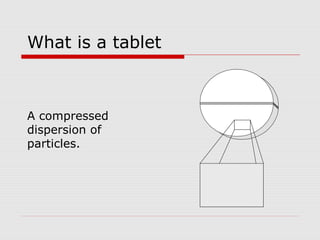
What is a tablet


A compressed
dispersion of
particles.
Different types of tablets
Tablets that are taken        Other oral
intact
  Conventional tablets
                               formulations
  Coated Tablets               Capsules
Tablets that are not            Oral solutions
taken intact
  Chewable tablets
  Effervescent tablets
  Lozenges
  Sublingual and buccal
   tablets
  Fast dissolving tablets
Tablet Manufacture
   Procurement of raw Material
   Preformulation Studies
   Formulation
   Mixing/Blending
   Granulation
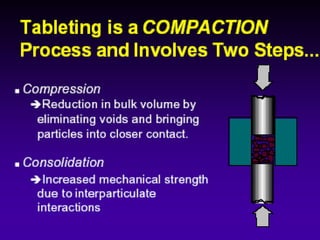
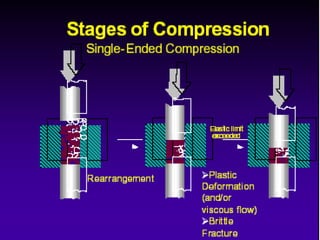
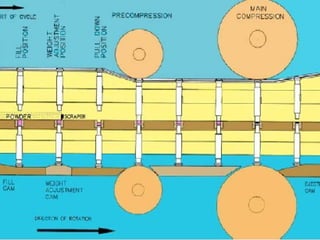
   Compression
   Coating
   Packaging
Three Principle Methods Of Developing
      Powders For Tablet Making


 Direct Compression
 Wet Granulating
 Dry Granulating
WHY GRANULATE?

 To improve powder flow.
 To improve compressibility.
 To reduce fines.
 To control the tendency of powders to
  segregate.
 To control density.
 To capture and fuse small quantities
  of active material.
WET GRANULATING PROCESS STEPS

   Pre-mix
   Wet massing
   Screening
   Drying
   Milling (Sieving)
   Final blend (Lubricant is added)
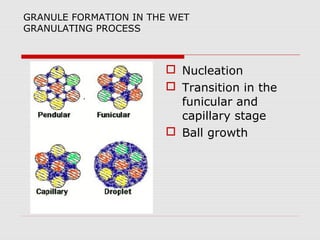
GRANULE FORMATION IN THE WET
GRANULATING PROCESS


                        Nucleation
                        Transition in the
          .
                         funicular and
                         capillary stage
                        Ball growth
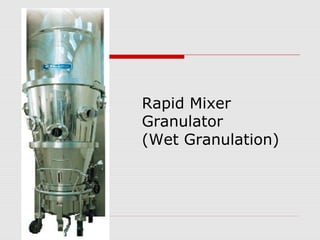
Rapid Mixer
Granulator
(Wet Granulation)
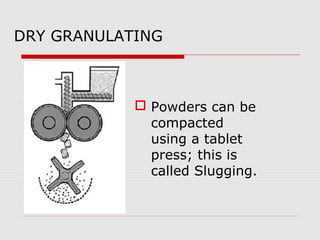
DRY GRANULATING


             Powders can be
              compacted
              using a tablet
              press; this is
              called Slugging.
Why Dry Granulating?

 Granulate materials which are sensitive to
  heat and/or moisture.
 Produce a uniform particle size range.
 Improve flow properties.
 Control dust.
 Control bulk density.
 Produce uniform blends
 Control particle hardness.
HOW GRANULES ARE TESTED


   LOD- water content (Loss on drying)
   Bulk Density, gm/ml
   Particle Size Distribution
   Angle of Repose.
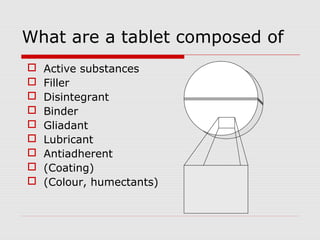
What are a tablet composed of
   Active substances
   Filler
   Disintegrant
   Binder
   Gliadant
   Lubricant
   Antiadherent
   (Coating)
   (Colour, humectants)
Filler / Diluent
   Give a reasonable size for      Sugars
    the tablet ≥50 mg                 Lactose
   Properties                        Sucrose
     Chemical inert                  Mannitol
     Non-hygroscopic               Salts
     Water soluble or                Calcium phosphate
        hydrophilic                   Calcium carbonate
     Good mechanical               Polymers
        properties
                                      Cellulose
     Acceptable taste
     Cheap
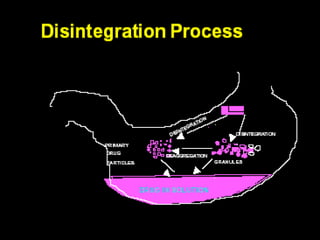
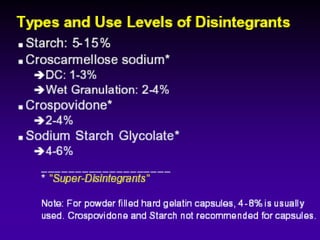
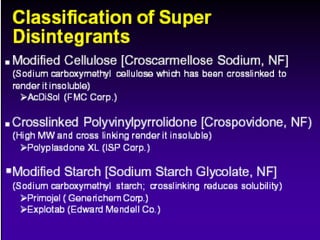
Dissintegrant
   Ensure that the tablet          Surfactants “small”
    breaks into small pieces         molecules that are both
    when in contact with water       water loving (hydrophilic)
   Addition of Disintegrant         and oil loving
     Intragranular addition         (hydrophobic)
     Extragranular addition        They will adsorb to
   Disintegration through           interfaces and in water
    wetting                          increase the hydrofilicity of
     Surfactant                     that interface
   Disintegration through          They will tend to form
    rupture                          associated structures
     Starch                         above a certain
     Cellulose derivates            concentration
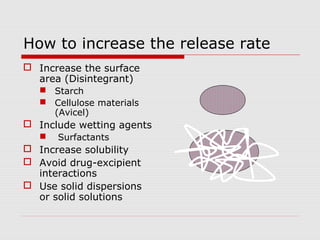
How to increase the release rate
 Increase the surface
  area (Disintegrant)
    Starch
    Cellulose materials
     (Avicel)
 Include wetting agents
      Surfactants
 Increase solubility
 Avoid drug-excipient
  interactions
 Use solid dispersions
  or solid solutions
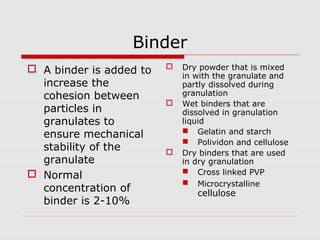
Binder
 A binder is added to      Dry powder that is mixed
                             in with the granulate and
  increase the               partly dissolved during
  cohesion between           granulation
                            Wet binders that are
  particles in               dissolved in granulation
  granulates to              liquid
                              Gelatin and starch
  ensure mechanical
                              Polividon and cellulose
  stability of the          Dry binders that are used
  granulate                  in dry granulation
 Normal                      Cross linked PVP
                              Microcrystalline
  concentration of              cellulose
  binder is 2-10%
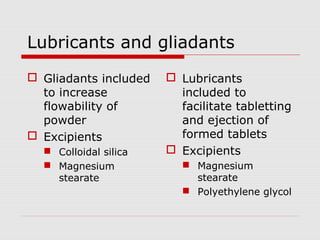
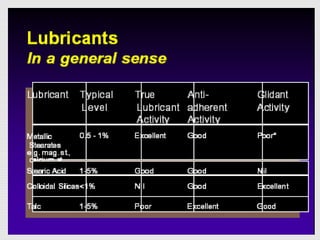
Lubricants and gliadants
 Gliadants included    Lubricants
  to increase            included to
  flowability of         facilitate tabletting
  powder                 and ejection of
 Excipients             formed tablets
   Colloidal silica    Excipients
   Magnesium              Magnesium
    stearate                stearate
                           Polyethylene glycol
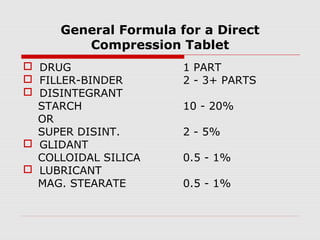
General Formula for a Direct
        Compression Tablet
 DRUG                1 PART
 FILLER-BINDER       2 - 3+ PARTS
 DISINTEGRANT
  STARCH              10 - 20%
  OR
  SUPER DISINT.       2 - 5%
 GLIDANT
  COLLOIDAL SILICA    0.5 - 1%
 LUBRICANT
  MAG. STEARATE       0.5 - 1%
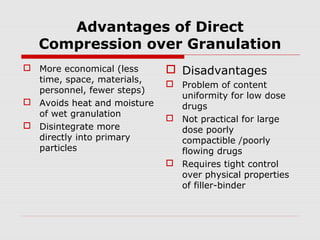
Advantages of Direct
   Compression over Granulation
 More economical (less       Disadvantages
  time, space, materials,
                              Problem of content
  personnel, fewer steps)
                               uniformity for low dose
 Avoids heat and moisture     drugs
  of wet granulation
                              Not practical for large
 Disintegrate more            dose poorly
  directly into primary        compactible /poorly
  particles                    flowing drugs
                              Requires tight control
                               over physical properties
                               of filler-binder
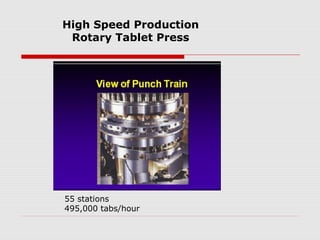
High Speed Production
 Rotary Tablet Press


55 stations
495,000 tabs/hour
Thank You…

Tablet 01

  • 1.
    Ta ble ts  Definition.  Half of all pharmaceutical products are for oral use (tablets or capsules)  The advantage is that they have high patient compliance, relatively easy to produce, easy to market  Disadvantage the conditions in the GI tract is difficult for some substance and all substances are not absorbed
  • 2.
    What is atablet A compressed dispersion of particles.
  • 3.
    Different types oftablets Tablets that are taken  Other oral intact  Conventional tablets formulations  Coated Tablets  Capsules Tablets that are not  Oral solutions taken intact  Chewable tablets  Effervescent tablets  Lozenges  Sublingual and buccal tablets  Fast dissolving tablets
  • 4.
    Tablet Manufacture  Procurement of raw Material  Preformulation Studies  Formulation  Mixing/Blending  Granulation  Compression  Coating  Packaging
  • 5.
    Three Principle MethodsOf Developing Powders For Tablet Making  Direct Compression  Wet Granulating  Dry Granulating
  • 6.
    WHY GRANULATE?  Toimprove powder flow.  To improve compressibility.  To reduce fines.  To control the tendency of powders to segregate.  To control density.  To capture and fuse small quantities of active material.
  • 7.
    WET GRANULATING PROCESSSTEPS  Pre-mix  Wet massing  Screening  Drying  Milling (Sieving)  Final blend (Lubricant is added)
  • 8.
    GRANULE FORMATION INTHE WET GRANULATING PROCESS  Nucleation  Transition in the . funicular and capillary stage  Ball growth
  • 9.
  • 10.
    DRY GRANULATING  Powders can be compacted using a tablet press; this is called Slugging.
  • 11.
    Why Dry Granulating? Granulate materials which are sensitive to heat and/or moisture.  Produce a uniform particle size range.  Improve flow properties.  Control dust.  Control bulk density.  Produce uniform blends  Control particle hardness.
  • 12.
    HOW GRANULES ARETESTED  LOD- water content (Loss on drying)  Bulk Density, gm/ml  Particle Size Distribution  Angle of Repose.
  • 13.
    What are atablet composed of  Active substances  Filler  Disintegrant  Binder  Gliadant  Lubricant  Antiadherent  (Coating)  (Colour, humectants)
  • 14.
    Filler / Diluent  Give a reasonable size for  Sugars the tablet ≥50 mg  Lactose  Properties  Sucrose  Chemical inert  Mannitol  Non-hygroscopic  Salts  Water soluble or  Calcium phosphate hydrophilic  Calcium carbonate  Good mechanical  Polymers properties  Cellulose  Acceptable taste  Cheap
  • 15.
    Dissintegrant  Ensure that the tablet  Surfactants “small” breaks into small pieces molecules that are both when in contact with water water loving (hydrophilic)  Addition of Disintegrant and oil loving  Intragranular addition (hydrophobic)  Extragranular addition  They will adsorb to  Disintegration through interfaces and in water wetting increase the hydrofilicity of  Surfactant that interface  Disintegration through  They will tend to form rupture associated structures  Starch above a certain  Cellulose derivates concentration
  • 17.
    How to increasethe release rate  Increase the surface area (Disintegrant)  Starch  Cellulose materials (Avicel)  Include wetting agents  Surfactants  Increase solubility  Avoid drug-excipient interactions  Use solid dispersions or solid solutions
  • 20.
    Binder  A binderis added to  Dry powder that is mixed in with the granulate and increase the partly dissolved during cohesion between granulation  Wet binders that are particles in dissolved in granulation granulates to liquid  Gelatin and starch ensure mechanical  Polividon and cellulose stability of the  Dry binders that are used granulate in dry granulation  Normal  Cross linked PVP  Microcrystalline concentration of cellulose binder is 2-10%
  • 21.
    Lubricants and gliadants Gliadants included  Lubricants to increase included to flowability of facilitate tabletting powder and ejection of  Excipients formed tablets  Colloidal silica  Excipients  Magnesium  Magnesium stearate stearate  Polyethylene glycol
  • 23.
    General Formula fora Direct Compression Tablet  DRUG 1 PART  FILLER-BINDER 2 - 3+ PARTS  DISINTEGRANT STARCH 10 - 20% OR SUPER DISINT. 2 - 5%  GLIDANT COLLOIDAL SILICA 0.5 - 1%  LUBRICANT MAG. STEARATE 0.5 - 1%
  • 24.
    Advantages of Direct Compression over Granulation  More economical (less  Disadvantages time, space, materials,  Problem of content personnel, fewer steps) uniformity for low dose  Avoids heat and moisture drugs of wet granulation  Not practical for large  Disintegrate more dose poorly directly into primary compactible /poorly particles flowing drugs  Requires tight control over physical properties of filler-binder
  • 30.
    High Speed Production Rotary Tablet Press 55 stations 495,000 tabs/hour
  • 31.