LESSON 4:
PLANNING A WRITTEN TEST TEST
A.
B.
…
DESIRED
SIGNIFICANT
LEARNING
OUTCOMES
Set appropriate instructional
objectives for a written test and,
Prepare a table of specifications(TOS)
for a written test.
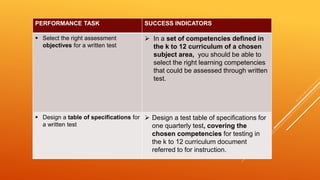
PERFORMANCE TASK SUCCESS INDICATORS
 Select the right assessment
objectives for a written test
 In a set of competencies defined in
the k to 12 curriculum of a chosen
subject area, you should be able to
select the right learning competencies
that could be assessed through written
test.
 Design a table of specifications for
a written test
 Design a test table of specifications for
one quarterly test, covering the
chosen competencies for testing in
the k to 12 curriculum document
referred to for instruction.
PREREQUISITE OF
THIS LESSON
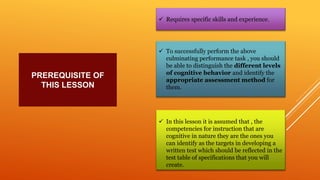
 In this lesson it is assumed that , the
competencies for instruction that are
cognitive in nature they are the ones you
can identify as the targets in developing a
written test which should be reflected in the
test table of specifications that you will
create.
 Requires specific skills and experience.
 To successfully perform the above
culminating performance task , you should
be able to distinguish the different levels
of cognitive behavior and identify the
appropriate assessment method for
them.
Why do we need to define the test
objectives?
• Learning objectives or outcomes are measureable statements that articulates.
• Setting objectives for assessment is the process of establishing direction to
guide both the teacher In teaching and the student in learning.
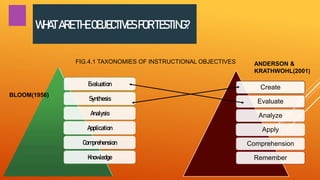
WHATARETHEOBJECTIVESFORTESTING?
Evaluation
Synthesis
Analysis
Application
Comprehension
Knowledge
Create
Evaluate
Analyze
Apply
Comprehension
Remember
FIG.4.1 TAXONOMIES OF INSTRUCTIONAL OBJECTIVES
BLOOM(1956)
ANDERSON &
KRATHWOHL(2001)
WHAT IS A TABLE OF SPECIFICATION?
 A tableof specifications(TOS), sometimes called a test
blueprint,is a tool used by teachers to design a test. It is a table
that maps out the test objectivescontents,or topicscovered by
the test; The levels of cognitive behavior to be measured; the
distribution items, number, placement, and weights of test
items; and the test format. It helps ensure the courses
intended learning outcomes and instructions are aligned.
 Generally the TOS is prepared before a test is created. However, it is
ideal to prepare one even before the start of instruction. Teachers need
to create a TOS for every test that they intend to develop. The test TOS is
important because it does the following
 Ensure that the instructional objectives and what the test captures
match
 Ensure that the test developer will not overlook details that are
considerate essential to a good test.
 Make developing a test easier and more efficient.
 Ensure that the test will sample all important content areas and
processes
 Is useful in planning organizing
 Offers an opportunity for teachers and students to clarify
achievement expectations.
GENERAL STEPS IN DEVELOPING A
TABLE OF SPECIFICATIONS
1. DETERMINE THE OBJECTIVES OF THE TEST
 This must be based on the instructional objectives.
 There are three types of objectives: (1) Cognitive, (2) Affective, and (3)
Psychomotor.
 Cognitive Objectives
 Designed to increase an individuals knowledge, understanding, and awareness.
 Affective Objectives
 Aims to change an individual’s attitude into something desirable.
Psychomotor Objectives
Designed to build physical or motor skills.
Example;
• If your test is at psychomotor domain, it is better to do a performance-based
assessment.
• If your test is in cognitive domain, you can do a written test ranging from
remembering to creating of ideas, that could be measured using common
formats for testing, such as multiple choice, alternative response test,
matching type, and even essays or open-ended tests.
2. DETERMINE THE COVERAGE OF
THE TEST
 Only topics or contents that have been discussed in class and are relevant
should be included in the test.
3. CALCULATE THE WEIGHT
FOR EACH TOPIC
• The weight assigned per topic in the test is based on the relevance
and the time spent to cover each topic during instruction.
 The percentage of time for a topic in a test is determined by dividing the time
spent for the topic during instruction by the total amount of time spent for all
topics covered in the test.
 Example;
 For the test on theories of Personality for General Psycholog 101 class, the teacher spent
¼ to 1½ hours class sessions.
Topic No. of Sessions Time Spent Percentage of
Time
Theories and
Concepts
0.5 class session 30 min 10.0
Psychoanalytic
Theories
1.5 class session 90 min 30.0
Trait Theories 1 class session 60 min 20.0
Humanistic Theories 0.5 class session 30 min 10.0
Cognitive Theories 0.5 class session 30 min 10.0
Behavioral Theories 0.5 class session 30 min 10.0
Social Learning
Theories
0.5 class session 30 min 10.0
Total 5 class session 300 min or 5
hours
100
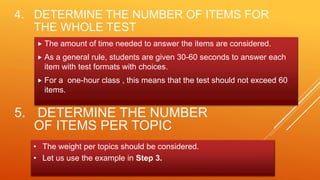
 The amount of time needed to answer the items are considered.
 As a general rule, students are given 30-60 seconds to answer each
item with test formats with choices.
 For a one-hour class , this means that the test should not exceed 60
items.
4. DETERMINE THE NUMBER OF ITEMS FOR
THE WHOLE TEST
• The weight per topics should be considered.
• Let us use the example in Step 3.
5. DETERMINE THE NUMBER
OF ITEMS PER TOPIC
Topic Percentage of Time
(Weight)
No. of Items
Theories and Concepts 10.0 5
Psychoanalytic Theories 30.0 15
Trait Theories 20.0 10
Humanistic Theories 10.0 5
Cognitive Theories 10.0 5
Behavioral Theories 10.0 5
Social Learning
Theories
10.0 5
Total 100 50
What are the different formats of a table of
specification(TOS)
TYPES
ONE WAY
TWO WAY
THREE-WAY
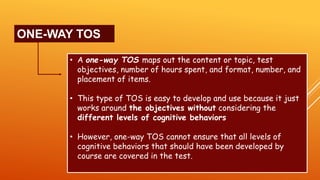
ONE-WAY TOS
• A one-way TOS maps out the content or topic, test
objectives, number of hours spent, and format, number, and
placement of items.
• This type of TOS is easy to develop and use because it just
works around the objectives without considering the
different levels of cognitive behaviors
• However, one-way TOS cannot ensure that all levels of
cognitive behaviors that should have been developed by
course are covered in the test.
TOPIC TEXT
OBJECTIVE
NO. OF
HOURS
SPENTS
FORMAT AND
PLACEMENT
OF ITEMS
NO. AND
PERCENT OF
ITEMS
theories and
concept
Recognize
important
concepts in
personality
theories.
0.5
Multiple
Choice Item
#s 1-5
5
(10.0%)
Psychoanalytic
Theories
Identify the
different theories
of personality
under the
psychoanalytic
Model
1.5
Multiple
Choice Item
#s 6-20
15
(30.0%)
etc
TOTAL
5 50
(100%)
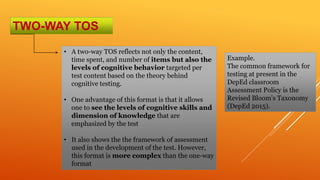
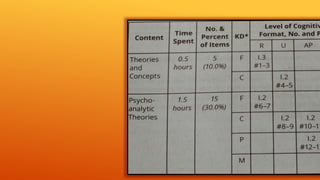
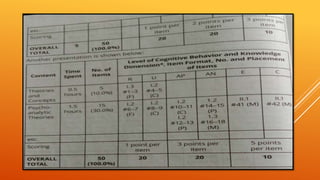
TWO-WAY TOS
• A two-way TOS reflects not only the content,
time spent, and number of items but also the
levels of cognitive behavior targeted per
test content based on the theory behind
cognitive testing.
• One advantage of this format is that it allows
one to see the levels of cognitive skills and
dimension of knowledge that are
emphasized by the test
• It also shows the the framework of assessment
used in the development of the test. However,
this format is more complex than the one-way
format
Example.
The common framework for
testing at present in the
DepEd classroom
Assessment Policy is the
Revised Bloom's Taxonomy
(DepEd 2015).
*LEGEND:
• KD=knowledge dimension
(factual,conceptual,procedural,metacogni
tive)
• I-multiple choice ; II- open-ended.
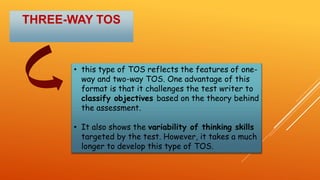
THREE-WAY TOS
• this type of TOS reflects the features of one-
way and two-way TOS. One advantage of this
format is that it challenges the test writer to
classify objectives based on the theory behind
the assessment.
• It also shows the variability of thinking skills
targeted by the test. However, it takes a much
longer to develop this type of TOS.
Prepare a 1/8 sheet of
lengthwise paper individually

CHOOSE THE LETTER OF THE CORRECT ANSWER.
1.The instructional objective focuses on the development of learner’s knowledge. Can
this objective be assessed by a multiple choice format?
a) No, this objective requires an essay format.
b) No, this objective is better assessed through matching type test.
c) Yes, as multiple choice is appropriate in assessing knowledge
d) Yes, as multiple choice is the most valid format when assessing learning
2. You prepared your objective for your quarterly test in mathematics. Which of the
following could NOT have been your test objective?
a) Interpret a line graph
b) Construct a line graph
c) Compare the information presented in a line graph
d) Draw conclusions from the data presented in a line graph.
3. Teacher Myrna prepared a TOS as her guide in developing test. Why is it
necessary?
a) To guide the planning of instruction
b) To satisfy the requirement in developing a test
c) To have test blueprint as accreditation usually requires this plan.
d) To ensure that the test is designed to cover what it intends to measure.
4. Ms. Zamora prepared a TOS that shows both objectives and different level of
cognitive behavior. What format could she have used?
a) One-way format
b) Two way format
c) Three way format
d) Four way format.
5. The school principal wants the teachers to develop
a TOS that uses a two way format then a one-way
format. why do you think it is the principal’s preferred
format?
a) So that, the dfferent level of cognitive behavior to be tested
are known.
b) So that the format of the test are known by just looking at the
TOS.
c.) so that the test writer would know the distribution of the test
items
d). So that objectives for instructions are also reflected on the
TOS.
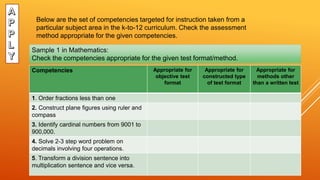
Below are the set of competencies targeted for instruction taken from a
particular subject area in the k-to-12 curriculum. Check the assessment
method appropriate for the given competencies.
Sample 1 in Mathematics:
Check the competencies appropriate for the given test format/method.
Competencies Appropriate for
objective test
format
Appropriate for
constructed type
of test format
Appropriate for
methods other
than a written test
1. Order fractions less than one
2. Construct plane figures using ruler and
compass
3. Identify cardinal numbers from 9001 to
900,000.
4. Solve 2-3 step word problem on
decimals involving four operations.
5. Transform a division sentence into
multiplication sentence and vice versa.
Sample 1 in Science:
Check the competencies appropriate for the given test format/method.
Competencies Appropriate for
objective test
format
Appropriate for
constructed type
of test format
Appropriate for
methods other
than a written test
1. Infer that the weather changes during
the day and from day to day.
2. Practice care and concern for animals.
3. Participate in campaigns and activities
for improving/ managing one’s
environment.
4. Compare the ability of land and water to
absorb and release heat.
5. Describe the four types of climate in the
Philippines.
Sample 1 in language :
Check the competencies appropriate for the given test format/method.
Competencies Appropriate for
objective test
format
Appropriate for
constructed type
of test format
Appropriate for
methods other
than a written test
1. Use words that describes person,
places , animals and events.
2. Draw conclusions on based on pictures,
stimuli or passages.
3. Write a different story ending.
4. Write simple friendly letter observing
the correct format.
5. Compose riddles, slogans, and
announcements from the given stimuli.
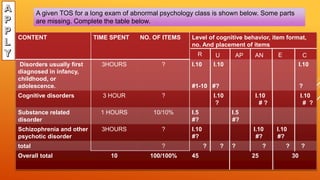
A given TOS for a long exam of abnormal psychology class is shown below. Some parts
are missing. Complete the table below.
CONTENT TIME SPENT NO. OF ITEMS Level of cognitive behavior, item format,
no. And placement of items
Disorders usually first
diagnosed in infancy,
childhood, or
adolescence.
3HOURS ? I.10 I.10 I.10
#1-10 #? ?
Cognitive disorders 3 HOUR ? I.10 I.10 I.10
? # ? # ?
Substance related
disorder
1 HOURS 10/10% I.5 I.5
#? #?
Schizophrenia and other
psychotic disorder
3HOURS ? I.10 I.10 I.10
#? #? #?
total ? ? ? ? ? ? ?
Overall total 10 100/100% 45 25 30
R U AP E C
AN
Let us now go back to the targets that were set at the start of the lesson. You are
expected to design your own test TOS reflective of the learning outcomes appropriate for
testing.
1. TASK 1: Select the right assessment objectives for a written test for
one quarter competencies in k-to-12 curriculum of any subject area and
level of your choice. Use the table below as your guide.
Grade level
Quarter covered domain/s covered
Content standards
Performance standards
CODE STATEMENT OF
COMPETENCY
TOPIC TEST FORMAT
TARGETED
1.
2.
3.
COMPETENCIES SELECTED
2. TASK 2:Design a TOS for a written test covering the
competencies selected in task 1, where you know testing is
appropriate method. Use the three-way TOS for this test. Prepare
this in Microsoft excel format.
THANK YOU FOR
LISTENING!


Lesson-4-EDUC-5GROUP-3 (1).pptx

  • 1.
    LESSON 4: PLANNING AWRITTEN TEST TEST A. B. …
  • 2.
    DESIRED SIGNIFICANT LEARNING OUTCOMES Set appropriate instructional objectivesfor a written test and, Prepare a table of specifications(TOS) for a written test.
  • 3.
    PERFORMANCE TASK SUCCESSINDICATORS  Select the right assessment objectives for a written test  In a set of competencies defined in the k to 12 curriculum of a chosen subject area, you should be able to select the right learning competencies that could be assessed through written test.  Design a table of specifications for a written test  Design a test table of specifications for one quarterly test, covering the chosen competencies for testing in the k to 12 curriculum document referred to for instruction.
  • 4.
    PREREQUISITE OF THIS LESSON In this lesson it is assumed that , the competencies for instruction that are cognitive in nature they are the ones you can identify as the targets in developing a written test which should be reflected in the test table of specifications that you will create.  Requires specific skills and experience.  To successfully perform the above culminating performance task , you should be able to distinguish the different levels of cognitive behavior and identify the appropriate assessment method for them.
  • 5.
    Why do weneed to define the test objectives? • Learning objectives or outcomes are measureable statements that articulates. • Setting objectives for assessment is the process of establishing direction to guide both the teacher In teaching and the student in learning.
  • 6.
  • 7.
    WHAT IS ATABLE OF SPECIFICATION?  A tableof specifications(TOS), sometimes called a test blueprint,is a tool used by teachers to design a test. It is a table that maps out the test objectivescontents,or topicscovered by the test; The levels of cognitive behavior to be measured; the distribution items, number, placement, and weights of test items; and the test format. It helps ensure the courses intended learning outcomes and instructions are aligned.
  • 8.
     Generally theTOS is prepared before a test is created. However, it is ideal to prepare one even before the start of instruction. Teachers need to create a TOS for every test that they intend to develop. The test TOS is important because it does the following  Ensure that the instructional objectives and what the test captures match  Ensure that the test developer will not overlook details that are considerate essential to a good test.  Make developing a test easier and more efficient.  Ensure that the test will sample all important content areas and processes  Is useful in planning organizing  Offers an opportunity for teachers and students to clarify achievement expectations.
  • 9.
    GENERAL STEPS INDEVELOPING A TABLE OF SPECIFICATIONS 1. DETERMINE THE OBJECTIVES OF THE TEST  This must be based on the instructional objectives.  There are three types of objectives: (1) Cognitive, (2) Affective, and (3) Psychomotor.  Cognitive Objectives  Designed to increase an individuals knowledge, understanding, and awareness.  Affective Objectives  Aims to change an individual’s attitude into something desirable.
  • 10.
    Psychomotor Objectives Designed tobuild physical or motor skills. Example; • If your test is at psychomotor domain, it is better to do a performance-based assessment. • If your test is in cognitive domain, you can do a written test ranging from remembering to creating of ideas, that could be measured using common formats for testing, such as multiple choice, alternative response test, matching type, and even essays or open-ended tests. 2. DETERMINE THE COVERAGE OF THE TEST  Only topics or contents that have been discussed in class and are relevant should be included in the test.
  • 11.
    3. CALCULATE THEWEIGHT FOR EACH TOPIC • The weight assigned per topic in the test is based on the relevance and the time spent to cover each topic during instruction.  The percentage of time for a topic in a test is determined by dividing the time spent for the topic during instruction by the total amount of time spent for all topics covered in the test.  Example;  For the test on theories of Personality for General Psycholog 101 class, the teacher spent ¼ to 1½ hours class sessions.
  • 12.
    Topic No. ofSessions Time Spent Percentage of Time Theories and Concepts 0.5 class session 30 min 10.0 Psychoanalytic Theories 1.5 class session 90 min 30.0 Trait Theories 1 class session 60 min 20.0 Humanistic Theories 0.5 class session 30 min 10.0 Cognitive Theories 0.5 class session 30 min 10.0 Behavioral Theories 0.5 class session 30 min 10.0 Social Learning Theories 0.5 class session 30 min 10.0 Total 5 class session 300 min or 5 hours 100
  • 13.
     The amountof time needed to answer the items are considered.  As a general rule, students are given 30-60 seconds to answer each item with test formats with choices.  For a one-hour class , this means that the test should not exceed 60 items. 4. DETERMINE THE NUMBER OF ITEMS FOR THE WHOLE TEST • The weight per topics should be considered. • Let us use the example in Step 3. 5. DETERMINE THE NUMBER OF ITEMS PER TOPIC
  • 14.
    Topic Percentage ofTime (Weight) No. of Items Theories and Concepts 10.0 5 Psychoanalytic Theories 30.0 15 Trait Theories 20.0 10 Humanistic Theories 10.0 5 Cognitive Theories 10.0 5 Behavioral Theories 10.0 5 Social Learning Theories 10.0 5 Total 100 50
  • 15.
    What are thedifferent formats of a table of specification(TOS) TYPES ONE WAY TWO WAY THREE-WAY
  • 16.
    ONE-WAY TOS • Aone-way TOS maps out the content or topic, test objectives, number of hours spent, and format, number, and placement of items. • This type of TOS is easy to develop and use because it just works around the objectives without considering the different levels of cognitive behaviors • However, one-way TOS cannot ensure that all levels of cognitive behaviors that should have been developed by course are covered in the test.
  • 17.
    TOPIC TEXT OBJECTIVE NO. OF HOURS SPENTS FORMATAND PLACEMENT OF ITEMS NO. AND PERCENT OF ITEMS theories and concept Recognize important concepts in personality theories. 0.5 Multiple Choice Item #s 1-5 5 (10.0%) Psychoanalytic Theories Identify the different theories of personality under the psychoanalytic Model 1.5 Multiple Choice Item #s 6-20 15 (30.0%) etc TOTAL 5 50 (100%)
  • 18.
    TWO-WAY TOS • Atwo-way TOS reflects not only the content, time spent, and number of items but also the levels of cognitive behavior targeted per test content based on the theory behind cognitive testing. • One advantage of this format is that it allows one to see the levels of cognitive skills and dimension of knowledge that are emphasized by the test • It also shows the the framework of assessment used in the development of the test. However, this format is more complex than the one-way format Example. The common framework for testing at present in the DepEd classroom Assessment Policy is the Revised Bloom's Taxonomy (DepEd 2015).
  • 19.
  • 22.
    THREE-WAY TOS • thistype of TOS reflects the features of one- way and two-way TOS. One advantage of this format is that it challenges the test writer to classify objectives based on the theory behind the assessment. • It also shows the variability of thinking skills targeted by the test. However, it takes a much longer to develop this type of TOS.
  • 24.
    Prepare a 1/8sheet of lengthwise paper individually 
  • 25.
    CHOOSE THE LETTEROF THE CORRECT ANSWER. 1.The instructional objective focuses on the development of learner’s knowledge. Can this objective be assessed by a multiple choice format? a) No, this objective requires an essay format. b) No, this objective is better assessed through matching type test. c) Yes, as multiple choice is appropriate in assessing knowledge d) Yes, as multiple choice is the most valid format when assessing learning 2. You prepared your objective for your quarterly test in mathematics. Which of the following could NOT have been your test objective? a) Interpret a line graph b) Construct a line graph c) Compare the information presented in a line graph d) Draw conclusions from the data presented in a line graph.
  • 26.
    3. Teacher Myrnaprepared a TOS as her guide in developing test. Why is it necessary? a) To guide the planning of instruction b) To satisfy the requirement in developing a test c) To have test blueprint as accreditation usually requires this plan. d) To ensure that the test is designed to cover what it intends to measure. 4. Ms. Zamora prepared a TOS that shows both objectives and different level of cognitive behavior. What format could she have used? a) One-way format b) Two way format c) Three way format d) Four way format.
  • 27.
    5. The schoolprincipal wants the teachers to develop a TOS that uses a two way format then a one-way format. why do you think it is the principal’s preferred format? a) So that, the dfferent level of cognitive behavior to be tested are known. b) So that the format of the test are known by just looking at the TOS. c.) so that the test writer would know the distribution of the test items d). So that objectives for instructions are also reflected on the TOS.
  • 28.
    Below are theset of competencies targeted for instruction taken from a particular subject area in the k-to-12 curriculum. Check the assessment method appropriate for the given competencies. Sample 1 in Mathematics: Check the competencies appropriate for the given test format/method. Competencies Appropriate for objective test format Appropriate for constructed type of test format Appropriate for methods other than a written test 1. Order fractions less than one 2. Construct plane figures using ruler and compass 3. Identify cardinal numbers from 9001 to 900,000. 4. Solve 2-3 step word problem on decimals involving four operations. 5. Transform a division sentence into multiplication sentence and vice versa.
  • 29.
    Sample 1 inScience: Check the competencies appropriate for the given test format/method. Competencies Appropriate for objective test format Appropriate for constructed type of test format Appropriate for methods other than a written test 1. Infer that the weather changes during the day and from day to day. 2. Practice care and concern for animals. 3. Participate in campaigns and activities for improving/ managing one’s environment. 4. Compare the ability of land and water to absorb and release heat. 5. Describe the four types of climate in the Philippines.
  • 30.
    Sample 1 inlanguage : Check the competencies appropriate for the given test format/method. Competencies Appropriate for objective test format Appropriate for constructed type of test format Appropriate for methods other than a written test 1. Use words that describes person, places , animals and events. 2. Draw conclusions on based on pictures, stimuli or passages. 3. Write a different story ending. 4. Write simple friendly letter observing the correct format. 5. Compose riddles, slogans, and announcements from the given stimuli.
  • 31.
    A given TOSfor a long exam of abnormal psychology class is shown below. Some parts are missing. Complete the table below. CONTENT TIME SPENT NO. OF ITEMS Level of cognitive behavior, item format, no. And placement of items Disorders usually first diagnosed in infancy, childhood, or adolescence. 3HOURS ? I.10 I.10 I.10 #1-10 #? ? Cognitive disorders 3 HOUR ? I.10 I.10 I.10 ? # ? # ? Substance related disorder 1 HOURS 10/10% I.5 I.5 #? #? Schizophrenia and other psychotic disorder 3HOURS ? I.10 I.10 I.10 #? #? #? total ? ? ? ? ? ? ? Overall total 10 100/100% 45 25 30 R U AP E C AN
  • 32.
    Let us nowgo back to the targets that were set at the start of the lesson. You are expected to design your own test TOS reflective of the learning outcomes appropriate for testing. 1. TASK 1: Select the right assessment objectives for a written test for one quarter competencies in k-to-12 curriculum of any subject area and level of your choice. Use the table below as your guide. Grade level Quarter covered domain/s covered Content standards Performance standards
  • 33.
    CODE STATEMENT OF COMPETENCY TOPICTEST FORMAT TARGETED 1. 2. 3. COMPETENCIES SELECTED
  • 34.
    2. TASK 2:Designa TOS for a written test covering the competencies selected in task 1, where you know testing is appropriate method. Use the three-way TOS for this test. Prepare this in Microsoft excel format.
  • 35.

Editor's Notes

  • #2 NOTE: YOU NEED TO FINISH THIS BEFORE MONDAY!