Updates!
a. Table of specifications
b. Test Construction and Type of
Test
Learning objective: At the end of the session,
participants are expected to Update and
improve the table of specifications, test
constructions and type of test.
DEPED ORDER NO. 08, SERIES OF 2015
POLICY GUIDELINES ON CLASSROOM ASSESSMENT
FOR THE K TO 12 BASIC EDUCATION PROGRAM
Classroom assessment is an integral part of the
curriculum implementation. It allows the teachers
to track and measure learner ’s progress and to
adjust instruction accordingly. Classroom
assessment informs the learners, as well as their
parents and guardian of their progress.
Table of Specifications
It is a tool used to ensure that a test or
assessment measures the content and thinking
skills that the test intends to measure.
Table of Specifications
Sometimes called a test blueprint, it is also
A table that helps teachers align objectives,
instruction and assessment.(Notar et. al. 2004)
Table of Specifications
I t c a n b e u s e d t o h e l p t e a c h e r s f ra m e t h e d e c i s i o n m a k i n g p ro c e s s
o f t e s t c o n s t r u c t i o n a n d i m p rov e t h e v a l i d i t y o f t e a c h e r s ’ ev a l u a t i o n
b a s e d o n t e s t c o n s t r u c t e d f o r c l a s s ro o m u s e .
Table of Specifications
B e a w a re t h a t b e f o re t h e t e a c h e r c a n c o n s t r u c t t h e TO S , h e / s h e
w i l l n e e d t o d e t e r m i n e ( 1 ) t h e n u m b e r o f t e s t i t e m s t o i n c l u d e a n d
( 2 ) t h e d i s t r i b u t i o n o f m u l t i p l e c h o i c e a n d s h o r t a n s w e r i t e m s .
Formula:
Percentage of items=no. of days/ total
no. of days x100%
Number of items= % of items x no. of
test items/100%
Tips in Preparing TOS:
1.Don’t make it overly detailed.
2.It’s best to identify major ideas and skills rather than
specific details.
3.Use cognitive taxonomy that is most appropriate to
your discipline.
4.Weigh the appropriateness of the distribution of
checks against the students’ level, the importance of
the test and the amount of time available.
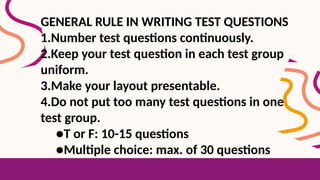
GENERAL RULE IN WRITING TEST QUESTIONS
1.Number test questions continuously.
2.Keep your test question in each test group
uniform.
3.Make your layout presentable.
4.Do not put too many test questions in one
test group.
●T or F: 10-15 questions
●Multiple choice: max. of 30 questions
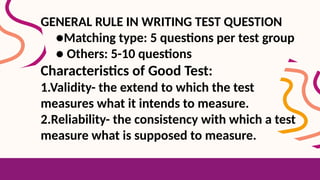
GENERAL RULE IN WRITING TEST QUESTION
●Matching type: 5 questions per test group
● Others: 5-10 questions
Characteristics of Good Test:
1.Validity- the extend to which the test
measures what it intends to measure.
2.Reliability- the consistency with which a test
measure what is supposed to measure.
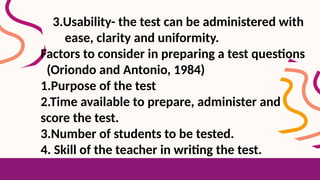
3.Usability- the test can be administered with
ease, clarity and uniformity.
Factors to consider in preparing a test questions
(Oriondo and Antonio, 1984)
1.Purpose of the test
2.Time available to prepare, administer and
score the test.
3.Number of students to be tested.
4. Skill of the teacher in writing the test.
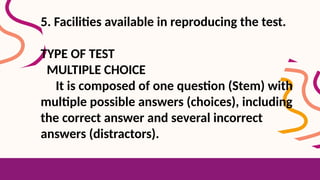
5. Facilities available in reproducing the test.
TYPE OF TEST
MULTIPLE CHOICE
It is composed of one question (Stem) with
multiple possible answers (choices), including
the correct answer and several incorrect
answers (distractors).
TYPE OF TEST
Example:
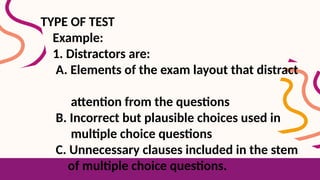
1. Distractors are:
A. Elements of the exam layout that distract
attention from the questions
B. Incorrect but plausible choices used in
multiple choice questions
C. Unnecessary clauses included in the stem
of multiple choice questions.
TYPE OF TEST
Example:
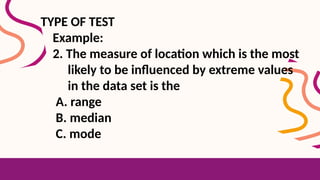
2. The measure of location which is the most
likely to be influenced by extreme values
in the data set is the
A. range
B. median
C. mode
TYPE OF TEST
Example:
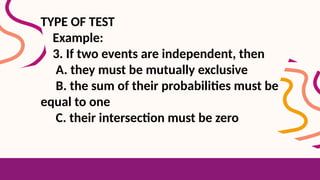
3. If two events are independent, then
A. they must be mutually exclusive
B. the sum of their probabilities must be
equal to one
C. their intersection must be zero
“ To be able to prepare a GOOD TEST, one has
to have a mastery of the subject matter,
knowledge of the pupils to be tested, skill in
verbal expression and the use of the different
test format”
Evaluating Educational Outcomes
( Oriondo and Antonio , 1984)

UPDATES-ON-TOS-editedoooooooooooooooooo.pptx

  • 1.
    Updates! a. Table ofspecifications b. Test Construction and Type of Test
  • 2.
    Learning objective: Atthe end of the session, participants are expected to Update and improve the table of specifications, test constructions and type of test.
  • 3.
    DEPED ORDER NO.08, SERIES OF 2015 POLICY GUIDELINES ON CLASSROOM ASSESSMENT FOR THE K TO 12 BASIC EDUCATION PROGRAM Classroom assessment is an integral part of the
  • 4.
    curriculum implementation. Itallows the teachers to track and measure learner ’s progress and to adjust instruction accordingly. Classroom assessment informs the learners, as well as their
  • 5.
    parents and guardianof their progress.
  • 6.
    Table of Specifications Itis a tool used to ensure that a test or assessment measures the content and thinking skills that the test intends to measure.
  • 7.
    Table of Specifications Sometimescalled a test blueprint, it is also A table that helps teachers align objectives, instruction and assessment.(Notar et. al. 2004)
  • 8.
    Table of Specifications It c a n b e u s e d t o h e l p t e a c h e r s f ra m e t h e d e c i s i o n m a k i n g p ro c e s s o f t e s t c o n s t r u c t i o n a n d i m p rov e t h e v a l i d i t y o f t e a c h e r s ’ ev a l u a t i o n b a s e d o n t e s t c o n s t r u c t e d f o r c l a s s ro o m u s e .
  • 9.
    Table of Specifications Be a w a re t h a t b e f o re t h e t e a c h e r c a n c o n s t r u c t t h e TO S , h e / s h e w i l l n e e d t o d e t e r m i n e ( 1 ) t h e n u m b e r o f t e s t i t e m s t o i n c l u d e a n d ( 2 ) t h e d i s t r i b u t i o n o f m u l t i p l e c h o i c e a n d s h o r t a n s w e r i t e m s .
  • 12.
    Formula: Percentage of items=no.of days/ total no. of days x100% Number of items= % of items x no. of test items/100%
  • 13.
    Tips in PreparingTOS: 1.Don’t make it overly detailed. 2.It’s best to identify major ideas and skills rather than specific details. 3.Use cognitive taxonomy that is most appropriate to your discipline. 4.Weigh the appropriateness of the distribution of checks against the students’ level, the importance of the test and the amount of time available.
  • 14.
    GENERAL RULE INWRITING TEST QUESTIONS 1.Number test questions continuously. 2.Keep your test question in each test group uniform. 3.Make your layout presentable. 4.Do not put too many test questions in one test group. ●T or F: 10-15 questions ●Multiple choice: max. of 30 questions
  • 15.
    GENERAL RULE INWRITING TEST QUESTION ●Matching type: 5 questions per test group ● Others: 5-10 questions Characteristics of Good Test: 1.Validity- the extend to which the test measures what it intends to measure. 2.Reliability- the consistency with which a test measure what is supposed to measure.
  • 16.
    3.Usability- the testcan be administered with ease, clarity and uniformity. Factors to consider in preparing a test questions (Oriondo and Antonio, 1984) 1.Purpose of the test 2.Time available to prepare, administer and score the test. 3.Number of students to be tested. 4. Skill of the teacher in writing the test.
  • 17.
    5. Facilities availablein reproducing the test. TYPE OF TEST MULTIPLE CHOICE It is composed of one question (Stem) with multiple possible answers (choices), including the correct answer and several incorrect answers (distractors).
  • 18.
    TYPE OF TEST Example: 1.Distractors are: A. Elements of the exam layout that distract attention from the questions B. Incorrect but plausible choices used in multiple choice questions C. Unnecessary clauses included in the stem of multiple choice questions.
  • 19.
    TYPE OF TEST Example: 2.The measure of location which is the most likely to be influenced by extreme values in the data set is the A. range B. median C. mode
  • 20.
    TYPE OF TEST Example: 3.If two events are independent, then A. they must be mutually exclusive B. the sum of their probabilities must be equal to one C. their intersection must be zero
  • 21.
    “ To beable to prepare a GOOD TEST, one has to have a mastery of the subject matter, knowledge of the pupils to be tested, skill in verbal expression and the use of the different test format” Evaluating Educational Outcomes ( Oriondo and Antonio , 1984)