NEW K -12 GRADING
SYSTEM
Elementary Parents’ Orientation
Manresa School
June 18, 2015
MS Auditorium
DO 8, s. 2015 –
Policy Guidelines on Classroom
Assessment for the K to 12 Basic
Education Program (BEP)
Dated: April 1, 2015
• DO 8, s. 2015 - Policy Guidelines on
Classroom Assessment for the K to
12 Basic Education Program
• http://www.deped.gov.ph/orders/do-8-s-2015
• http://www.deped.gov.ph/sites/default/files/order/
2015/DO_s2015_08.pdf
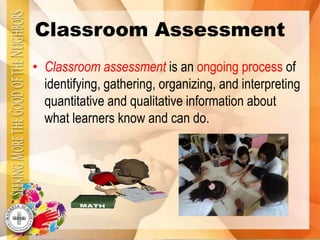
Classroom Assessment
• Classroom assessment is an ongoing process of
identifying, gathering, organizing, and interpreting
quantitative and qualitative information about
what learners know and can do.
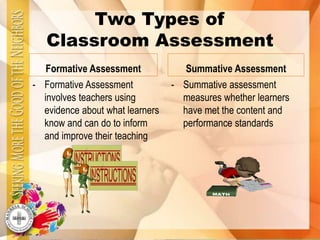
Two Types of
Classroom Assessment
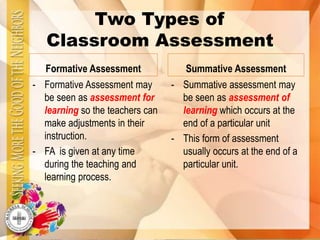
Formative Assessment
- Formative Assessment may
be seen as assessment for
learning so the teachers can
make adjustments in their
instruction.
- FA is given at any time
during the teaching and
learning process.
Summative Assessment
- Summative assessment may
be seen as assessment of
learning which occurs at the
end of a particular unit
- This form of assessment
usually occurs at the end of a
particular unit.
Two Types of
Classroom Assessment
Formative Assessment
- Formative Assessment
involves teachers using
evidence about what learners
know and can do to inform
and improve their teaching
Summative Assessment
- Summative assessment
measures whether learners
have met the content and
performance standards
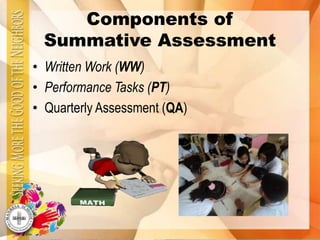
Components of
Summative Assessment
• Written Work (WW)
• Performance Tasks (PT)
• Quarterly Assessment (QA)
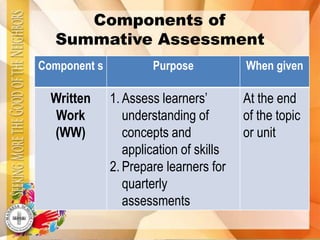
Components of
Summative Assessment
Component s Purpose When given
Written
Work
(WW)
1. Assess learners’
understanding of
concepts and
application of skills
2. Prepare learners for
quarterly
assessments
At the end
of the topic
or unit
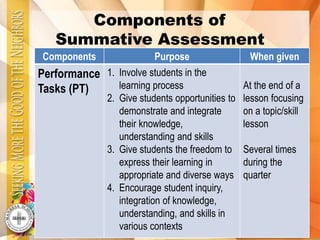
Components of
Summative Assessment
Components Purpose When given
Performance
Tasks (PT)
1. Involve students in the
learning process
2. Give students opportunities to
demonstrate and integrate
their knowledge,
understanding and skills
3. Give students the freedom to
express their learning in
appropriate and diverse ways
4. Encourage student inquiry,
integration of knowledge,
understanding, and skills in
various contexts
At the end of a
lesson focusing
on a topic/skill
lesson
Several times
during the
quarter
Components of
Summative Assessment
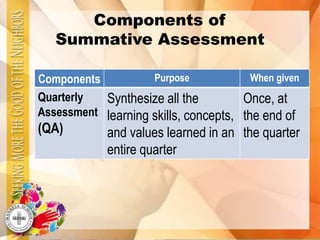
Components Purpose When given
Quarterly
Assessment
(QA)
Synthesize all the
learning skills, concepts,
and values learned in an
entire quarter
Once, at
the end of
the quarter
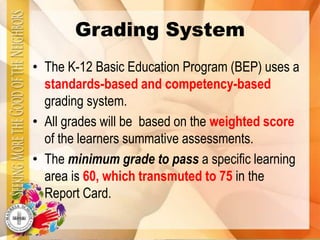
Grading System
• The K-12 Basic Education Program (BEP) uses a
standards-based and competency-based
grading system.
• All grades will be based on the weighted score
of the learners summative assessments.
• The minimum grade to pass a specific learning
area is 60, which transmuted to 75 in the
Report Card.
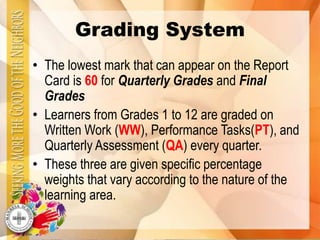
Grading System
• The lowest mark that can appear on the Report
Card is 60 for Quarterly Grades and Final
Grades
• Learners from Grades 1 to 12 are graded on
Written Work (WW), Performance Tasks(PT), and
Quarterly Assessment (QA) every quarter.
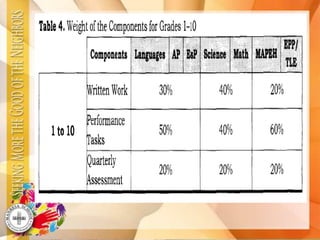
• These three are given specific percentage
weights that vary according to the nature of the
learning area.
Grading System
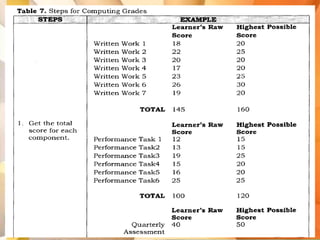
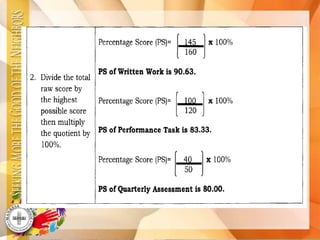
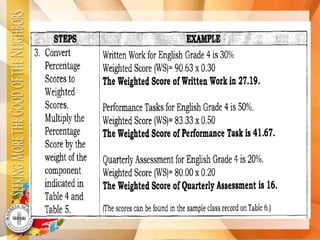
How is learner progress recorded and
computed ?
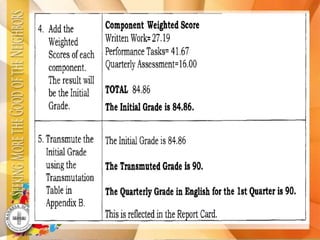
The following table shows the step-by-step
way of computing the grades.
Grading System
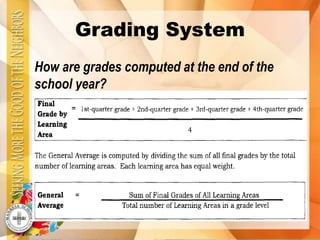
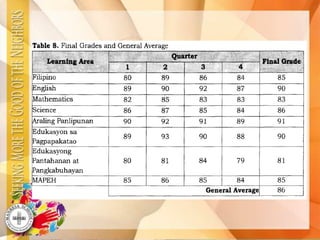
How are grades computed at the end of the
school year?
Grading System
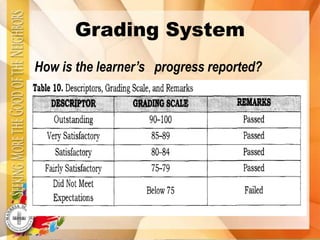
How is the learner’s progress reported?
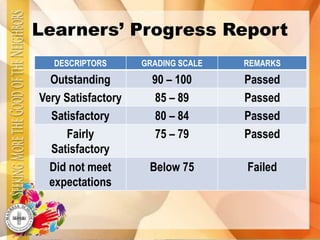
Learners’ Progress Report
DESCRIPTORS GRADING SCALE REMARKS
Outstanding 90 – 100 Passed
Very Satisfactory 85 – 89 Passed
Satisfactory 80 – 84 Passed
Fairly
Satisfactory
75 – 79 Passed
Did not meet
expectations
Below 75 Failed
Grading System
How are learners promoted or retained at the
end of the school year?
A Final Grade of 75 or higher in all learning
areas allows the student to be promoted to the
next grade level.
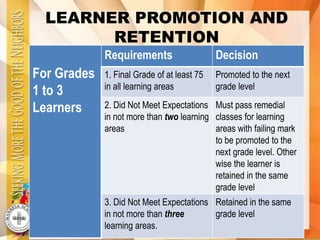
LEARNER PROMOTION AND
RETENTION
For Grades
1 to 3
Learners
Requirements Decision
1. Final Grade of at least 75
in all learning areas
Promoted to the next
grade level
2. Did Not Meet Expectations
in not more than two learning
areas
Must pass remedial
classes for learning
areas with failing mark
to be promoted to the
next grade level. Other
wise the learner is
retained in the same
grade level
3. Did Not Meet Expectations
in not more than three
learning areas.
Retained in the same
grade level
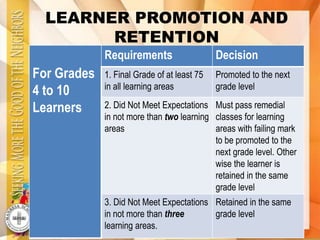
LEARNER PROMOTION AND
RETENTION
For Grades
4 to 10
Learners
Requirements Decision
1. Final Grade of at least 75
in all learning areas
Promoted to the next
grade level
2. Did Not Meet Expectations
in not more than two learning
areas
Must pass remedial
classes for learning
areas with failing mark
to be promoted to the
next grade level. Other
wise the learner is
retained in the same
grade level
3. Did Not Meet Expectations
in not more than three
learning areas.
Retained in the same
grade level
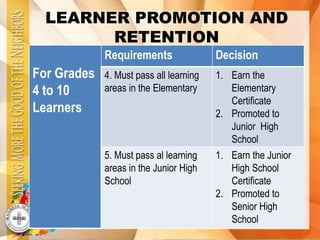
LEARNER PROMOTION AND
RETENTION
For Grades
4 to 10
Learners
Requirements Decision
4. Must pass all learning
areas in the Elementary
1. Earn the
Elementary
Certificate
2. Promoted to
Junior High
School
5. Must pass al learning
areas in the Junior High
School
1. Earn the Junior
High School
Certificate
2. Promoted to
Senior High
School
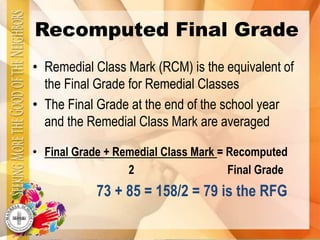
Recomputed Final Grade
• Remedial Class Mark (RCM) is the equivalent of
the Final Grade for Remedial Classes
• The Final Grade at the end of the school year
and the Remedial Class Mark are averaged
• Final Grade + Remedial Class Mark = Recomputed
2 Final Grade
73 + 85 = 158/2 = 79 is the RFG
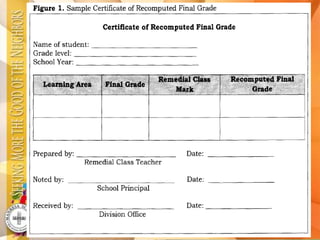
• The teacher of the Remedial Class issues the
Certificate of Recomputed Final Grade,
which is noted by the School Principal.
• This is submitted to the Division Office and
must be attached to both Form 137 and
School Form no. 5
New k – 12 Grading System
Assessment is part
of day-to-day lessons
and extends the day-
to-day classroom
activities that are
already in place of K-
12 curriculum.
It is the integral
part of teaching
and learning.
We, both help our
children achieve!
Thank you for listening.

New k 12 grading system

  • 1.
    NEW K -12GRADING SYSTEM Elementary Parents’ Orientation Manresa School June 18, 2015 MS Auditorium
  • 2.
    DO 8, s.2015 – Policy Guidelines on Classroom Assessment for the K to 12 Basic Education Program (BEP) Dated: April 1, 2015
  • 3.
    • DO 8,s. 2015 - Policy Guidelines on Classroom Assessment for the K to 12 Basic Education Program • http://www.deped.gov.ph/orders/do-8-s-2015 • http://www.deped.gov.ph/sites/default/files/order/ 2015/DO_s2015_08.pdf
  • 4.
    Classroom Assessment • Classroomassessment is an ongoing process of identifying, gathering, organizing, and interpreting quantitative and qualitative information about what learners know and can do.
  • 5.
    Two Types of ClassroomAssessment Formative Assessment - Formative Assessment may be seen as assessment for learning so the teachers can make adjustments in their instruction. - FA is given at any time during the teaching and learning process. Summative Assessment - Summative assessment may be seen as assessment of learning which occurs at the end of a particular unit - This form of assessment usually occurs at the end of a particular unit.
  • 6.
    Two Types of ClassroomAssessment Formative Assessment - Formative Assessment involves teachers using evidence about what learners know and can do to inform and improve their teaching Summative Assessment - Summative assessment measures whether learners have met the content and performance standards
  • 7.
    Components of Summative Assessment •Written Work (WW) • Performance Tasks (PT) • Quarterly Assessment (QA)
  • 8.
    Components of Summative Assessment Components Purpose When given Written Work (WW) 1. Assess learners’ understanding of concepts and application of skills 2. Prepare learners for quarterly assessments At the end of the topic or unit
  • 9.
    Components of Summative Assessment ComponentsPurpose When given Performance Tasks (PT) 1. Involve students in the learning process 2. Give students opportunities to demonstrate and integrate their knowledge, understanding and skills 3. Give students the freedom to express their learning in appropriate and diverse ways 4. Encourage student inquiry, integration of knowledge, understanding, and skills in various contexts At the end of a lesson focusing on a topic/skill lesson Several times during the quarter
  • 10.
    Components of Summative Assessment ComponentsPurpose When given Quarterly Assessment (QA) Synthesize all the learning skills, concepts, and values learned in an entire quarter Once, at the end of the quarter
  • 11.
    Grading System • TheK-12 Basic Education Program (BEP) uses a standards-based and competency-based grading system. • All grades will be based on the weighted score of the learners summative assessments. • The minimum grade to pass a specific learning area is 60, which transmuted to 75 in the Report Card.
  • 12.
    Grading System • Thelowest mark that can appear on the Report Card is 60 for Quarterly Grades and Final Grades • Learners from Grades 1 to 12 are graded on Written Work (WW), Performance Tasks(PT), and Quarterly Assessment (QA) every quarter. • These three are given specific percentage weights that vary according to the nature of the learning area.
  • 14.
    Grading System How islearner progress recorded and computed ? The following table shows the step-by-step way of computing the grades.
  • 19.
    Grading System How aregrades computed at the end of the school year?
  • 21.
    Grading System How isthe learner’s progress reported?
  • 22.
    Learners’ Progress Report DESCRIPTORSGRADING SCALE REMARKS Outstanding 90 – 100 Passed Very Satisfactory 85 – 89 Passed Satisfactory 80 – 84 Passed Fairly Satisfactory 75 – 79 Passed Did not meet expectations Below 75 Failed
  • 23.
    Grading System How arelearners promoted or retained at the end of the school year? A Final Grade of 75 or higher in all learning areas allows the student to be promoted to the next grade level.
  • 24.
    LEARNER PROMOTION AND RETENTION ForGrades 1 to 3 Learners Requirements Decision 1. Final Grade of at least 75 in all learning areas Promoted to the next grade level 2. Did Not Meet Expectations in not more than two learning areas Must pass remedial classes for learning areas with failing mark to be promoted to the next grade level. Other wise the learner is retained in the same grade level 3. Did Not Meet Expectations in not more than three learning areas. Retained in the same grade level
  • 25.
    LEARNER PROMOTION AND RETENTION ForGrades 4 to 10 Learners Requirements Decision 1. Final Grade of at least 75 in all learning areas Promoted to the next grade level 2. Did Not Meet Expectations in not more than two learning areas Must pass remedial classes for learning areas with failing mark to be promoted to the next grade level. Other wise the learner is retained in the same grade level 3. Did Not Meet Expectations in not more than three learning areas. Retained in the same grade level
  • 26.
    LEARNER PROMOTION AND RETENTION ForGrades 4 to 10 Learners Requirements Decision 4. Must pass all learning areas in the Elementary 1. Earn the Elementary Certificate 2. Promoted to Junior High School 5. Must pass al learning areas in the Junior High School 1. Earn the Junior High School Certificate 2. Promoted to Senior High School
  • 27.
    Recomputed Final Grade •Remedial Class Mark (RCM) is the equivalent of the Final Grade for Remedial Classes • The Final Grade at the end of the school year and the Remedial Class Mark are averaged • Final Grade + Remedial Class Mark = Recomputed 2 Final Grade 73 + 85 = 158/2 = 79 is the RFG
  • 28.
    • The teacherof the Remedial Class issues the Certificate of Recomputed Final Grade, which is noted by the School Principal. • This is submitted to the Division Office and must be attached to both Form 137 and School Form no. 5
  • 30.
    New k –12 Grading System Assessment is part of day-to-day lessons and extends the day- to-day classroom activities that are already in place of K- 12 curriculum. It is the integral part of teaching and learning.
  • 31.
    We, both helpour children achieve! Thank you for listening.