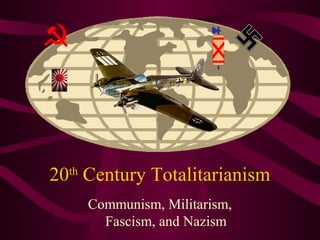
20th
Century Totalitarianism
Communism, Militarism,
Fascism, and Nazism
The Stock Market Crash
• In 1929, the Wall
Street stock market
crash ushered in a
worldwide financial
crisis.
The Great Depression
• Nation after nation fell victim to:
• Industrial decline
• Bank failures
• Deflated prices and profits
• Commercial stagnation
Personal Hardship
• People the world over suffered from:
• Lowered standards of living
• Unemployment
• Hunger
• Fear of the
future
Policies of Self-Sufficiency
• In desperation, governments sought
economic recovery by adopting restrictive
policies of self-sufficiency:
• High tariffs
• Import quotas
• Barter agreements
Planned Economies
• Governments
experimented
with new plans
for internal
economies.
Great Britain
• Great Britain adopted far-reaching measures
in the development of a planned national
economy.
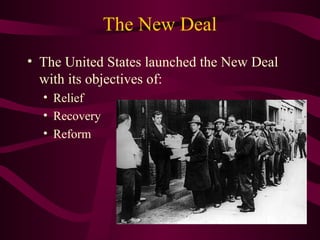
The New Deal
• The United States launched the New Deal
with its objectives of:
• Relief
• Recovery
• Reform
FDR’s 1st
Inaugural Address
• “So first of all let me
assert my firm belief
that the only thing we
have to fear is . . . fear
itself. . . nameless,
unreasoning, unjustified
terror which paralyzes
needed efforts to
convert retreat into
advance.”
The Rise of Dictators
• Elsewhere, the hardships of the depression formed
a dismal backdrop on a political stage where
dictators seized the leading roles.
• Extremist groups took advantage of widespread
discontent to rise to power.
• They preached that bold actions and strong leaders
were necessary to restore prosperity.
Joseph Stalin
• Established a Communist
dictatorship in Russia.
• Advocated government
ownership of property and
capital.
• Set up three Five-Year Plans for:
• Industrialization
• Collectivization of agriculture
• Restricted manufacture of consumer
goods
• Sent those who opposed him to
firing squads or labor camps.
Stalin on the Worker’s Paradise
• "If there had been a crisis in our country, if there
had been unemployment - the scourge of the
working class, if there had been abject poverty, if
output hadn't gone up, if our workers and
peasants didn't have such a good government
who looked after them, who cared about them -
in a word, if you lived badly, joylessly - we
would not have heroes and heroines of socialism,
I can assure you."
Emperor Hirohito
• Influenced by Japanese militarists,
was committed to extension of Japan's
borders by military force.
• Pursued these major foreign policy
objectives:
• To resist Russian pressure on Japan's
empire from the north.
• To undertake the military conquest of the
whole of China.
• To seize the wealth and raw materials
available in the Southeast Asian colonies
of Britain, France, and Holland.
Hirohito’s Surrender Speech
• To our good and loyal subjects: After pondering deeply the
general trends of the world and the actual conditions
obtaining in our empire today, we have decided to effect a
settlement of the present situation by resorting to an
extraordinary measure….We have ordered our Government
to communicate to the Governments of the United States,
Great Britain, China, and the Soviet Union that our empire
accepts the provisions of their joint declaration…. We are
keenly aware of the inmost feelings of all of you, our
subjects. However, it is according to the dictates of time
and fate that we have resolved to pave the way for a grand
peace for all the generations to come by enduring the
unendurable and suffering what is unsufferable.
This is a very long speech. I suggest you move on when you have heard enough to appreciate the Japanese intonation.
Benito Mussolini
• Established a Fascist
dictatorship in Italy.
• Permitted private ownership of
property and capital.
• Placed strict government rules
on the people and the economy.
• Glorified the state and used
force to achieve his ends.
• Punished individuals not
conforming to Fascist practices.
Mussolini on End of Ethiopian War
• An English-speaking Italian
commentator, in all candor,
refers to the end of Italy's
seven month war against
barefoot, passive Ethiopians,
which Mussolini has just
announced in his speech, as
"one of the greatest military
feats known in history".
Adolf Hitler
• Established a Nazi dictatorship in
Germany.
• Changed Germany into a police state.
• Controlled every area of life – the
economy, schools, labor unions,
newspapers, radio, films.
• Pursued economic recovery through:
• Rearmament
• Conscription
• Public works
• Preached the idea of a “super race”
and began a carefully planned program
to eliminate Jews.
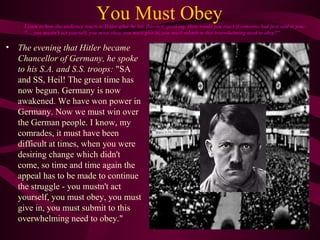
You Must Obey
• The evening that Hitler became
Chancellor of Germany, he spoke
to his S.A. and S.S. troops: "SA
and SS, Heil! The great time has
now begun. Germany is now
awakened. We have won power in
Germany. Now we must win over
the German people. I know, my
comrades, it must have been
difficult at times, when you were
desiring change which didn't
come, so time and time again the
appeal has to be made to continue
the struggle - you mustn't act
yourself, you must obey, you must
give in, you must submit to this
overwhelming need to obey."
Listen to how the audience reacts to Hitler after he has finished speaking. How would you react if someone had just said to you:
“… you mustn't act yourself, you must obey, you must give in, you must submit to this overwhelming need to obey?"
The Choice
• Communism
• Militarism
• Fascism
• Nazism
• New Deal
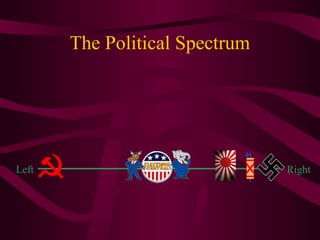
The Political Spectrum
Left Right
Another Perspective
Left Right
Freedom
Coercion
The Aftermath
World War II Death Toll
COUNTRY MILITARY CIVILIAN DEATHS
USSR 13,600,000 7,700,000 21,300,000
China 1,324,000 10,000,000 11,324,000
Germany 3,250,000 3,810,000 7,060,000
Poland 850,000 6,000,000 6,850,000
Japan - - 2,000,000
Yugoslavia 300,000 1,400,000 1,706,000
Rumania 520,000 465,000 985,000
France 340,000 470,000 810,000
Hungary - - 750,000
Austria 380,000 145,000 525,000
Greece - - 520,000
UnitedStates 500,000 - 500,000
Italy 330,000 80,000 410,000
Czechoslovakia - - 400,000
COUNTRY MILITARY CIVILIAN DEATHS
Great Britain 326,000 62,000 388,000
Netherlands 198,000 12,000 210,000
Belgium 76,000 12,000 88,000
Finland - - 84,000
Canada 39,000 - 39,000
India 36,000 - 36,000
Australia 29,000 - 29,000
Albania - - 28,000
Spain 12,000 10,000 22,000
Bulgaria 19,000 2,000 21,000
NewZealand 12,000 - 12,000
Norway - - 10,262
South Africa 9,000 - 9,000
Luxembourg - - 5,000
Denmark 4,000 - 4,000
TOTAL: - - 56,125,262
T

T

  • 1.
  • 2.
    The Stock MarketCrash • In 1929, the Wall Street stock market crash ushered in a worldwide financial crisis.
  • 3.
    The Great Depression •Nation after nation fell victim to: • Industrial decline • Bank failures • Deflated prices and profits • Commercial stagnation
  • 4.
    Personal Hardship • Peoplethe world over suffered from: • Lowered standards of living • Unemployment • Hunger • Fear of the future
  • 5.
    Policies of Self-Sufficiency •In desperation, governments sought economic recovery by adopting restrictive policies of self-sufficiency: • High tariffs • Import quotas • Barter agreements
  • 6.
    Planned Economies • Governments experimented withnew plans for internal economies.
  • 7.
    Great Britain • GreatBritain adopted far-reaching measures in the development of a planned national economy.
  • 8.
    The New Deal •The United States launched the New Deal with its objectives of: • Relief • Recovery • Reform
  • 9.
    FDR’s 1st Inaugural Address •“So first of all let me assert my firm belief that the only thing we have to fear is . . . fear itself. . . nameless, unreasoning, unjustified terror which paralyzes needed efforts to convert retreat into advance.”
  • 10.
    The Rise ofDictators • Elsewhere, the hardships of the depression formed a dismal backdrop on a political stage where dictators seized the leading roles. • Extremist groups took advantage of widespread discontent to rise to power. • They preached that bold actions and strong leaders were necessary to restore prosperity.
  • 11.
    Joseph Stalin • Establisheda Communist dictatorship in Russia. • Advocated government ownership of property and capital. • Set up three Five-Year Plans for: • Industrialization • Collectivization of agriculture • Restricted manufacture of consumer goods • Sent those who opposed him to firing squads or labor camps.
  • 12.
    Stalin on theWorker’s Paradise • "If there had been a crisis in our country, if there had been unemployment - the scourge of the working class, if there had been abject poverty, if output hadn't gone up, if our workers and peasants didn't have such a good government who looked after them, who cared about them - in a word, if you lived badly, joylessly - we would not have heroes and heroines of socialism, I can assure you."
  • 13.
    Emperor Hirohito • Influencedby Japanese militarists, was committed to extension of Japan's borders by military force. • Pursued these major foreign policy objectives: • To resist Russian pressure on Japan's empire from the north. • To undertake the military conquest of the whole of China. • To seize the wealth and raw materials available in the Southeast Asian colonies of Britain, France, and Holland.
  • 14.
    Hirohito’s Surrender Speech •To our good and loyal subjects: After pondering deeply the general trends of the world and the actual conditions obtaining in our empire today, we have decided to effect a settlement of the present situation by resorting to an extraordinary measure….We have ordered our Government to communicate to the Governments of the United States, Great Britain, China, and the Soviet Union that our empire accepts the provisions of their joint declaration…. We are keenly aware of the inmost feelings of all of you, our subjects. However, it is according to the dictates of time and fate that we have resolved to pave the way for a grand peace for all the generations to come by enduring the unendurable and suffering what is unsufferable. This is a very long speech. I suggest you move on when you have heard enough to appreciate the Japanese intonation.
  • 15.
    Benito Mussolini • Establisheda Fascist dictatorship in Italy. • Permitted private ownership of property and capital. • Placed strict government rules on the people and the economy. • Glorified the state and used force to achieve his ends. • Punished individuals not conforming to Fascist practices.
  • 16.
    Mussolini on Endof Ethiopian War • An English-speaking Italian commentator, in all candor, refers to the end of Italy's seven month war against barefoot, passive Ethiopians, which Mussolini has just announced in his speech, as "one of the greatest military feats known in history".
  • 17.
    Adolf Hitler • Establisheda Nazi dictatorship in Germany. • Changed Germany into a police state. • Controlled every area of life – the economy, schools, labor unions, newspapers, radio, films. • Pursued economic recovery through: • Rearmament • Conscription • Public works • Preached the idea of a “super race” and began a carefully planned program to eliminate Jews.
  • 18.
    You Must Obey •The evening that Hitler became Chancellor of Germany, he spoke to his S.A. and S.S. troops: "SA and SS, Heil! The great time has now begun. Germany is now awakened. We have won power in Germany. Now we must win over the German people. I know, my comrades, it must have been difficult at times, when you were desiring change which didn't come, so time and time again the appeal has to be made to continue the struggle - you mustn't act yourself, you must obey, you must give in, you must submit to this overwhelming need to obey." Listen to how the audience reacts to Hitler after he has finished speaking. How would you react if someone had just said to you: “… you mustn't act yourself, you must obey, you must give in, you must submit to this overwhelming need to obey?"
  • 19.
    The Choice • Communism •Militarism • Fascism • Nazism • New Deal
  • 20.
  • 21.
  • 22.
  • 24.
    World War IIDeath Toll COUNTRY MILITARY CIVILIAN DEATHS USSR 13,600,000 7,700,000 21,300,000 China 1,324,000 10,000,000 11,324,000 Germany 3,250,000 3,810,000 7,060,000 Poland 850,000 6,000,000 6,850,000 Japan - - 2,000,000 Yugoslavia 300,000 1,400,000 1,706,000 Rumania 520,000 465,000 985,000 France 340,000 470,000 810,000 Hungary - - 750,000 Austria 380,000 145,000 525,000 Greece - - 520,000 UnitedStates 500,000 - 500,000 Italy 330,000 80,000 410,000 Czechoslovakia - - 400,000
  • 25.
    COUNTRY MILITARY CIVILIANDEATHS Great Britain 326,000 62,000 388,000 Netherlands 198,000 12,000 210,000 Belgium 76,000 12,000 88,000 Finland - - 84,000 Canada 39,000 - 39,000 India 36,000 - 36,000 Australia 29,000 - 29,000 Albania - - 28,000 Spain 12,000 10,000 22,000 Bulgaria 19,000 2,000 21,000 NewZealand 12,000 - 12,000 Norway - - 10,262 South Africa 9,000 - 9,000 Luxembourg - - 5,000 Denmark 4,000 - 4,000 TOTAL: - - 56,125,262