What is
Communism?
  {   Supplemental
What is Communism?
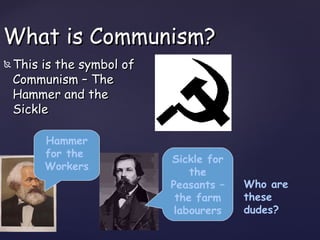
   This is the symbol of
    Communism – The
    Hammer and the
    Sickle

         Hammer
         for the
                            Sickle for
         Workers
                                the
                            Peasants –   Who are
                             the farm    these
                             labourers   dudes?
‘Those dudes’ wrote the ‘Communist Manifesto’
    in 1847. It’s a short book – but billions of
    people have read it….


What is Communism?
This is Karl Marx, the ‘Father of    This is his good friend,
Communism’. People who believe         Frederick Engels.
in his ideas are called ‘Marxists’
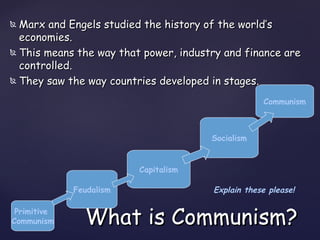
 Marx and Engels studied the history of the world’s
  economies.
 This means the way that power, industry and finance are

  controlled.
 They saw the way countries developed in stages.


                                                   Communism


                                       Socialism


                         Capitalism

             Feudalism                 Explain these please!

 Primitive
Communism      What is Communism?
What is Communism?


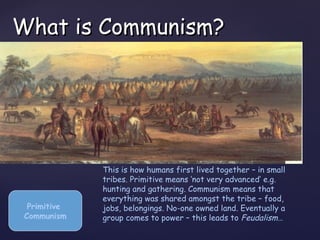
              This is how humans first lived together – in small
              tribes. Primitive means ‘not very advanced’ e.g.
              hunting and gathering. Communism means that
              everything was shared amongst the tribe – food,
  Primitive   jobs, belongings. No-one owned land. Eventually a
 Communism    group comes to power – this leads to Feudalism…
What is Communism?
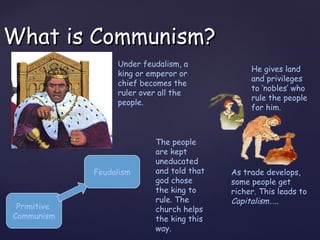
                  Under feudalism, a
                                                He gives land
                  king or emperor or
                                                and privileges
                  chief becomes the
                                                to ‘nobles’ who
                  ruler over all the
                                                rule the people
                  people.
                                                for him.


                           The people
                           are kept
                           uneducated
             Feudalism     and told that   As trade develops,
                           god chose       some people get
                           the king to     richer. This leads to
                           rule. The       Capitalism…..
 Primitive                 church helps
Communism                  the king this
                           way.
What is Communism?

                  The
                  capitalists
                  get more
                  power to
                  serve
The business
                  their own
owners or
                  interests.
capitalists get                 Capitalism
richer while
the workers do
all the hard
                   Feudalism       Capitalism creates a huge working-
work.
                                   class of people who soon get angry
                                   at the way they are treated. They
                                   organise in unions and demand
                                   changes. This will lead to a
                                   revolution and Socialism…
What is Communism?
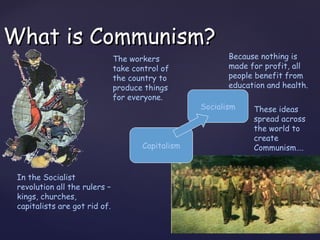
                               The workers                Because nothing is
                               take control of            made for profit, all
                               the country to             people benefit from
                               produce things             education and health.
                               for everyone.
                                                   Socialism    These ideas
                                                                spread across
                                                                the world to
                                                                create
                                      Capitalism                Communism….


 In the Socialist
 revolution all the rulers –
 kings, churches,
 capitalists are got rid of.
What is Communism?
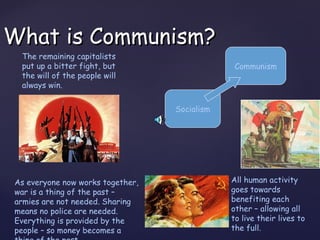
 The remaining capitalists
 put up a bitter fight, but                    Communism
 the will of the people will
 always win.


                                  Socialism


As everyone now works together,               All human activity
war is a thing of the past –                  goes towards
armies are not needed. Sharing                benefiting each
means no police are needed.                   other – allowing all
Everything is provided by the                 to live their lives to
people – so money becomes a                   the full.
Capitalism vs.
Communism
  { An inside look on the differences
   The Cold War was the protracted geopolitical,
    ideological, and economic struggle that emerged after
    World War II between capitalism and communism,
    centering around the global superpowers of the United
    States and the Soviet Union.

   It lasted from about 1947 to the period leading to the
    collapse of the Soviet Union on December 25, 1991


    The Cold War
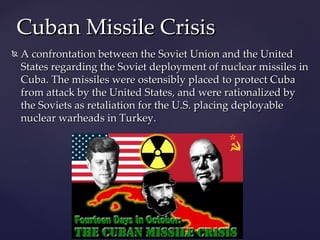
Cuban Missile Crisis
   A confrontation between the Soviet Union and the United
    States regarding the Soviet deployment of nuclear missiles in
    Cuba. The missiles were ostensibly placed to protect Cuba
    from attack by the United States, and were rationalized by
    the Soviets as retaliation for the U.S. placing deployable
    nuclear warheads in Turkey.
 The crisis started on October 16, 1962,
  when U.S. reconnaissance data revealing
  Soviet nuclear missile installations on the
  island was shown to U.S. President John
  F. Kennedy, and ended twelve days later
  on October 28, 1962, when Soviet leader
  Nikita Khrushchev announced that the
  installations would be dismantled.
 The Cuban Missile Crisis is regarded as
  the moment when the Cold War came
  closest to escalating into a nuclear war.


    Cuban Missile Crisis
   How would you define “capitalism”?
       What other words come to mind when you
        think of the word “capitalism”?
       Are these associations positive or negative?


Capitalism
   An economic system in which the means of production are
    owned mostly privately.
   Capital is invested in the production of goods for profit in a
    competitive free market.


    Capitalism
   Latin, caput, “head”
       The term “capitalism” was first used in English
        in 1854.
       Marxist writers originally popularized the
        term.


Etymology
   The classical tradition in economic thought
        emerged in Britain in the late 18th century.
       The classical economists included Adam Smith,
        David Ricardo, and John Stuart Mill.


Classical Economics
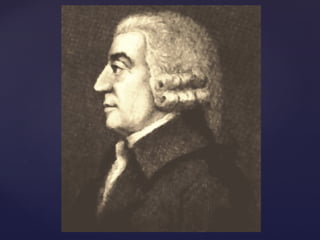
   A Scottish political economist and moral
       philosopher (1723-1790).
      His Inquiry into the Nature and Causes of the
       Wealth of Nations (1776) founded the modern
       discipline of economics and provided the
       rationale for free trade, capitalism and
       libertarianism.


Adam Smith
   In his mid-20s he began expounding “the
        obvious and simple system of natural liberty.”


Natural Liberty
   Smith criticized mercantilism, the theory that large reserves of
    bullion are essential for economic success.
   The British government acquired colonies in order to acquire
    natural resources for its factories and markets for its finished
    goods.
   Mercantilism required that colonies not be allowed to
    industrialize or trade with countries other than the mother
    country.


    Mercantilism
   Smith criticized physiocracy, which taught that wealth originated
    in land.
   Smith argued that labor was the major source of wealth and that
    the division of labor was the key to economic growth.
   As productivity rises, wages will rise.

    Physiocracy
   The free market appears chaotic and
        unrestrained.
       Actually, it is guided by “an invisible hand” to
        produce the right amount and variety of goods.
       If a product shortage occurs, the price rises,
        establishing a profit margin that provides an
        incentive for others to enter production.


The Invisible Hand
   While human motives are selfish and greedy,
         the competition in the free market tends to
         benefit society as a whole by keeping prices
         law, while still building in an incentive for a
         wide variety of goods and services.
        He argued against the formation of
         monopolies.


Social Benefit
   Smith attacked most forms of government
         interference in the economic process, including
         tariffs on imported goods.
        Government restrictions on trade cause
         inefficiency and high prices.
        “Laissez-faire” means “let them do.”


Laissez-faire
   It is not from the benevolence of the butcher, the
         brewer, or the baker that we expect our dinner, but
         from their regard to their own interest.
        We address ourselves, not to their humanity but to
         their self-love, and never talk to them of our own
         necessities but of their advantages.


Self-Interest
   As every individual, therefore, endeavours as much as he can both to
    employ his capital in the support of domestic industry, and so to direct
    that industry that its produce may be of the greatest value; every
    individual necessarily labours to render the annual value of society as
    great as he can.


    National Wealth
   How would you define “communism”?
      What other words come to mind when you
       think of the word “communism”?
      Are these associations positive or negative?


Communism
   An ideology that seeks to establish a future
       classless, stateless social organization, based
       upon common ownership of the means of
       production and the absence of private
       property.


Communism
   Karl Marx (1818-1883) was an immensely
        influential German philosopher, political
        economist, and socialist revolutionary.
       He is most famous for his analysis of history in
        terms of class struggles.


Karl Marx
   The history of all hitherto existing society is the
         history of class struggles.

Communist Manifesto
(1848)
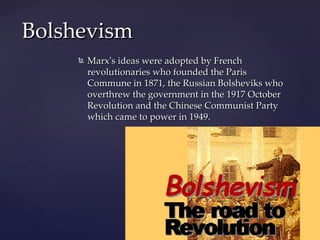
Bolshevism
        Marx’s ideas were adopted by French
         revolutionaries who founded the Paris
         Commune in 1871, the Russian Bolsheviks who
         overthrew the government in the 1917 October
         Revolution and the Chinese Communist Party
         which came to power in 1949.
   Marx was an atheist.
   He believed that religion was “the opiate of the
    people.”
   The owners of capital used religion to keep the
    peasants and workers subjugated by leading
    them to think, not of their present misery, of
    future happiness in heaven.


        Atheism
   Marx taught that paradise would appear on earth, following the
    destruction of capitalism and the state.
   Under capitalism, labor is alienated.
   In a communist society, human beings freely develop their nature
    in cooperative production.
   Under communism, there is no government and, accordingly,
    perfect freedom.


Communist Paradise
   The nature of individuals depends on the material
        conditions determining their production.


Human Nature Changes
   Marx traced the history of the various modes of
        production and predicted the collapse of the
        present one—industrial capitalism—and its
        replacement by communism, just as capitalism
        had replaced feudalism.
       The appearance of communism would
        represent the end of history.


Determinism
   Marx’s moral teaching was that the leaders of the Communist
    Party, which he termed “the vanguard of the proletariat,” were
    free to commit any crime as long as it served the end—the
    destruction of capitalism and the ushering in of communism.
   This historical process, he said, was inevitable.


    The End Justifies the
    Means
   Those who must sell their labor power are
        “proletarians.”
       The person who buys the labor power someone
        who owns the land and technology to produce,
        is a “capitalist” or “bourgeoise.”
       The proletarians inevitably outnumber the
        capitalists.


Class Struggle
   Profit is “theft.”
        It is the difference between the value of a good
         produced by a worker and the wages paid to
         the worker by the owner.
        Due to competition among workers for
         employment, wages will decline, leading to
         poverty, misery and rebellion.


Profit
   The state is “a committee of the bourgeoisie”
        and laws support the capitalists, the ruling
        class.
       Class conflict between the proletariat and the
        capitalists can only be resolved by violent
        revolution.
       A dictatorship of the working class is a
        temporary necessity before communism is
        possible.


Revolution
The principle of distribution in communism, is
     “From each according to ability, to each
     according to need.”


Justice
   Why do you think the United States won the
        Cold War?
       Why has capitalism proven much more
        durable and attractive than communism?


The Failure of
Communism
   In the 20th century, it is estimated that 50
        million people were killed in the name of
        communism.
       Most of Marx’s predictions were wrong, such
        as that communist revolutions would occur
        only in industrial societies.
       It is inconsistent with human nature.
       It ignores the appeal of religion.


Criticism of Communism

Communism

  • 1.
    What is Communism? { Supplemental
  • 2.
    What is Communism?  This is the symbol of Communism – The Hammer and the Sickle Hammer for the Sickle for Workers the Peasants – Who are the farm these labourers dudes?
  • 3.
    ‘Those dudes’ wrotethe ‘Communist Manifesto’ in 1847. It’s a short book – but billions of people have read it…. What is Communism? This is Karl Marx, the ‘Father of This is his good friend, Communism’. People who believe Frederick Engels. in his ideas are called ‘Marxists’
  • 4.
     Marx andEngels studied the history of the world’s economies.  This means the way that power, industry and finance are controlled.  They saw the way countries developed in stages. Communism Socialism Capitalism Feudalism Explain these please! Primitive Communism What is Communism?
  • 5.
    What is Communism? This is how humans first lived together – in small tribes. Primitive means ‘not very advanced’ e.g. hunting and gathering. Communism means that everything was shared amongst the tribe – food, Primitive jobs, belongings. No-one owned land. Eventually a Communism group comes to power – this leads to Feudalism…
  • 6.
    What is Communism? Under feudalism, a He gives land king or emperor or and privileges chief becomes the to ‘nobles’ who ruler over all the rule the people people. for him. The people are kept uneducated Feudalism and told that As trade develops, god chose some people get the king to richer. This leads to rule. The Capitalism….. Primitive church helps Communism the king this way.
  • 7.
    What is Communism? The capitalists get more power to serve The business their own owners or interests. capitalists get Capitalism richer while the workers do all the hard Feudalism Capitalism creates a huge working- work. class of people who soon get angry at the way they are treated. They organise in unions and demand changes. This will lead to a revolution and Socialism…
  • 8.
    What is Communism? The workers Because nothing is take control of made for profit, all the country to people benefit from produce things education and health. for everyone. Socialism These ideas spread across the world to create Capitalism Communism…. In the Socialist revolution all the rulers – kings, churches, capitalists are got rid of.
  • 9.
    What is Communism? The remaining capitalists put up a bitter fight, but Communism the will of the people will always win. Socialism As everyone now works together, All human activity war is a thing of the past – goes towards armies are not needed. Sharing benefiting each means no police are needed. other – allowing all Everything is provided by the to live their lives to people – so money becomes a the full.
  • 10.
    Capitalism vs. Communism { An inside look on the differences
  • 11.
    The Cold War was the protracted geopolitical, ideological, and economic struggle that emerged after World War II between capitalism and communism, centering around the global superpowers of the United States and the Soviet Union.  It lasted from about 1947 to the period leading to the collapse of the Soviet Union on December 25, 1991 The Cold War
  • 12.
    Cuban Missile Crisis  A confrontation between the Soviet Union and the United States regarding the Soviet deployment of nuclear missiles in Cuba. The missiles were ostensibly placed to protect Cuba from attack by the United States, and were rationalized by the Soviets as retaliation for the U.S. placing deployable nuclear warheads in Turkey.
  • 13.
     The crisisstarted on October 16, 1962, when U.S. reconnaissance data revealing Soviet nuclear missile installations on the island was shown to U.S. President John F. Kennedy, and ended twelve days later on October 28, 1962, when Soviet leader Nikita Khrushchev announced that the installations would be dismantled.  The Cuban Missile Crisis is regarded as the moment when the Cold War came closest to escalating into a nuclear war. Cuban Missile Crisis
  • 14.
    How would you define “capitalism”?  What other words come to mind when you think of the word “capitalism”?  Are these associations positive or negative? Capitalism
  • 15.
    An economic system in which the means of production are owned mostly privately.  Capital is invested in the production of goods for profit in a competitive free market. Capitalism
  • 16.
    Latin, caput, “head”  The term “capitalism” was first used in English in 1854.  Marxist writers originally popularized the term. Etymology
  • 17.
    The classical tradition in economic thought emerged in Britain in the late 18th century.  The classical economists included Adam Smith, David Ricardo, and John Stuart Mill. Classical Economics
  • 19.
    A Scottish political economist and moral philosopher (1723-1790).  His Inquiry into the Nature and Causes of the Wealth of Nations (1776) founded the modern discipline of economics and provided the rationale for free trade, capitalism and libertarianism. Adam Smith
  • 20.
    In his mid-20s he began expounding “the obvious and simple system of natural liberty.” Natural Liberty
  • 21.
    Smith criticized mercantilism, the theory that large reserves of bullion are essential for economic success.  The British government acquired colonies in order to acquire natural resources for its factories and markets for its finished goods.  Mercantilism required that colonies not be allowed to industrialize or trade with countries other than the mother country. Mercantilism
  • 22.
    Smith criticized physiocracy, which taught that wealth originated in land.  Smith argued that labor was the major source of wealth and that the division of labor was the key to economic growth.  As productivity rises, wages will rise. Physiocracy
  • 23.
    The free market appears chaotic and unrestrained.  Actually, it is guided by “an invisible hand” to produce the right amount and variety of goods.  If a product shortage occurs, the price rises, establishing a profit margin that provides an incentive for others to enter production. The Invisible Hand
  • 24.
    While human motives are selfish and greedy, the competition in the free market tends to benefit society as a whole by keeping prices law, while still building in an incentive for a wide variety of goods and services.  He argued against the formation of monopolies. Social Benefit
  • 25.
    Smith attacked most forms of government interference in the economic process, including tariffs on imported goods.  Government restrictions on trade cause inefficiency and high prices.  “Laissez-faire” means “let them do.” Laissez-faire
  • 26.
    It is not from the benevolence of the butcher, the brewer, or the baker that we expect our dinner, but from their regard to their own interest.  We address ourselves, not to their humanity but to their self-love, and never talk to them of our own necessities but of their advantages. Self-Interest
  • 27.
    As every individual, therefore, endeavours as much as he can both to employ his capital in the support of domestic industry, and so to direct that industry that its produce may be of the greatest value; every individual necessarily labours to render the annual value of society as great as he can. National Wealth
  • 28.
    How would you define “communism”?  What other words come to mind when you think of the word “communism”?  Are these associations positive or negative? Communism
  • 29.
    An ideology that seeks to establish a future classless, stateless social organization, based upon common ownership of the means of production and the absence of private property. Communism
  • 31.
    Karl Marx (1818-1883) was an immensely influential German philosopher, political economist, and socialist revolutionary.  He is most famous for his analysis of history in terms of class struggles. Karl Marx
  • 32.
    The history of all hitherto existing society is the history of class struggles. Communist Manifesto (1848)
  • 33.
    Bolshevism  Marx’s ideas were adopted by French revolutionaries who founded the Paris Commune in 1871, the Russian Bolsheviks who overthrew the government in the 1917 October Revolution and the Chinese Communist Party which came to power in 1949.
  • 34.
    Marx was an atheist.  He believed that religion was “the opiate of the people.”  The owners of capital used religion to keep the peasants and workers subjugated by leading them to think, not of their present misery, of future happiness in heaven. Atheism
  • 35.
    Marx taught that paradise would appear on earth, following the destruction of capitalism and the state.  Under capitalism, labor is alienated.  In a communist society, human beings freely develop their nature in cooperative production.  Under communism, there is no government and, accordingly, perfect freedom. Communist Paradise
  • 36.
    The nature of individuals depends on the material conditions determining their production. Human Nature Changes
  • 37.
    Marx traced the history of the various modes of production and predicted the collapse of the present one—industrial capitalism—and its replacement by communism, just as capitalism had replaced feudalism.  The appearance of communism would represent the end of history. Determinism
  • 38.
    Marx’s moral teaching was that the leaders of the Communist Party, which he termed “the vanguard of the proletariat,” were free to commit any crime as long as it served the end—the destruction of capitalism and the ushering in of communism.  This historical process, he said, was inevitable. The End Justifies the Means
  • 39.
    Those who must sell their labor power are “proletarians.”  The person who buys the labor power someone who owns the land and technology to produce, is a “capitalist” or “bourgeoise.”  The proletarians inevitably outnumber the capitalists. Class Struggle
  • 40.
    Profit is “theft.”  It is the difference between the value of a good produced by a worker and the wages paid to the worker by the owner.  Due to competition among workers for employment, wages will decline, leading to poverty, misery and rebellion. Profit
  • 41.
    The state is “a committee of the bourgeoisie” and laws support the capitalists, the ruling class.  Class conflict between the proletariat and the capitalists can only be resolved by violent revolution.  A dictatorship of the working class is a temporary necessity before communism is possible. Revolution
  • 42.
    The principle ofdistribution in communism, is “From each according to ability, to each according to need.” Justice
  • 43.
    Why do you think the United States won the Cold War?  Why has capitalism proven much more durable and attractive than communism? The Failure of Communism
  • 44.
    In the 20th century, it is estimated that 50 million people were killed in the name of communism.  Most of Marx’s predictions were wrong, such as that communist revolutions would occur only in industrial societies.  It is inconsistent with human nature.  It ignores the appeal of religion. Criticism of Communism