Federal and Unitary Political Systems


                      Prof. Lourdes Veneracion-Rallonza, PhD
                      Department of Political Science
                      Ateneo de Manila University
Power
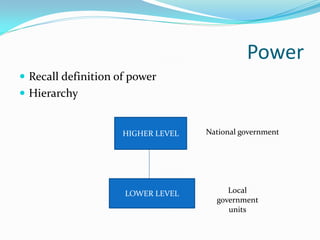
 Recall definition of power
 Hierarchy


                     HIGHER LEVEL   National government


                     LOWER LEVEL         Local
                                      government
                                         units
Operationalization of Hierarchy:
                 Local Governments
 “political subdivisions of the nation state”
 non-sovereign communities with subordinate status
 governments which are below the central government;
 constituted by law --- actual extent of local self-
  determination or local autonomy (ability for self-
  government) depends on delegated authorities and on
  local capability
Nature of Dispersal of Power
 Centralized
  - power concentrated in the center (national
  government)
 Decentralized
  - power from the center
  - enables the maximum participation of the people
  - lower levels of government are encouraged and
  trained to be self-reliant
Modes of Decentralization
 Deconcentration (administrative decentralization)


 - involves the transfer of functions from the national
 office to the regional and local offices

 - delegating functions from the central government to
 local government units (sectoral approach)

 - redistribution of administrative responsibilities
Modes of Decentralization
 Devolution (political decentralization)


 - transfer of power for the performance of certain
 functions for the national authorities to the lower
 levels of government (area approach)

 - local governments are “perceived to be separate levels
 over which central authorities exercise less or no direct
 control” (i.e. autonomy)
Unitarism
 Unitas
 sovereignty is vested in central (national)
  government
 (may have) decentralization through local
  government units
 Functions of central authority
 - Controls local governments and determines how
 much power they will have
 - Imposes its decisions on all local governments
 - Emergency: greater concentration of power
Federalism
 Foederis or covenant
 Normative principle: ‘unity in diversity’
 ‘self and shared rule’: ‘divided sovereignty
 Components (Riker 1964)
 - 2 levels of government rule the same land and people
 - each level has at least one area of action in which it is
 autonomous
Federalism
 Functions of central authority

 - Permits a central government to represent the various
 entities w/in the State where they have common interests -
 -- defense, foreign affairs, communication

 - yet allows these various entities to retain their own
 identities and to have their own laws, policies and customs
 in certain fields
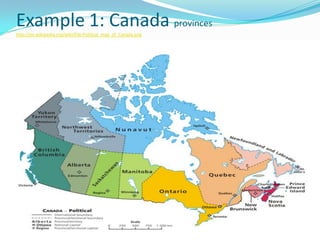
Example 1: Canada provinces
http://en.wikipedia.org/wiki/File:Political_map_of_Canada.png
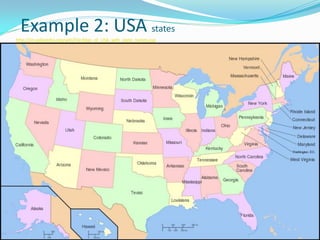
Example 2: USA states
http://en.wikipedia.org/wiki/File:Map_of_USA_with_state_names.svg
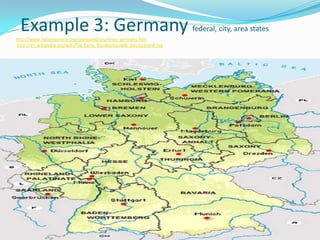
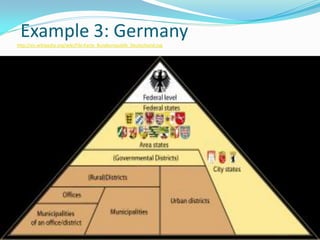
Example 3: Germany
http://www.nationsonline.org/oneworld/countries_germany.htm
                                                                         federal, city, area states
http://en.wikipedia.org/wiki/File:Karte_Bundesrepublik_Deutschland.svg
Example 3: Germany
http://en.wikipedia.org/wiki/File:Karte_Bundesrepublik_Deutschland.svg
Arguments for Federalism
 56 % of world’s population live in federal systems
 Most democracies transition from unitary to federal
  systems
 good for economic development: lower inflation
  (Lijphart, Lancaster & Hicks), lower unemployment
  (Crepaz)
 decrease incidence of political violence
 Increase efficiency in administration and delivery of
  services
Proposed Shift from Unitary to
      Federal System: Philippine Case
 Based on Proposed Revision of 1987 Constitution by
  Consultative Committee on Charter Change (2005) -
  geographic contiguity, culture & language & economic
  viability

    “Within one year and after at least sixty percent of the
   provinces, highly urbanized cities and component cities of
    the country shall have joined in the creation of different
   autonomous territories, upon petition of majority of such
    autonomous territories through their respective regional
   assemblies, the Parliament shall enact a basic law for the
    establishment of the Federal Republic of the Philippines,
  whereby autonomous territories shall become federal states”
                        (Art. XX, Sec. 15)
Proposed Shift from Unitary to
       Federal System: Philippine Case
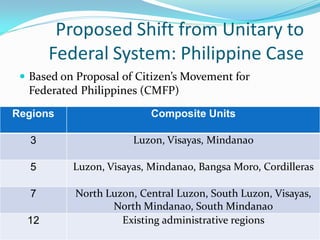
  Based on Proposal of Citizen’s Movement for
   Federated Philippines (CMFP)

Regions                    Composite Units

   3                   Luzon, Visayas, Mindanao

   5       Luzon, Visayas, Mindanao, Bangsa Moro, Cordilleras

   7       North Luzon, Central Luzon, South Luzon, Visayas,
                  North Mindanao, South Mindanao
  12                Existing administrative regions
Proposed Shift from Unitary to
     Federal System: Philippine Case
 Based on PGMA’s 2005 proposal - super regions for fast
  track economic development
 North Luzon (agribusiness), Metro Luzon (urban,
 industries & services), Central Philippines (tourism) &
 North Mindanao (agribusiness center in Mindanao
 region).
So, what about the Philippines?
 Impact on economic development?
 Solution for political violence?
 Effect on governance?

Federal And Unitary

  • 1.
    Federal and UnitaryPolitical Systems Prof. Lourdes Veneracion-Rallonza, PhD Department of Political Science Ateneo de Manila University
  • 2.
    Power  Recall definitionof power  Hierarchy HIGHER LEVEL National government LOWER LEVEL Local government units
  • 3.
    Operationalization of Hierarchy: Local Governments  “political subdivisions of the nation state”  non-sovereign communities with subordinate status  governments which are below the central government;  constituted by law --- actual extent of local self- determination or local autonomy (ability for self- government) depends on delegated authorities and on local capability
  • 4.
    Nature of Dispersalof Power  Centralized - power concentrated in the center (national government)  Decentralized - power from the center - enables the maximum participation of the people - lower levels of government are encouraged and trained to be self-reliant
  • 5.
    Modes of Decentralization Deconcentration (administrative decentralization) - involves the transfer of functions from the national office to the regional and local offices - delegating functions from the central government to local government units (sectoral approach) - redistribution of administrative responsibilities
  • 6.
    Modes of Decentralization Devolution (political decentralization) - transfer of power for the performance of certain functions for the national authorities to the lower levels of government (area approach) - local governments are “perceived to be separate levels over which central authorities exercise less or no direct control” (i.e. autonomy)
  • 7.
    Unitarism  Unitas  sovereigntyis vested in central (national) government  (may have) decentralization through local government units  Functions of central authority - Controls local governments and determines how much power they will have - Imposes its decisions on all local governments - Emergency: greater concentration of power
  • 8.
    Federalism  Foederis orcovenant  Normative principle: ‘unity in diversity’  ‘self and shared rule’: ‘divided sovereignty  Components (Riker 1964) - 2 levels of government rule the same land and people - each level has at least one area of action in which it is autonomous
  • 9.
    Federalism  Functions ofcentral authority - Permits a central government to represent the various entities w/in the State where they have common interests - -- defense, foreign affairs, communication - yet allows these various entities to retain their own identities and to have their own laws, policies and customs in certain fields
  • 10.
    Example 1: Canadaprovinces http://en.wikipedia.org/wiki/File:Political_map_of_Canada.png
  • 11.
    Example 2: USAstates http://en.wikipedia.org/wiki/File:Map_of_USA_with_state_names.svg
  • 12.
    Example 3: Germany http://www.nationsonline.org/oneworld/countries_germany.htm federal, city, area states http://en.wikipedia.org/wiki/File:Karte_Bundesrepublik_Deutschland.svg
  • 13.
  • 14.
    Arguments for Federalism 56 % of world’s population live in federal systems  Most democracies transition from unitary to federal systems  good for economic development: lower inflation (Lijphart, Lancaster & Hicks), lower unemployment (Crepaz)  decrease incidence of political violence  Increase efficiency in administration and delivery of services
  • 15.
    Proposed Shift fromUnitary to Federal System: Philippine Case  Based on Proposed Revision of 1987 Constitution by Consultative Committee on Charter Change (2005) - geographic contiguity, culture & language & economic viability “Within one year and after at least sixty percent of the provinces, highly urbanized cities and component cities of the country shall have joined in the creation of different autonomous territories, upon petition of majority of such autonomous territories through their respective regional assemblies, the Parliament shall enact a basic law for the establishment of the Federal Republic of the Philippines, whereby autonomous territories shall become federal states” (Art. XX, Sec. 15)
  • 16.
    Proposed Shift fromUnitary to Federal System: Philippine Case  Based on Proposal of Citizen’s Movement for Federated Philippines (CMFP) Regions Composite Units 3 Luzon, Visayas, Mindanao 5 Luzon, Visayas, Mindanao, Bangsa Moro, Cordilleras 7 North Luzon, Central Luzon, South Luzon, Visayas, North Mindanao, South Mindanao 12 Existing administrative regions
  • 17.
    Proposed Shift fromUnitary to Federal System: Philippine Case  Based on PGMA’s 2005 proposal - super regions for fast track economic development North Luzon (agribusiness), Metro Luzon (urban, industries & services), Central Philippines (tourism) & North Mindanao (agribusiness center in Mindanao region).
  • 18.
    So, what aboutthe Philippines?  Impact on economic development?  Solution for political violence?  Effect on governance?