
SCLERODERMA
YUZBASHEVA NIHAL 221B
• Scleroderma is a disease characterized by
sclerosis of the skin and visceral organs,
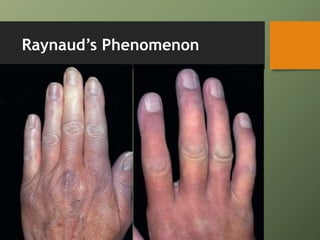
vasculopathy (Raynaud’s phenomenon), and
the presence of autoantibodies. The spectrum
of disease is wide, with systemic and localized
forms
• All forms of scleroderma are more common in
females.
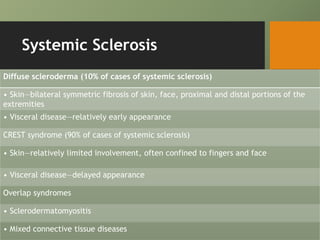
Systemic Sclerosis
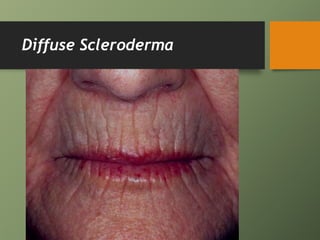
Diffuse scleroderma (10% of cases of systemic sclerosis)
• Skin—bilateral symmetric fibrosis of skin, face, proximal and distal portions of the
extremities
• Visceral disease—relatively early appearance
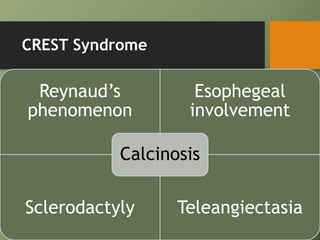
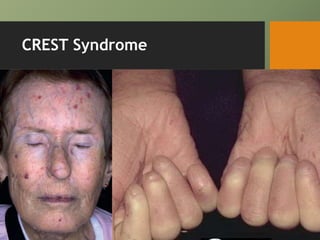
CREST syndrome (90% of cases of systemic sclerosis)
• Skin—relatively limited involvement, often confined to fingers and face
• Visceral disease—delayed appearance
Overlap syndromes
• Sclerodermatomyositis
• Mixed connective tissue diseases
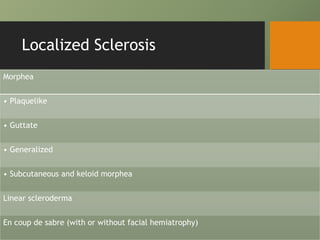
Localized Sclerosis
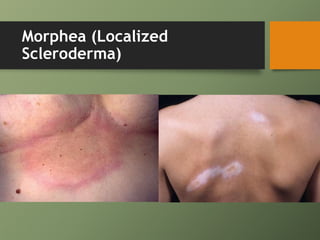
Morphea
• Plaquelike
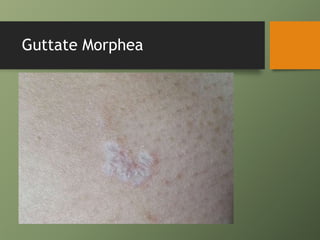
• Guttate
• Generalized
• Subcutaneous and keloid morphea
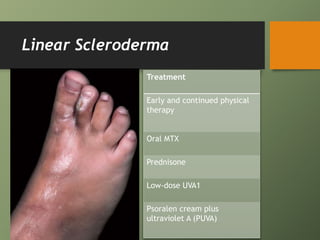
Linear scleroderma
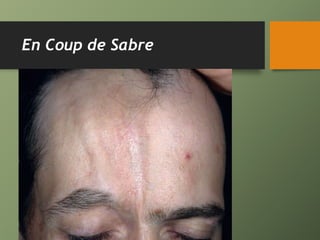
En coup de sabre (with or without facial hemiatrophy)
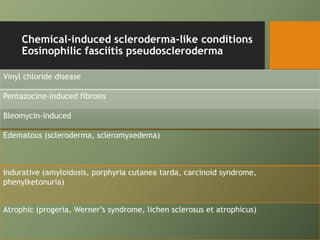
Chemical-induced scleroderma-like conditions
Eosinophilic fasciitis pseudoscleroderma
Vinyl chloride disease
Pentazocine-induced fibrosis
Bleomycin-induced
Edematous (scleroderma, scleromyxedema)
Indurative (amyloidosis, porphyria cutanea tarda, carcinoid syndrome,
phenylketonuria)
Atrophic (progeria, Werner’s syndrome, lichen sclerosus et atrophicus)
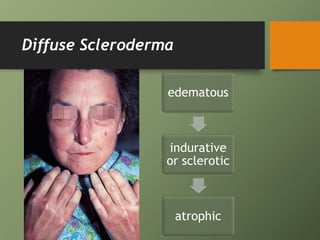
Diffuse Scleroderma
edematous
indurative
or sclerotic
atrophic
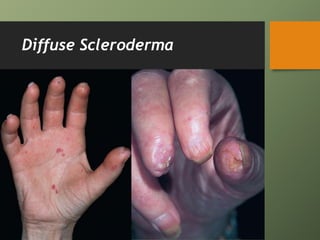
Diffuse Scleroderma
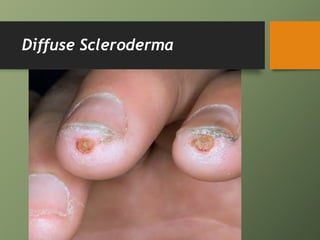
Diffuse Scleroderma
Diffuse Scleroderma
Raynaud’s Phenomenon
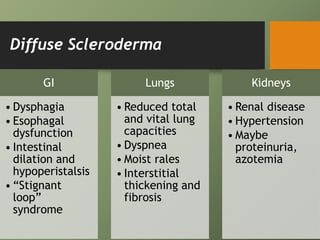
GI
• Dysphagia
• Esophagal
dysfunction
• Intestinal
dilation and
hypoperistalsis
• “Stignant
loop”
syndrome
Lungs
• Reduced total
and vital lung
capacities
• Dyspnea
• Moist rales
• Interstitial
thickening and
fibrosis
Kidneys
• Renal disease
• Hypertension
• Maybe
proteinuria,
azotemia
Diffuse Scleroderma
CREST Syndrome
Reynaud’s
phenomenon
Esophegeal
involvement
Sclerodactyly Teleangiectasia
Calcinosis
CREST Syndrome
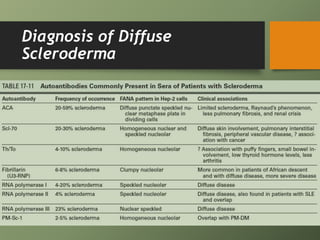
Diagnosis of Diffuse
Scleroderma
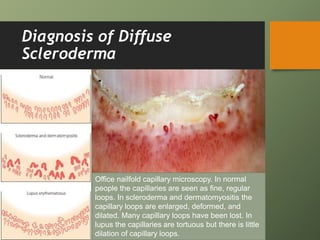
Diagnosis of Diffuse
Scleroderma
Office nailfold capillary microscopy. In normal
people the capillaries are seen as fine, regular
loops. In scleroderma and dermatomyositis the
capillary loops are enlarged, deformed, and
dilated. Many capillary loops have been lost. In
lupus the capillaries are tortuous but there is little
dilation of capillary loops.
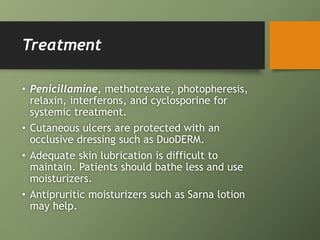
Treatment
• Penicillamine, methotrexate, photopheresis,
relaxin, interferons, and cyclosporine for
systemic treatment.
• Cutaneous ulcers are protected with an
occlusive dressing such as DuoDERM.
• Adequate skin lubrication is difficult to
maintain. Patients should bathe less and use
moisturizers.
• Antipruritic moisturizers such as Sarna lotion
may help.
Morphea (Localized
Scleroderma)
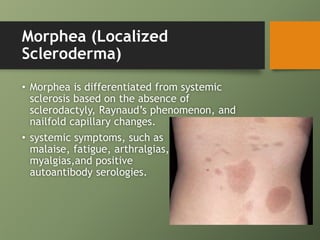
Morphea (Localized
Scleroderma)
• Morphea is differentiated from systemic
sclerosis based on the absence of
sclerodactyly, Raynaud’s phenomenon, and
nailfold capillary changes.
• systemic symptoms, such as
malaise, fatigue, arthralgias, and
myalgias,and positive
autoantibody serologies.
Guttate Morphea
Treatment
• Asymptomatic plaques should probably be left alone
to resolve spontaneously.
• Topical steroids and occlusion may induce slight
improvement.
• Inducing atrophy by infiltrating with triamcinolone
acetonide (10 mg/ml) may be useful in areas where
skin thickening has resulted in discomfort or
limitation of motion.
• Phototherapy (methotrexate with/without
• systemic glucocorticoids)
• Calcipotriene cream (Dovonex) 0.005%
• Tacrolimus 0.1% ointment
Linear Scleroderma
Treatment
Early and continued physical
therapy
Oral MTX
Prednisone
Low-dose UVA1
Psoralen cream plus
ultraviolet A (PUVA)
En Coup de Sabre
Thanks
for your
attention

Scleroderma