Sanjivani Rural Education Society’s
Sanjivani College of Engineering, Kopargaon
(An Autonomous Institute, Affiliated to Savitribai Phule Pune University, Pune)
NAAC ‘A’ Grade Accredited , ISO 9001:2015 certified
Subject: Engineering Mechanics
Unit 1: System of Forces
Presented By,
Miss. Shinde Bharti M. (Assistant Professor)
Department of Structural Engineering
Email- shindebharticivil@sanjivani.org.in
1
2
Contents:
Basic concepts, resolution of force, parallel and
non-concurrent force system, moment of force,
couple, Varignon’s theorem, resultant of
concurrent and non-concurrent forces..
3 Important terms-
• Particle- A body of negligible dimensions but containing definite
number of matter.
• Rigid Body- The body in which the particle does not change their
relative position under the action of any force.
• Scalar Quantities- Quantities which has magnitude only.
(eg. Length, mass, time)
• Vector Quantities- Quantities which has magnitude and direction
both (eg. Force, velocity, acceleration)
• Fundamental Units- It does not depends on other quantities.
• Derived Units- It depends on other quantities.
4
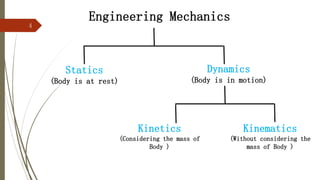
Engineering Mechanics
Dynamics
(Body is in motion)
Statics
(Body is at rest)
Kinetics
(Considering the mass of
Body )
Kinematics
(Without considering the
mass of Body )
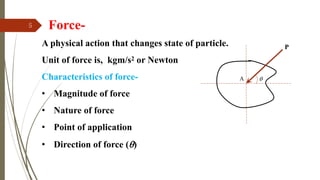
5 Force-
A physical action that changes state of particle.
Unit of force is, kgm/s2 or Newton
Characteristics of force-
• Magnitude of force
• Nature of force
• Point of application
• Direction of force ()

A
P
6
6
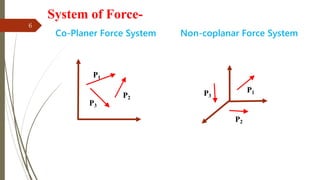
System of Force-
Co-Planer Force System Non-coplanar Force System
P1
P2
P3
P1
P2
P3
7
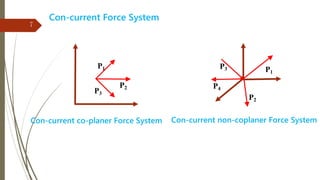
Con-current Force System
P1
P2
P3
P1
P2
P3
P4
Con-current co-planer Force System Con-current non-coplaner Force System
8
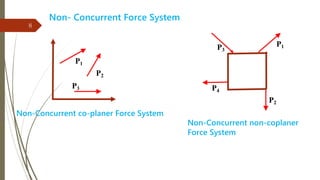
Non- Concurrent Force System
P1
P2
P3
Non-Concurrent co-planer Force System
Non-Concurrent non-coplaner
Force System
P1
P2
P3
P4
9
9
9
9
9
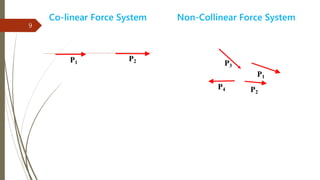
Co-linear Force System Non-Collinear Force System
P1
P2
P3
P4
P1
P2
10
10
10
10
10
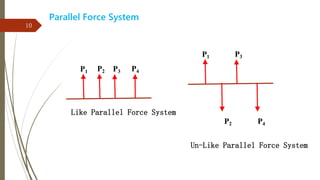
Parallel Force System
P1 P4
P2 P3
P1
P4
P2
P3
Like Parallel Force System
Un-Like Parallel Force System
11
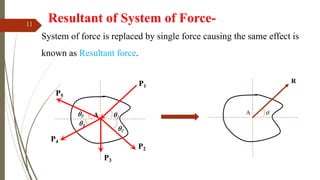
Resultant of System of Force-
System of force is replaced by single force causing the same effect is
known as Resultant force.

A
R
4
1
A
P1
P5
P4
P2
P3
2
5
12
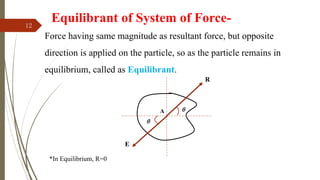
Equilibrant of System of Force-
Force having same magnitude as resultant force, but opposite
direction is applied on the particle, so as the particle remains in
equilibrium, called as Equilibrant.

A
R
E

*In Equilibrium, R=0
13
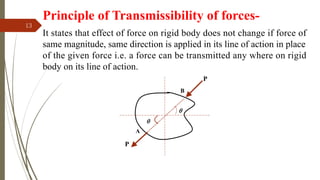
Principle of Transmissibility of forces-
It states that effect of force on rigid body does not change if force of
same magnitude, same direction is applied in its line of action in place
of the given force i.e. a force can be transmitted any where on rigid
body on its line of action.

A
P
P

B
14
Methods to find Resultant of System of Force-
• Triangle Law
• Parallelogram Law
• Polygon Law
• Resolution and Composition
15

System of forces.pdf

  • 1.
    Sanjivani Rural EducationSociety’s Sanjivani College of Engineering, Kopargaon (An Autonomous Institute, Affiliated to Savitribai Phule Pune University, Pune) NAAC ‘A’ Grade Accredited , ISO 9001:2015 certified Subject: Engineering Mechanics Unit 1: System of Forces Presented By, Miss. Shinde Bharti M. (Assistant Professor) Department of Structural Engineering Email- shindebharticivil@sanjivani.org.in 1
  • 2.
    2 Contents: Basic concepts, resolutionof force, parallel and non-concurrent force system, moment of force, couple, Varignon’s theorem, resultant of concurrent and non-concurrent forces..
  • 3.
    3 Important terms- •Particle- A body of negligible dimensions but containing definite number of matter. • Rigid Body- The body in which the particle does not change their relative position under the action of any force. • Scalar Quantities- Quantities which has magnitude only. (eg. Length, mass, time) • Vector Quantities- Quantities which has magnitude and direction both (eg. Force, velocity, acceleration) • Fundamental Units- It does not depends on other quantities. • Derived Units- It depends on other quantities.
  • 4.
    4 Engineering Mechanics Dynamics (Body isin motion) Statics (Body is at rest) Kinetics (Considering the mass of Body ) Kinematics (Without considering the mass of Body )
  • 5.
    5 Force- A physicalaction that changes state of particle. Unit of force is, kgm/s2 or Newton Characteristics of force- • Magnitude of force • Nature of force • Point of application • Direction of force ()  A P
  • 6.
    6 6 System of Force- Co-PlanerForce System Non-coplanar Force System P1 P2 P3 P1 P2 P3
  • 7.
    7 Con-current Force System P1 P2 P3 P1 P2 P3 P4 Con-currentco-planer Force System Con-current non-coplaner Force System
  • 8.
    8 Non- Concurrent ForceSystem P1 P2 P3 Non-Concurrent co-planer Force System Non-Concurrent non-coplaner Force System P1 P2 P3 P4
  • 9.
    9 9 9 9 9 Co-linear Force SystemNon-Collinear Force System P1 P2 P3 P4 P1 P2
  • 10.
    10 10 10 10 10 Parallel Force System P1P4 P2 P3 P1 P4 P2 P3 Like Parallel Force System Un-Like Parallel Force System
  • 11.
    11 Resultant of Systemof Force- System of force is replaced by single force causing the same effect is known as Resultant force.  A R 4 1 A P1 P5 P4 P2 P3 2 5
  • 12.
    12 Equilibrant of Systemof Force- Force having same magnitude as resultant force, but opposite direction is applied on the particle, so as the particle remains in equilibrium, called as Equilibrant.  A R E  *In Equilibrium, R=0
  • 13.
    13 Principle of Transmissibilityof forces- It states that effect of force on rigid body does not change if force of same magnitude, same direction is applied in its line of action in place of the given force i.e. a force can be transmitted any where on rigid body on its line of action.  A P P  B
  • 14.
    14 Methods to findResultant of System of Force- • Triangle Law • Parallelogram Law • Polygon Law • Resolution and Composition
  • 15.