Sanjivani Rural Education Society’s
Sanjivani College of Engineering, Kopargaon
(An Autonomous Institute, Affiliated to Savitribai Phule Pune University, Pune)
NAAC ‘A’ Grade Accredited , ISO 9001:2015 certified
Subject: Structural Audit and Health Monitoring
FY Mtech
Introduction
Presented By,
Miss. Shinde Bharti M. (Assistant Professor)
Department of Civil Engineering
Email- shindebharticivil@sanjivani.org.in
1
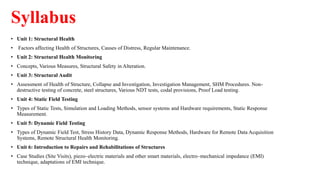
Syllabus
• Unit 1: Structural Health
• Factors affecting Health of Structures, Causes of Distress, Regular Maintenance.
• Unit 2: Structural Health Monitoring
• Concepts, Various Measures, Structural Safety in Alteration.
• Unit 3: Structural Audit
• Assessment of Health of Structure, Collapse and Investigation, Investigation Management, SHM Procedures. Non-
destructive testing of concrete, steel structures, Various NDT tests, codal provisions, Proof Load testing.
• Unit 4: Static Field Testing
• Types of Static Tests, Simulation and Loading Methods, sensor systems and Hardware requirements, Static Response
Measurement.
• Unit 5: Dynamic Field Testing
• Types of Dynamic Field Test, Stress History Data, Dynamic Response Methods, Hardware for Remote Data Acquisition
Systems, Remote Structural Health Monitoring.
• Unit 6: Introduction to Repairs and Rehabilitations of Structures
• Case Studies (Site Visits), piezo–electric materials and other smart materials, electro–mechanical impedance (EMI)
technique, adaptations of EMI technique.
Unit 3: Structural Audit
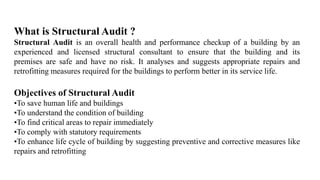
What is Structural Audit ?
Structural Audit is an overall health and performance checkup of a building by an
experienced and licensed structural consultant to ensure that the building and its
premises are safe and have no risk. It analyses and suggests appropriate repairs and
retrofitting measures required for the buildings to perform better in its service life.
Objectives of Structural Audit
•To save human life and buildings
•To understand the condition of building
•To find critical areas to repair immediately
•To comply with statutory requirements
•To enhance life cycle of building by suggesting preventive and corrective measures like
repairs and retrofitting
Types of Audit
•Statutory audit
•Structural audit
•Safety audit
•Budgetary audit
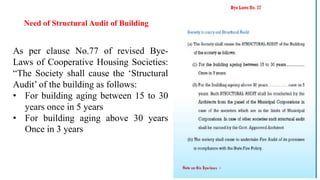
Need of Structural Audit of Building
As per clause No.77 of revised Bye-
Laws of Cooperative Housing Societies:
“The Society shall cause the ‘Structural
Audit’ of the building as follows:
• For building aging between 15 to 30
years once in 5 years
• For building aging above 30 years
Once in 3 years
Stages in Carrying Out Structural Audit
1. Study of architectural and structural drawings, design criteria, design
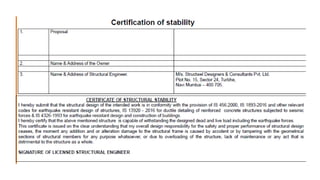
calculations, structural stability certificate of existing structures
2. If architectural and structural drawings are not available, as built
drawings can be prepared by an engineer
3. Visual Inspection
Need of visual inspection
• to recognize the types of structural defects
• to identify any signs of material deterioration
• to identify any signs of structural distress and deformation
• to identify any alteration and addition in the structure, misuse
which may result in overloading
Scope of visual inspection
• General information of the building
• Structural System of the building
• Addition or Alteration in the building
• Dampness and Leakages

Structural Audit- Basic Fundamentals and types

  • 1.
    Sanjivani Rural EducationSociety’s Sanjivani College of Engineering, Kopargaon (An Autonomous Institute, Affiliated to Savitribai Phule Pune University, Pune) NAAC ‘A’ Grade Accredited , ISO 9001:2015 certified Subject: Structural Audit and Health Monitoring FY Mtech Introduction Presented By, Miss. Shinde Bharti M. (Assistant Professor) Department of Civil Engineering Email- shindebharticivil@sanjivani.org.in 1
  • 2.
    Syllabus • Unit 1:Structural Health • Factors affecting Health of Structures, Causes of Distress, Regular Maintenance. • Unit 2: Structural Health Monitoring • Concepts, Various Measures, Structural Safety in Alteration. • Unit 3: Structural Audit • Assessment of Health of Structure, Collapse and Investigation, Investigation Management, SHM Procedures. Non- destructive testing of concrete, steel structures, Various NDT tests, codal provisions, Proof Load testing. • Unit 4: Static Field Testing • Types of Static Tests, Simulation and Loading Methods, sensor systems and Hardware requirements, Static Response Measurement. • Unit 5: Dynamic Field Testing • Types of Dynamic Field Test, Stress History Data, Dynamic Response Methods, Hardware for Remote Data Acquisition Systems, Remote Structural Health Monitoring. • Unit 6: Introduction to Repairs and Rehabilitations of Structures • Case Studies (Site Visits), piezo–electric materials and other smart materials, electro–mechanical impedance (EMI) technique, adaptations of EMI technique.
  • 3.
  • 4.
    What is StructuralAudit ? Structural Audit is an overall health and performance checkup of a building by an experienced and licensed structural consultant to ensure that the building and its premises are safe and have no risk. It analyses and suggests appropriate repairs and retrofitting measures required for the buildings to perform better in its service life. Objectives of Structural Audit •To save human life and buildings •To understand the condition of building •To find critical areas to repair immediately •To comply with statutory requirements •To enhance life cycle of building by suggesting preventive and corrective measures like repairs and retrofitting
  • 5.
    Types of Audit •Statutoryaudit •Structural audit •Safety audit •Budgetary audit
  • 6.
    Need of StructuralAudit of Building As per clause No.77 of revised Bye- Laws of Cooperative Housing Societies: “The Society shall cause the ‘Structural Audit’ of the building as follows: • For building aging between 15 to 30 years once in 5 years • For building aging above 30 years Once in 3 years
  • 9.
    Stages in CarryingOut Structural Audit 1. Study of architectural and structural drawings, design criteria, design calculations, structural stability certificate of existing structures 2. If architectural and structural drawings are not available, as built drawings can be prepared by an engineer 3. Visual Inspection
  • 10.
    Need of visualinspection • to recognize the types of structural defects • to identify any signs of material deterioration • to identify any signs of structural distress and deformation • to identify any alteration and addition in the structure, misuse which may result in overloading
  • 11.
    Scope of visualinspection • General information of the building • Structural System of the building • Addition or Alteration in the building • Dampness and Leakages