Prof. Samirsinh P. Parmar
samirddu@gmail.com, spp.cl@ddu.ac.in
Asst. Prof. Dept. of Civil Engineering
Dharmasinh Desai University, Nadiad, Gujarat, India
Lecture-0
CL- ENGG. MECHANICS, DOCL- SPP, DDU, NADIAD 1
Content of the presentation
General Introduction to Engineering Mechanics
SI System of Units
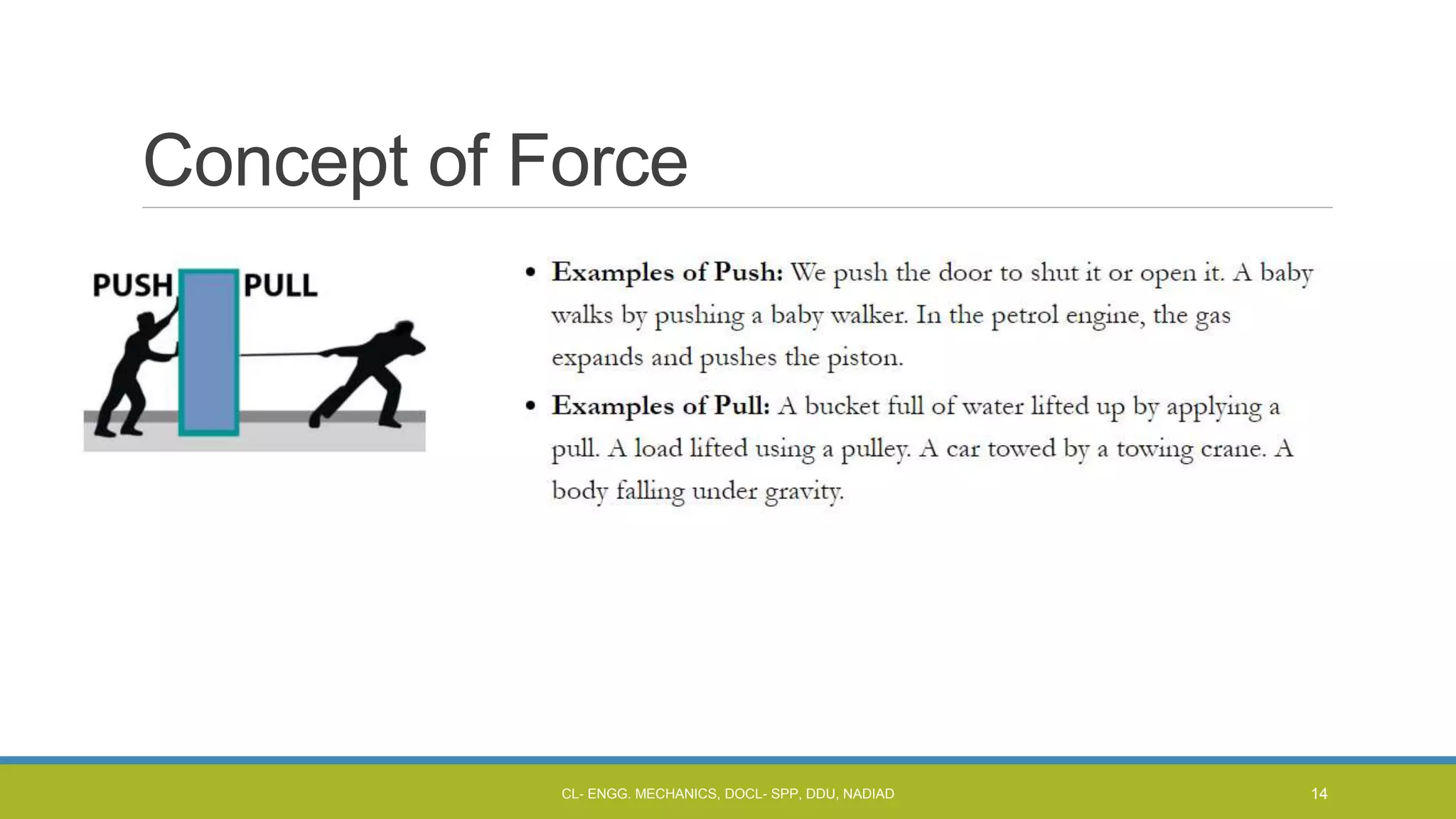
Concept of Force
System of forces
Idealization in Mechanics
Fundamental Concepts
Scaler and Vector Quantities
Accuracy in Calculation
Problem Solving Approach
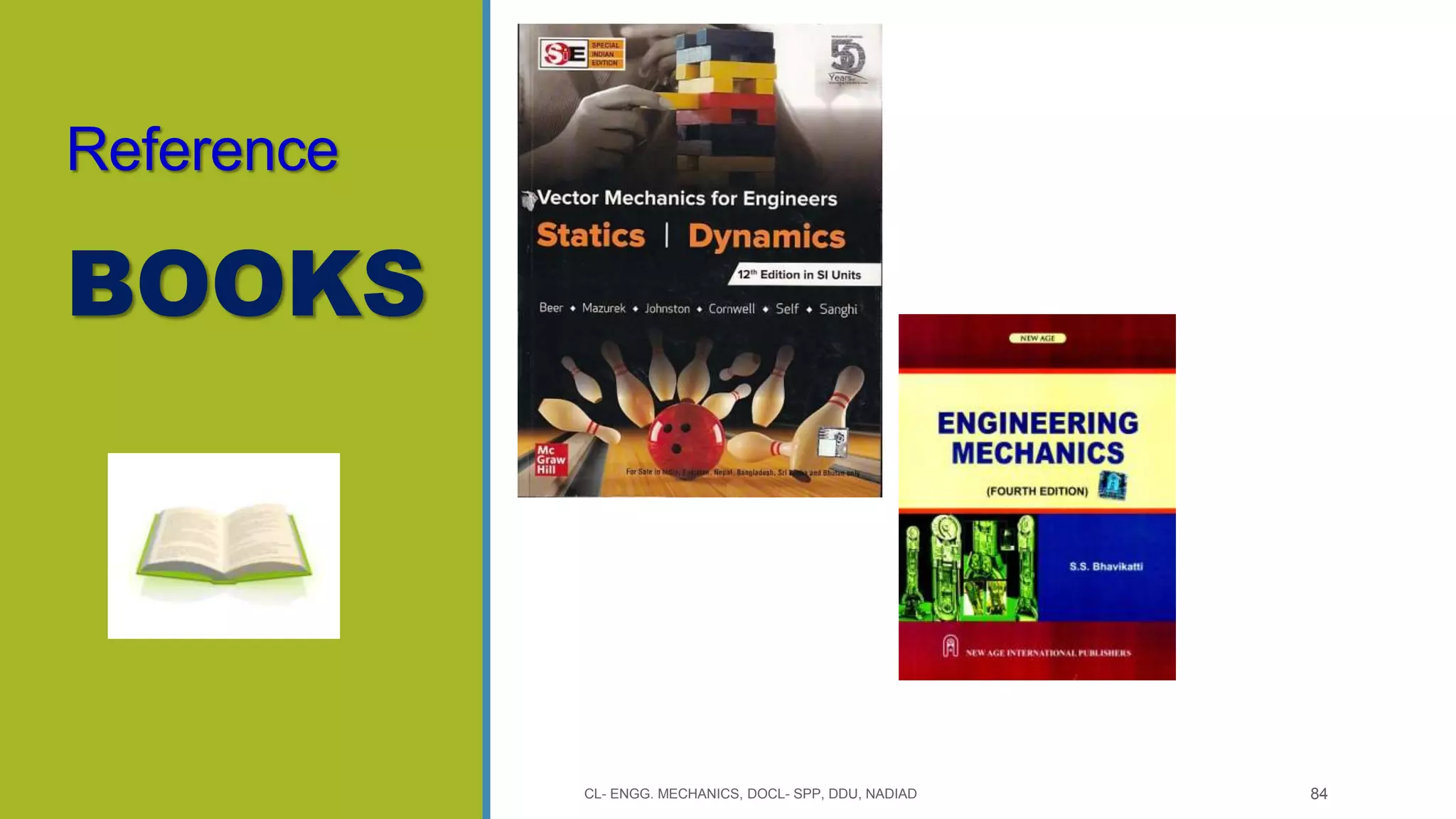
Reference BOOKS:
CL- ENGG. MECHANICS, DOCL- SPP, DDU, NADIAD 2
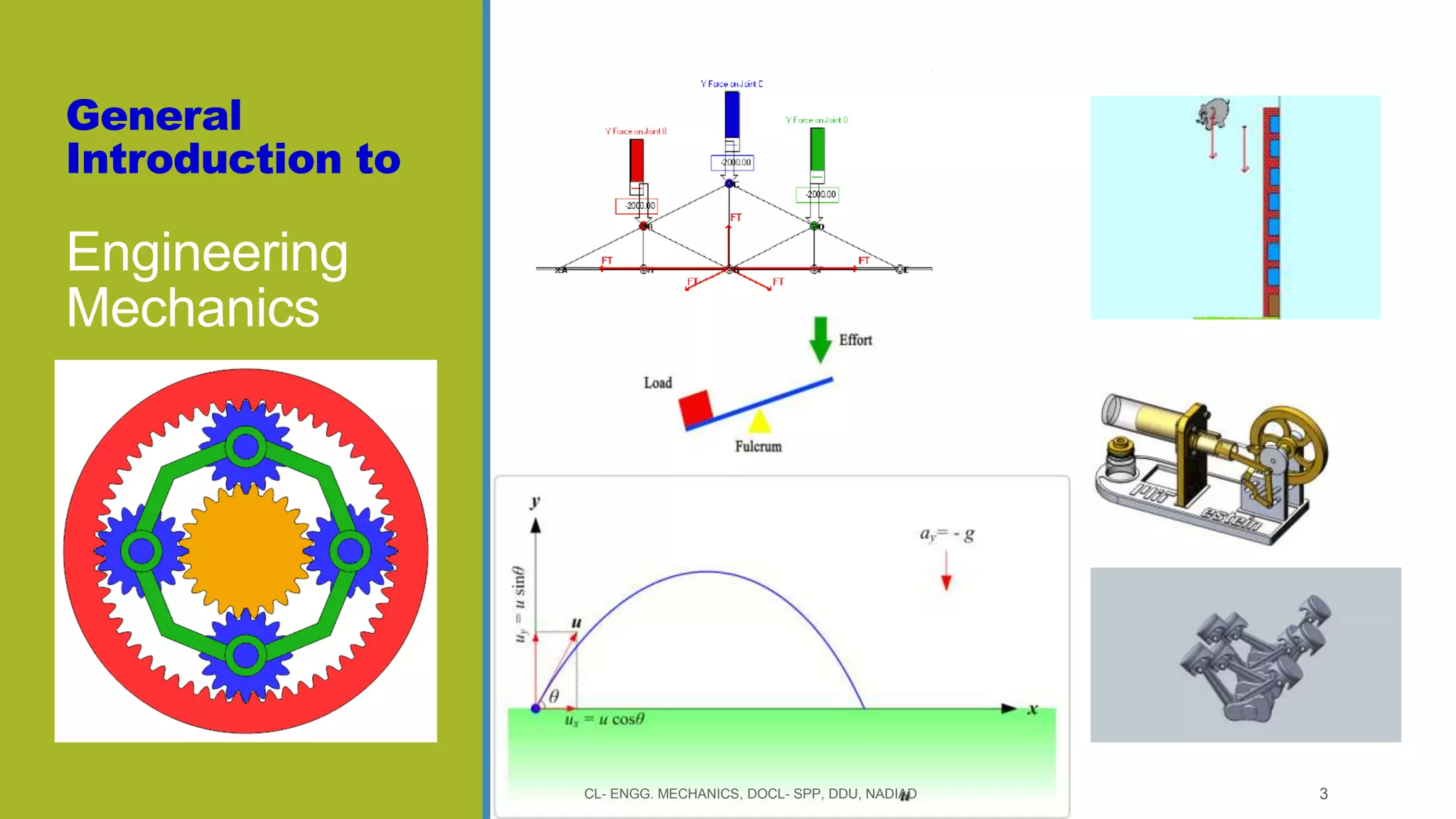
General
Introduction to
Engineering
Mechanics
CL- ENGG. MECHANICS, DOCL- SPP, DDU, NADIAD 3
Engineering Mechanics
CL- ENGG. MECHANICS, DOCL- SPP, DDU, NADIAD 4
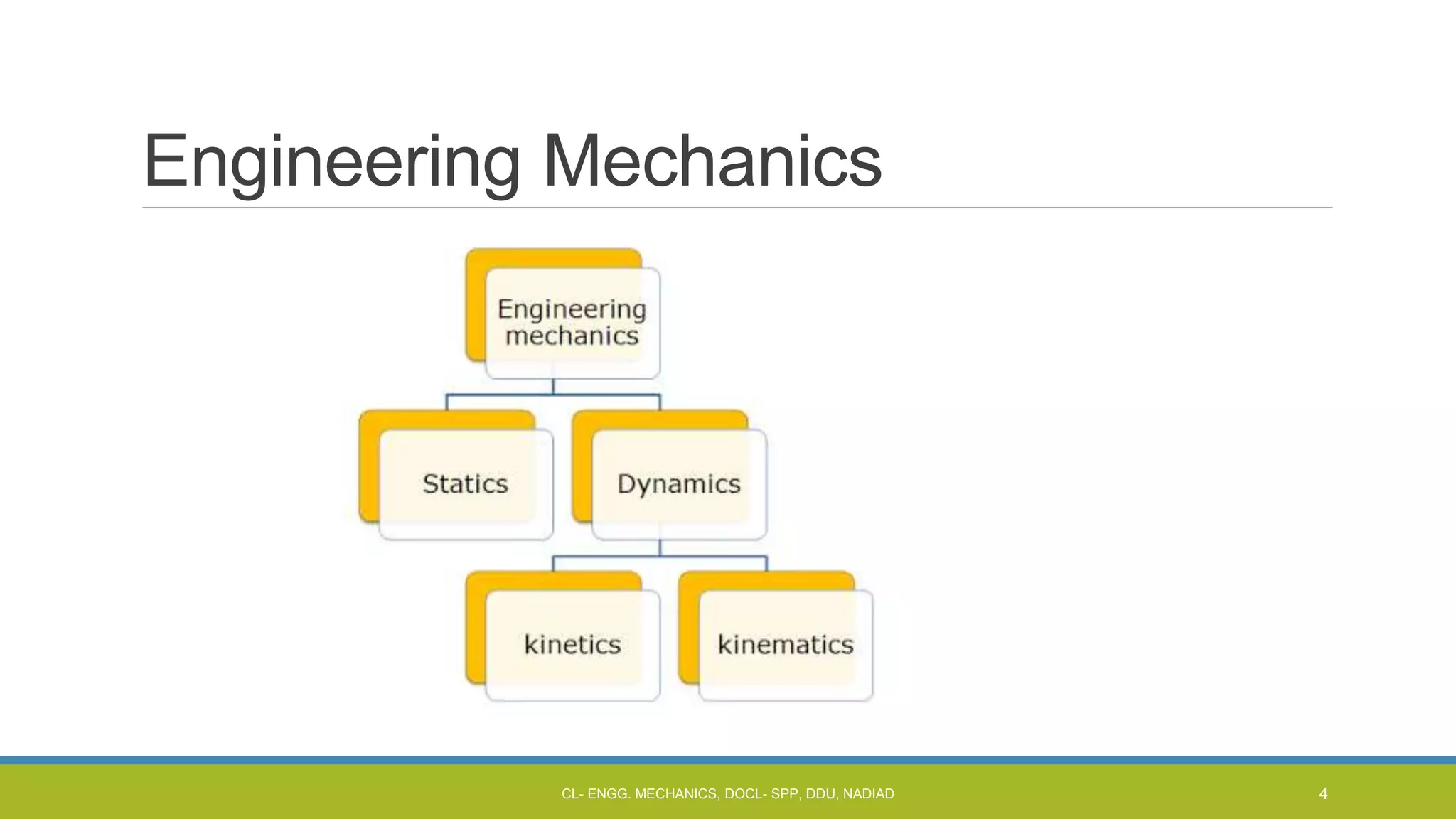
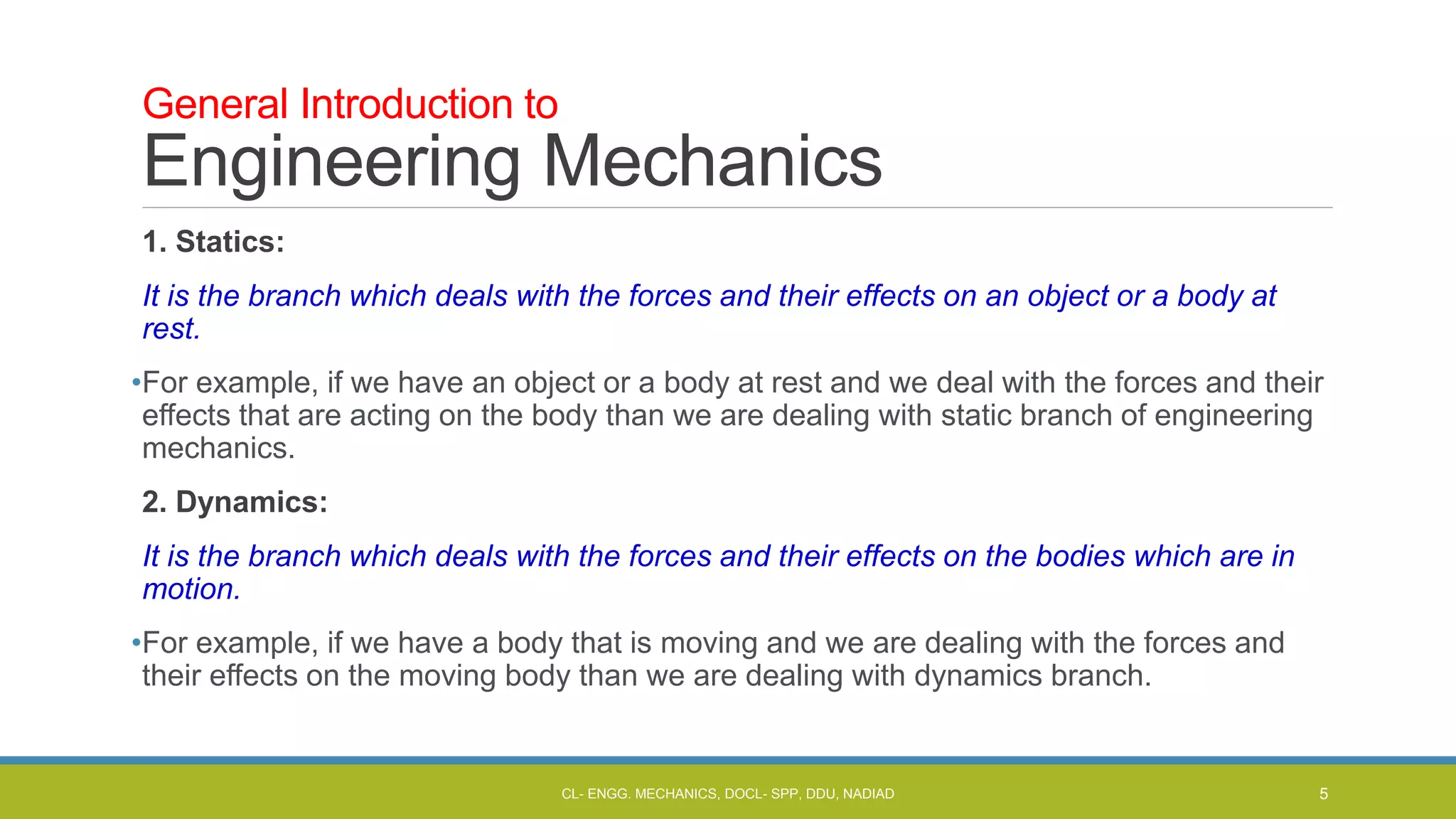
1. Statics:
It is the branch which deals with the forces and their effects on an object or a body at
rest.
•For example, if we have an object or a body at rest and we deal with the forces and their
effects that are acting on the body than we are dealing with static branch of engineering
mechanics.
2. Dynamics:
It is the branch which deals with the forces and their effects on the bodies which are in
motion.
•For example, if we have a body that is moving and we are dealing with the forces and
their effects on the moving body than we are dealing with dynamics branch.
General Introduction to
Engineering Mechanics
CL- ENGG. MECHANICS, DOCL- SPP, DDU, NADIAD 5
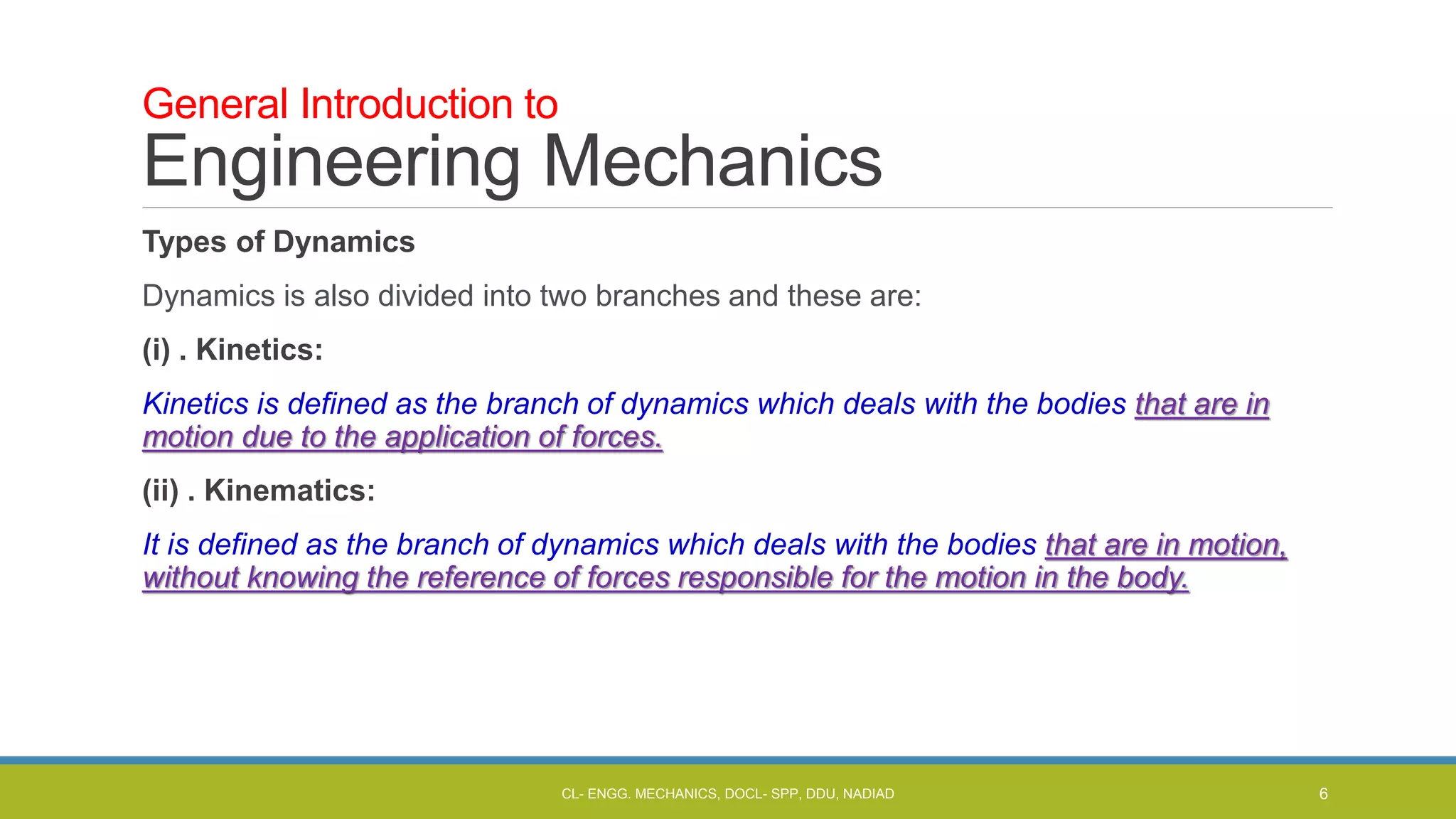
Types of Dynamics
Dynamics is also divided into two branches and these are:
(i) . Kinetics:
Kinetics is defined as the branch of dynamics which deals with the bodies that are in
motion due to the application of forces.
(ii) . Kinematics:
It is defined as the branch of dynamics which deals with the bodies that are in motion,
without knowing the reference of forces responsible for the motion in the body.
General Introduction to
Engineering Mechanics
CL- ENGG. MECHANICS, DOCL- SPP, DDU, NADIAD 6
SI
System of
units
CL- ENGG. MECHANICS, DOCL- SPP, DDU, NADIAD 7
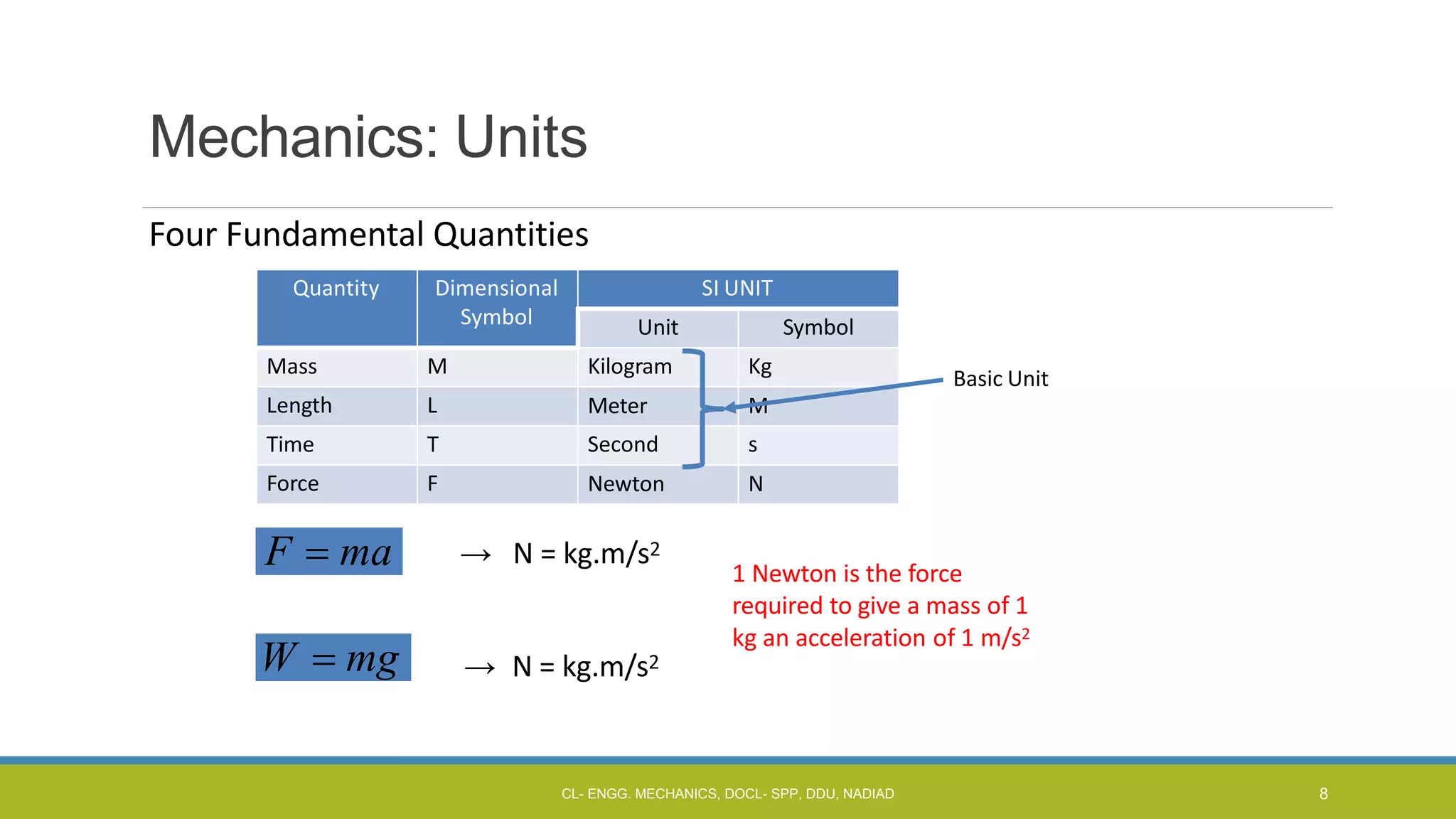
Mechanics: Units
W  mg
F  ma
Four Fundamental Quantities
→ N = kg.m/s2
→ N = kg.m/s2
1 Newton is the force
required to give a mass of 1
kg an acceleration of 1 m/s2
Quantity Dimensional SI UNIT
Symbol Unit Symbol
Mass M
Length L
Kilogram Kg
Meter M
Time T
Force F
Second s
Newton N
Basic Unit
CL- ENGG. MECHANICS, DOCL- SPP, DDU, NADIAD 8
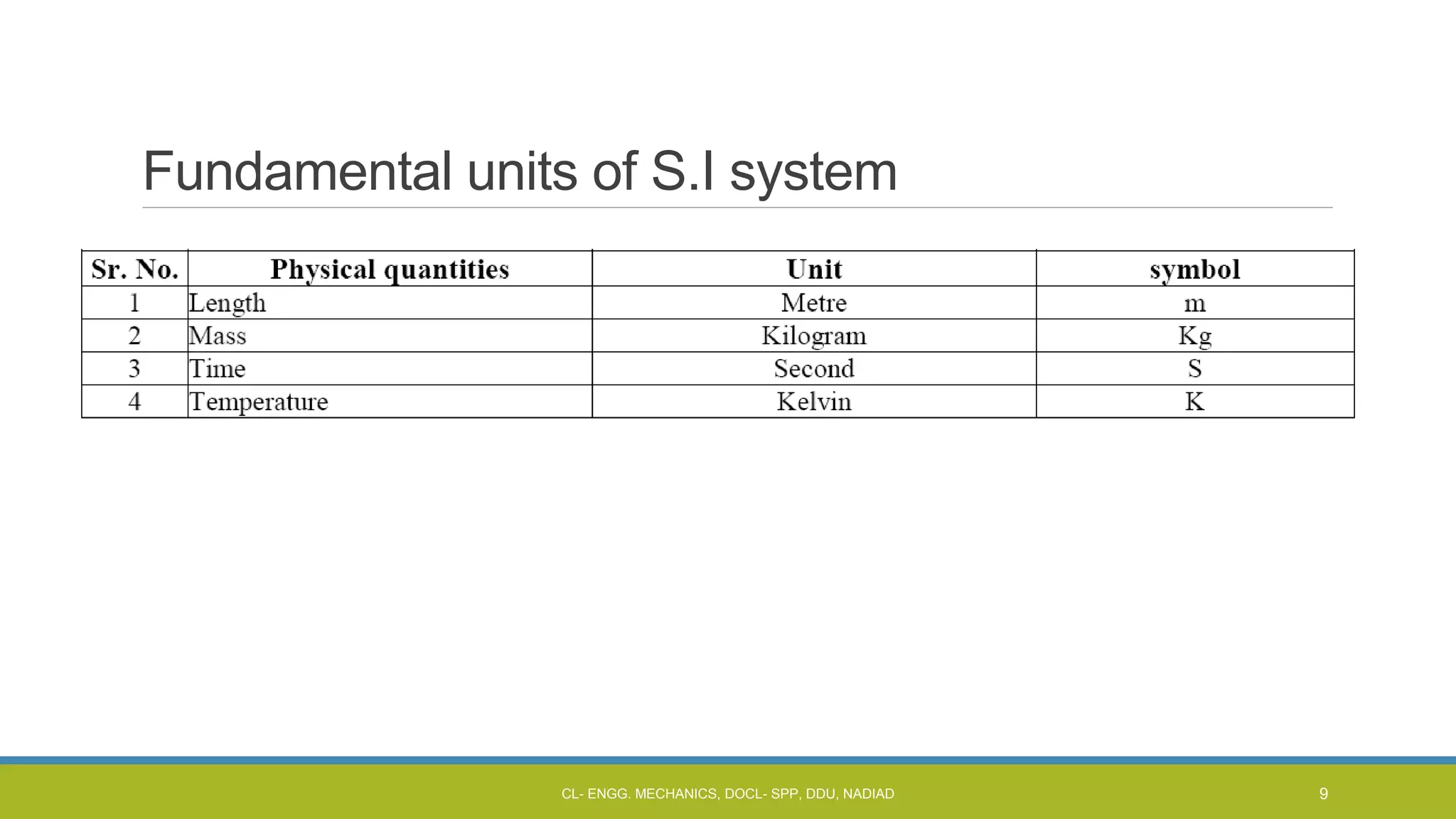
Fundamental units of S.I system
CL- ENGG. MECHANICS, DOCL- SPP, DDU, NADIAD 9
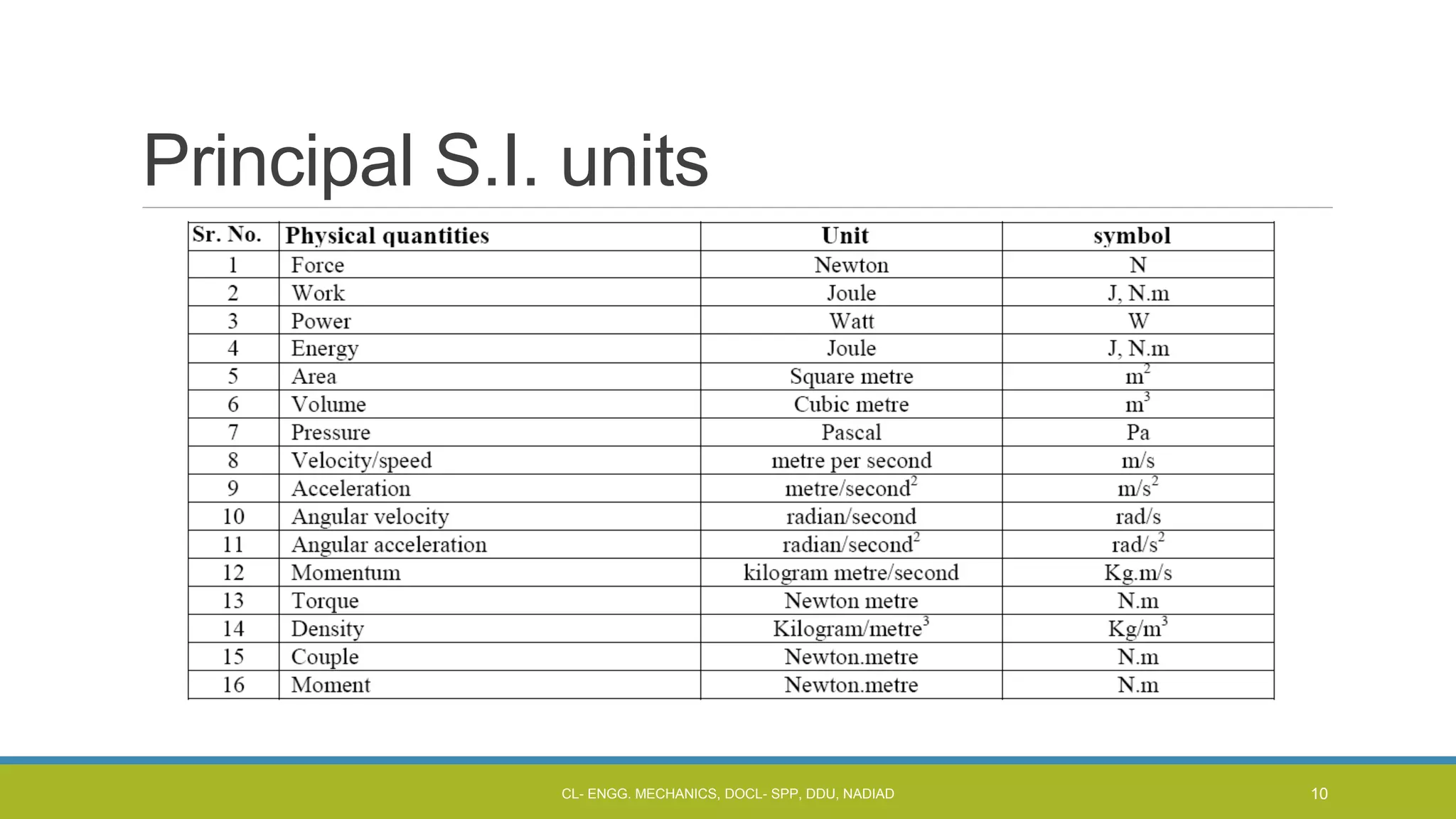
Principal S.I. units
CL- ENGG. MECHANICS, DOCL- SPP, DDU, NADIAD 10
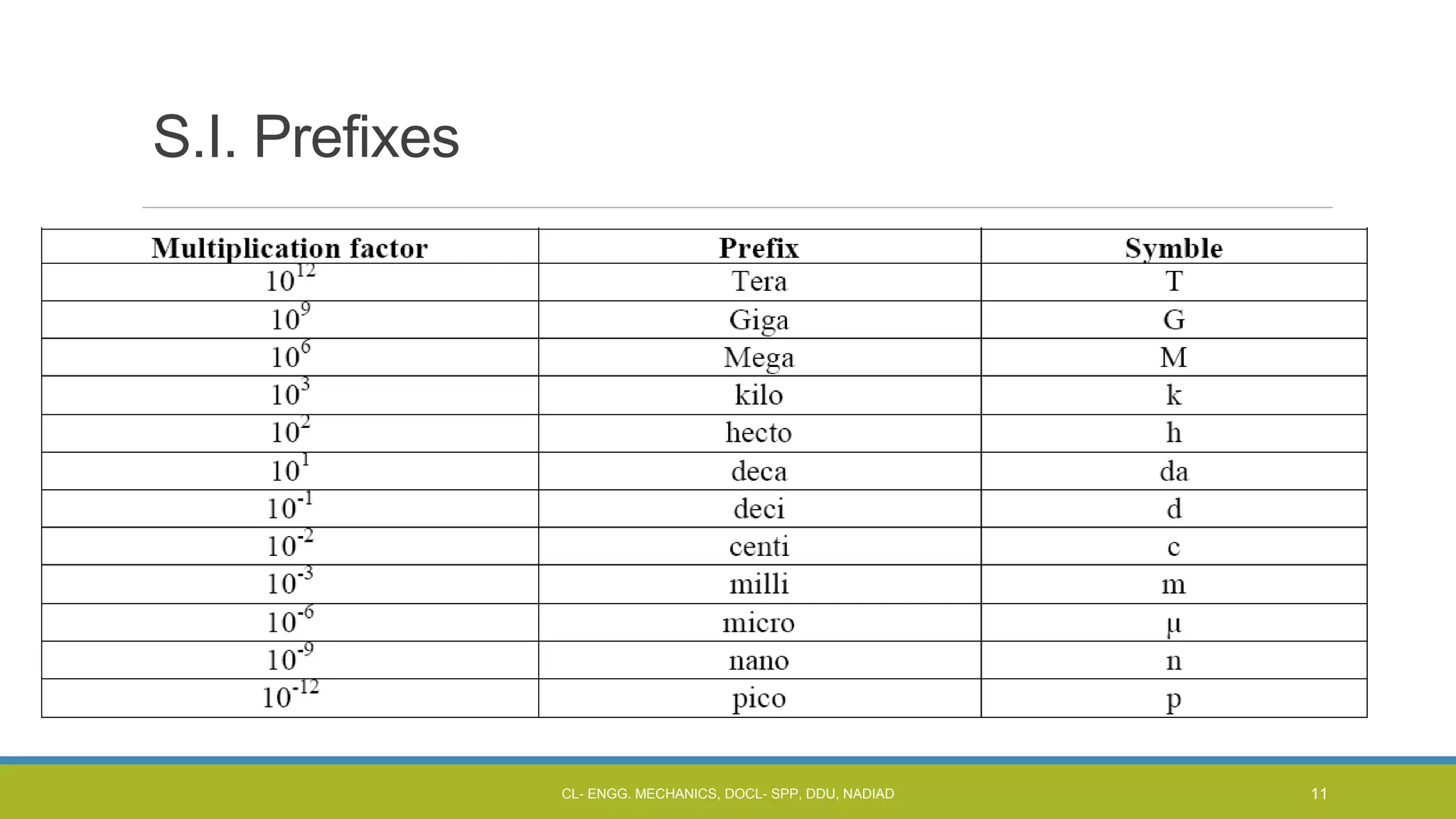
S.I. Prefixes
CL- ENGG. MECHANICS, DOCL- SPP, DDU, NADIAD 11
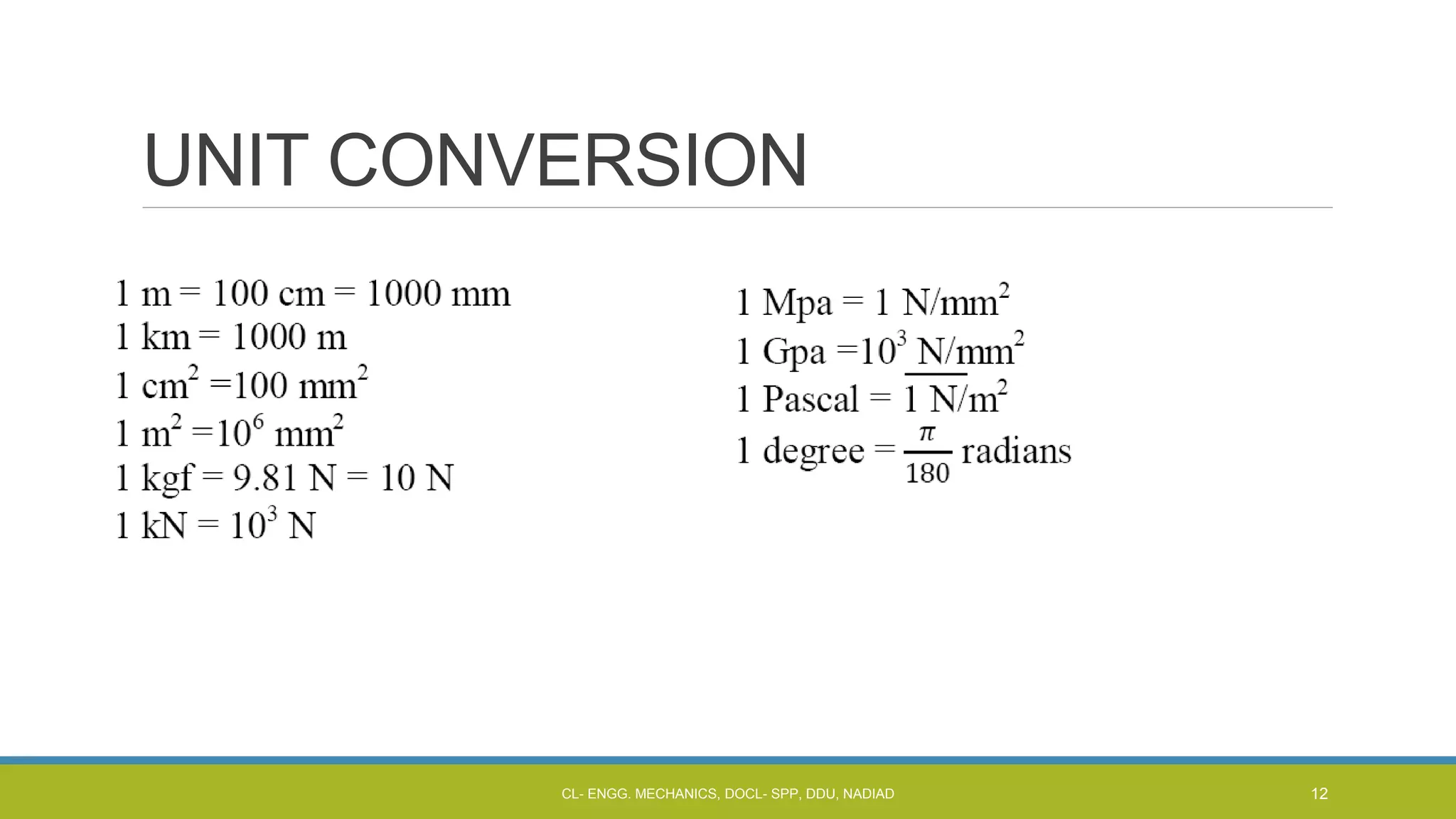
UNIT CONVERSION
CL- ENGG. MECHANICS, DOCL- SPP, DDU, NADIAD 12
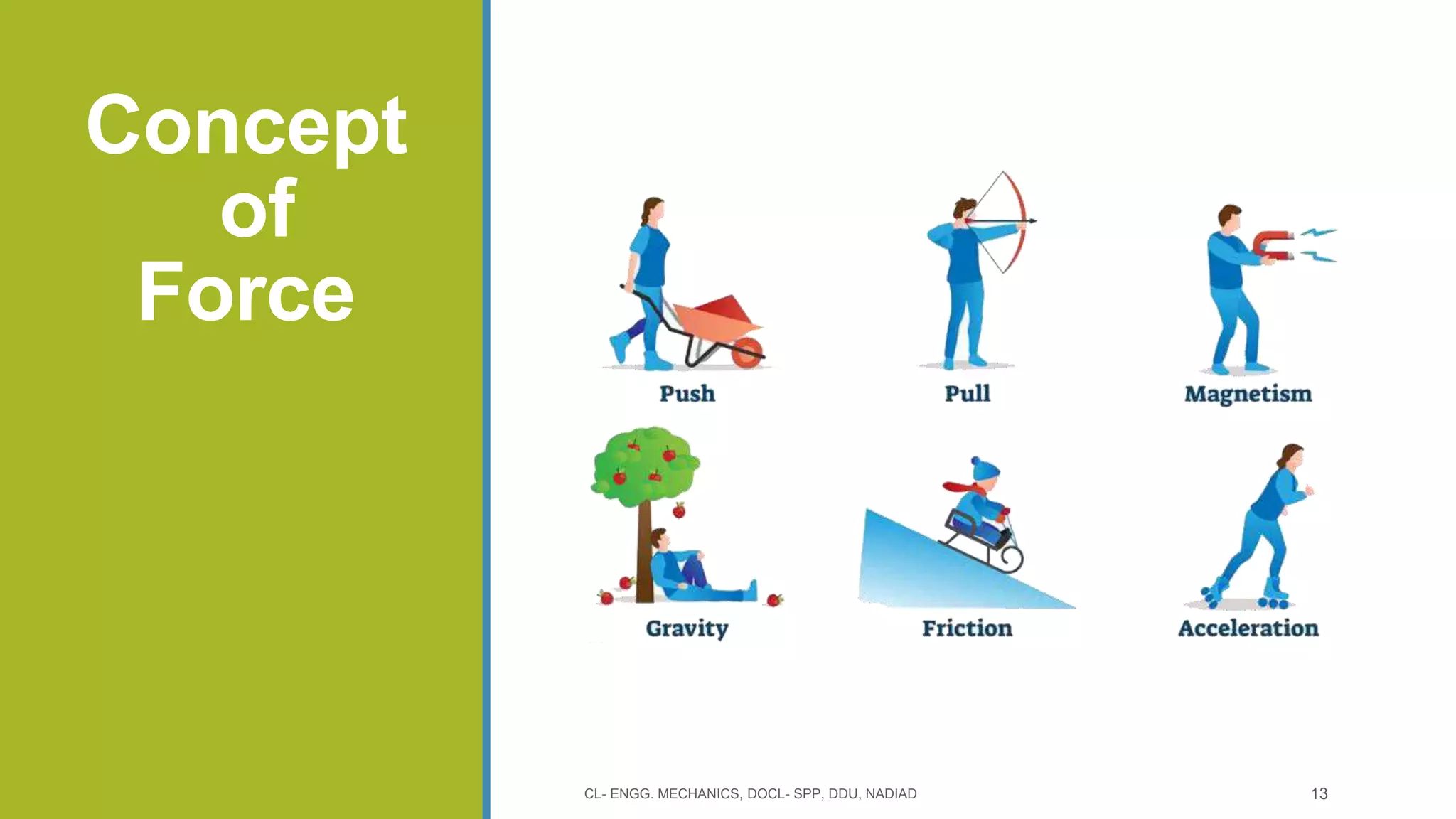
Concept
of
Force
CL- ENGG. MECHANICS, DOCL- SPP, DDU, NADIAD 13
Concept of Force
CL- ENGG. MECHANICS, DOCL- SPP, DDU, NADIAD 14
The necessity of force:
To move a stationary object i.e. to move a body which is at rest.
To change the direction of the motion of an object
To change the magnitude of the velocity (speed) of the motion of an object
To change the shape of an object.
CL- ENGG. MECHANICS, DOCL- SPP, DDU, NADIAD 15
Effects of force
It may set a body into motion
It may bring a body to rest.
It may change the magnitude of motion
It may change the direction of motion
It may change the magnitude and direction of motion
It may change the shape of an object
CL- ENGG. MECHANICS, DOCL- SPP, DDU, NADIAD 16
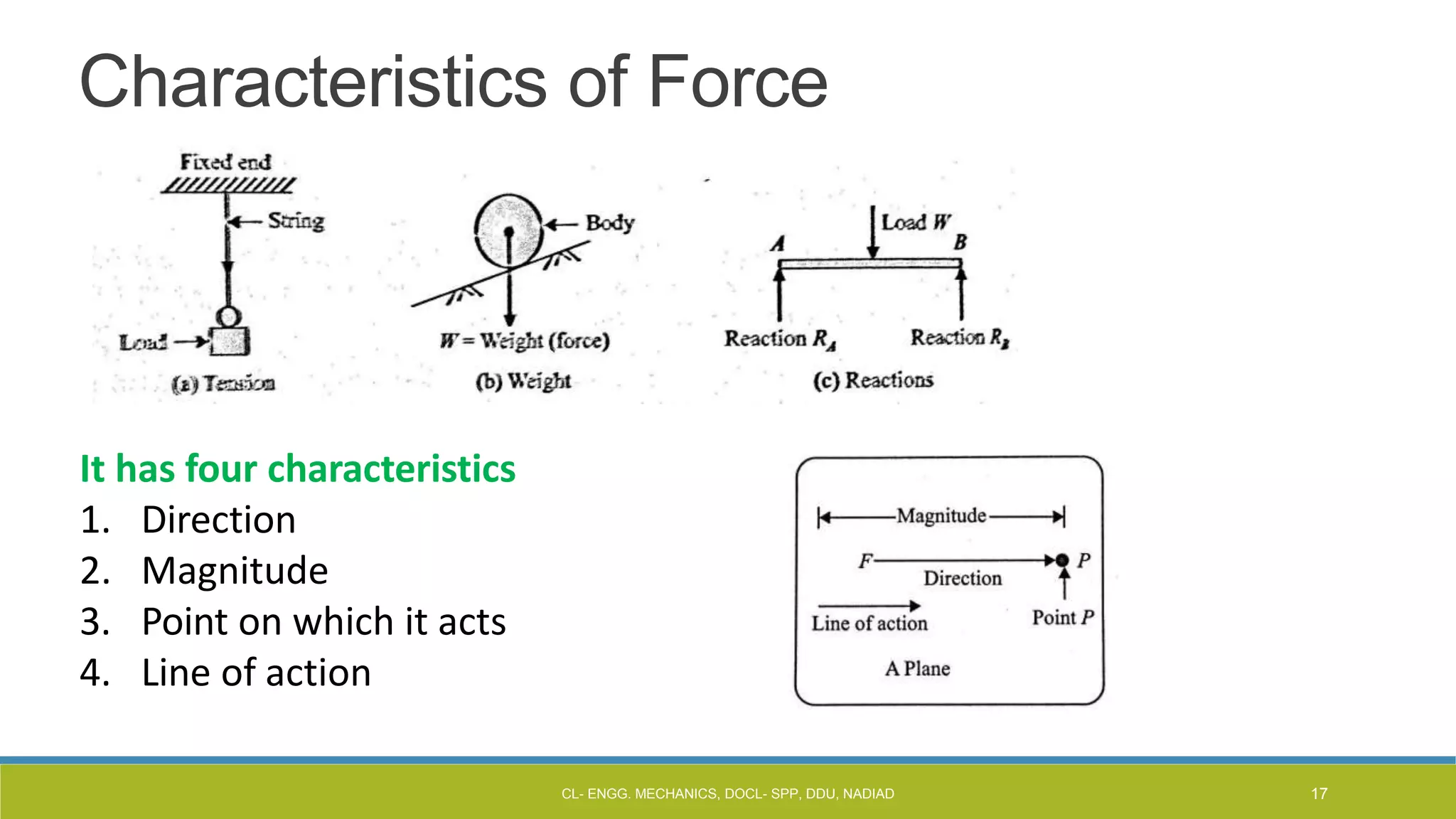
Characteristics of Force
It has four characteristics
1. Direction
2. Magnitude
3. Point on which it acts
4. Line of action
CL- ENGG. MECHANICS, DOCL- SPP, DDU, NADIAD 17
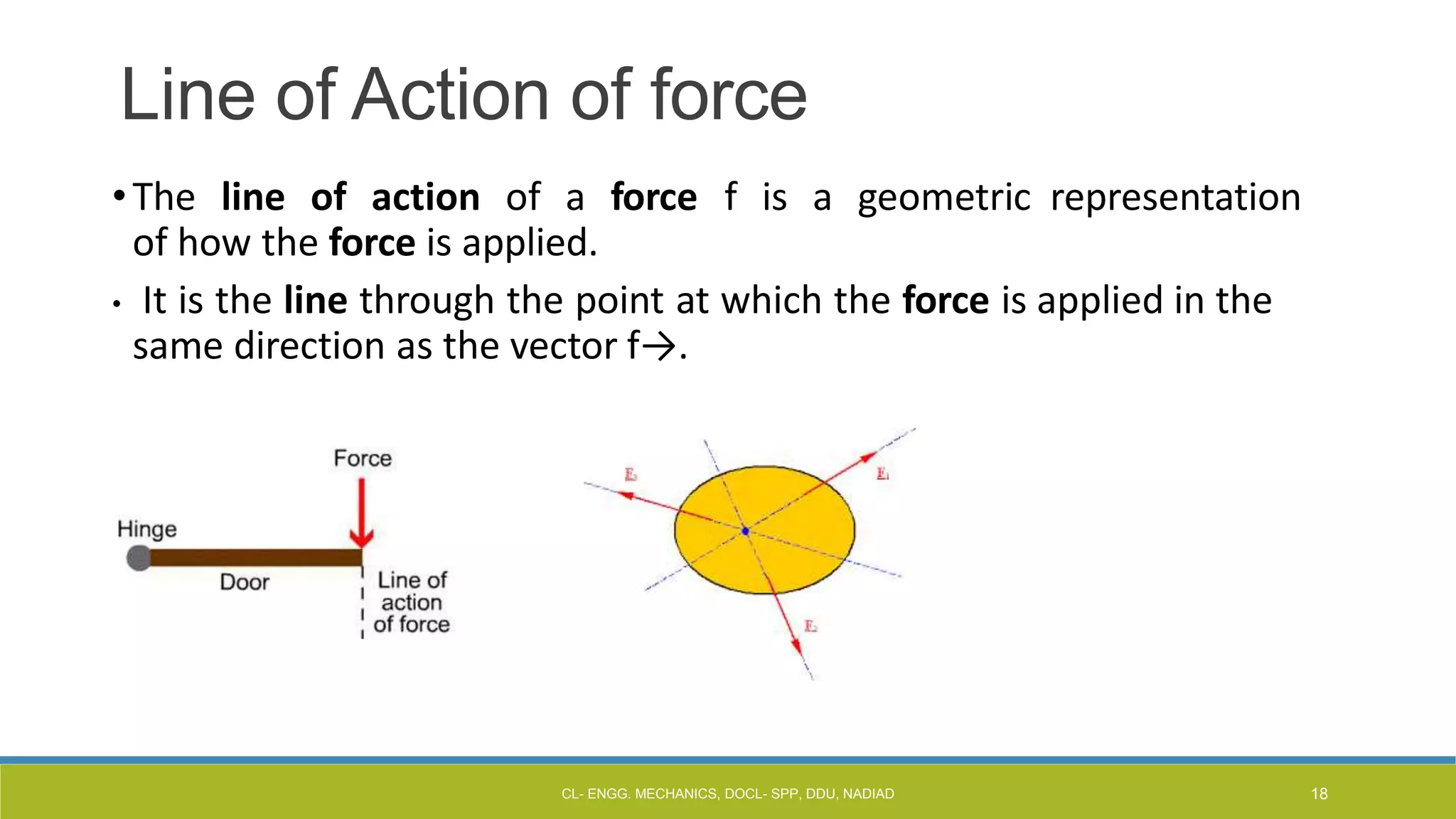
Line of Action of force
•The line of action of a force f is a geometric representation
of how the force is applied.
• It is the line through the point at which the force is applied in the
same direction as the vector f→.
CL- ENGG. MECHANICS, DOCL- SPP, DDU, NADIAD 18
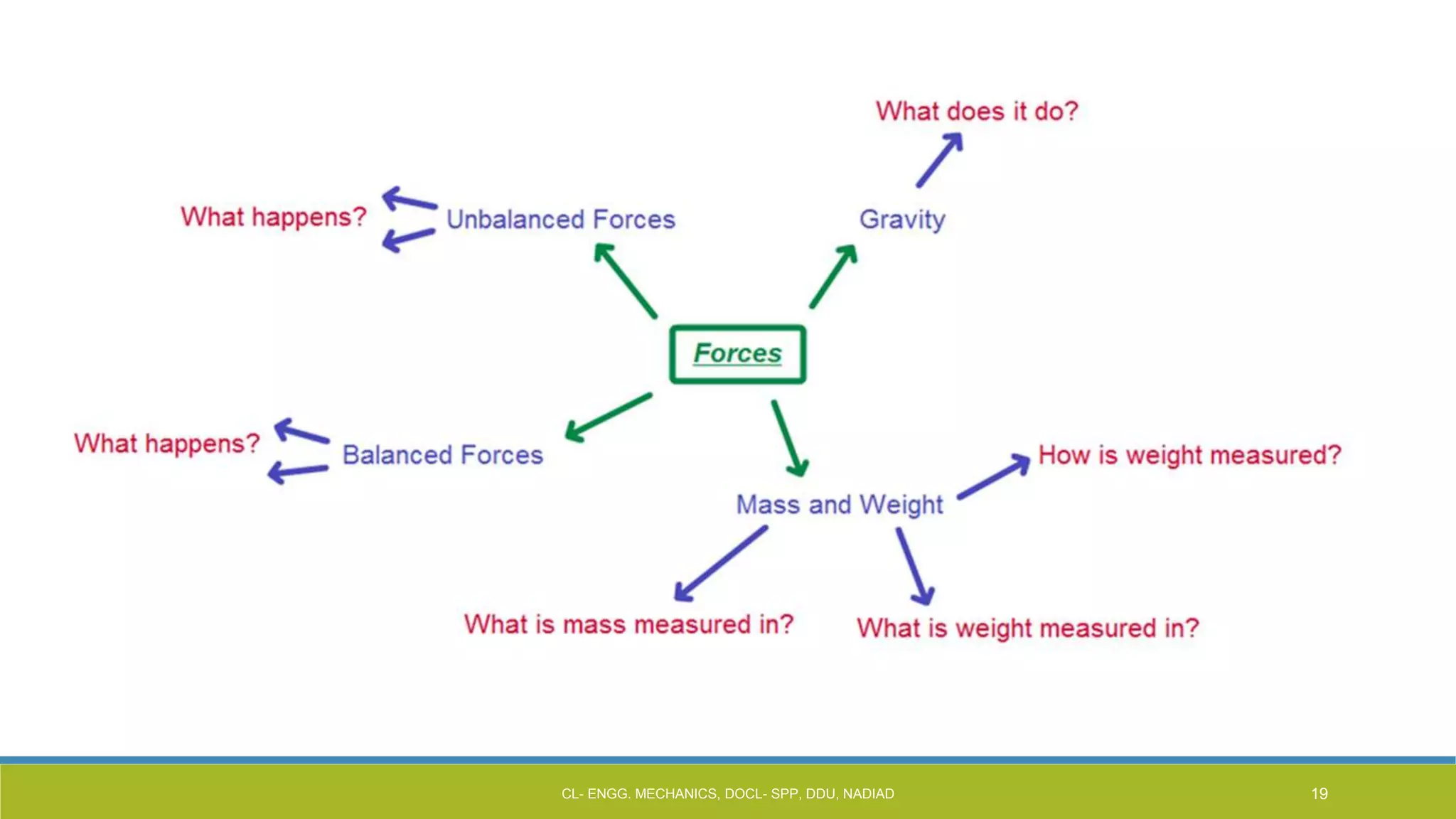
CL- ENGG. MECHANICS, DOCL- SPP, DDU, NADIAD 19
System of
Forces
When two are or more forces acts act on a body,
they are called system of forces.
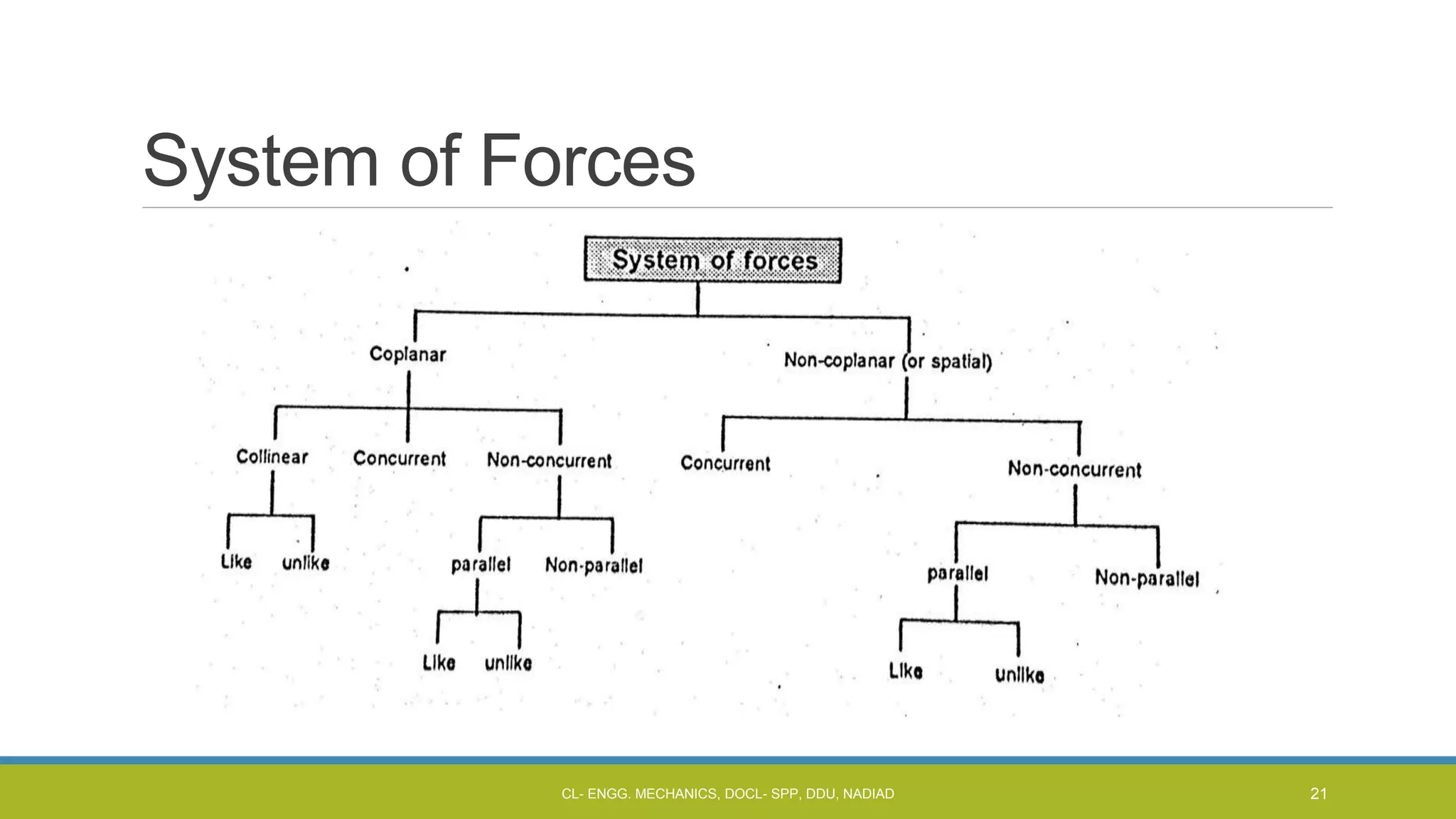
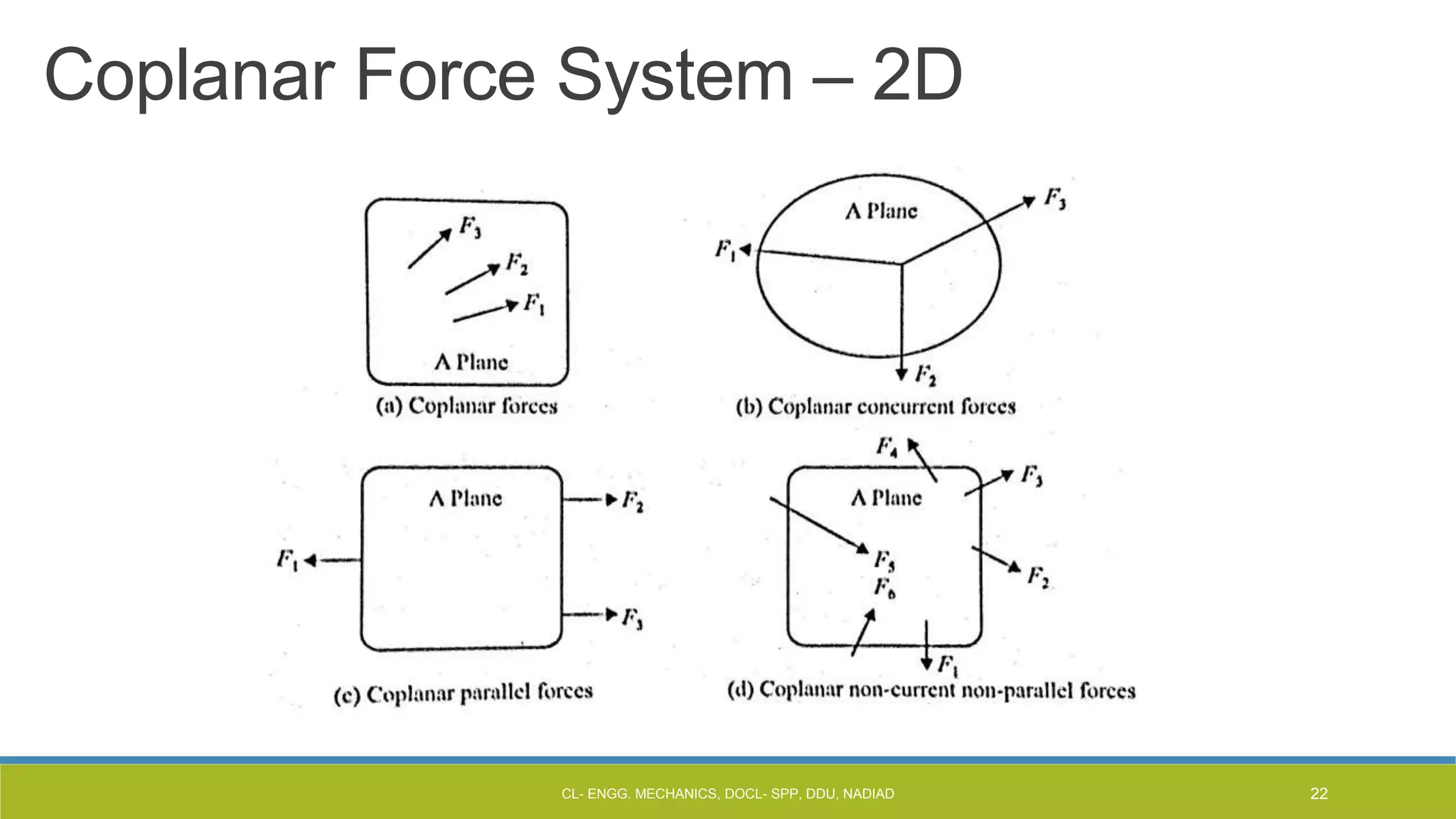
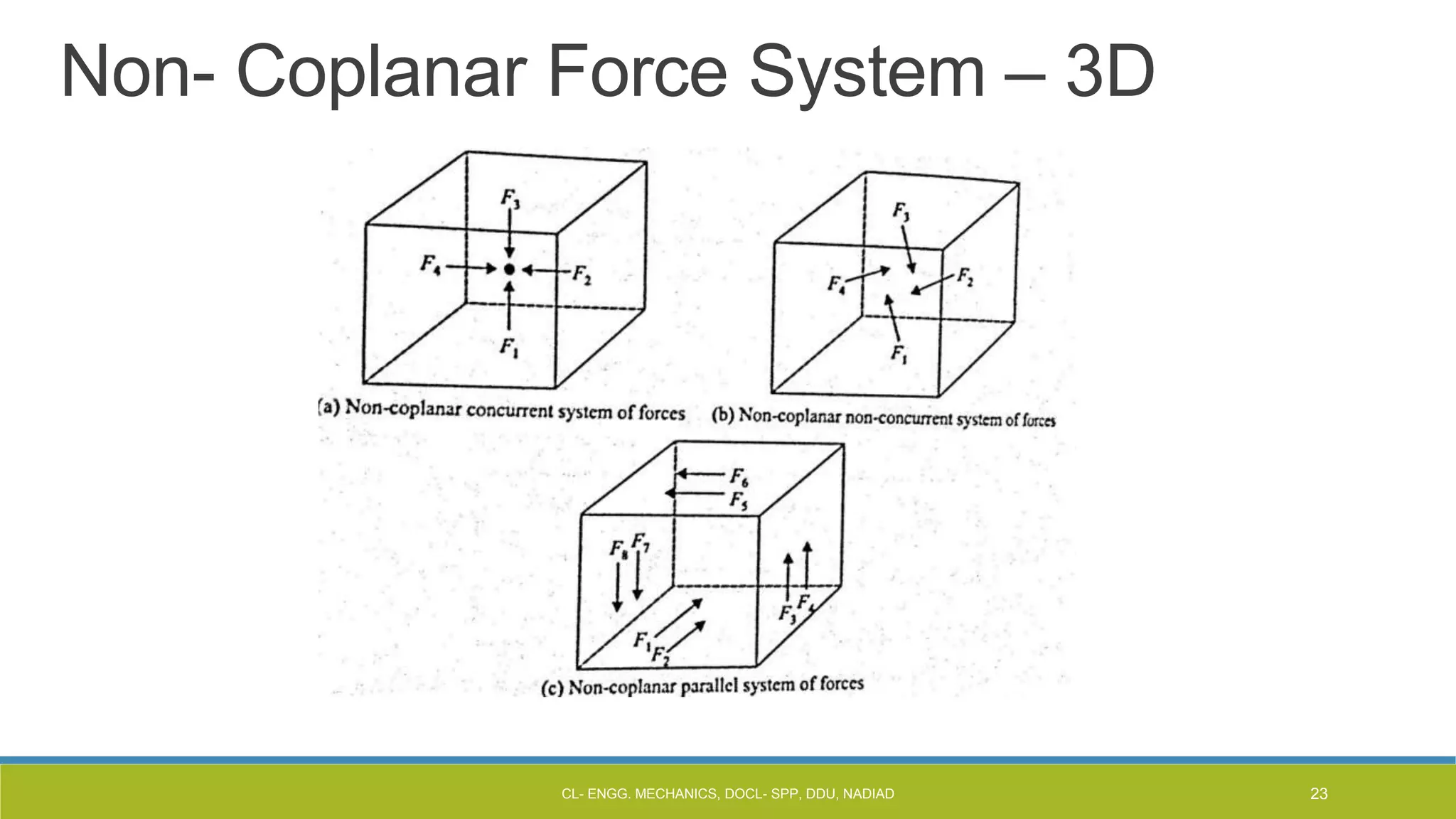
1. Coplanar Force system – 2D and Non –
Coplanar system – 3D
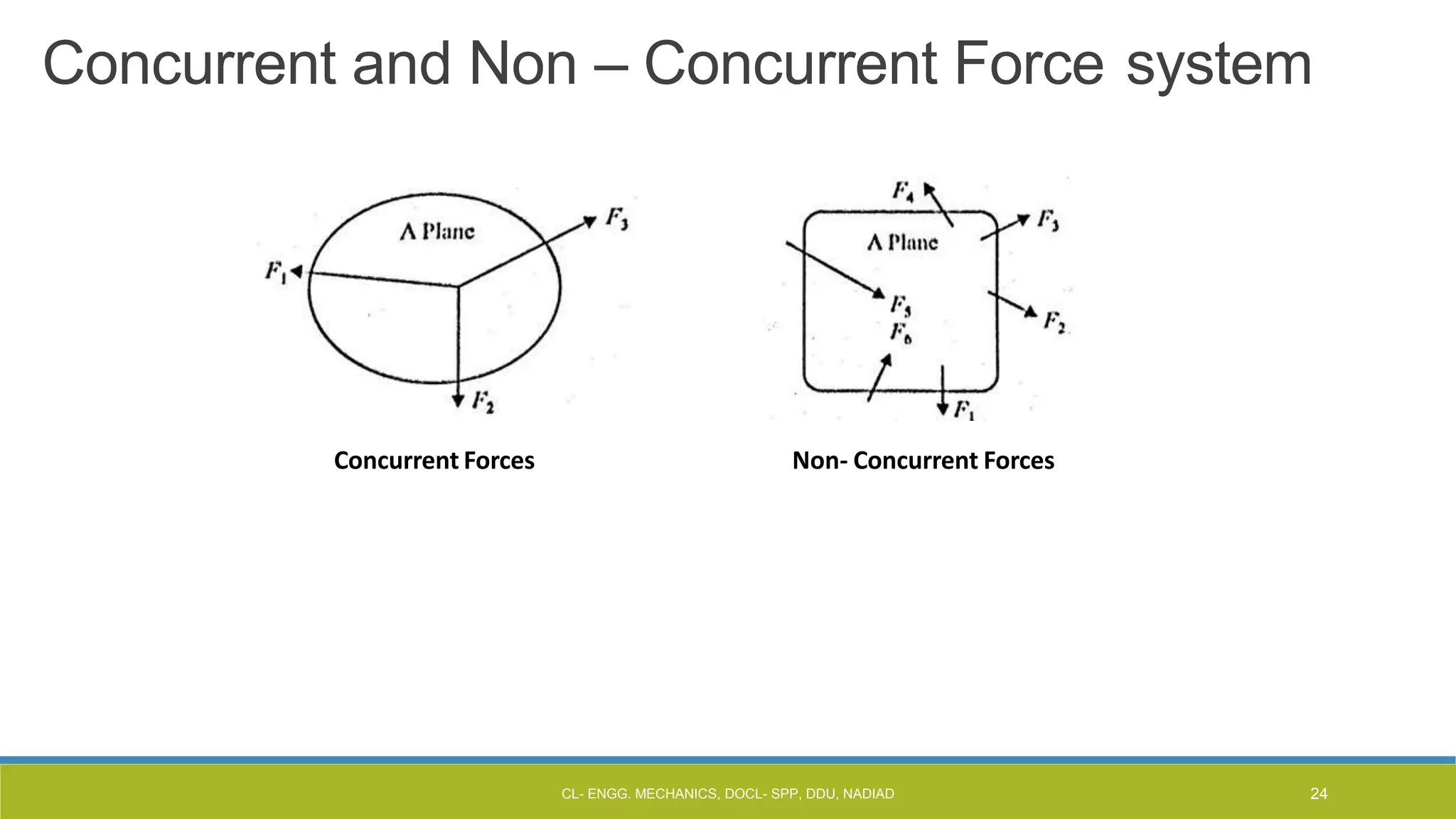
2. Concurrent and Non – Concurrent Force system
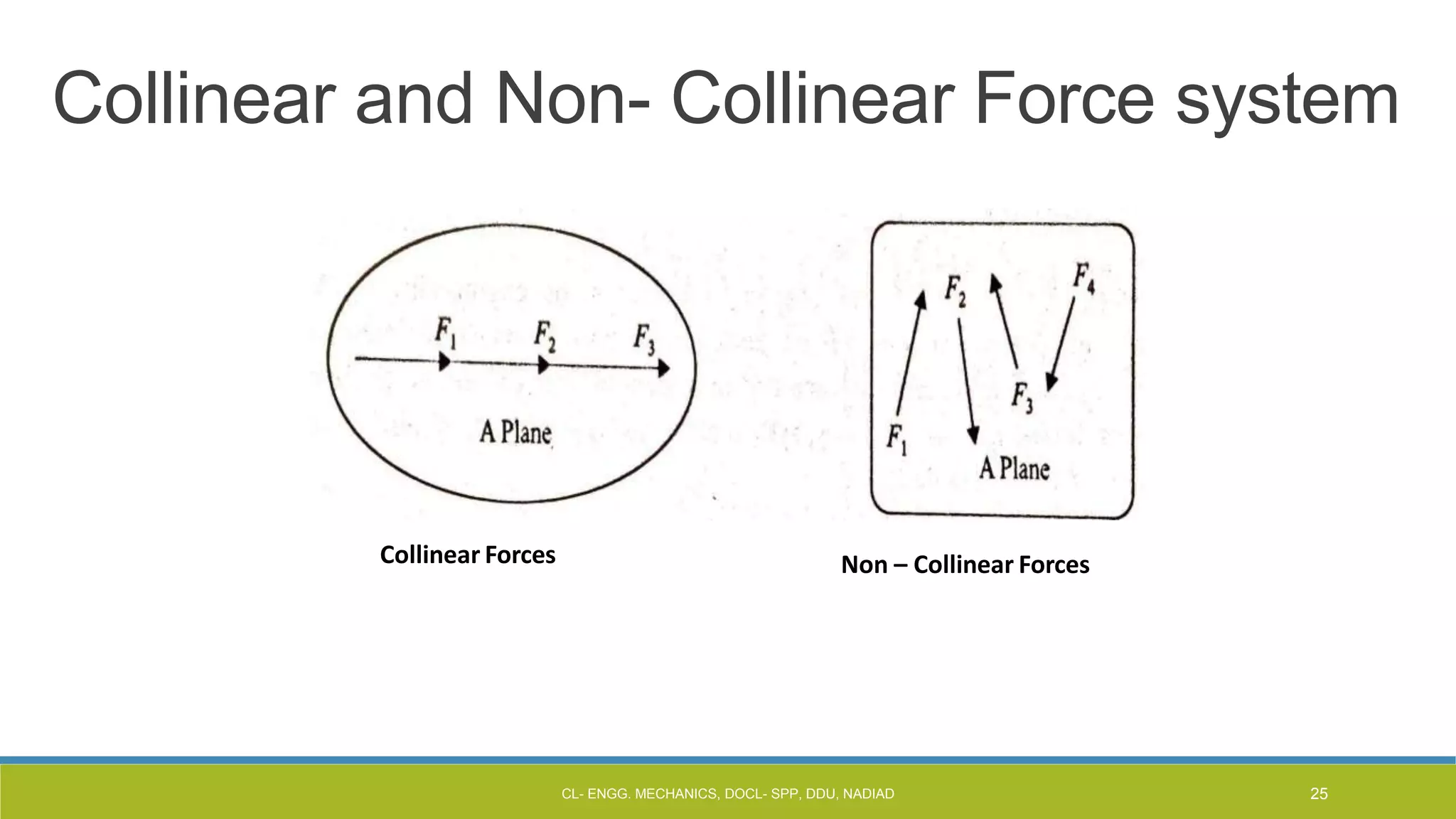
3. Collinear and Non- Collinear Force system
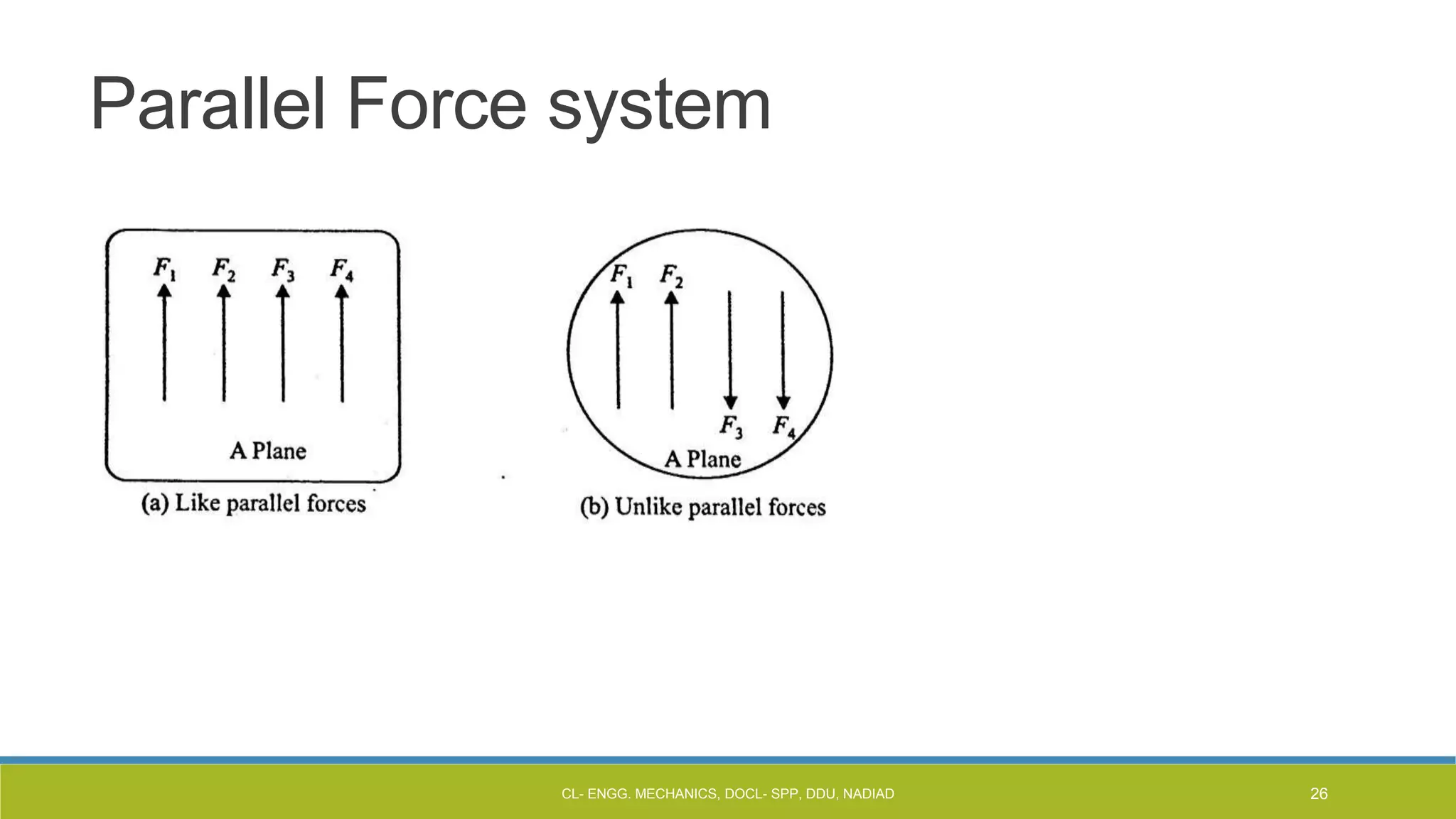
4. Parallel – Like and Unlike
CL- ENGG. MECHANICS, DOCL- SPP, DDU, NADIAD 20
System of Forces
CL- ENGG. MECHANICS, DOCL- SPP, DDU, NADIAD 21
Coplanar Force System – 2D
CL- ENGG. MECHANICS, DOCL- SPP, DDU, NADIAD 22
Non- Coplanar Force System – 3D
CL- ENGG. MECHANICS, DOCL- SPP, DDU, NADIAD 23
Concurrent and Non – Concurrent Force system
Concurrent Forces Non- Concurrent Forces
CL- ENGG. MECHANICS, DOCL- SPP, DDU, NADIAD 24
Collinear and Non- Collinear Force system
Collinear Forces Non – Collinear Forces
CL- ENGG. MECHANICS, DOCL- SPP, DDU, NADIAD 25
Parallel Force system
CL- ENGG. MECHANICS, DOCL- SPP, DDU, NADIAD 26
Idealization in
Mechanics
Models or idealizations are used in
order to simplify application of the
theory of mechanics.
Here we will consider three important
idealizations
1. Rigid Body
2. Particle
3. Concentrated force
CL- ENGG. MECHANICS, DOCL- SPP, DDU, NADIAD 27
Mechanics: Idealizations
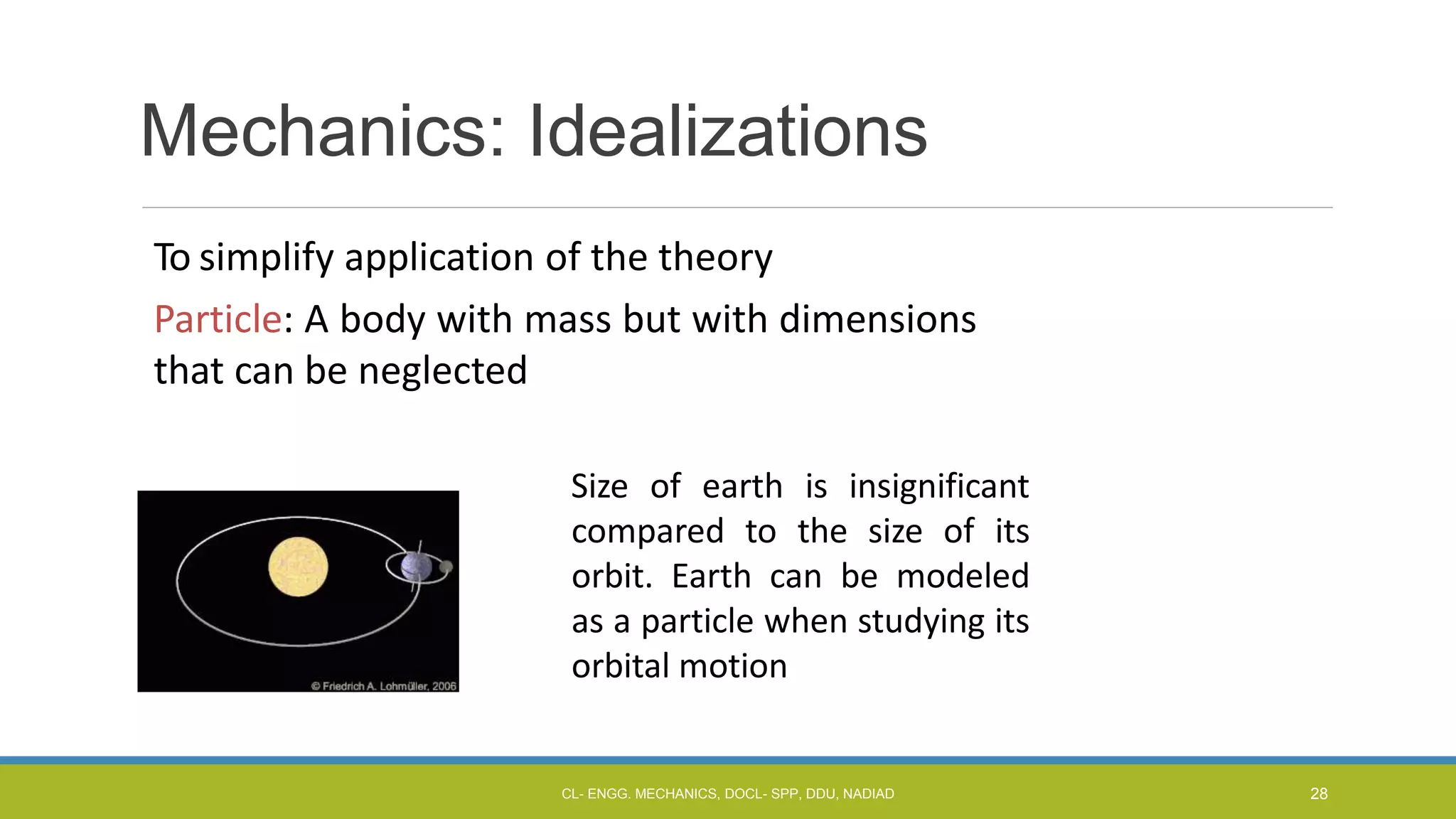
To simplify application of the theory
Particle: A body with mass but with dimensions
that can be neglected
Size of earth is insignificant
compared to the size of its
orbit. Earth can be modeled
as a particle when studying its
orbital motion
CL- ENGG. MECHANICS, DOCL- SPP, DDU, NADIAD 28
Mechanics: Idealizations
Rigid Body: A combination of large number of particles in which all particles
remain at a fixed distance (practically) from one another before and after
applying a load.
Material properties of a rigid body are not required to be considered when
analyzing the forces acting on the body.
In most cases, actual deformations occurring in structures, machines,
mechanisms, etc. are relatively small, and rigid body assumption is suitable for
analysis
CL- ENGG. MECHANICS, DOCL- SPP, DDU, NADIAD 29
Mechanics: Idealizations
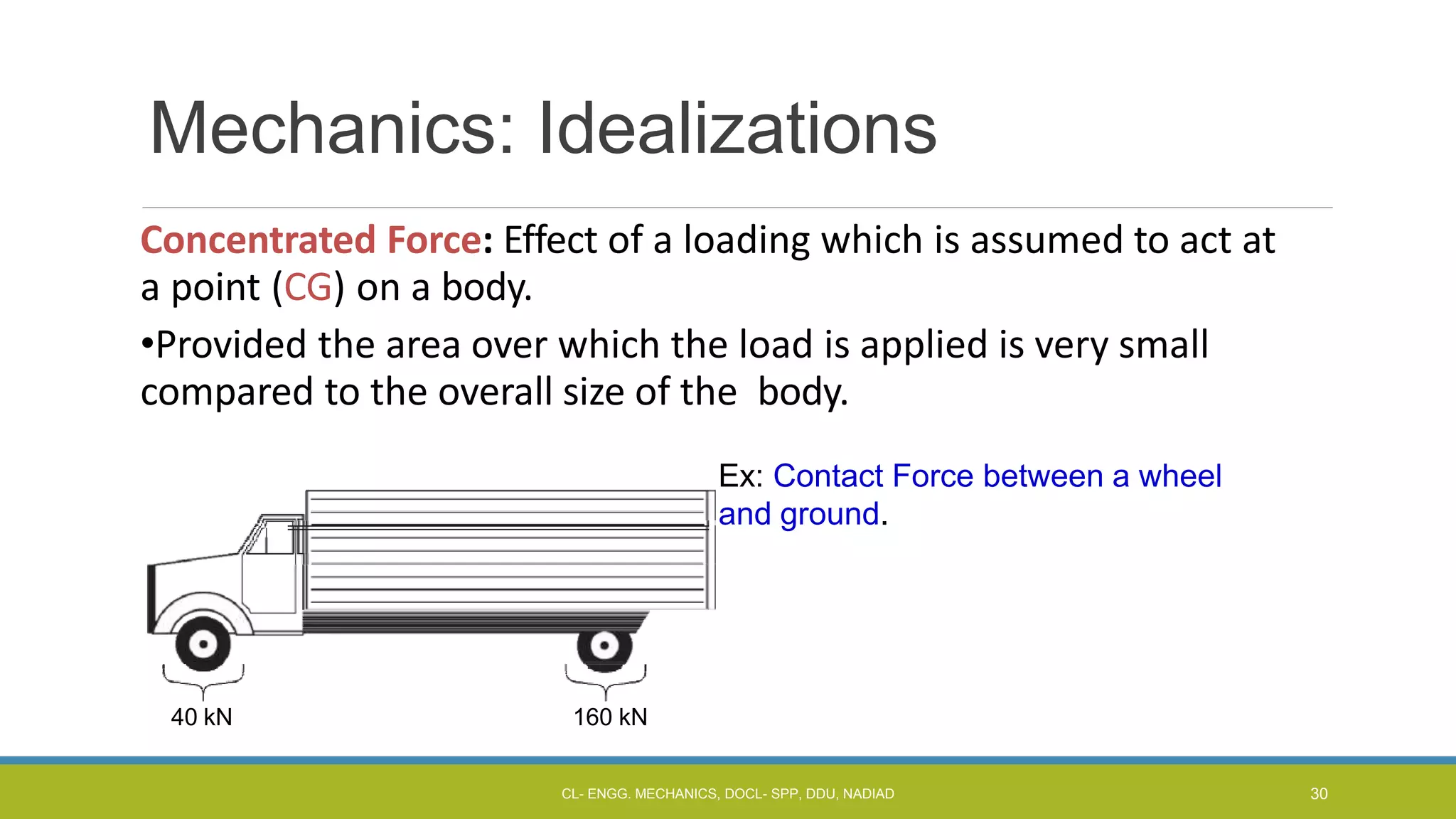
Concentrated Force: Effect of a loading which is assumed to act at
a point (CG) on a body.
•Provided the area over which the load is applied is very small
compared to the overall size of the body.
Ex: Contact Force between a wheel
and ground.
40 kN 160 kN
CL- ENGG. MECHANICS, DOCL- SPP, DDU, NADIAD 30
Fundamental
Concepts
CL- ENGG. MECHANICS, DOCL- SPP, DDU, NADIAD 31
Mechanics: Fundamental Concepts
Length (Space): needed to locate position of a point in space, & describe size of the
physical system. → Distances, Geometric Properties
Time: measure of succession of even. → basic quantity in Dynamics
Mass: quantity of matter in a body →measure of inertia of a body (its resistance to
change in velocity)
Force: represents the action of one body on another → characterized by its
magnitude, direction of its action, and its point of application

Force is a Vector quantity.
CL- ENGG. MECHANICS, DOCL- SPP, DDU, NADIAD 32
Mechanics: Fundamental Concepts
Newtonian Mechanics
Length, Time, and Mass are absolute concepts independent of each other
Force is a derived concept not independent of the other fundamental concepts.
Force acting on a body is related to the mass of the body and the variation of its
velocity with time.
Force can also occur between bodies that are physically separated (Ex: gravitational,
electrical, and magnetic forces)
CL- ENGG. MECHANICS, DOCL- SPP, DDU, NADIAD 33
Mechanics: Fundamental Concepts
Remember:
• Mass is a property of matter that does not change from one
location to another.
• Weight refers to the gravitational attraction of the earth on a body
or quantity of mass. Its magnitude depends upon the elevation at
which the mass is located
• Weight of a body is the gravitational force acting on it.
CL- ENGG. MECHANICS, DOCL- SPP, DDU, NADIAD 34
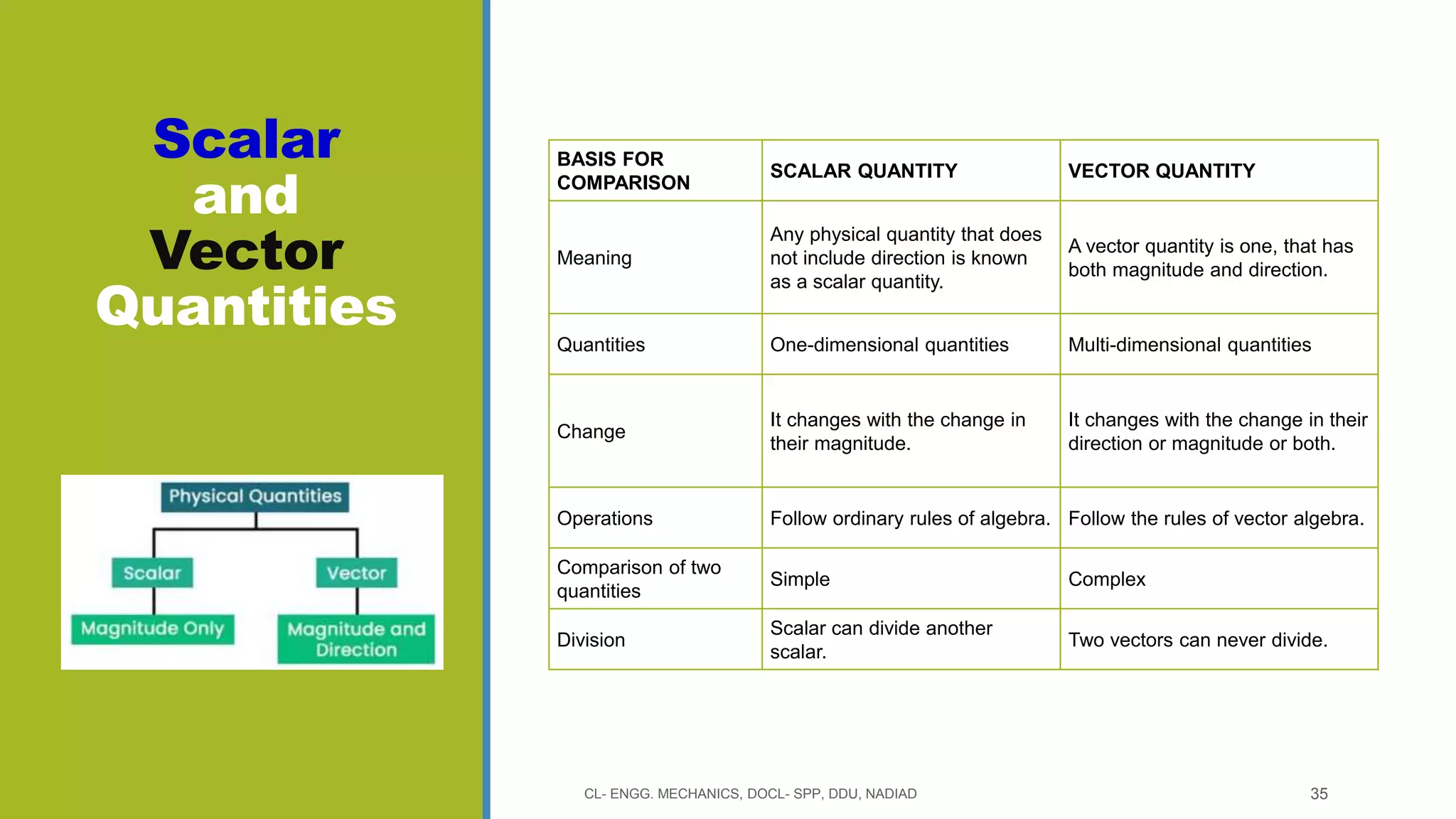
Scalar
and
Vector
Quantities
CL- ENGG. MECHANICS, DOCL- SPP, DDU, NADIAD 35
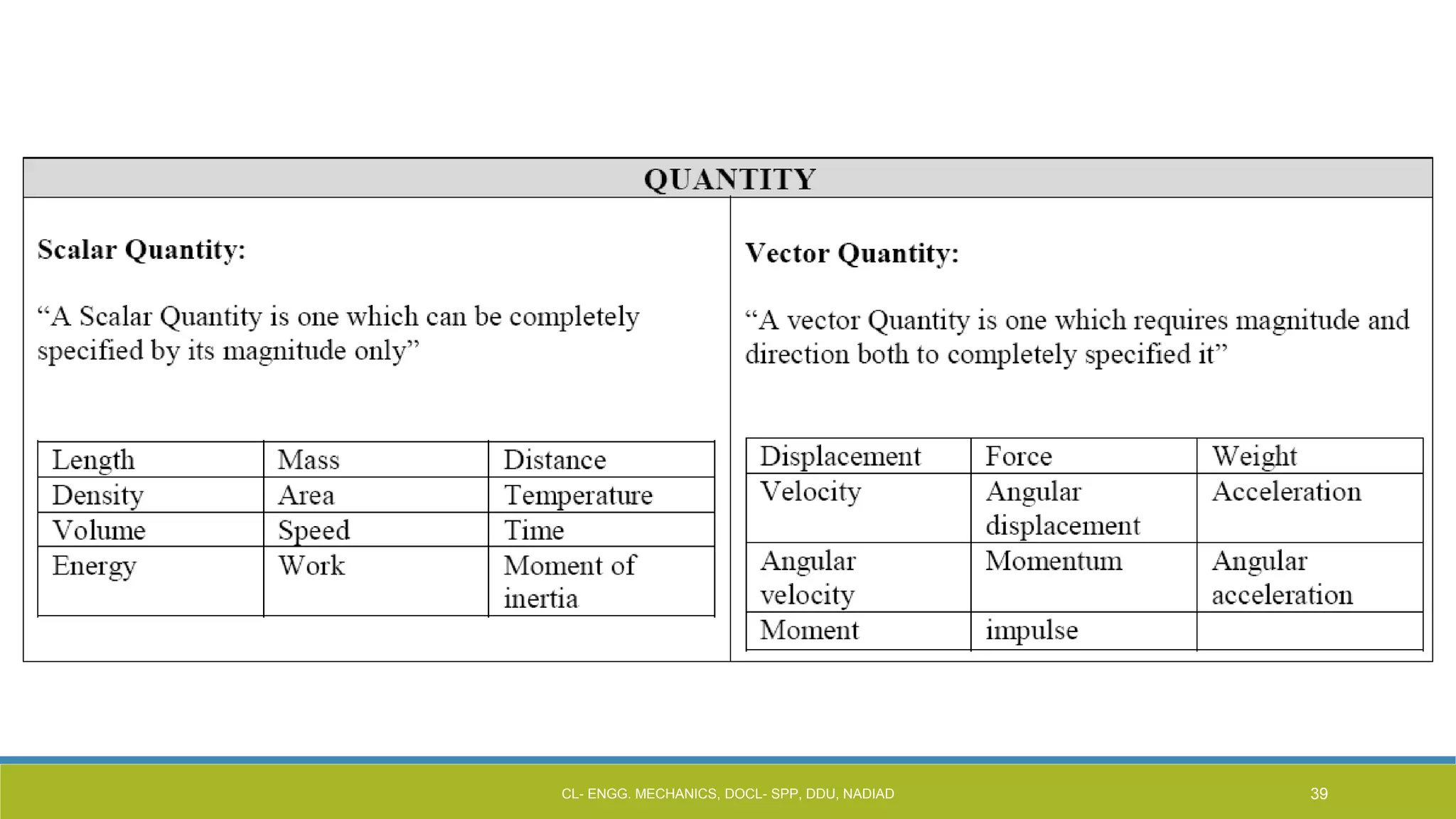
BASIS FOR
COMPARISON
SCALAR QUANTITY VECTOR QUANTITY
Meaning
Any physical quantity that does
not include direction is known
as a scalar quantity.
A vector quantity is one, that has
both magnitude and direction.
Quantities One-dimensional quantities Multi-dimensional quantities
Change
It changes with the change in
their magnitude.
It changes with the change in their
direction or magnitude or both.
Operations Follow ordinary rules of algebra. Follow the rules of vector algebra.
Comparison of two
quantities
Simple Complex
Division
Scalar can divide another
scalar.
Two vectors can never divide.
What is a scalar?
Scalar quantities are measured with numbers and units.
length
(e.g. 102 °C)
time
(e.g. 16 cm)
temperature
(e.g. 7 s)
CL- ENGG. MECHANICS, DOCL- SPP, DDU, NADIAD 36
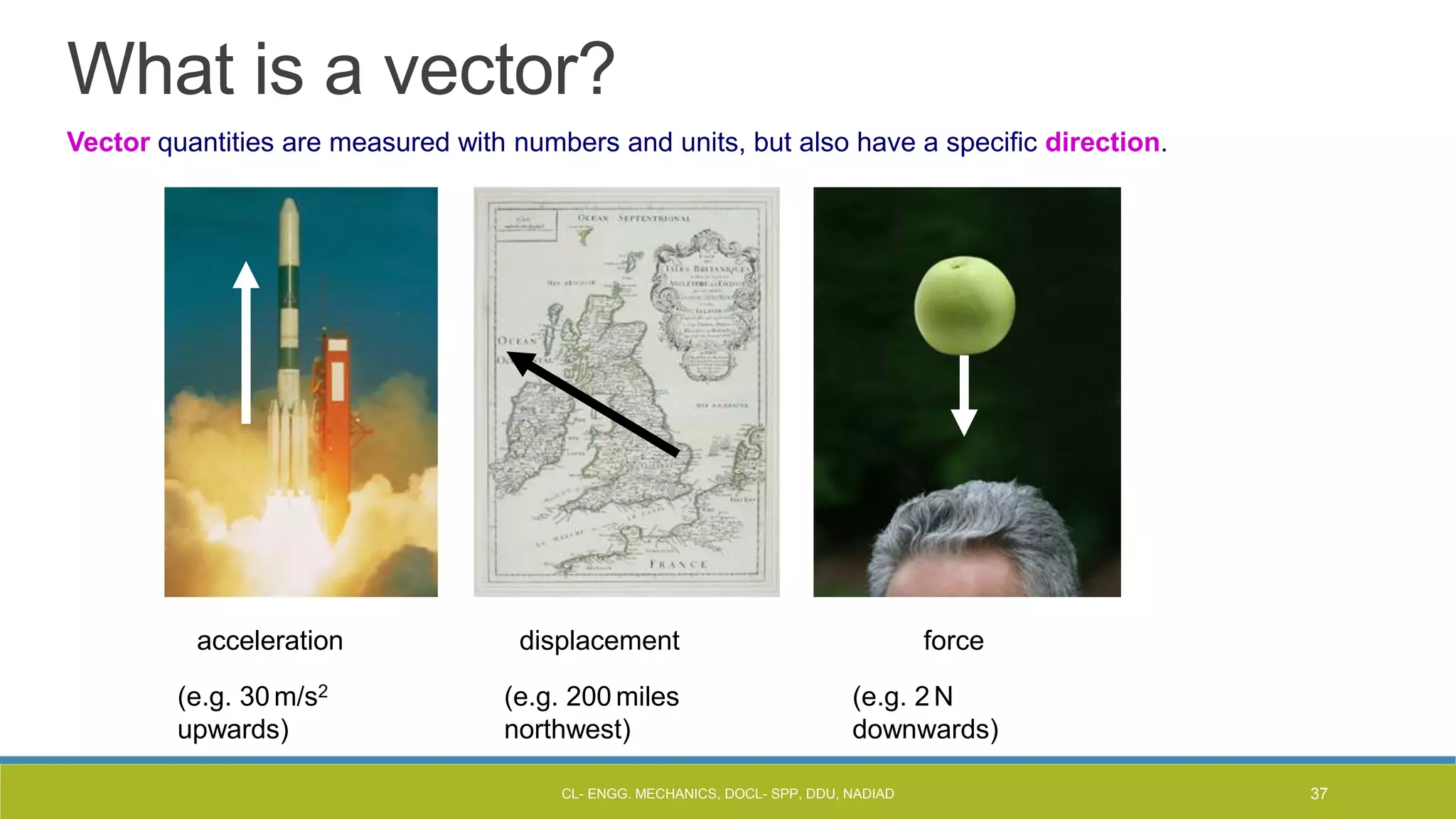
What is a vector?
Vector quantities are measured with numbers and units, but also have a specific direction.
acceleration
(e.g. 30m/s2
upwards)
displacement
(e.g. 200 miles
northwest)
force
(e.g. 2 N
downwards)
CL- ENGG. MECHANICS, DOCL- SPP, DDU, NADIAD 37
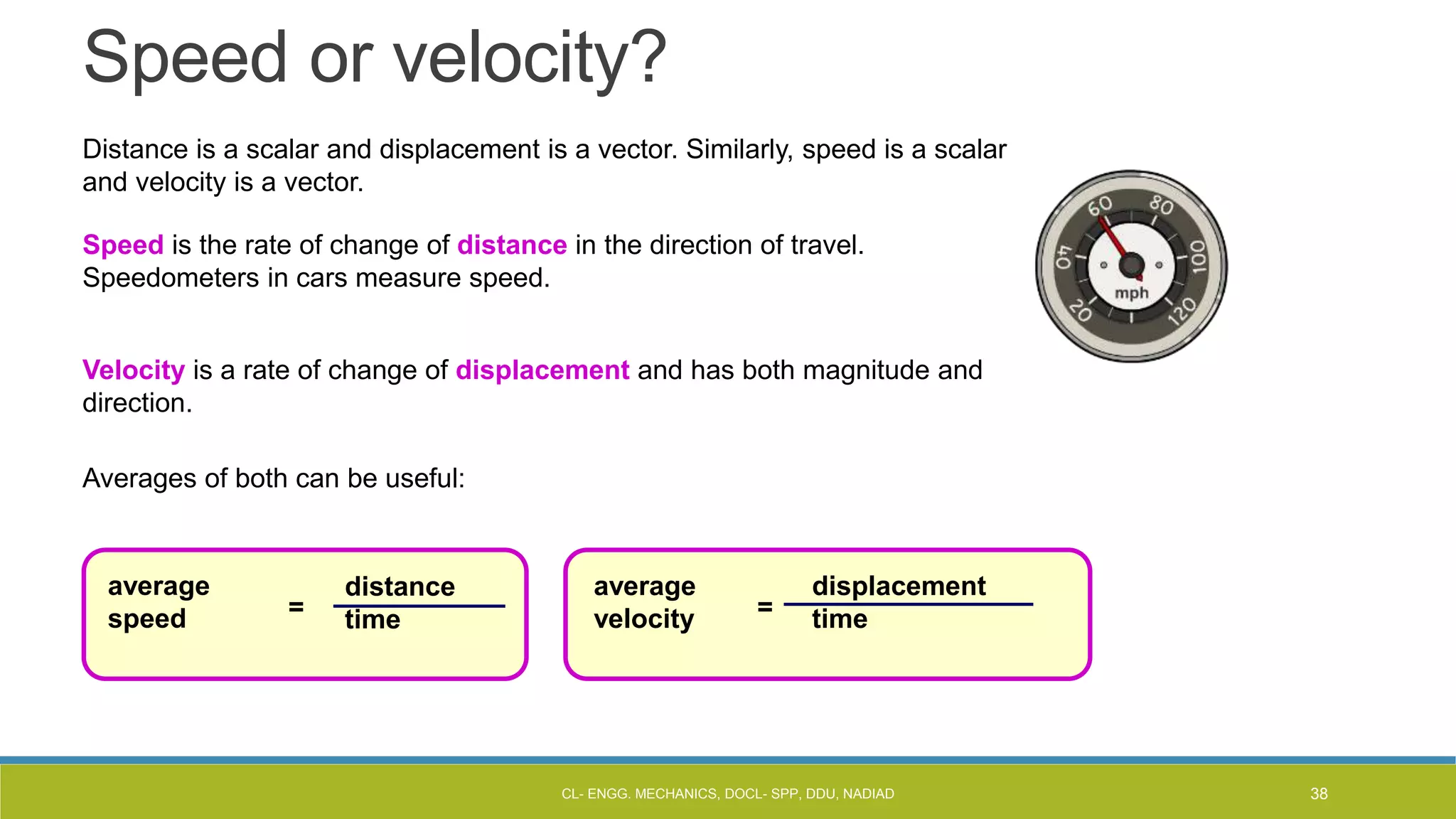
Speed or velocity?
Distance is a scalar and displacement is a vector. Similarly, speed is a scalar
and velocity is a vector.
Speed is the rate of change of distance in the direction of travel.
Speedometers in cars measure speed.
Velocity is a rate of change of displacement and has both magnitude and
direction.
average
speed
average
velocity
Averages of both can be useful:
distance
time
displacement
time
= =
CL- ENGG. MECHANICS, DOCL- SPP, DDU, NADIAD 38
CL- ENGG. MECHANICS, DOCL- SPP, DDU, NADIAD 39
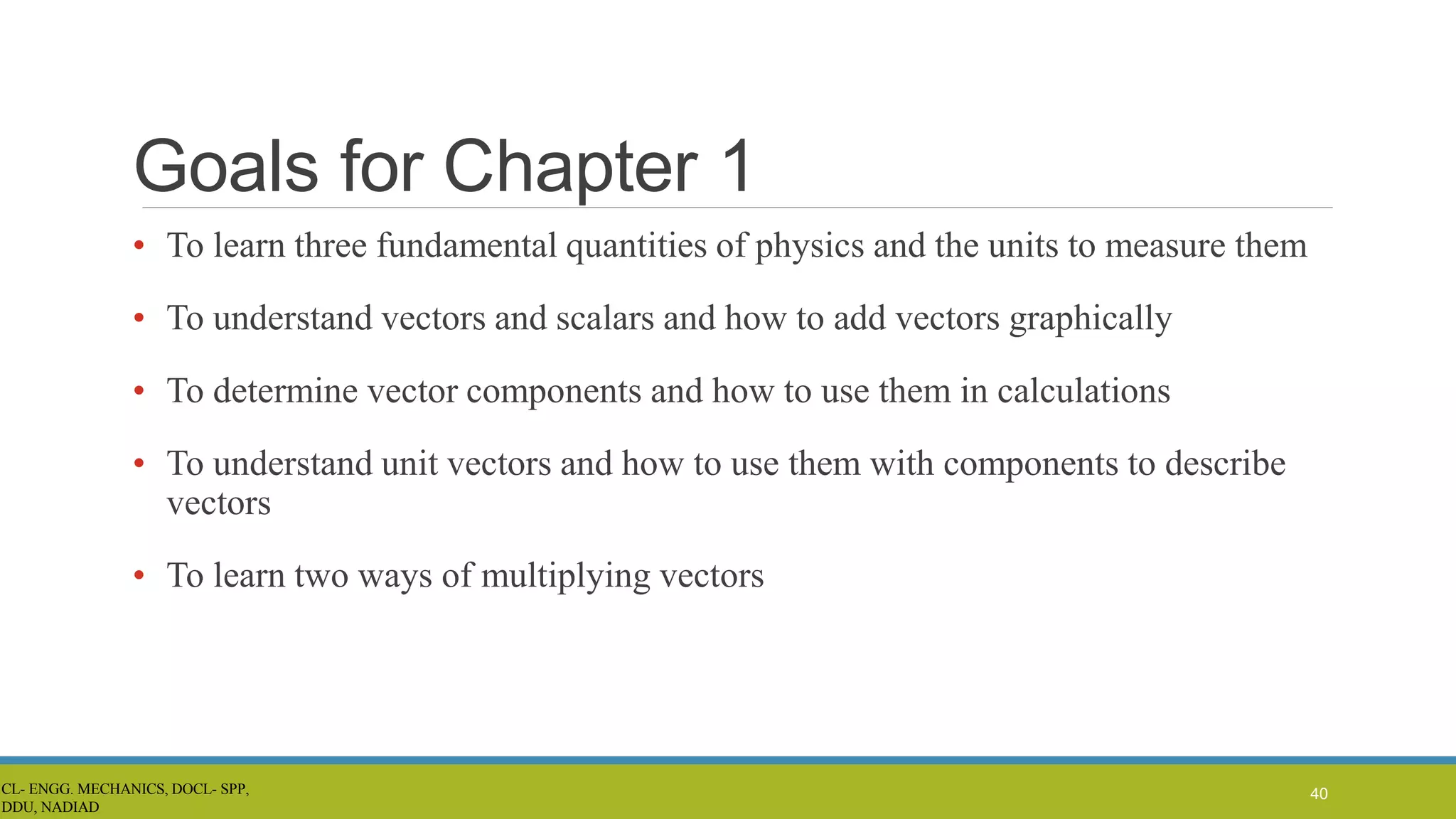
Goals for Chapter 1
• To learn three fundamental quantities of physics and the units to measure them
• To understand vectors and scalars and how to add vectors graphically
• To determine vector components and how to use them in calculations
• To understand unit vectors and how to use them with components to describe
vectors
• To learn two ways of multiplying vectors
40
CL- ENGG. MECHANICS, DOCL- SPP,
DDU, NADIAD
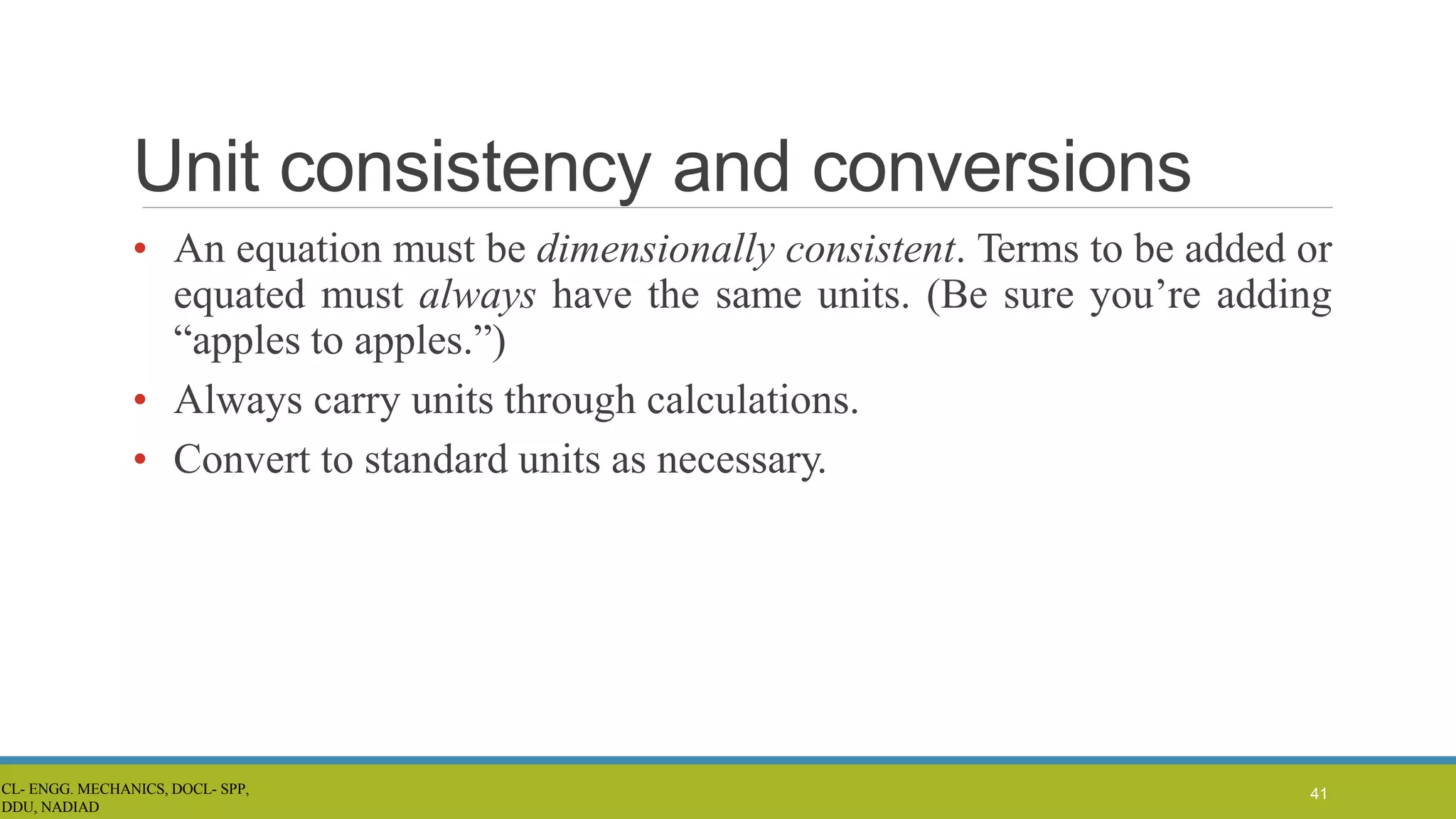
Unit consistency and conversions
• An equation must be dimensionally consistent. Terms to be added or
equated must always have the same units. (Be sure you’re adding
“apples to apples.”)
• Always carry units through calculations.
• Convert to standard units as necessary.
41
CL- ENGG. MECHANICS, DOCL- SPP,
DDU, NADIAD
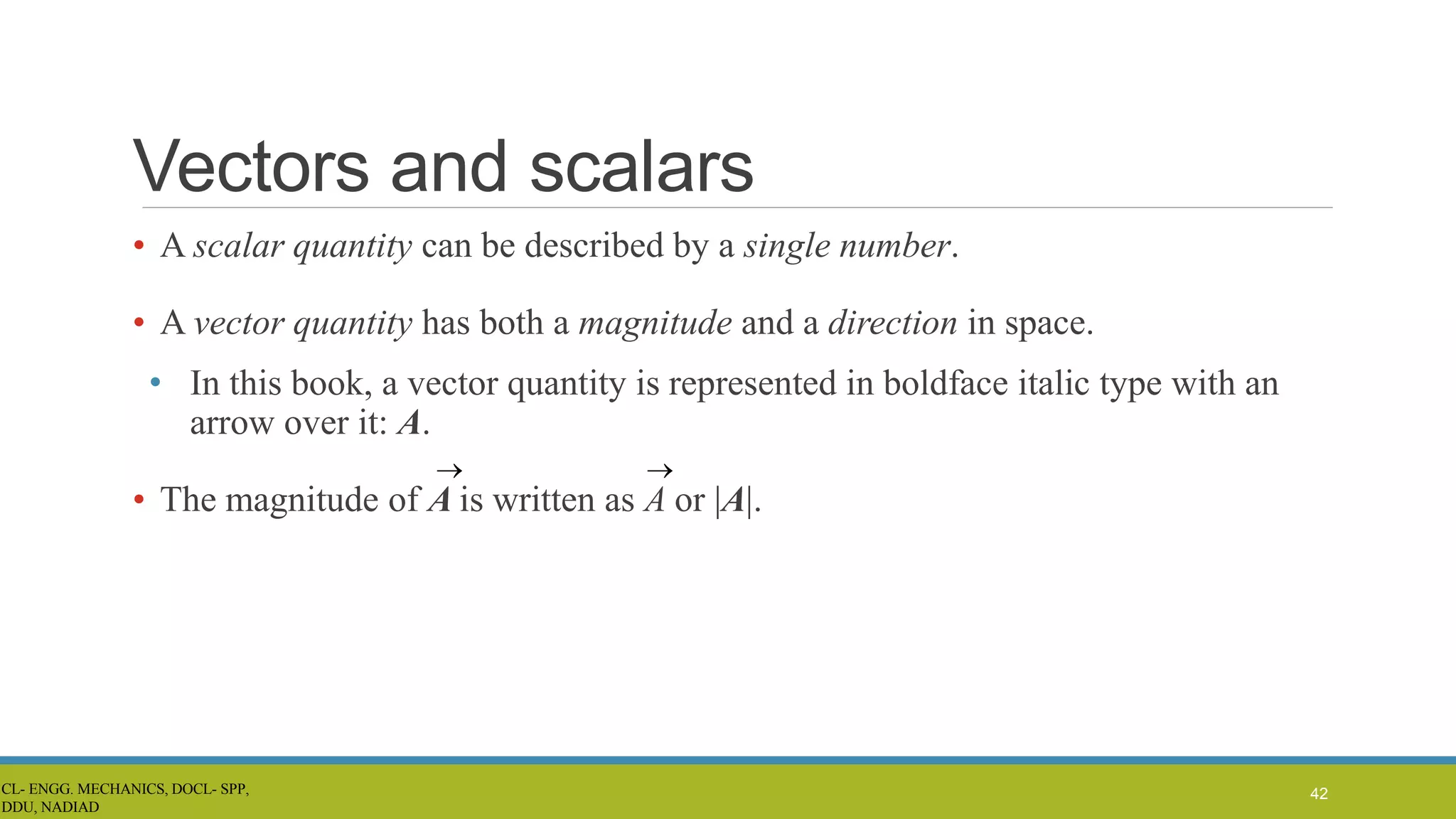
Vectors and scalars
• A scalar quantity can be described by a single number.
• A vector quantity has both a magnitude and a direction in space.
• In this book, a vector quantity is represented in boldface italic type with an
arrow over it: A.
• The magnitude of A is written as A or |A|.
42
CL- ENGG. MECHANICS, DOCL- SPP,
DDU, NADIAD
 
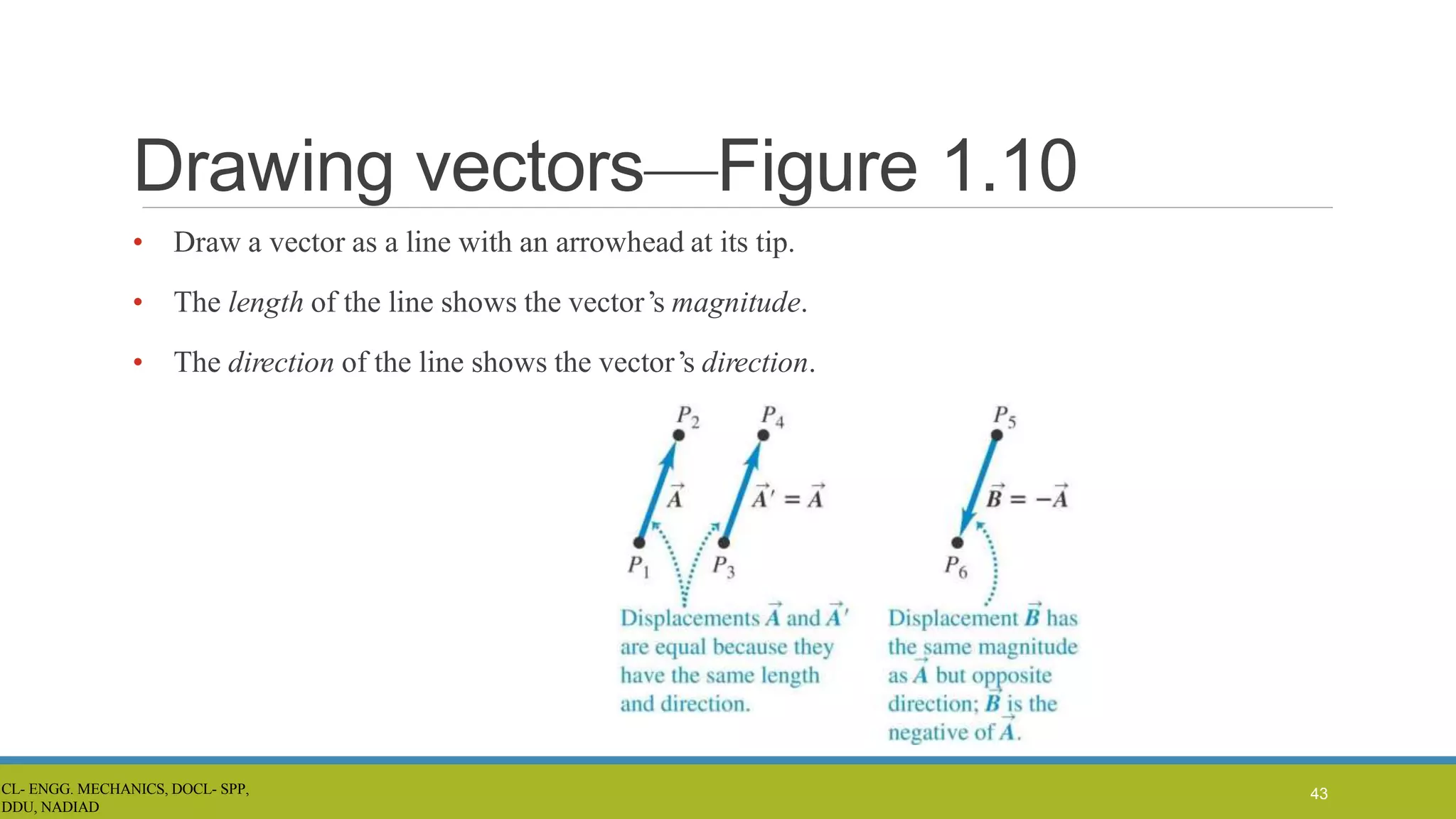
Drawing vectors—Figure 1.10
• Draw a vector as a line with an arrowhead at its tip.
• The length of the line shows the vector’s magnitude.
• The direction of the line shows the vector’s direction.
43
CL- ENGG. MECHANICS, DOCL- SPP,
DDU, NADIAD
CL- ENGG. MECHANICS, DOCL- SPP, DDU, NADIAD 44
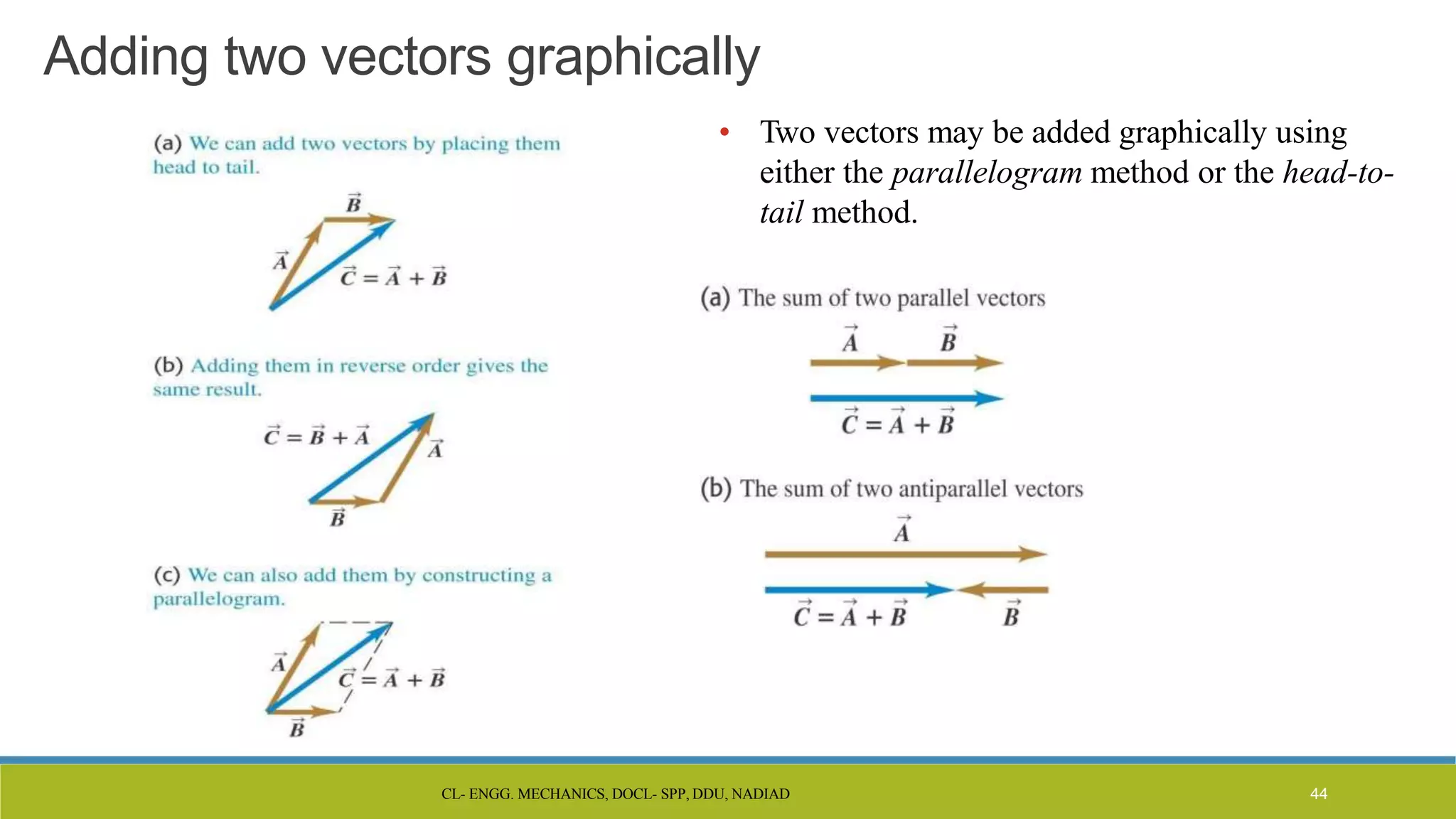
Adding two vectors graphically
• Two vectors may be added graphically using
either the parallelogram method or the head-to-
tail method.
CL- ENGG. MECHANICS, DOCL- SPP, DDU, NADIAD 45
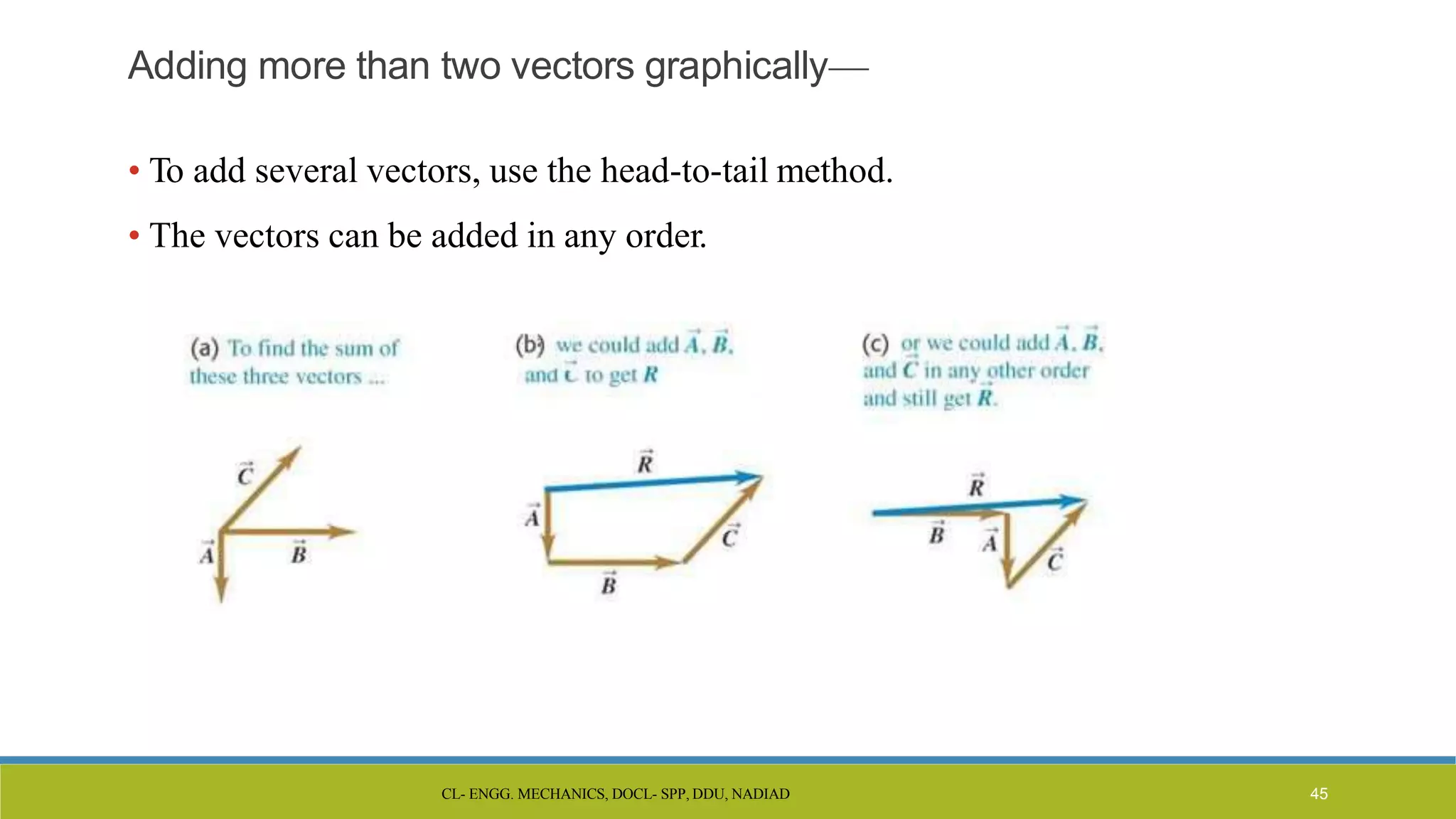
Adding more than two vectors graphically—
• To add several vectors, use the head-to-tail method.
• The vectors can be added in any order.
CL- ENGG. MECHANICS, DOCL- SPP, DDU, NADIAD 46
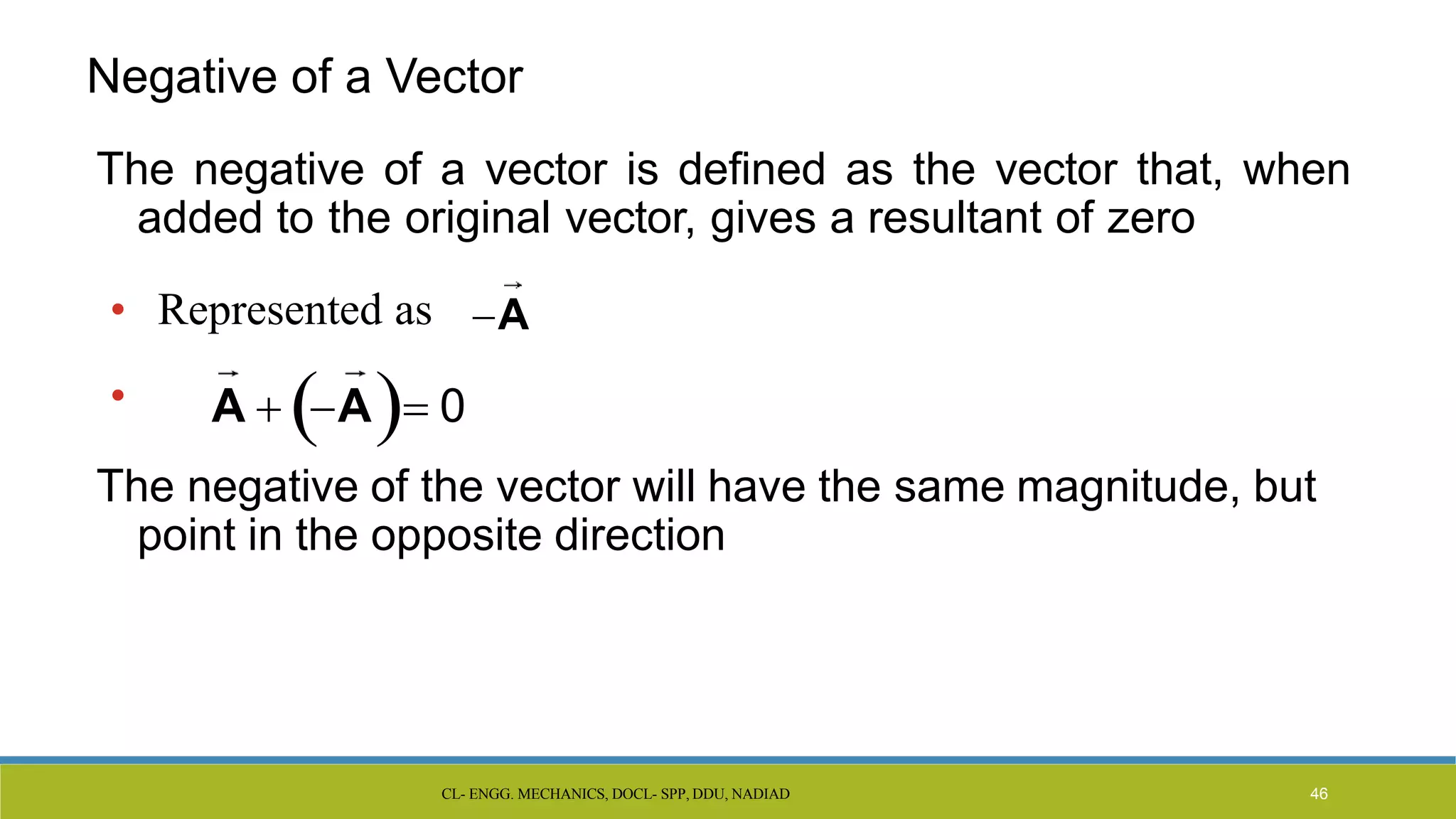
The negative of a vector is defined as the vector that, when
added to the original vector, gives a resultant of zero
The negative of the vector will have the same magnitude, but
point in the opposite direction
• Represented as
• A  A 0
A
Negative of a Vector
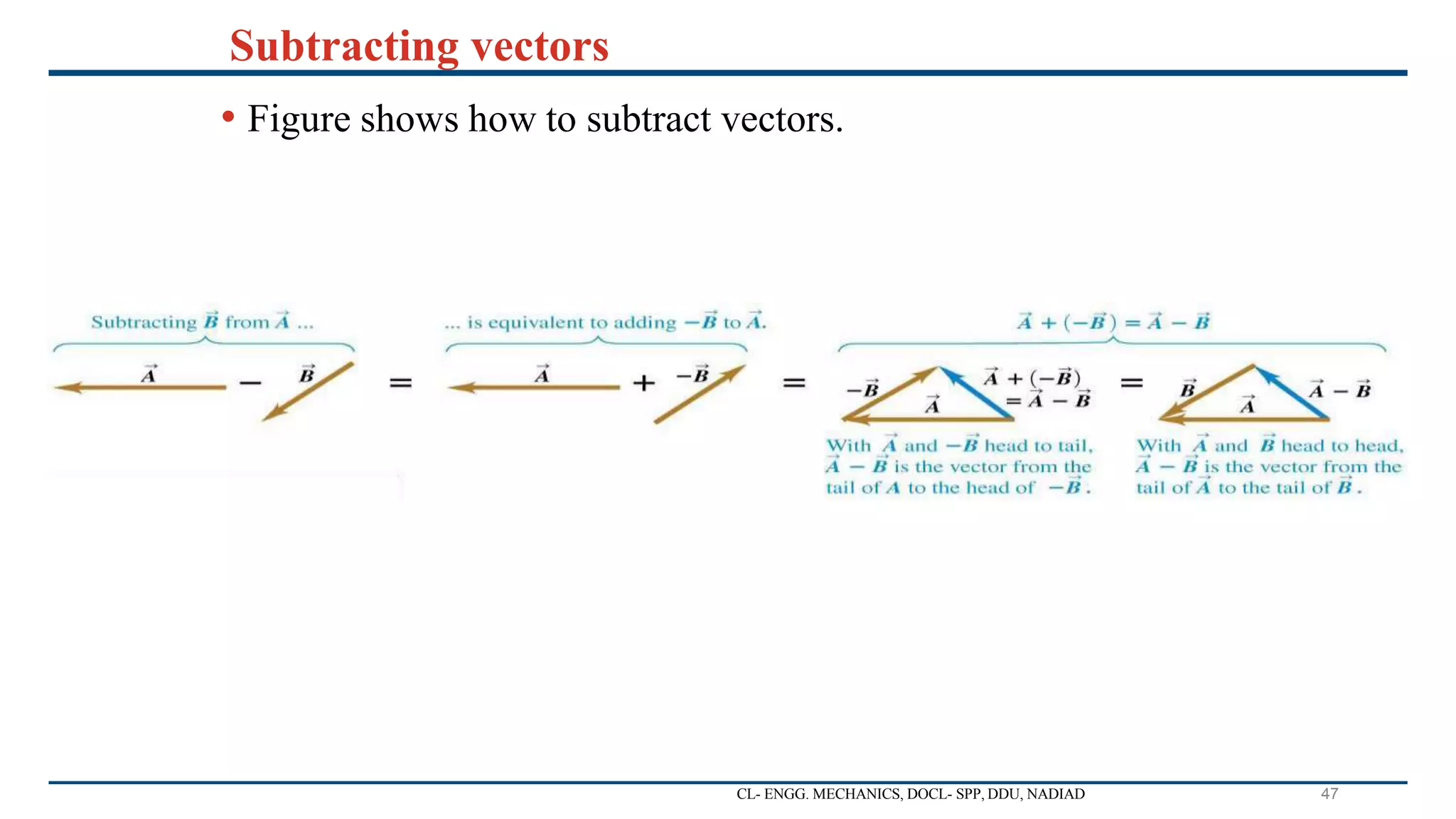
Subtracting vectors
CL- ENGG. MECHANICS, DOCL- SPP, DDU, NADIAD
• Figure shows how to subtract vectors.
47
CL- ENGG. MECHANICS, DOCL- SPP, DDU, NADIAD
48
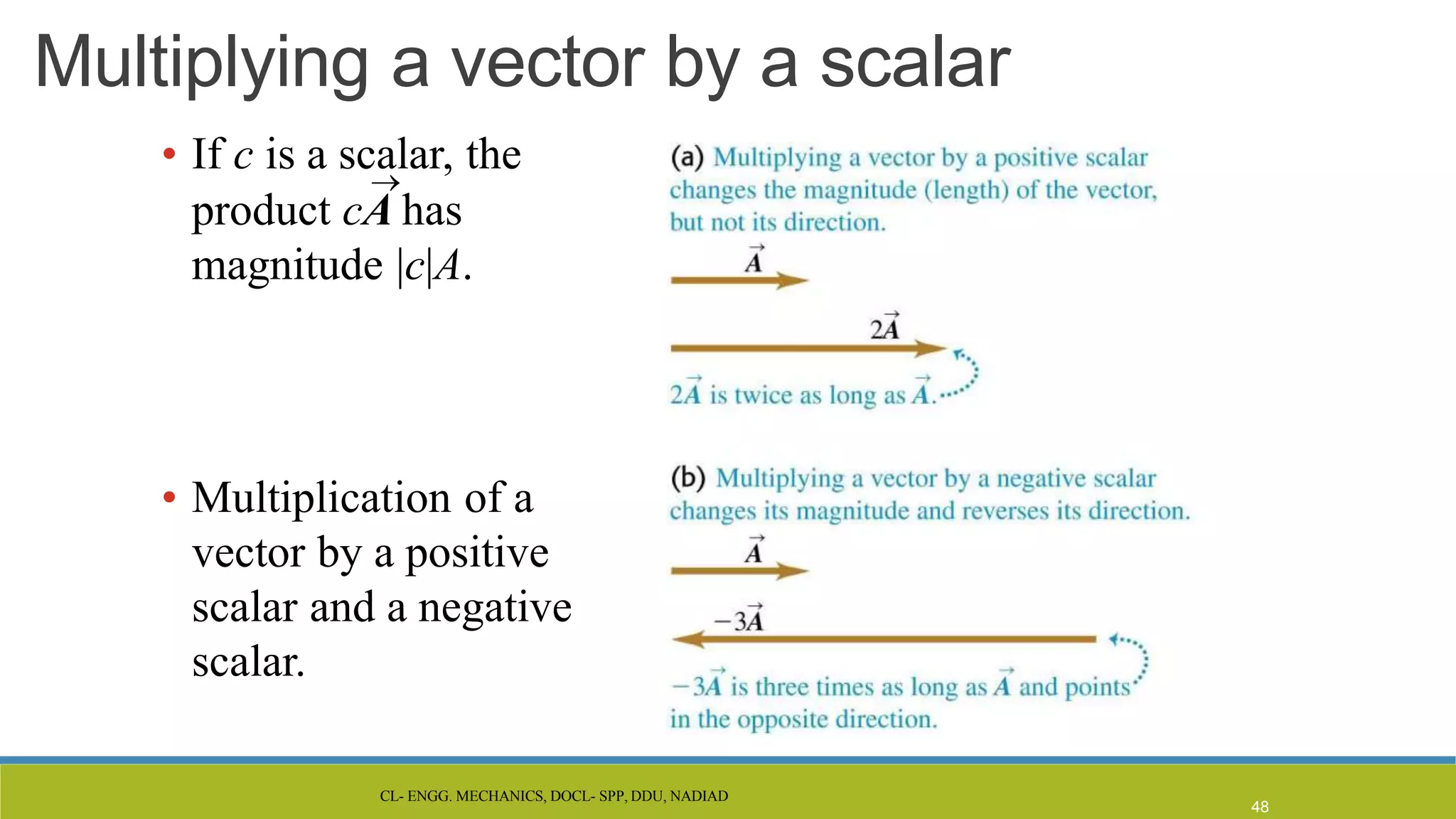
Multiplying a vector by a scalar
• If c is a scalar, the
product cA has
magnitude |c|A.
• Multiplication of a
vector by a positive
scalar and a negative
scalar.

CL- ENGG. MECHANICS, DOCL- SPP, DDU, NADIAD 49
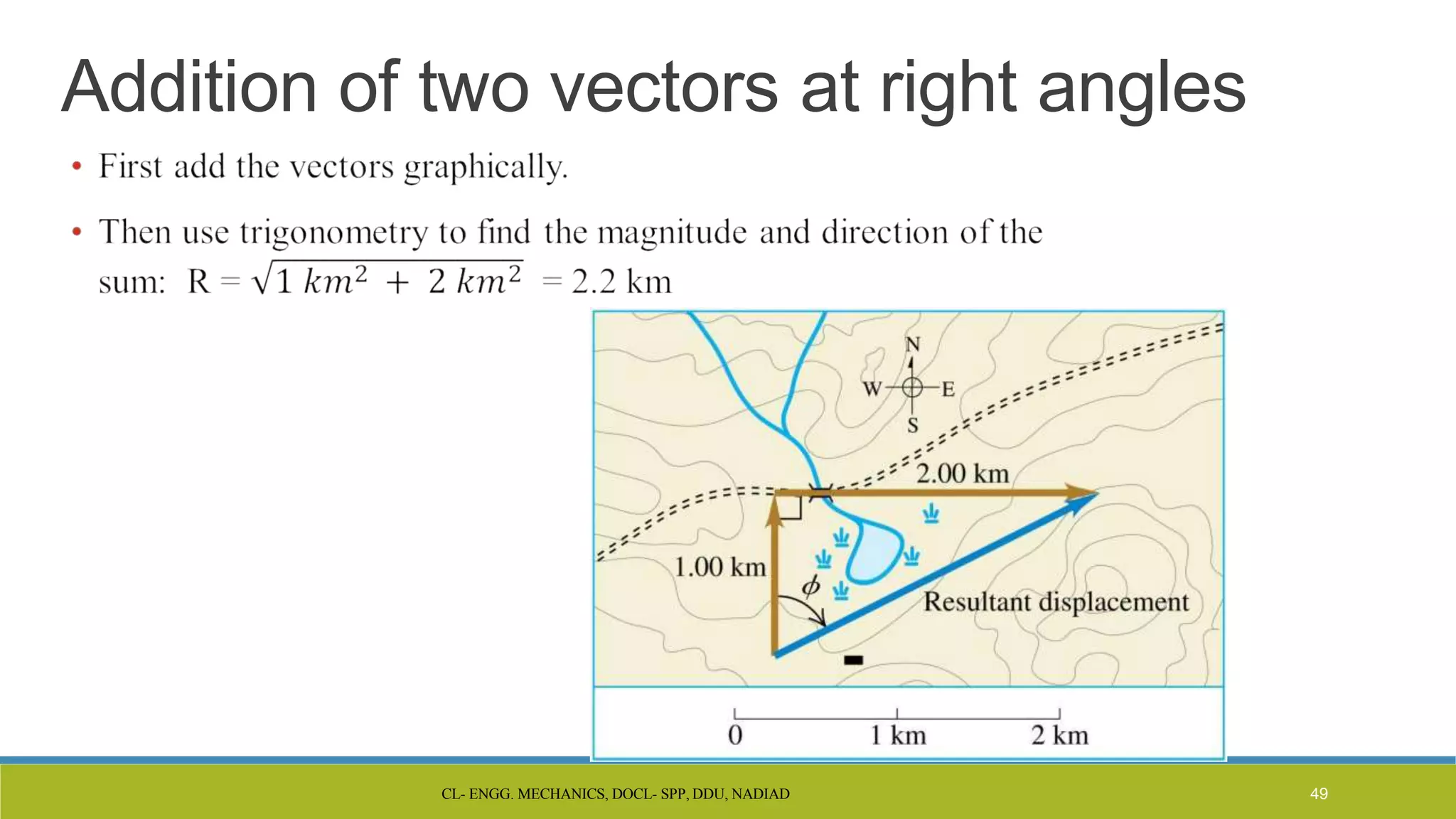
Addition of two vectors at right angles
CL- ENGG. MECHANICS, DOCL- SPP, DDU, NADIAD 50
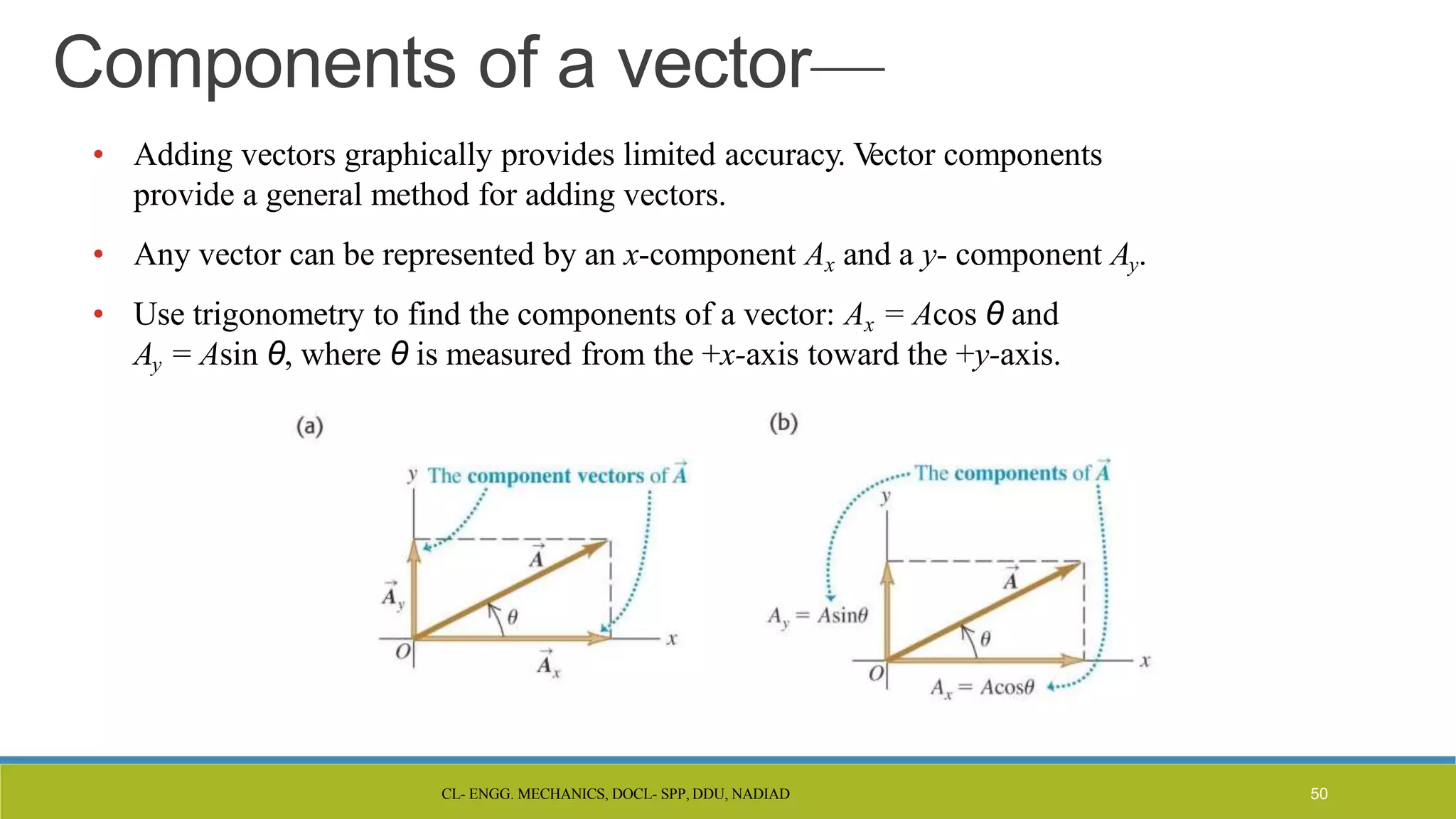
Components of a vector—
• Adding vectors graphically provides limited accuracy. V
ector components
provide a general method for adding vectors.
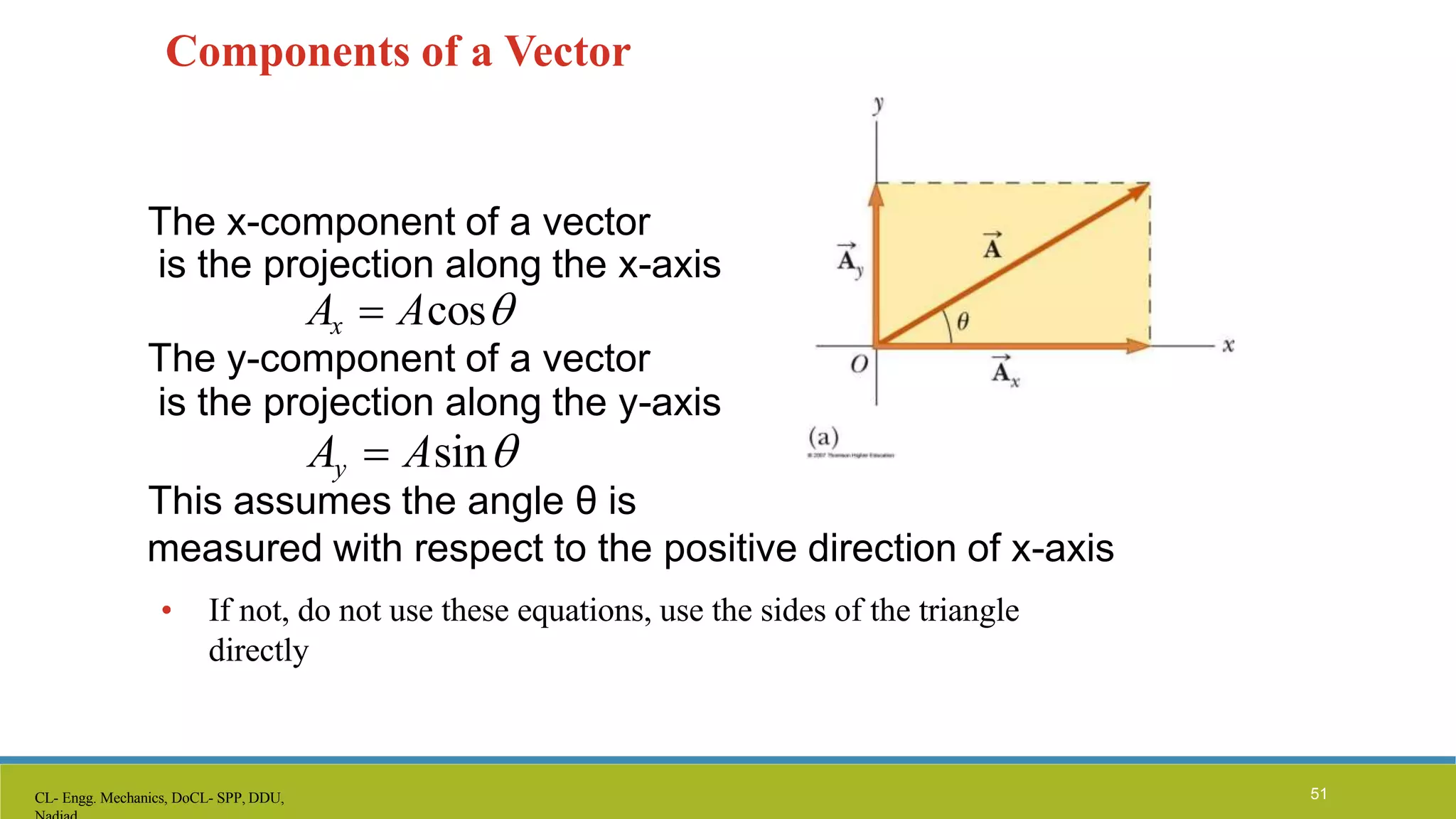
• Any vector can be represented by an x-component Ax and a y- component Ay.
• Use trigonometry to find the components of a vector: Ax = Acos θ and
Ay = Asin θ, where θ is measured from the +x-axis toward the +y-axis.
Components of a Vector
The x-component of a vector
is the projection along the x-axis
Ax  Acos
The y-component of a vector
is the projection along the y-axis
Ay  Asin
This assumes the angle θ is
measured with respect to the positive direction of x-axis
• If not, do not use these equations, use the sides of the triangle
directly
CL- Engg. Mechanics, DoCL- SPP, DDU, 51
CL- ENGG. MECHANICS, DOCL- SPP, DDU, NADIAD 52
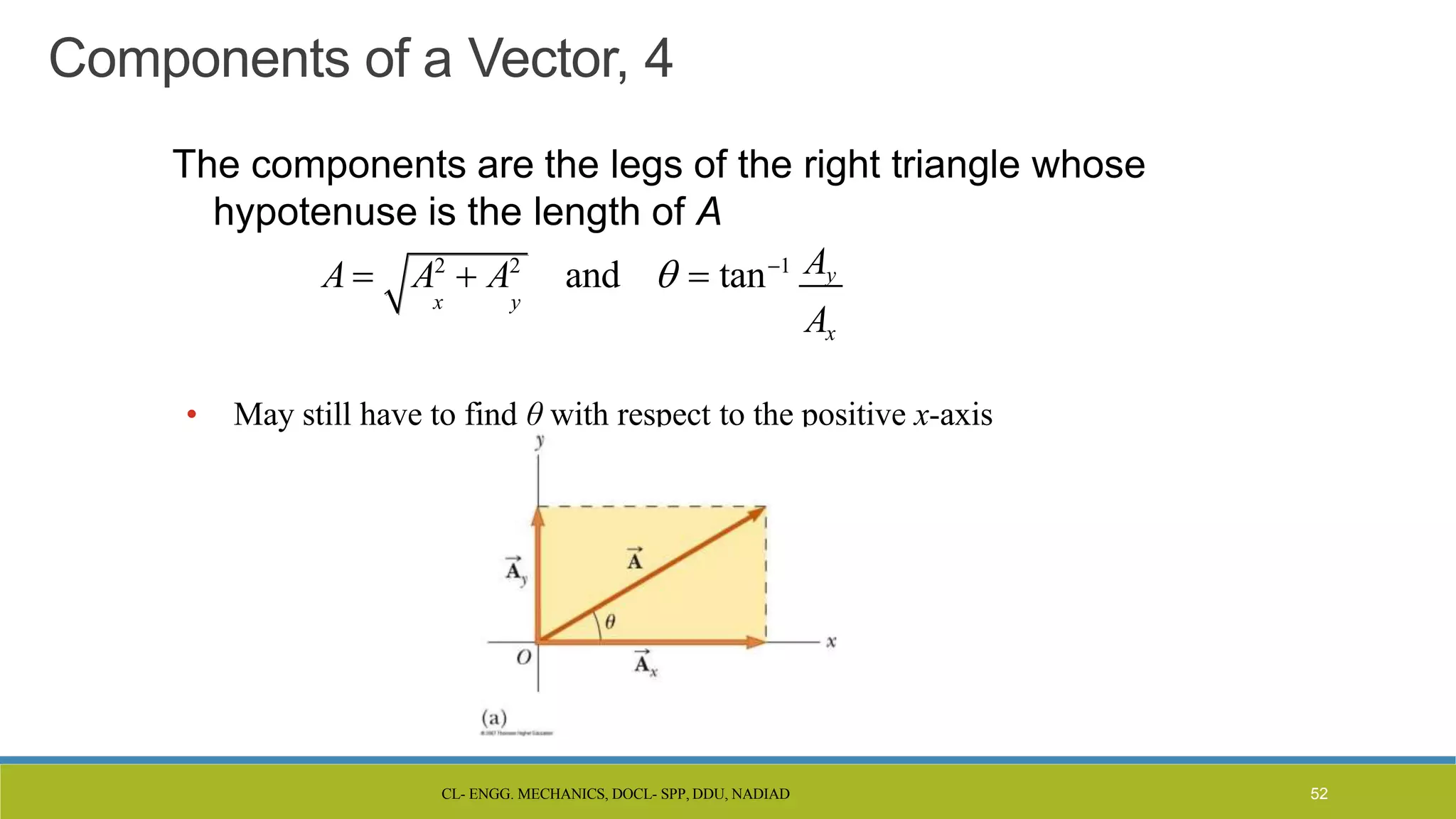
Components of a Vector, 4
The components are the legs of the right triangle whose
hypotenuse is the length of A
• May still have to find θ with respect to the positive x-axis
A  A2
 A2
and   tan1
x y
Ay
Ax
CL- ENGG. MECHANICS, DOCL- SPP, DDU, NADIAD 53
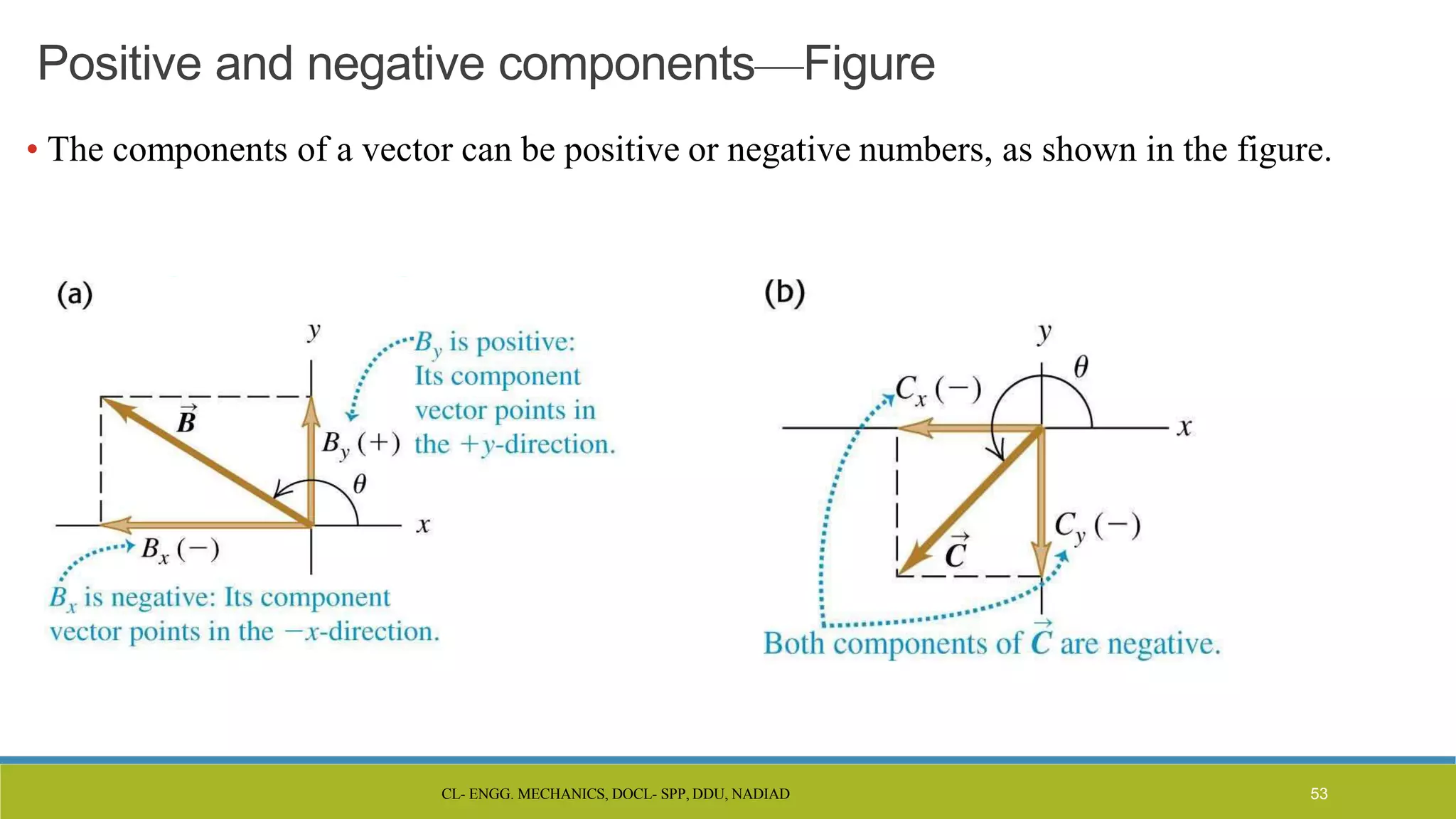
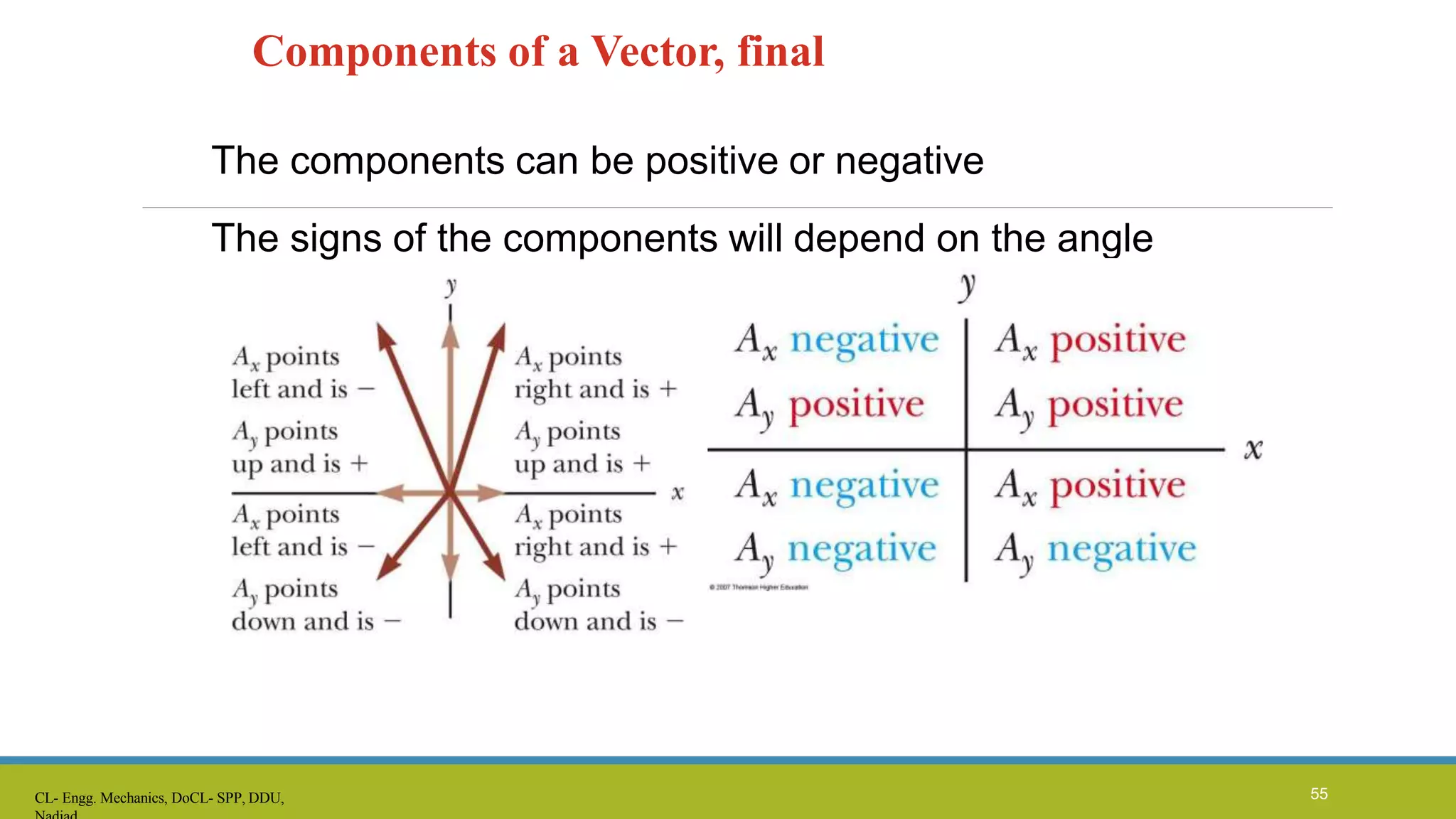
Positive and negative components—Figure
• The components of a vector can be positive or negative numbers, as shown in the figure.
CL- ENGG. MECHANICS, DOCL- SPP, DDU, NADIAD 54
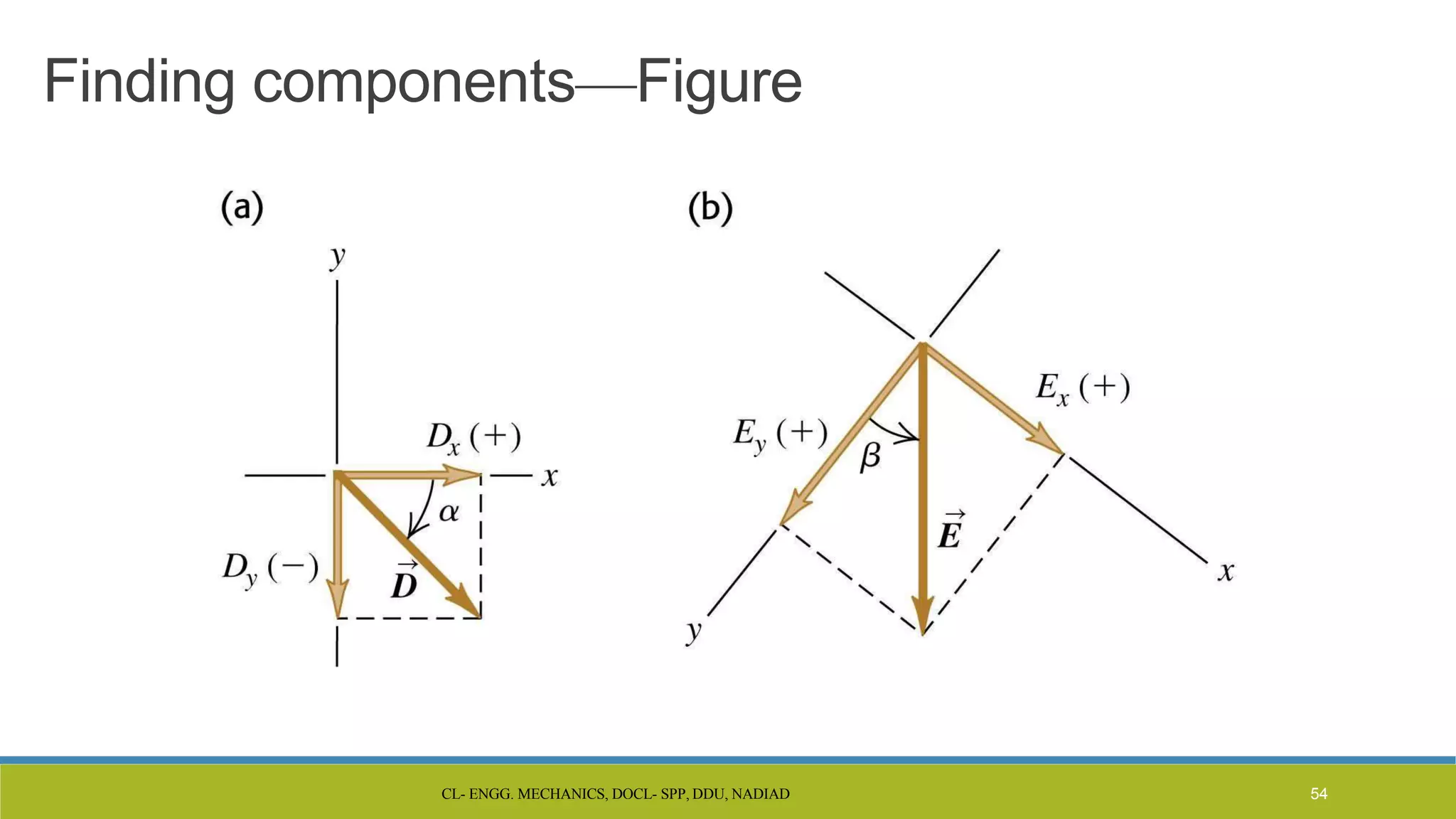
Finding components—Figure
Components of a Vector, final
The components can be positive or negative
The signs of the components will depend on the angle
CL- Engg. Mechanics, DoCL- SPP, DDU, 55
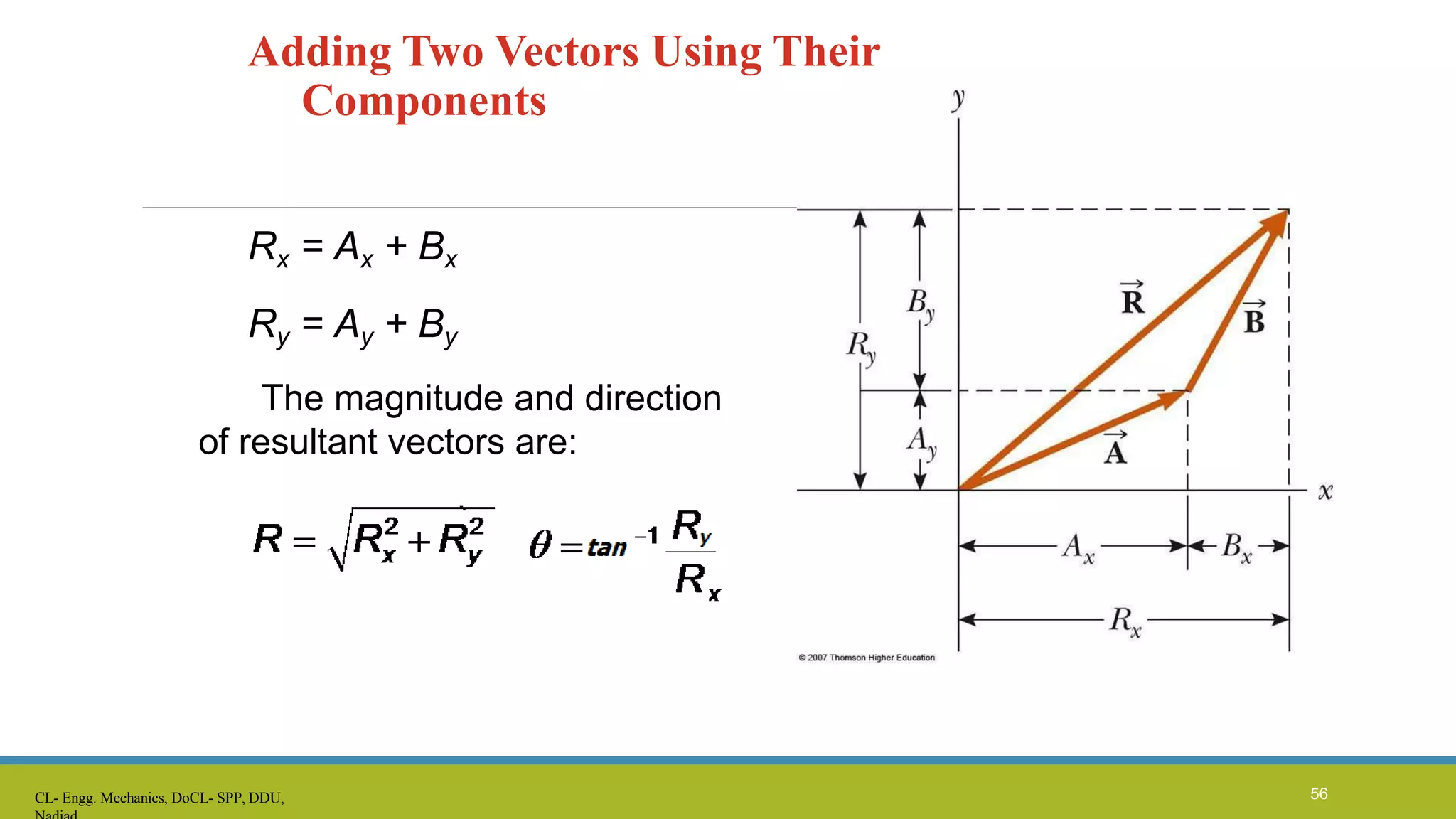
Adding Two Vectors Using Their
Components
Rx = Ax + Bx
Ry = Ay + By
The magnitude and direction
of resultant vectors are:
CL- Engg. Mechanics, DoCL- SPP, DDU, 56
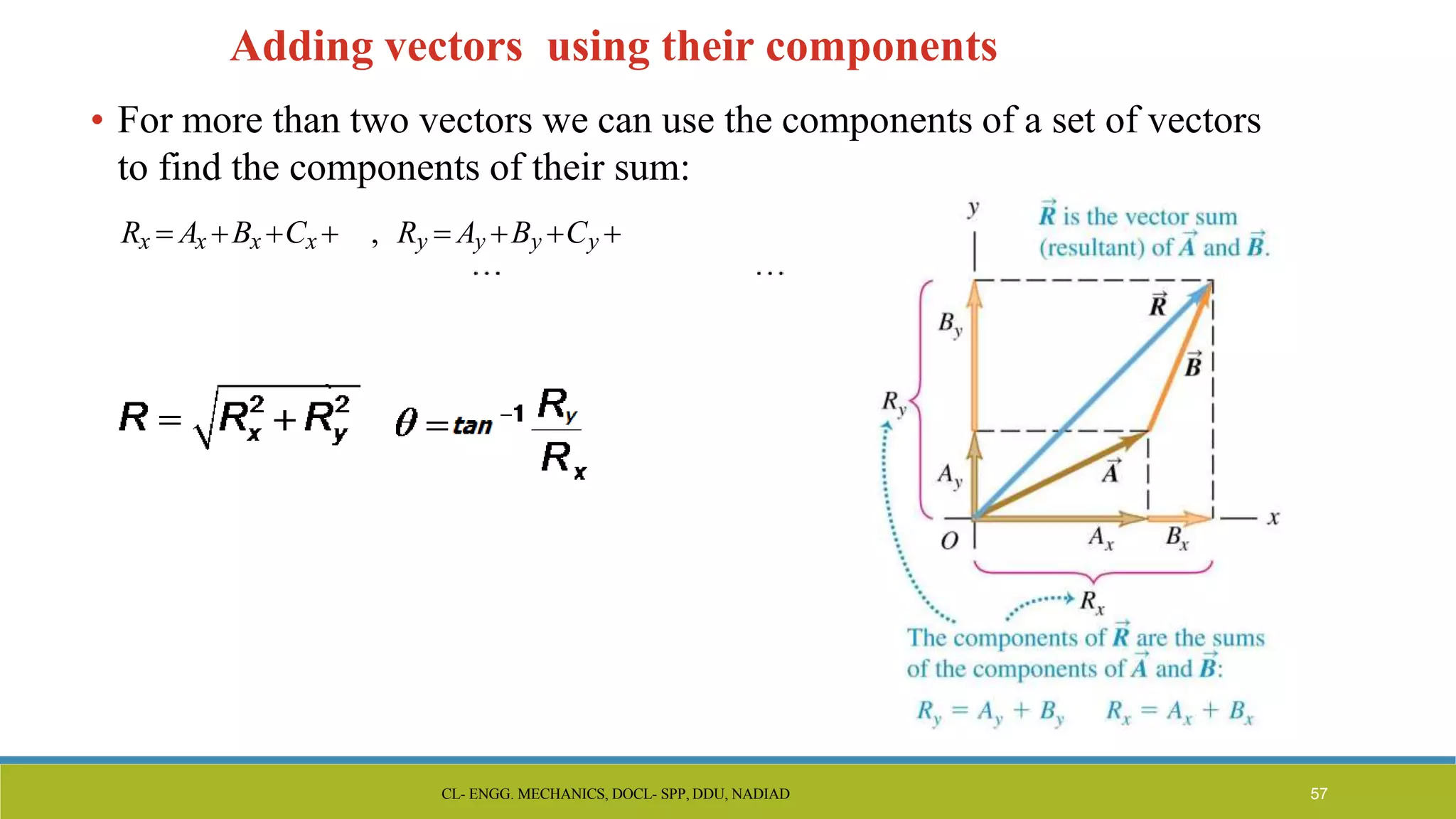
Adding vectors using their components
• For more than two vectors we can use the components of a set of vectors
to find the components of their sum:
Rx  Ax Bx Cx  , Ry  Ay By Cy 
CL- ENGG. MECHANICS, DOCL- SPP, DDU, NADIAD 57
CL- ENGG. MECHANICS, DOCL- SPP, DDU, NADIAD 58
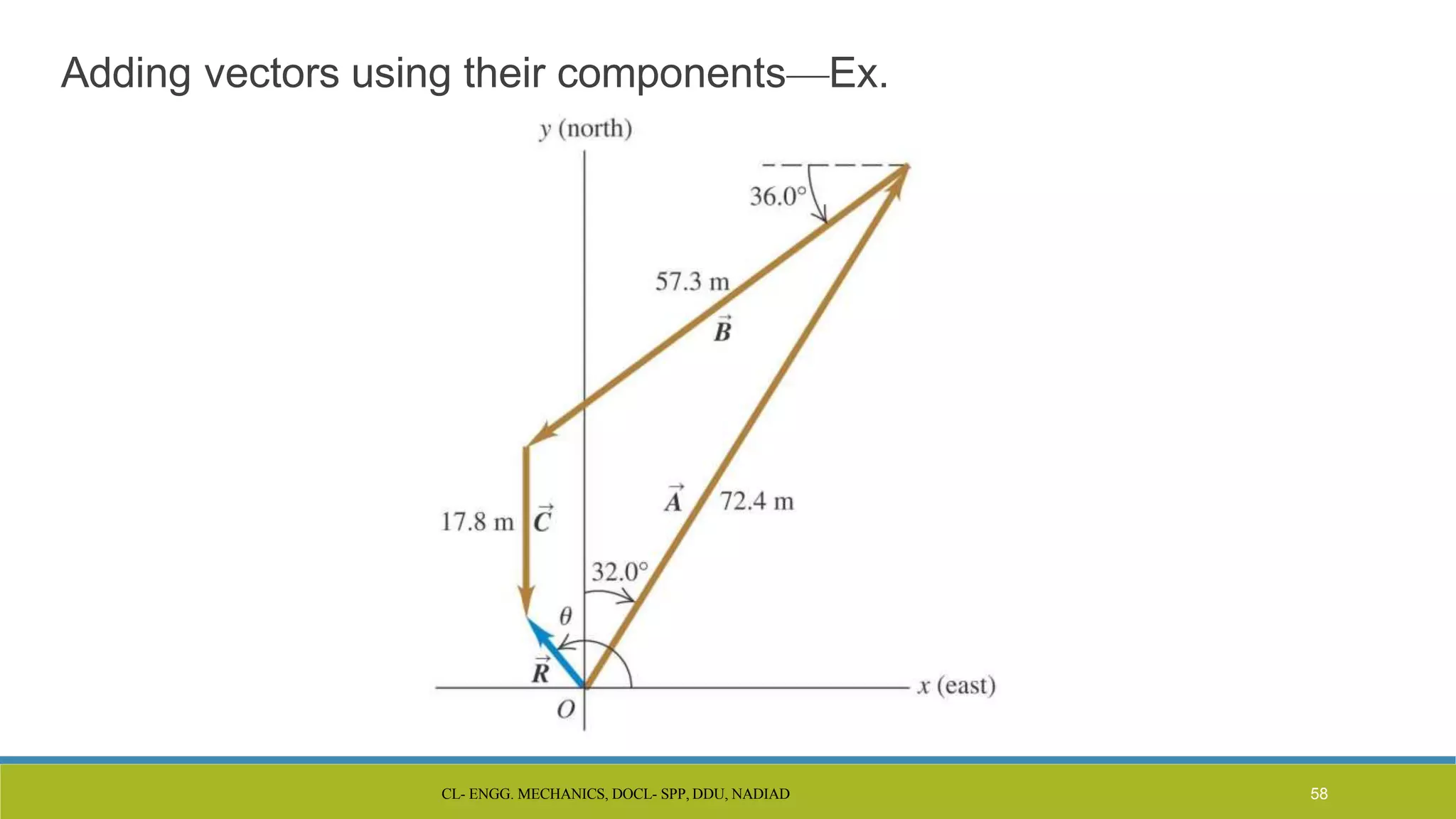
Adding vectors using their components—Ex.
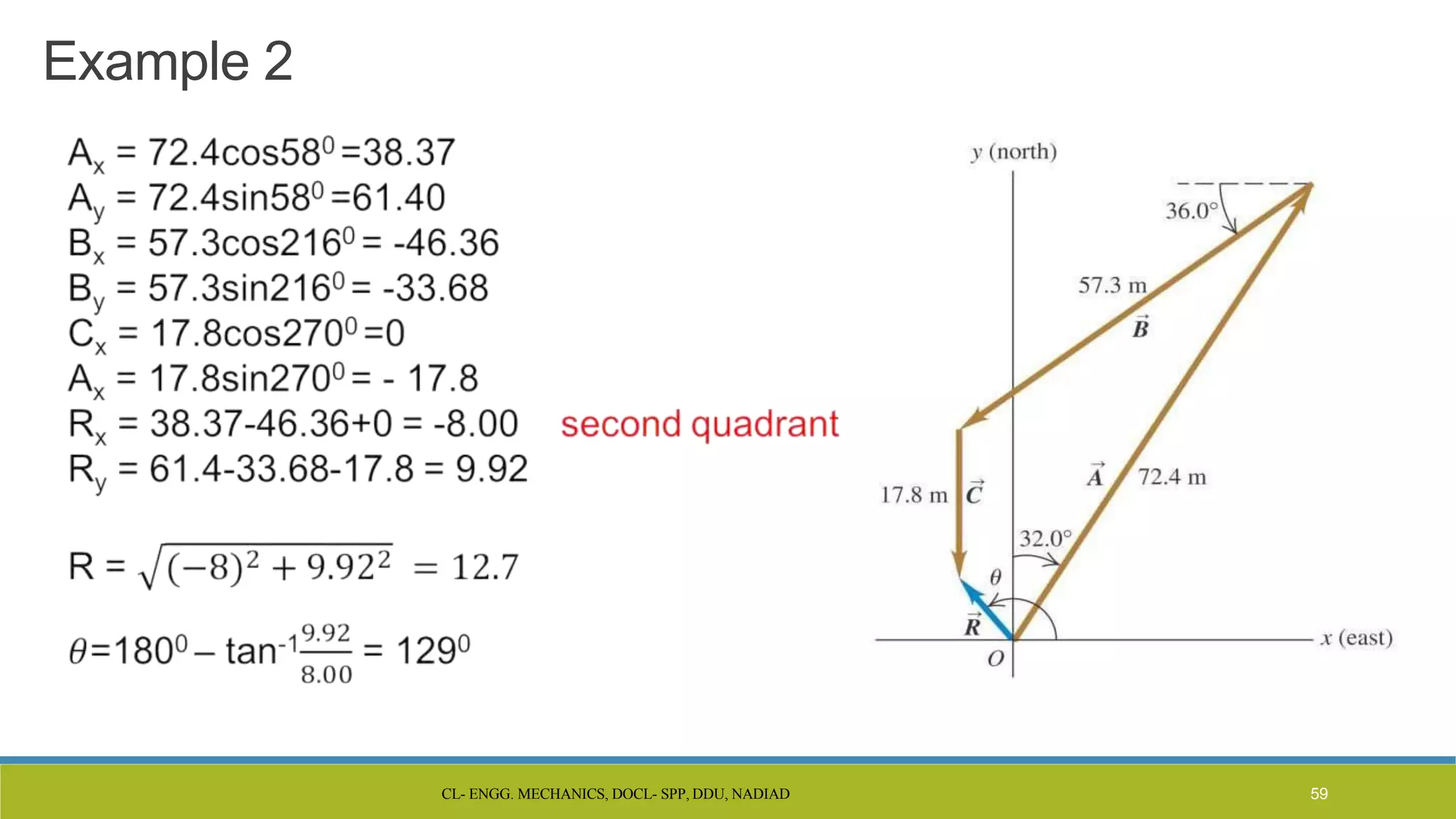
CL- ENGG. MECHANICS, DOCL- SPP, DDU, NADIAD 59
Example 2
CL- ENGG. MECHANICS, DOCL- SPP, DDU, NADIAD 60
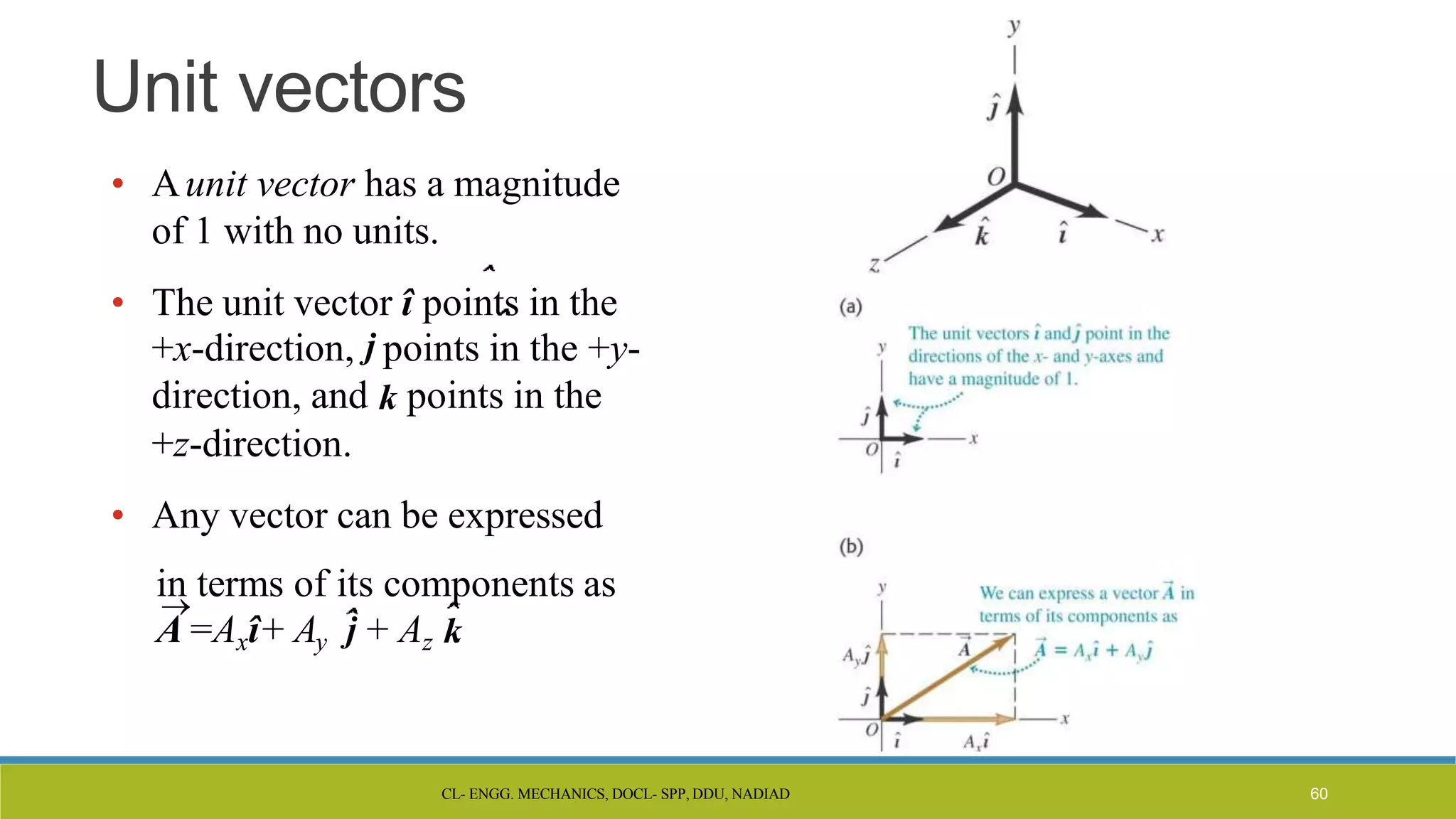
Unit vectors
in terms of its components as
A =Axî+ Ay j + Az k
.
• Aunit vector has a magnitude
of 1 with no units.
• The unit vector î points in the
+x-direction, j points in the +y-
direction, and k points in the
+z-direction.
• Any vector can be expressed

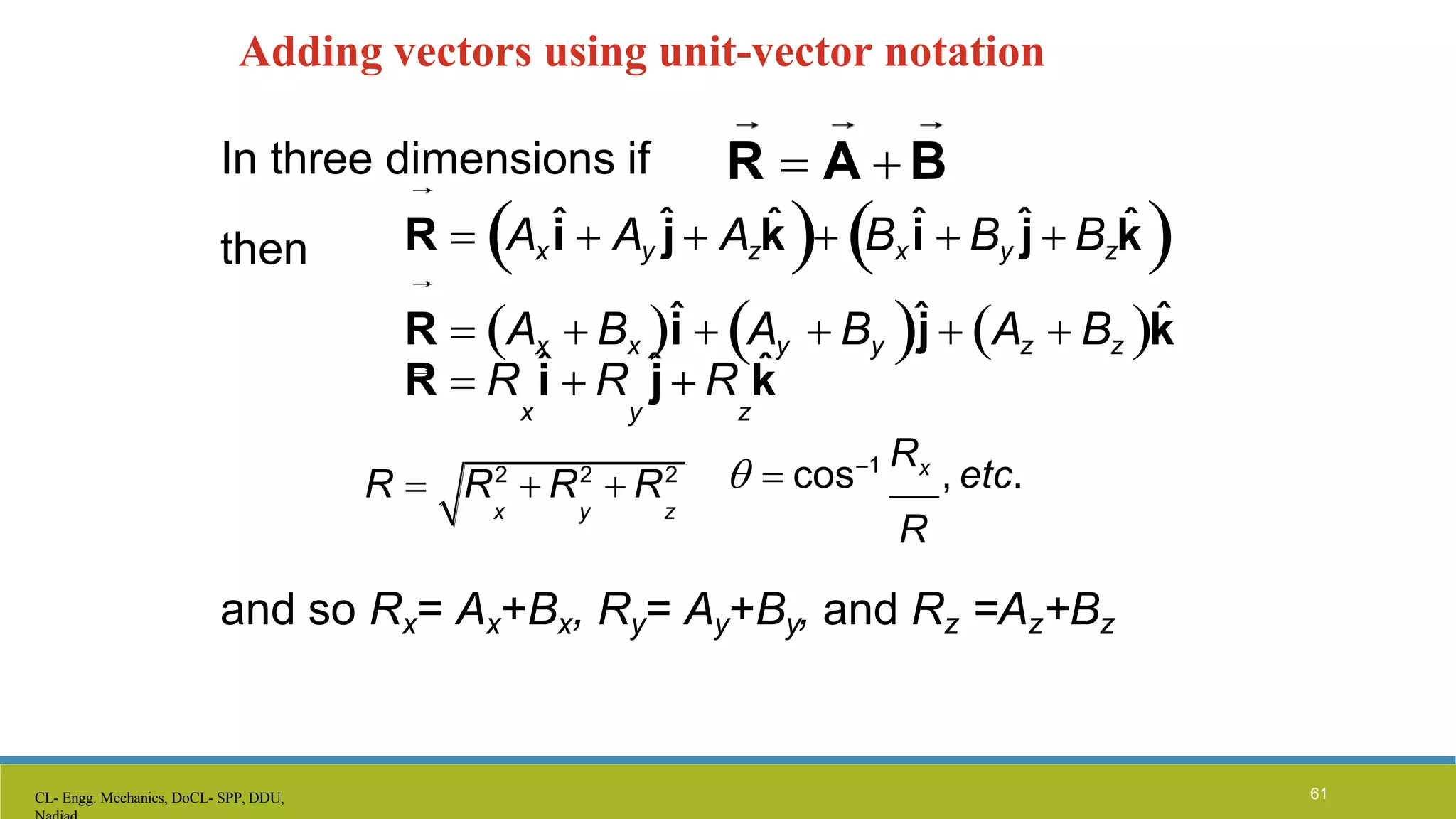
Adding vectors using unit-vector notation
In three dimensions if
then
and so Rx= Ax+Bx, Ry= Ay+By, and Rz =Az+Bz
R  Axî  Ay ĵ  Azk̂ Bxî  By ĵ  Bzk̂
R  Ax  Bx î  Ay  By ĵ  Az  Bz k̂
R  R î  R ĵ  R k̂
x y z
R  R2
 R2
 R2
x y z
  cos1 Rx
, etc.
R
R  A  B
CL- Engg. Mechanics, DoCL- SPP, DDU, 61
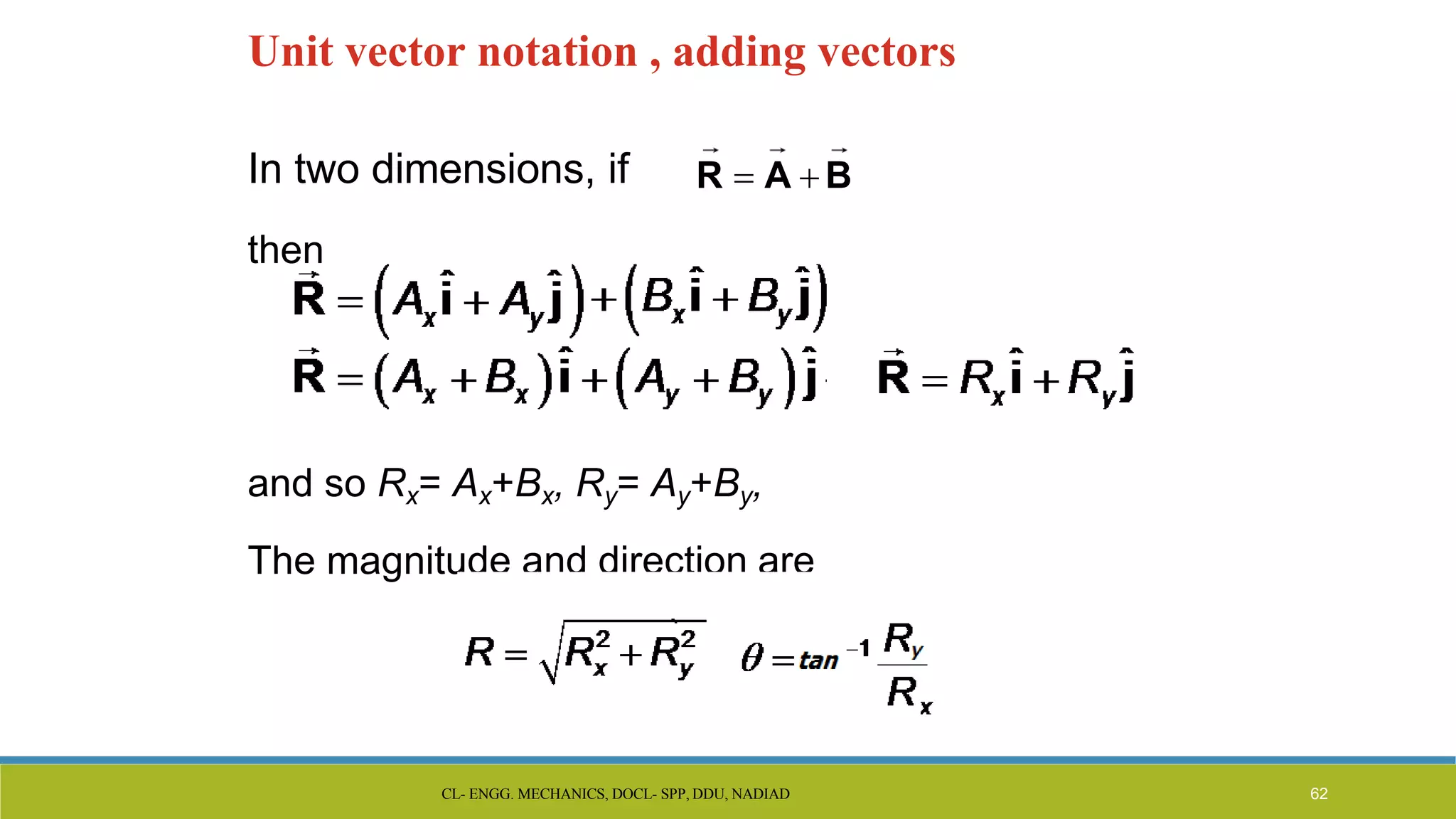
Unit vector notation , adding vectors
In two dimensions, if
then
and so Rx= Ax+Bx, Ry= Ay+By,
The magnitude and direction are
R  A  B
CL- ENGG. MECHANICS, DOCL- SPP, DDU, NADIAD 62
CL- ENGG. MECHANICS, DOCL- SPP, DDU, NADIAD 63
Example 3
If A = 24i-32j and B=24i+10j, what is the
magnitude and direction of the vector C = A-B?
CL- ENGG. MECHANICS, DOCL- SPP, DDU, NADIAD 64
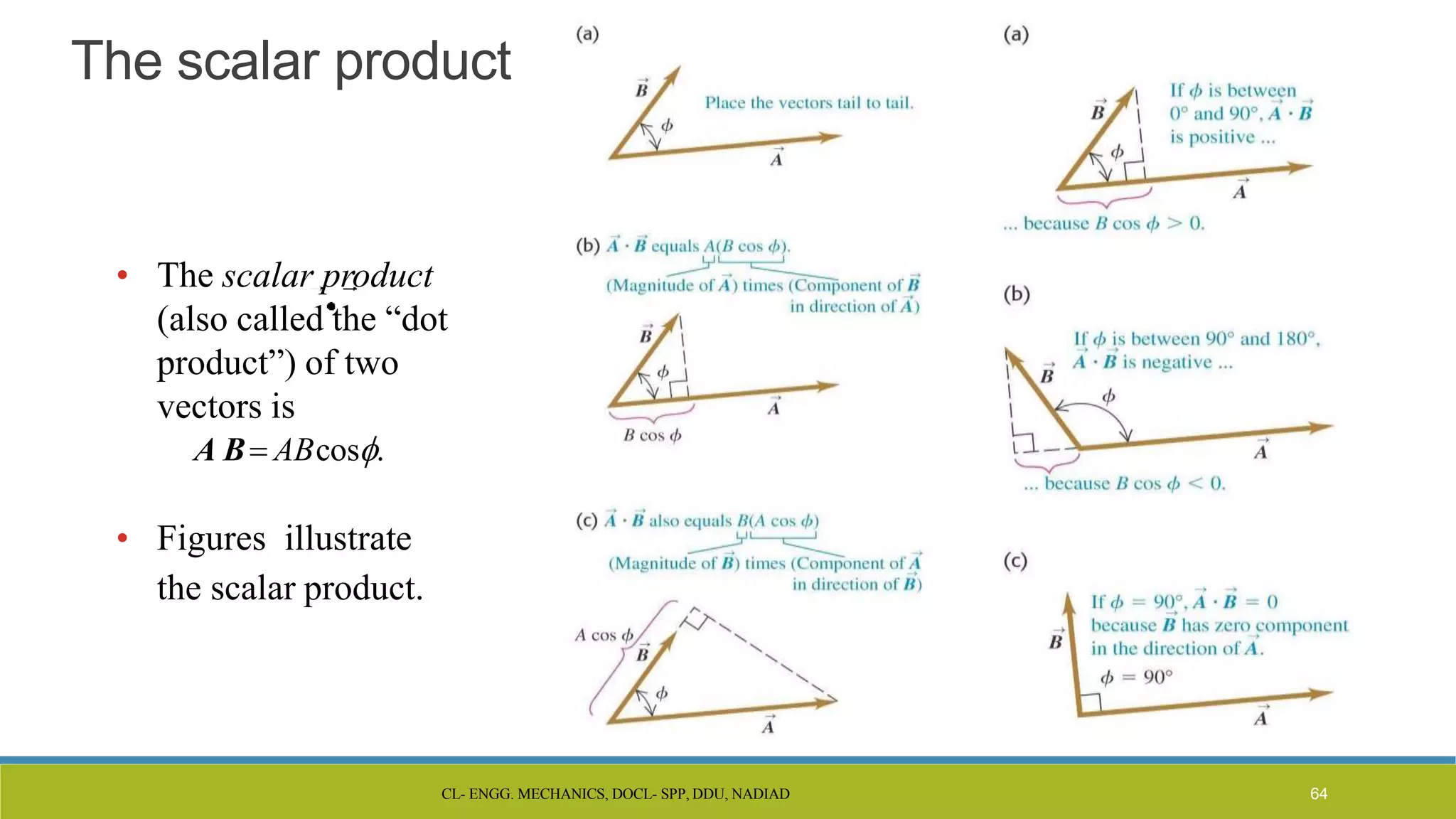
The scalar product
• The scalar product
(also called the “dot
product”) of two
vectors is
A B ABcos.
• Figures illustrate
the scalar product.
CL- ENGG. MECHANICS, DOCL- SPP, DDU, NADIAD 65
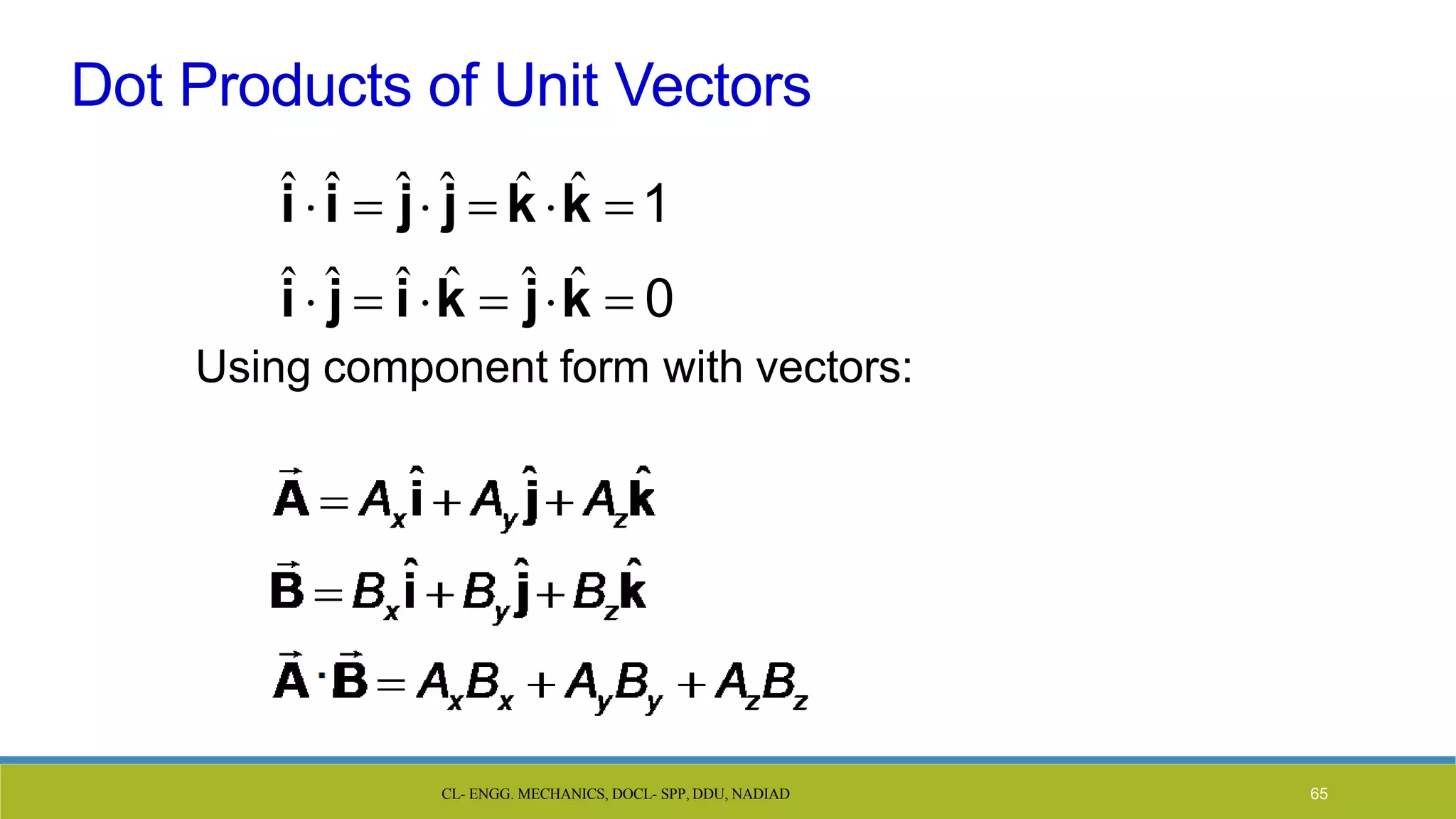
Dot Products of Unit Vectors
î î  ĵ ĵ  k̂k̂ 1
î  ĵ  î k̂  ĵk̂  0
Using component form with vectors:
CL- ENGG. MECHANICS, DOCL- SPP, DDU, NADIAD
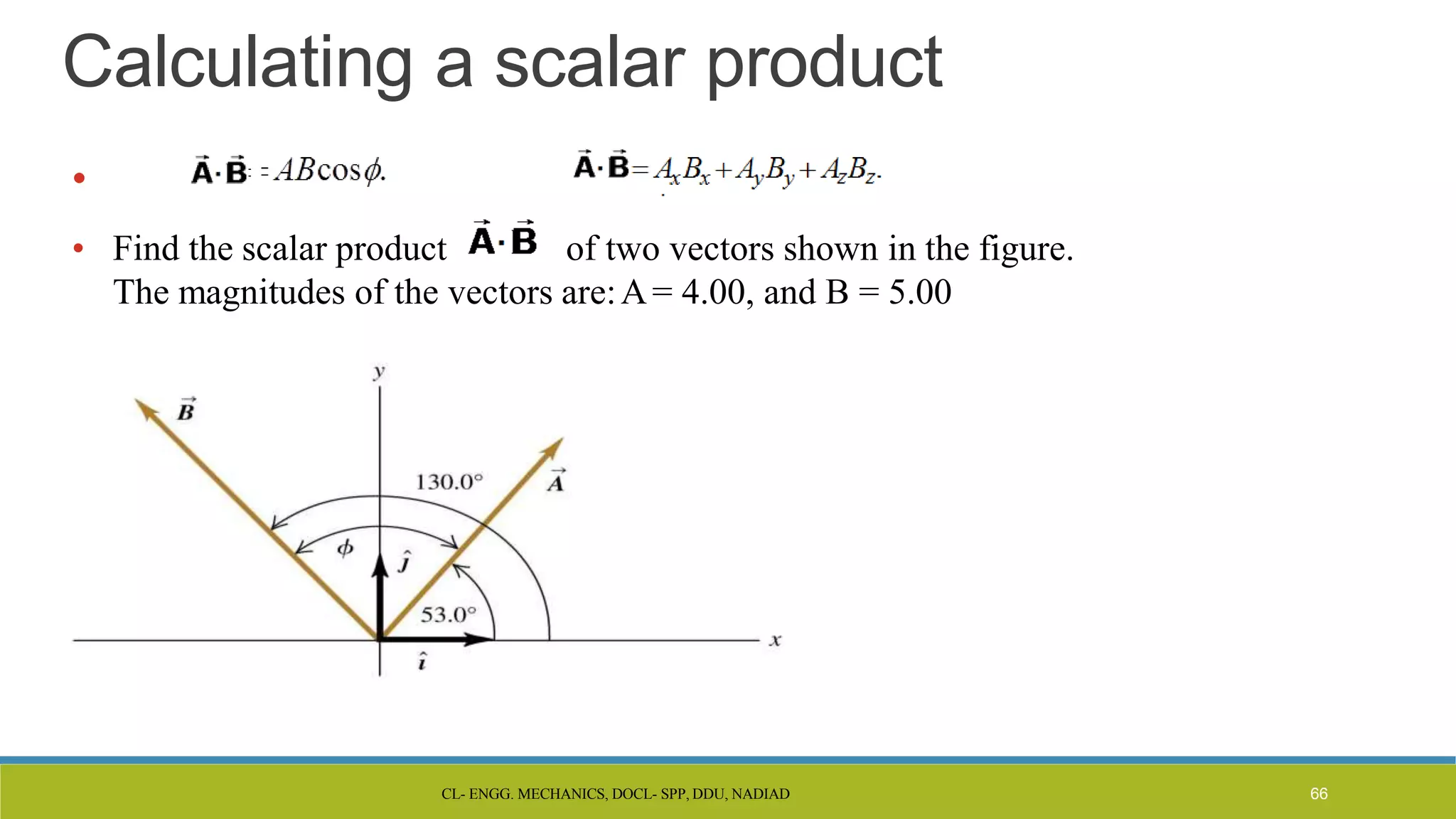
Calculating a scalar product
•
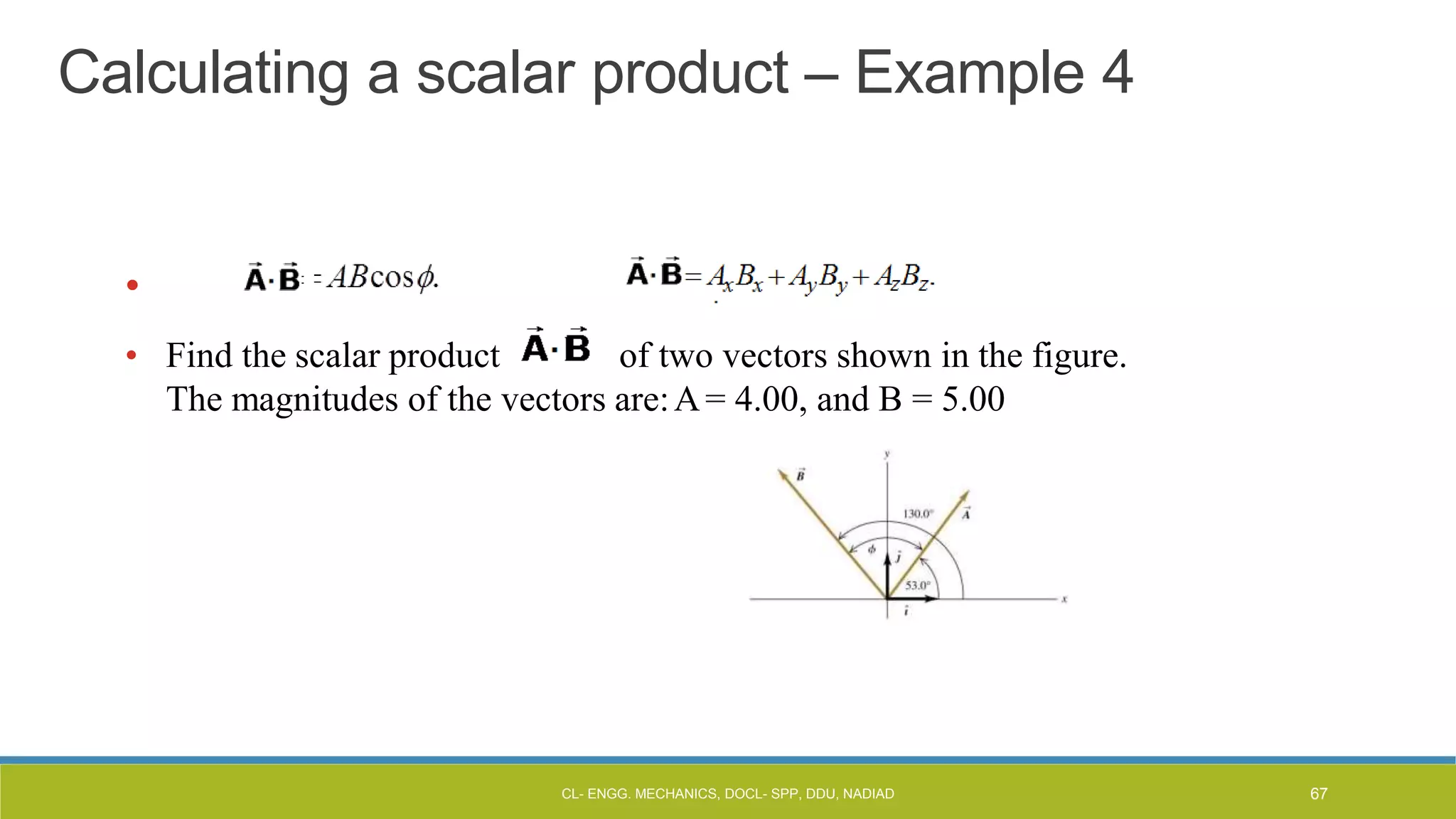
• Find the scalar product of two vectors shown in the figure.
The magnitudes of the vectors are:A= 4.00, and B = 5.00
66
Calculating a scalar product – Example 4
•
• Find the scalar product of two vectors shown in the figure.
The magnitudes of the vectors are:A= 4.00, and B = 5.00
CL- ENGG. MECHANICS, DOCL- SPP, DDU, NADIAD 67
Finding an angle using the scalar product – Ex. 5
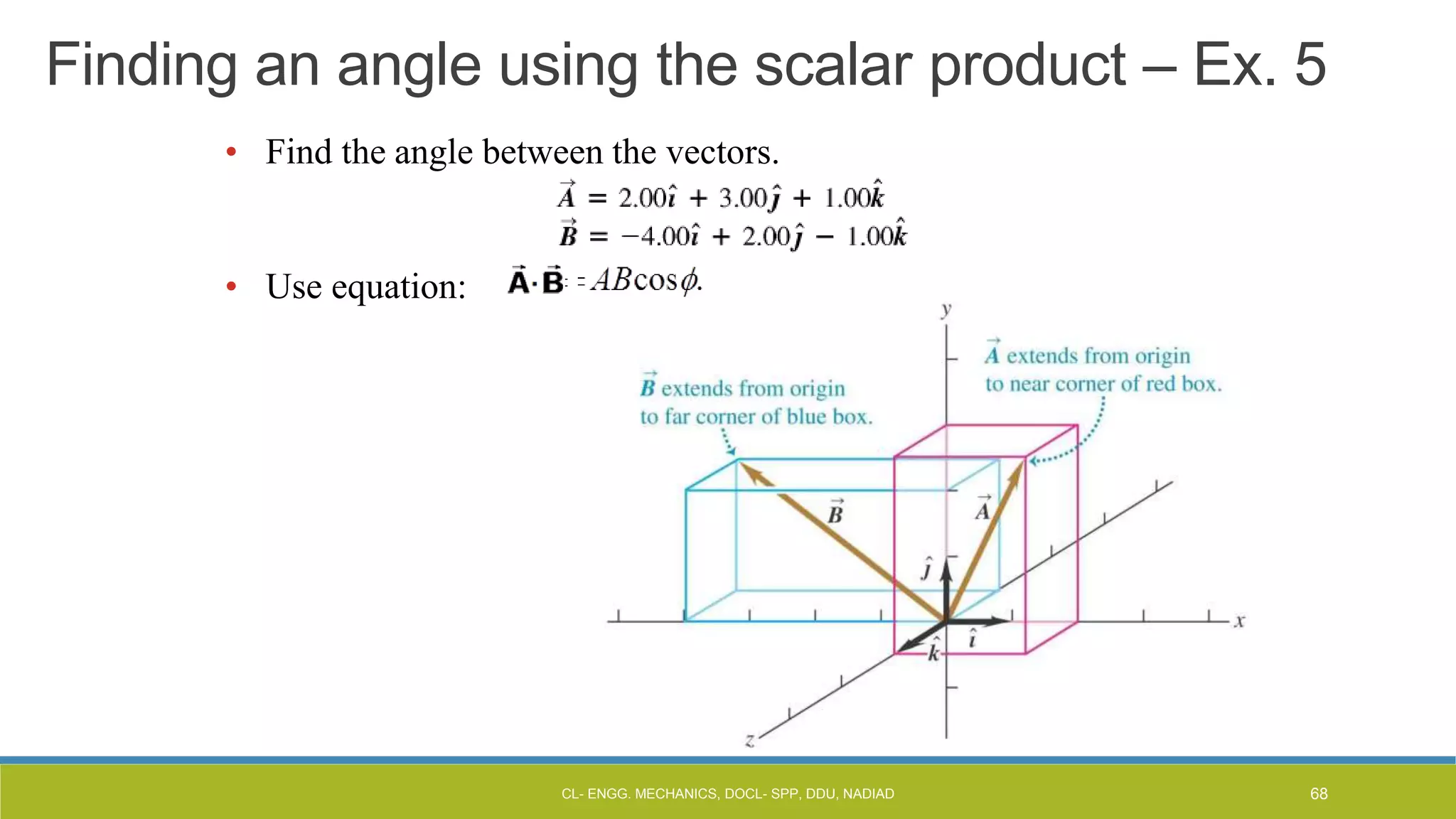
• Find the angle between the vectors.
• Use equation:
CL- ENGG. MECHANICS, DOCL- SPP, DDU, NADIAD 68
CL- ENGG. MECHANICS, DOCL- SPP, DDU, NADIAD
Finding an angle using the scalar
product – Ex. 5
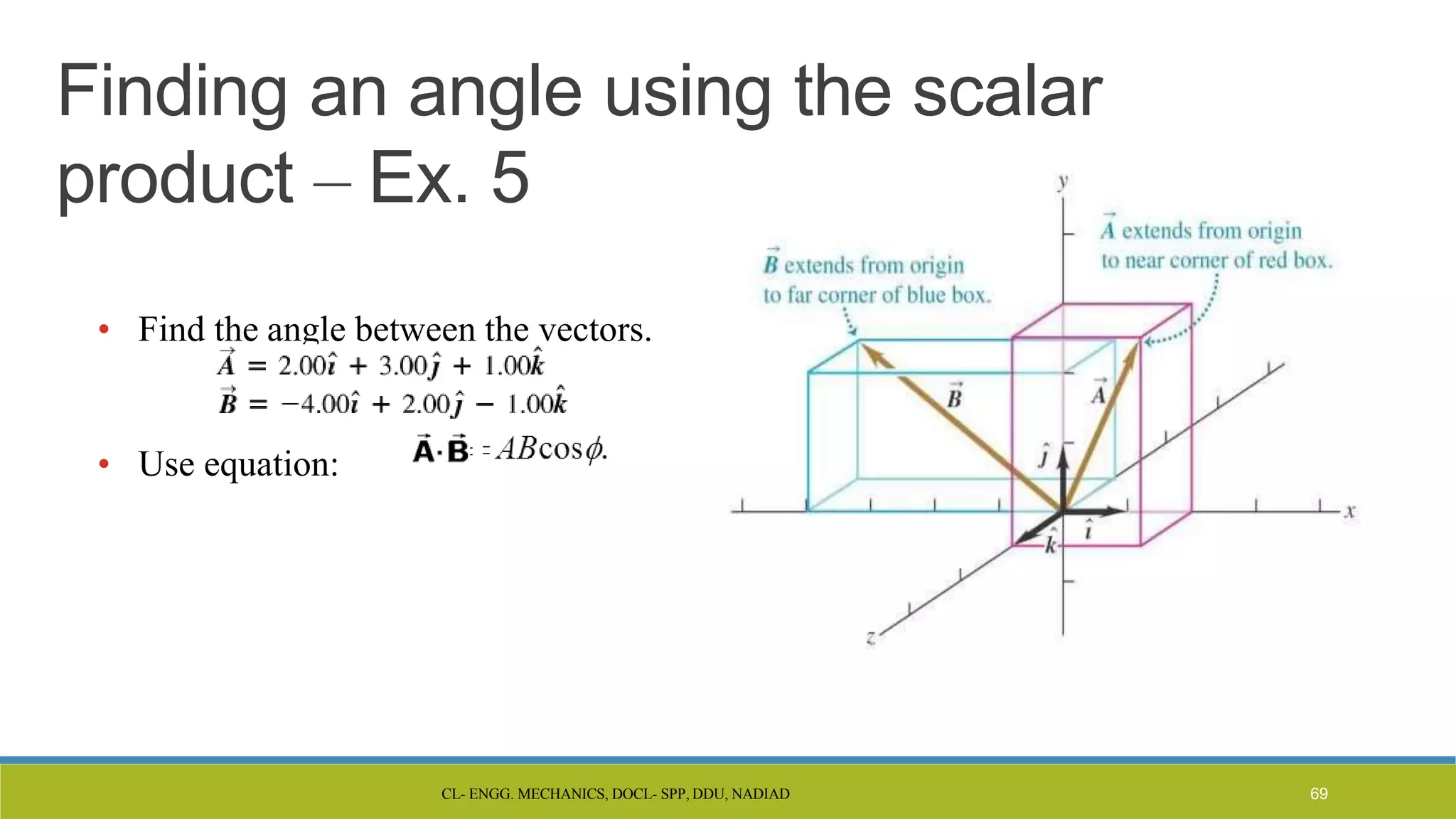
• Find the angle between the vectors.
• Use equation:
69
The Vector Product Defined
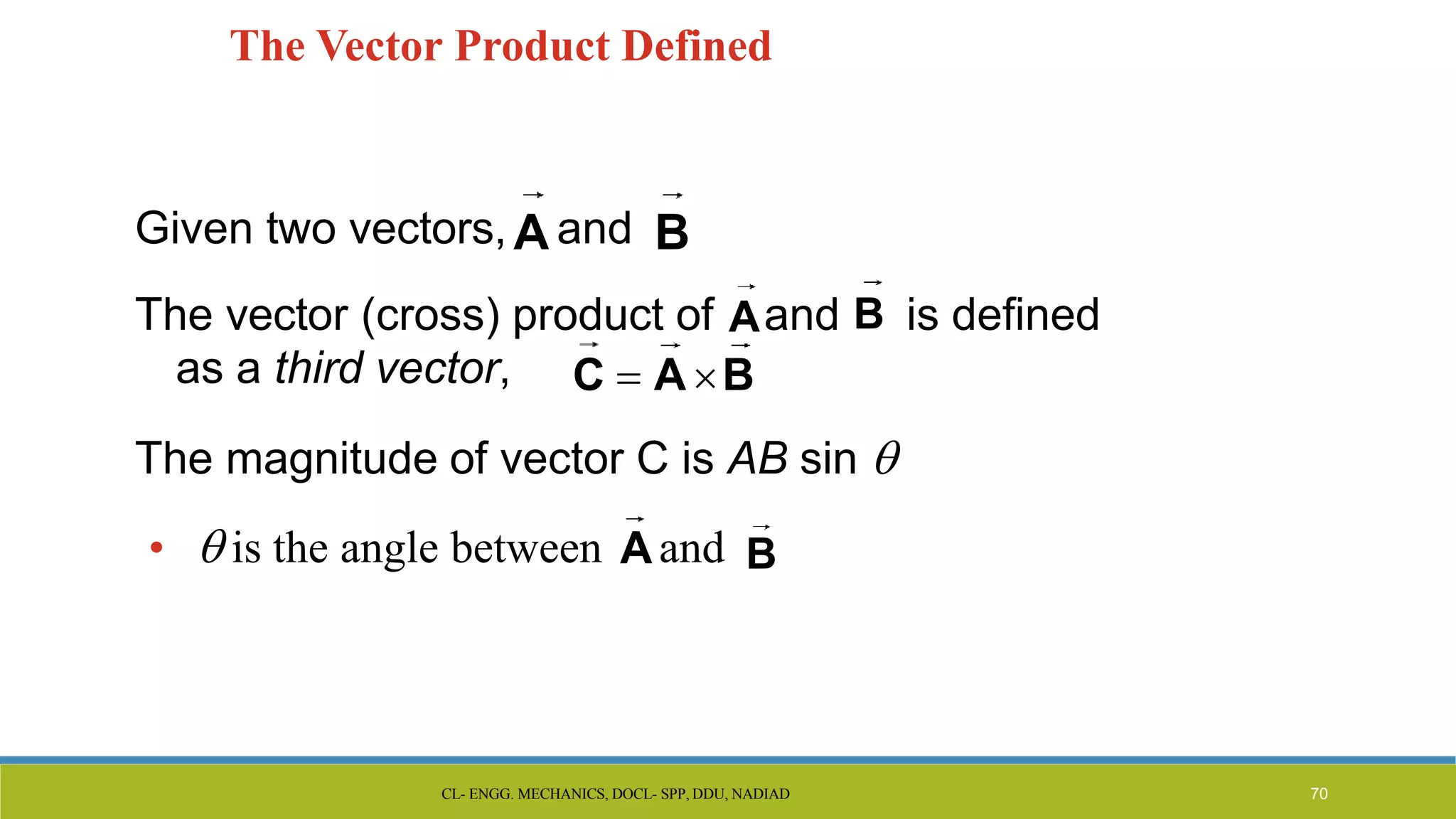
Given two vectors, A and B
The vector (cross) product of Aand B is defined
as a third vector,
The magnitude of vector C is AB sin 
•  is the angle between Aand B
C  A B
CL- ENGG. MECHANICS, DOCL- SPP, DDU, NADIAD 70
More About the Vector Product
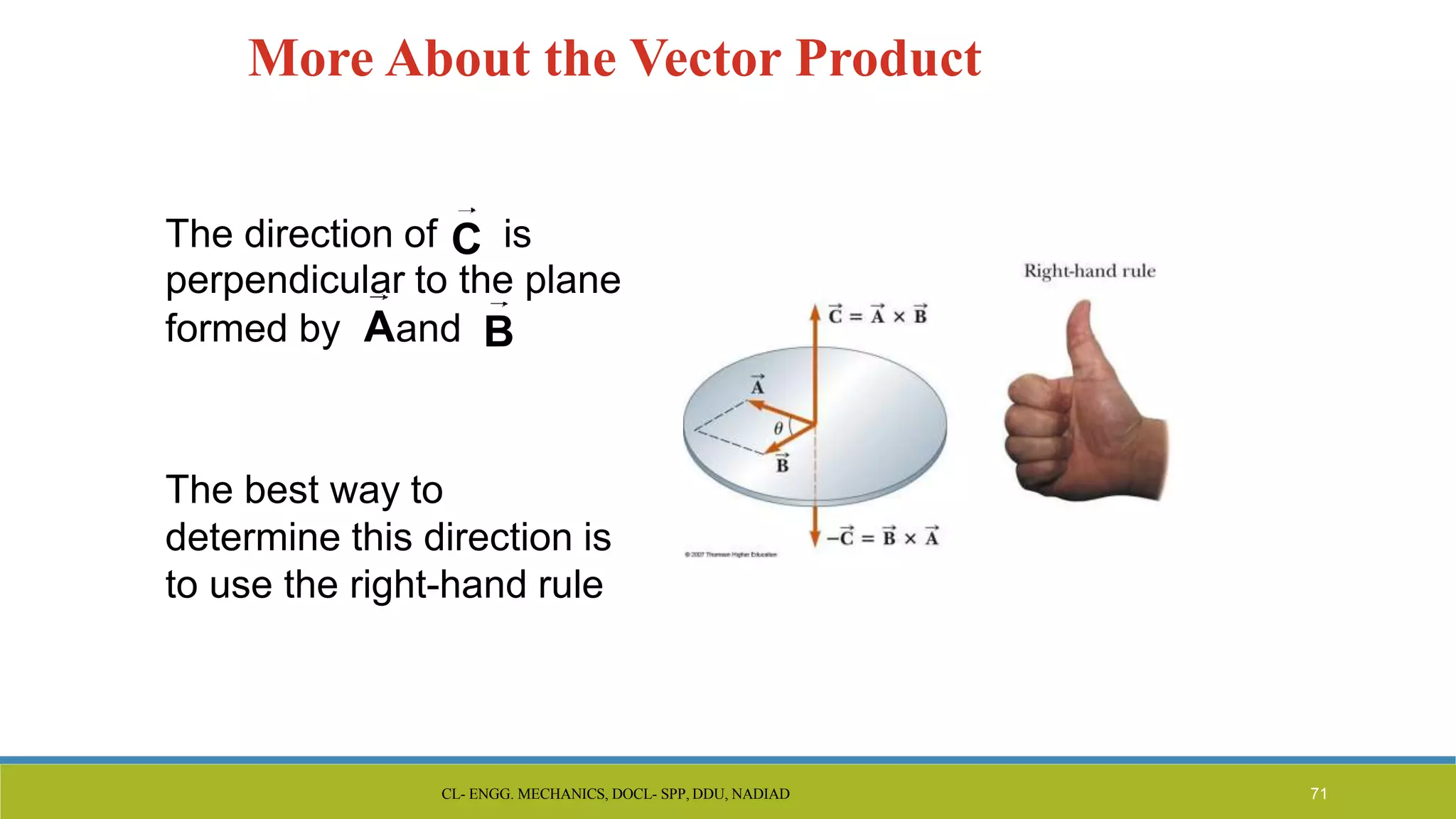
The direction of C is
perpendicular to the plane
formed by Aand B
The best way to
determine this direction is
to use the right-hand rule
CL- ENGG. MECHANICS, DOCL- SPP, DDU, NADIAD 71
Using Determinants
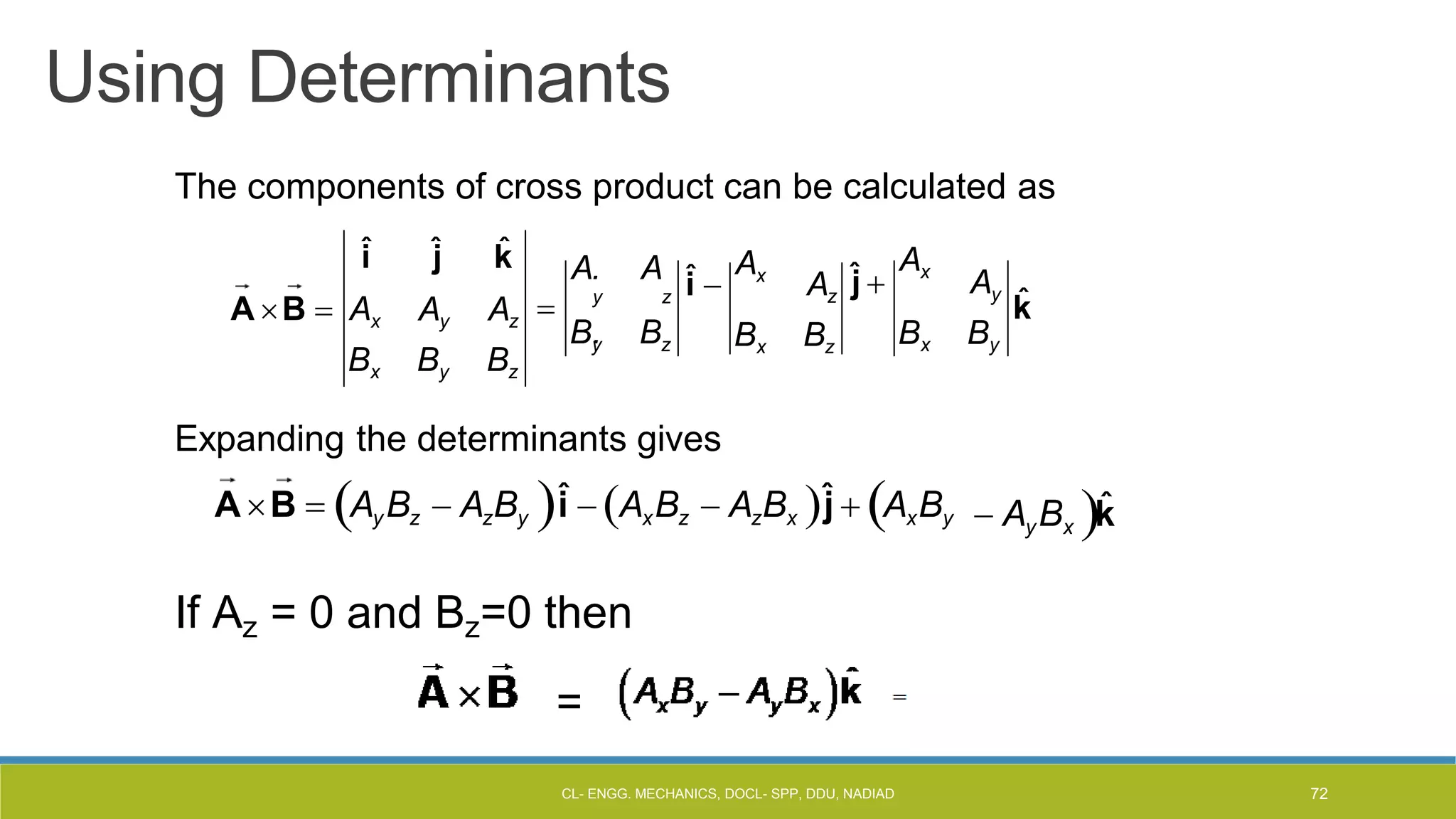
The components of cross product can be calculated as
Expanding the determinants gives
AB  AyBz  AzBy î  AxBz  AzBx ĵ  AxBy
If Az = 0 and Bz=0 then
=
î ĵ k̂
A A
î 
Ax
ĵ 
Ax
k̂
A. A
 y z
B. B
Ay
B B
Az
B B
x y z
y z x y
x z
x y z
A B  A
B B B
 AyBx k̂
CL- ENGG. MECHANICS, DOCL- SPP, DDU, NADIAD 72
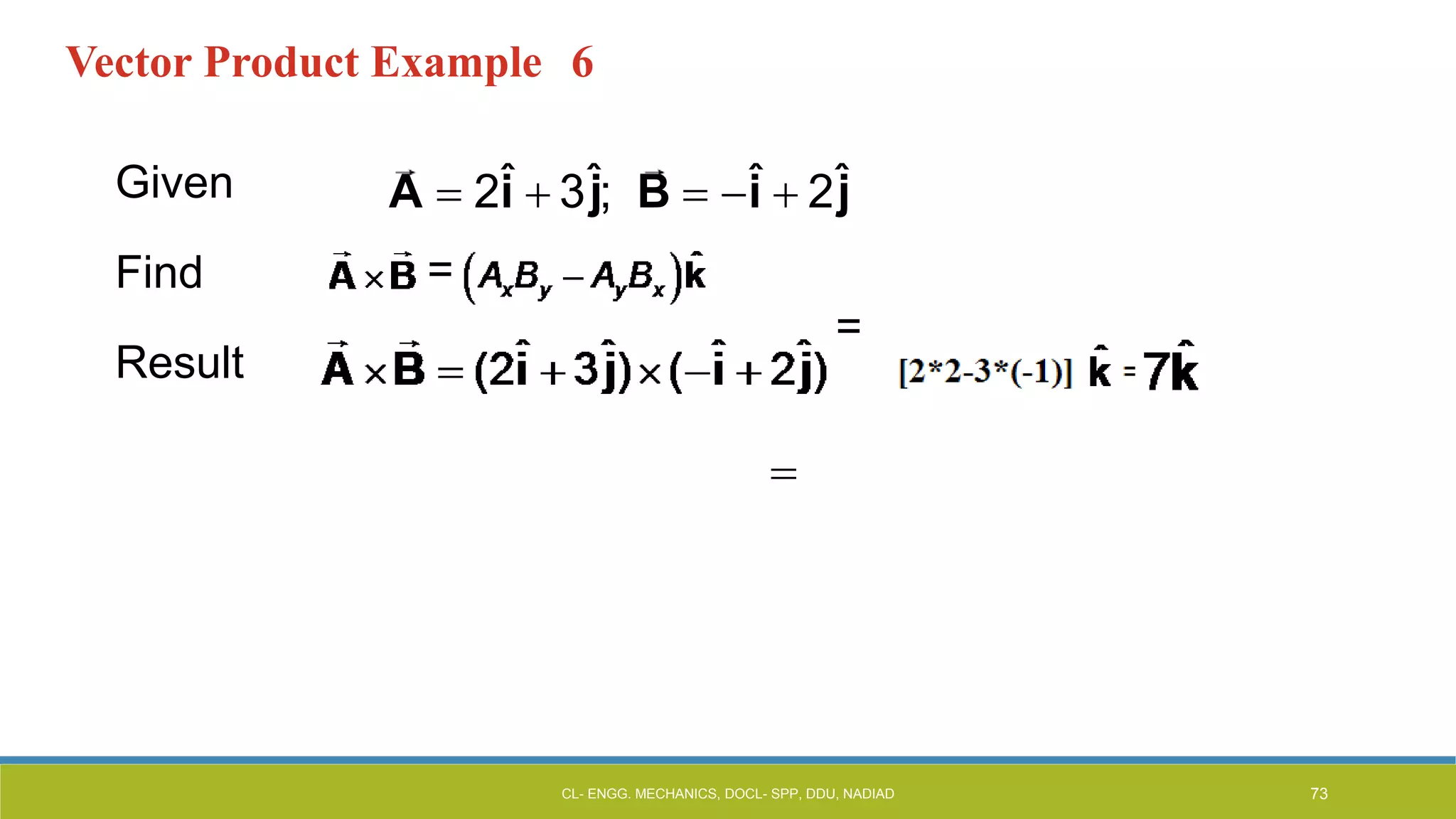
Vector Product Example 6
Given
Find
Result
A  2î  3ĵ; B  î  2ĵ
=
=
CL- ENGG. MECHANICS, DOCL- SPP, DDU, NADIAD 73
CL- ENGG. MECHANICS, DOCL- SPP, DDU, NADIAD
The vector product—Summary
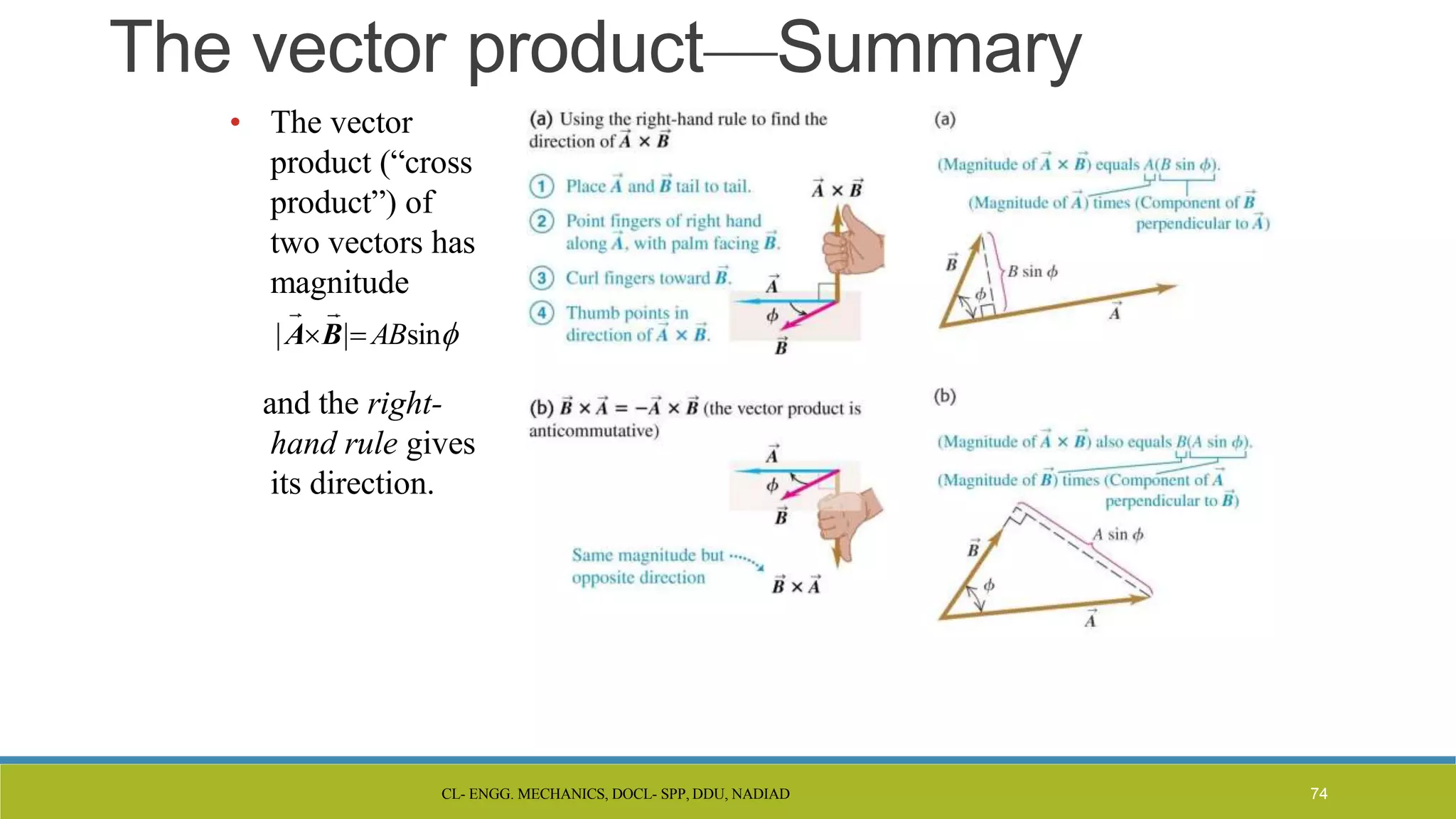
• The vector
product (“cross
product”) of
two vectors has
magnitude
|AB| ABsin
and the right-
hand rule gives
its direction.
74
CL- ENGG. MECHANICS, DOCL- SPP, DDU, NADIAD
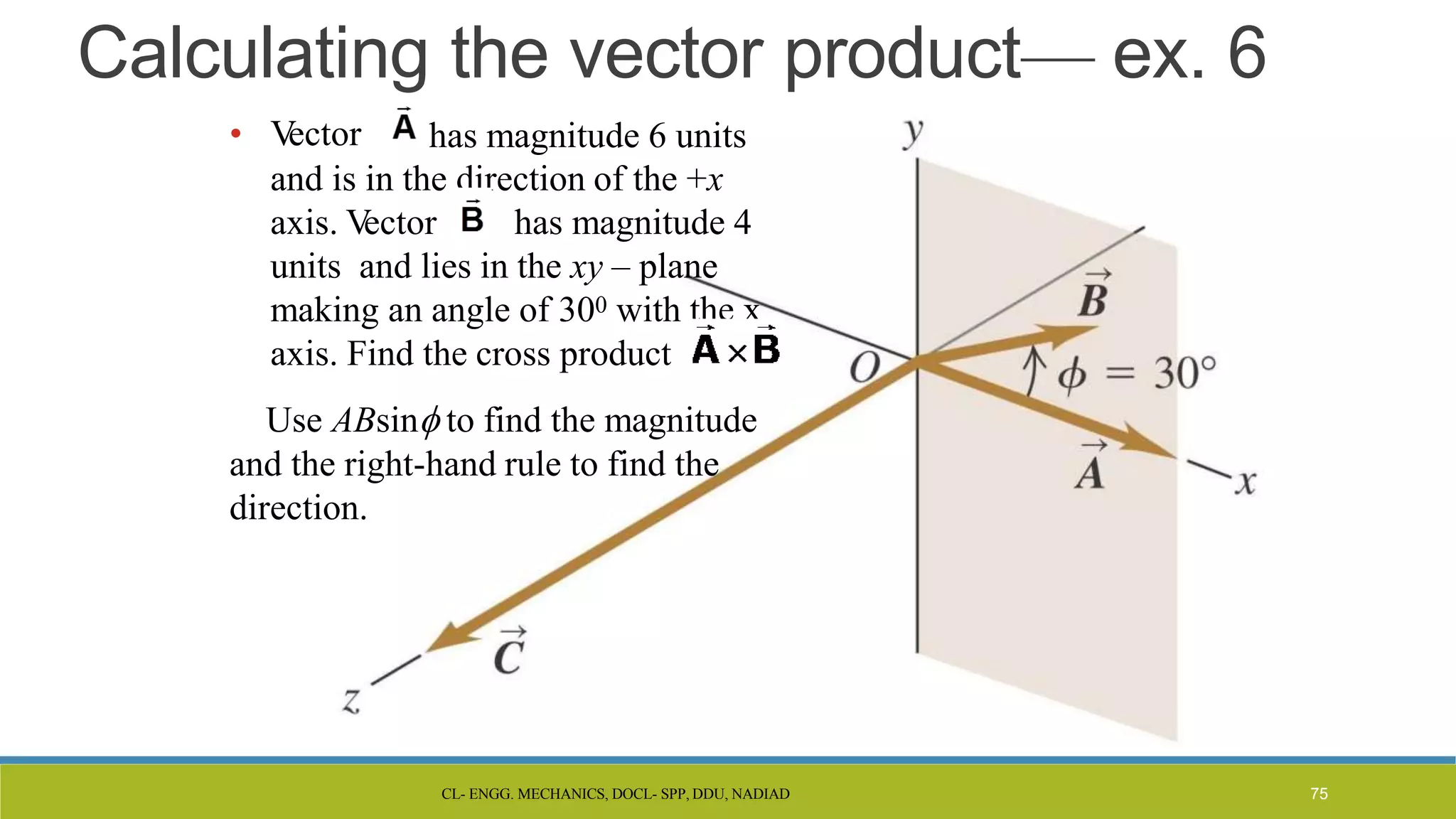
Calculating the vector product— ex. 6
• V
ector has magnitude 6 units
and is in the direction of the +x
axis. V
ector has magnitude 4
units and lies in the xy – plane
making an angle of 300 with the x
axis. Find the cross product
Use ABsin to find the magnitude
and the right-hand rule to find the
direction.
75
Accuracy of
Calculations
CL- ENGG. MECHANICS, DOCL- SPP, DDU, NADIAD 76
NUMERICAL ACCURACY
The accuracy of a solution depends on
1. Accuracy of the given data.
2. Accuracy of the computations performed. The solution cannot be more
accurate than the less accurate of these two.
3. The use of hand calculators and computers generally makes the
accuracy of the computations much greater than the accuracy of the
data. Hence, the solution accuracy is usually limited by the data
accuracy.
CL- ENGG. MECHANICS, DOCL- SPP, DDU, NADIAD 77
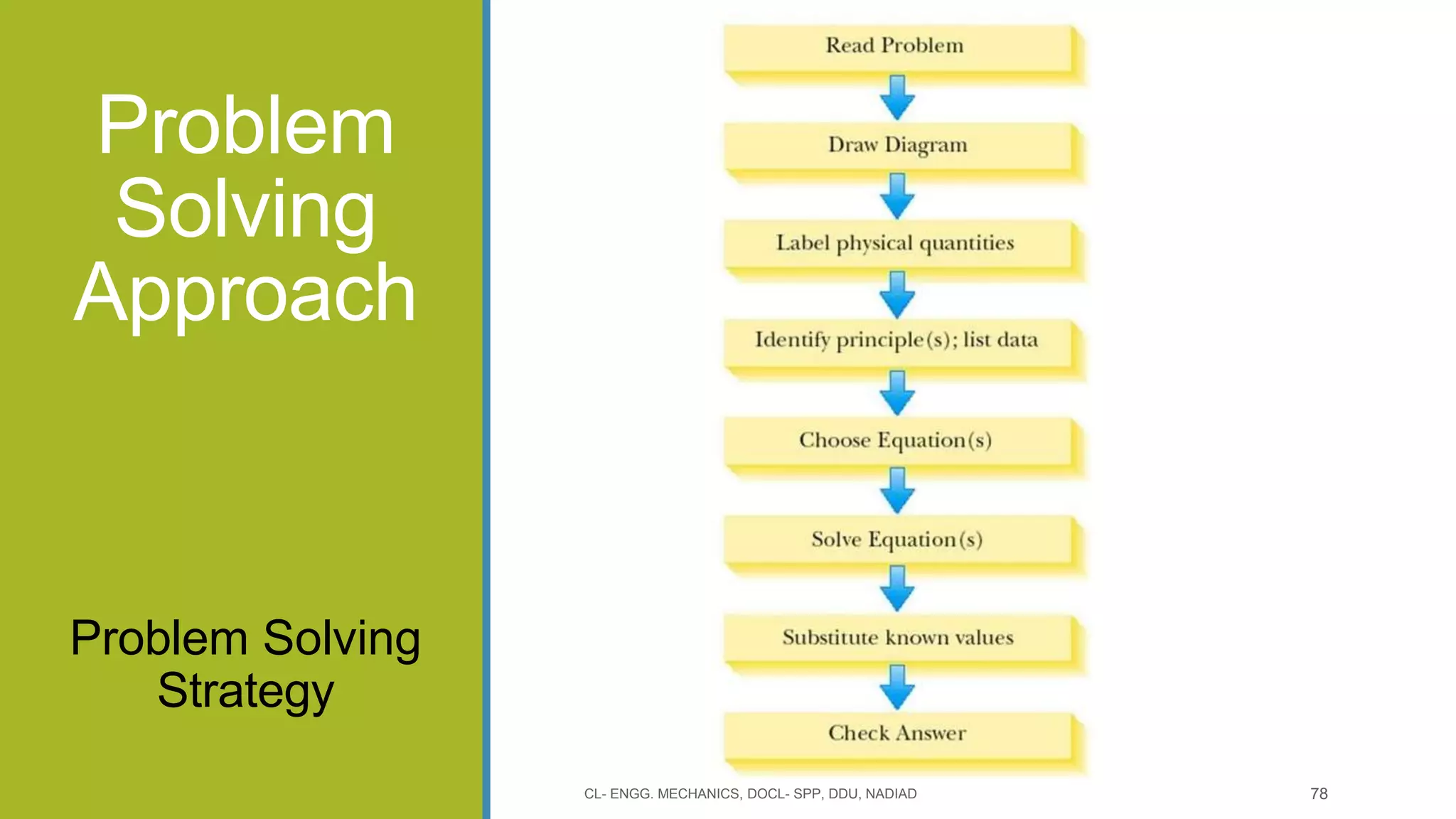
Problem
Solving
Approach
Problem Solving
Strategy
CL- ENGG. MECHANICS, DOCL- SPP, DDU, NADIAD 78
Problem Solving Strategy
• Read the problem
– Identify the nature of the problem
• Draw a diagram
– Some types of problems require very specific types of diagrams
CL- ENGG. MECHANICS, DOCL- SPP, DDU, NADIAD 79
Problem Solving cont.
• Label the physical quantities
– Can label on the diagram
– Use letters that remind you of the quantity
• Many quantities have specific letters
– Choose a coordinate system and label it
• Identify principles and list data
– Identify the principle involved
– List the data (given information)
– Indicate the unknown (what you are looking for)
CL- ENGG. MECHANICS, DOCL- SPP, DDU, NADIAD 80
Problem Solving, cont.
• Choose equation(s)
– Based on the principle, choose an equation or
set of equations to apply to the problem
• Substitute into the equation(s)
– Solve for the unknown quantity
– Substitute the data into the equation
– Obtain a result
– Include units
CL- ENGG. MECHANICS, DOCL- SPP, DDU, NADIAD 81
Problem Solving, final
• Check the answer
– Do the units match?
• Are the units correct for the quantity being found?
– Does the answer seem reasonable?
• Check order of magnitude
– Are signs appropriate and meaningful?
CL- ENGG. MECHANICS, DOCL- SPP, DDU, NADIAD 82
Problem Solving Summary
• Equations are the tools of physics
– Understand what the equations mean and how to use them
• Carry through the algebra as far as possible
– Substitute numbers at the end
• Be organized
CL- ENGG. MECHANICS, DOCL- SPP, DDU, NADIAD 83
Reference
BOOKS
CL- ENGG. MECHANICS, DOCL- SPP, DDU, NADIAD 84
Pre-
Requisite
√ Trigonometry equations
√ Calculation on calculation
√ Unit Conversion
√ Balancing equation for Units
CL- ENGG. MECHANICS, DOCL- SPP, DDU, NADIAD 85
References:
https://www.studocu.com/row/document/balochistan-university-of-
information-technology-engineering-and-management-
sciences/engineering-surveying/engineering-mechanics-17/2544731
https://sites.pitt.edu/~qiw4/Academic/ENGR0135/Chapter2.pdf
CL- ENGG. MECHANICS, DOCL- SPP, DDU, NADIAD 86
CL- ENGG. MECHANICS, DOCL- SPP, DDU, NADIAD 87

INTRODUCTION TO ENGINEERING MECHANICS - SPP.pptx

  • 1.
    Prof. Samirsinh P.Parmar samirddu@gmail.com, spp.cl@ddu.ac.in Asst. Prof. Dept. of Civil Engineering Dharmasinh Desai University, Nadiad, Gujarat, India Lecture-0 CL- ENGG. MECHANICS, DOCL- SPP, DDU, NADIAD 1
  • 2.
    Content of thepresentation General Introduction to Engineering Mechanics SI System of Units Concept of Force System of forces Idealization in Mechanics Fundamental Concepts Scaler and Vector Quantities Accuracy in Calculation Problem Solving Approach Reference BOOKS: CL- ENGG. MECHANICS, DOCL- SPP, DDU, NADIAD 2
  • 3.
  • 4.
    Engineering Mechanics CL- ENGG.MECHANICS, DOCL- SPP, DDU, NADIAD 4
  • 5.
    1. Statics: It isthe branch which deals with the forces and their effects on an object or a body at rest. •For example, if we have an object or a body at rest and we deal with the forces and their effects that are acting on the body than we are dealing with static branch of engineering mechanics. 2. Dynamics: It is the branch which deals with the forces and their effects on the bodies which are in motion. •For example, if we have a body that is moving and we are dealing with the forces and their effects on the moving body than we are dealing with dynamics branch. General Introduction to Engineering Mechanics CL- ENGG. MECHANICS, DOCL- SPP, DDU, NADIAD 5
  • 6.
    Types of Dynamics Dynamicsis also divided into two branches and these are: (i) . Kinetics: Kinetics is defined as the branch of dynamics which deals with the bodies that are in motion due to the application of forces. (ii) . Kinematics: It is defined as the branch of dynamics which deals with the bodies that are in motion, without knowing the reference of forces responsible for the motion in the body. General Introduction to Engineering Mechanics CL- ENGG. MECHANICS, DOCL- SPP, DDU, NADIAD 6
  • 7.
    SI System of units CL- ENGG.MECHANICS, DOCL- SPP, DDU, NADIAD 7
  • 8.
    Mechanics: Units W mg F  ma Four Fundamental Quantities → N = kg.m/s2 → N = kg.m/s2 1 Newton is the force required to give a mass of 1 kg an acceleration of 1 m/s2 Quantity Dimensional SI UNIT Symbol Unit Symbol Mass M Length L Kilogram Kg Meter M Time T Force F Second s Newton N Basic Unit CL- ENGG. MECHANICS, DOCL- SPP, DDU, NADIAD 8
  • 9.
    Fundamental units ofS.I system CL- ENGG. MECHANICS, DOCL- SPP, DDU, NADIAD 9
  • 10.
    Principal S.I. units CL-ENGG. MECHANICS, DOCL- SPP, DDU, NADIAD 10
  • 11.
    S.I. Prefixes CL- ENGG.MECHANICS, DOCL- SPP, DDU, NADIAD 11
  • 12.
    UNIT CONVERSION CL- ENGG.MECHANICS, DOCL- SPP, DDU, NADIAD 12
  • 13.
    Concept of Force CL- ENGG. MECHANICS,DOCL- SPP, DDU, NADIAD 13
  • 14.
    Concept of Force CL-ENGG. MECHANICS, DOCL- SPP, DDU, NADIAD 14
  • 15.
    The necessity offorce: To move a stationary object i.e. to move a body which is at rest. To change the direction of the motion of an object To change the magnitude of the velocity (speed) of the motion of an object To change the shape of an object. CL- ENGG. MECHANICS, DOCL- SPP, DDU, NADIAD 15
  • 16.
    Effects of force Itmay set a body into motion It may bring a body to rest. It may change the magnitude of motion It may change the direction of motion It may change the magnitude and direction of motion It may change the shape of an object CL- ENGG. MECHANICS, DOCL- SPP, DDU, NADIAD 16
  • 17.
    Characteristics of Force Ithas four characteristics 1. Direction 2. Magnitude 3. Point on which it acts 4. Line of action CL- ENGG. MECHANICS, DOCL- SPP, DDU, NADIAD 17
  • 18.
    Line of Actionof force •The line of action of a force f is a geometric representation of how the force is applied. • It is the line through the point at which the force is applied in the same direction as the vector f→. CL- ENGG. MECHANICS, DOCL- SPP, DDU, NADIAD 18
  • 19.
    CL- ENGG. MECHANICS,DOCL- SPP, DDU, NADIAD 19
  • 20.
    System of Forces When twoare or more forces acts act on a body, they are called system of forces. 1. Coplanar Force system – 2D and Non – Coplanar system – 3D 2. Concurrent and Non – Concurrent Force system 3. Collinear and Non- Collinear Force system 4. Parallel – Like and Unlike CL- ENGG. MECHANICS, DOCL- SPP, DDU, NADIAD 20
  • 21.
    System of Forces CL-ENGG. MECHANICS, DOCL- SPP, DDU, NADIAD 21
  • 22.
    Coplanar Force System– 2D CL- ENGG. MECHANICS, DOCL- SPP, DDU, NADIAD 22
  • 23.
    Non- Coplanar ForceSystem – 3D CL- ENGG. MECHANICS, DOCL- SPP, DDU, NADIAD 23
  • 24.
    Concurrent and Non– Concurrent Force system Concurrent Forces Non- Concurrent Forces CL- ENGG. MECHANICS, DOCL- SPP, DDU, NADIAD 24
  • 25.
    Collinear and Non-Collinear Force system Collinear Forces Non – Collinear Forces CL- ENGG. MECHANICS, DOCL- SPP, DDU, NADIAD 25
  • 26.
    Parallel Force system CL-ENGG. MECHANICS, DOCL- SPP, DDU, NADIAD 26
  • 27.
    Idealization in Mechanics Models oridealizations are used in order to simplify application of the theory of mechanics. Here we will consider three important idealizations 1. Rigid Body 2. Particle 3. Concentrated force CL- ENGG. MECHANICS, DOCL- SPP, DDU, NADIAD 27
  • 28.
    Mechanics: Idealizations To simplifyapplication of the theory Particle: A body with mass but with dimensions that can be neglected Size of earth is insignificant compared to the size of its orbit. Earth can be modeled as a particle when studying its orbital motion CL- ENGG. MECHANICS, DOCL- SPP, DDU, NADIAD 28
  • 29.
    Mechanics: Idealizations Rigid Body:A combination of large number of particles in which all particles remain at a fixed distance (practically) from one another before and after applying a load. Material properties of a rigid body are not required to be considered when analyzing the forces acting on the body. In most cases, actual deformations occurring in structures, machines, mechanisms, etc. are relatively small, and rigid body assumption is suitable for analysis CL- ENGG. MECHANICS, DOCL- SPP, DDU, NADIAD 29
  • 30.
    Mechanics: Idealizations Concentrated Force:Effect of a loading which is assumed to act at a point (CG) on a body. •Provided the area over which the load is applied is very small compared to the overall size of the body. Ex: Contact Force between a wheel and ground. 40 kN 160 kN CL- ENGG. MECHANICS, DOCL- SPP, DDU, NADIAD 30
  • 31.
  • 32.
    Mechanics: Fundamental Concepts Length(Space): needed to locate position of a point in space, & describe size of the physical system. → Distances, Geometric Properties Time: measure of succession of even. → basic quantity in Dynamics Mass: quantity of matter in a body →measure of inertia of a body (its resistance to change in velocity) Force: represents the action of one body on another → characterized by its magnitude, direction of its action, and its point of application  Force is a Vector quantity. CL- ENGG. MECHANICS, DOCL- SPP, DDU, NADIAD 32
  • 33.
    Mechanics: Fundamental Concepts NewtonianMechanics Length, Time, and Mass are absolute concepts independent of each other Force is a derived concept not independent of the other fundamental concepts. Force acting on a body is related to the mass of the body and the variation of its velocity with time. Force can also occur between bodies that are physically separated (Ex: gravitational, electrical, and magnetic forces) CL- ENGG. MECHANICS, DOCL- SPP, DDU, NADIAD 33
  • 34.
    Mechanics: Fundamental Concepts Remember: •Mass is a property of matter that does not change from one location to another. • Weight refers to the gravitational attraction of the earth on a body or quantity of mass. Its magnitude depends upon the elevation at which the mass is located • Weight of a body is the gravitational force acting on it. CL- ENGG. MECHANICS, DOCL- SPP, DDU, NADIAD 34
  • 35.
    Scalar and Vector Quantities CL- ENGG. MECHANICS,DOCL- SPP, DDU, NADIAD 35 BASIS FOR COMPARISON SCALAR QUANTITY VECTOR QUANTITY Meaning Any physical quantity that does not include direction is known as a scalar quantity. A vector quantity is one, that has both magnitude and direction. Quantities One-dimensional quantities Multi-dimensional quantities Change It changes with the change in their magnitude. It changes with the change in their direction or magnitude or both. Operations Follow ordinary rules of algebra. Follow the rules of vector algebra. Comparison of two quantities Simple Complex Division Scalar can divide another scalar. Two vectors can never divide.
  • 36.
    What is ascalar? Scalar quantities are measured with numbers and units. length (e.g. 102 °C) time (e.g. 16 cm) temperature (e.g. 7 s) CL- ENGG. MECHANICS, DOCL- SPP, DDU, NADIAD 36
  • 37.
    What is avector? Vector quantities are measured with numbers and units, but also have a specific direction. acceleration (e.g. 30m/s2 upwards) displacement (e.g. 200 miles northwest) force (e.g. 2 N downwards) CL- ENGG. MECHANICS, DOCL- SPP, DDU, NADIAD 37
  • 38.
    Speed or velocity? Distanceis a scalar and displacement is a vector. Similarly, speed is a scalar and velocity is a vector. Speed is the rate of change of distance in the direction of travel. Speedometers in cars measure speed. Velocity is a rate of change of displacement and has both magnitude and direction. average speed average velocity Averages of both can be useful: distance time displacement time = = CL- ENGG. MECHANICS, DOCL- SPP, DDU, NADIAD 38
  • 39.
    CL- ENGG. MECHANICS,DOCL- SPP, DDU, NADIAD 39
  • 40.
    Goals for Chapter1 • To learn three fundamental quantities of physics and the units to measure them • To understand vectors and scalars and how to add vectors graphically • To determine vector components and how to use them in calculations • To understand unit vectors and how to use them with components to describe vectors • To learn two ways of multiplying vectors 40 CL- ENGG. MECHANICS, DOCL- SPP, DDU, NADIAD
  • 41.
    Unit consistency andconversions • An equation must be dimensionally consistent. Terms to be added or equated must always have the same units. (Be sure you’re adding “apples to apples.”) • Always carry units through calculations. • Convert to standard units as necessary. 41 CL- ENGG. MECHANICS, DOCL- SPP, DDU, NADIAD
  • 42.
    Vectors and scalars •A scalar quantity can be described by a single number. • A vector quantity has both a magnitude and a direction in space. • In this book, a vector quantity is represented in boldface italic type with an arrow over it: A. • The magnitude of A is written as A or |A|. 42 CL- ENGG. MECHANICS, DOCL- SPP, DDU, NADIAD  
  • 43.
    Drawing vectors—Figure 1.10 •Draw a vector as a line with an arrowhead at its tip. • The length of the line shows the vector’s magnitude. • The direction of the line shows the vector’s direction. 43 CL- ENGG. MECHANICS, DOCL- SPP, DDU, NADIAD
  • 44.
    CL- ENGG. MECHANICS,DOCL- SPP, DDU, NADIAD 44 Adding two vectors graphically • Two vectors may be added graphically using either the parallelogram method or the head-to- tail method.
  • 45.
    CL- ENGG. MECHANICS,DOCL- SPP, DDU, NADIAD 45 Adding more than two vectors graphically— • To add several vectors, use the head-to-tail method. • The vectors can be added in any order.
  • 46.
    CL- ENGG. MECHANICS,DOCL- SPP, DDU, NADIAD 46 The negative of a vector is defined as the vector that, when added to the original vector, gives a resultant of zero The negative of the vector will have the same magnitude, but point in the opposite direction • Represented as • A  A 0 A Negative of a Vector
  • 47.
    Subtracting vectors CL- ENGG.MECHANICS, DOCL- SPP, DDU, NADIAD • Figure shows how to subtract vectors. 47
  • 48.
    CL- ENGG. MECHANICS,DOCL- SPP, DDU, NADIAD 48 Multiplying a vector by a scalar • If c is a scalar, the product cA has magnitude |c|A. • Multiplication of a vector by a positive scalar and a negative scalar. 
  • 49.
    CL- ENGG. MECHANICS,DOCL- SPP, DDU, NADIAD 49 Addition of two vectors at right angles
  • 50.
    CL- ENGG. MECHANICS,DOCL- SPP, DDU, NADIAD 50 Components of a vector— • Adding vectors graphically provides limited accuracy. V ector components provide a general method for adding vectors. • Any vector can be represented by an x-component Ax and a y- component Ay. • Use trigonometry to find the components of a vector: Ax = Acos θ and Ay = Asin θ, where θ is measured from the +x-axis toward the +y-axis.
  • 51.
    Components of aVector The x-component of a vector is the projection along the x-axis Ax  Acos The y-component of a vector is the projection along the y-axis Ay  Asin This assumes the angle θ is measured with respect to the positive direction of x-axis • If not, do not use these equations, use the sides of the triangle directly CL- Engg. Mechanics, DoCL- SPP, DDU, 51
  • 52.
    CL- ENGG. MECHANICS,DOCL- SPP, DDU, NADIAD 52 Components of a Vector, 4 The components are the legs of the right triangle whose hypotenuse is the length of A • May still have to find θ with respect to the positive x-axis A  A2  A2 and   tan1 x y Ay Ax
  • 53.
    CL- ENGG. MECHANICS,DOCL- SPP, DDU, NADIAD 53 Positive and negative components—Figure • The components of a vector can be positive or negative numbers, as shown in the figure.
  • 54.
    CL- ENGG. MECHANICS,DOCL- SPP, DDU, NADIAD 54 Finding components—Figure
  • 55.
    Components of aVector, final The components can be positive or negative The signs of the components will depend on the angle CL- Engg. Mechanics, DoCL- SPP, DDU, 55
  • 56.
    Adding Two VectorsUsing Their Components Rx = Ax + Bx Ry = Ay + By The magnitude and direction of resultant vectors are: CL- Engg. Mechanics, DoCL- SPP, DDU, 56
  • 57.
    Adding vectors usingtheir components • For more than two vectors we can use the components of a set of vectors to find the components of their sum: Rx  Ax Bx Cx  , Ry  Ay By Cy  CL- ENGG. MECHANICS, DOCL- SPP, DDU, NADIAD 57
  • 58.
    CL- ENGG. MECHANICS,DOCL- SPP, DDU, NADIAD 58 Adding vectors using their components—Ex.
  • 59.
    CL- ENGG. MECHANICS,DOCL- SPP, DDU, NADIAD 59 Example 2
  • 60.
    CL- ENGG. MECHANICS,DOCL- SPP, DDU, NADIAD 60 Unit vectors in terms of its components as A =Axî+ Ay j + Az k . • Aunit vector has a magnitude of 1 with no units. • The unit vector î points in the +x-direction, j points in the +y- direction, and k points in the +z-direction. • Any vector can be expressed 
  • 61.
    Adding vectors usingunit-vector notation In three dimensions if then and so Rx= Ax+Bx, Ry= Ay+By, and Rz =Az+Bz R  Axî  Ay ĵ  Azk̂ Bxî  By ĵ  Bzk̂ R  Ax  Bx î  Ay  By ĵ  Az  Bz k̂ R  R î  R ĵ  R k̂ x y z R  R2  R2  R2 x y z   cos1 Rx , etc. R R  A  B CL- Engg. Mechanics, DoCL- SPP, DDU, 61
  • 62.
    Unit vector notation, adding vectors In two dimensions, if then and so Rx= Ax+Bx, Ry= Ay+By, The magnitude and direction are R  A  B CL- ENGG. MECHANICS, DOCL- SPP, DDU, NADIAD 62
  • 63.
    CL- ENGG. MECHANICS,DOCL- SPP, DDU, NADIAD 63 Example 3 If A = 24i-32j and B=24i+10j, what is the magnitude and direction of the vector C = A-B?
  • 64.
    CL- ENGG. MECHANICS,DOCL- SPP, DDU, NADIAD 64 The scalar product • The scalar product (also called the “dot product”) of two vectors is A B ABcos. • Figures illustrate the scalar product.
  • 65.
    CL- ENGG. MECHANICS,DOCL- SPP, DDU, NADIAD 65 Dot Products of Unit Vectors î î  ĵ ĵ  k̂k̂ 1 î  ĵ  î k̂  ĵk̂  0 Using component form with vectors:
  • 66.
    CL- ENGG. MECHANICS,DOCL- SPP, DDU, NADIAD Calculating a scalar product • • Find the scalar product of two vectors shown in the figure. The magnitudes of the vectors are:A= 4.00, and B = 5.00 66
  • 67.
    Calculating a scalarproduct – Example 4 • • Find the scalar product of two vectors shown in the figure. The magnitudes of the vectors are:A= 4.00, and B = 5.00 CL- ENGG. MECHANICS, DOCL- SPP, DDU, NADIAD 67
  • 68.
    Finding an angleusing the scalar product – Ex. 5 • Find the angle between the vectors. • Use equation: CL- ENGG. MECHANICS, DOCL- SPP, DDU, NADIAD 68
  • 69.
    CL- ENGG. MECHANICS,DOCL- SPP, DDU, NADIAD Finding an angle using the scalar product – Ex. 5 • Find the angle between the vectors. • Use equation: 69
  • 70.
    The Vector ProductDefined Given two vectors, A and B The vector (cross) product of Aand B is defined as a third vector, The magnitude of vector C is AB sin  •  is the angle between Aand B C  A B CL- ENGG. MECHANICS, DOCL- SPP, DDU, NADIAD 70
  • 71.
    More About theVector Product The direction of C is perpendicular to the plane formed by Aand B The best way to determine this direction is to use the right-hand rule CL- ENGG. MECHANICS, DOCL- SPP, DDU, NADIAD 71
  • 72.
    Using Determinants The componentsof cross product can be calculated as Expanding the determinants gives AB  AyBz  AzBy î  AxBz  AzBx ĵ  AxBy If Az = 0 and Bz=0 then = î ĵ k̂ A A î  Ax ĵ  Ax k̂ A. A  y z B. B Ay B B Az B B x y z y z x y x z x y z A B  A B B B  AyBx k̂ CL- ENGG. MECHANICS, DOCL- SPP, DDU, NADIAD 72
  • 73.
    Vector Product Example6 Given Find Result A  2î  3ĵ; B  î  2ĵ = = CL- ENGG. MECHANICS, DOCL- SPP, DDU, NADIAD 73
  • 74.
    CL- ENGG. MECHANICS,DOCL- SPP, DDU, NADIAD The vector product—Summary • The vector product (“cross product”) of two vectors has magnitude |AB| ABsin and the right- hand rule gives its direction. 74
  • 75.
    CL- ENGG. MECHANICS,DOCL- SPP, DDU, NADIAD Calculating the vector product— ex. 6 • V ector has magnitude 6 units and is in the direction of the +x axis. V ector has magnitude 4 units and lies in the xy – plane making an angle of 300 with the x axis. Find the cross product Use ABsin to find the magnitude and the right-hand rule to find the direction. 75
  • 76.
    Accuracy of Calculations CL- ENGG.MECHANICS, DOCL- SPP, DDU, NADIAD 76
  • 77.
    NUMERICAL ACCURACY The accuracyof a solution depends on 1. Accuracy of the given data. 2. Accuracy of the computations performed. The solution cannot be more accurate than the less accurate of these two. 3. The use of hand calculators and computers generally makes the accuracy of the computations much greater than the accuracy of the data. Hence, the solution accuracy is usually limited by the data accuracy. CL- ENGG. MECHANICS, DOCL- SPP, DDU, NADIAD 77
  • 78.
  • 79.
    Problem Solving Strategy •Read the problem – Identify the nature of the problem • Draw a diagram – Some types of problems require very specific types of diagrams CL- ENGG. MECHANICS, DOCL- SPP, DDU, NADIAD 79
  • 80.
    Problem Solving cont. •Label the physical quantities – Can label on the diagram – Use letters that remind you of the quantity • Many quantities have specific letters – Choose a coordinate system and label it • Identify principles and list data – Identify the principle involved – List the data (given information) – Indicate the unknown (what you are looking for) CL- ENGG. MECHANICS, DOCL- SPP, DDU, NADIAD 80
  • 81.
    Problem Solving, cont. •Choose equation(s) – Based on the principle, choose an equation or set of equations to apply to the problem • Substitute into the equation(s) – Solve for the unknown quantity – Substitute the data into the equation – Obtain a result – Include units CL- ENGG. MECHANICS, DOCL- SPP, DDU, NADIAD 81
  • 82.
    Problem Solving, final •Check the answer – Do the units match? • Are the units correct for the quantity being found? – Does the answer seem reasonable? • Check order of magnitude – Are signs appropriate and meaningful? CL- ENGG. MECHANICS, DOCL- SPP, DDU, NADIAD 82
  • 83.
    Problem Solving Summary •Equations are the tools of physics – Understand what the equations mean and how to use them • Carry through the algebra as far as possible – Substitute numbers at the end • Be organized CL- ENGG. MECHANICS, DOCL- SPP, DDU, NADIAD 83
  • 84.
    Reference BOOKS CL- ENGG. MECHANICS,DOCL- SPP, DDU, NADIAD 84
  • 85.
    Pre- Requisite √ Trigonometry equations √Calculation on calculation √ Unit Conversion √ Balancing equation for Units CL- ENGG. MECHANICS, DOCL- SPP, DDU, NADIAD 85
  • 86.
  • 87.
    CL- ENGG. MECHANICS,DOCL- SPP, DDU, NADIAD 87