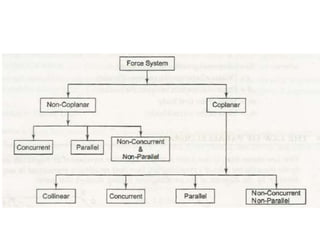
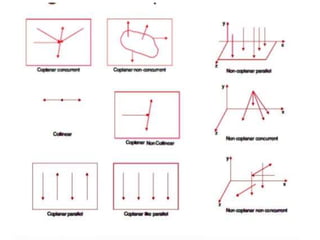
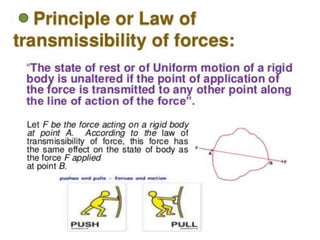
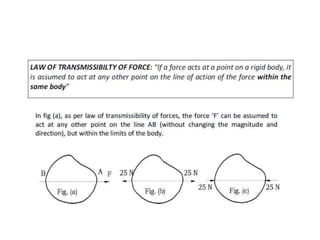
Engineering Mechanics
Yogesh Kulkarni
(M.E Structures)
Assistant Professor
SIT CoE
Definition
• Mechanics is a branch of the physical sciences
that is concerned with the state of rest or
motion of bodies subjected to the action of
forces
• It is the branch of science which deals with a
system of forces and their effect on the
bodies.
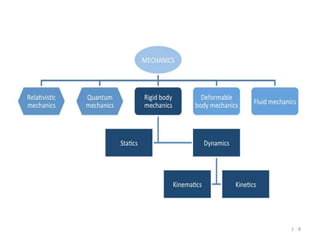
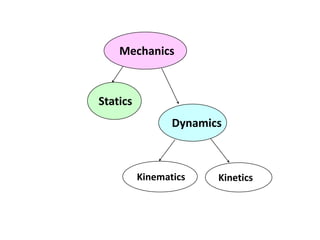
• It is divided into statics and dynamics.
Basic Concepts
• Space is the region occupied by the bodies. We
set up an coordinate system to specify where the
object is by the position and its posture by the
orientation.
• Time is the measure of the succession of events.
Often, we are more interested in the change of
physical quantities with respect to time instead of
time variable itself.
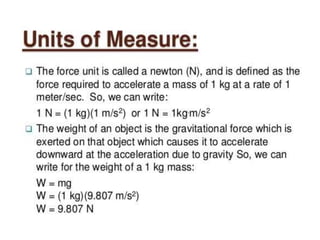
• Force is an external agency which changes or
tends to change the state of the body. (Vector
Quantity) Newton N as S.I units
• Particle is a body of which its dimension is
negligible. The rotation effect is insignificant
because it is just a point.
• Whether the body can be treated as the
particle or not depends on the relative
dimensions in the problem and how much
detailed of the solution we are interested in.
• Rigid body is a body whose relative
movement between its parts are negligible
relative to the gross motion of the body. For
example the motion of an ingot can be
analyzed by assuming the object being rigid.
• Non rigid body is a body whose relative
movement between its parts are significant
relative to the gross motion of the body.
• Knowledge of the mechanics of the
deformable material must be used along with
Dynamics in order to determine the absolute
motion of the non rigid bodies.
Engineering Mechanics
Rigid-body Mechanics
• a basic requirement for the study of the
mechanics of deformable bodies and the
mechanics of fluids (advanced courses).
• essential for the design and analysis of many
types of structural members, mechanical
components, electrical devices, etc,
encountered in engineering.
A rigid body does not deform under load!
1 - 8
Mechanics
Statics
Dynamics
Kinematics Kinetics
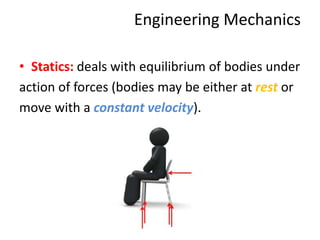
Engineering Mechanics
• Statics: deals with equilibrium of bodies under
action of forces (bodies may be either at rest or
move with a constant velocity).
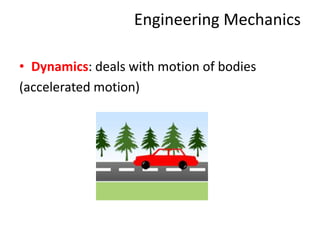
Engineering Mechanics
• Dynamics: deals with motion of bodies
(accelerated motion)
• Kinematics : Branch of dynamics which deals
with the study of system of forces and their
effects on bodies in motion without
considering mass of the body and forces
which causes the motion
• Kinetics : Branch of dynamics which deals with
the study of system of forces and their effects
on bodies in motion considering mass of the
body and forces which causes the motion
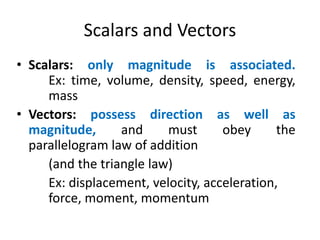
Scalars and Vectors
• Scalars: only magnitude is associated.
Ex: time, volume, density, speed, energy,
mass
• Vectors: possess direction as well as
magnitude, and must obey the
parallelogram law of addition
(and the triangle law)
Ex: displacement, velocity, acceleration,
force, moment, momentum
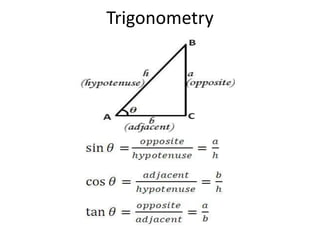
Trigonometry
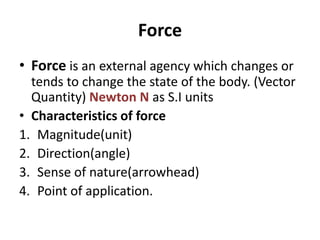
Force
• Force is an external agency which changes or
tends to change the state of the body. (Vector
Quantity) Newton N as S.I units
• Characteristics of force
1. Magnitude(unit)
2. Direction(angle)
3. Sense of nature(arrowhead)
4. Point of application.
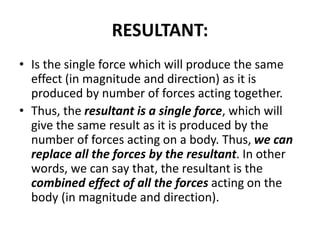
RESULTANT:
• Is the single force which will produce the same
effect (in magnitude and direction) as it is
produced by number of forces acting together.
• Thus, the resultant is a single force, which will
give the same result as it is produced by the
number of forces acting on a body. Thus, we can
replace all the forces by the resultant. In other
words, we can say that, the resultant is the
combined effect of all the forces acting on the
body (in magnitude and direction).
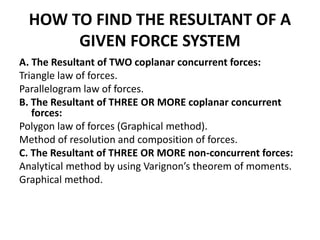
HOW TO FIND THE RESULTANT OF A
GIVEN FORCE SYSTEM
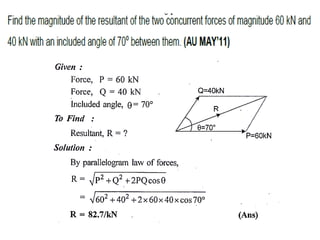
A. The Resultant of TWO coplanar concurrent forces:
Triangle law of forces.
Parallelogram law of forces.
B. The Resultant of THREE OR MORE coplanar concurrent
forces:
Polygon law of forces (Graphical method).
Method of resolution and composition of forces.
C. The Resultant of THREE OR MORE non-concurrent forces:
Analytical method by using Varignon’s theorem of moments.
Graphical method.
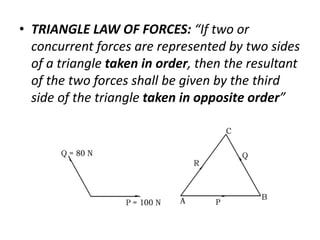
• TRIANGLE LAW OF FORCES: “If two or
concurrent forces are represented by two sides
of a triangle taken in order, then the resultant
of the two forces shall be given by the third
side of the triangle taken in opposite order”
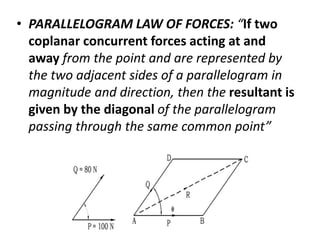
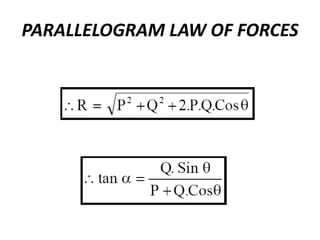
• PARALLELOGRAM LAW OF FORCES: “If two
coplanar concurrent forces acting at and
away from the point and are represented by
the two adjacent sides of a parallelogram in
magnitude and direction, then the resultant is
given by the diagonal of the parallelogram
passing through the same common point”
PARALLELOGRAM LAW OF FORCES
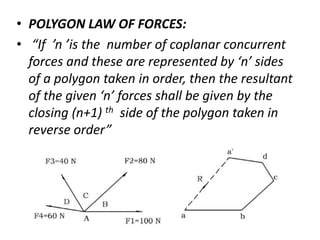
• POLYGON LAW OF FORCES:
• “If ’n ’is the number of coplanar concurrent
forces and these are represented by ‘n’ sides
of a polygon taken in order, then the resultant
of the given ‘n’ forces shall be given by the
closing (n+1) th side of the polygon taken in
reverse order”
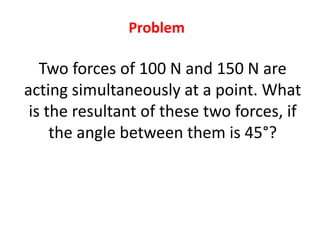
Two forces of 100 N and 150 N are
acting simultaneously at a point. What
is the resultant of these two forces, if
the angle between them is 45°?
Problem
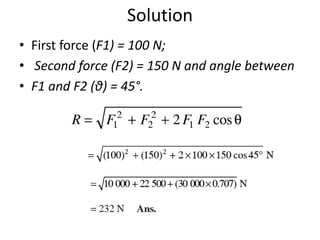
Solution
• First force (F1) = 100 N;
• Second force (F2) = 150 N and angle between
• F1 and F2 (θ) = 45°.
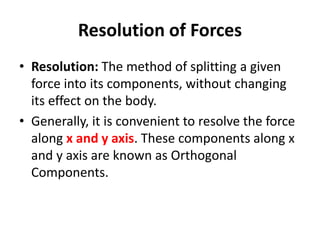
Resolution of Forces
• Resolution: The method of splitting a given
force into its components, without changing
its effect on the body.
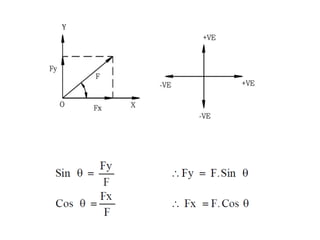
• Generally, it is convenient to resolve the force
along x and y axis. These components along x
and y axis are known as Orthogonal
Components.
Steps to find the Resultant of
Concurrent Forces
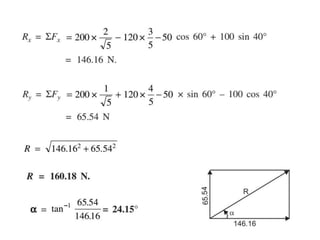
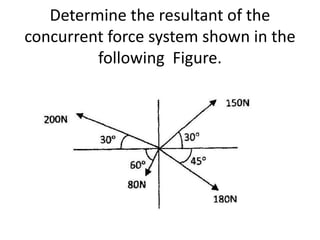
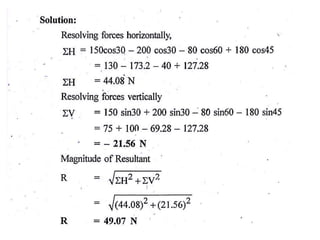
Determine the resultant of the
concurrent force system shown in the
following Figure.
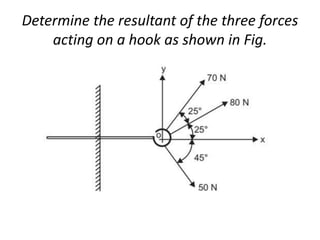
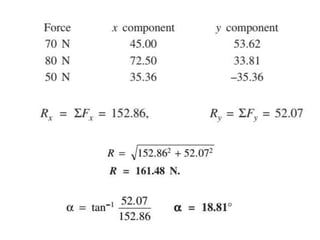
Determine the resultant of the three forces
acting on a hook as shown in Fig.
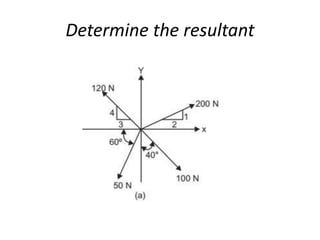
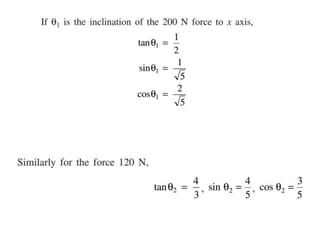
Determine the resultant
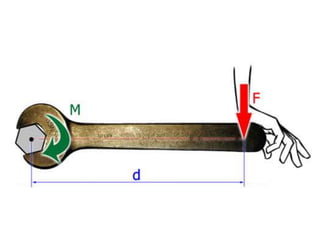
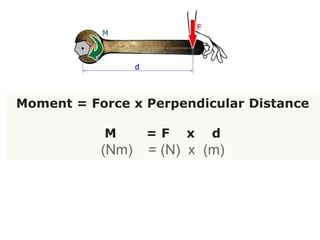
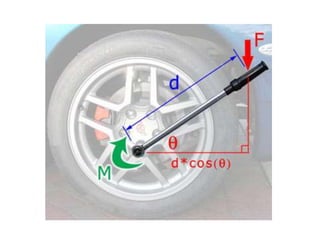
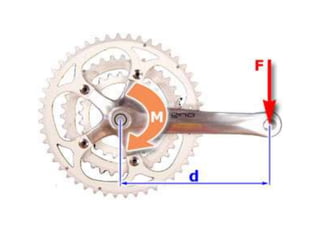
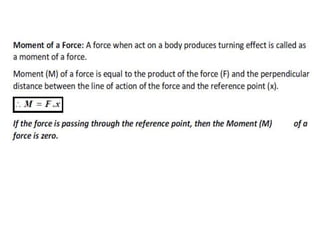
Moment
Moment = Force x Perpendicular Distance
M = F x d
(Nm) = (N) x (m)
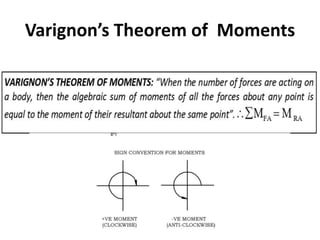
Varignon’s Theorem of Moments
Steps To Find Resultant
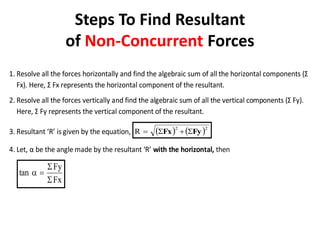
of Non-Concurrent Forces
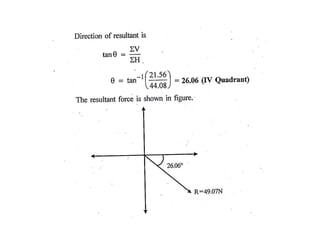
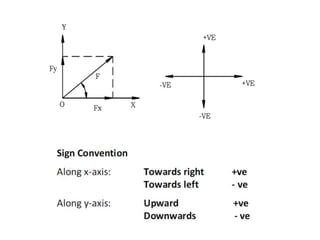
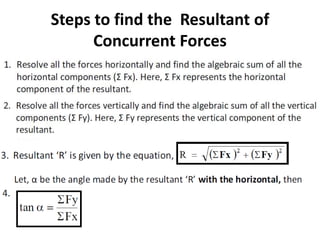
1. Resolve all the forces horizontally and find the algebraic sum of all the horizontal components (Σ
Fx). Here, Σ Fx represents the horizontal component of the resultant.
2. Resolve all the forces vertically and find the algebraic sum of all the vertical components (Σ Fy).
Here, Σ Fy represents the vertical component of the resultant.
3. Resultant ‘R’ is given by the equation,    2
2
R Fy
Fx 



4. Let, α be the angle made by the resultant ‘R’ with the horizontal, then
Fx
Fy
tan




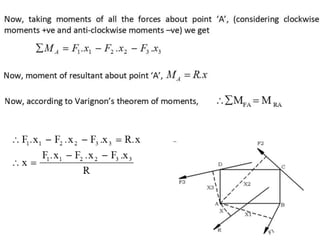
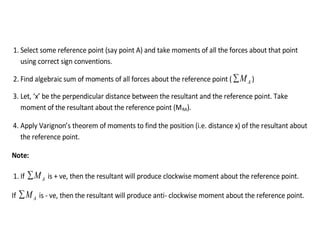
1. Select some reference point (say point A) and take moments of all the forces about that point
using correct sign conventions.
2. Find algebraic sum of moments of all forces about the reference point ( A
M
 )
3. Let, ‘x’ be the perpendicular distance between the resultant and the reference point. Take
moment of the resultant about the reference point (MRA).
4. Apply Varignon’s theorem of moments to find the position (i.e. distance x) of the resultant about
the reference point.
Note:
1. If A
M
 is + ve, then the resultant will produce clockwise moment about the reference point.
If A
M
 is - ve, then the resultant will produce anti- clockwise moment about the reference point.
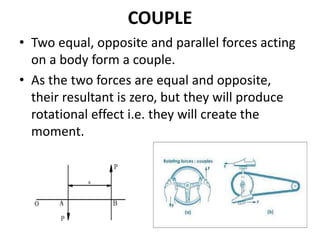
COUPLE
• Two equal, opposite and parallel forces acting
on a body form a couple.
• As the two forces are equal and opposite,
their resultant is zero, but they will produce
rotational effect i.e. they will create the
moment.
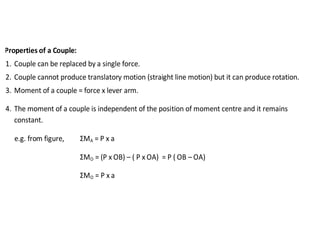
Properties of a Couple:
1. Couple can be replaced by a single force.
2. Couple cannot produce translatory motion (straight line motion) but it can produce rotation.
3. Moment of a couple = force x lever arm.
4. The moment of a couple is independent of the position of moment centre and it remains
constant.
e.g. from figure, ΣMA = P x a
ΣMO = (P x OB) – ( P x OA) = P ( OB – OA)
ΣMO = P x a
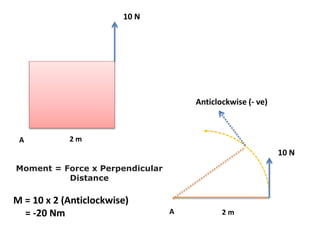
10 N
Anticlockwise (- ve)
10 N
A 2 m
M = 10 x 2 (Anticlockwise)
= -20 Nm
Moment = Force x Perpendicular
Distance
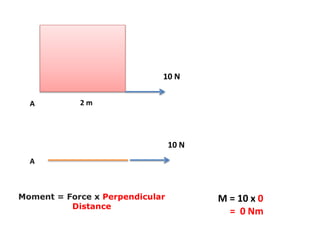
A 2 m
A 2 m
10 N
A
10 N
M = 10 x 0
= 0 Nm
Moment = Force x Perpendicular
Distance
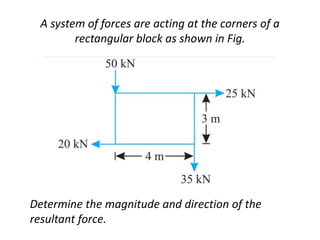
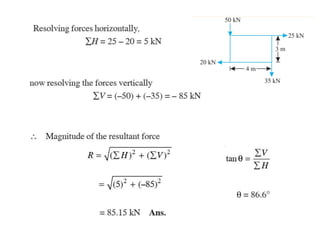
A system of forces are acting at the corners of a
rectangular block as shown in Fig.
Determine the magnitude and direction of the
resultant force.
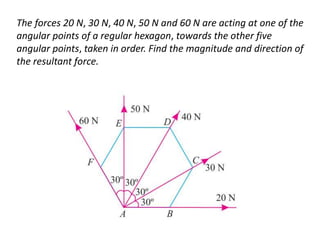
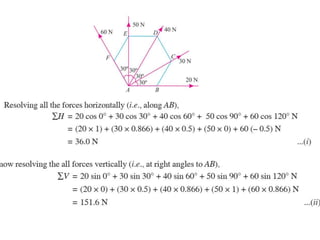
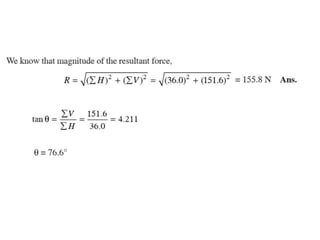
The forces 20 N, 30 N, 40 N, 50 N and 60 N are acting at one of the
angular points of a regular hexagon, towards the other five
angular points, taken in order. Find the magnitude and direction of
the resultant force.
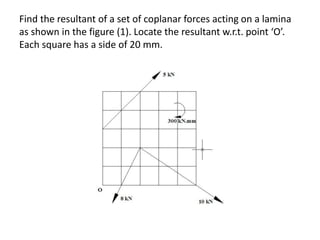
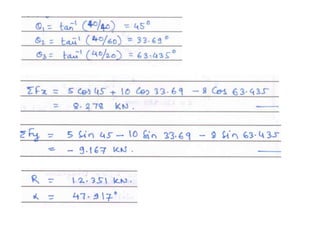
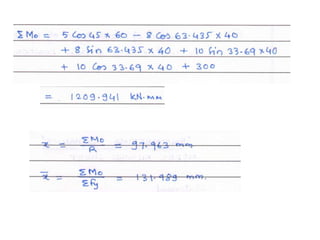
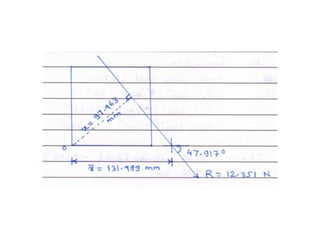
Find the resultant of a set of coplanar forces acting on a lamina
as shown in the figure (1). Locate the resultant w.r.t. point ‘O’.
Each square has a side of 20 mm.
Engineering Mechanics.pptx

Engineering Mechanics.pptx

  • 1.
    Engineering Mechanics Yogesh Kulkarni (M.EStructures) Assistant Professor SIT CoE
  • 2.
    Definition • Mechanics isa branch of the physical sciences that is concerned with the state of rest or motion of bodies subjected to the action of forces • It is the branch of science which deals with a system of forces and their effect on the bodies. • It is divided into statics and dynamics.
  • 3.
    Basic Concepts • Spaceis the region occupied by the bodies. We set up an coordinate system to specify where the object is by the position and its posture by the orientation. • Time is the measure of the succession of events. Often, we are more interested in the change of physical quantities with respect to time instead of time variable itself. • Force is an external agency which changes or tends to change the state of the body. (Vector Quantity) Newton N as S.I units
  • 4.
    • Particle isa body of which its dimension is negligible. The rotation effect is insignificant because it is just a point. • Whether the body can be treated as the particle or not depends on the relative dimensions in the problem and how much detailed of the solution we are interested in.
  • 5.
    • Rigid bodyis a body whose relative movement between its parts are negligible relative to the gross motion of the body. For example the motion of an ingot can be analyzed by assuming the object being rigid.
  • 6.
    • Non rigidbody is a body whose relative movement between its parts are significant relative to the gross motion of the body. • Knowledge of the mechanics of the deformable material must be used along with Dynamics in order to determine the absolute motion of the non rigid bodies.
  • 7.
    Engineering Mechanics Rigid-body Mechanics •a basic requirement for the study of the mechanics of deformable bodies and the mechanics of fluids (advanced courses). • essential for the design and analysis of many types of structural members, mechanical components, electrical devices, etc, encountered in engineering. A rigid body does not deform under load!
  • 8.
  • 9.
  • 10.
    Engineering Mechanics • Statics:deals with equilibrium of bodies under action of forces (bodies may be either at rest or move with a constant velocity).
  • 11.
    Engineering Mechanics • Dynamics:deals with motion of bodies (accelerated motion)
  • 12.
    • Kinematics :Branch of dynamics which deals with the study of system of forces and their effects on bodies in motion without considering mass of the body and forces which causes the motion • Kinetics : Branch of dynamics which deals with the study of system of forces and their effects on bodies in motion considering mass of the body and forces which causes the motion
  • 16.
    Scalars and Vectors •Scalars: only magnitude is associated. Ex: time, volume, density, speed, energy, mass • Vectors: possess direction as well as magnitude, and must obey the parallelogram law of addition (and the triangle law) Ex: displacement, velocity, acceleration, force, moment, momentum
  • 17.
  • 18.
    Force • Force isan external agency which changes or tends to change the state of the body. (Vector Quantity) Newton N as S.I units • Characteristics of force 1. Magnitude(unit) 2. Direction(angle) 3. Sense of nature(arrowhead) 4. Point of application.
  • 24.
    RESULTANT: • Is thesingle force which will produce the same effect (in magnitude and direction) as it is produced by number of forces acting together. • Thus, the resultant is a single force, which will give the same result as it is produced by the number of forces acting on a body. Thus, we can replace all the forces by the resultant. In other words, we can say that, the resultant is the combined effect of all the forces acting on the body (in magnitude and direction).
  • 25.
    HOW TO FINDTHE RESULTANT OF A GIVEN FORCE SYSTEM A. The Resultant of TWO coplanar concurrent forces: Triangle law of forces. Parallelogram law of forces. B. The Resultant of THREE OR MORE coplanar concurrent forces: Polygon law of forces (Graphical method). Method of resolution and composition of forces. C. The Resultant of THREE OR MORE non-concurrent forces: Analytical method by using Varignon’s theorem of moments. Graphical method.
  • 26.
    • TRIANGLE LAWOF FORCES: “If two or concurrent forces are represented by two sides of a triangle taken in order, then the resultant of the two forces shall be given by the third side of the triangle taken in opposite order”
  • 27.
    • PARALLELOGRAM LAWOF FORCES: “If two coplanar concurrent forces acting at and away from the point and are represented by the two adjacent sides of a parallelogram in magnitude and direction, then the resultant is given by the diagonal of the parallelogram passing through the same common point”
  • 28.
  • 29.
    • POLYGON LAWOF FORCES: • “If ’n ’is the number of coplanar concurrent forces and these are represented by ‘n’ sides of a polygon taken in order, then the resultant of the given ‘n’ forces shall be given by the closing (n+1) th side of the polygon taken in reverse order”
  • 30.
    Two forces of100 N and 150 N are acting simultaneously at a point. What is the resultant of these two forces, if the angle between them is 45°? Problem
  • 31.
    Solution • First force(F1) = 100 N; • Second force (F2) = 150 N and angle between • F1 and F2 (θ) = 45°.
  • 33.
    Resolution of Forces •Resolution: The method of splitting a given force into its components, without changing its effect on the body. • Generally, it is convenient to resolve the force along x and y axis. These components along x and y axis are known as Orthogonal Components.
  • 36.
    Steps to findthe Resultant of Concurrent Forces
  • 37.
    Determine the resultantof the concurrent force system shown in the following Figure.
  • 40.
    Determine the resultantof the three forces acting on a hook as shown in Fig.
  • 42.
  • 45.
  • 47.
    Moment = Forcex Perpendicular Distance M = F x d (Nm) = (N) x (m)
  • 51.
  • 53.
    Steps To FindResultant of Non-Concurrent Forces 1. Resolve all the forces horizontally and find the algebraic sum of all the horizontal components (Σ Fx). Here, Σ Fx represents the horizontal component of the resultant. 2. Resolve all the forces vertically and find the algebraic sum of all the vertical components (Σ Fy). Here, Σ Fy represents the vertical component of the resultant. 3. Resultant ‘R’ is given by the equation,    2 2 R Fy Fx     4. Let, α be the angle made by the resultant ‘R’ with the horizontal, then Fx Fy tan    
  • 54.
    1. Select somereference point (say point A) and take moments of all the forces about that point using correct sign conventions. 2. Find algebraic sum of moments of all forces about the reference point ( A M  ) 3. Let, ‘x’ be the perpendicular distance between the resultant and the reference point. Take moment of the resultant about the reference point (MRA). 4. Apply Varignon’s theorem of moments to find the position (i.e. distance x) of the resultant about the reference point. Note: 1. If A M  is + ve, then the resultant will produce clockwise moment about the reference point. If A M  is - ve, then the resultant will produce anti- clockwise moment about the reference point.
  • 55.
    COUPLE • Two equal,opposite and parallel forces acting on a body form a couple. • As the two forces are equal and opposite, their resultant is zero, but they will produce rotational effect i.e. they will create the moment.
  • 56.
    Properties of aCouple: 1. Couple can be replaced by a single force. 2. Couple cannot produce translatory motion (straight line motion) but it can produce rotation. 3. Moment of a couple = force x lever arm. 4. The moment of a couple is independent of the position of moment centre and it remains constant. e.g. from figure, ΣMA = P x a ΣMO = (P x OB) – ( P x OA) = P ( OB – OA) ΣMO = P x a
  • 57.
    10 N Anticlockwise (-ve) 10 N A 2 m M = 10 x 2 (Anticlockwise) = -20 Nm Moment = Force x Perpendicular Distance A 2 m
  • 58.
    A 2 m 10N A 10 N M = 10 x 0 = 0 Nm Moment = Force x Perpendicular Distance
  • 59.
    A system offorces are acting at the corners of a rectangular block as shown in Fig. Determine the magnitude and direction of the resultant force.
  • 61.
    The forces 20N, 30 N, 40 N, 50 N and 60 N are acting at one of the angular points of a regular hexagon, towards the other five angular points, taken in order. Find the magnitude and direction of the resultant force.
  • 64.
    Find the resultantof a set of coplanar forces acting on a lamina as shown in the figure (1). Locate the resultant w.r.t. point ‘O’. Each square has a side of 20 mm.