RN BScN
Presented by:
Sehrish naz
Curriculum and its types
Objectives
 Define curriculum.
 Explain types of curriculum.
 Describe Steps of curriculum.
 Explain Process of curriculum development.
 Impacts of curriculum on students
 Advantages and disadvantages of curriculum.
 Curriculum development in nursing.
Definitions of curriculum
 Definition 1: Curriculum is all the experiences
learners have under the guidance of the school.
 Definition 2: Curriculum is all
planned learnings for which the school is
responsible.
(From Marsh, C. J. & Willis, G. (2003).
Definitions of curriculum
 Curriculum is:
 That which is taught in schools
 A set of subjects.
 Content
 A program of studies.
 A set of materials
 A sequence of courses.
 A set of performance objectives
 A course of study
Types of curriculum
 1. Overt, explicit, or written curriculum
 Is simply that which is written as part of formal
instruction of schooling experiences. It may refer
to a curriculum document, texts, films, and
supportive teaching materials that are overtly
chosen to support the intentional instructional
agenda of a school.
Sub types of overt curriculum
 The formal curriculum (written or overt)
comprises those things in textbooks, and content
and concepts in the curriculum guides. However,
those "formal" elements are frequently not taught.
The curriculum-in-use is the actual curriculum that
is delivered and presented by each teacher.
Cont…
 The received or the learned curriculum:
"The gap between what is taught and what is
learned—both intended and unintended." Cuban,
p. 223, 1992)
Cont…
Rhetorical curriculum
Elements from the rhetorical curriculum are
comprised from ideas offered by policymakers,
school officials, administrators, or politicians.
 The rhetorical curriculum may also come from the
publicized works offering updates in pedagogical
knowledge.
Cont…
 2. Societal curriculum
 As defined by Cortes (1981). Cortes defines this
curriculum as:
 The massive, ongoing, informal curriculum of
family, peer groups, neighborhoods, churches
organizations, occupations, mass, media and
other socializing forces that "educate" all of us
throughout our lives.
Sub types of societal curriculum
 Concomitant curriculum - What is taught, or
emphasized at home.
 Phantom curriculum -The messages prevalent in
and through exposure to media.
Cont…
3. The hidden or covert curriculum
 Longstreet and Shane (1993) offer a commonly
accepted definition for this term.
 . . . the "hidden curriculum," which refers to the
kinds of learnings. children derive from the very
nature and organizational design of the public
school, as well as from the behaviors and
attitudes of teachers and administrators.... "
Cont…
 4. The null curriculum
 That which we do not teach, thus giving students
the message that these elements are not
important in their educational experiences or in
our society.
The process of curriculum
development
 It is process of deciding what to teach and learn, along
with the considerations needed to make such decisions.
 It includes aspects such as tasks, roles, expectations,
resources, time and space, and the ordering of all these
elements to create a curriculum plan or document
(Behar, 1994).
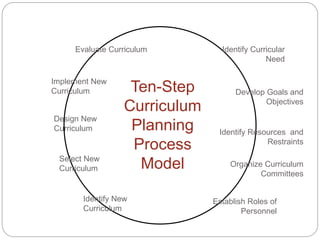
Identify Curricular
Need
Develop Goals and
Objectives
Identify Resources and
Restraints
Organize Curriculum
Committees
Establish Roles of
Personnel
Identify New
Curriculum
Select New
Curriculum
Design New
Curriculum
Implement New
Curriculum
Evaluate Curriculum
Ten-Step
Curriculum
Planning
Process
Model
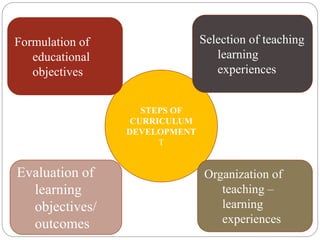
STEPS OF
CURRICULUM
DEVELOPMENT
T
Formulation of
educational
objectives
Selection of teaching
learning
experiences
Organization of
teaching –
learning
experiences
Evaluation of
learning
objectives/
outcomes
Impacts of curriculum
 Traditionally, curriculum is considered as content and
examination. However, curriculum is beyond the
written document. It is about the experiences of the
learners, the teachers, and even the learning
environment and the the community. In post-modern
society, the access of information is not an constraint
at all. The learners can gain the information through
different channels. But, how to make the learners to
internalize the information / knowledge to make
learning happens is stilling challenging all the
educators. The design in teaching and learning
comes in at this juncture. A well designed curriculum
will definitely attract attention and engage learners.
The first step towards a well designed curriculum
should be mindset change of the educators from
teacher- centric to learner-centric model. When
design the curriculum, we should always bear in mind
the " 4 curriculum commonplaces".
Advantages of curriculum
 As the curriculum is designed by the teacher, it become
easy to achieve the desired goals.
 Subject matter become psychologically sound due to its
relevance with the interests, needs and level of the
children.
 Content/Subject matter is logically arranged. - Irrelevant
material/ Subject matter is avoided.
 Teachers feel comfortable and confident in the classroom
activities.
 Democracy is encouraged.
 Co-operation is developed.
 Society/Community is also involved (directly or
indirectly) in the development of curriculum.
 No objection is raised by the teacher in connection with the
availability of sources and resources.
Disadvantages of Teacher
Centered Approach
 Following limitations may hinder the process.
 A change in the attitude on the part of learners,
teachers and community is difficult to develop.
 Lack of sources and resources.
 Hinderance due to rigid administration, planning and
management.
 It will become difficult to maintain a common
standared in various institutions.
 The existing curriculum for the teaching training
institutions is not suitable for the teacher centered
approach.
 A drastic change in the examination
system/evaluation will be required.
Curriculum development in
nursing
 Heidgerkin, a respected nurse educator in the
1940s and1950s, believed that curriculum
entailed all planned day to day learning
experiences of the students and faculty, including
both organized instructions and clinical
experiences
(Diekelmann, 1993)
Cont…
 “ it is the responsibility of nursing education in
collaboration with practice setting to shape
practice, not merely respond to changes in
practice environment.”
 (American Association of colleges of Nursing, 1999,p.60)
References
 Slattery, P. (1995) Curriculum Development in the
Postmodern Era. New York: Garland Publishing Inc.
 Wiles, J. and Bondi, J. (1998) Curriculum Development: A
Guide to Practice. Columbus, Ohio: Merrill.
 Slattery, P. (1995) Curriculum Development in the
Postmodern Era. New York: Garland Publishing Inc.
 Wiles, J. and Bondi, J. (1998) Curriculum Development: A
Guide to Practice. Columbus, Ohio: Merri
 Copyright© Leslie Owen Wilson,
1997 University of Wisconsin at Steven’s Point. Web
assistance by Lynn Kirby
http://www.uwsp.edu/acad/educ/lwilson/CURRIC/curtyp.htm
Cont…

Cortes, C.E. (1981) The societal curriculum:
Implications for multiethnic educations. In Banks, J.A
(ed.) Education in the 80's: Multiethnic
education. National Education Association.
 *Cuban, Larry (1992) Curriculum stability and
change. In Jackson, Philip (ed.) Handbook of Research
on Curriculum. American Educational Research
Association (added by MBeech)
 Eisner, E.W. (1994) The educational imagination: On
design and evaluation of school programs.
(3rd. ed) New York: Macmillan.
 Longstreet, W.S. and Shane, H.G. (1993) Curriculum
for a new millennium. Boston: Allyn and Bacon.


curriculum and its types

  • 1.
  • 2.
  • 3.
    Objectives  Define curriculum. Explain types of curriculum.  Describe Steps of curriculum.  Explain Process of curriculum development.  Impacts of curriculum on students  Advantages and disadvantages of curriculum.  Curriculum development in nursing.
  • 4.
    Definitions of curriculum Definition 1: Curriculum is all the experiences learners have under the guidance of the school.  Definition 2: Curriculum is all planned learnings for which the school is responsible. (From Marsh, C. J. & Willis, G. (2003).
  • 5.
    Definitions of curriculum Curriculum is:  That which is taught in schools  A set of subjects.  Content  A program of studies.  A set of materials  A sequence of courses.  A set of performance objectives  A course of study
  • 6.
    Types of curriculum 1. Overt, explicit, or written curriculum  Is simply that which is written as part of formal instruction of schooling experiences. It may refer to a curriculum document, texts, films, and supportive teaching materials that are overtly chosen to support the intentional instructional agenda of a school.
  • 7.
    Sub types ofovert curriculum  The formal curriculum (written or overt) comprises those things in textbooks, and content and concepts in the curriculum guides. However, those "formal" elements are frequently not taught. The curriculum-in-use is the actual curriculum that is delivered and presented by each teacher.
  • 8.
    Cont…  The receivedor the learned curriculum: "The gap between what is taught and what is learned—both intended and unintended." Cuban, p. 223, 1992)
  • 9.
    Cont… Rhetorical curriculum Elements fromthe rhetorical curriculum are comprised from ideas offered by policymakers, school officials, administrators, or politicians.  The rhetorical curriculum may also come from the publicized works offering updates in pedagogical knowledge.
  • 10.
    Cont…  2. Societalcurriculum  As defined by Cortes (1981). Cortes defines this curriculum as:  The massive, ongoing, informal curriculum of family, peer groups, neighborhoods, churches organizations, occupations, mass, media and other socializing forces that "educate" all of us throughout our lives.
  • 11.
    Sub types ofsocietal curriculum  Concomitant curriculum - What is taught, or emphasized at home.  Phantom curriculum -The messages prevalent in and through exposure to media.
  • 12.
    Cont… 3. The hiddenor covert curriculum  Longstreet and Shane (1993) offer a commonly accepted definition for this term.  . . . the "hidden curriculum," which refers to the kinds of learnings. children derive from the very nature and organizational design of the public school, as well as from the behaviors and attitudes of teachers and administrators.... "
  • 13.
    Cont…  4. Thenull curriculum  That which we do not teach, thus giving students the message that these elements are not important in their educational experiences or in our society.
  • 14.
    The process ofcurriculum development  It is process of deciding what to teach and learn, along with the considerations needed to make such decisions.  It includes aspects such as tasks, roles, expectations, resources, time and space, and the ordering of all these elements to create a curriculum plan or document (Behar, 1994).
  • 15.
    Identify Curricular Need Develop Goalsand Objectives Identify Resources and Restraints Organize Curriculum Committees Establish Roles of Personnel Identify New Curriculum Select New Curriculum Design New Curriculum Implement New Curriculum Evaluate Curriculum Ten-Step Curriculum Planning Process Model
  • 16.
    STEPS OF CURRICULUM DEVELOPMENT T Formulation of educational objectives Selectionof teaching learning experiences Organization of teaching – learning experiences Evaluation of learning objectives/ outcomes
  • 17.
    Impacts of curriculum Traditionally, curriculum is considered as content and examination. However, curriculum is beyond the written document. It is about the experiences of the learners, the teachers, and even the learning environment and the the community. In post-modern society, the access of information is not an constraint at all. The learners can gain the information through different channels. But, how to make the learners to internalize the information / knowledge to make learning happens is stilling challenging all the educators. The design in teaching and learning comes in at this juncture. A well designed curriculum will definitely attract attention and engage learners. The first step towards a well designed curriculum should be mindset change of the educators from teacher- centric to learner-centric model. When design the curriculum, we should always bear in mind the " 4 curriculum commonplaces".
  • 18.
    Advantages of curriculum As the curriculum is designed by the teacher, it become easy to achieve the desired goals.  Subject matter become psychologically sound due to its relevance with the interests, needs and level of the children.  Content/Subject matter is logically arranged. - Irrelevant material/ Subject matter is avoided.  Teachers feel comfortable and confident in the classroom activities.  Democracy is encouraged.  Co-operation is developed.  Society/Community is also involved (directly or indirectly) in the development of curriculum.  No objection is raised by the teacher in connection with the availability of sources and resources.
  • 19.
    Disadvantages of Teacher CenteredApproach  Following limitations may hinder the process.  A change in the attitude on the part of learners, teachers and community is difficult to develop.  Lack of sources and resources.  Hinderance due to rigid administration, planning and management.  It will become difficult to maintain a common standared in various institutions.  The existing curriculum for the teaching training institutions is not suitable for the teacher centered approach.  A drastic change in the examination system/evaluation will be required.
  • 20.
    Curriculum development in nursing Heidgerkin, a respected nurse educator in the 1940s and1950s, believed that curriculum entailed all planned day to day learning experiences of the students and faculty, including both organized instructions and clinical experiences (Diekelmann, 1993)
  • 21.
    Cont…  “ itis the responsibility of nursing education in collaboration with practice setting to shape practice, not merely respond to changes in practice environment.”  (American Association of colleges of Nursing, 1999,p.60)
  • 22.
    References  Slattery, P.(1995) Curriculum Development in the Postmodern Era. New York: Garland Publishing Inc.  Wiles, J. and Bondi, J. (1998) Curriculum Development: A Guide to Practice. Columbus, Ohio: Merrill.  Slattery, P. (1995) Curriculum Development in the Postmodern Era. New York: Garland Publishing Inc.  Wiles, J. and Bondi, J. (1998) Curriculum Development: A Guide to Practice. Columbus, Ohio: Merri  Copyright© Leslie Owen Wilson, 1997 University of Wisconsin at Steven’s Point. Web assistance by Lynn Kirby http://www.uwsp.edu/acad/educ/lwilson/CURRIC/curtyp.htm
  • 23.
    Cont…  Cortes, C.E. (1981)The societal curriculum: Implications for multiethnic educations. In Banks, J.A (ed.) Education in the 80's: Multiethnic education. National Education Association.  *Cuban, Larry (1992) Curriculum stability and change. In Jackson, Philip (ed.) Handbook of Research on Curriculum. American Educational Research Association (added by MBeech)  Eisner, E.W. (1994) The educational imagination: On design and evaluation of school programs. (3rd. ed) New York: Macmillan.  Longstreet, W.S. and Shane, H.G. (1993) Curriculum for a new millennium. Boston: Allyn and Bacon. 