TITLE: INSTITUTIONAL PLANNING
PRESENTED BY
NEHA MERCY PRASHAD
ID. NO. - 19MED006
INSTITUTIONAL
PLANNING
 Institutional planning is a programme of development and
improvement prepared by an educational institution on the
basis of its felt needs and the resources available or likely to be
available, with a viewto improving the school programme and
school practices. It is based on the principle of optimum
utilisation of the resources available in the school and the
community.” –M.B.Buch.
 In drawing a plan of educationfor a national systemof education of a
country, the following twoapproaches are available:
(i) A plan may be drawn at the central level on the basis of the resources
available and the needs of the country. In other words, in planning; a
top-based approach may be followed.
(ii) Planning may begin at the level of an institution. First, a plan is drawn
by each institution, second, a consolidated plan is drawn at the Block
level or District level on the basis of the plan drawn at institutional
level.
OBJECTIVES
 To provide equality of opportunities to all the pupils to get education.
 2. To bring an accord between the development of an institution and national-level planning.
 To have all-round development and improvement of the school.
 To make education productive, so that with education may come economic riches.
 To make provision for utilisation of adequate available manpower of the institution.
 To make education available to even the poorest of the citizens.
 To provide an opportunity to the local community, school staff, students and teachers to join hands in
improving the institution.
 To provide realistic and concrete ideas to institutional planning.
CHARACTERSTICS OF
INSTITUTIONAL PLANNING
1. Need based and not grant based
2. Optimum utilization of resources
3. Co-operative affair
4. Goal oriented
5. Prospective plan
6. Specific plan
7. Improvement motivation
8. School improvement and development
9. Continuous development
10. Democratic outlook
11. Collaboration with the community
12. Basis of district plan
Scope of Institutional
Planning
(a) Improvement of the schoolcampus:
(i) Provision of more facilities to the pupils like the supply of drinking water, sanitary facilities, mid-day meals, medical
facilities etc.
(ii) Collection of library books, magazines, journals; instructional materials and audio-visual aids for the school.
(iii) Construction, maintenance and repair of school building.
b) Improvement of AcademicFacilities:
(i) Dividing the curriculum in each subject into monthly and weekly units and sub-units.
(ii) Organization of remedial teaching for slow-learners.
(iii) Organisation of seminars, conference etc. in the institution.
(iv) Support to teacher-improvement programmes like in-service training.
refresher courses, orientation courses etc. for teachers.
c) Improvement of Co-curricular activities:
(i) Organisation of physical activities in the school.
(ii) Organisation of literary activities like preparation of bulletin boards, wall magazine, improved teaching aids and
equipment’s.
(iii) Organisation of social service projects.
d) School Improvement Projects:
(i) Functional Literacy programmes.
(ii) Adult education programme.
(iii) Organisation of S.U.P.W.
(iv) Maintenance of and love for ecological equilibrium.
PROCEDURE OF
EDUCATIONAL PLANNING
1. Analysis the present situation according to the need of the institution
2. Survey of existing resources
3.Preparation for improvement
4. Implementation
5. Evaluation
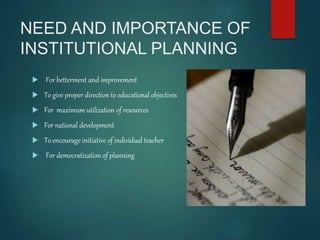
NEED AND IMPORTANCE OF
INSTITUTIONAL PLANNING
 For betterment and improvement
 To give proper direction to educational objectives
 For maximum utilization of resources
 For national development
 To encourage initiative of individual teacher
 For democratization of planning
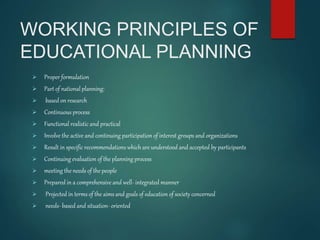
WORKING PRINCIPLES OF
EDUCATIONAL PLANNING
 Proper formulation
 Part of national planning:
 based on research
 Continuous process
 Functional realistic and practical
 Involve the active and continuing participation of interest groups and organizations
 Result in specific recommendations which are understood and accepted by participants
 Continuing evaluation of the planning process
 meeting the needs of the people
 Prepared in a comprehensive and well- integrated manner
 Projected in terms of the aims and goals of education of society concerned
 needs- based and situation- oriented
Institutional planning

Institutional planning

  • 1.
    TITLE: INSTITUTIONAL PLANNING PRESENTEDBY NEHA MERCY PRASHAD ID. NO. - 19MED006
  • 2.
    INSTITUTIONAL PLANNING  Institutional planningis a programme of development and improvement prepared by an educational institution on the basis of its felt needs and the resources available or likely to be available, with a viewto improving the school programme and school practices. It is based on the principle of optimum utilisation of the resources available in the school and the community.” –M.B.Buch.
  • 3.
     In drawinga plan of educationfor a national systemof education of a country, the following twoapproaches are available: (i) A plan may be drawn at the central level on the basis of the resources available and the needs of the country. In other words, in planning; a top-based approach may be followed. (ii) Planning may begin at the level of an institution. First, a plan is drawn by each institution, second, a consolidated plan is drawn at the Block level or District level on the basis of the plan drawn at institutional level.
  • 4.
    OBJECTIVES  To provideequality of opportunities to all the pupils to get education.  2. To bring an accord between the development of an institution and national-level planning.  To have all-round development and improvement of the school.  To make education productive, so that with education may come economic riches.  To make provision for utilisation of adequate available manpower of the institution.  To make education available to even the poorest of the citizens.  To provide an opportunity to the local community, school staff, students and teachers to join hands in improving the institution.  To provide realistic and concrete ideas to institutional planning.
  • 5.
    CHARACTERSTICS OF INSTITUTIONAL PLANNING 1.Need based and not grant based 2. Optimum utilization of resources 3. Co-operative affair 4. Goal oriented 5. Prospective plan 6. Specific plan 7. Improvement motivation 8. School improvement and development 9. Continuous development 10. Democratic outlook 11. Collaboration with the community 12. Basis of district plan
  • 6.
    Scope of Institutional Planning (a)Improvement of the schoolcampus: (i) Provision of more facilities to the pupils like the supply of drinking water, sanitary facilities, mid-day meals, medical facilities etc. (ii) Collection of library books, magazines, journals; instructional materials and audio-visual aids for the school. (iii) Construction, maintenance and repair of school building. b) Improvement of AcademicFacilities: (i) Dividing the curriculum in each subject into monthly and weekly units and sub-units. (ii) Organization of remedial teaching for slow-learners. (iii) Organisation of seminars, conference etc. in the institution. (iv) Support to teacher-improvement programmes like in-service training. refresher courses, orientation courses etc. for teachers.
  • 7.
    c) Improvement ofCo-curricular activities: (i) Organisation of physical activities in the school. (ii) Organisation of literary activities like preparation of bulletin boards, wall magazine, improved teaching aids and equipment’s. (iii) Organisation of social service projects. d) School Improvement Projects: (i) Functional Literacy programmes. (ii) Adult education programme. (iii) Organisation of S.U.P.W. (iv) Maintenance of and love for ecological equilibrium.
  • 8.
    PROCEDURE OF EDUCATIONAL PLANNING 1.Analysis the present situation according to the need of the institution 2. Survey of existing resources 3.Preparation for improvement 4. Implementation 5. Evaluation
  • 9.
    NEED AND IMPORTANCEOF INSTITUTIONAL PLANNING  For betterment and improvement  To give proper direction to educational objectives  For maximum utilization of resources  For national development  To encourage initiative of individual teacher  For democratization of planning
  • 10.
    WORKING PRINCIPLES OF EDUCATIONALPLANNING  Proper formulation  Part of national planning:  based on research  Continuous process  Functional realistic and practical  Involve the active and continuing participation of interest groups and organizations  Result in specific recommendations which are understood and accepted by participants  Continuing evaluation of the planning process  meeting the needs of the people  Prepared in a comprehensive and well- integrated manner  Projected in terms of the aims and goals of education of society concerned  needs- based and situation- oriented