Grammar
• We recognizethat the phrase the lucky boys is a well-formed
phrase in English, but that the following two “phrases” are not at
all well-formed.
• *boys the lucky *lucky boys the
• (We use an asterisk * to indicate that a form is unacceptable or
ungrammatical.) From these examples, we can see that English
has strict rules for combining words into phrases. The article (the)
must go before the adjective (lucky), which must go before the
noun (boys). So, in order to be grammatical, this type of phrase
must have the sequence article + adjective + noun (and not
*noun + article + adjective, for example).
• The process of describing the structure of phrases and sentences
in such a way that we account for all the grammatical sequences
in a language and rule out all the ungrammatical sequences is one
way of defining grammar.
3.
Traditional Grammar
• Theterms “article,” “adjective” and “noun” that
we used to label the grammatical categories of
the words in the phrase the lucky boys come
from traditional grammar.
4.
Parts of Speech
•Terms such as “adjective” and “noun” are used to label
forms in the language as the parts of speech or word
classes. The technical terms used to describe each part
of speech are illustrated in the following sentence and
simple definitions of each term are listed below.
• The (article) lucky (adjective) boys (noun) found (verb)
a (article) backpack (noun) in (preposition) the
(article) park (noun) and (conjunction) they (pronoun)
opened (verb) it (pronoun) carefully (adverb).
5.
Definitions
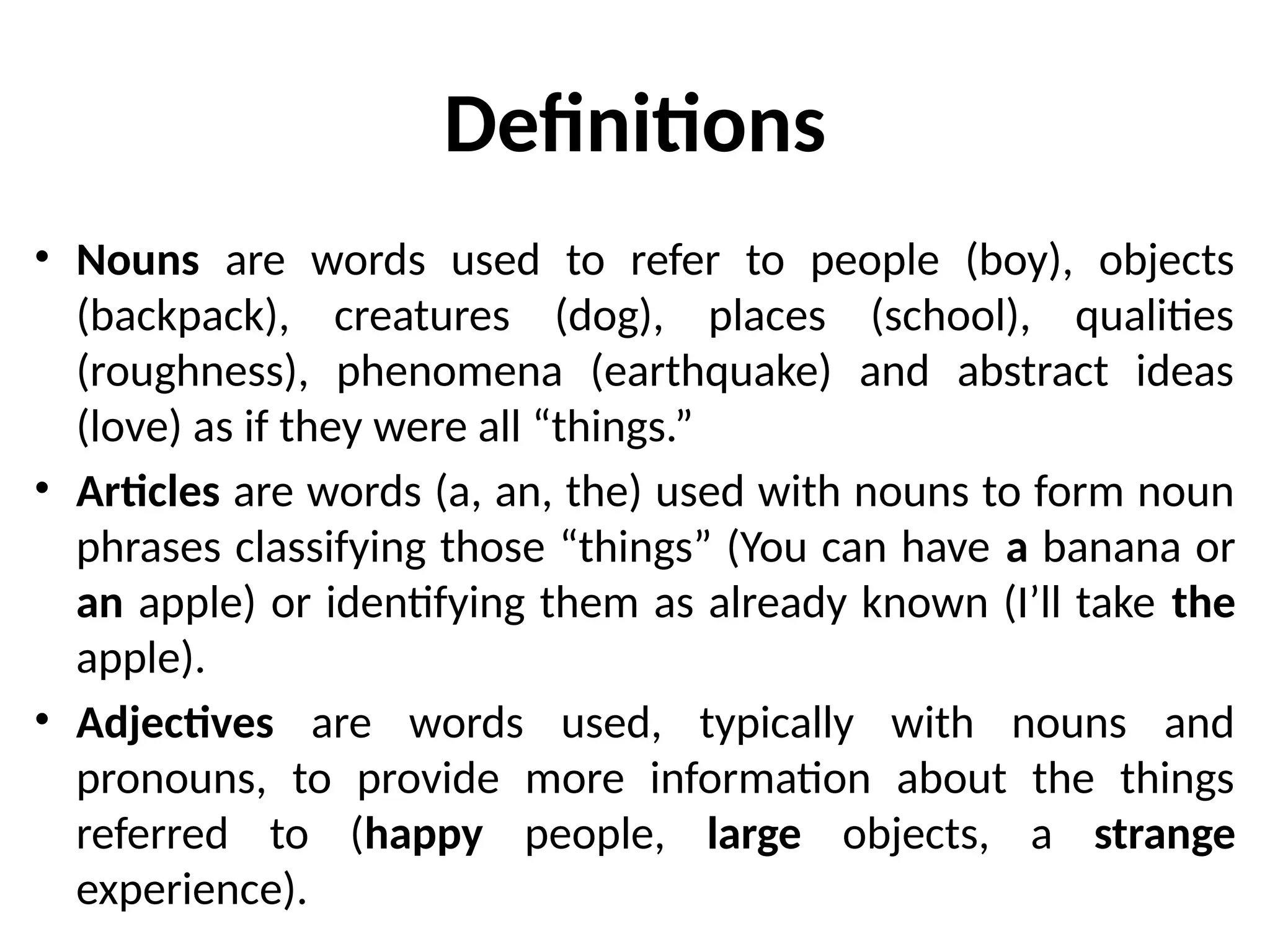
• Nouns arewords used to refer to people (boy), objects
(backpack), creatures (dog), places (school), qualities
(roughness), phenomena (earthquake) and abstract ideas
(love) as if they were all “things.”
• Articles are words (a, an, the) used with nouns to form noun
phrases classifying those “things” (You can have a banana or
an apple) or identifying them as already known (I’ll take the
apple).
• Adjectives are words used, typically with nouns and
pronouns, to provide more information about the things
referred to (happy people, large objects, a strange
experience).
6.
Definitions
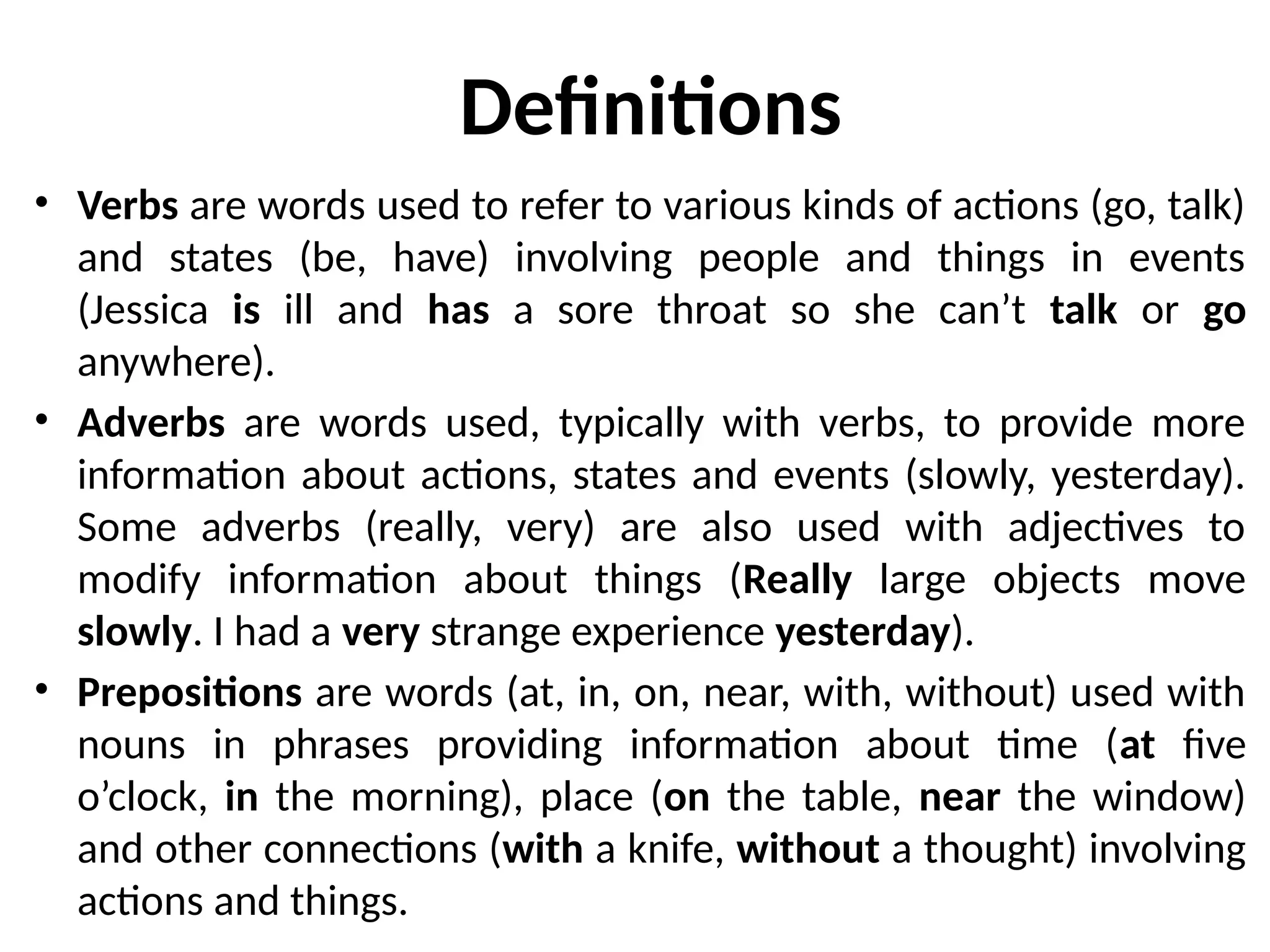
• Verbs arewords used to refer to various kinds of actions (go, talk)
and states (be, have) involving people and things in events
(Jessica is ill and has a sore throat so she can’t talk or go
anywhere).
• Adverbs are words used, typically with verbs, to provide more
information about actions, states and events (slowly, yesterday).
Some adverbs (really, very) are also used with adjectives to
modify information about things (Really large objects move
slowly. I had a very strange experience yesterday).
• Prepositions are words (at, in, on, near, with, without) used with
nouns in phrases providing information about time (at five
o’clock, in the morning), place (on the table, near the window)
and other connections (with a knife, without a thought) involving
actions and things.
7.
Definitions
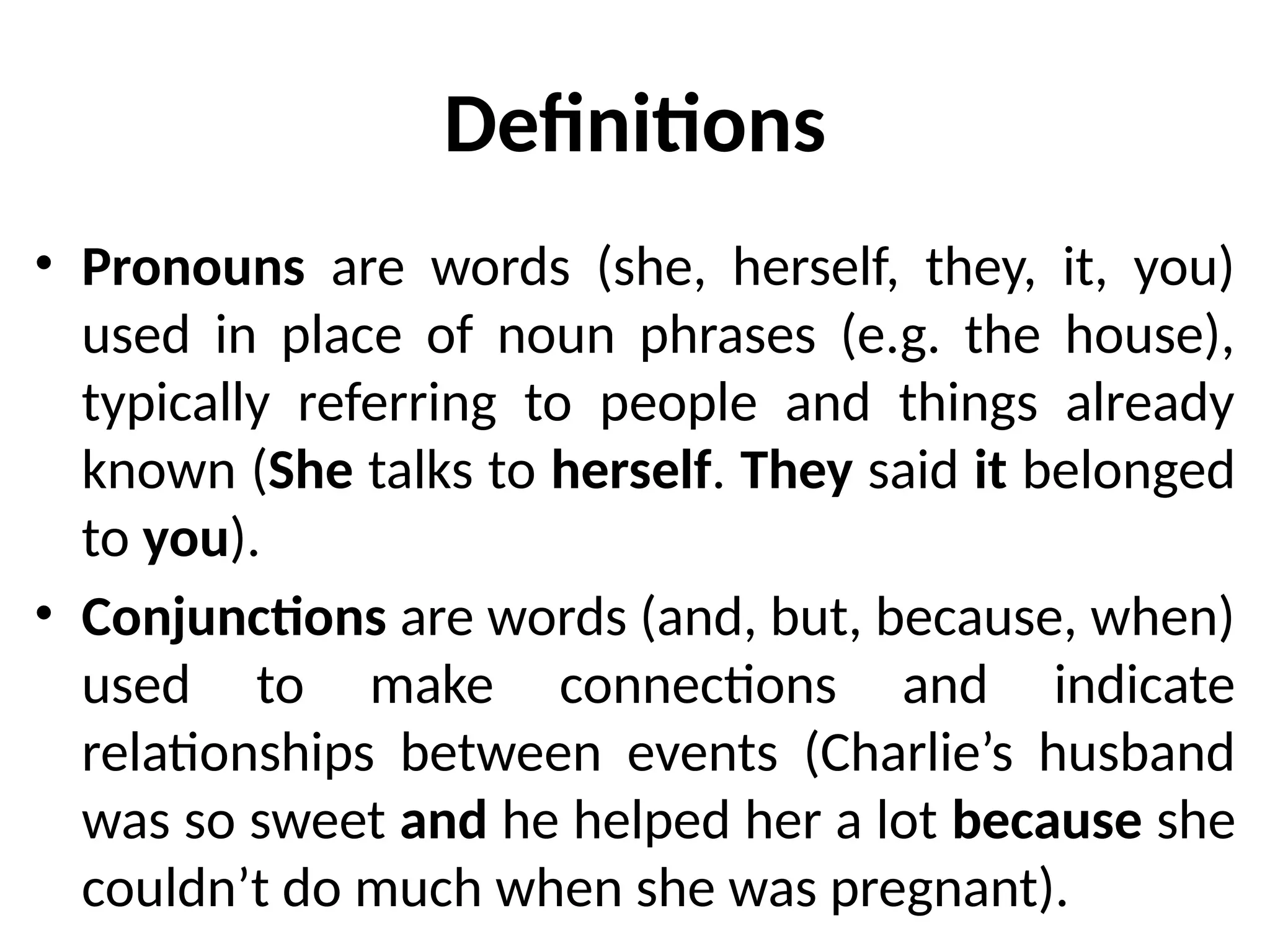
• Pronouns arewords (she, herself, they, it, you)
used in place of noun phrases (e.g. the house),
typically referring to people and things already
known (She talks to herself. They said it belonged
to you).
• Conjunctions are words (and, but, because, when)
used to make connections and indicate
relationships between events (Charlie’s husband
was so sweet and he helped her a lot because she
couldn’t do much when she was pregnant).
8.
Grammatical Categories
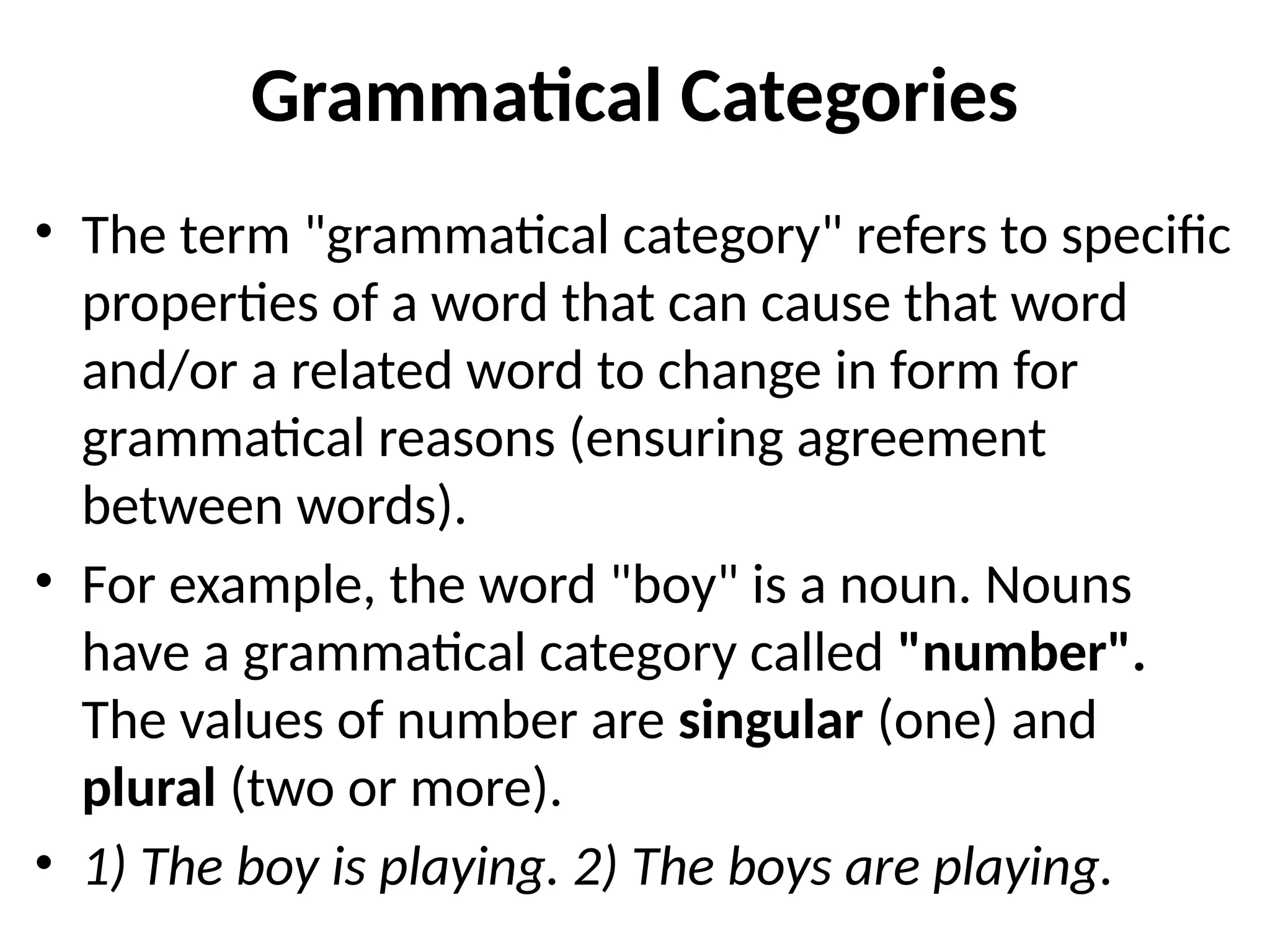
• Theterm "grammatical category" refers to specific
properties of a word that can cause that word
and/or a related word to change in form for
grammatical reasons (ensuring agreement
between words).
• For example, the word "boy" is a noun. Nouns
have a grammatical category called "number".
The values of number are singular (one) and
plural (two or more).
• 1) The boy is playing. 2) The boys are playing.
9.
Number
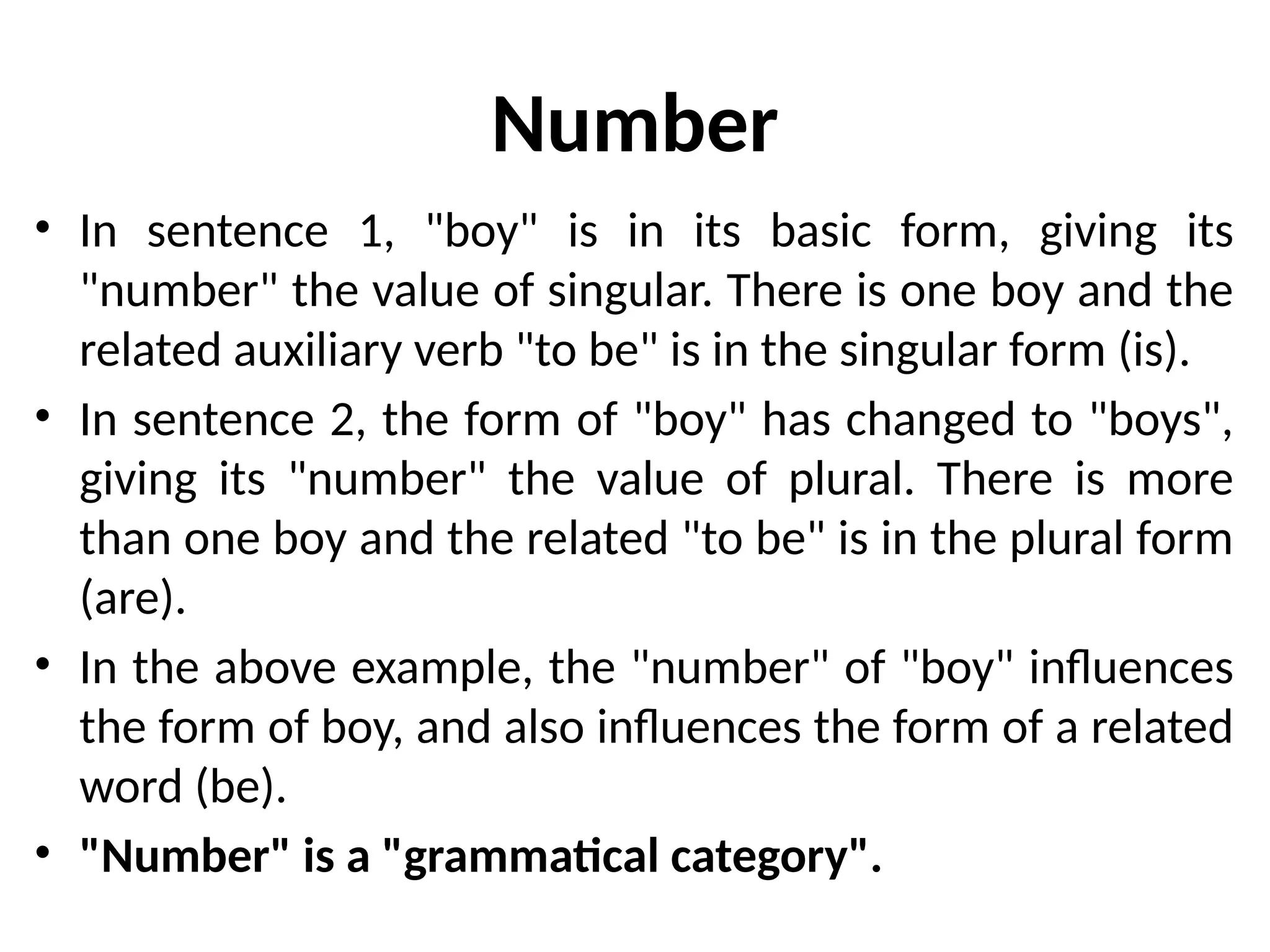
• In sentence1, "boy" is in its basic form, giving its
"number" the value of singular. There is one boy and the
related auxiliary verb "to be" is in the singular form (is).
• In sentence 2, the form of "boy" has changed to "boys",
giving its "number" the value of plural. There is more
than one boy and the related "to be" is in the plural form
(are).
• In the above example, the "number" of "boy" influences
the form of boy, and also influences the form of a related
word (be).
• "Number" is a "grammatical category".
10.
Number
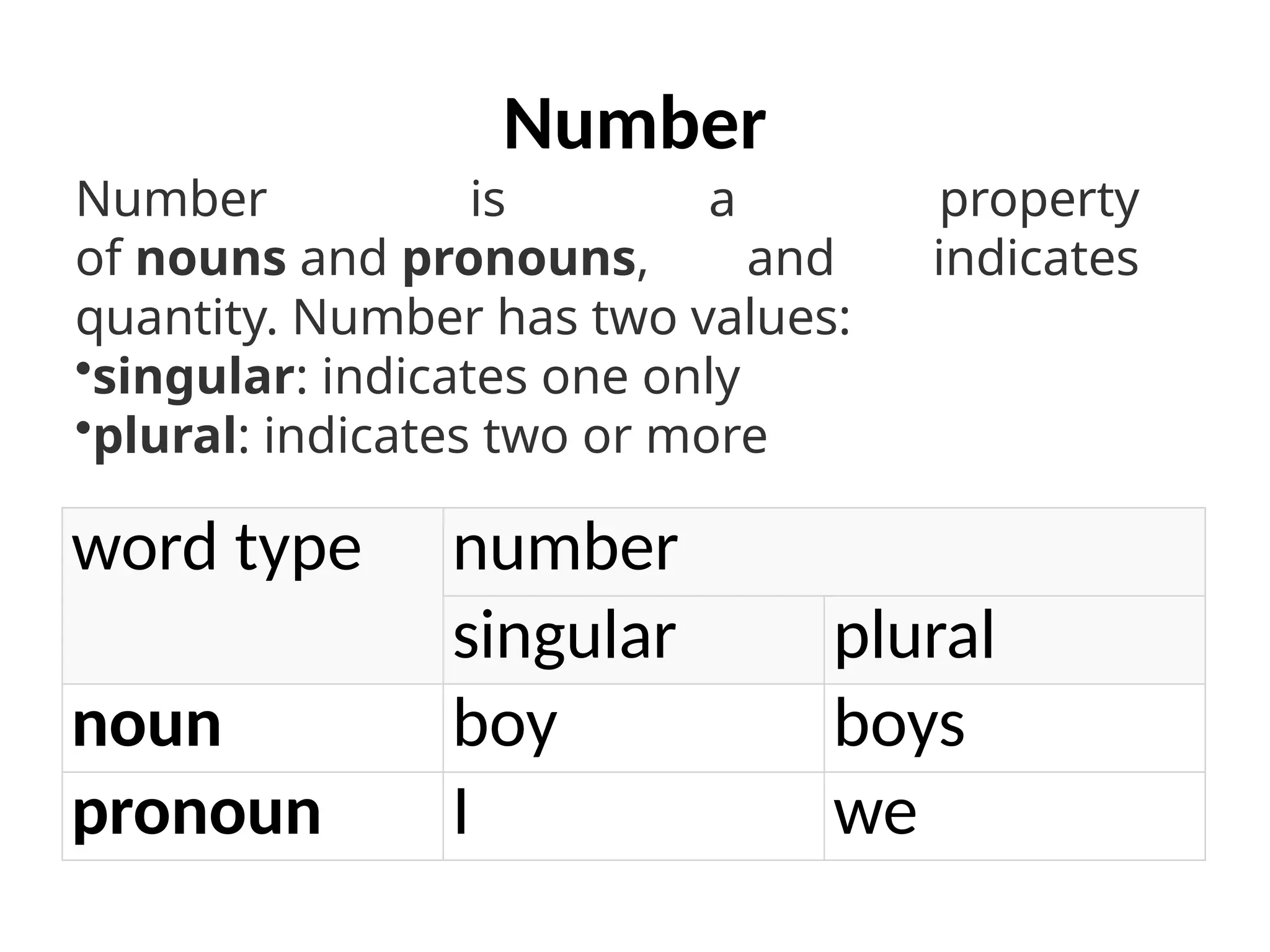
word type number
singularplural
noun boy boys
pronoun I we
Number is a property
of nouns and pronouns, and indicates
quantity. Number has two values:
•singular: indicates one only
•plural: indicates two or more
11.
Case
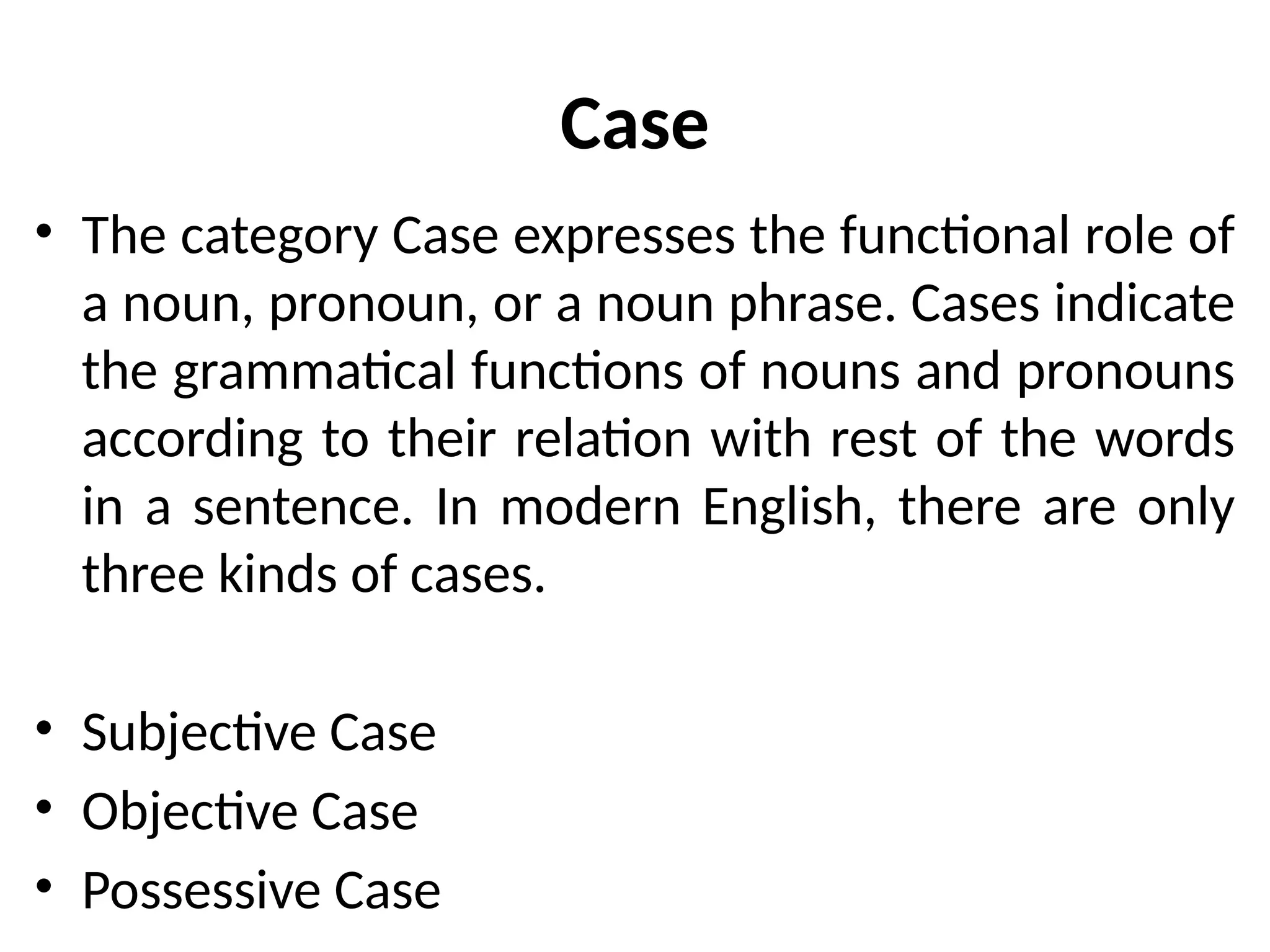
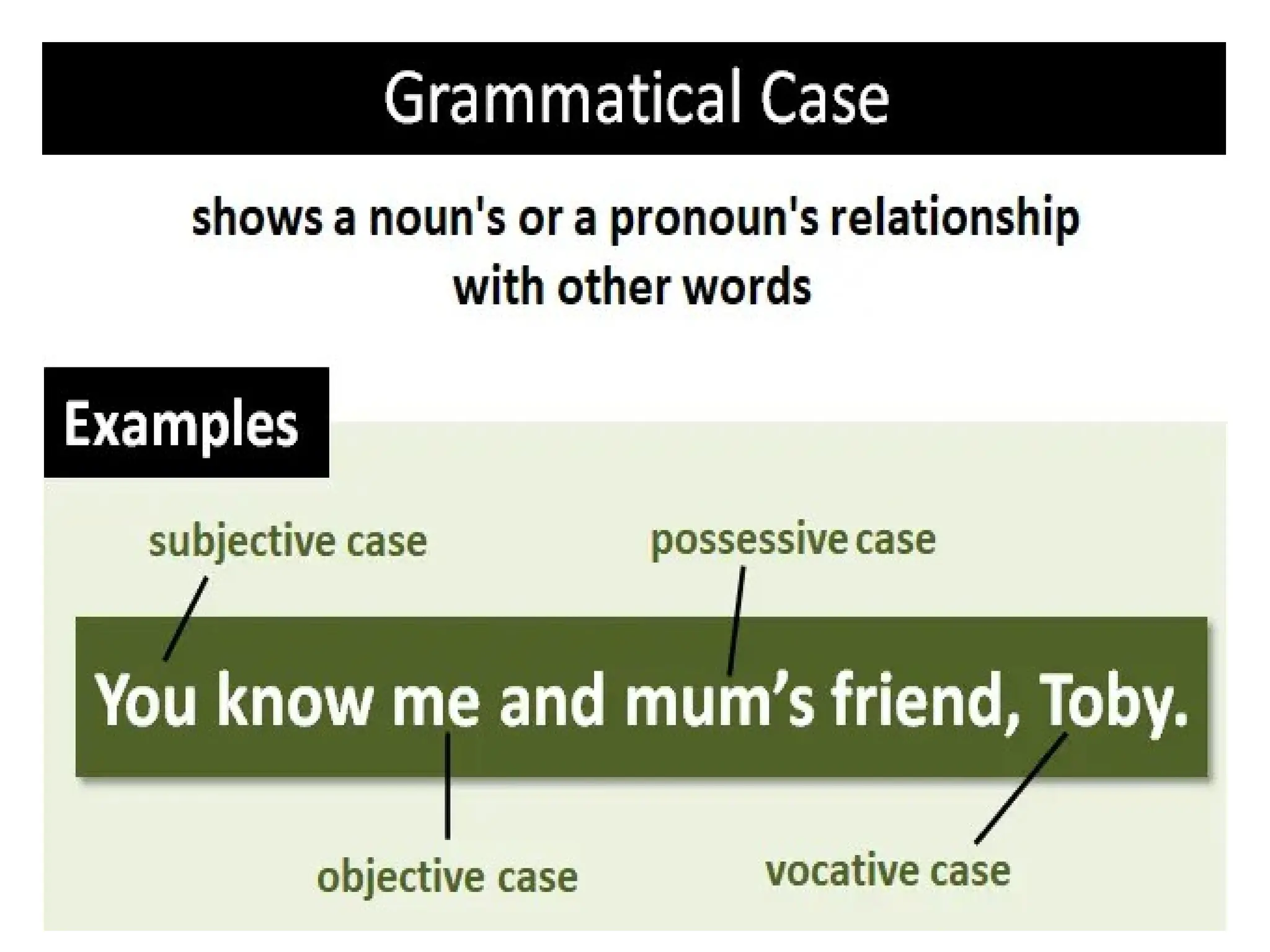
• The categoryCase expresses the functional role of
a noun, pronoun, or a noun phrase. Cases indicate
the grammatical functions of nouns and pronouns
according to their relation with rest of the words
in a sentence. In modern English, there are only
three kinds of cases.
• Subjective Case
• Objective Case
• Possessive Case
12.
Subjective Case
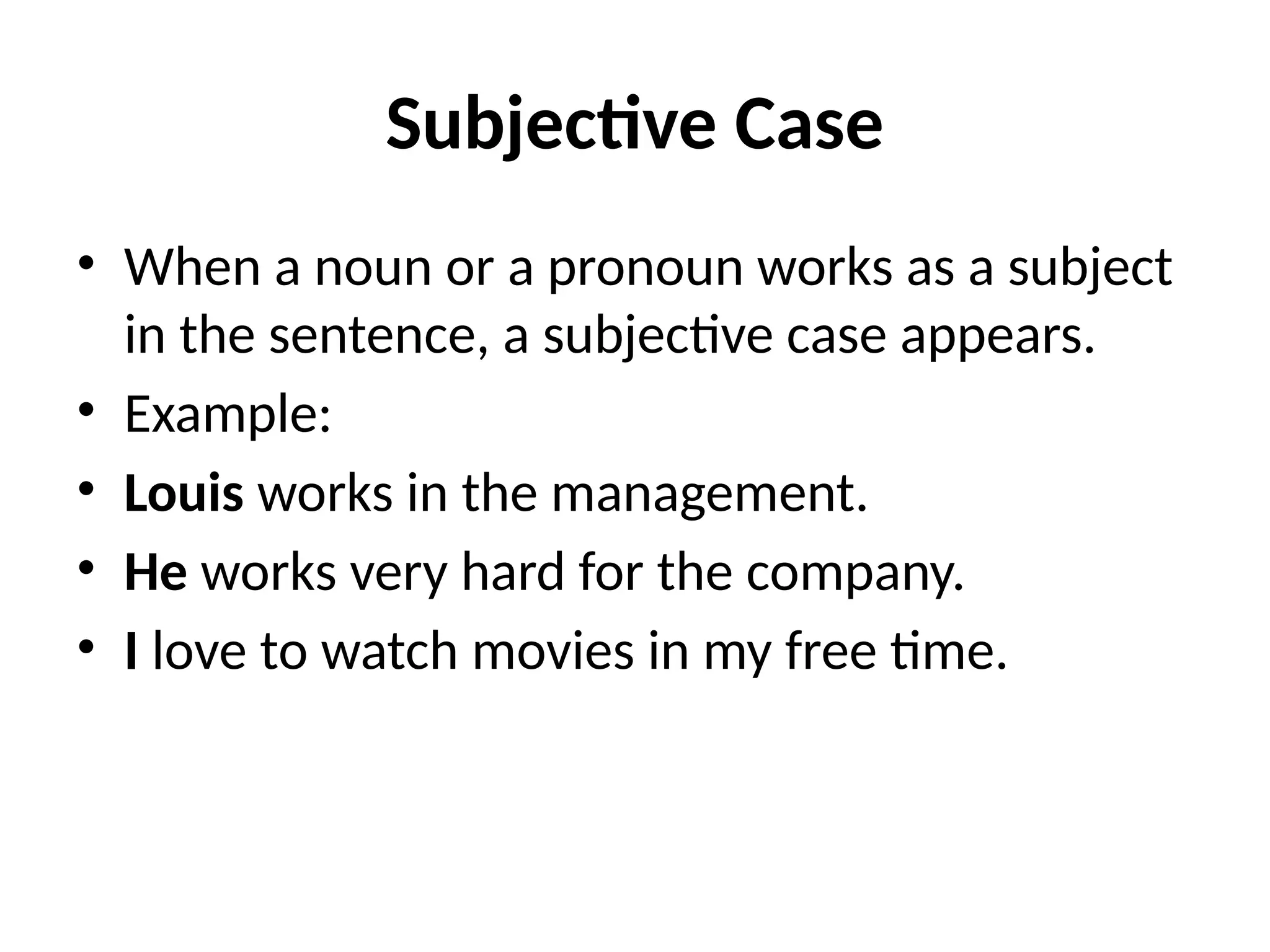
• Whena noun or a pronoun works as a subject
in the sentence, a subjective case appears.
• Example:
• Louis works in the management.
• He works very hard for the company.
• I love to watch movies in my free time.
13.
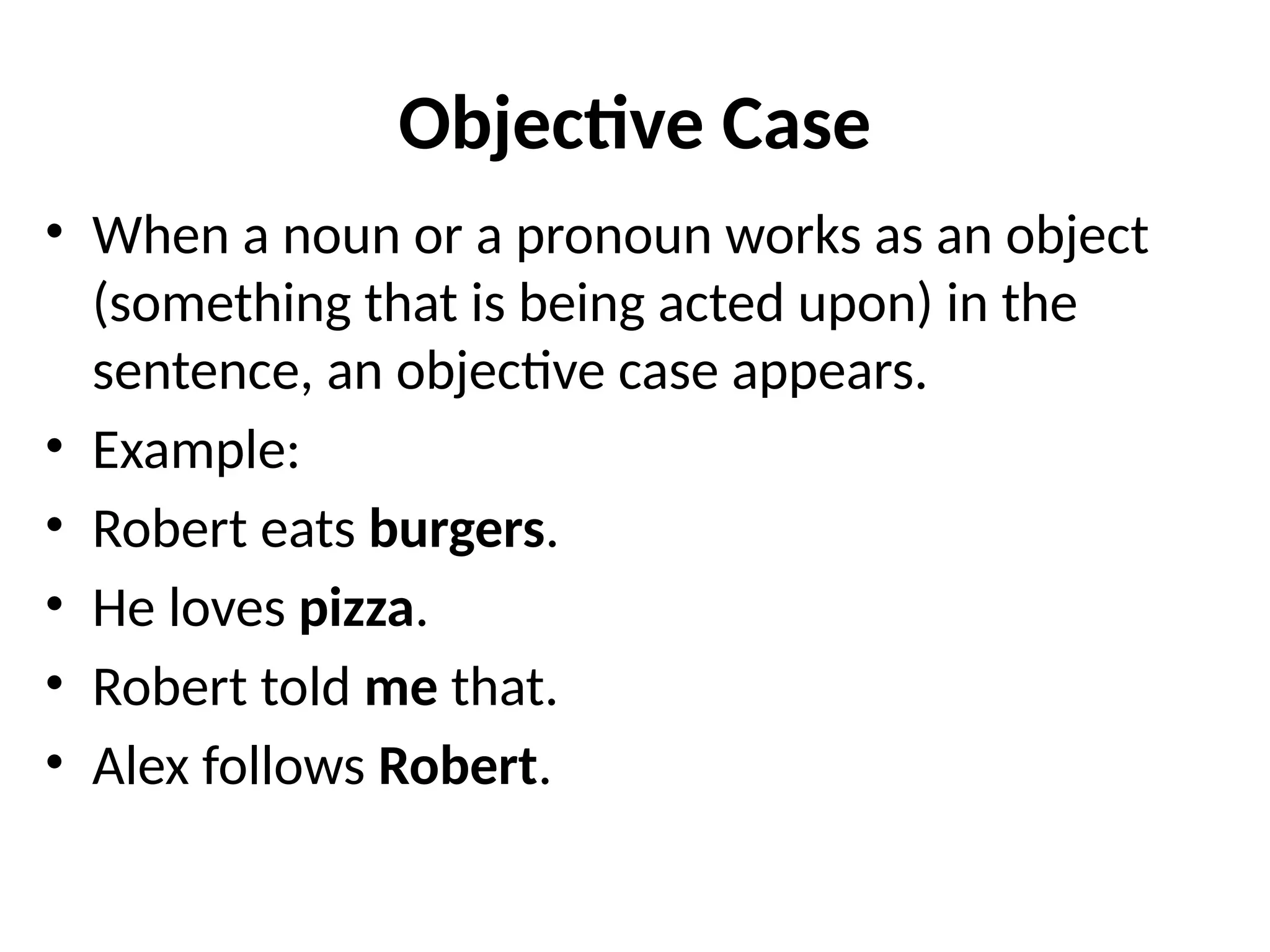
Objective Case
• Whena noun or a pronoun works as an object
(something that is being acted upon) in the
sentence, an objective case appears.
• Example:
• Robert eats burgers.
• He loves pizza.
• Robert told me that.
• Alex follows Robert.
14.
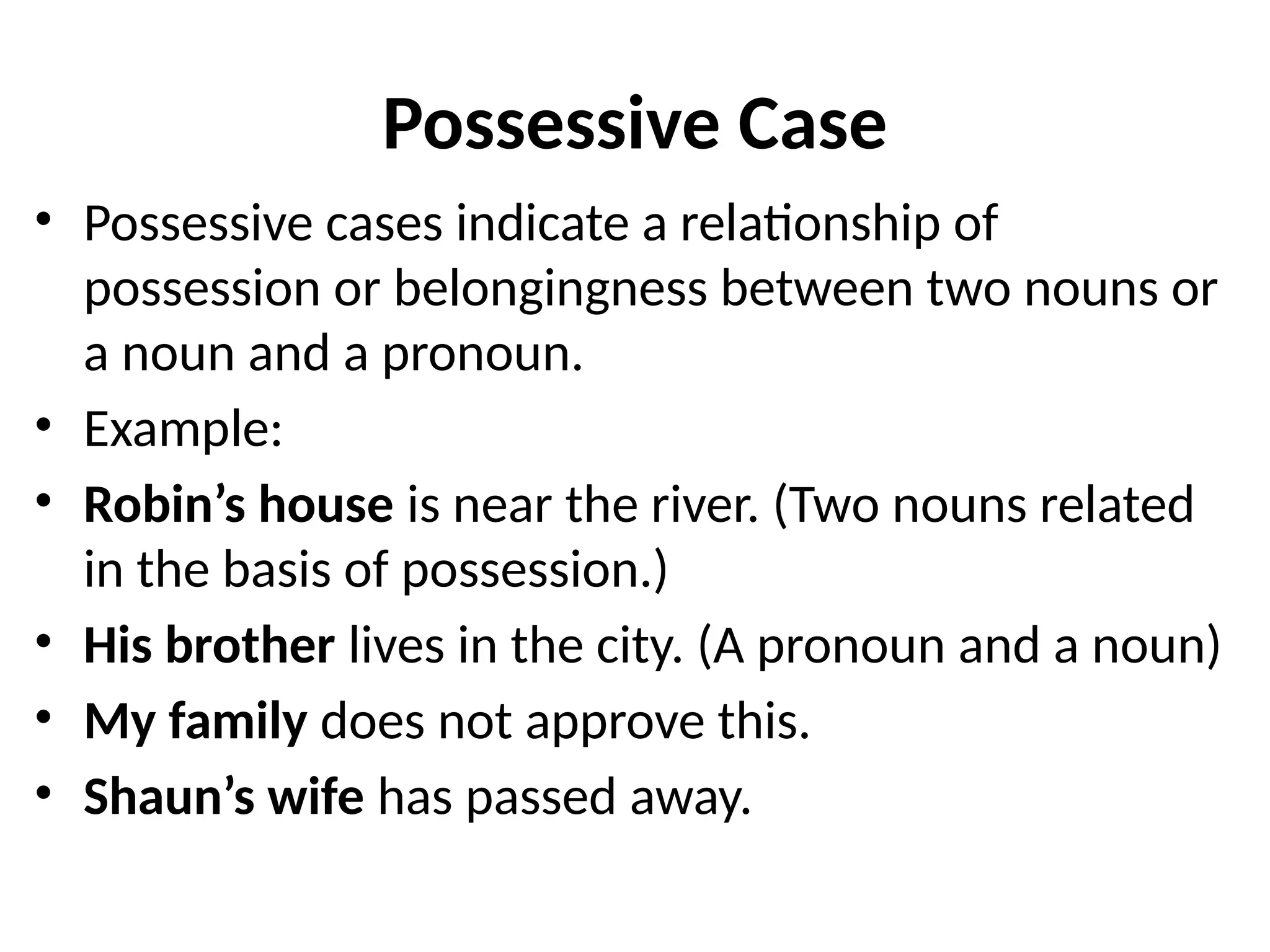
Possessive Case
• Possessivecases indicate a relationship of
possession or belongingness between two nouns or
a noun and a pronoun.
• Example:
• Robin’s house is near the river. (Two nouns related
in the basis of possession.)
• His brother lives in the city. (A pronoun and a noun)
• My family does not approve this.
• Shaun’s wife has passed away.
15.
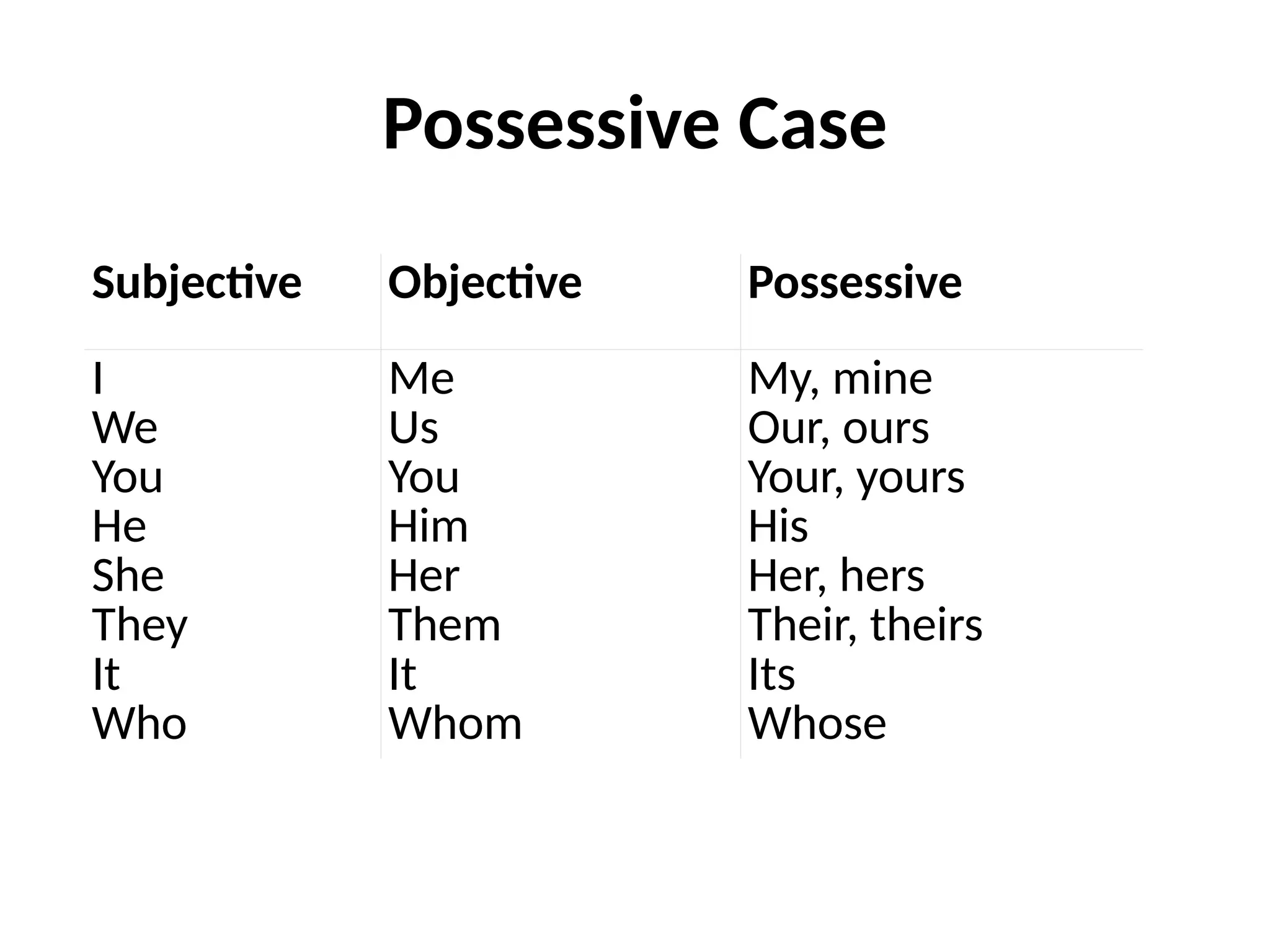
Possessive Case
Subjective ObjectivePossessive
I
We
You
He
She
They
It
Who
Me
Us
You
Him
Her
Them
It
Whom
My, mine
Our, ours
Your, yours
His
Her, hers
Their, theirs
Its
Whose
16.
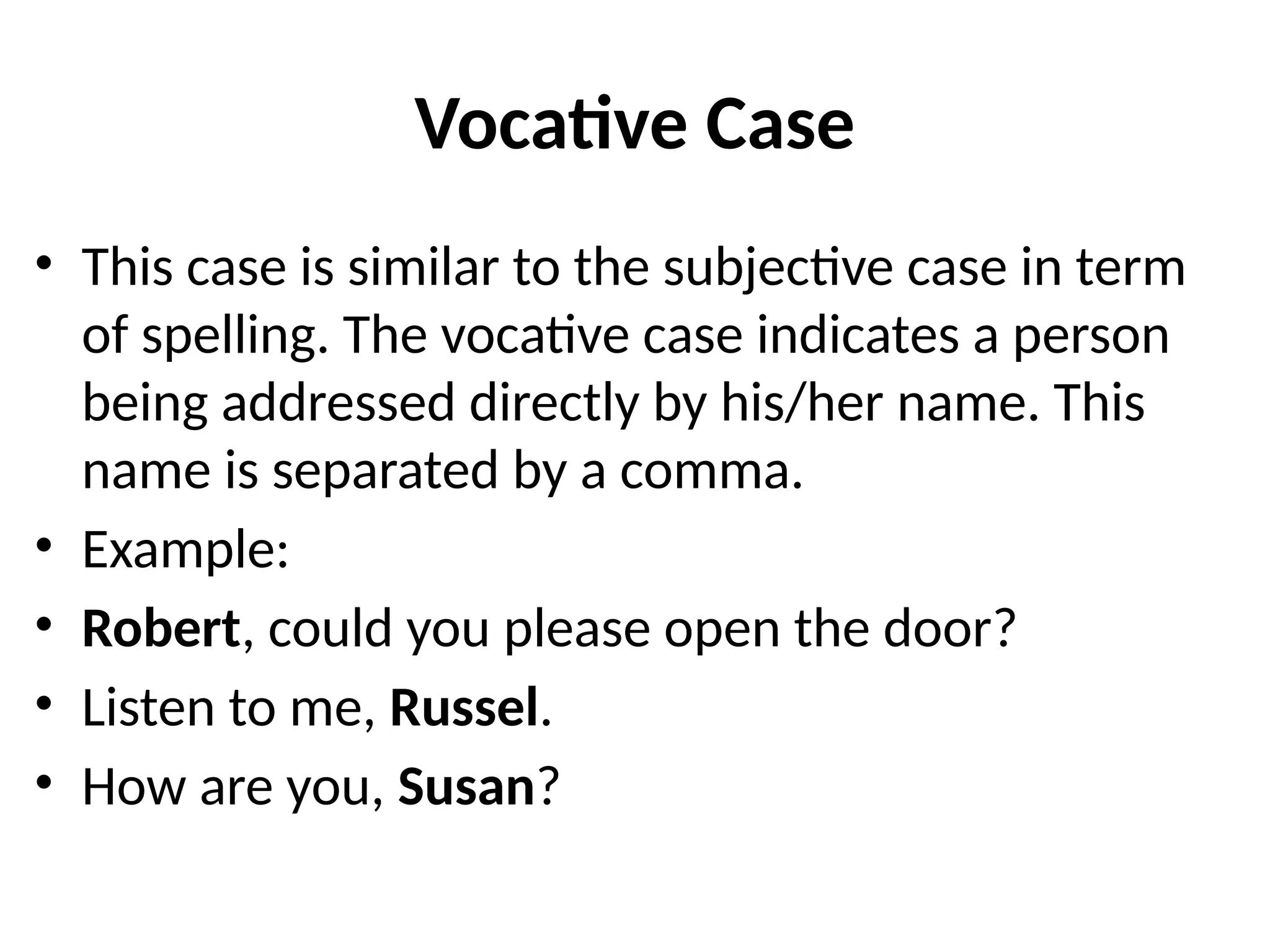
Vocative Case
• Thiscase is similar to the subjective case in term
of spelling. The vocative case indicates a person
being addressed directly by his/her name. This
name is separated by a comma.
• Example:
• Robert, could you please open the door?
• Listen to me, Russel.
• How are you, Susan?
18.
Gender
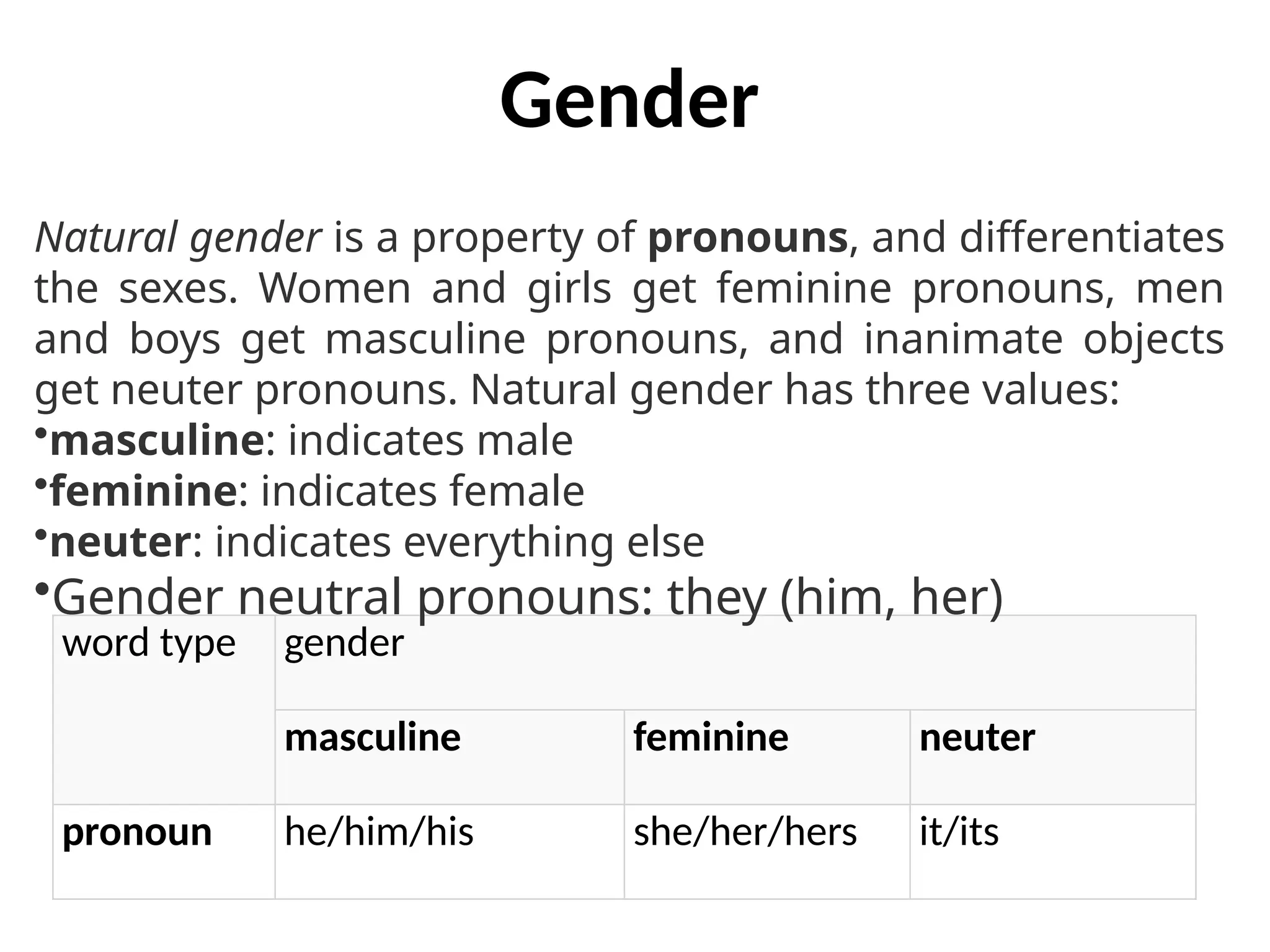
word type gender
masculinefeminine neuter
pronoun he/him/his she/her/hers it/its
Natural gender is a property of pronouns, and differentiates
the sexes. Women and girls get feminine pronouns, men
and boys get masculine pronouns, and inanimate objects
get neuter pronouns. Natural gender has three values:
•masculine: indicates male
•feminine: indicates female
•neuter: indicates everything else
•Gender neutral pronouns: they (him, her)
19.
Person
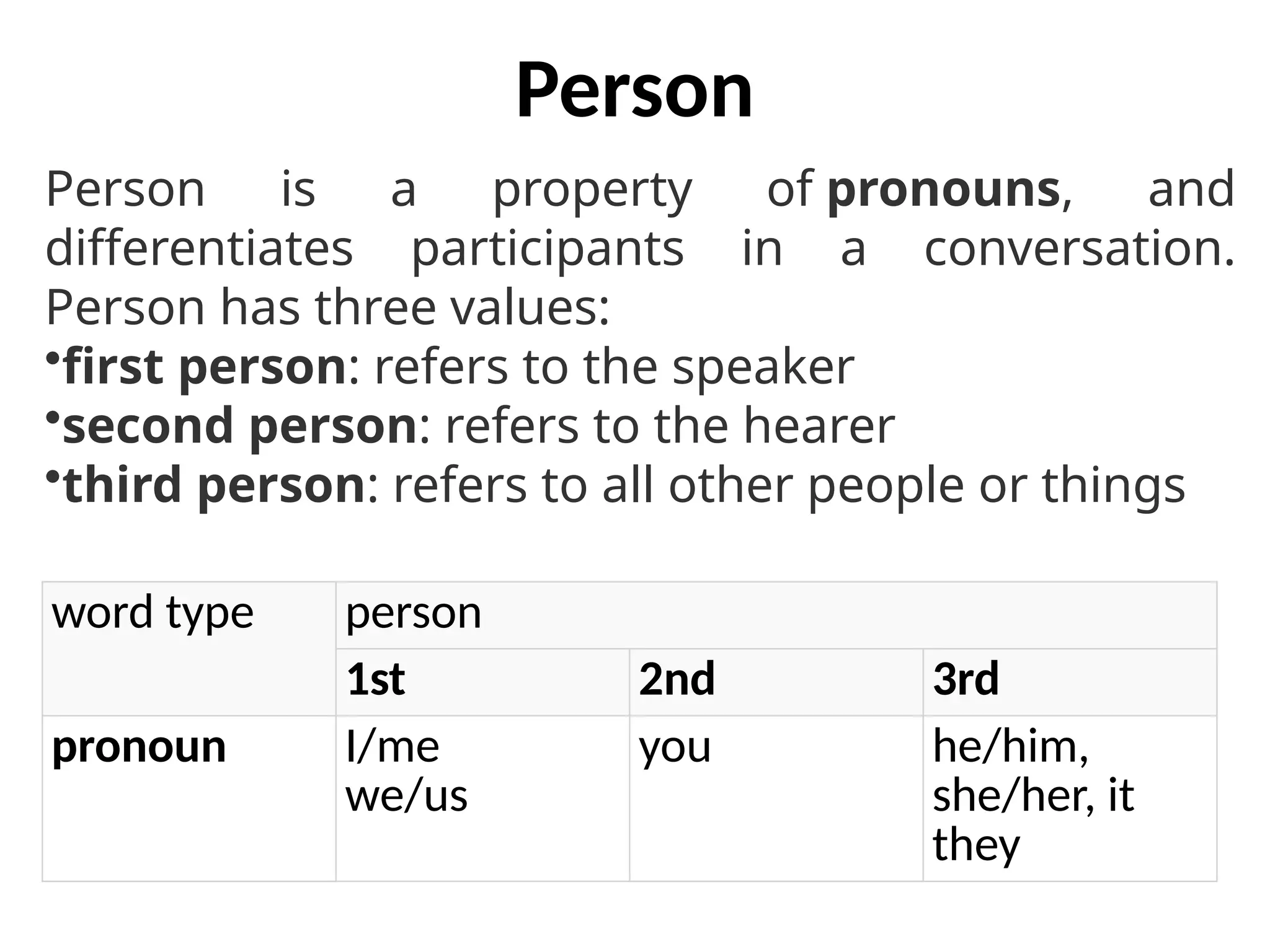
word type person
1st2nd 3rd
pronoun I/me
we/us
you he/him,
she/her, it
they
Person is a property of pronouns, and
differentiates participants in a conversation.
Person has three values:
•first person: refers to the speaker
•second person: refers to the hearer
•third person: refers to all other people or things
20.
Tense
• Tenses showwhen an action took place, as
well as how long it occurred. The main
tenses are the past, present, and future.
There are also additional aspects that give
extra details, such as the length of time the
action occurred, which actions happened
first, or whether a past action has an impact
on the present.
21.
Simple Tense
• "Simpletense" is a category of verb
tense. It covers the simple past tense, the
simple present tense, and the simple
future tense.
• She reads. (Simple present)
• She read. (Simple past)
• She will read. (Simple future)
22.
Perfect Tense
• Theperfect tense in English grammar is a verb form that describes
an action that has been completed or is still happening in the
present:
• Present perfect: Used to describe an action that began in the past
and continues into the present. For example, "I have lived in Brazil
last month". “I have borrowed a book from the library”.
• Past perfect: Used to describe an action that was completed
before another point in the past. For example, "I had called before
she arrived". I took a shower before leaving for the party.
• Future perfect: Used to describe an action that will be completed
by a specific point in the future. For example, "She will have called
by tomorrow morning".
23.
Present perfect vs.Past perfect
• Present perfect focuses on events that recently
started or started in the past but are still ongoing
in the present. Past perfect centers around
actions that are set and done in the past.
• She had gone to New York.
• Here, we are referring to an action that
happened in the past is already finished.
• She has gone to New York.
• Here, we are referring to an action that probably
started a while ago and is still ongoing.
24.
Continuous Tense
• Thecontinuous tense is used to describe actions that are happening, were
happening, or will be happening at a specific time. It is formed by
combining the verb "be" with the "-ing" form of the verb.
• Here are some examples of the continuous tense:
• Present continuous
• Used to describe actions that are happening at the time of speaking. For
example, "I am having dinner at the moment".
• Past continuous
• Used to describe actions that were happening in the past. For example, "I
was having dinner when Sarah called me".
• Future continuous (talks about the action over time e.g. the dinner
might last for 20 minutes or longer, more certain than simple future)
• Used to describe actions that will be happening in the future. For
example, "I will be having dinner at my parents' house tomorrow". “The
plane will be landing in an hour”, “They will be coming with us on holidays
this summer”.
25.
Perfect continuous tense
•The perfect progressive tense (also called the perfect
continuous tense) is used to say that an event or action is,
was, or will be continually occurring.
• Present Perfect Continuous Tense:
• Formation: Subject + "have/has been" + (-ing form) of the
main verb.
• Usage: Describes actions or states that started in the past,
continue in the present, and may continue into the future.
It emphasizes the ongoing nature of the action or state.
• Example:
• She has been studying for three hours.
26.
Perfect continuous tense
•Past Perfect Continuous Tense:
• Formation: Subject + "had been" + (-ing form) of the main
verb.
• Usage: Describes actions or states that were ongoing in the
past before another past action or a specific point in the past.
It indicates the continuity leading up to a specific time in the
past.
• Example:
• I had been working on the project all day before I took a break.
• They had been traveling for weeks before they reached their
destination.
27.
Perfect continuous tense
•Future Perfect Continuous Tense:
• Formation: Subject + "will have been" + (-ing form)
of the main verb.
• Usage: Describes actions or states that will be
ongoing and in progress before a specific future
time or reference point. It emphasizes the continuity
leading up to a future moment.
• Example:
• By next month, she will have been studying English
for a year.
28.
Mood
• Mood isa property of verbs, and relates to the speaker's feelings
about the reality of what he is saying. Mood has three values:
• indicative: expresses simple statement of fact (It's used to state facts,
opinions, or ideas. It's used to ask questions in the form of a statement. It's used to
express a condition. It's used in declarative statements, which are sentences that
"declare" or state a fact. It doesn't have a standard structure, but it usually includes a
subject and verb. Modals like "can", "may", or "should" can be added to express
obligations, abilities, or permission. Negative statements are also considered to be in the
indicative mood.
• imperative: expresses command
• subjunctive: expresses something desired or imagined
word type mood
indicative imperative subjunctive
verb James stood
up.
Stand up! We insist that he stand.
Is it quiet
enough?
Be quiet! It is essential that you be quiet.
29.
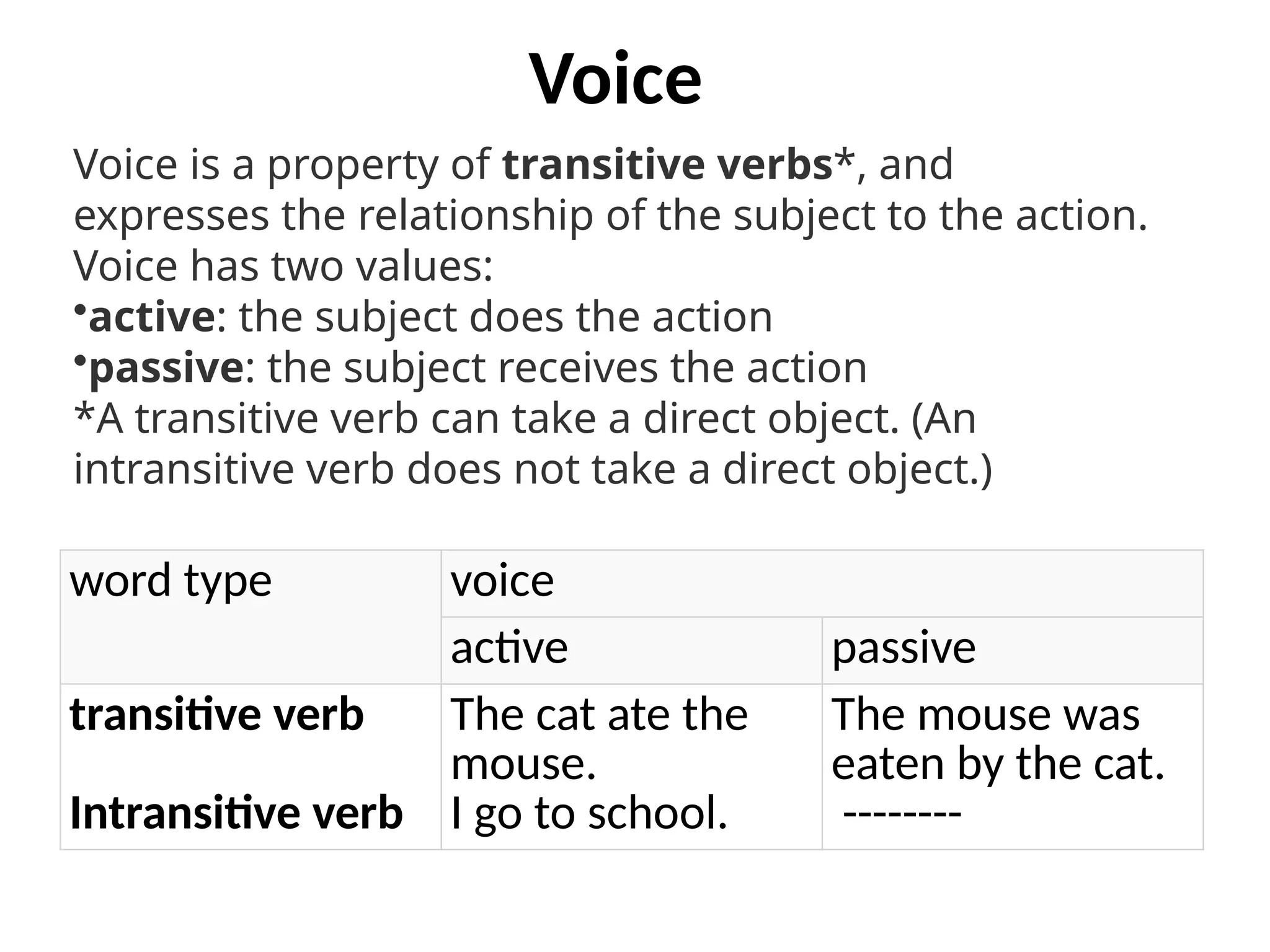
Voice
word type voice
activepassive
transitive verb
Intransitive verb
The cat ate the
mouse.
I go to school.
The mouse was
eaten by the cat.
--------
Voice is a property of transitive verbs*, and
expresses the relationship of the subject to the action.
Voice has two values:
•active: the subject does the action
•passive: the subject receives the action
*A transitive verb can take a direct object. (An
intransitive verb does not take a direct object.)
30.
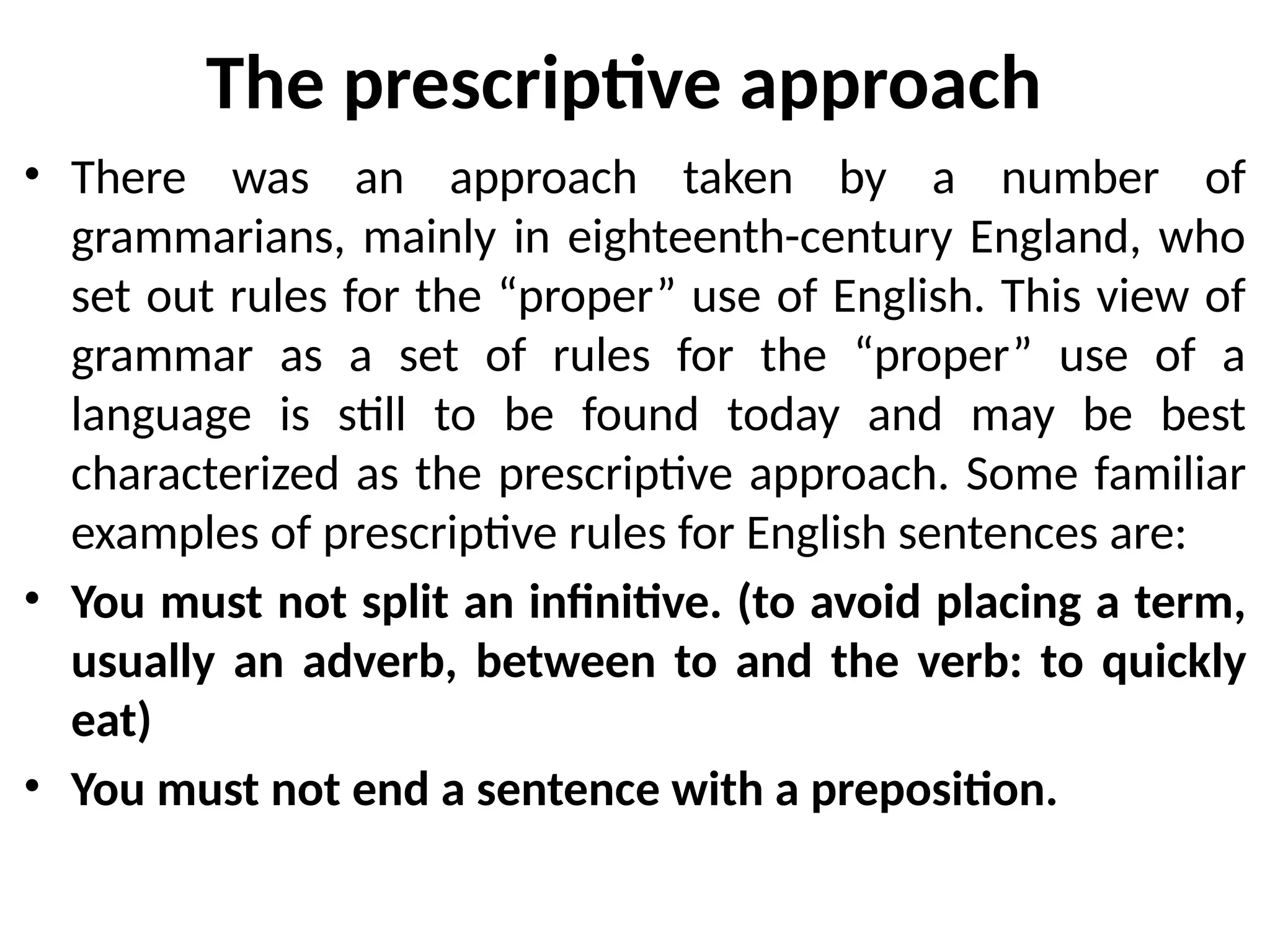
The prescriptive approach
•There was an approach taken by a number of
grammarians, mainly in eighteenth-century England, who
set out rules for the “proper” use of English. This view of
grammar as a set of rules for the “proper” use of a
language is still to be found today and may be best
characterized as the prescriptive approach. Some familiar
examples of prescriptive rules for English sentences are:
• You must not split an infinitive. (to avoid placing a term,
usually an adverb, between to and the verb: to quickly
eat)
• You must not end a sentence with a preposition.
31.
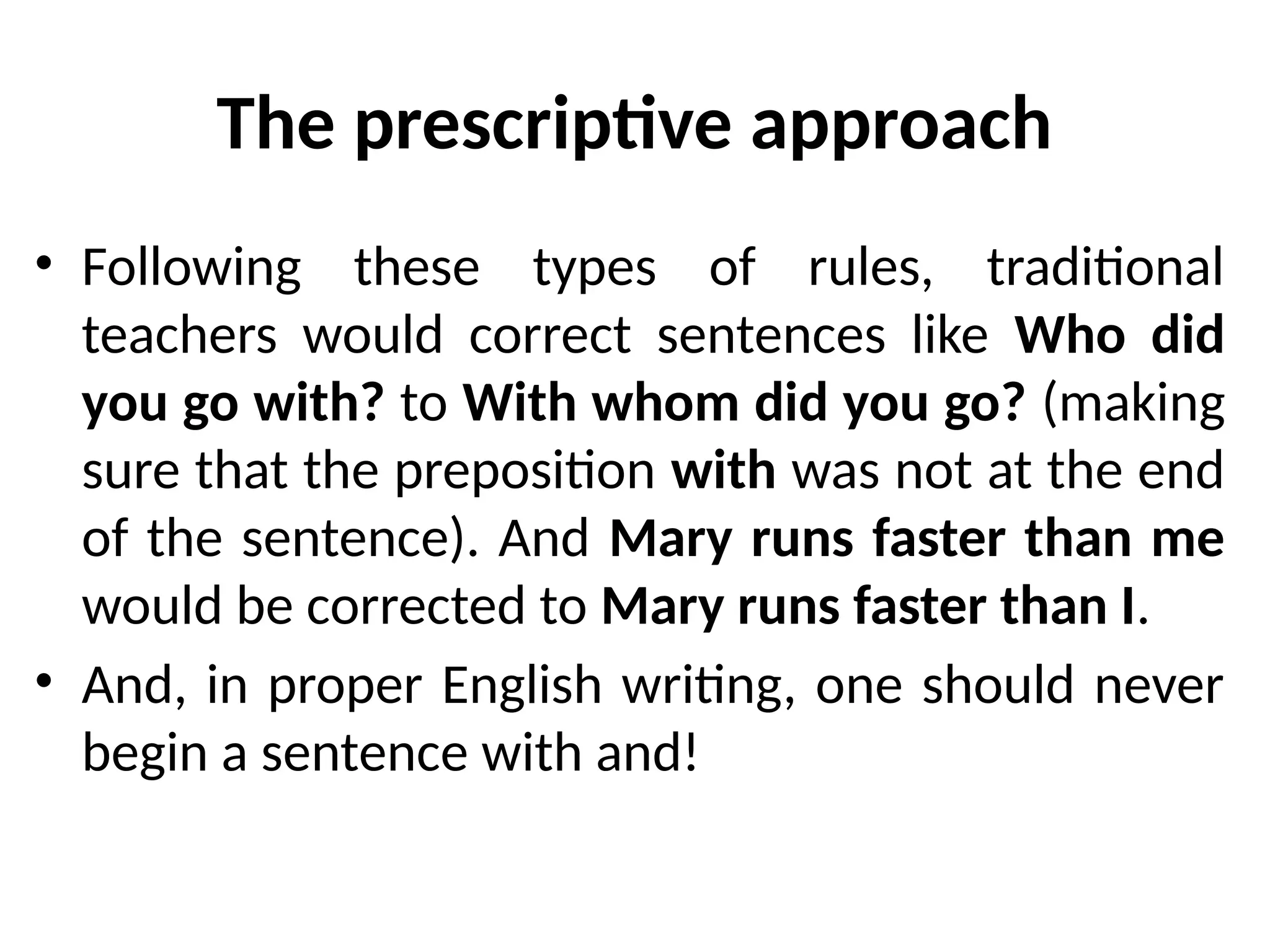
The prescriptive approach
•Following these types of rules, traditional
teachers would correct sentences like Who did
you go with? to With whom did you go? (making
sure that the preposition with was not at the end
of the sentence). And Mary runs faster than me
would be corrected to Mary runs faster than I.
• And, in proper English writing, one should never
begin a sentence with and!
32.
The descriptive approach
•The descriptive approach in linguistics is a way
of studying language by objectively analyzing
how it is used in real life, without making
judgments about what is correct. It is also
known as descriptive linguistics.
33.
Syntax
• When weconcentrate on the structure and ordering of components within a
sentence, we are studying the syntax of a language. The word “syntax” comes
originally from Greek and literally means “a putting together” or
“arrangement.
• A goal of syntactic analysis is to have a small and finite (i.e. limited) set of
rules that will be capable of producing a large and potentially infinite (i.e.
unlimited) number of well-formed structures. This small and finite set of
rules is sometimes described as a generative grammar because it can be used
to “generate” or produce sentence structures and not just describe them.
• This type of grammar should also be capable of revealing the basis of two
other phenomena: first, how some superficially different sentences are
closely related and, second, how some superficially similar sentences are in
fact different.
34.
Deep and surfacestructure
• Two superficially different sentences are shown in these examples:
• Charlie broke the window.
• The window was broken by Charlie.
• In traditional grammar, the first is called an active sentence, focusing
on what Charlie did, and the second is a passive sentence, focusing
on The window and what happened to it.
• The distinction between them is a difference in their surface
structure, that is, the different syntactic forms they have as
individual English sentences. However, this superficial difference in
form disguises the fact that the two sentences are very closely
related, even identical, at some less superficial level (the level of
meaning).
35.
Deep and surfacestructure
• Surface structures are the versions of sentences that are seen or
heard, while deep structures contain the basic units of meaning of a
sentence. The deep structure is an abstract level of structural
organization in which all the elements determining structural
interpretation are represented.
• Deep structure refers to concepts, thoughts, ideas and feelings
whereas surface structure refers to the words/language we use to
represent the deep structure.
• That same deep structure can be the source of many other surface
structures such as It was Charlie who broke the window and Was
the window broken by Charlie?.
• In short, the grammar must be capable of showing how a single
underlying abstract representation can become different surface
structures.
36.
Structural ambiguity
Let’s saywe have two distinct deep structures. One expresses
the idea that “Annie had an umbrella and she bumped into a
man with it.” The other expresses the idea that “Annie
bumped into a man and the man happened to be carrying an
umbrella.”
Now, these two different versions of events can actually be
expressed in the same surface structure form: Annie bumped
into a man with an umbrella. This sentence provides an
example of structural ambiguity. It has two distinct underlying
interpretations that have to be represented differently in deep
structure (bcz the 2 ideas are different).
37.
Structural ambiguity
• Thecomedian Groucho Marx knew how to have fun with
structural ambiguity. In the film Animal Crackers, he first says I
once shot an elephant in my pajamas, then follows it with How
he got into my pajamas I’ll never know.
• In the non-funny interpretation, part of the underlying (deep)
structure of the first sentence could be something like: “I shot
an elephant (while I was) in my pajamas.” In the other (ho, ho)
interpretation, part of the underlying structure would be
something like: “I shot an elephant (which was) in my
pajamas.”
• There are two different underlying (deep) structures with the
same surface structure. Our syntactic analysis will have to be
capable of showing the structural distinction (on surface level –
clear) between these underlying representations.
38.
Recursion
• The rulesof the grammar will also need the crucial property of recursion.
Recursive (“repeatable any number of times”) rules have the capacity to be
applied more than once in generating a structure. For example, we can have one
prepositional phrase describing location (on the table) in the sentence The gun
was on the table.
• We can also repeat this type of phrase, using different words (near the window),
for as long as the sentence still makes sense (in the bedroom). So, in order to
generate a sentence such as The gun was on the table near the window in the
bedroom, we must be able to repeat the rule that creates a prepositional phrase
over and over again.
• We must also be able to put sentences inside other sentences. For example, when
we produce a sentence such as Cathy knew that Mary helped George, we do so
with the sentence Mary helped George inside it.
• And those two sentences can be generated inside another sentence such as John
believed that Cathy knew that Mary helped George. In principle, there is no end
to the recursion that would produce ever longer versions of complex sentences
with this structure.
39.
Recursion
• A relativeclause can be contained within a
larger noun phrase. For example, in the
sentence "Hand me the books that Dan
bought", the relative clause "that Dan bought"
is contained within the larger noun phrase "the
books". Hand me the books that Dan bought
which were lent to Alina who took them home.
• Noun phrases can be repeated within the same
clause too. E.g. the book on the table belongs
to Kiara.
40.
Tree diagram
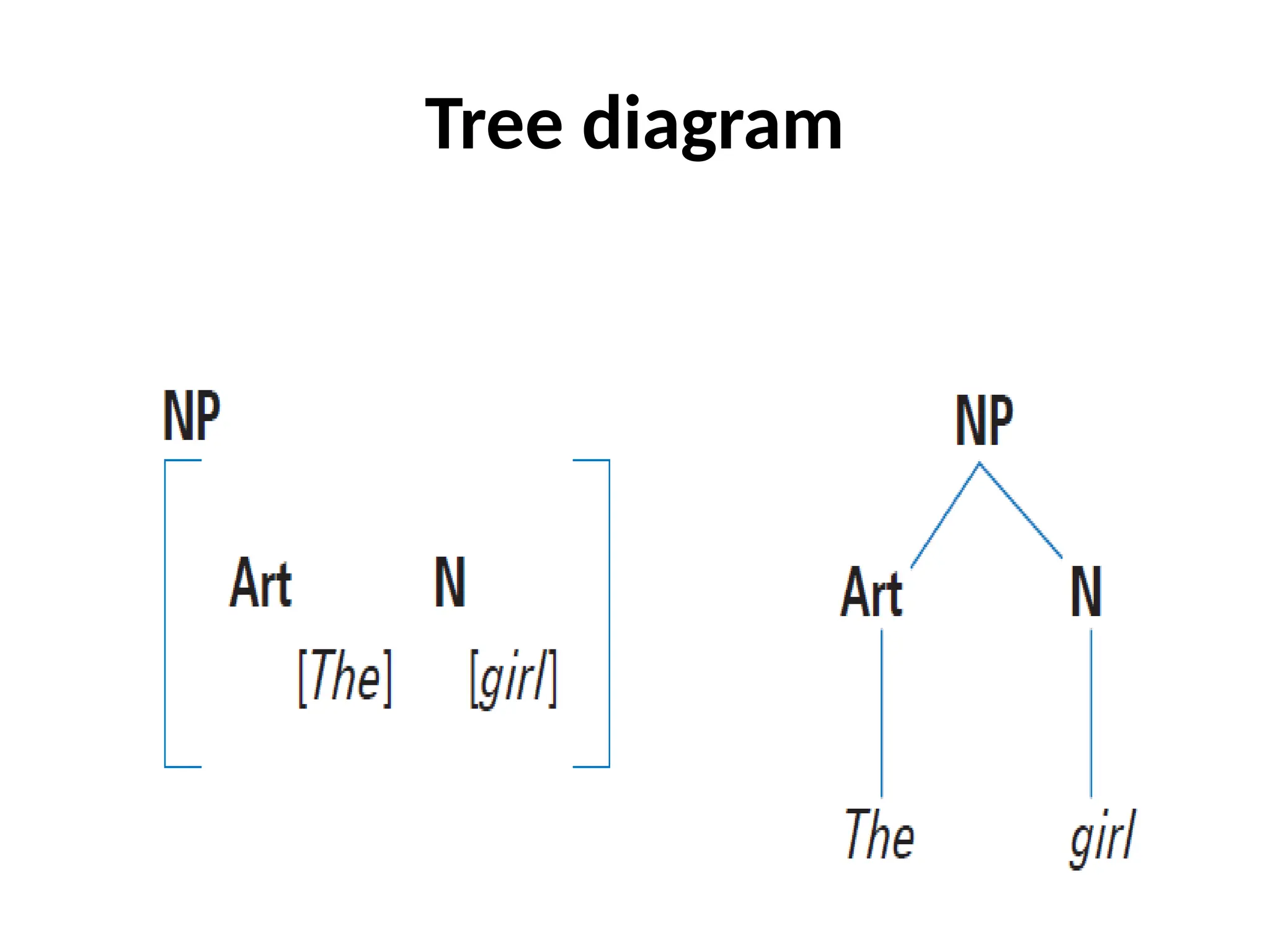
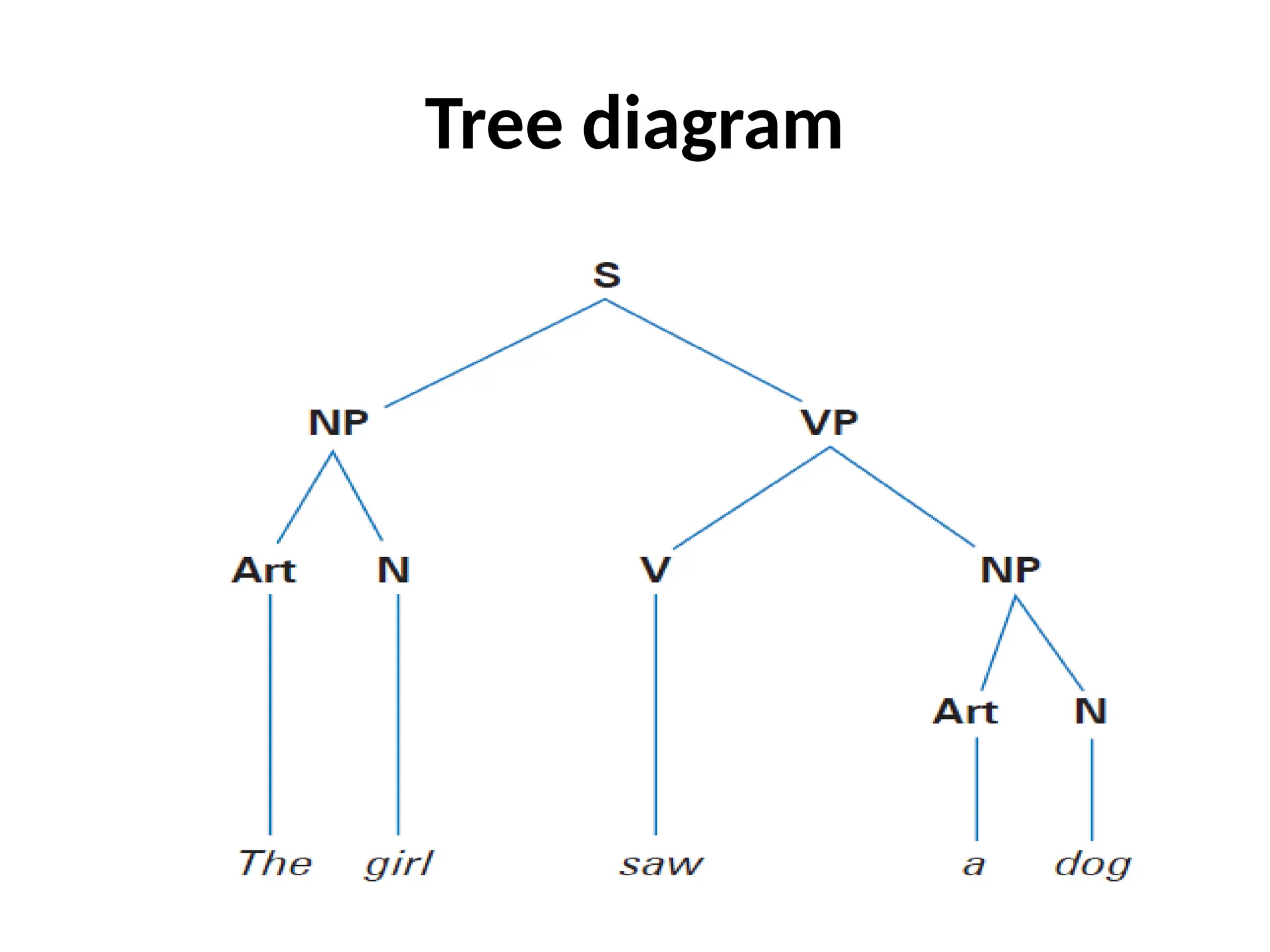
• Oneof the most common ways to create a visual
representation of syntactic structure is through
tree diagrams. We can use the symbols
(Art=article, N = noun, NP = noun phrase) to
label parts of the tree as we try to capture the
hierarchical organization of those parts in the
underlying structure of phrases and sentences.
So, we can take the information in a labeled and
bracketed format, shown on the left, and
present it in a tree diagram, shown on the right.
Symbols used insyntactic analysis
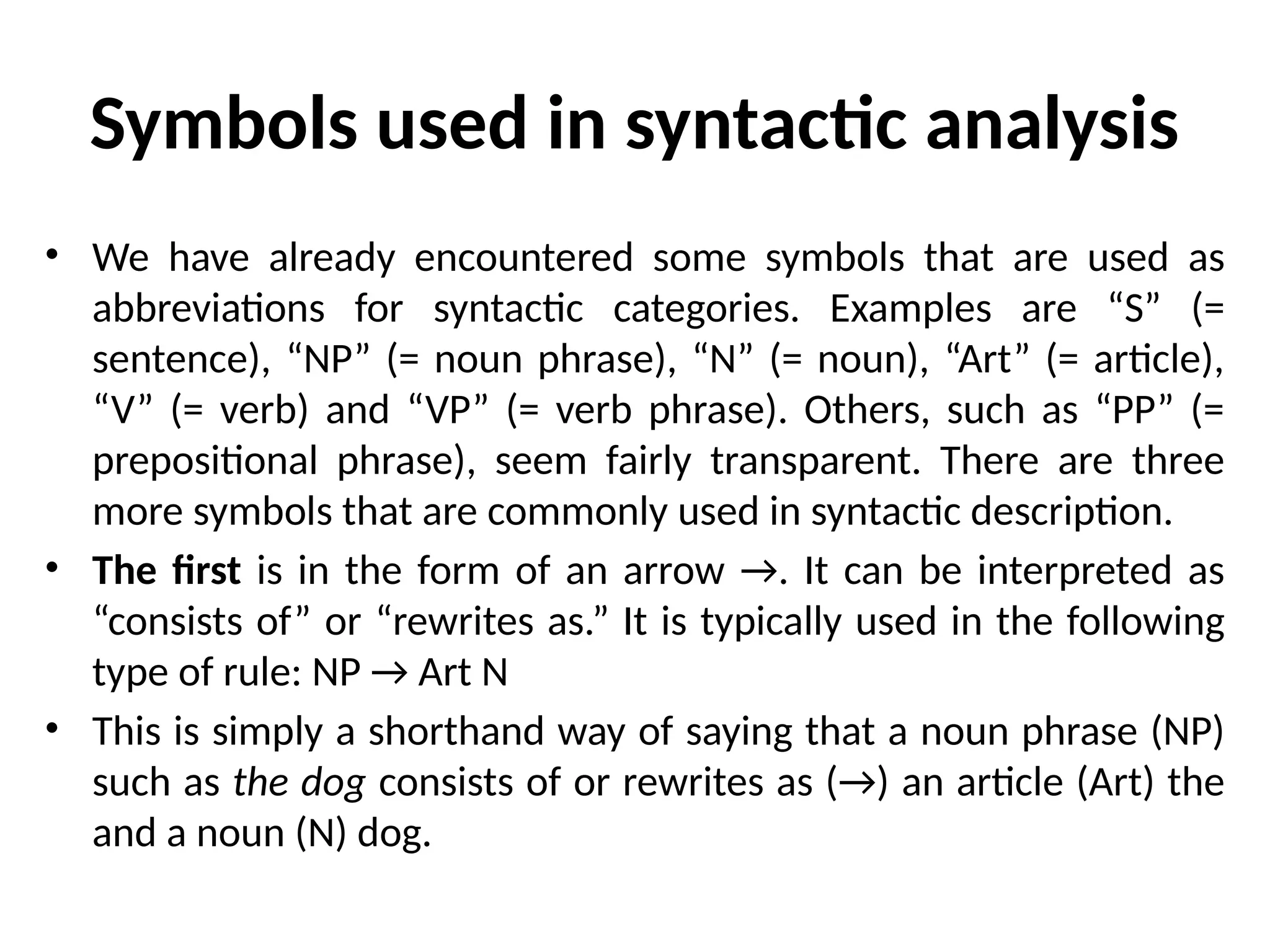
• We have already encountered some symbols that are used as
abbreviations for syntactic categories. Examples are “S” (=
sentence), “NP” (= noun phrase), “N” (= noun), “Art” (= article),
“V” (= verb) and “VP” (= verb phrase). Others, such as “PP” (=
prepositional phrase), seem fairly transparent. There are three
more symbols that are commonly used in syntactic description.
• The first is in the form of an arrow →. It can be interpreted as
“consists of” or “rewrites as.” It is typically used in the following
type of rule: NP → Art N
• This is simply a shorthand way of saying that a noun phrase (NP)
such as the dog consists of or rewrites as (→) an article (Art) the
and a noun (N) dog.
44.
Symbols used insyntactic analysis
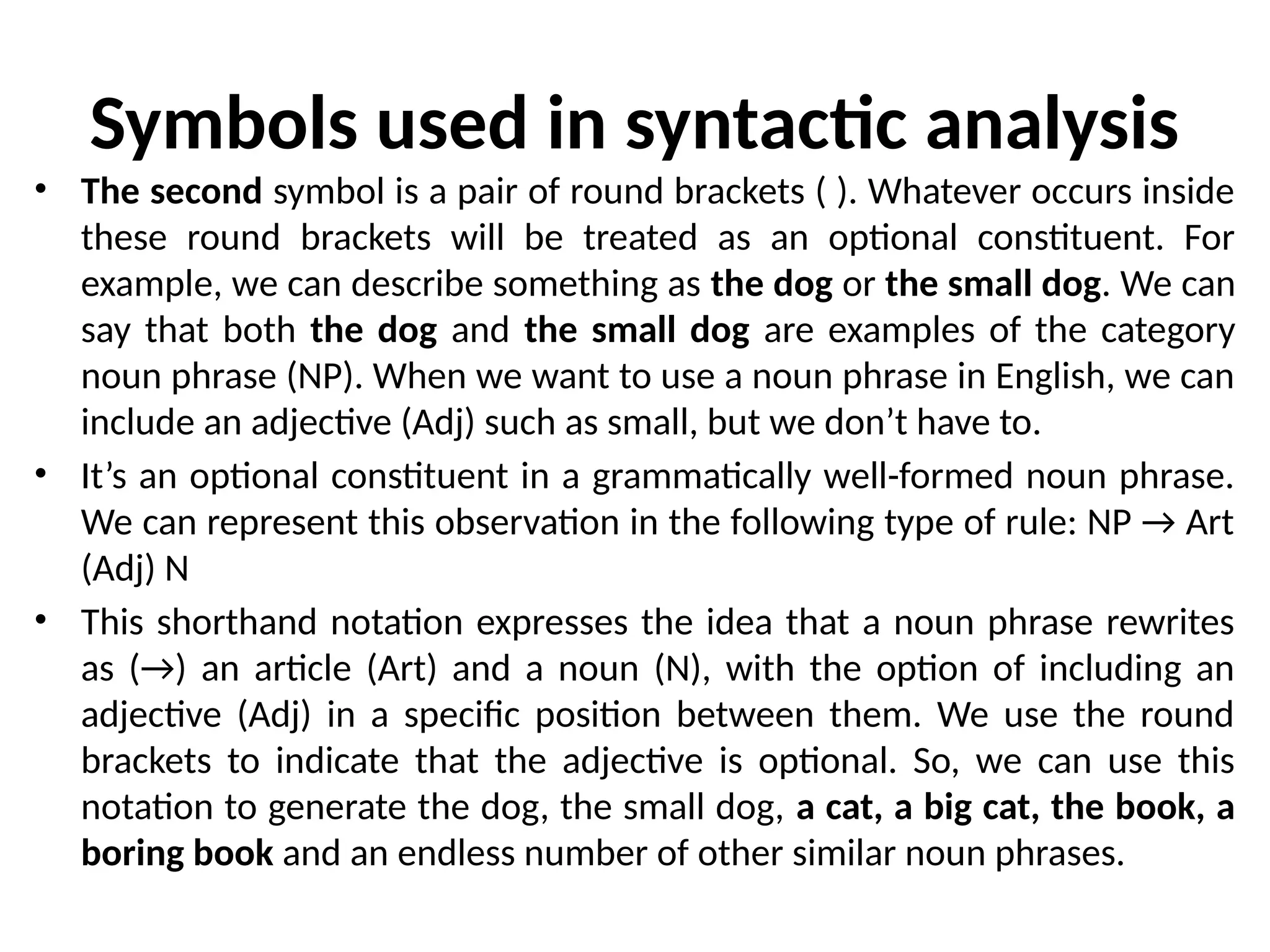
• The second symbol is a pair of round brackets ( ). Whatever occurs inside
these round brackets will be treated as an optional constituent. For
example, we can describe something as the dog or the small dog. We can
say that both the dog and the small dog are examples of the category
noun phrase (NP). When we want to use a noun phrase in English, we can
include an adjective (Adj) such as small, but we don’t have to.
• It’s an optional constituent in a grammatically well-formed noun phrase.
We can represent this observation in the following type of rule: NP → Art
(Adj) N
• This shorthand notation expresses the idea that a noun phrase rewrites
as (→) an article (Art) and a noun (N), with the option of including an
adjective (Adj) in a specific position between them. We use the round
brackets to indicate that the adjective is optional. So, we can use this
notation to generate the dog, the small dog, a cat, a big cat, the book, a
boring book and an endless number of other similar noun phrases.
45.
Symbols used insyntactic analysis
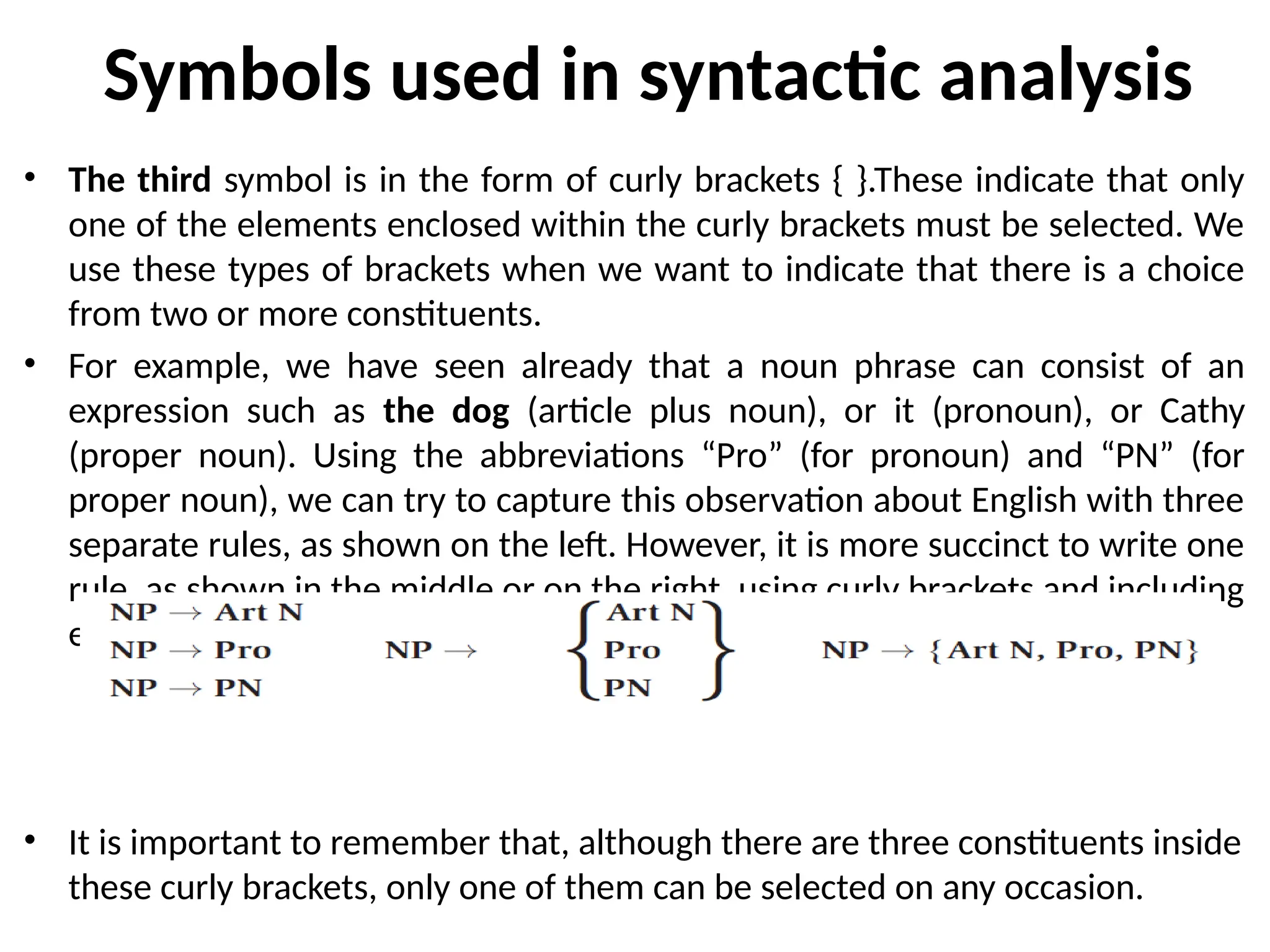
• The third symbol is in the form of curly brackets { }.These indicate that only
one of the elements enclosed within the curly brackets must be selected. We
use these types of brackets when we want to indicate that there is a choice
from two or more constituents.
• For example, we have seen already that a noun phrase can consist of an
expression such as the dog (article plus noun), or it (pronoun), or Cathy
(proper noun). Using the abbreviations “Pro” (for pronoun) and “PN” (for
proper noun), we can try to capture this observation about English with three
separate rules, as shown on the left. However, it is more succinct to write one
rule, as shown in the middle or on the right, using curly brackets and including
exactly the same information.
• It is important to remember that, although there are three constituents inside
these curly brackets, only one of them can be selected on any occasion.
46.
Phrase structure rules
•Phrase structure rules, also known as rewrite rules or
constituent structure rules, describe how words and
phrases combine to form grammatical sentences in a
language.
• These rules are commonly used in linguistics, especially
in syntax, to illustrate the hierarchical structure of
sentences and how different types of phrases (like
noun phrases or verb phrases) are built from smaller
components. Some basic phrase structure rules
commonly found in English grammar are:
47.
Phrase structure rules
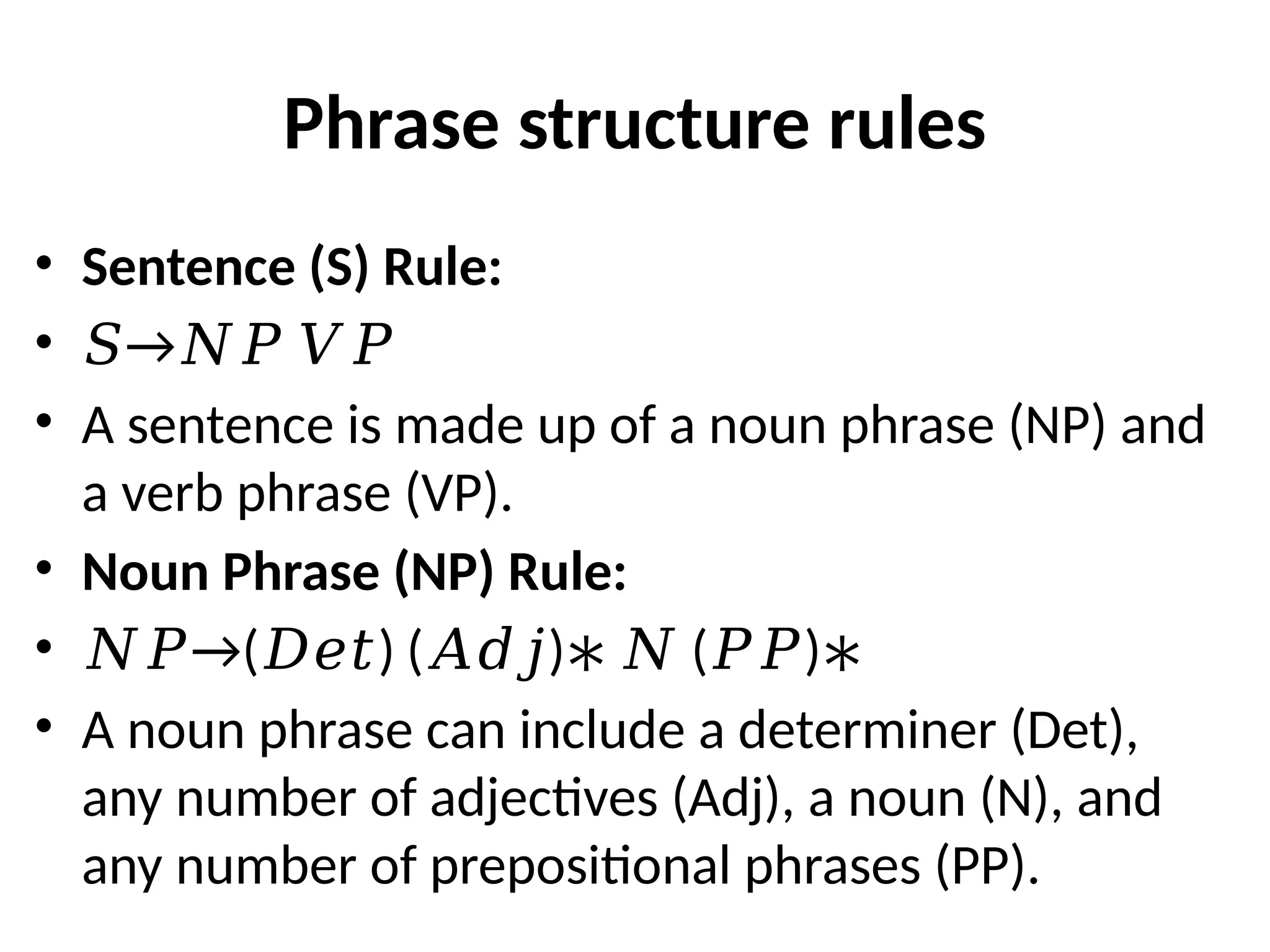
•Sentence (S) Rule:
• →
𝑆 𝑁𝑃 𝑉𝑃
• A sentence is made up of a noun phrase (NP) and
a verb phrase (VP).
• Noun Phrase (NP) Rule:
• →
𝑁𝑃 ( ) ( ) ( )
𝐷𝑒𝑡 𝐴𝑑𝑗 ∗ 𝑁 𝑃𝑃 ∗
• A noun phrase can include a determiner (Det),
any number of adjectives (Adj), a noun (N), and
any number of prepositional phrases (PP).
48.
Phrase structure rules
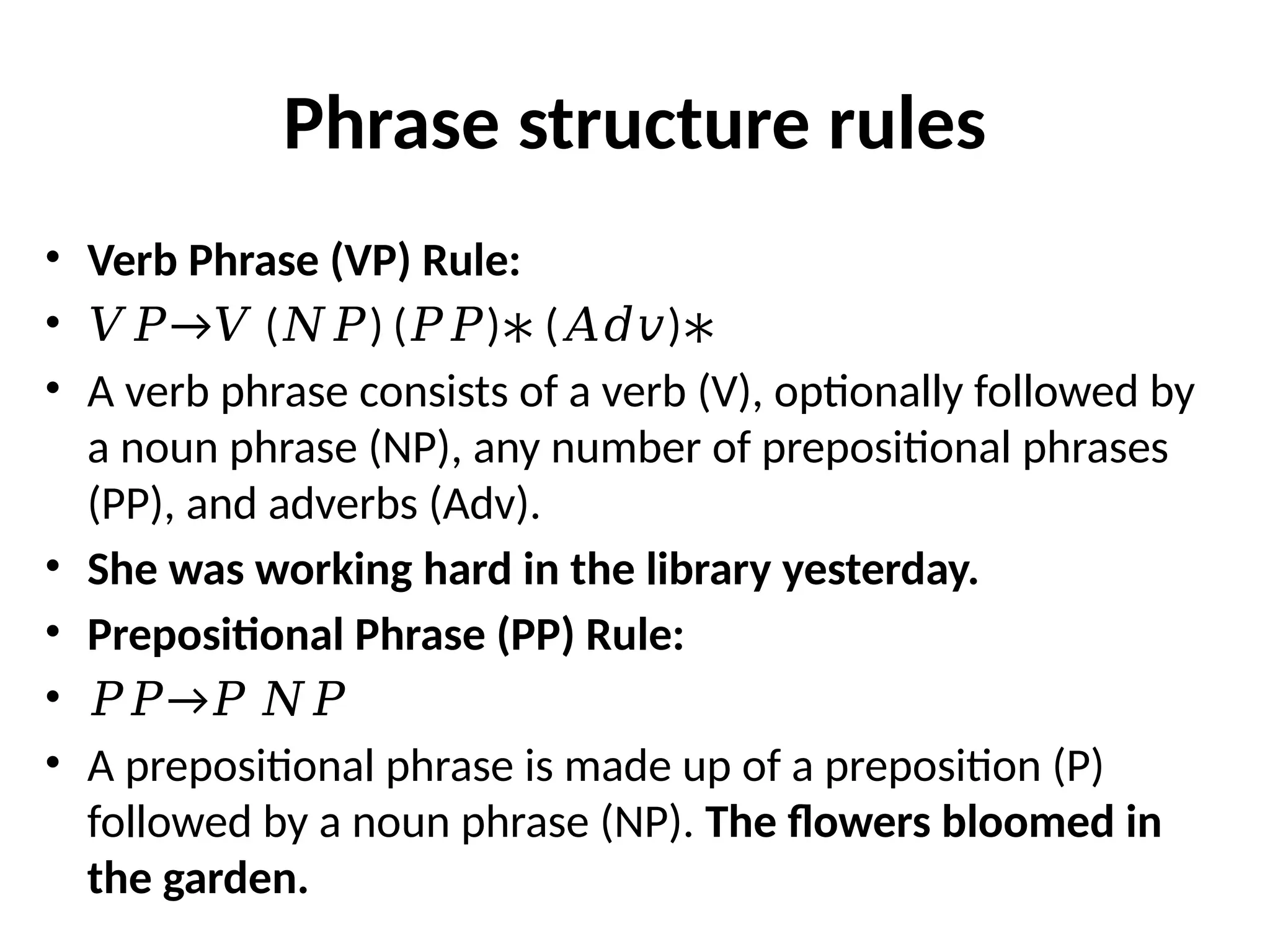
•Verb Phrase (VP) Rule:
• →
𝑉𝑃 𝑉 ( ) ( ) ( )
𝑁𝑃 𝑃𝑃 ∗ 𝐴𝑑𝑣 ∗
• A verb phrase consists of a verb (V), optionally followed by
a noun phrase (NP), any number of prepositional phrases
(PP), and adverbs (Adv).
• She was working hard in the library yesterday.
• Prepositional Phrase (PP) Rule:
• →
𝑃𝑃 𝑃 𝑁𝑃
• A prepositional phrase is made up of a preposition (P)
followed by a noun phrase (NP). The flowers bloomed in
the garden.
49.
Phrase structure rules
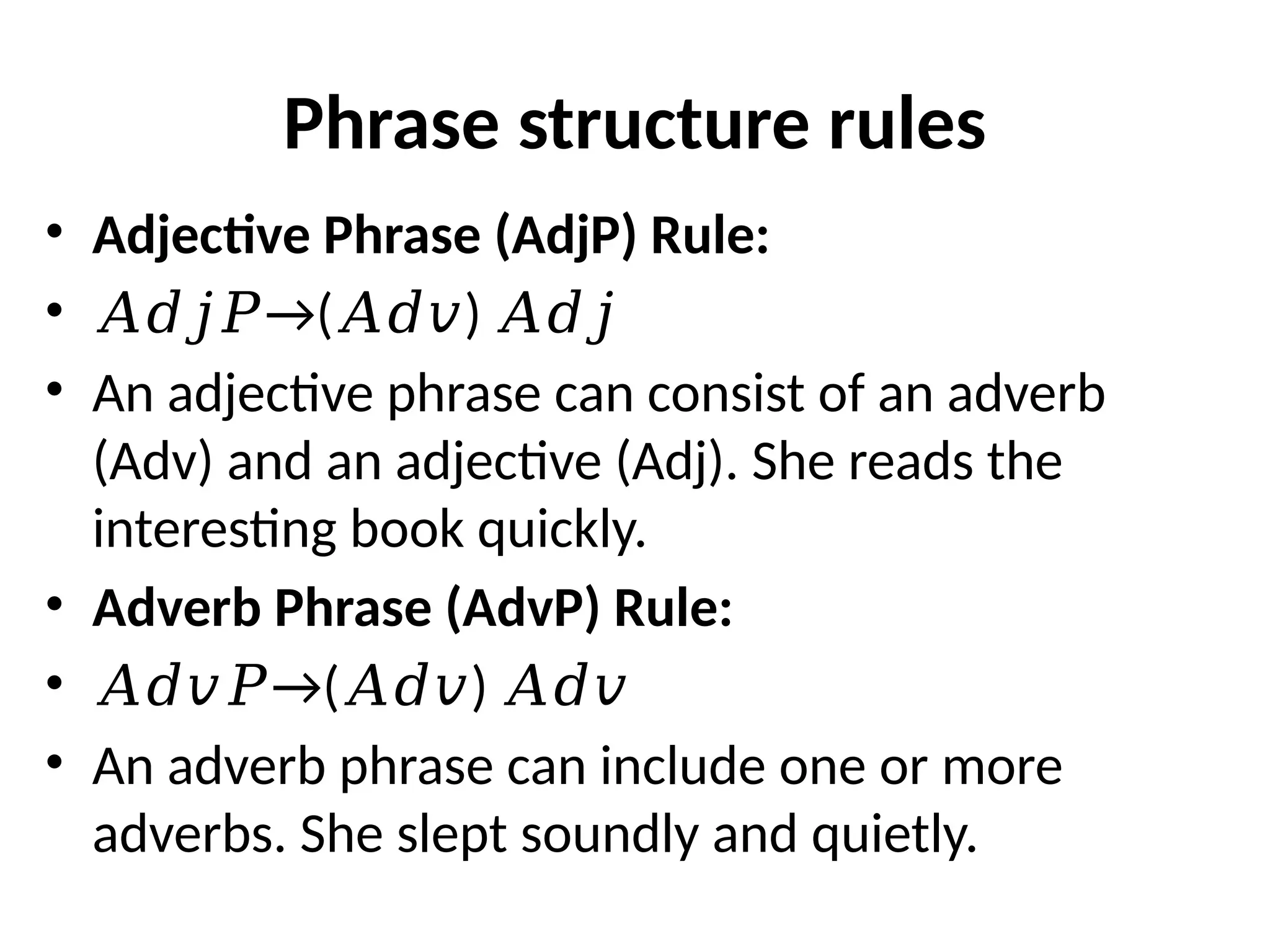
•Adjective Phrase (AdjP) Rule:
• →
𝐴𝑑𝑗𝑃 ( )
𝐴𝑑𝑣 𝐴𝑑𝑗
• An adjective phrase can consist of an adverb
(Adv) and an adjective (Adj). She reads the
interesting book quickly.
• Adverb Phrase (AdvP) Rule:
• →
𝐴𝑑𝑣𝑃 ( )
𝐴𝑑𝑣 𝐴𝑑𝑣
• An adverb phrase can include one or more
adverbs. She slept soundly and quietly.
50.
Phrase structure rules
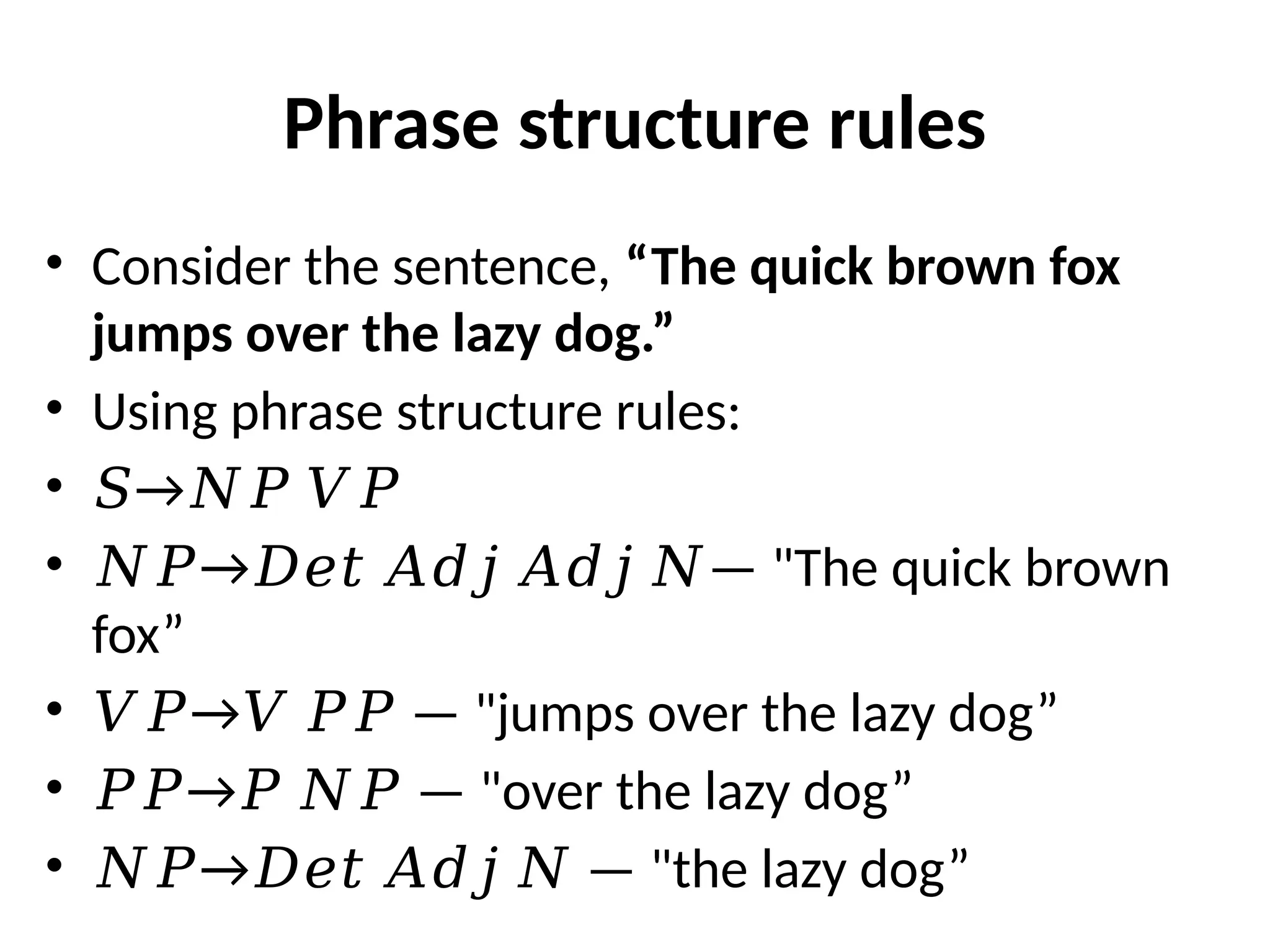
•Consider the sentence, “The quick brown fox
jumps over the lazy dog.”
• Using phrase structure rules:
• →
𝑆 𝑁𝑃 𝑉𝑃
• → —
𝑁𝑃 𝐷𝑒𝑡 𝐴𝑑𝑗 𝐴𝑑𝑗 𝑁 "The quick brown
fox”
• → —
𝑉𝑃 𝑉 𝑃𝑃 "jumps over the lazy dog”
• → —
𝑃𝑃 𝑃 𝑁𝑃 "over the lazy dog”
• → —
𝑁𝑃 𝐷𝑒𝑡 𝐴𝑑𝑗 𝑁 "the lazy dog”
51.
Movement rules
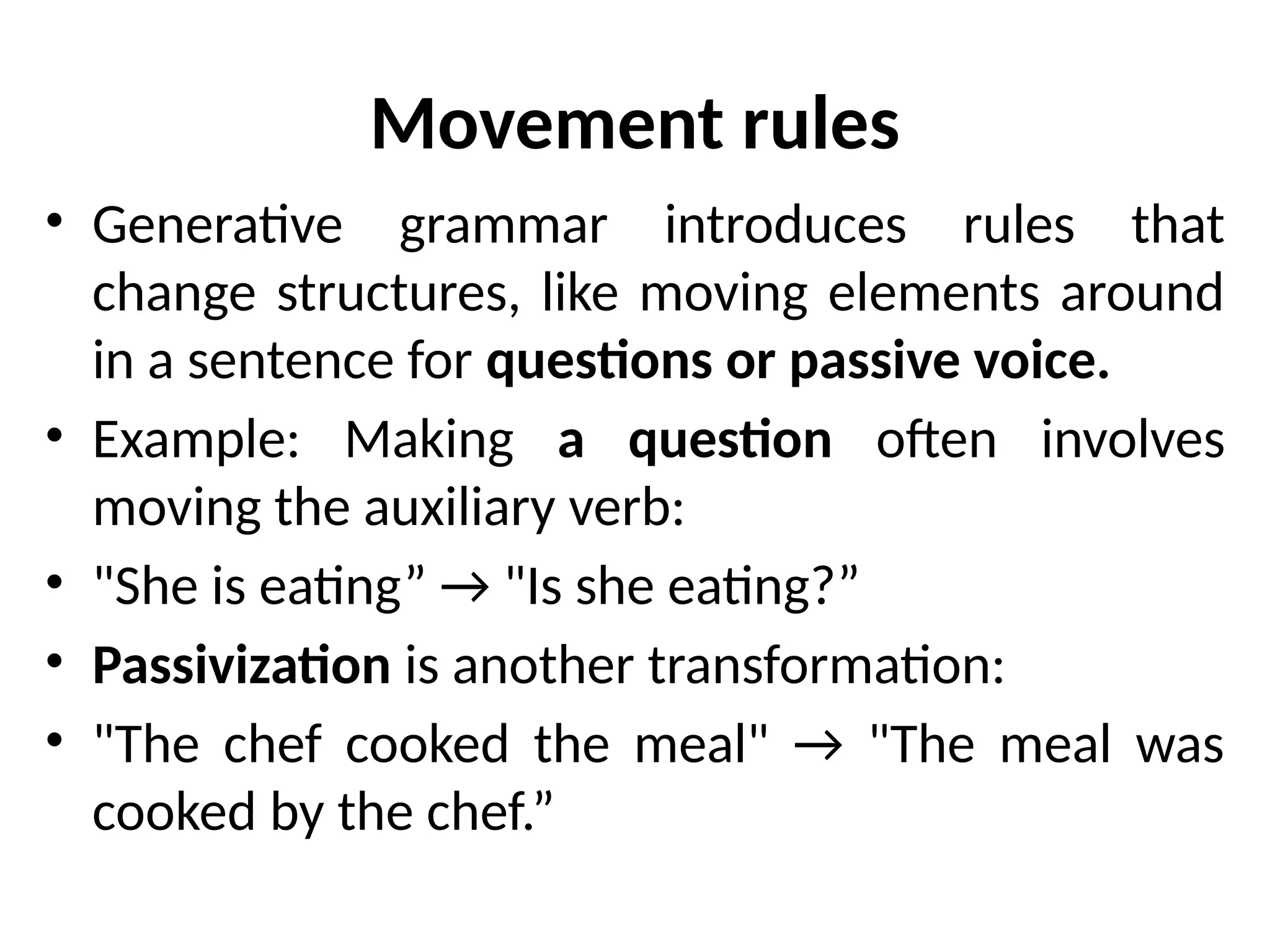
• Generativegrammar introduces rules that
change structures, like moving elements around
in a sentence for questions or passive voice.
• Example: Making a question often involves
moving the auxiliary verb:
• "She is eating” → "Is she eating?”
• Passivization is another transformation:
• "The chef cooked the meal" → "The meal was
cooked by the chef.”
52.
Complementizers and EmbeddedClauses
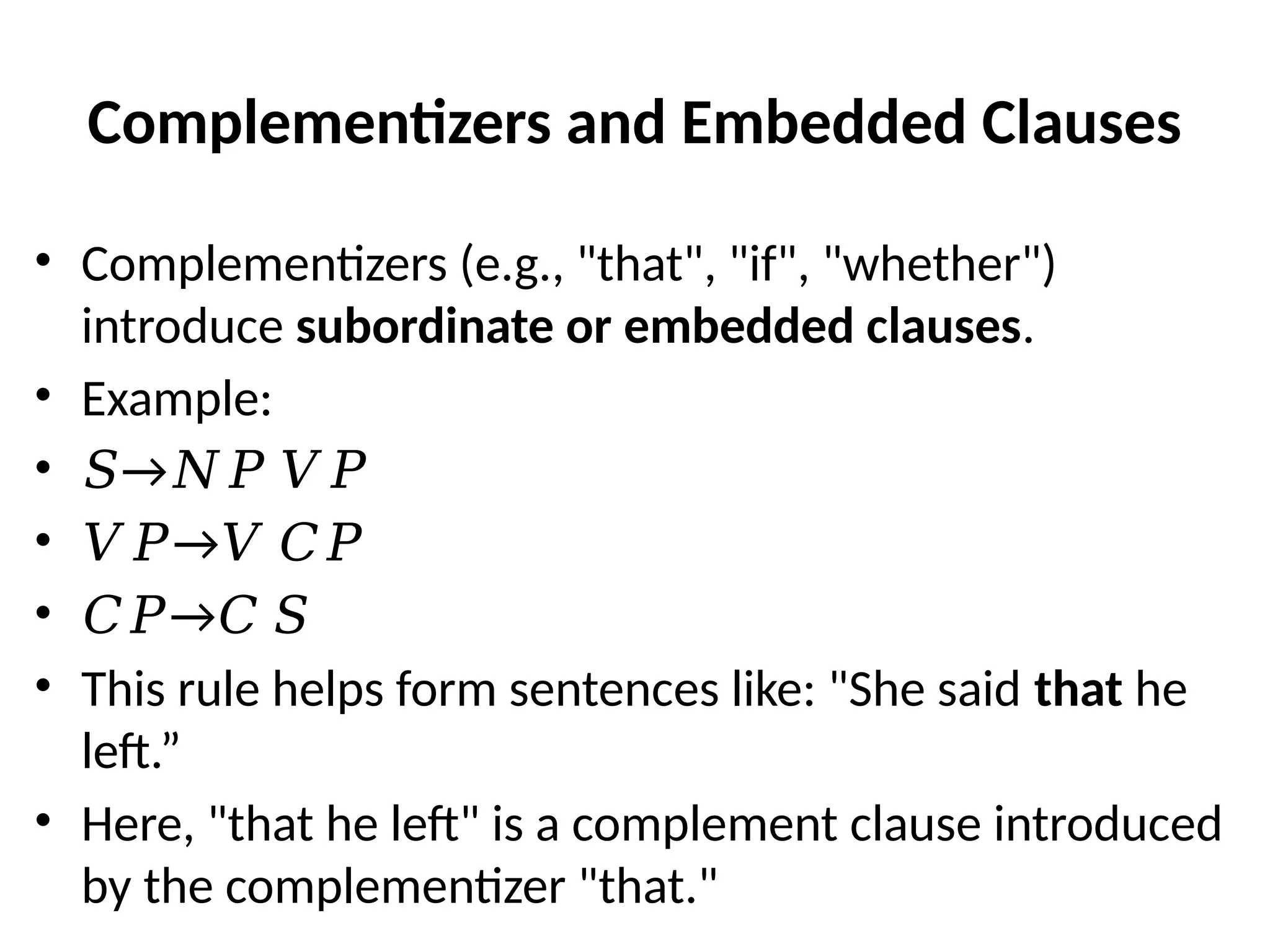
• Complementizers (e.g., "that", "if", "whether")
introduce subordinate or embedded clauses.
• Example:
• →
𝑆 𝑁𝑃 𝑉𝑃
• →
𝑉𝑃 𝑉 𝐶𝑃
• →
𝐶𝑃 𝐶 𝑆
• This rule helps form sentences like: "She said that he
left.”
• Here, "that he left" is a complement clause introduced
by the complementizer "that."
53.
Complementizers
• The wordthat, as used in these examples, is called a
complementizer (C). The role of that as a complementizer is to
introduce a complement phrase (CP). For example, in the second
sentence (Cathy knew…), we can identify one CP which contains
that plus Mary helped George.
• We already know that Mary helped George is a sentence (S). So, we
are now in a position to define a CP in the following way: “a
complement phrase rewrites as a complementizer and a sentence,”
or CP → C S.
• We can also see from the same sentence that the complement
phrase (CP) comes after a verb (V) knew. This means that we are
using the CP as part of a verb phrase (VP), as in knew that Mary
helped George. So, there must be another rule that says: “a verb
phrase rewrites as a verb and complement phrase,” or VP → V CP.


![Parts of speech review[1]](https://cdn.slidesharecdn.com/ss_thumbnails/partsofspeechreview1-150701121837-lva1-app6892-thumbnail.jpg?width=640&height=640&fit=bounds)


