This document analyzes the structure of syllables in English. It defines a syllable as a rhythmic unit with an obligatory vowel nucleus that can be preceded by an onset and followed by a coda of optional consonant sounds. Examples of mono-, di-, and polysyllabic words are provided. The significance of syllables for language rhythm, stress patterns, and permissible phoneme combinations is discussed. Syllabic consonants and the process of syllabification for dividing multisyllabic words are also explained.
Ministry of HigherEducation &
scientific Research
Salahadin University- Erbil
College of Language-
Department of English.
الرحيم الرحمن هللا بسم
The Analysis of Syllable
2016-2017
AWAN K.MUHAMMED
MA STUDENT
Syllable
The syllable isthe basic unit of speech that is
studied on both the phonetic and
phonological levels of analysis. The syllable
plays an important role in spoken English.
A syllable is a rhythmic unit. It's a unit of
sound that gets one "beat" in a word.
4.
Here are someexamples with single syllable(Monosyllable) :
Pen, man, pig, cup, hat
A word can have more than one syllable (Disyllable):
Garden: gar-den
Hotel: ho-tel
Consist: con-sist
Focus: fo-cus
Object: ob-ject
5.
Examples ofwords with three syllables (Trisyllable) :
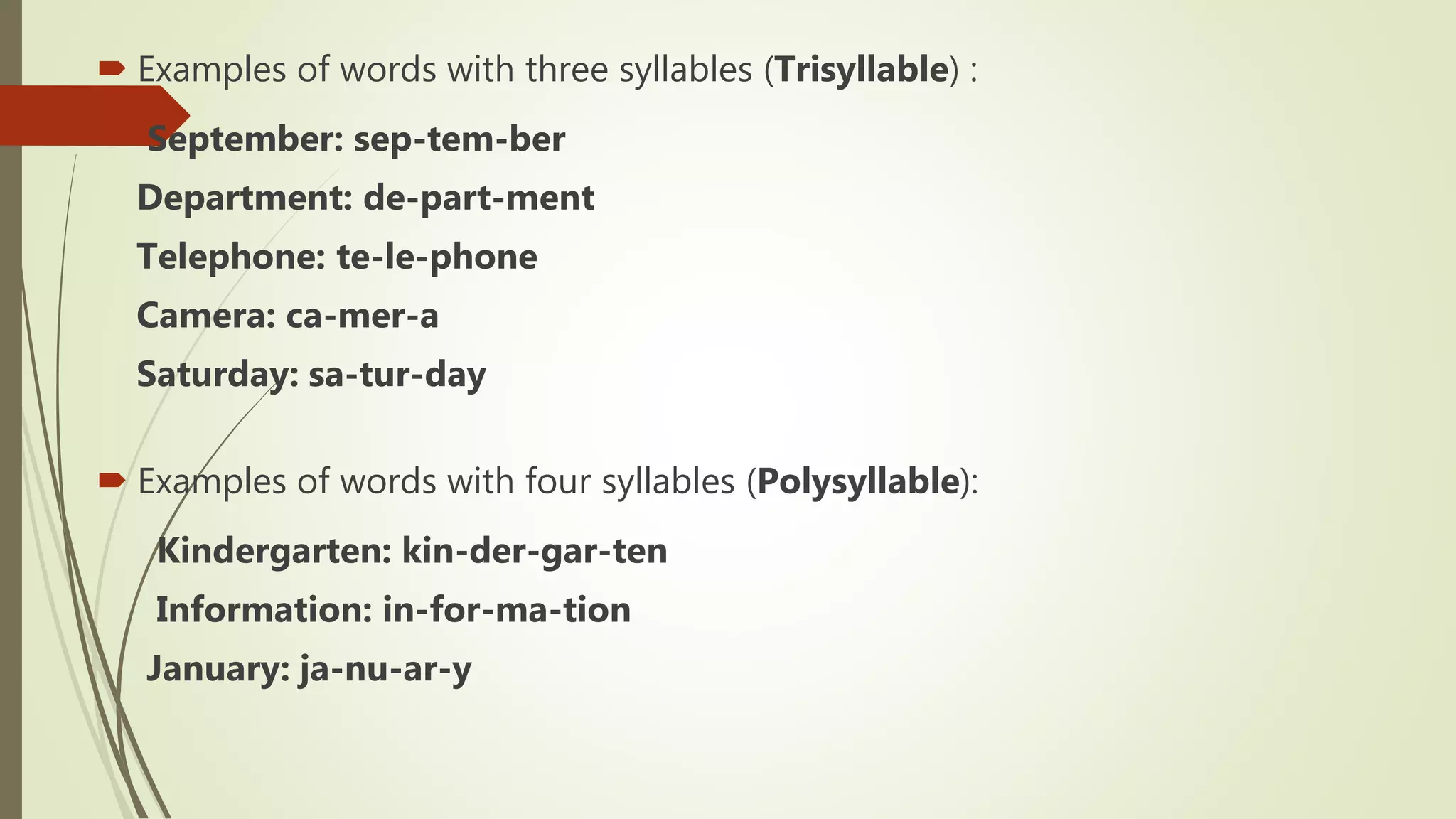
September: sep-tem-ber
Department: de-part-ment
Telephone: te-le-phone
Camera: ca-mer-a
Saturday: sa-tur-day
Examples of words with four syllables (Polysyllable):
Kindergarten: kin-der-gar-ten
Information: in-for-ma-tion
January: ja-nu-ar-y
6.
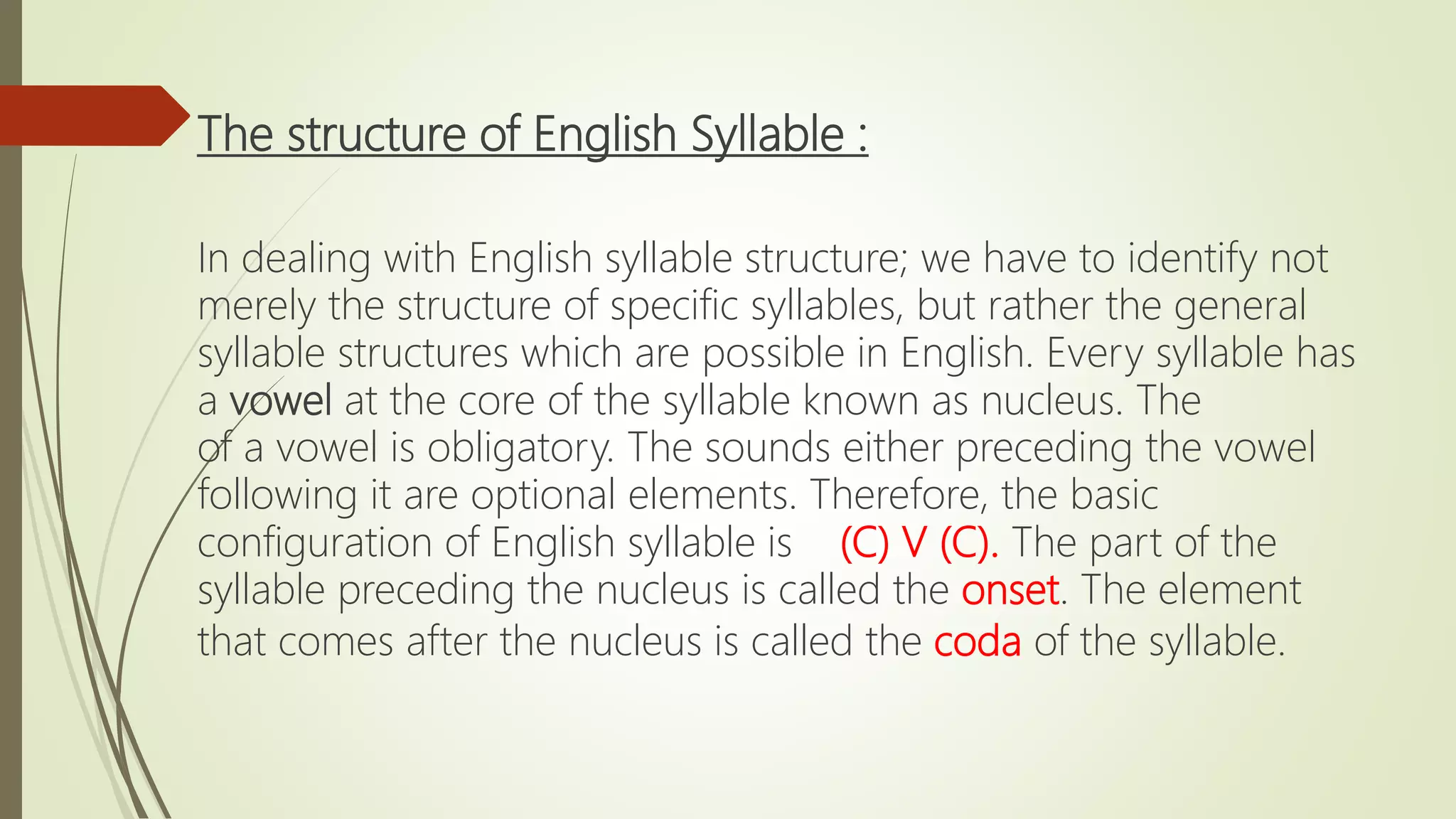
The structure ofEnglish Syllable :
In dealing with English syllable structure; we have to identify not
merely the structure of specific syllables, but rather the general
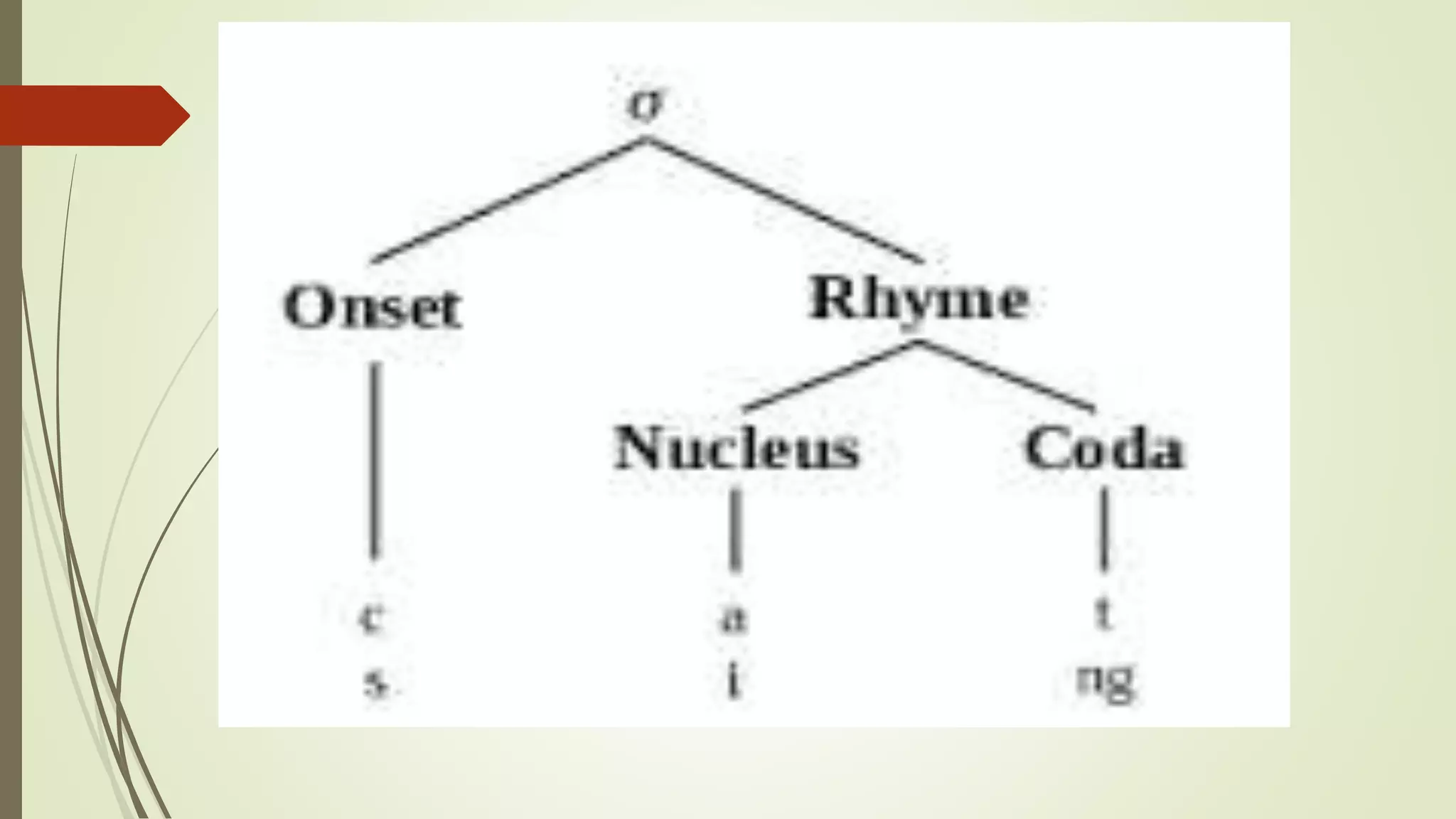
syllable structures which are possible in English. Every syllable has
a vowel at the core of the syllable known as nucleus. The
of a vowel is obligatory. The sounds either preceding the vowel
following it are optional elements. Therefore, the basic
configuration of English syllable is (C) V (C). The part of the
syllable preceding the nucleus is called the onset. The element
that comes after the nucleus is called the coda of the syllable.
8.
The significance ofsyllable:
Firstly ,It greatly influences the rhythm of the
language, its poetic meter and stress patterns.
Secondly, it is useful as the largest unit we need
to consider in explaining how phonemes are
permitted to combine together in a language.
9.
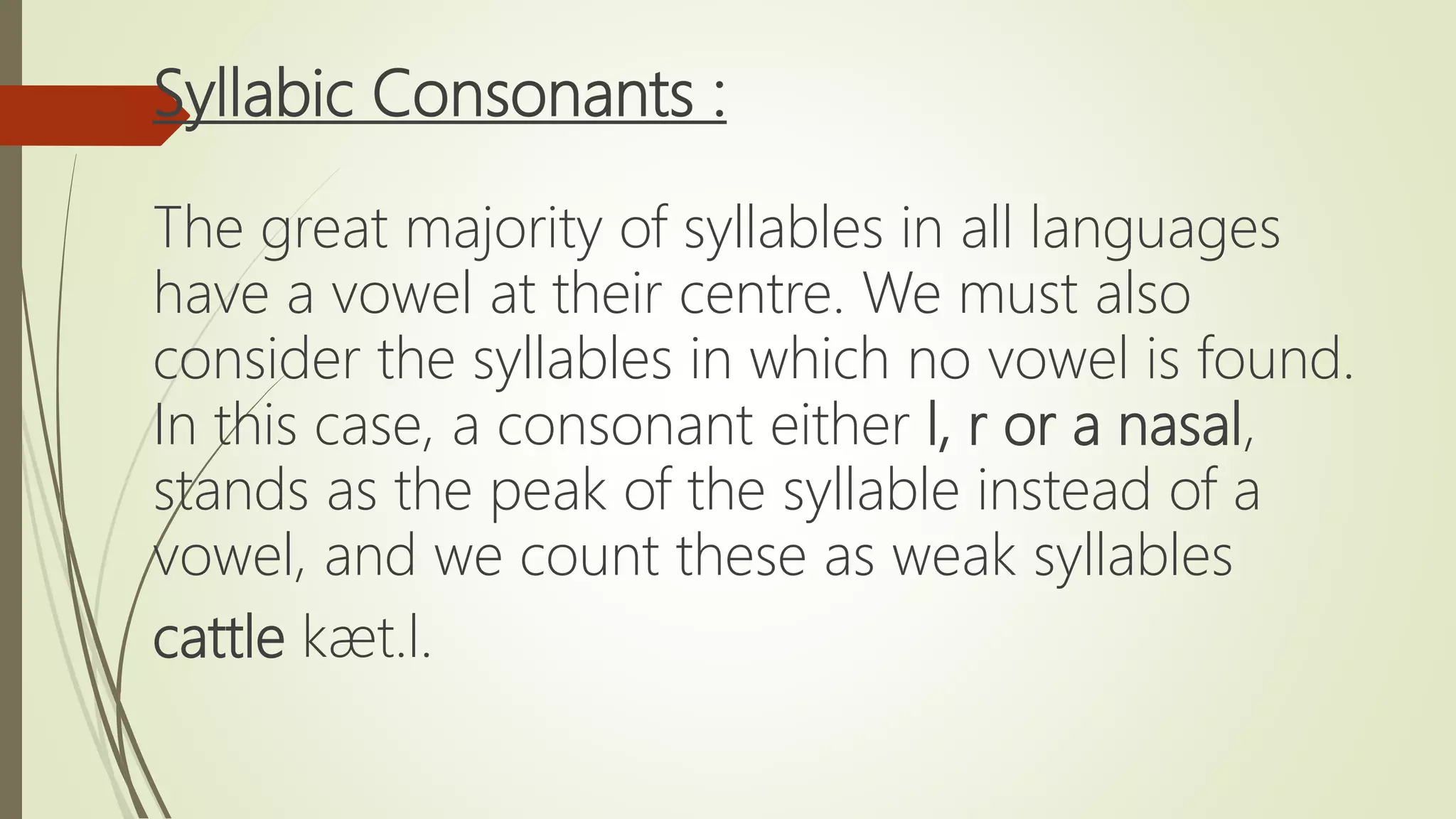
Syllabic Consonants :
Thegreat majority of syllables in all languages
have a vowel at their centre. We must also
consider the syllables in which no vowel is found.
In this case, a consonant either l, r or a nasal,
stands as the peak of the syllable instead of a
vowel, and we count these as weak syllables
cattle kæt.l.
10.
Syllabification
Syllabification is aphonological process and
it is usually applied on words of more than
one syllable, i.e. disyllabic words, that is,
words of more than three syllables. Thus, in
the case of monosyllabic words a syllable is
always a word (Lass, 1984: 262, 264).
11.
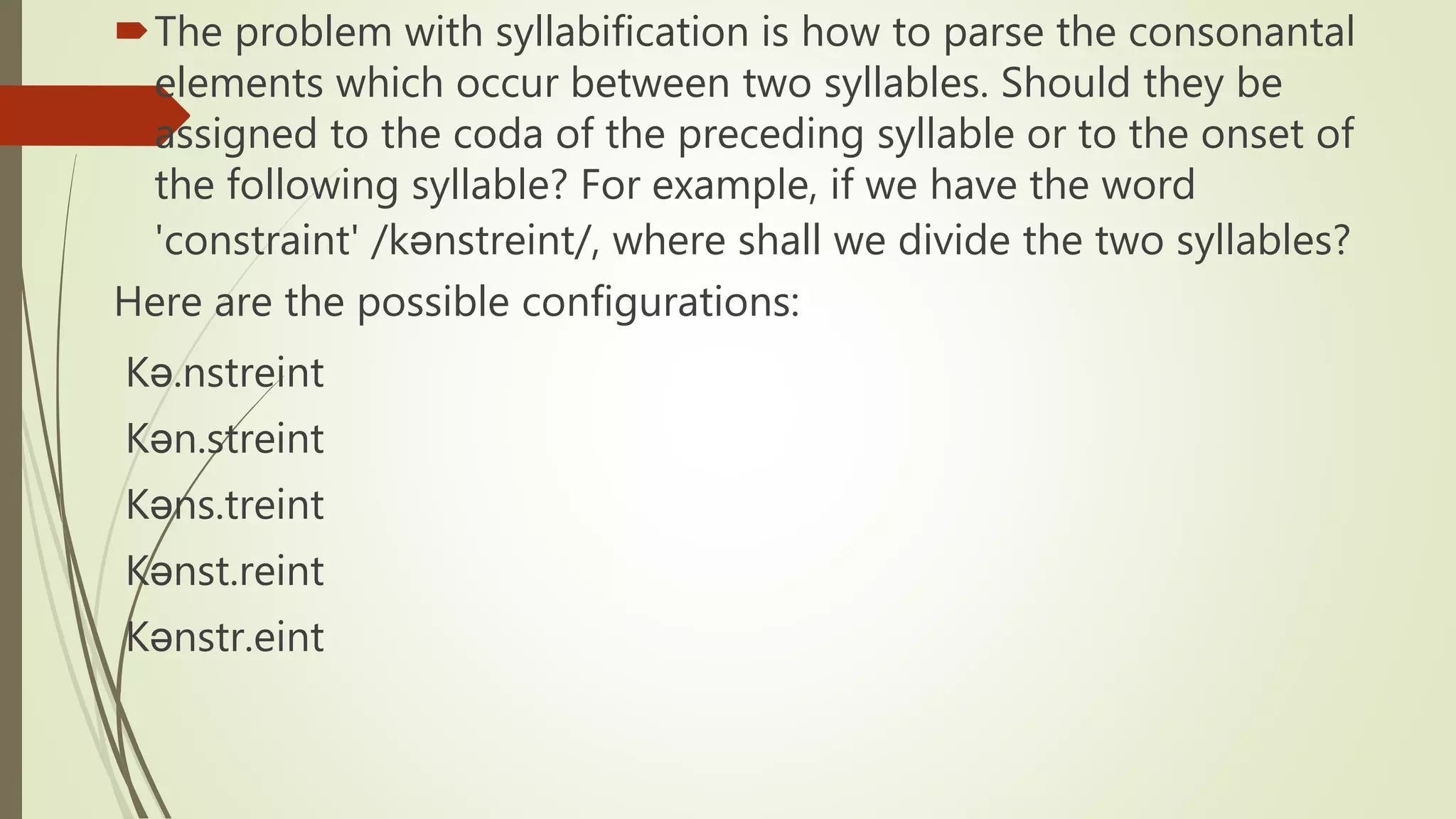
The problem withsyllabification is how to parse the consonantal
elements which occur between two syllables. Should they be
assigned to the coda of the preceding syllable or to the onset of
the following syllable? For example, if we have the word
'constraint' /kənstreint/, where shall we divide the two syllables?
Here are the possible configurations:
Kə.nstreint
Kən.streint
Kəns.treint
Kənst.reint
Kənstr.eint