SKBE1013
ORAL COMMUNICATION
Semester 1
2023/24
Syllable
• Definition
• The structure of a Syllable:
Onset, Rhyme, Peak and Coda
Defining Syllable
• When we say a word, the sounds we create naturally divide
the word into parts.
For example:
The word “machine” has two parts: ma-chine.
• The word “important” has three parts: im-por-tant.
• We call these parts “syllables.
• the process of dividing words into syllables = Syllabification
• A syllable is a part of a word that is composed of one or more
speech sounds e.g are /a:/ or guard /ɡɑːd/
• A syllable must contain a vowel or vowel-like sound, including
diphthongs e.g. guard /ɡɑːd/ or bye /baɪ/
“consists of a centre which has little or no obstruction to the airflow
and which sounds comparatively loud; before and after this centre,
there will be greater obstruction to the airflow and/or less sound”
(Roach, 2009:56)
What is a syllable?
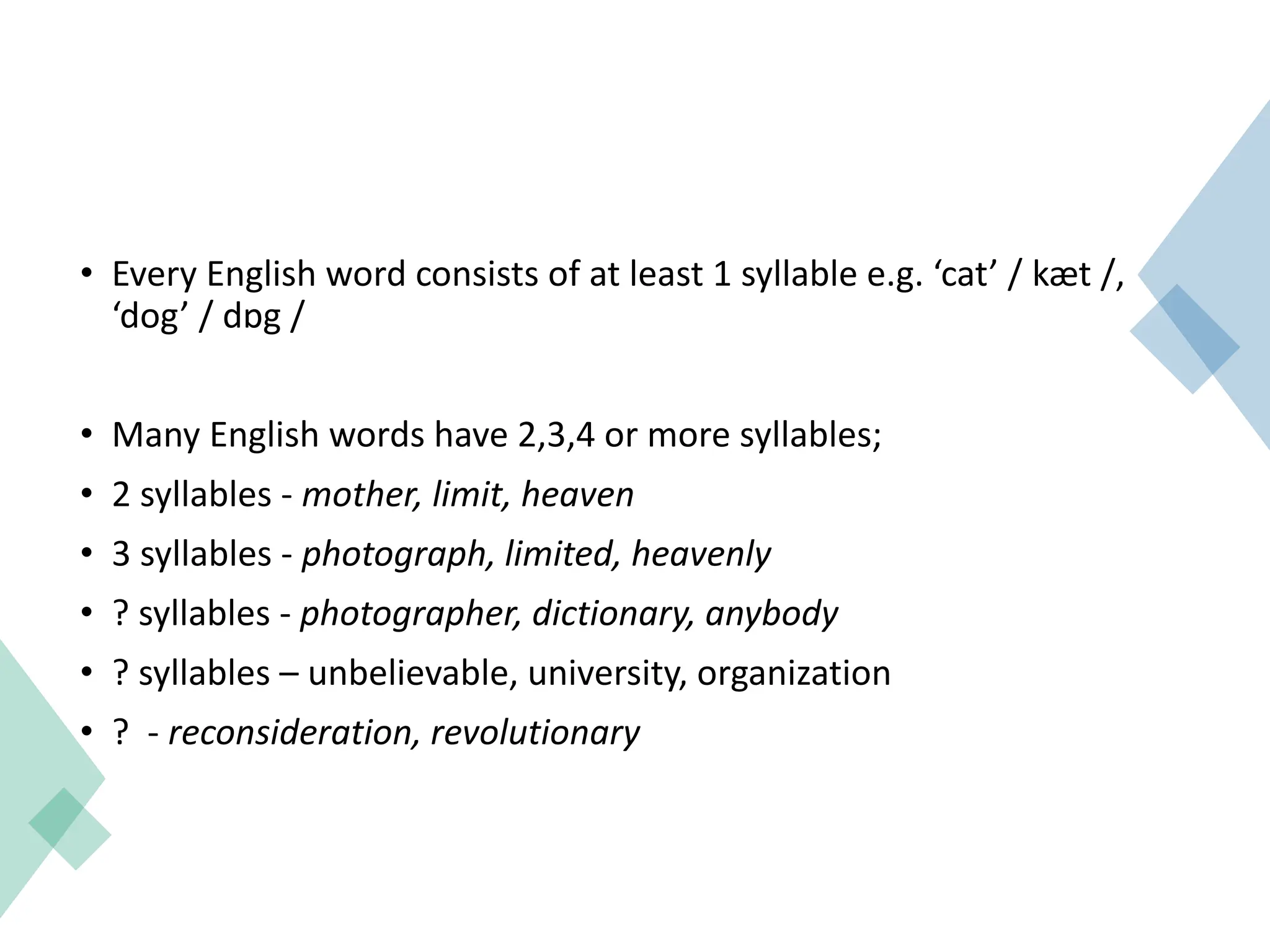
• Every English word consists of at least 1 syllable e.g. ‘cat’ / kæt /,
‘dog’ / dɒg /
• Many English words have 2,3,4 or more syllables;
• 2 syllables - mother, limit, heaven
• 3 syllables - photograph, limited, heavenly
• ? syllables - photographer, dictionary, anybody
• ? syllables – unbelievable, university, organization
• ? - reconsideration, revolutionary
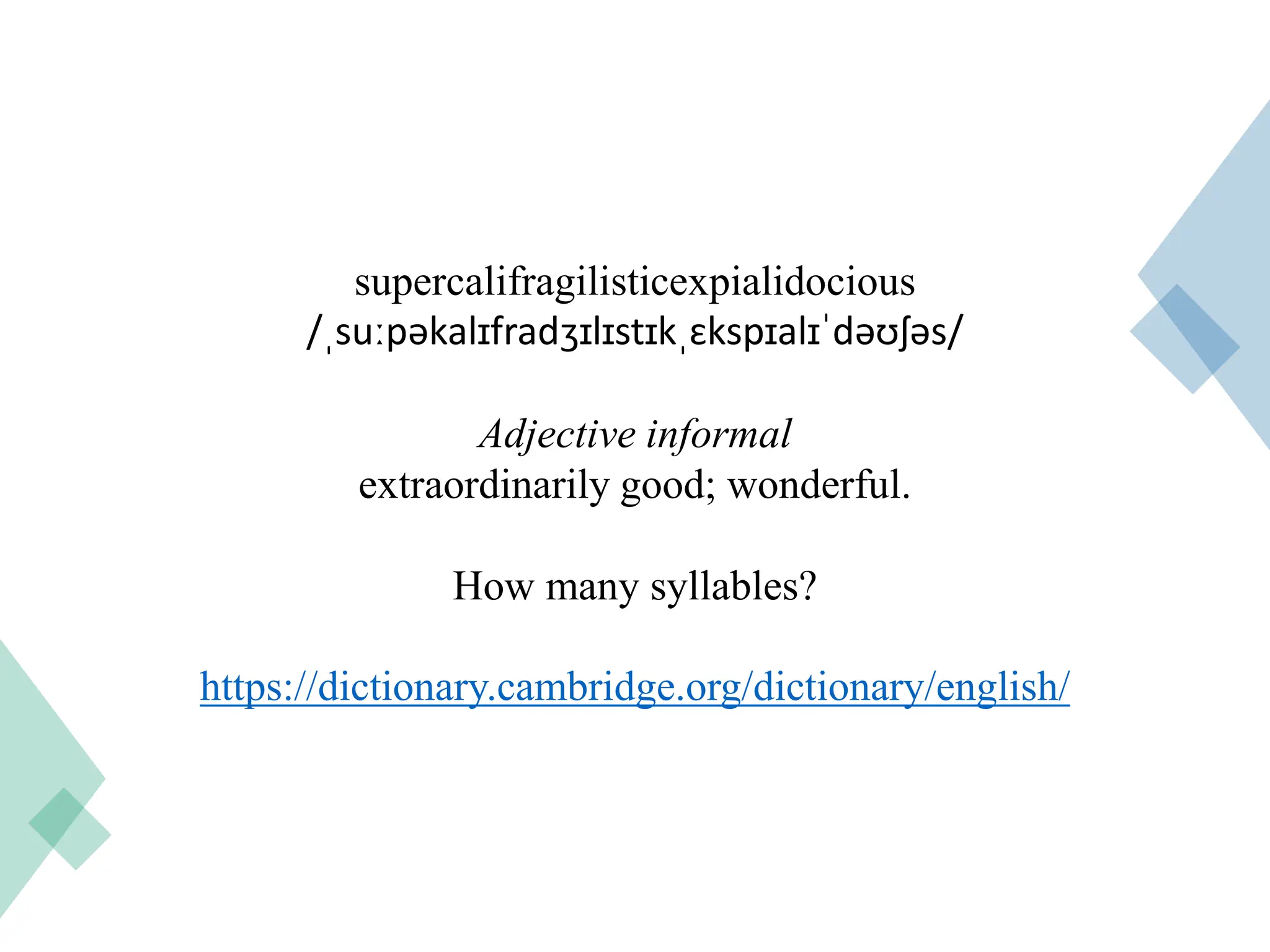
supercalifragilisticexpialidocious
/ˌsuːpəkalɪfradʒɪlɪstɪkˌɛkspɪalɪˈdəʊʃəs/
Adjective informal
extraordinarily good; wonderful.
How many syllables?
https://dictionary.cambridge.org/dictionary/english/
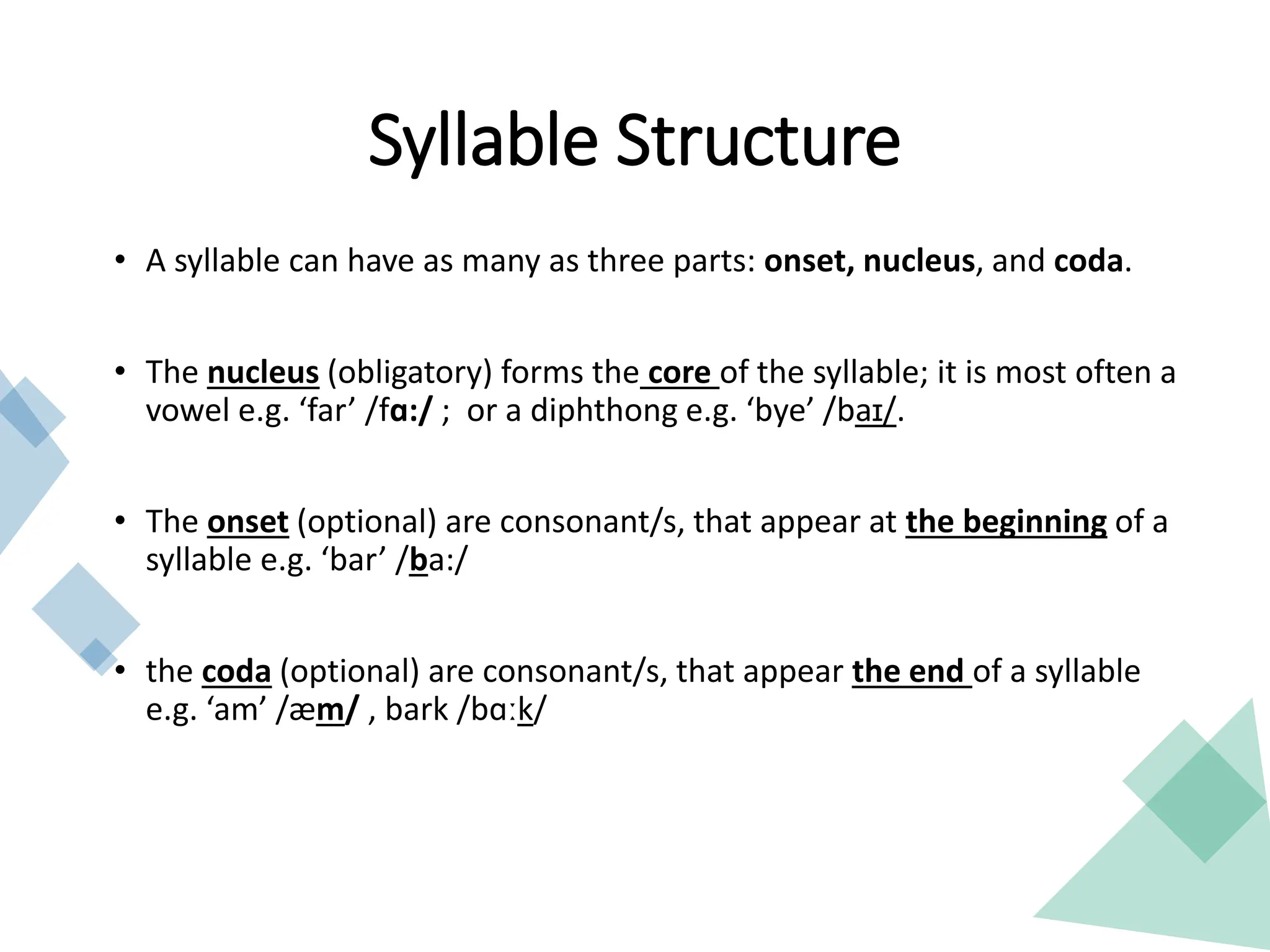
• A syllable can have as many as three parts: onset, nucleus, and coda.
• The nucleus (obligatory) forms the core of the syllable; it is most often a
vowel e.g. ‘far’ /fɑ:/ ; or a diphthong e.g. ‘bye’ /baɪ/.
• The onset (optional) are consonant/s, that appear at the beginning of a
syllable e.g. ‘bar’ /ba:/
• the coda (optional) are consonant/s, that appear the end of a syllable
e.g. ‘am’ /æm/ , bark /bɑːk/
Syllable Structure
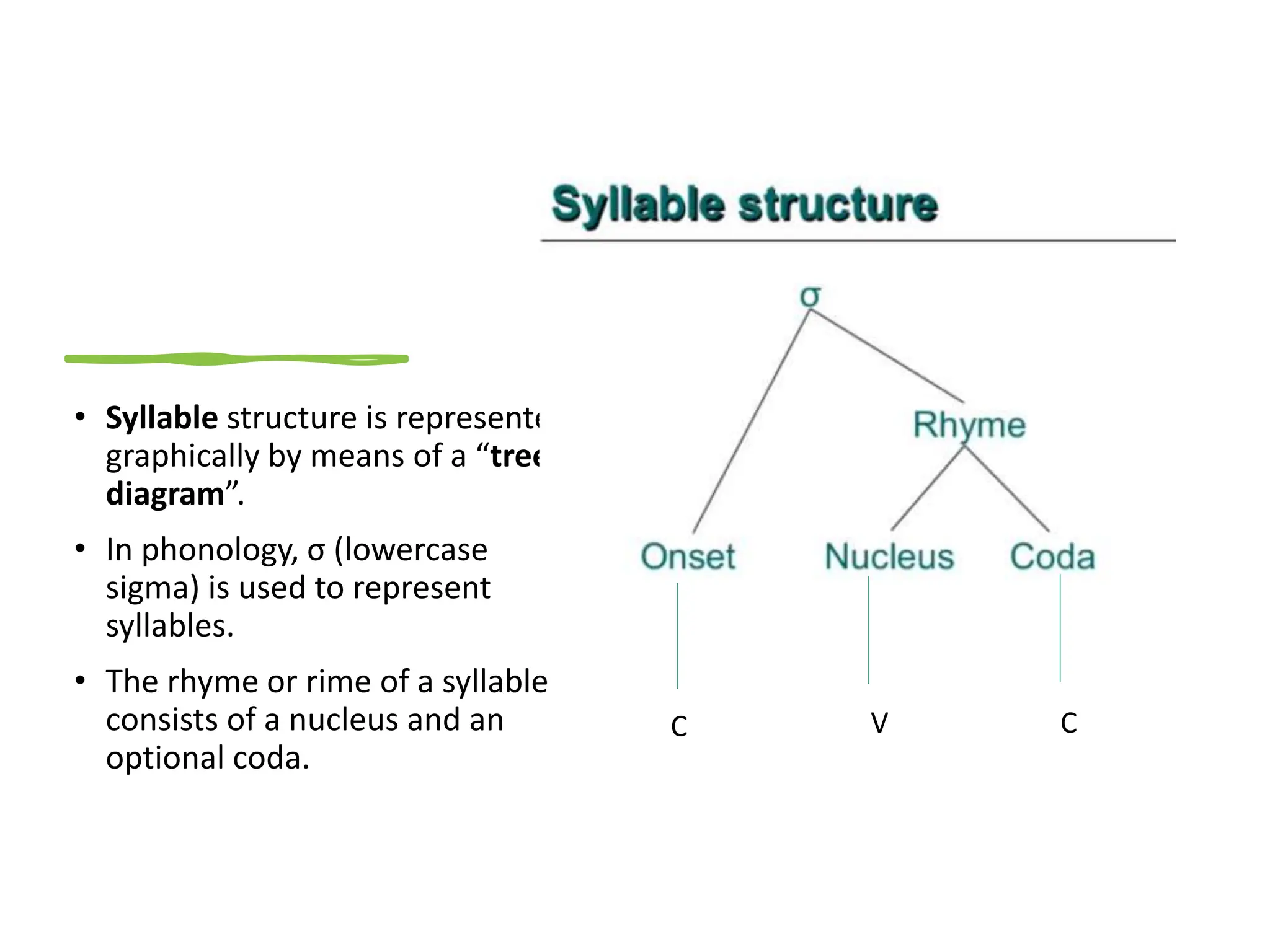
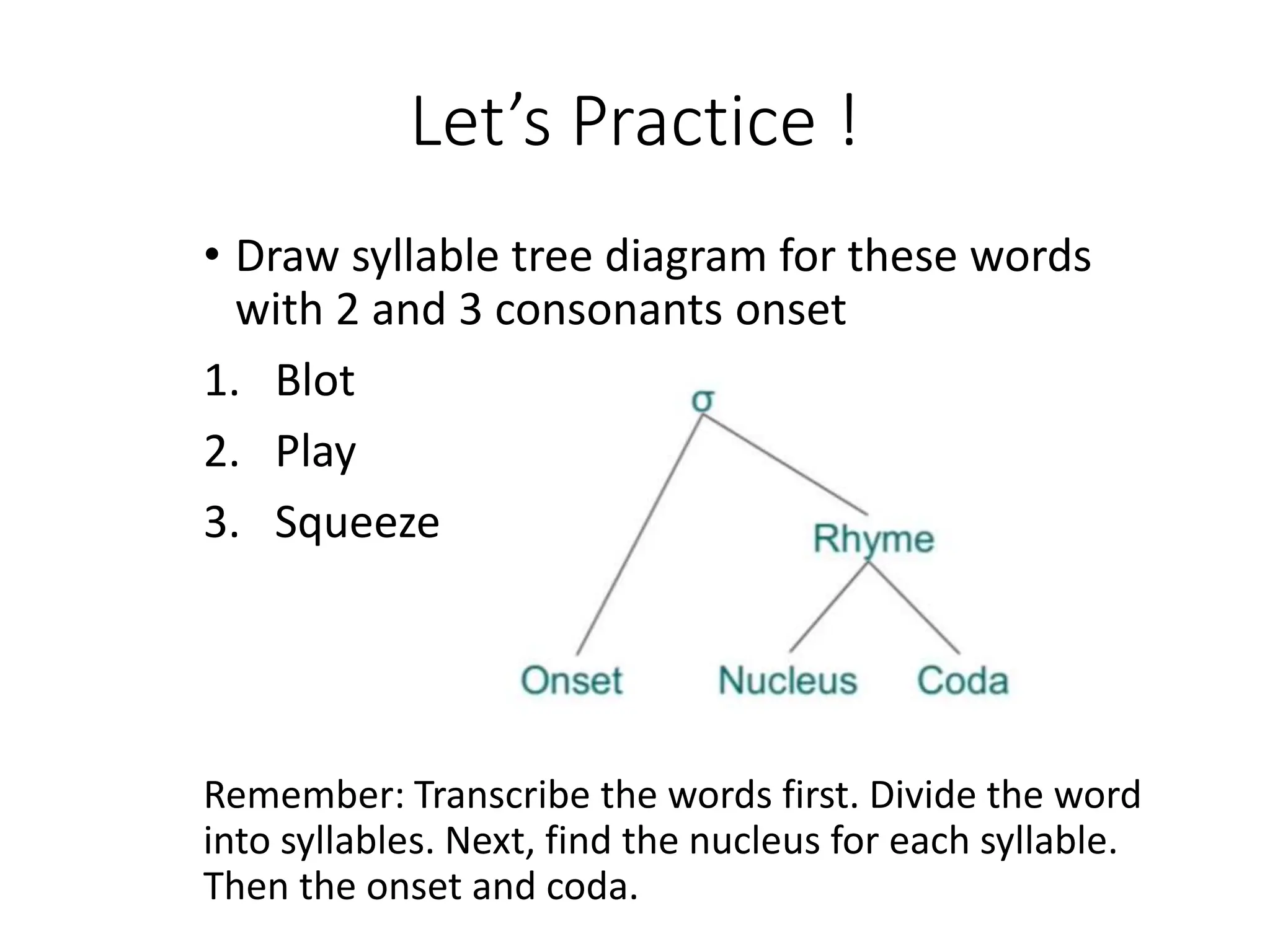
• Syllable structure is represented
graphically by means of a “tree
diagram”.
• In phonology, σ (lowercase
sigma) is used to represent
syllables.
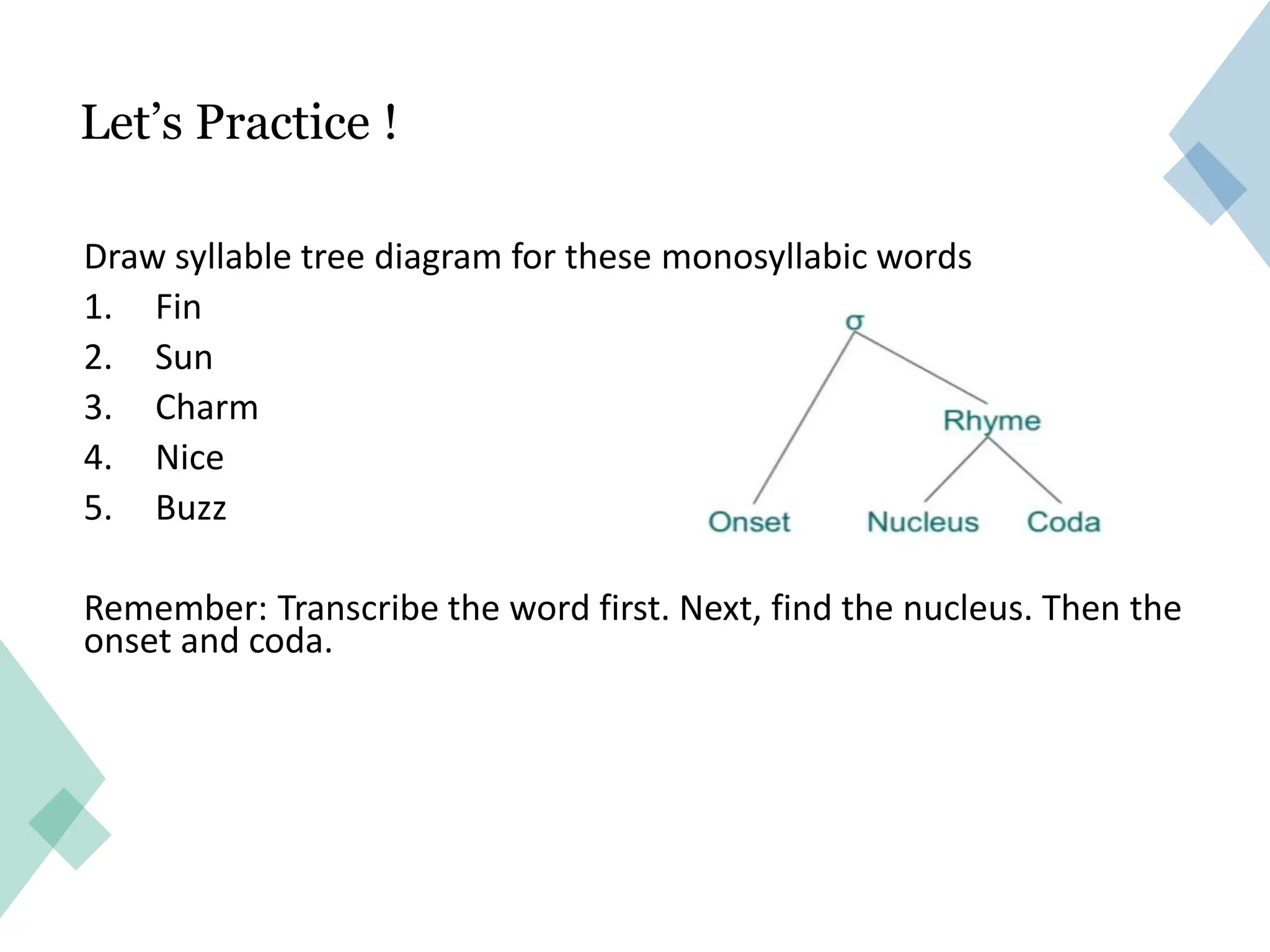
• The rhyme or rime of a syllable
consists of a nucleus and an
optional coda.
C V C
Syllable Structure
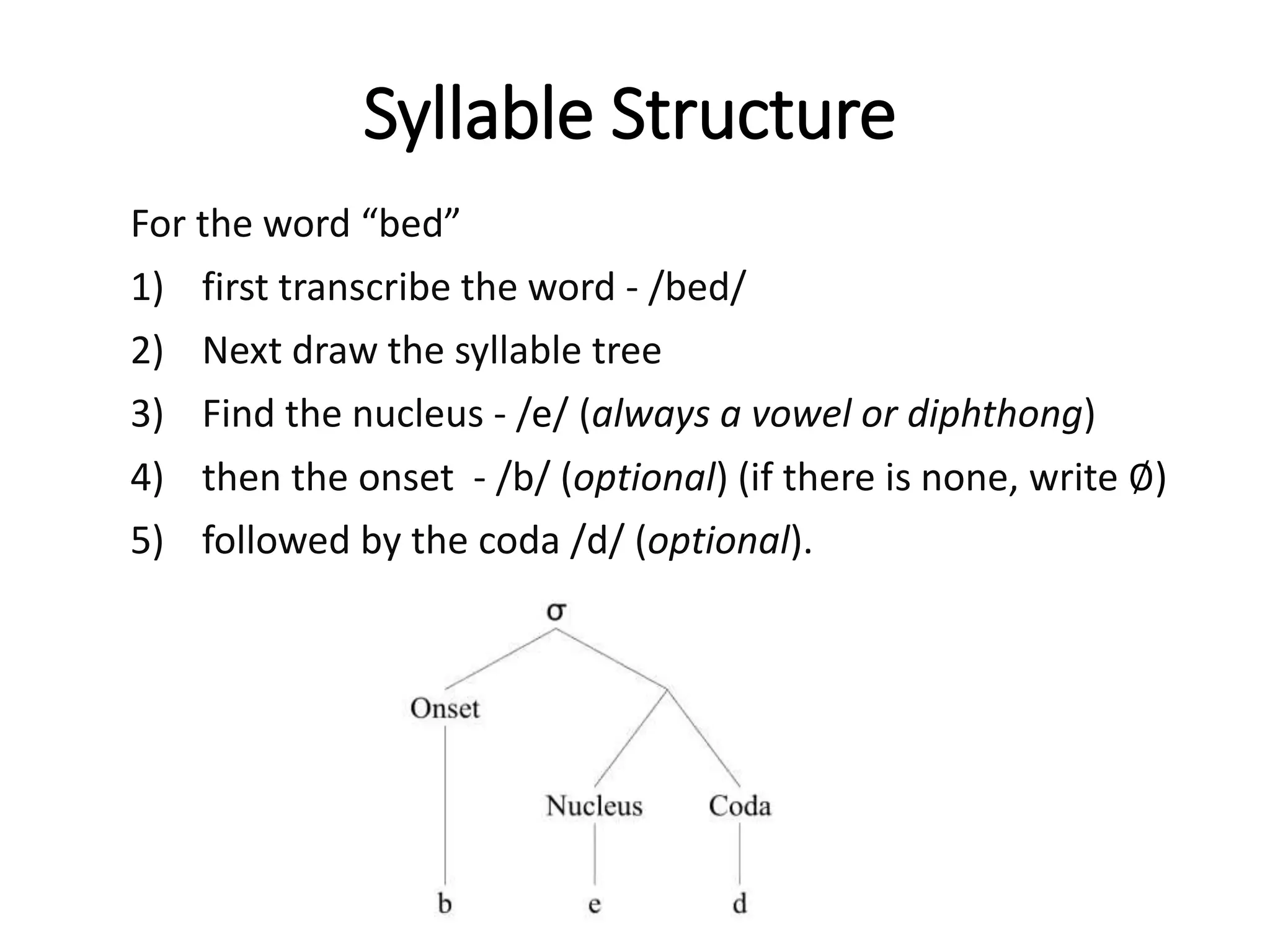
For the word “bed”
1) first transcribe the word - /bed/
2) Next draw the syllable tree
3) Find the nucleus - /e/ (always a vowel or diphthong)
4) then the onset - /b/ (optional) (if there is none, write ∅)
5) followed by the coda /d/ (optional).
Try this…
Another example of a monosyllabic word ‘pain’
1) transcribe = /peɪn/
2) Next draw the syllable tree
3) identify the nucleus
4) then the onset and coda
Syllable Structure
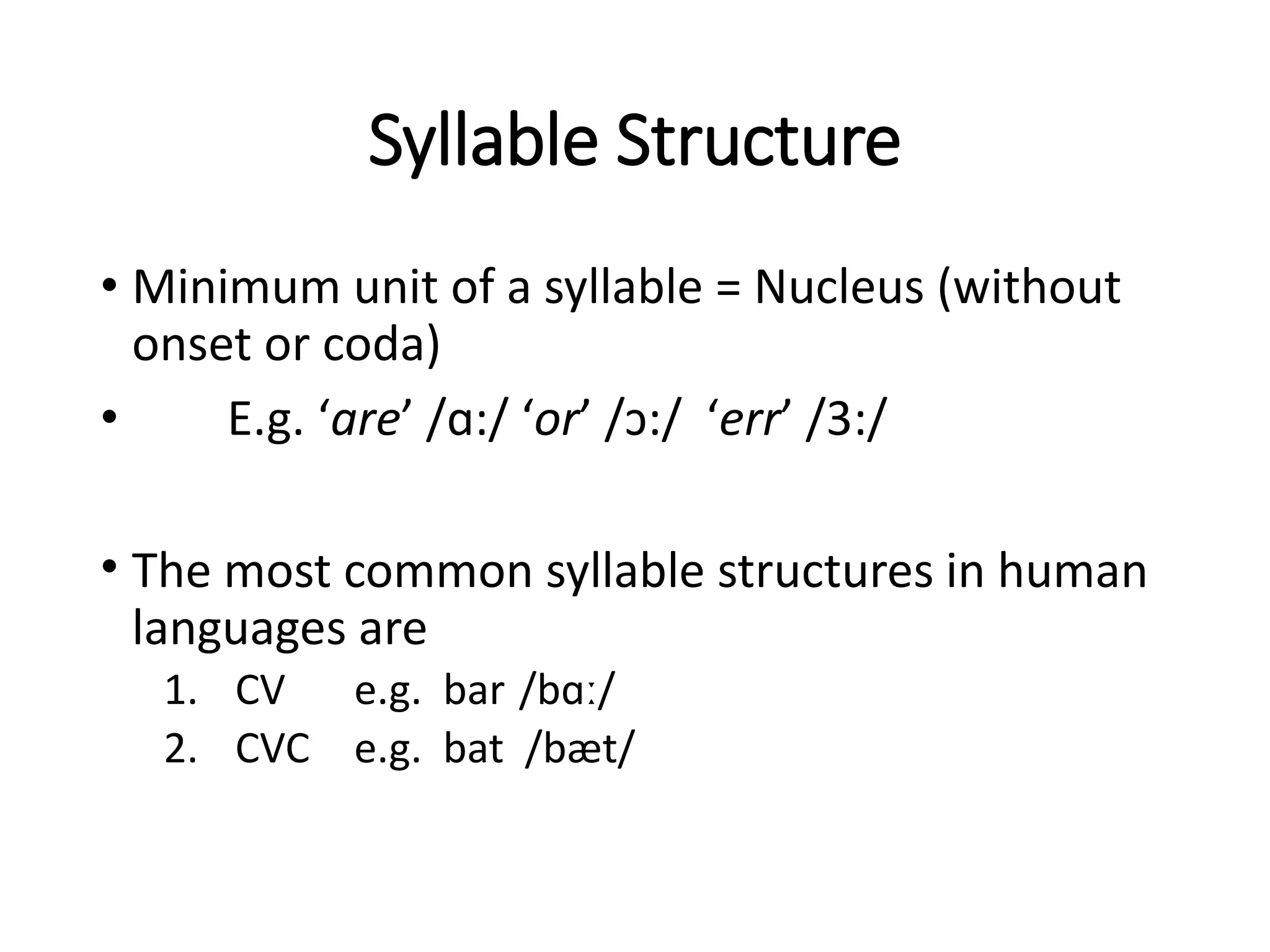
• Minimum unit of a syllable = Nucleus (without
onset or coda)
• E.g. ‘are’ /ɑ:/ ‘or’ /ɔ:/ ‘err’ /3:/
• The most common syllable structures in human
languages are
1. CV e.g. bar /bɑː/
2. CVC e.g. bat /bæt/
Let’s Practice !
Draw syllable tree diagram for these monosyllabic words
1. Fin
2. Sun
3. Charm
4. Nice
5. Buzz
Remember: Transcribe the word first. Next, find the nucleus. Then the
onset and coda.
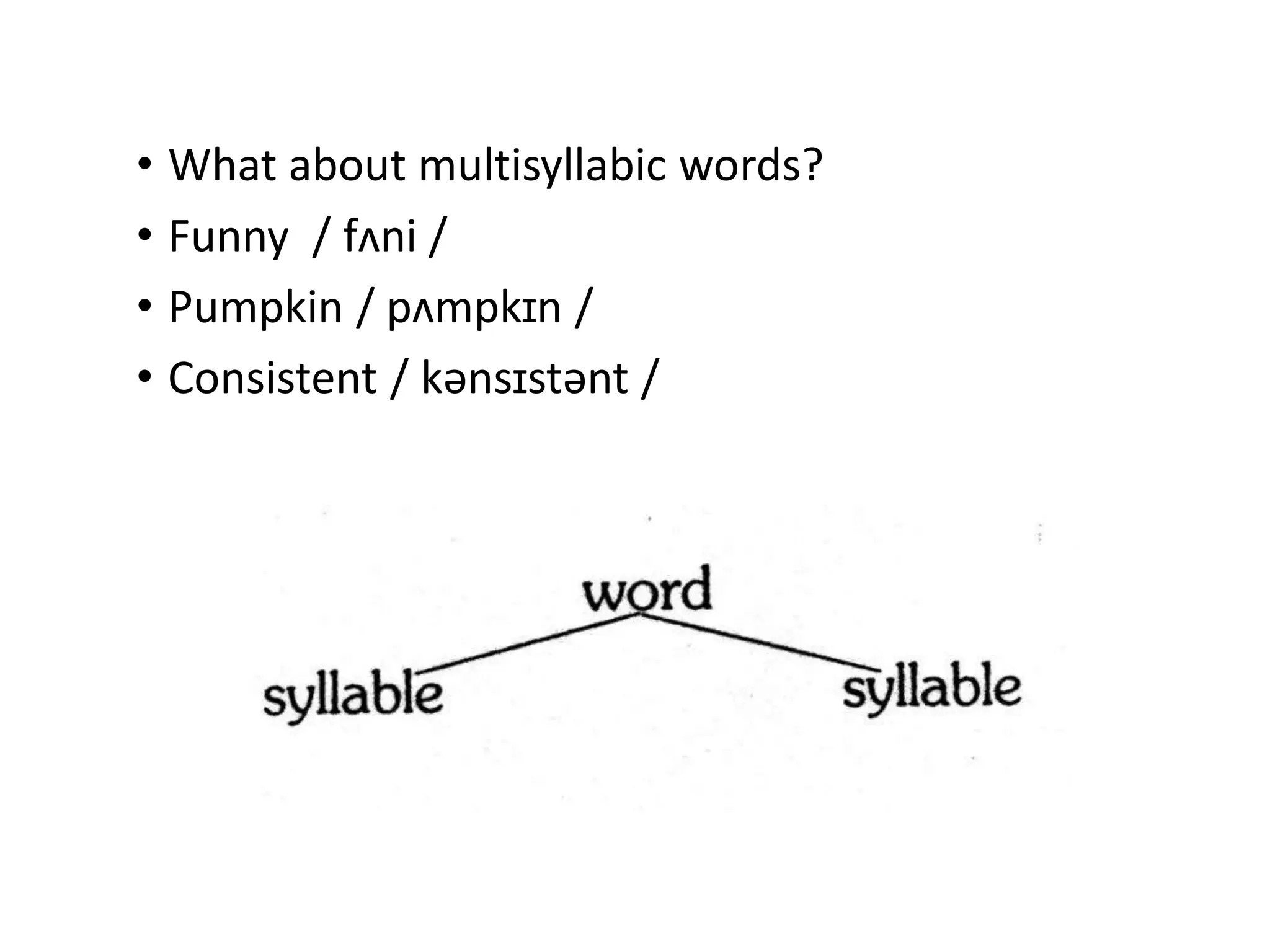
• What about multisyllabic words?
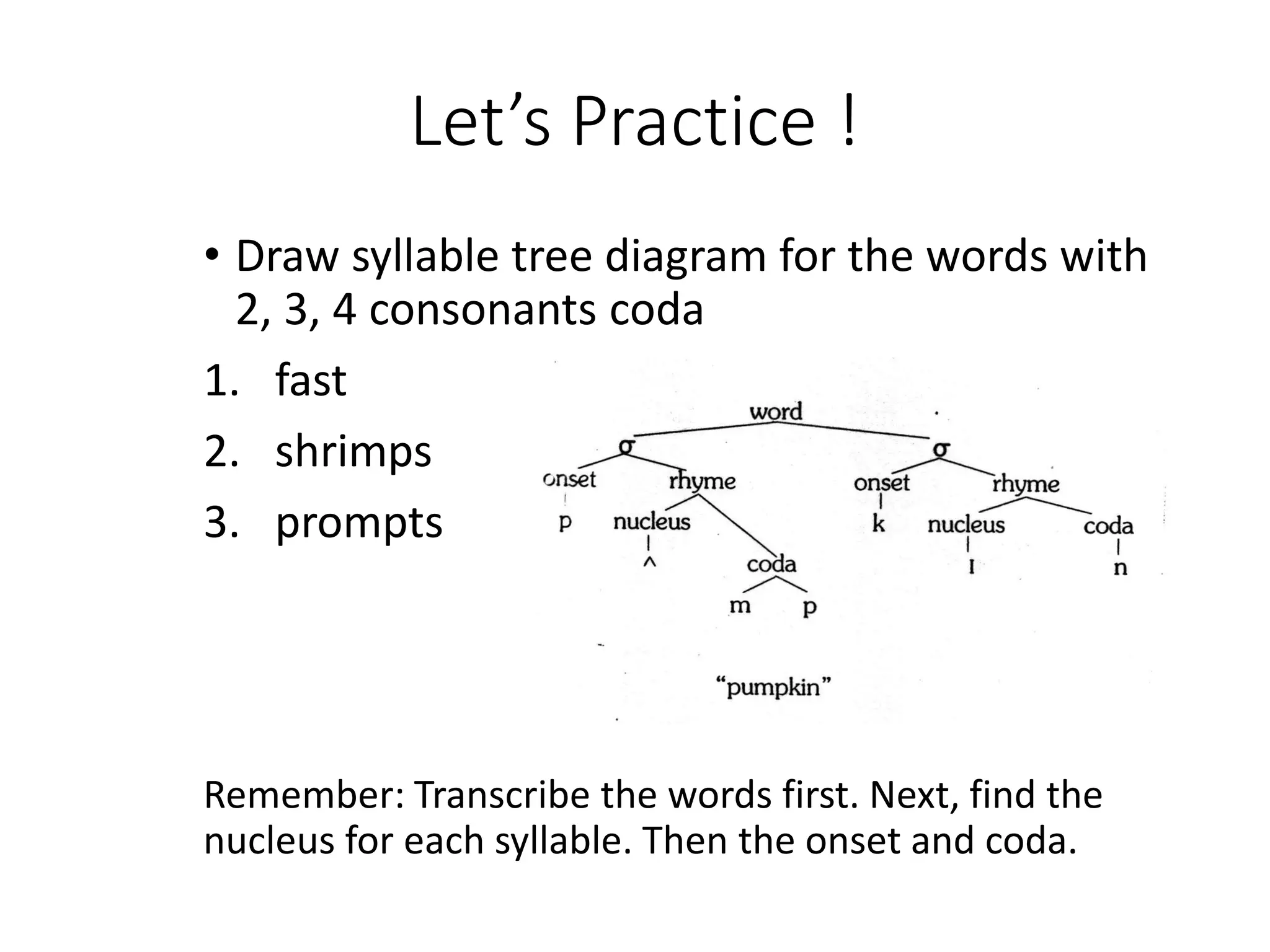
• Funny / fʌni /
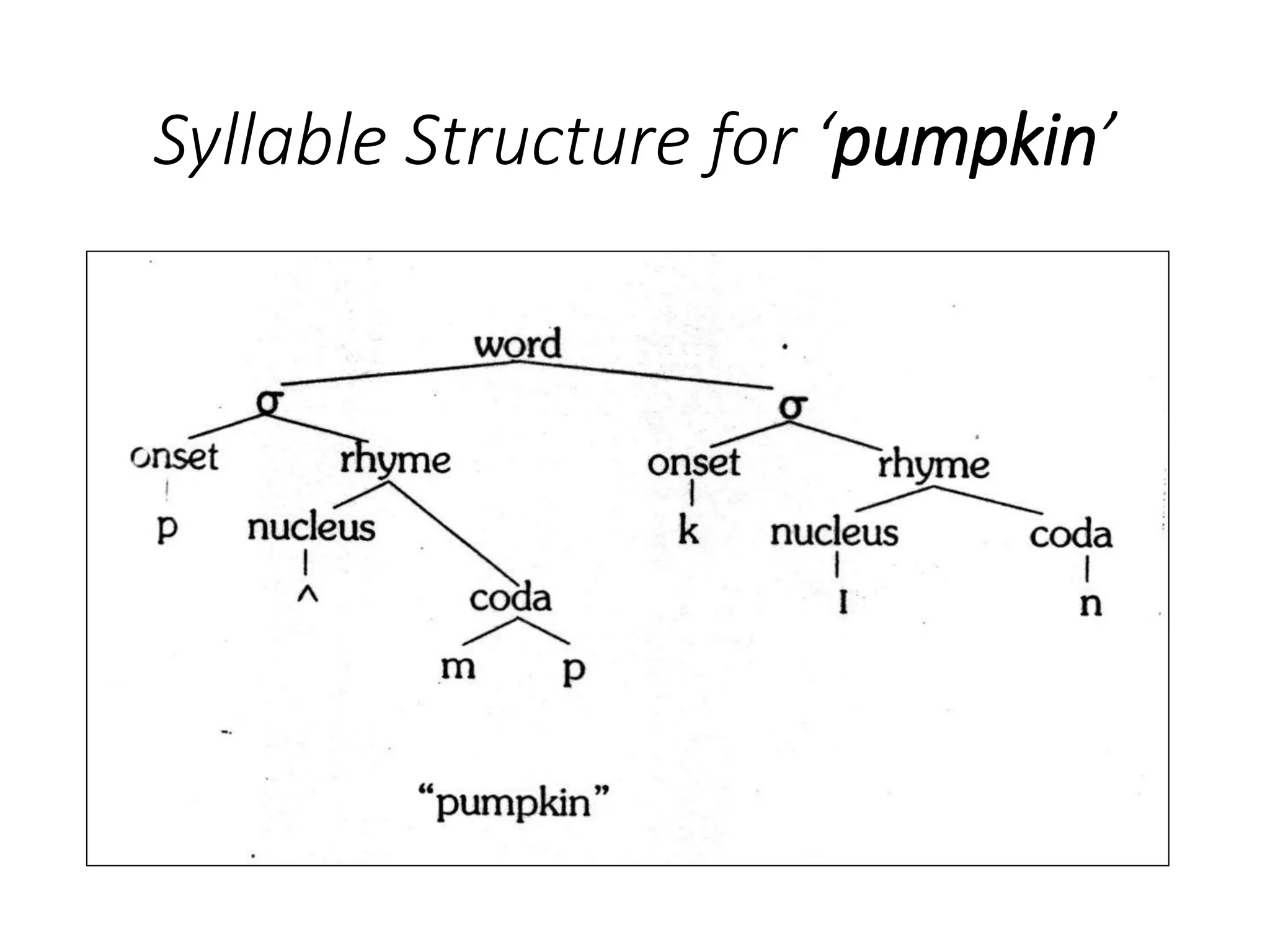
• Pumpkin / pʌmpkɪn /
• Consistent / kənsɪstənt /
Syllable Structure for ‘pumpkin’
Let’s Practice !
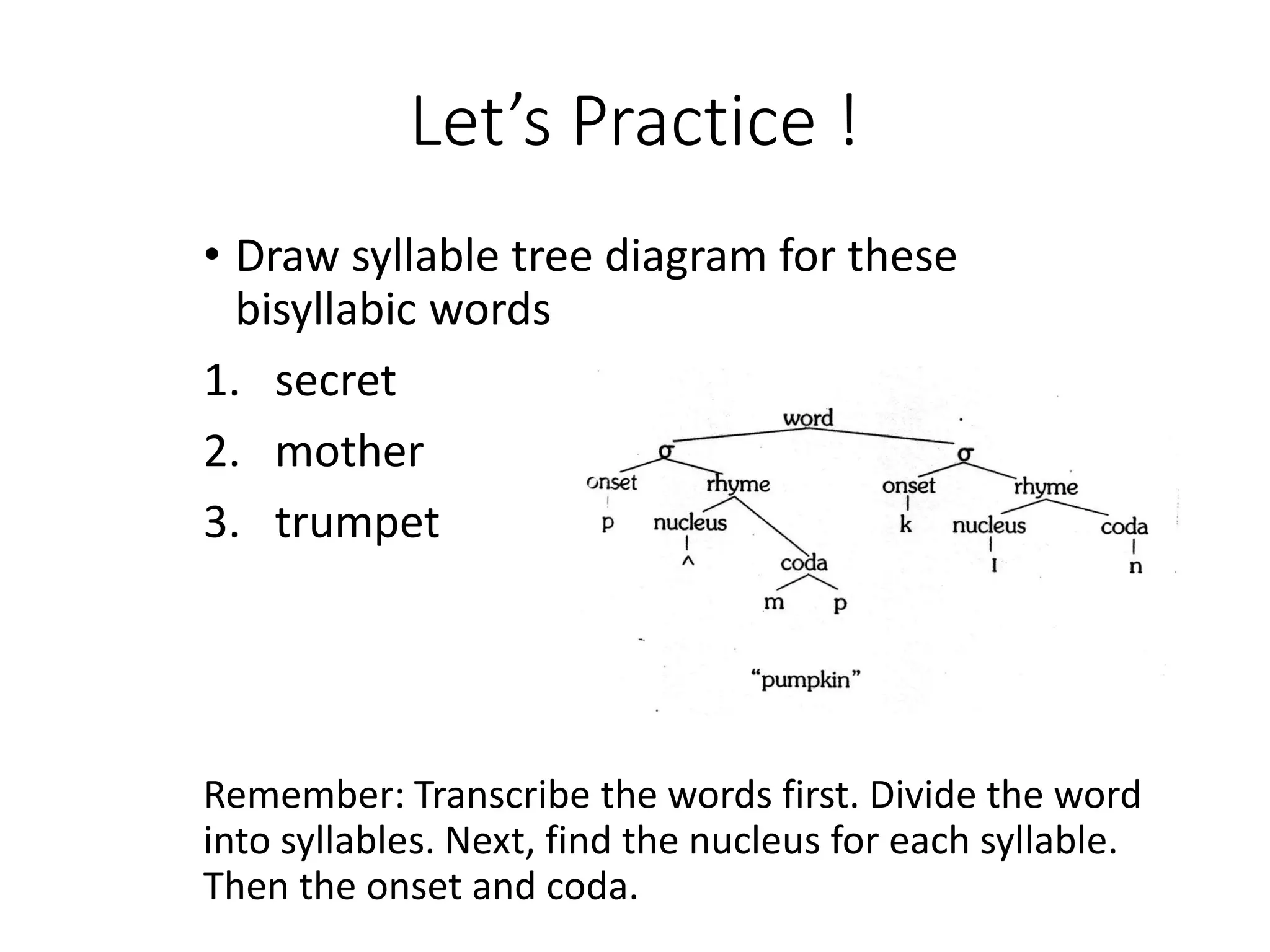
• Draw syllable tree diagram for these
bisyllabic words
1. secret
2. mother
3. trumpet
Remember: Transcribe the words first. Divide the word
into syllables. Next, find the nucleus for each syllable.
Then the onset and coda.
Let’s Practice !
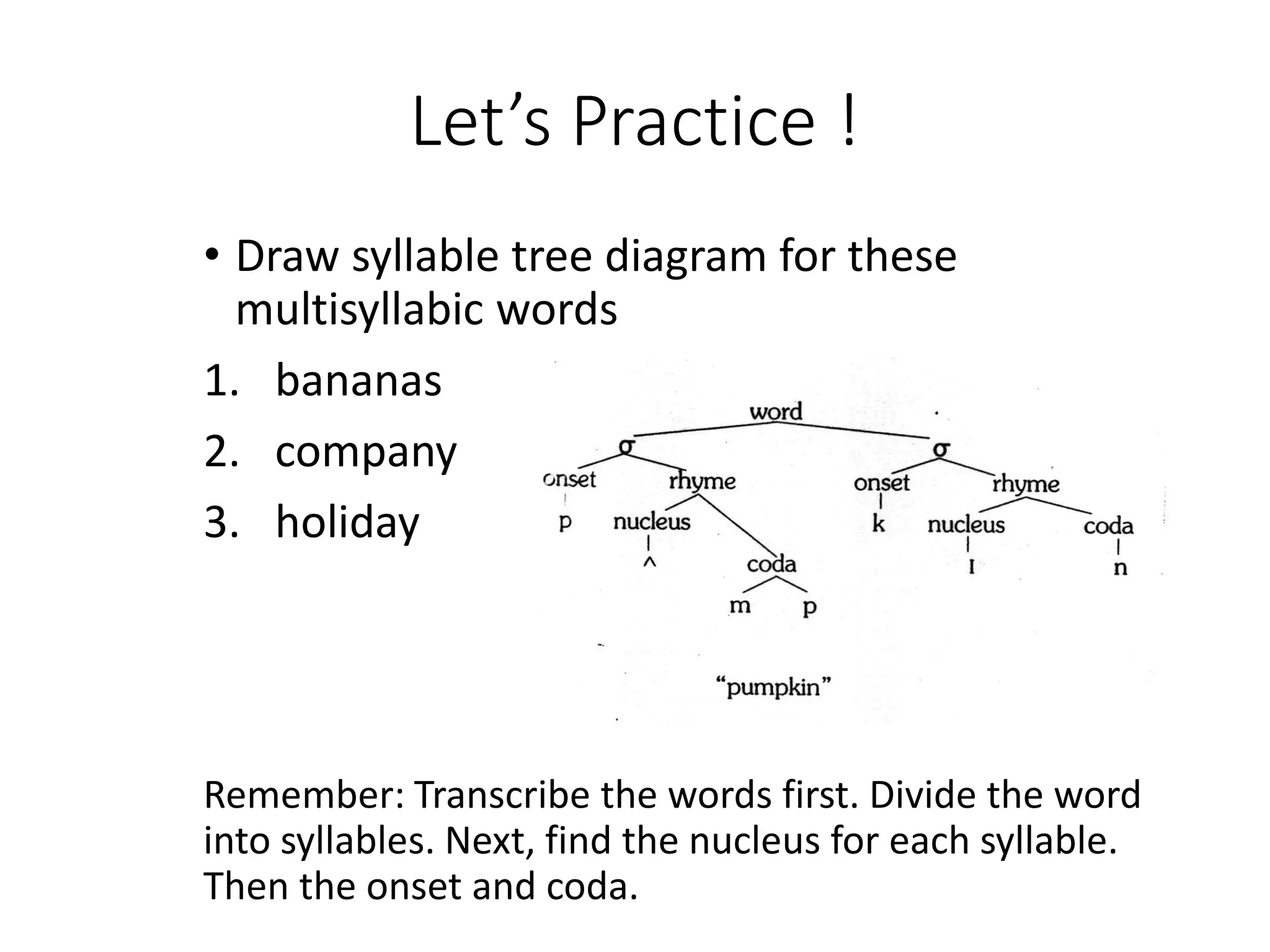
• Draw syllable tree diagram for these
multisyllabic words
1. bananas
2. company
3. holiday
Remember: Transcribe the words first. Divide the word
into syllables. Next, find the nucleus for each syllable.
Then the onset and coda.
NUCLEUS
• The core of a syllable
• Normally , a VOWEL (or dipthong or tripthong), e.g. ‘am’
[æm ] , bark [bɑːk ] bye [baɪ] fire [ˈfaɪə]
• also possible for a consonant to act as a nucleus in English
language e.g. syllabic consonant i.e. l̩, r̩ , m̩ , n̩ or ŋ,
indicated by a small vertical mark ( ̩) beneath the symbol
• A syllabic consonant normally replaces the vowel [ə] and
forms a syllable on its own
E.g. prison / prɪzṇ / or cattle /kaetl̩/
2 syllables / prɪ / and / zn̩/ /kae/ and /tl̩/
syllabic nasal / n̩ / syllabic alveolar lateral /l̩/
ONSET
• Consonant/s at the beginning of a syllable
• If syllable starts with a vowel [æm ] = zero onset ∅
• If begins with one consonant = initial - can be any
consonant except /ŋ/ and /ʒ/ (rare)
‘ought’ / ɔːt / = ∅ onset
saw - / sɔː / = initial consonant
• 2-consonant onset e.g. sport /spɔːt/, stuck /stʌk/ play
/pleɪ/, clear /klɪə/, muse /mjuːz/
• 3-consonant onset e.g. strike /straɪk/, scream /skriːm/,
squeak /skwiːk/
Let’s Practice !
• Draw syllable tree diagram for these words
with 2 and 3 consonants onset
1. Blot
2. Play
3. Squeeze
Remember: Transcribe the words first. Divide the word
into syllables. Next, find the nucleus for each syllable.
Then the onset and coda.
Coda - Final part
• Up to 4 consonants
• No final consonant e.g. [ba:] = ∅ coda
• One consonant e.g. [ɑːt] = final consonant
• Any consonant may be a final except /h/ /r/ /w/ /j/
• 2-consonant coda e.g. bump /bʌmp/, bank /bæŋk/
• 3-consonant coda e.g. bumps /bʌmps/, bank
/bæŋks/ banked /bæŋkt/, lapsed /læpst/
• 4 consonants e.g. twelfths / twelfθs /
prompts /prɒmpts /
Let’s Practice !
• Draw syllable tree diagram for the words with
2, 3, 4 consonants coda
1. fast
2. shrimps
3. prompts
Remember: Transcribe the words first. Next, find the
nucleus for each syllable. Then the onset and coda.
Homework: Syllable structure
Draw syllable tree diagram for the following words
1. Gray
2. Sphinx
3. Define
4. Dictionary
5. Reference
6. Entertain
Post your syllable diagrams in the homework folder in Teams
Class notebook.

Week 8 Syllables.pptx

  • 1.
  • 2.
    Syllable • Definition • Thestructure of a Syllable: Onset, Rhyme, Peak and Coda
  • 3.
    Defining Syllable • Whenwe say a word, the sounds we create naturally divide the word into parts. For example: The word “machine” has two parts: ma-chine. • The word “important” has three parts: im-por-tant. • We call these parts “syllables. • the process of dividing words into syllables = Syllabification
  • 4.
    • A syllableis a part of a word that is composed of one or more speech sounds e.g are /a:/ or guard /ɡɑːd/ • A syllable must contain a vowel or vowel-like sound, including diphthongs e.g. guard /ɡɑːd/ or bye /baɪ/ “consists of a centre which has little or no obstruction to the airflow and which sounds comparatively loud; before and after this centre, there will be greater obstruction to the airflow and/or less sound” (Roach, 2009:56) What is a syllable?
  • 5.
    • Every Englishword consists of at least 1 syllable e.g. ‘cat’ / kæt /, ‘dog’ / dɒg / • Many English words have 2,3,4 or more syllables; • 2 syllables - mother, limit, heaven • 3 syllables - photograph, limited, heavenly • ? syllables - photographer, dictionary, anybody • ? syllables – unbelievable, university, organization • ? - reconsideration, revolutionary
  • 6.
  • 7.
    • A syllablecan have as many as three parts: onset, nucleus, and coda. • The nucleus (obligatory) forms the core of the syllable; it is most often a vowel e.g. ‘far’ /fɑ:/ ; or a diphthong e.g. ‘bye’ /baɪ/. • The onset (optional) are consonant/s, that appear at the beginning of a syllable e.g. ‘bar’ /ba:/ • the coda (optional) are consonant/s, that appear the end of a syllable e.g. ‘am’ /æm/ , bark /bɑːk/ Syllable Structure
  • 8.
    • Syllable structureis represented graphically by means of a “tree diagram”. • In phonology, σ (lowercase sigma) is used to represent syllables. • The rhyme or rime of a syllable consists of a nucleus and an optional coda. C V C
  • 9.
    Syllable Structure For theword “bed” 1) first transcribe the word - /bed/ 2) Next draw the syllable tree 3) Find the nucleus - /e/ (always a vowel or diphthong) 4) then the onset - /b/ (optional) (if there is none, write ∅) 5) followed by the coda /d/ (optional).
  • 10.
    Try this… Another exampleof a monosyllabic word ‘pain’ 1) transcribe = /peɪn/ 2) Next draw the syllable tree 3) identify the nucleus 4) then the onset and coda
  • 11.
    Syllable Structure • Minimumunit of a syllable = Nucleus (without onset or coda) • E.g. ‘are’ /ɑ:/ ‘or’ /ɔ:/ ‘err’ /3:/ • The most common syllable structures in human languages are 1. CV e.g. bar /bɑː/ 2. CVC e.g. bat /bæt/
  • 12.
    Let’s Practice ! Drawsyllable tree diagram for these monosyllabic words 1. Fin 2. Sun 3. Charm 4. Nice 5. Buzz Remember: Transcribe the word first. Next, find the nucleus. Then the onset and coda.
  • 13.
    • What aboutmultisyllabic words? • Funny / fʌni / • Pumpkin / pʌmpkɪn / • Consistent / kənsɪstənt /
  • 14.
  • 15.
    Let’s Practice ! •Draw syllable tree diagram for these bisyllabic words 1. secret 2. mother 3. trumpet Remember: Transcribe the words first. Divide the word into syllables. Next, find the nucleus for each syllable. Then the onset and coda.
  • 16.
    Let’s Practice ! •Draw syllable tree diagram for these multisyllabic words 1. bananas 2. company 3. holiday Remember: Transcribe the words first. Divide the word into syllables. Next, find the nucleus for each syllable. Then the onset and coda.
  • 17.
    NUCLEUS • The coreof a syllable • Normally , a VOWEL (or dipthong or tripthong), e.g. ‘am’ [æm ] , bark [bɑːk ] bye [baɪ] fire [ˈfaɪə] • also possible for a consonant to act as a nucleus in English language e.g. syllabic consonant i.e. l̩, r̩ , m̩ , n̩ or ŋ, indicated by a small vertical mark ( ̩) beneath the symbol • A syllabic consonant normally replaces the vowel [ə] and forms a syllable on its own E.g. prison / prɪzṇ / or cattle /kaetl̩/ 2 syllables / prɪ / and / zn̩/ /kae/ and /tl̩/ syllabic nasal / n̩ / syllabic alveolar lateral /l̩/
  • 18.
    ONSET • Consonant/s atthe beginning of a syllable • If syllable starts with a vowel [æm ] = zero onset ∅ • If begins with one consonant = initial - can be any consonant except /ŋ/ and /ʒ/ (rare) ‘ought’ / ɔːt / = ∅ onset saw - / sɔː / = initial consonant • 2-consonant onset e.g. sport /spɔːt/, stuck /stʌk/ play /pleɪ/, clear /klɪə/, muse /mjuːz/ • 3-consonant onset e.g. strike /straɪk/, scream /skriːm/, squeak /skwiːk/
  • 19.
    Let’s Practice ! •Draw syllable tree diagram for these words with 2 and 3 consonants onset 1. Blot 2. Play 3. Squeeze Remember: Transcribe the words first. Divide the word into syllables. Next, find the nucleus for each syllable. Then the onset and coda.
  • 20.
    Coda - Finalpart • Up to 4 consonants • No final consonant e.g. [ba:] = ∅ coda • One consonant e.g. [ɑːt] = final consonant • Any consonant may be a final except /h/ /r/ /w/ /j/ • 2-consonant coda e.g. bump /bʌmp/, bank /bæŋk/ • 3-consonant coda e.g. bumps /bʌmps/, bank /bæŋks/ banked /bæŋkt/, lapsed /læpst/ • 4 consonants e.g. twelfths / twelfθs / prompts /prɒmpts /
  • 21.
    Let’s Practice ! •Draw syllable tree diagram for the words with 2, 3, 4 consonants coda 1. fast 2. shrimps 3. prompts Remember: Transcribe the words first. Next, find the nucleus for each syllable. Then the onset and coda.
  • 22.
    Homework: Syllable structure Drawsyllable tree diagram for the following words 1. Gray 2. Sphinx 3. Define 4. Dictionary 5. Reference 6. Entertain Post your syllable diagrams in the homework folder in Teams Class notebook.