

Prepared by:
Pir Azrar Ahmed Chishti
0331-6366665
0308-6696688
Syllable
Defintion
 A unit/cluster of pronunciation
having one vowel sound, with or
without surrounding consonants,
forming the whole or a part of a
word.
Water
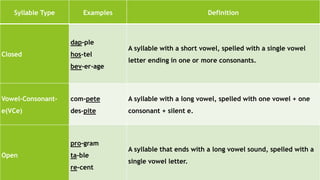
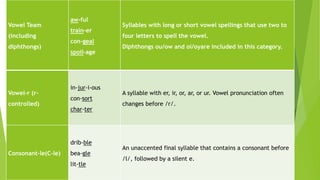
Syllable Type Examples Definition
Closed
dap-ple
hos-tel
bev-er-age
A syllable with a short vowel, spelled with a single vowel
letter ending in one or more consonants.
Vowel-Consonant-
e(VCe)
com-pete
des-pite
A syllable with a long vowel, spelled with one vowel + one
consonant + silent e.
Open
pro-gram
ta-ble
re-cent
A syllable that ends with a long vowel sound, spelled with a
single vowel letter.
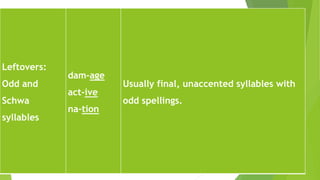
Vowel Team
(including
diphthongs)
aw-ful
train-er
con-geal
spoil-age
Syllables with long or short vowel spellings that use two to
four letters to spell the vowel.
Diphthongs ou/ow and oi/oyare included in this category.
Vowel-r (r-
controlled)
in-jur-i-ous
con-sort
char-ter
A syllable with er, ir, or, ar, or ur. Vowel pronunciation often
changes before /r/.
Consonant-le(C-le)
drib-ble
bea-gle
lit-tle
An unaccented final syllable that contains a consonant before
/l/, followed by a silent e.
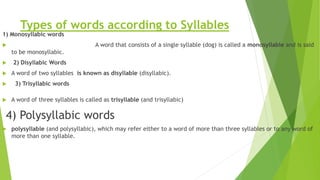
Leftovers:
Odd and
Schwa
syllables
dam-age
act-ive
na-tion
Usually final, unaccented syllables with
odd spellings.
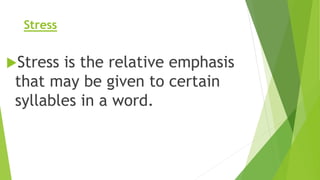
Types of words according to Syllables
1) Monosyllabic words
 A word that consists of a single syllable (dog) is called a monosyllable and is said
to be monosyllabic.
 2) Disyllabic Words
 A word of two syllables is known as disyllable (disyllabic).
 3) Trisyllabic words
 A word of three syllables is called as trisyllable (and trisyllabic)
4) Polysyllabic words
 polysyllable (and polysyllabic), which may refer either to a word of more than three syllables or to any word of
more than one syllable.
Stress
Stress is the relative emphasis
that may be given to certain
syllables in a word.
Types of Stress
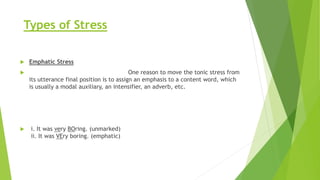
 Emphatic Stress
 One reason to move the tonic stress from
its utterance final position is to assign an emphasis to a content word, which
is usually a modal auxiliary, an intensifier, an adverb, etc.
 i. It was very BOring. (unmarked)
ii. It was VEry boring. (emphatic)
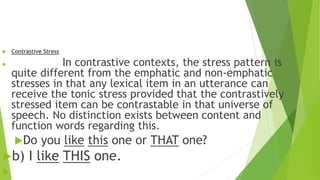
 Contrastive Stress
 In contrastive contexts, the stress pattern is
quite different from the emphatic and non-emphatic
stresses in that any lexical item in an utterance can
receive the tonic stress provided that the contrastively
stressed item can be contrastable in that universe of
speech. No distinction exists between content and
function words regarding this.
Do you like this one or THAT one?
b) I like THIS one.

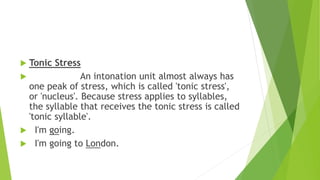
 Tonic Stress
 An intonation unit almost always has
one peak of stress, which is called 'tonic stress',
or 'nucleus'. Because stress applies to syllables,
the syllable that receives the tonic stress is called
'tonic syllable'.
 I'm going.
 I'm going to London.
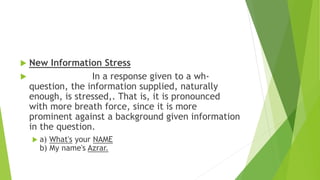
 New Information Stress
 In a response given to a wh-
question, the information supplied, naturally
enough, is stressed,. That is, it is pronounced
with more breath force, since it is more
prominent against a background given information
in the question.
 a) What's your NAME
b) My name's Azrar.

 Word Stress
 Word Stress is the singling out of one or more syllables in a
word, which is accompanied by the change of the force of utterance, pitch of
the voice, qualitative and quantitative characteristics of the sound which is
usually a vowel.
 Analysis of word stress is carried out according to the parameters:
 The nature of English word-stress;
 Its degree and syllabic location;
 Its functions;
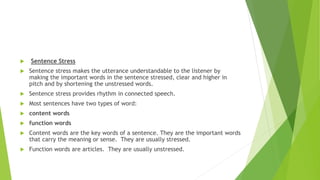
 Sentence Stress
 Sentence stress makes the utterance understandable to the listener by
making the important words in the sentence stressed, clear and higher in
pitch and by shortening the unstressed words.
 Sentence stress provides rhythm in connected speech.
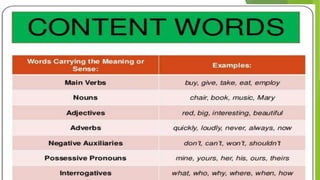
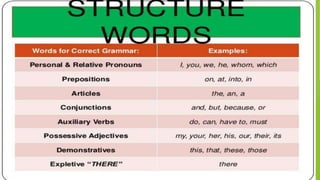
 Most sentences have two types of word:
 content words
 function words
 Content words are the key words of a sentence. They are the important words
that carry the meaning or sense. They are usually stressed.
 Function words are articles. They are usually unstressed.
 Patterns of Stress in Syllables
 Monosyllabic Words
 Monosyllabic words with one syllable are
stressed. (but normally they do not carry stress marks in dictionaries because
the stress is on the one and the same syllable).
 e.g: farm, struck, saw, floor, reach, work, lose.
 Disyllabic Words
 Disyllabic words may have the stress on the
first syllable or on the second syllable.
 Stress on the first syllable :
’visit, ’city, ’recent, ’knowledge, ’solar.
 Multi/Polysyllabic words
 Polysyllabic words gave
the stress on any one of the syllables
 Stress on the first syllable :
’popular, ’telegram, ’atmosphere, ’mechanism, ’grandfather.
 Stress on second syllable :
in’volvement, la’boratory, a’rrangement, ex’periment,
in’terpreet.
 Stress on the third syllable :
availa’bility, communi’cation, under’stand, integ’ration.
 Degrees of Stress
 There are four degrees of words stress as they are given below;
 Primary stress
 It is the stronger degree of stress.
 Primary stress gives the final stressed syllable.
 Primary stress is very important in compound words.
 Secondary stress
 Secondary stress is the weaker of two degrees of stress in the
pronunciation of a word.
 Secondary stress gives the other lexically stressed syllables in a word.
 Secondary stress is important primarily in long words with several
syllables.
 Tertiary stress
 It includes the fully
unstressed vowels. An unstressed vowel is the vowel sound
that forms the syllable peak of a syllable that has no lexical
stress.
 Quaternary stress
 It includes the reduced
vowels. Vowel reduction is the term in phonetics that
refers to various changes in the acoustic quality of vowels,
which are related to changes in stress, sonority, duration,
loudness, articulation, or position in the word which are
perceived as "weakening.
Syllable and stress

Syllable and stress

  • 2.
    Prepared by: Pir AzrarAhmed Chishti 0331-6366665 0308-6696688
  • 3.
  • 4.
    Defintion  A unit/clusterof pronunciation having one vowel sound, with or without surrounding consonants, forming the whole or a part of a word. Water
  • 5.
    Syllable Type ExamplesDefinition Closed dap-ple hos-tel bev-er-age A syllable with a short vowel, spelled with a single vowel letter ending in one or more consonants. Vowel-Consonant- e(VCe) com-pete des-pite A syllable with a long vowel, spelled with one vowel + one consonant + silent e. Open pro-gram ta-ble re-cent A syllable that ends with a long vowel sound, spelled with a single vowel letter.
  • 6.
    Vowel Team (including diphthongs) aw-ful train-er con-geal spoil-age Syllables withlong or short vowel spellings that use two to four letters to spell the vowel. Diphthongs ou/ow and oi/oyare included in this category. Vowel-r (r- controlled) in-jur-i-ous con-sort char-ter A syllable with er, ir, or, ar, or ur. Vowel pronunciation often changes before /r/. Consonant-le(C-le) drib-ble bea-gle lit-tle An unaccented final syllable that contains a consonant before /l/, followed by a silent e.
  • 7.
  • 8.
    Types of wordsaccording to Syllables 1) Monosyllabic words  A word that consists of a single syllable (dog) is called a monosyllable and is said to be monosyllabic.  2) Disyllabic Words  A word of two syllables is known as disyllable (disyllabic).  3) Trisyllabic words  A word of three syllables is called as trisyllable (and trisyllabic) 4) Polysyllabic words  polysyllable (and polysyllabic), which may refer either to a word of more than three syllables or to any word of more than one syllable.
  • 9.
    Stress Stress is therelative emphasis that may be given to certain syllables in a word.
  • 10.
    Types of Stress Emphatic Stress  One reason to move the tonic stress from its utterance final position is to assign an emphasis to a content word, which is usually a modal auxiliary, an intensifier, an adverb, etc.  i. It was very BOring. (unmarked) ii. It was VEry boring. (emphatic)
  • 11.
     Contrastive Stress In contrastive contexts, the stress pattern is quite different from the emphatic and non-emphatic stresses in that any lexical item in an utterance can receive the tonic stress provided that the contrastively stressed item can be contrastable in that universe of speech. No distinction exists between content and function words regarding this. Do you like this one or THAT one? b) I like THIS one. 
  • 12.
     Tonic Stress An intonation unit almost always has one peak of stress, which is called 'tonic stress', or 'nucleus'. Because stress applies to syllables, the syllable that receives the tonic stress is called 'tonic syllable'.  I'm going.  I'm going to London.
  • 13.
     New InformationStress  In a response given to a wh- question, the information supplied, naturally enough, is stressed,. That is, it is pronounced with more breath force, since it is more prominent against a background given information in the question.  a) What's your NAME b) My name's Azrar.
  • 14.
      Word Stress Word Stress is the singling out of one or more syllables in a word, which is accompanied by the change of the force of utterance, pitch of the voice, qualitative and quantitative characteristics of the sound which is usually a vowel.  Analysis of word stress is carried out according to the parameters:  The nature of English word-stress;  Its degree and syllabic location;  Its functions;
  • 15.
     Sentence Stress Sentence stress makes the utterance understandable to the listener by making the important words in the sentence stressed, clear and higher in pitch and by shortening the unstressed words.  Sentence stress provides rhythm in connected speech.  Most sentences have two types of word:  content words  function words  Content words are the key words of a sentence. They are the important words that carry the meaning or sense. They are usually stressed.  Function words are articles. They are usually unstressed.
  • 18.
     Patterns ofStress in Syllables  Monosyllabic Words  Monosyllabic words with one syllable are stressed. (but normally they do not carry stress marks in dictionaries because the stress is on the one and the same syllable).  e.g: farm, struck, saw, floor, reach, work, lose.  Disyllabic Words  Disyllabic words may have the stress on the first syllable or on the second syllable.  Stress on the first syllable : ’visit, ’city, ’recent, ’knowledge, ’solar.
  • 19.
     Multi/Polysyllabic words Polysyllabic words gave the stress on any one of the syllables  Stress on the first syllable : ’popular, ’telegram, ’atmosphere, ’mechanism, ’grandfather.  Stress on second syllable : in’volvement, la’boratory, a’rrangement, ex’periment, in’terpreet.  Stress on the third syllable : availa’bility, communi’cation, under’stand, integ’ration.
  • 20.
     Degrees ofStress  There are four degrees of words stress as they are given below;  Primary stress  It is the stronger degree of stress.  Primary stress gives the final stressed syllable.  Primary stress is very important in compound words.  Secondary stress  Secondary stress is the weaker of two degrees of stress in the pronunciation of a word.  Secondary stress gives the other lexically stressed syllables in a word.  Secondary stress is important primarily in long words with several syllables.
  • 21.
     Tertiary stress It includes the fully unstressed vowels. An unstressed vowel is the vowel sound that forms the syllable peak of a syllable that has no lexical stress.  Quaternary stress  It includes the reduced vowels. Vowel reduction is the term in phonetics that refers to various changes in the acoustic quality of vowels, which are related to changes in stress, sonority, duration, loudness, articulation, or position in the word which are perceived as "weakening.