

What is
“Syllable?”
What is
“stress”?
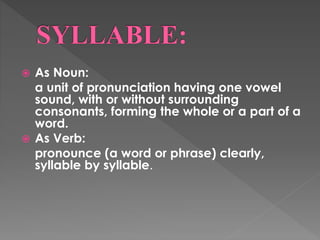
 As Noun:
a unit of pronunciation having one vowel
sound, with or without surrounding
consonants, forming the whole or a part of a
word.
 As Verb:
pronounce (a word or phrase) clearly,
syllable by syllable.
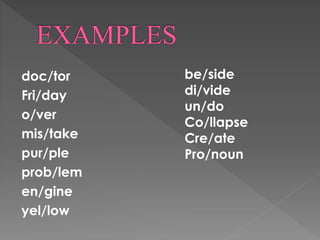
doc/tor
Fri/day
o/ver
mis/take
pur/ple
prob/lem
en/gine
yel/low
be/side
di/vide
un/do
Co/llapse
Cre/ate
Pro/noun
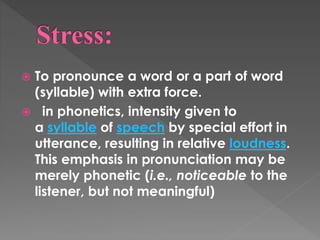
 To pronounce a word or a part of word
(syllable) with extra force.
 in phonetics, intensity given to
a syllable of speech by special effort in
utterance, resulting in relative loudness.
This emphasis in pronunciation may be
merely phonetic (i.e., noticeable to the
listener, but not meaningful)
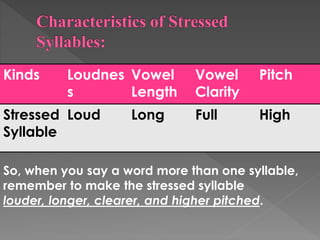
Kinds Loudnes
s
Vowel
Length
Vowel
Clarity
Pitch
Stressed
Syllable
Loud Long Full High
So, when you say a word more than one syllable,
remember to make the stressed syllable
louder, longer, clearer, and higher pitched.
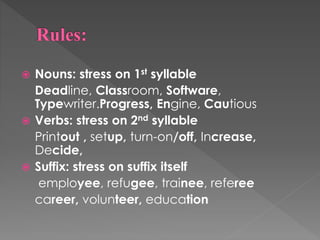
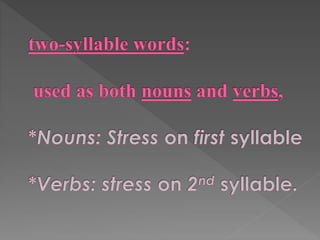
 Nouns: stress on 1st syllable
Deadline, Classroom, Software,
Typewriter.Progress, Engine, Cautious
 Verbs: stress on 2nd syllable
Printout , setup, turn-on/off, Increase,
Decide,
 Suffix: stress on suffix itself
employee, refugee, trainee, referee
career, volunteer, education
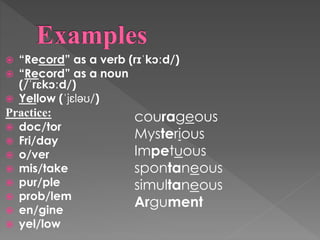
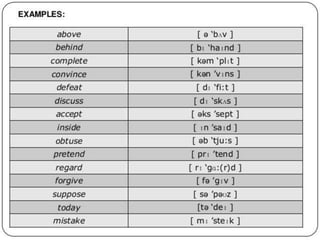
 “Record” as a verb (rɪˈkɔːd/)
 “Record” as a noun
(/ˈrɛkɔːd/)
 Yellow (ˈjɛləʊ/)
Practice:
 doc/tor
 Fri/day
 o/ver
 mis/take
 pur/ple
 prob/lem
 en/gine
 yel/low
courageous
Mysterious
Impetuous
spontaneous
simultaneous
Argument
 Accent Improvement
 Pronunciation
 Golden key to spoken language
 Helps Spelling
 Rhythm in speech
 Clarity of meaning
 Differentiate parts of speech
 Word stress
Stress on syllable in the same word.
 Sentence Stress:
Stress on certain words in the same
Sentence.
 There are 3 kinds of words:
› Monosyllabic
› Bisyllabic
› Multisyllabic
Bat Sheet
Play Good
Stop Pink
You Tie
Fan Fish
There are three types of stress
in bisyllabic words.
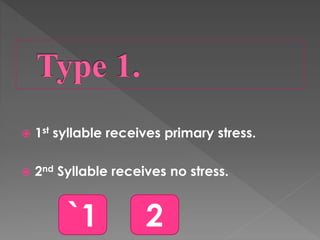
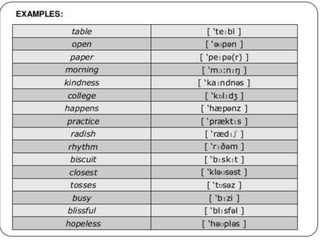
 1st syllable receives primary stress.
 2nd Syllable receives no stress.
`1 2
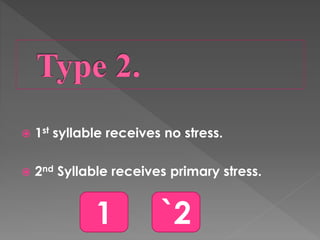
 1st syllable receives no stress.
 2nd Syllable receives primary stress.
1 `2
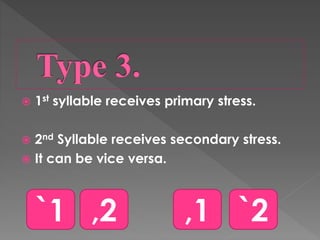
 1st syllable receives primary stress.
 2nd Syllable receives secondary stress.
 It can be vice versa.
`1 ,2 `2,1
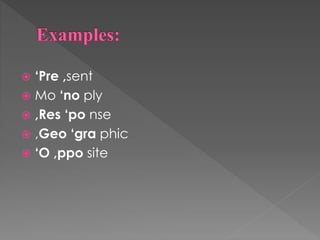
 ‘Pre ,sent
 Mo ‘no ply
 ,Res ‘po nse
 ,Geo ‘gra phic
 ‘O ,ppo site
These words consist of more
than one words.
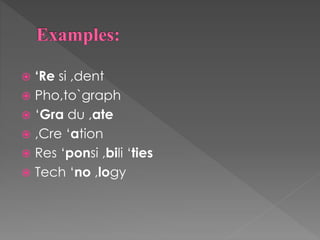
 ‘Re si ,dent
 Pho,to`graph
 ‘Gra du ,ate
 ,Cre ‘ation
 Res ‘ponsi ,bili ‘ties
 Tech ‘no ,logy
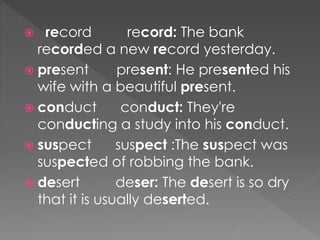
 record record: The bank
recorded a new record yesterday.
 present present: He presented his
wife with a beautiful present.
 conduct conduct: They're
conducting a study into his conduct.
 suspect suspect :The suspect was
suspected of robbing the bank.
 desert deser: The desert is so dry
that it is usually deserted.
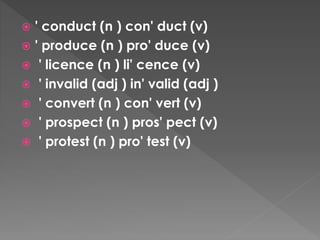
 ' conduct (n ) con' duct (v)
 ' produce (n ) pro' duce (v)
 ' licence (n ) li' cence (v)
 ' invalid (adj ) in' valid (adj )
 ' convert (n ) con' vert (v)
 ' prospect (n ) pros' pect (v)
 ' protest (n ) pro' test (v)
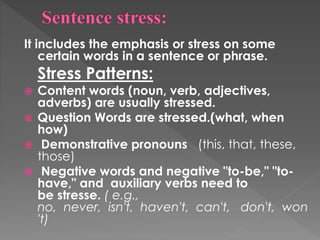
It includes the emphasis or stress on some
certain words in a sentence or phrase.
Stress Patterns:
 Content words (noun, verb, adjectives,
adverbs) are usually stressed.
 Question Words are stressed.(what, when
how)
 Demonstrative pronouns (this, that, these,
those)
 Negative words and negative "to-be," "to-
have," and auxiliary verbs need to
be stresse. ( e.g.,
no, never, isn't, haven't, can't, don't, won
't)
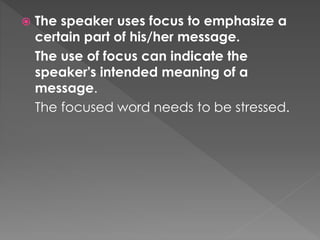
 The speaker uses focus to emphasize a
certain part of his/her message.
The use of focus can indicate the
speaker's intended meaning of a
message.
The focused word needs to be stressed.
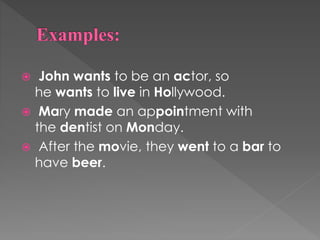
 John wants to be an actor, so
he wants to live in Hollywood.
 Mary made an appointment with
the dentist on Monday.
 After the movie, they went to a bar to
have beer.
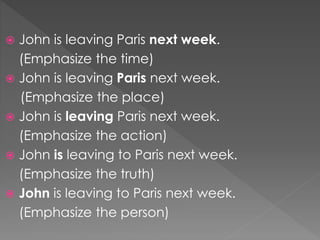
 John is leaving Paris next week.
(Emphasize the time)
 John is leaving Paris next week.
(Emphasize the place)
 John is leaving Paris next week.
(Emphasize the action)
 John is leaving to Paris next week.
(Emphasize the truth)
 John is leaving to Paris next week.
(Emphasize the person)
Stressed syllables

Stressed syllables

  • 3.
  • 4.
     As Noun: aunit of pronunciation having one vowel sound, with or without surrounding consonants, forming the whole or a part of a word.  As Verb: pronounce (a word or phrase) clearly, syllable by syllable.
  • 5.
  • 6.
     To pronouncea word or a part of word (syllable) with extra force.  in phonetics, intensity given to a syllable of speech by special effort in utterance, resulting in relative loudness. This emphasis in pronunciation may be merely phonetic (i.e., noticeable to the listener, but not meaningful)
  • 7.
    Kinds Loudnes s Vowel Length Vowel Clarity Pitch Stressed Syllable Loud LongFull High So, when you say a word more than one syllable, remember to make the stressed syllable louder, longer, clearer, and higher pitched.
  • 8.
     Nouns: stresson 1st syllable Deadline, Classroom, Software, Typewriter.Progress, Engine, Cautious  Verbs: stress on 2nd syllable Printout , setup, turn-on/off, Increase, Decide,  Suffix: stress on suffix itself employee, refugee, trainee, referee career, volunteer, education
  • 9.
     “Record” asa verb (rɪˈkɔːd/)  “Record” as a noun (/ˈrɛkɔːd/)  Yellow (ˈjɛləʊ/) Practice:  doc/tor  Fri/day  o/ver  mis/take  pur/ple  prob/lem  en/gine  yel/low courageous Mysterious Impetuous spontaneous simultaneous Argument
  • 10.
     Accent Improvement Pronunciation  Golden key to spoken language  Helps Spelling  Rhythm in speech  Clarity of meaning  Differentiate parts of speech
  • 11.
     Word stress Stresson syllable in the same word.  Sentence Stress: Stress on certain words in the same Sentence.
  • 12.
     There are3 kinds of words: › Monosyllabic › Bisyllabic › Multisyllabic
  • 13.
    Bat Sheet Play Good StopPink You Tie Fan Fish
  • 14.
    There are threetypes of stress in bisyllabic words.
  • 15.
     1st syllablereceives primary stress.  2nd Syllable receives no stress. `1 2
  • 17.
     1st syllablereceives no stress.  2nd Syllable receives primary stress. 1 `2
  • 19.
     1st syllablereceives primary stress.  2nd Syllable receives secondary stress.  It can be vice versa. `1 ,2 `2,1
  • 20.
     ‘Pre ,sent Mo ‘no ply  ,Res ‘po nse  ,Geo ‘gra phic  ‘O ,ppo site
  • 21.
    These words consistof more than one words.
  • 22.
     ‘Re si,dent  Pho,to`graph  ‘Gra du ,ate  ,Cre ‘ation  Res ‘ponsi ,bili ‘ties  Tech ‘no ,logy
  • 24.
     record record:The bank recorded a new record yesterday.  present present: He presented his wife with a beautiful present.  conduct conduct: They're conducting a study into his conduct.  suspect suspect :The suspect was suspected of robbing the bank.  desert deser: The desert is so dry that it is usually deserted.
  • 25.
     ' conduct(n ) con' duct (v)  ' produce (n ) pro' duce (v)  ' licence (n ) li' cence (v)  ' invalid (adj ) in' valid (adj )  ' convert (n ) con' vert (v)  ' prospect (n ) pros' pect (v)  ' protest (n ) pro' test (v)
  • 26.
    It includes theemphasis or stress on some certain words in a sentence or phrase. Stress Patterns:  Content words (noun, verb, adjectives, adverbs) are usually stressed.  Question Words are stressed.(what, when how)  Demonstrative pronouns (this, that, these, those)  Negative words and negative "to-be," "to- have," and auxiliary verbs need to be stresse. ( e.g., no, never, isn't, haven't, can't, don't, won 't)
  • 27.
     The speakeruses focus to emphasize a certain part of his/her message. The use of focus can indicate the speaker's intended meaning of a message. The focused word needs to be stressed.
  • 28.
     John wantsto be an actor, so he wants to live in Hollywood.  Mary made an appointment with the dentist on Monday.  After the movie, they went to a bar to have beer.
  • 29.
     John isleaving Paris next week. (Emphasize the time)  John is leaving Paris next week. (Emphasize the place)  John is leaving Paris next week. (Emphasize the action)  John is leaving to Paris next week. (Emphasize the truth)  John is leaving to Paris next week. (Emphasize the person)