Principles of
Intonation
P.Jency
II MA ENG. LIT.
INTONATION
Intonation is about how we say things, rather
than what we say, the way the voice rises
and falls when speaking, in other words the
music of the language.
Two basic patterns of intonations
Falling intonation and Rising
FALLING TONE
It is commonly found in statements,
commands, wh-questions,
confirmatory question tags and
exclamations.
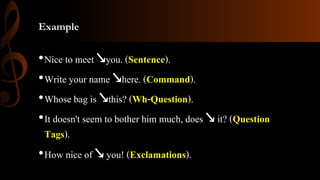
Example
•Nice to meet ↘you. (Sentence).
•Write your name ↘here. (Command).
•Whose bag is ↘this? (Wh-Question).
•It doesn't seem to bother him much, does ↘ it? (Question
Tags).
•How nice of ↘ you! (Exclamations).
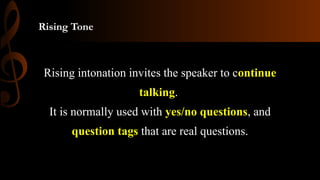
Rising Tone
Rising intonation invites the speaker to continue
talking.
It is normally used with yes/no questions, and
question tags that are real questions.
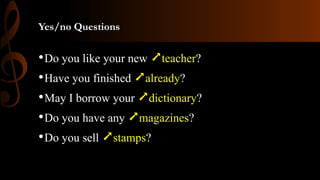
Yes/no Questions
•Do you like your new ➚teacher?
•Have you finished ➚already?
•May I borrow your ➚dictionary?
•Do you have any ➚magazines?
•Do you sell ➚stamps?
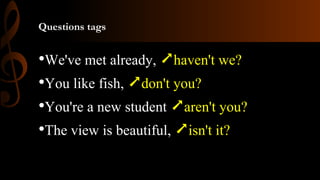
Questions tags
•We've met already, ➚haven't we?
•You like fish, ➚don't you?
•You're a new student ➚aren't you?
•The view is beautiful, ➚isn't it?
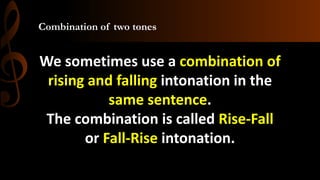
Combination of two tones
We sometimes use a combination of
rising and falling intonation in the
same sentence.
The combination is called Rise-Fall
or Fall-Rise intonation.
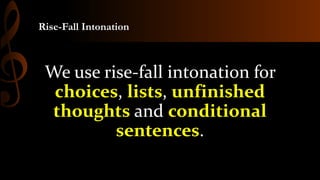
Rise-Fall Intonation
We use rise-fall intonation for
choices, lists, unfinished
thoughts and conditional
sentences.
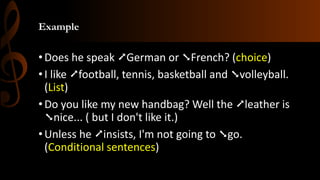
Example
•Does he speak ➚German or ➘French? (choice)
•I like ➚football, tennis, basketball and ➘volleyball.
(List)
•Do you like my new handbag? Well the ➚leather is
➘nice... ( but I don't like it.)
•Unless he ➚insists, I'm not going to ➘go.
(Conditional sentences)
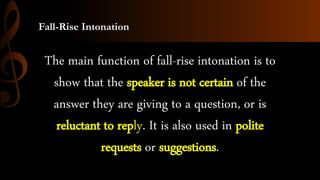
Fall-Rise Intonation
The main function of fall-rise intonation is to
show that the speaker is not certain of the
answer they are giving to a question, or is
reluctant to reply. It is also used in polite
requests or suggestions.
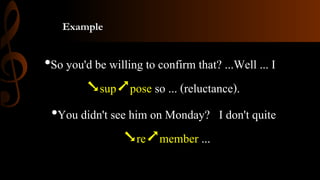
Example
•So you'd be willing to confirm that? ...Well ... I
➘sup➚pose so ... (reluctance).
•You didn't see him on Monday? I don't quite
➘re➚member ...
Thank You!

Intonation and its types rules

  • 1.
  • 2.
    INTONATION Intonation is abouthow we say things, rather than what we say, the way the voice rises and falls when speaking, in other words the music of the language.
  • 3.
    Two basic patternsof intonations Falling intonation and Rising
  • 4.
    FALLING TONE It iscommonly found in statements, commands, wh-questions, confirmatory question tags and exclamations.
  • 5.
    Example •Nice to meet↘you. (Sentence). •Write your name ↘here. (Command). •Whose bag is ↘this? (Wh-Question). •It doesn't seem to bother him much, does ↘ it? (Question Tags). •How nice of ↘ you! (Exclamations).
  • 6.
    Rising Tone Rising intonationinvites the speaker to continue talking. It is normally used with yes/no questions, and question tags that are real questions.
  • 7.
    Yes/no Questions •Do youlike your new ➚teacher? •Have you finished ➚already? •May I borrow your ➚dictionary? •Do you have any ➚magazines? •Do you sell ➚stamps?
  • 8.
    Questions tags •We've metalready, ➚haven't we? •You like fish, ➚don't you? •You're a new student ➚aren't you? •The view is beautiful, ➚isn't it?
  • 9.
    Combination of twotones We sometimes use a combination of rising and falling intonation in the same sentence. The combination is called Rise-Fall or Fall-Rise intonation.
  • 10.
    Rise-Fall Intonation We userise-fall intonation for choices, lists, unfinished thoughts and conditional sentences.
  • 11.
    Example •Does he speak➚German or ➘French? (choice) •I like ➚football, tennis, basketball and ➘volleyball. (List) •Do you like my new handbag? Well the ➚leather is ➘nice... ( but I don't like it.) •Unless he ➚insists, I'm not going to ➘go. (Conditional sentences)
  • 12.
    Fall-Rise Intonation The mainfunction of fall-rise intonation is to show that the speaker is not certain of the answer they are giving to a question, or is reluctant to reply. It is also used in polite requests or suggestions.
  • 13.
    Example •So you'd bewilling to confirm that? ...Well ... I ➘sup➚pose so ... (reluctance). •You didn't see him on Monday? I don't quite ➘re➚member ...
  • 14.