Switch Statements
Comparing Exact Values
The Switch Statement
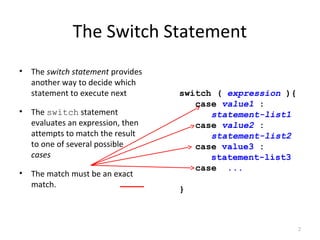
• The switch statement provides
another way to decide which
statement to execute next
• The switch statement
evaluates an expression, then
attempts to match the result
to one of several possible
cases
• The match must be an exact
match.
2
switch ( expression ){
case value1 :
statement-list1
case value2 :
statement-list2
case value3 :
statement-list3
case ...
}
The Switch Statement
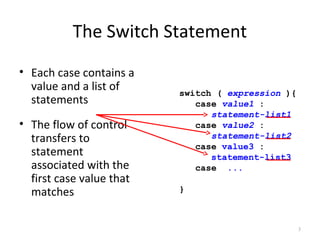
• Each case contains a
value and a list of
statements
• The flow of control
transfers to
statement
associated with the
first case value that
matches
3
switch ( expression ){
case value1 :
statement-list1
case value2 :
statement-list2
case value3 :
statement-list3
case ...
}
Switch - syntax
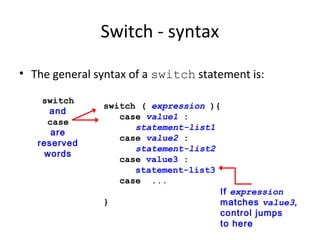
• The general syntax of a switch statement is:
switch ( expression ){
case value1 :
statement-list1
case value2 :
statement-list2
case value3 :
statement-list3
case ...
}
switch
and
case
are
reserved
words
If expression
matches value3,
control jumps
to here
The Switch Statement
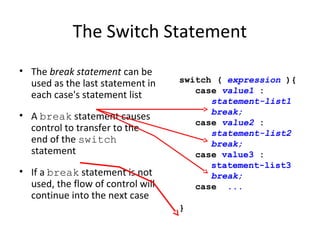
• The break statement can be
used as the last statement in
each case's statement list
• A break statement causes
control to transfer to the
end of the switch
statement
• If a break statement is not
used, the flow of control will
continue into the next case
switch ( expression ){
case value1 :
statement-list1
break;
case value2 :
statement-list2
break;
case value3 :
statement-list3
break;
case ...
}
Switch Example
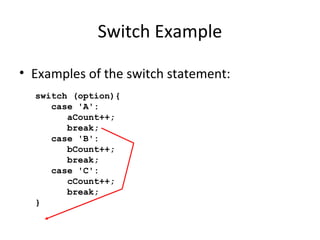
• Examples of the switch statement:
switch (option){
case 'A':
aCount++;
break;
case 'B':
bCount++;
break;
case 'C':
cCount++;
break;
}
Switch – no breaks!!!
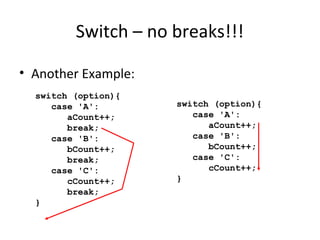
• Another Example:
switch (option){
case 'A':
aCount++;
case 'B':
bCount++;
case 'C':
cCount++;
}
switch (option){
case 'A':
aCount++;
break;
case 'B':
bCount++;
break;
case 'C':
cCount++;
break;
}
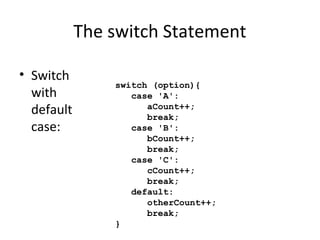
Switch - default
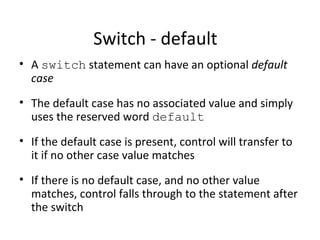
• A switch statement can have an optional default
case
• The default case has no associated value and simply
uses the reserved word default
• If the default case is present, control will transfer to
it if no other case value matches
• If there is no default case, and no other value
matches, control falls through to the statement after
the switch
The switch Statement
• Switch
with
default
case:
switch (option){
case 'A':
aCount++;
break;
case 'B':
bCount++;
break;
case 'C':
cCount++;
break;
default:
otherCount++;
break;
}
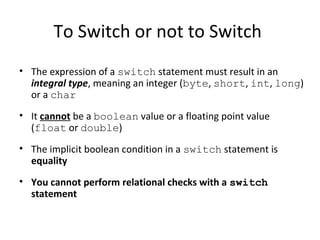
To Switch or not to Switch
• The expression of a switch statement must result in an
integral type, meaning an integer (byte, short, int, long)
or a char
• It cannot be a boolean value or a floating point value
(float or double)
• The implicit boolean condition in a switch statement is
equality
• You cannot perform relational checks with a switch
statement

Switch statements in Java

  • 1.
  • 2.
    The Switch Statement •The switch statement provides another way to decide which statement to execute next • The switch statement evaluates an expression, then attempts to match the result to one of several possible cases • The match must be an exact match. 2 switch ( expression ){ case value1 : statement-list1 case value2 : statement-list2 case value3 : statement-list3 case ... }
  • 3.
    The Switch Statement •Each case contains a value and a list of statements • The flow of control transfers to statement associated with the first case value that matches 3 switch ( expression ){ case value1 : statement-list1 case value2 : statement-list2 case value3 : statement-list3 case ... }
  • 4.
    Switch - syntax •The general syntax of a switch statement is: switch ( expression ){ case value1 : statement-list1 case value2 : statement-list2 case value3 : statement-list3 case ... } switch and case are reserved words If expression matches value3, control jumps to here
  • 5.
    The Switch Statement •The break statement can be used as the last statement in each case's statement list • A break statement causes control to transfer to the end of the switch statement • If a break statement is not used, the flow of control will continue into the next case switch ( expression ){ case value1 : statement-list1 break; case value2 : statement-list2 break; case value3 : statement-list3 break; case ... }
  • 6.
    Switch Example • Examplesof the switch statement: switch (option){ case 'A': aCount++; break; case 'B': bCount++; break; case 'C': cCount++; break; }
  • 7.
    Switch – nobreaks!!! • Another Example: switch (option){ case 'A': aCount++; case 'B': bCount++; case 'C': cCount++; } switch (option){ case 'A': aCount++; break; case 'B': bCount++; break; case 'C': cCount++; break; }
  • 8.
    Switch - default •A switch statement can have an optional default case • The default case has no associated value and simply uses the reserved word default • If the default case is present, control will transfer to it if no other case value matches • If there is no default case, and no other value matches, control falls through to the statement after the switch
  • 9.
    The switch Statement •Switch with default case: switch (option){ case 'A': aCount++; break; case 'B': bCount++; break; case 'C': cCount++; break; default: otherCount++; break; }
  • 10.
    To Switch ornot to Switch • The expression of a switch statement must result in an integral type, meaning an integer (byte, short, int, long) or a char • It cannot be a boolean value or a floating point value (float or double) • The implicit boolean condition in a switch statement is equality • You cannot perform relational checks with a switch statement