A 
PRESENTATION ON 
CONDITIONAL 
STATEMENT IN “C” 
LANGUAGE
C0NTENT 
1. INTRODUCTION 
2. IF CONDITION 
3. IF ELSE CONDITION 
4. NESTED IF ELSE CONDITION 
5. LADDER ELSE IF CONDITION 
6. SWITCH CASE CONDITION 
7. BREAK STATEMENT 
8. GOTO LABEL STATEMENT 
9. CONTINUE STATEMENT
INTRODUCTION 
Conditional Statements Are Used To Execute A 
Set Of Statements On Some Conditions. It 
Provides A Unit Of Block In Which We Can 
Either One Statement Or More Than One 
Statments. If The Given Condition Is True Then 
The Set Of Statements Are Executed Otherwise 
Body Is Skipped.
IF CONDITION 
It is conditional statement, which is used to 
execute a set of statement on some conditions. 
The condition must be of Boolean type 
expression. 
An expression, which returns only two value 
either TRUE or FALSE, is known as Boolean 
type expression.
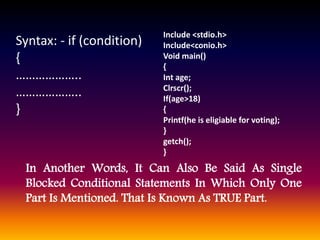
Syntax: - if (condition) 
{ 
……………….. 
……………….. 
} 
Include <stdio.h> 
Include<conio.h> 
Void main() 
{ 
Int age; 
Clrscr(); 
If(age>18) 
{ 
Printf(he is eligiable for voting); 
} 
getch(); 
} 
In Another Words, It Can Also Be Said As Single 
Blocked Conditional Statements In Which Only One 
Part Is Mentioned. That Is Known As TRUE Part.
IF ELSE CONDITION 
It Is Known As Double Blocked Conditional 
Statements .It Means, It Has TRUE Parts As 
Well As FALSE Part. 
If The Given Condition Is True Then The 
True Part Is Executed Otherwise False Part Is 
Executed.
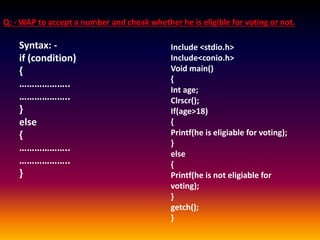
Q: -WAP to accept a number and cheak whether he is eligible for voting or not. 
Syntax: - 
if (condition) 
{ 
……………….. 
……………….. 
} 
else 
{ 
……………….. 
……………….. 
} 
Include <stdio.h> 
Include<conio.h> 
Void main() 
{ 
Int age; 
Clrscr(); 
If(age>18) 
{ 
Printf(he is eligiable for voting); 
} 
else 
{ 
Printf(he is not eligiable for 
voting); 
} 
getch(); 
}
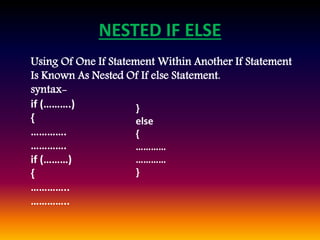
NESTED IF ELSE 
Using Of One If Statement Within Another If Statement 
Is Known As Nested Of If else Statement. 
syntax-if 
(……….) 
} 
{ 
else 
…………. 
{ 
…………. 
………… 
if (………) 
………… 
{ 
} 
………….. 
…………..
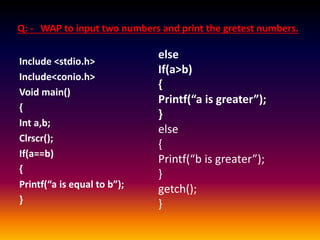
Q: - WAP to input two numbers and print the gretest numbers. 
Include <stdio.h> 
Include<conio.h> 
Void main() 
{ 
Int a,b; 
Clrscr(); 
If(a==b) 
{ 
Printf(“a is equal to b”); 
} 
else 
If(a>b) 
{ 
Printf(“a is greater”); 
} 
else 
{ 
Printf(“b is greater”); 
} 
getch(); 
}
LADDER ELSE IF CONDITION 
When We Want To Specify Condition With Else 
Part Then We Have To Use Ladder Of If 
Statement. In This Case If The Condition 
Specified With First If -Statement Is False, Then 
Control Goes To Second ―Else If‖ Statement. If It 
Is True Then Part (2) Is Executed Otherwise 
Control Goes To Third ―Else-if‖ Statement. If It 
Is True, Then Part (3) Is Executed Otherwise Part 
(4) Is Executed. 
If The Condition Specified With First If Statement 
Is True, Then Part (1) Is Executed.
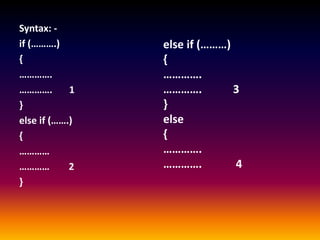
Syntax: - 
if (……….) 
{ 
…………. 
…………. 1 
} 
else if (…….) 
{ 
………… 
………… 2 
} 
else if (………) 
{ 
…………. 
…………. 3 
} 
else 
{ 
…………. 
…………. 4
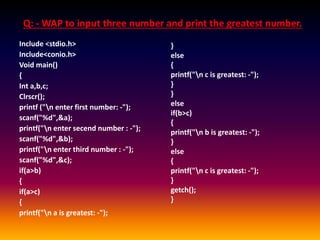
Q: - WAP to input three number and print the greatest number. 
Include <stdio.h> 
Include<conio.h> 
Void main() 
{ 
Int a,b,c; 
Clrscr(); 
printf ("n enter first number: -"); 
scanf("%d",&a); 
printf("n enter secend number : -"); 
scanf("%d",&b); 
printf("n enter third number : -"); 
scanf("%d",&c); 
if(a>b) 
{ 
if(a>c) 
{ 
printf("n a is greatest: -"); 
} 
else 
{ 
printf("n c is greatest: -"); 
} 
} 
else 
if(b>c) 
{ 
printf("n b is greatest: -"); 
} 
else 
{ 
printf("n c is greatest: -"); 
} 
getch(); 
}
SWITCH CASE CONDITION 
It Is Multiple Conditioned Checking 
Statements, Which Is Generally Used For 
Menu- Driven Program Where We Have To 
Select One Option Out Of Several Options At 
A Time. 
The number of ―case within switch – 
statement is same as the number of options 
present in menu. Each ―case is used to do 
only one work at a time.
Default section: - 
It is optional section, which is generally used 
for error handling. It means by using this 
section we can displays error messages. In 
case of wrong choice entry or out of range 
choice. It is automatically executed when any 
user enters wrong choice.
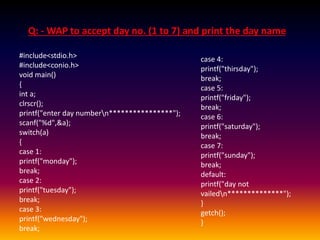
Q: - WAP to accept day no. (1 to 7) and print the day name 
#include<stdio.h> 
#include<conio.h> 
void main() 
{ 
int a; 
clrscr(); 
printf("enter day numbern****************"); 
scanf("%d",&a); 
switch(a) 
{ 
case 1: 
printf("monday"); 
break; 
case 2: 
printf("tuesday"); 
break; 
case 3: 
printf("wednesday"); 
break; 
case 4: 
printf("thirsday"); 
break; 
case 5: 
printf("friday"); 
break; 
case 6: 
printf("saturday"); 
break; 
case 7: 
printf("sunday"); 
break; 
default: 
printf("day not 
vailedn**************"); 
} 
getch(); 
}
GOTO LABELCONDITION 
This statement is used to send the control 
from one position to any desired position 
within a program. 
Since program is executed from top to bottom 
statement by statement. So if we want to 
execute certain part of program directly, then 
we can use this statement to do the same 
work.
Label: - 
May Be Any User Defined Name Or Identifiers. It Is 
Just Like A Variable But Not A Variable. It Should Not 
Be Declared As Variables By Any Data Type. 
Label Must Be Indicated At That Place Where We 
Want To Send The Control And It Must Be Followed 
By Colon (:) Sign. 
When It Is Directly Used In A Program Then It Just 
Works As Infinite Loop. So It Must Be Used On Some 
Condition.
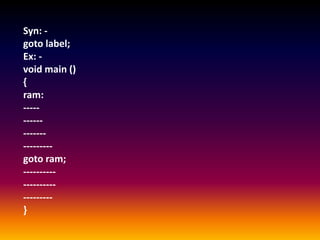
Syn: - 
goto label; 
Ex: - 
void main () 
{ 
ram: 
----- 
------ 
------- 
--------- 
goto ram; 
---------- 
---------- 
--------- 
}
CONDITIONAL STATEMENT IN C LANGUAGE

CONDITIONAL STATEMENT IN C LANGUAGE

  • 1.
    A PRESENTATION ON CONDITIONAL STATEMENT IN “C” LANGUAGE
  • 2.
    C0NTENT 1. INTRODUCTION 2. IF CONDITION 3. IF ELSE CONDITION 4. NESTED IF ELSE CONDITION 5. LADDER ELSE IF CONDITION 6. SWITCH CASE CONDITION 7. BREAK STATEMENT 8. GOTO LABEL STATEMENT 9. CONTINUE STATEMENT
  • 3.
    INTRODUCTION Conditional StatementsAre Used To Execute A Set Of Statements On Some Conditions. It Provides A Unit Of Block In Which We Can Either One Statement Or More Than One Statments. If The Given Condition Is True Then The Set Of Statements Are Executed Otherwise Body Is Skipped.
  • 4.
    IF CONDITION Itis conditional statement, which is used to execute a set of statement on some conditions. The condition must be of Boolean type expression. An expression, which returns only two value either TRUE or FALSE, is known as Boolean type expression.
  • 5.
    Syntax: - if(condition) { ……………….. ……………….. } Include <stdio.h> Include<conio.h> Void main() { Int age; Clrscr(); If(age>18) { Printf(he is eligiable for voting); } getch(); } In Another Words, It Can Also Be Said As Single Blocked Conditional Statements In Which Only One Part Is Mentioned. That Is Known As TRUE Part.
  • 6.
    IF ELSE CONDITION It Is Known As Double Blocked Conditional Statements .It Means, It Has TRUE Parts As Well As FALSE Part. If The Given Condition Is True Then The True Part Is Executed Otherwise False Part Is Executed.
  • 7.
    Q: -WAP toaccept a number and cheak whether he is eligible for voting or not. Syntax: - if (condition) { ……………….. ……………….. } else { ……………….. ……………….. } Include <stdio.h> Include<conio.h> Void main() { Int age; Clrscr(); If(age>18) { Printf(he is eligiable for voting); } else { Printf(he is not eligiable for voting); } getch(); }
  • 8.
    NESTED IF ELSE Using Of One If Statement Within Another If Statement Is Known As Nested Of If else Statement. syntax-if (……….) } { else …………. { …………. ………… if (………) ………… { } ………….. …………..
  • 9.
    Q: - WAPto input two numbers and print the gretest numbers. Include <stdio.h> Include<conio.h> Void main() { Int a,b; Clrscr(); If(a==b) { Printf(“a is equal to b”); } else If(a>b) { Printf(“a is greater”); } else { Printf(“b is greater”); } getch(); }
  • 10.
    LADDER ELSE IFCONDITION When We Want To Specify Condition With Else Part Then We Have To Use Ladder Of If Statement. In This Case If The Condition Specified With First If -Statement Is False, Then Control Goes To Second ―Else If‖ Statement. If It Is True Then Part (2) Is Executed Otherwise Control Goes To Third ―Else-if‖ Statement. If It Is True, Then Part (3) Is Executed Otherwise Part (4) Is Executed. If The Condition Specified With First If Statement Is True, Then Part (1) Is Executed.
  • 11.
    Syntax: - if(……….) { …………. …………. 1 } else if (…….) { ………… ………… 2 } else if (………) { …………. …………. 3 } else { …………. …………. 4
  • 12.
    Q: - WAPto input three number and print the greatest number. Include <stdio.h> Include<conio.h> Void main() { Int a,b,c; Clrscr(); printf ("n enter first number: -"); scanf("%d",&a); printf("n enter secend number : -"); scanf("%d",&b); printf("n enter third number : -"); scanf("%d",&c); if(a>b) { if(a>c) { printf("n a is greatest: -"); } else { printf("n c is greatest: -"); } } else if(b>c) { printf("n b is greatest: -"); } else { printf("n c is greatest: -"); } getch(); }
  • 13.
    SWITCH CASE CONDITION It Is Multiple Conditioned Checking Statements, Which Is Generally Used For Menu- Driven Program Where We Have To Select One Option Out Of Several Options At A Time. The number of ―case within switch – statement is same as the number of options present in menu. Each ―case is used to do only one work at a time.
  • 14.
    Default section: - It is optional section, which is generally used for error handling. It means by using this section we can displays error messages. In case of wrong choice entry or out of range choice. It is automatically executed when any user enters wrong choice.
  • 15.
    Q: - WAPto accept day no. (1 to 7) and print the day name #include<stdio.h> #include<conio.h> void main() { int a; clrscr(); printf("enter day numbern****************"); scanf("%d",&a); switch(a) { case 1: printf("monday"); break; case 2: printf("tuesday"); break; case 3: printf("wednesday"); break; case 4: printf("thirsday"); break; case 5: printf("friday"); break; case 6: printf("saturday"); break; case 7: printf("sunday"); break; default: printf("day not vailedn**************"); } getch(); }
  • 16.
    GOTO LABELCONDITION Thisstatement is used to send the control from one position to any desired position within a program. Since program is executed from top to bottom statement by statement. So if we want to execute certain part of program directly, then we can use this statement to do the same work.
  • 17.
    Label: - MayBe Any User Defined Name Or Identifiers. It Is Just Like A Variable But Not A Variable. It Should Not Be Declared As Variables By Any Data Type. Label Must Be Indicated At That Place Where We Want To Send The Control And It Must Be Followed By Colon (:) Sign. When It Is Directly Used In A Program Then It Just Works As Infinite Loop. So It Must Be Used On Some Condition.
  • 18.
    Syn: - gotolabel; Ex: - void main () { ram: ----- ------ ------- --------- goto ram; ---------- ---------- --------- }