INTRODUCTION TO
Search Engine Optimization
How Search Engine
OPERATE
HOW SEARCH ENGINE OPERATE
• SEARCH ENGINE HAVE FOUR
FUNCTIONS
•CRAWLING
•INDEXING
•CALCULATING RELEVANCY
•SERVING RESULTS
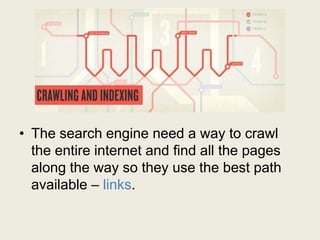
• The search engine need a way to crawl
the entire internet and find all the pages
along the way so they use the best path
available – links.
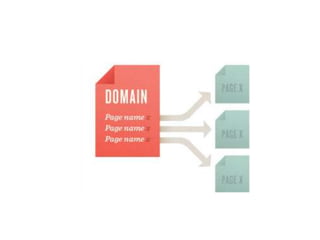
The link structure of the web
serves to bind together all of the
pages in existence…
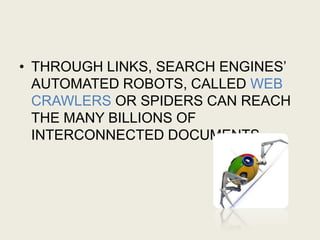
• THROUGH LINKS, SEARCH ENGINES’
AUTOMATED ROBOTS, CALLED WEB
CRAWLERS OR SPIDERS CAN REACH
THE MANY BILLIONS OF
INTERCONNECTED DOCUMENTS.
• Once the engines find these pages,
their next job is to parse the code
from them and store selected pieces
of the pages in massive hard drives,
to be recalled when needed in
a query.
• To accomplish the monumental task of
holding billions of pages that can be
accessed in a fraction of a second, the
search engines have constructed massive
datacenters in cities all over the world.
• When a person performs a search at any
of the major engines, they demand results
instantaneously – even a 1 or 2 second
delay can cause DISSATISFACTION, so the
engines work hard to provide answers as
fast as possible.
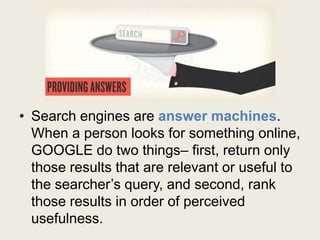
• Search engines are answer machines.
When a person looks for something online,
GOOGLE do two things– first, return only
those results that are relevant or useful to
the searcher’s query, and second, rank
those results in order of perceived
usefulness.
IT IS BOTH “RELEVANCE” AND
“IMPORTANCE” THAT THE
PROCESS OF SEO IS MEANT
TO INFLUENCE.
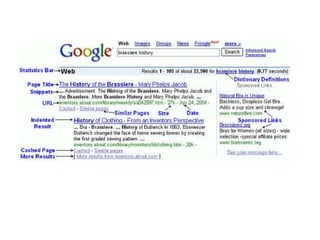
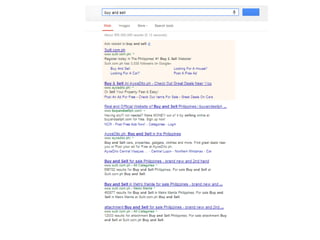
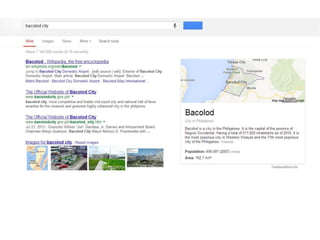
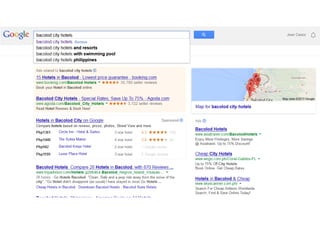
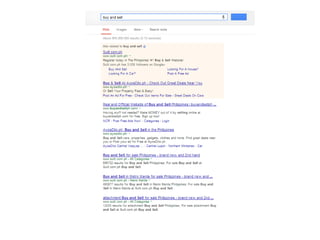
Parts of Search Engine
Results Page(SERP)
FACTS
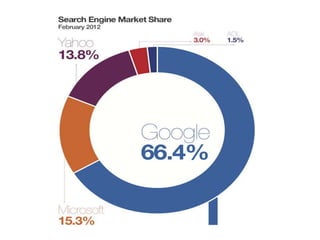
 80% of consumers find your website by first writing a
query into a box on a search engine (Google, Yahoo,
Bing)
 90% choose a site listed on the first page
 85% of all traffic on the internet is referred to by search
engines
 Operates under this assumption:
More (relevant) traffic + Good Conversions Rate =
More Sales/Leads
WHAT IS SEO
WHAT IS SEO
• SEO = Search Engine Optimization
– SEO is the process of improving the volume
and quality of traffic to a web site from search
engines via "natural" (organic) search results.
WHY IS SEO IS IMPORTANT
• The point of having a website is to attract
VISITORS OR TRAFFIC. Without visitors all
your time and effort on conception and
design of your website is worthless.
• An important aspect of Search Engine
Optimization is making your website easy
for both users and search engine robots to
understand.
WHAT DO WE NEED?
KEYWORDS
DESCRIPTION
TITLE
A GOOD SEO
STRATEGY:
• RESEARCH DESIRABLE KEYWORDS AND
PHRASES
• STUDY COMPETITORS
• ADD QUALITY CONTENT
• QUALITY LINK BUILDING
• SOCIAL BOOK MARKING
• IMAGES/VIDEOS OPTIMIZATION
• SOCIAL MEDIA OPTIMIZATION
• PRESS RELEASE SUBMISSION
• FORUM/BLOG POSTING
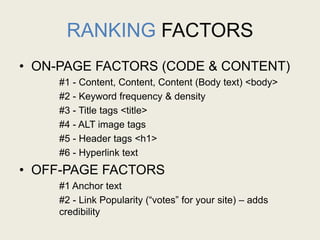
RANKING FACTORS
• ON-PAGE FACTORS (CODE & CONTENT)
#1 - Content, Content, Content (Body text) <body>
#2 - Keyword frequency & density
#3 - Title tags <title>
#4 - ALT image tags
#5 - Header tags <h1>
#6 - Hyperlink text
• OFF-PAGE FACTORS
#1 Anchor text
#2 - Link Popularity (“votes” for your site) – adds
credibility
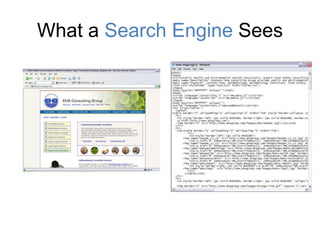
What a Search Engine Sees
PAY PER CLICK
 PPC ads appear as “SPONSORED LISTINGS”
Ability to control ad text
Can set budgets and spending limits
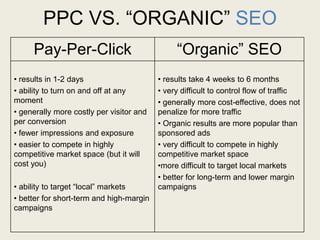
PPC VS. “ORGANIC” SEO
Pay-Per-Click “Organic” SEO
• results in 1-2 days
• ability to turn on and off at any
moment
• generally more costly per visitor and
per conversion
• fewer impressions and exposure
• easier to compete in highly
competitive market space (but it will
cost you)
• ability to target “local” markets
• better for short-term and high-margin
campaigns
• results take 4 weeks to 6 months
• very difficult to control flow of traffic
• generally more cost-effective, does not
penalize for more traffic
• Organic results are more popular than
sponsored ads
• very difficult to compete in highly
competitive market space
•more difficult to target local markets
• better for long-term and lower margin
campaigns
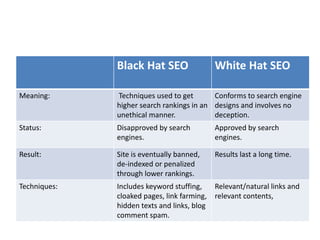
White Hat VS. Black Hat
Black Hat SEO White Hat SEO
Meaning: Techniques used to get
higher search rankings in an
unethical manner.
Conforms to search engine
designs and involves no
deception.
Status: Disapproved by search
engines.
Approved by search
engines.
Result: Site is eventually banned,
de-indexed or penalized
through lower rankings.
Results last a long time.
Techniques: Includes keyword stuffing,
cloaked pages, link farming,
hidden texts and links, blog
comment spam.
Relevant/natural links and
relevant contents,
SEO REPORTS
SEO REPORTS
• Keywords Report
• Google Analytics Report
Tips & Optimization Techniques
• Research keywords related to your
business
• Utilize descriptive title tags for each page
• Ensure that your text is HTML-text and not
image text
• Use text links when ever possible
“…the time has come to ask
yourselves does your site sucks
… and what are you doing to
change it?”
- Michael Gray
Introduction to search engine optimization

Introduction to search engine optimization

  • 1.
  • 2.
  • 3.
    HOW SEARCH ENGINEOPERATE • SEARCH ENGINE HAVE FOUR FUNCTIONS •CRAWLING •INDEXING •CALCULATING RELEVANCY •SERVING RESULTS
  • 4.
    • The searchengine need a way to crawl the entire internet and find all the pages along the way so they use the best path available – links.
  • 5.
    The link structureof the web serves to bind together all of the pages in existence…
  • 6.
    • THROUGH LINKS,SEARCH ENGINES’ AUTOMATED ROBOTS, CALLED WEB CRAWLERS OR SPIDERS CAN REACH THE MANY BILLIONS OF INTERCONNECTED DOCUMENTS.
  • 8.
    • Once theengines find these pages, their next job is to parse the code from them and store selected pieces of the pages in massive hard drives, to be recalled when needed in a query.
  • 9.
    • To accomplishthe monumental task of holding billions of pages that can be accessed in a fraction of a second, the search engines have constructed massive datacenters in cities all over the world.
  • 12.
    • When aperson performs a search at any of the major engines, they demand results instantaneously – even a 1 or 2 second delay can cause DISSATISFACTION, so the engines work hard to provide answers as fast as possible.
  • 13.
    • Search enginesare answer machines. When a person looks for something online, GOOGLE do two things– first, return only those results that are relevant or useful to the searcher’s query, and second, rank those results in order of perceived usefulness.
  • 14.
    IT IS BOTH“RELEVANCE” AND “IMPORTANCE” THAT THE PROCESS OF SEO IS MEANT TO INFLUENCE.
  • 15.
    Parts of SearchEngine Results Page(SERP)
  • 21.
    FACTS  80% ofconsumers find your website by first writing a query into a box on a search engine (Google, Yahoo, Bing)  90% choose a site listed on the first page  85% of all traffic on the internet is referred to by search engines  Operates under this assumption: More (relevant) traffic + Good Conversions Rate = More Sales/Leads
  • 22.
  • 23.
    WHAT IS SEO •SEO = Search Engine Optimization – SEO is the process of improving the volume and quality of traffic to a web site from search engines via "natural" (organic) search results.
  • 25.
    WHY IS SEOIS IMPORTANT
  • 26.
    • The pointof having a website is to attract VISITORS OR TRAFFIC. Without visitors all your time and effort on conception and design of your website is worthless.
  • 27.
    • An importantaspect of Search Engine Optimization is making your website easy for both users and search engine robots to understand.
  • 28.
  • 29.
  • 30.
  • 31.
    • RESEARCH DESIRABLEKEYWORDS AND PHRASES • STUDY COMPETITORS • ADD QUALITY CONTENT • QUALITY LINK BUILDING • SOCIAL BOOK MARKING • IMAGES/VIDEOS OPTIMIZATION • SOCIAL MEDIA OPTIMIZATION • PRESS RELEASE SUBMISSION • FORUM/BLOG POSTING
  • 32.
    RANKING FACTORS • ON-PAGEFACTORS (CODE & CONTENT) #1 - Content, Content, Content (Body text) <body> #2 - Keyword frequency & density #3 - Title tags <title> #4 - ALT image tags #5 - Header tags <h1> #6 - Hyperlink text • OFF-PAGE FACTORS #1 Anchor text #2 - Link Popularity (“votes” for your site) – adds credibility
  • 33.
    What a SearchEngine Sees
  • 34.
    PAY PER CLICK PPC ads appear as “SPONSORED LISTINGS” Ability to control ad text Can set budgets and spending limits
  • 35.
    PPC VS. “ORGANIC”SEO Pay-Per-Click “Organic” SEO • results in 1-2 days • ability to turn on and off at any moment • generally more costly per visitor and per conversion • fewer impressions and exposure • easier to compete in highly competitive market space (but it will cost you) • ability to target “local” markets • better for short-term and high-margin campaigns • results take 4 weeks to 6 months • very difficult to control flow of traffic • generally more cost-effective, does not penalize for more traffic • Organic results are more popular than sponsored ads • very difficult to compete in highly competitive market space •more difficult to target local markets • better for long-term and lower margin campaigns
  • 36.
    White Hat VS.Black Hat
  • 37.
    Black Hat SEOWhite Hat SEO Meaning: Techniques used to get higher search rankings in an unethical manner. Conforms to search engine designs and involves no deception. Status: Disapproved by search engines. Approved by search engines. Result: Site is eventually banned, de-indexed or penalized through lower rankings. Results last a long time. Techniques: Includes keyword stuffing, cloaked pages, link farming, hidden texts and links, blog comment spam. Relevant/natural links and relevant contents,
  • 38.
  • 39.
    SEO REPORTS • KeywordsReport • Google Analytics Report
  • 40.
    Tips & OptimizationTechniques • Research keywords related to your business • Utilize descriptive title tags for each page • Ensure that your text is HTML-text and not image text • Use text links when ever possible
  • 41.
    “…the time hascome to ask yourselves does your site sucks … and what are you doing to change it?” - Michael Gray