CONTROL STRUCTURE in C
Flow of Control
• Unless specified otherwise, the order of statement
execution through a function is linear: one statement after
another in sequence
• Some programming statements allow us to:
– decide whether or not to execute a particular statement
– execute a statement over and over, repetitively
• These decisions are based on boolean expressions (or
conditions) that evaluate to true or false
• The order of statement execution is called
the flow of control
Conditional Statements
• A conditional statement lets us choose which statement
will be executed next
• Therefore they are sometimes called selection
statements
• Conditional statements give us the power to make basic
decisions
• The C conditional statements are the:
– if statement
– if-else statement
– switch statement
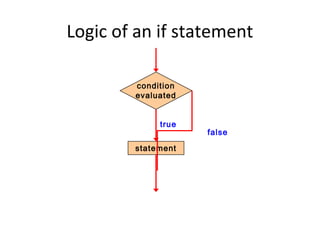
Logic of an if statement
condition
evaluated
statement
true
false
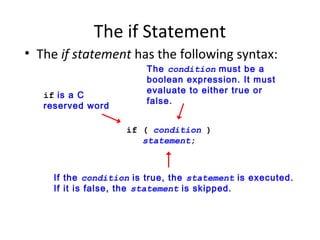
The if Statement
• The if statement has the following syntax:
if ( condition )
statement;
if is a C
reserved word
The condition must be a
boolean expression. It must
evaluate to either true or
false.
If the condition is true, the statement is executed.
If it is false, the statement is skipped.
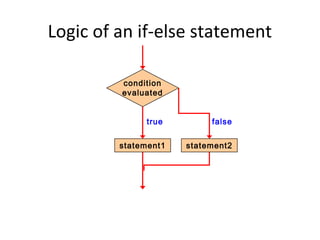
Logic of an if-else statement
condition
evaluated
statement1
true false
statement2
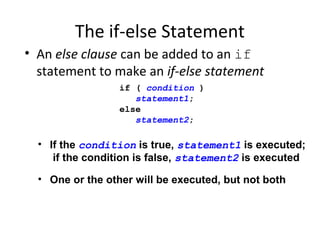
The if-else Statement
• An else clause can be added to an if
statement to make an if-else statement
if ( condition )
statement1;
else
statement2;
• If the condition is true, statement1 is executed;
if the condition is false, statement2 is executed
• One or the other will be executed, but not both
Boolean Expressions
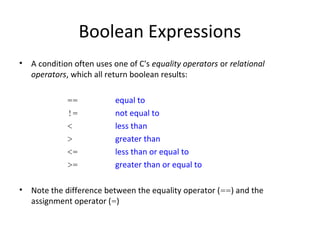
• A condition often uses one of C's equality operators or relational
operators, which all return boolean results:
== equal to
!= not equal to
< less than
> greater than
<= less than or equal to
>= greater than or equal to
• Note the difference between the equality operator (==) and the
assignment operator (=)
Boolean Expressions in C
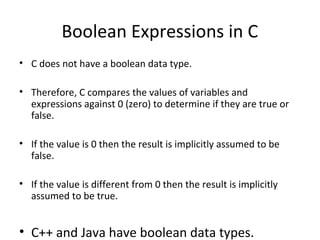
• C does not have a boolean data type.
• Therefore, C compares the values of variables and
expressions against 0 (zero) to determine if they are true or
false.
• If the value is 0 then the result is implicitly assumed to be
false.
• If the value is different from 0 then the result is implicitly
assumed to be true.
• C++ and Java have boolean data types.
Block Statements
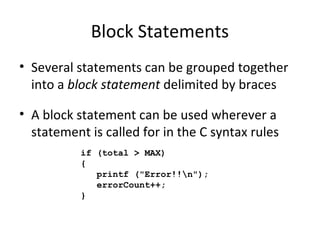
• Several statements can be grouped together
into a block statement delimited by braces
• A block statement can be used wherever a
statement is called for in the C syntax rules
if (total > MAX)
{
printf ("Error!!n");
errorCount++;
}
Block Statements
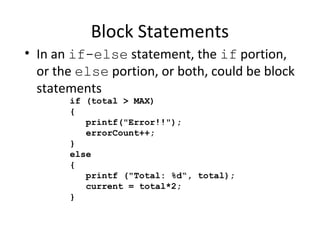
• In an if-else statement, the if portion,
or the else portion, or both, could be block
statements
if (total > MAX)
{
printf("Error!!");
errorCount++;
}
else
{
printf ("Total: %d“, total);
current = total*2;
}
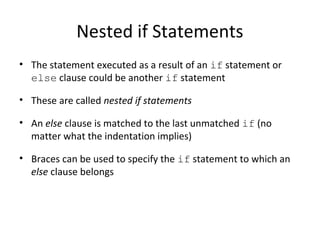
Nested if Statements
• The statement executed as a result of an if statement or
else clause could be another if statement
• These are called nested if statements
• An else clause is matched to the last unmatched if (no
matter what the indentation implies)
• Braces can be used to specify the if statement to which an
else clause belongs
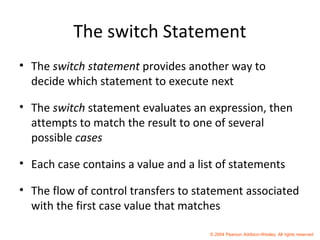
The switch Statement
• The switch statement provides another way to
decide which statement to execute next
• The switch statement evaluates an expression, then
attempts to match the result to one of several
possible cases
• Each case contains a value and a list of statements
• The flow of control transfers to statement associated
with the first case value that matches
© 2004 Pearson Addison-Wesley. All rights reserved
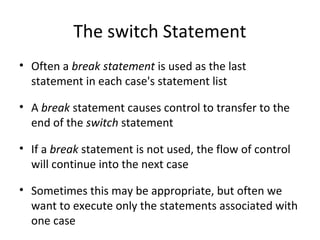
The switch Statement
• Often a break statement is used as the last
statement in each case's statement list
• A break statement causes control to transfer to the
end of the switch statement
• If a break statement is not used, the flow of control
will continue into the next case
• Sometimes this may be appropriate, but often we
want to execute only the statements associated with
one case
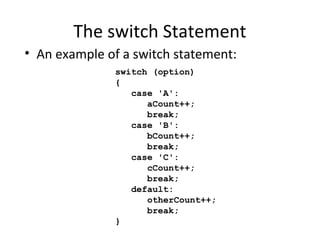
The switch Statement
switch (option)
{
case 'A':
aCount++;
break;
case 'B':
bCount++;
break;
case 'C':
cCount++;
break;
default:
otherCount++;
break;
}
• An example of a switch statement:
The switch Statement
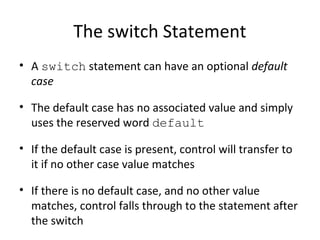
• A switch statement can have an optional default
case
• The default case has no associated value and simply
uses the reserved word default
• If the default case is present, control will transfer to
it if no other case value matches
• If there is no default case, and no other value
matches, control falls through to the statement after
the switch
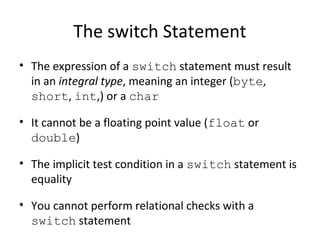
The switch Statement
• The expression of a switch statement must result
in an integral type, meaning an integer (byte,
short, int,) or a char
• It cannot be a floating point value (float or
double)
• The implicit test condition in a switch statement is
equality
• You cannot perform relational checks with a
switch statement
The switch Statement
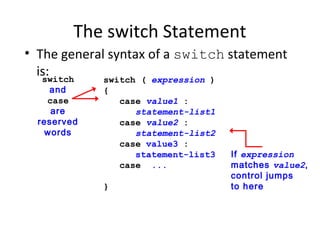
• The general syntax of a switch statement
is: switch ( expression )
{
case value1 :
statement-list1
case value2 :
statement-list2
case value3 :
statement-list3
case ...
}
switch
and
case
are
reserved
words
If expression
matches value2,
control jumps
to here
Repetition in Programs
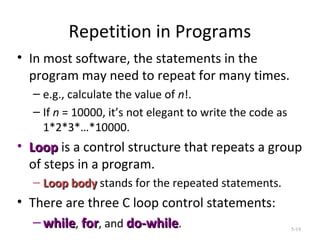
• In most software, the statements in the
program may need to repeat for many times.
– e.g., calculate the value of n!.
– If n = 10000, it’s not elegant to write the code as
1*2*3*…*10000.
• LoopLoop is a control structure that repeats a group
of steps in a program.
– Loop bodyLoop body stands for the repeated statements.
• There are three C loop control statements:
– whilewhile, forfor, and do-whiledo-while. 5-19
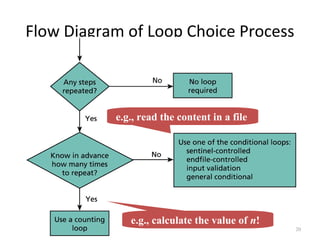
Flow Diagram of Loop Choice Process
Copyright ©2004 Pearson Addison-Wesley.
All rights reserved.
5-20
e.g., calculate the value of n!
e.g., read the content in a file
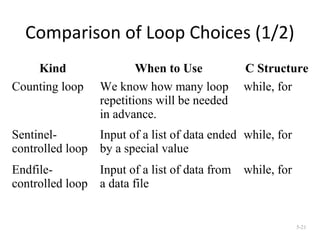
Comparison of Loop Choices (1/2)
Kind When to Use C Structure
Counting loop We know how many loop
repetitions will be needed
in advance.
while, for
Sentinel-
controlled loop
Input of a list of data ended
by a special value
while, for
Endfile-
controlled loop
Input of a list of data from
a data file
while, for
5-21
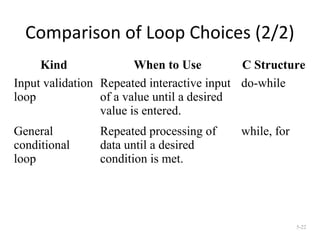
Comparison of Loop Choices (2/2)
Kind When to Use C Structure
Input validation
loop
Repeated interactive input
of a value until a desired
value is entered.
do-while
General
conditional
loop
Repeated processing of
data until a desired
condition is met.
while, for
5-22
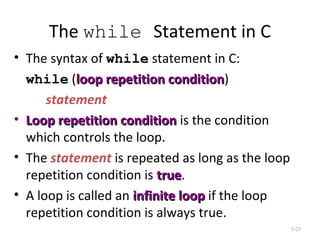
The while Statement in C
• The syntax of while statement in C:
while (loop repetition conditionloop repetition condition)
statement
• Loop repetition conditionLoop repetition condition is the condition
which controls the loop.
• The statement is repeated as long as the loop
repetition condition is truetrue.
• A loop is called an infinite loopinfinite loop if the loop
repetition condition is always true.
5-23
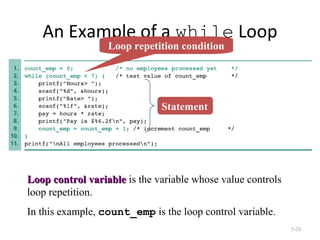
An Example of a while Loop
5-24
Statement
Loop repetition condition
Loop control variableLoop control variable is the variable whose value controls
loop repetition.
In this example, count_emp is the loop control variable.
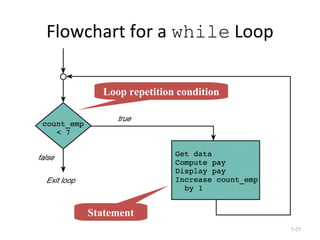
Flowchart for a while Loop
5-25
Loop repetition condition
Statement
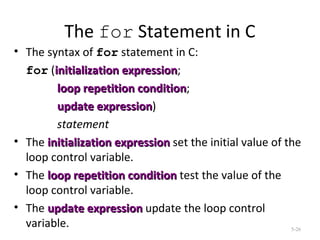
The for Statement in C
• The syntax of for statement in C:
for (initialization expressioninitialization expression;
loop repetition conditionloop repetition condition;
update expressionupdate expression)
statement
• The initialization expressioninitialization expression set the initial value of the
loop control variable.
• The loop repetition conditionloop repetition condition test the value of the
loop control variable.
• The update expressionupdate expression update the loop control
variable. 5-26
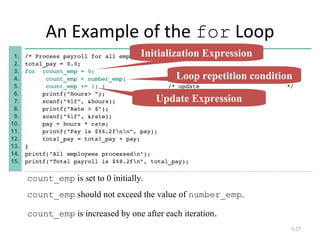
An Example of the for Loop
5-27
Loop repetition condition
Initialization Expression
Update Expression
count_emp is set to 0 initially.
count_emp should not exceed the value of number_emp.
count_emp is increased by one after each iteration.
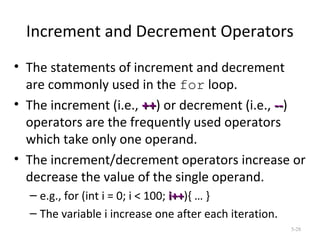
Increment and Decrement Operators
• The statements of increment and decrement
are commonly used in the for loop.
• The increment (i.e., ++++) or decrement (i.e., ----)
operators are the frequently used operators
which take only one operand.
• The increment/decrement operators increase or
decrease the value of the single operand.
– e.g., for (int i = 0; i < 100; i++i++){ … }
– The variable i increase one after each iteration.
5-28
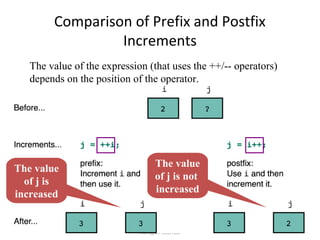
Comparison of Prefix and Postfix
Increments
Copyright ©2004 Pearson Addison-Wesley.
All rights reserved.
5-29
The value of the expression (that uses the ++/-- operators)
depends on the position of the operator.
The value
of j is
increased
The value
of j is not
increased
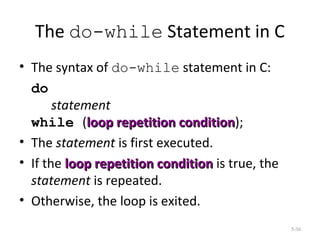
The do-while Statement in C
• The syntax of do-while statement in C:
do
statement
while (loop repetition conditionloop repetition condition);
• The statement is first executed.
• If the loop repetition conditionloop repetition condition is true, the
statement is repeated.
• Otherwise, the loop is exited.
5-30
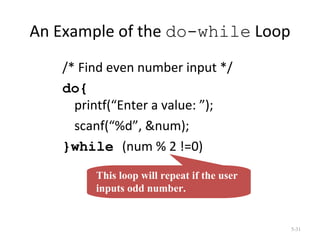
An Example of the do-while Loop
/* Find even number input */
do{
printf(“Enter a value: ”);
scanf(“%d”, &num);
}while (num % 2 !=0)
5-31
This loop will repeat if the user
inputs odd number.

Control structure

  • 1.
  • 2.
    Flow of Control •Unless specified otherwise, the order of statement execution through a function is linear: one statement after another in sequence • Some programming statements allow us to: – decide whether or not to execute a particular statement – execute a statement over and over, repetitively • These decisions are based on boolean expressions (or conditions) that evaluate to true or false • The order of statement execution is called the flow of control
  • 3.
    Conditional Statements • Aconditional statement lets us choose which statement will be executed next • Therefore they are sometimes called selection statements • Conditional statements give us the power to make basic decisions • The C conditional statements are the: – if statement – if-else statement – switch statement
  • 4.
    Logic of anif statement condition evaluated statement true false
  • 5.
    The if Statement •The if statement has the following syntax: if ( condition ) statement; if is a C reserved word The condition must be a boolean expression. It must evaluate to either true or false. If the condition is true, the statement is executed. If it is false, the statement is skipped.
  • 6.
    Logic of anif-else statement condition evaluated statement1 true false statement2
  • 7.
    The if-else Statement •An else clause can be added to an if statement to make an if-else statement if ( condition ) statement1; else statement2; • If the condition is true, statement1 is executed; if the condition is false, statement2 is executed • One or the other will be executed, but not both
  • 8.
    Boolean Expressions • Acondition often uses one of C's equality operators or relational operators, which all return boolean results: == equal to != not equal to < less than > greater than <= less than or equal to >= greater than or equal to • Note the difference between the equality operator (==) and the assignment operator (=)
  • 9.
    Boolean Expressions inC • C does not have a boolean data type. • Therefore, C compares the values of variables and expressions against 0 (zero) to determine if they are true or false. • If the value is 0 then the result is implicitly assumed to be false. • If the value is different from 0 then the result is implicitly assumed to be true. • C++ and Java have boolean data types.
  • 10.
    Block Statements • Severalstatements can be grouped together into a block statement delimited by braces • A block statement can be used wherever a statement is called for in the C syntax rules if (total > MAX) { printf ("Error!!n"); errorCount++; }
  • 11.
    Block Statements • Inan if-else statement, the if portion, or the else portion, or both, could be block statements if (total > MAX) { printf("Error!!"); errorCount++; } else { printf ("Total: %d“, total); current = total*2; }
  • 12.
    Nested if Statements •The statement executed as a result of an if statement or else clause could be another if statement • These are called nested if statements • An else clause is matched to the last unmatched if (no matter what the indentation implies) • Braces can be used to specify the if statement to which an else clause belongs
  • 13.
    The switch Statement •The switch statement provides another way to decide which statement to execute next • The switch statement evaluates an expression, then attempts to match the result to one of several possible cases • Each case contains a value and a list of statements • The flow of control transfers to statement associated with the first case value that matches © 2004 Pearson Addison-Wesley. All rights reserved
  • 14.
    The switch Statement •Often a break statement is used as the last statement in each case's statement list • A break statement causes control to transfer to the end of the switch statement • If a break statement is not used, the flow of control will continue into the next case • Sometimes this may be appropriate, but often we want to execute only the statements associated with one case
  • 15.
    The switch Statement switch(option) { case 'A': aCount++; break; case 'B': bCount++; break; case 'C': cCount++; break; default: otherCount++; break; } • An example of a switch statement:
  • 16.
    The switch Statement •A switch statement can have an optional default case • The default case has no associated value and simply uses the reserved word default • If the default case is present, control will transfer to it if no other case value matches • If there is no default case, and no other value matches, control falls through to the statement after the switch
  • 17.
    The switch Statement •The expression of a switch statement must result in an integral type, meaning an integer (byte, short, int,) or a char • It cannot be a floating point value (float or double) • The implicit test condition in a switch statement is equality • You cannot perform relational checks with a switch statement
  • 18.
    The switch Statement •The general syntax of a switch statement is: switch ( expression ) { case value1 : statement-list1 case value2 : statement-list2 case value3 : statement-list3 case ... } switch and case are reserved words If expression matches value2, control jumps to here
  • 19.
    Repetition in Programs •In most software, the statements in the program may need to repeat for many times. – e.g., calculate the value of n!. – If n = 10000, it’s not elegant to write the code as 1*2*3*…*10000. • LoopLoop is a control structure that repeats a group of steps in a program. – Loop bodyLoop body stands for the repeated statements. • There are three C loop control statements: – whilewhile, forfor, and do-whiledo-while. 5-19
  • 20.
    Flow Diagram ofLoop Choice Process Copyright ©2004 Pearson Addison-Wesley. All rights reserved. 5-20 e.g., calculate the value of n! e.g., read the content in a file
  • 21.
    Comparison of LoopChoices (1/2) Kind When to Use C Structure Counting loop We know how many loop repetitions will be needed in advance. while, for Sentinel- controlled loop Input of a list of data ended by a special value while, for Endfile- controlled loop Input of a list of data from a data file while, for 5-21
  • 22.
    Comparison of LoopChoices (2/2) Kind When to Use C Structure Input validation loop Repeated interactive input of a value until a desired value is entered. do-while General conditional loop Repeated processing of data until a desired condition is met. while, for 5-22
  • 23.
    The while Statementin C • The syntax of while statement in C: while (loop repetition conditionloop repetition condition) statement • Loop repetition conditionLoop repetition condition is the condition which controls the loop. • The statement is repeated as long as the loop repetition condition is truetrue. • A loop is called an infinite loopinfinite loop if the loop repetition condition is always true. 5-23
  • 24.
    An Example ofa while Loop 5-24 Statement Loop repetition condition Loop control variableLoop control variable is the variable whose value controls loop repetition. In this example, count_emp is the loop control variable.
  • 25.
    Flowchart for awhile Loop 5-25 Loop repetition condition Statement
  • 26.
    The for Statementin C • The syntax of for statement in C: for (initialization expressioninitialization expression; loop repetition conditionloop repetition condition; update expressionupdate expression) statement • The initialization expressioninitialization expression set the initial value of the loop control variable. • The loop repetition conditionloop repetition condition test the value of the loop control variable. • The update expressionupdate expression update the loop control variable. 5-26
  • 27.
    An Example ofthe for Loop 5-27 Loop repetition condition Initialization Expression Update Expression count_emp is set to 0 initially. count_emp should not exceed the value of number_emp. count_emp is increased by one after each iteration.
  • 28.
    Increment and DecrementOperators • The statements of increment and decrement are commonly used in the for loop. • The increment (i.e., ++++) or decrement (i.e., ----) operators are the frequently used operators which take only one operand. • The increment/decrement operators increase or decrease the value of the single operand. – e.g., for (int i = 0; i < 100; i++i++){ … } – The variable i increase one after each iteration. 5-28
  • 29.
    Comparison of Prefixand Postfix Increments Copyright ©2004 Pearson Addison-Wesley. All rights reserved. 5-29 The value of the expression (that uses the ++/-- operators) depends on the position of the operator. The value of j is increased The value of j is not increased
  • 30.
    The do-while Statementin C • The syntax of do-while statement in C: do statement while (loop repetition conditionloop repetition condition); • The statement is first executed. • If the loop repetition conditionloop repetition condition is true, the statement is repeated. • Otherwise, the loop is exited. 5-30
  • 31.
    An Example ofthe do-while Loop /* Find even number input */ do{ printf(“Enter a value: ”); scanf(“%d”, &num); }while (num % 2 !=0) 5-31 This loop will repeat if the user inputs odd number.