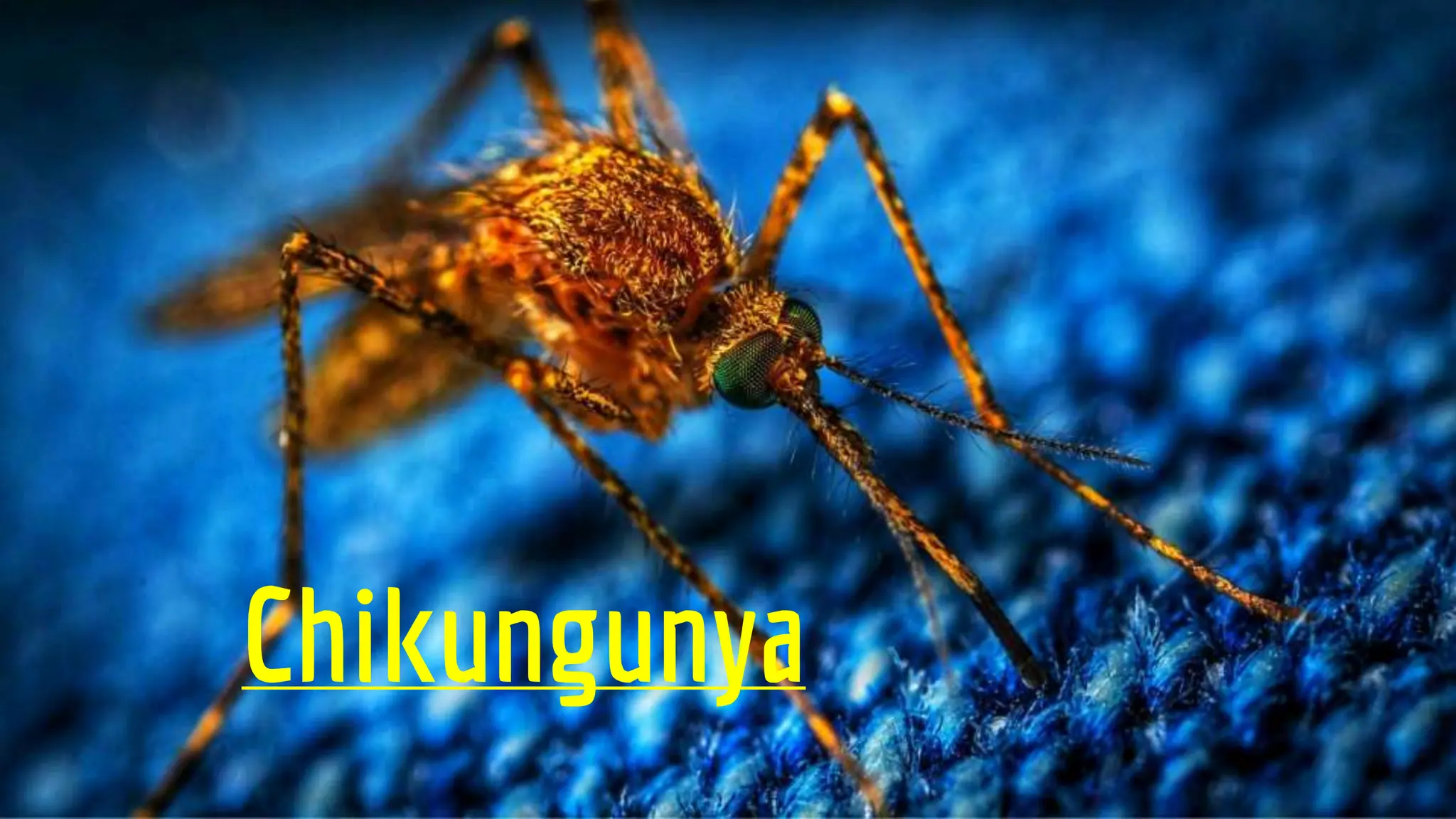
Chikungunya
presented by:
➢ Chikungunya is characterized by an abrupt
onset of fever, frequently accompanied by joint
pain.
➢ Chikungunya is a viral disease transmitted to
humans by infected mosquitoes. It is caused by
the chikungunya virus (CHIKV).
➢ The joint pain is often very debilitating; it
usually lasts for a few days, but may be
prolonged for weeks, months or even years.
Hence, the virus can cause acute, subacute or
chronic disease.
❏ What is Chikungunya:
➢ An infected person cannot directly transmit the
virus to another person. The disease is spread
when a mosquito feeds on a person with the
virus circulating in their blood. The mosquito
can pick up the virus and spread it to another
person through its bite.
➢ Chikungunya virus is most often spread to
people by Aedes aegypti and Aedes
albopictus mosquitoes. These are the same
mosquitoes that transmit dengue virus.
❏ Causation :
➢ The virus causes a fever that lasts a few days and joint
pain that can last weeks or months.
➢ The symptoms of chikungunya virus are similar to
those of other diseases such as dengue fever. The
symptoms normally appear just a few days after a
mosquito has bitten an individual. The most common
symptoms are:
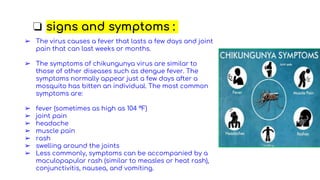
➢ fever (sometimes as high as 104 °F)
➢ joint pain
➢ headache
➢ muscle pain
➢ rash
➢ swelling around the joints
➢ Less commonly, symptoms can be accompanied by a
maculopapular rash (similar to measles or heat rash),
conjunctivitis, nausea, and vomiting.
❏ signs and symptoms :
❏ Treatment :
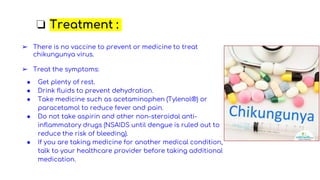
➢ There is no vaccine to prevent or medicine to treat
chikungunya virus.
➢ Treat the symptoms:
● Get plenty of rest.
● Drink fluids to prevent dehydration.
● Take medicine such as acetaminophen (Tylenol®) or
paracetamol to reduce fever and pain.
● Do not take aspirin and other non-steroidal anti-
inflammatory drugs (NSAIDS until dengue is ruled out to
reduce the risk of bleeding).
● If you are taking medicine for another medical condition,
talk to your healthcare provider before taking additional
medication.
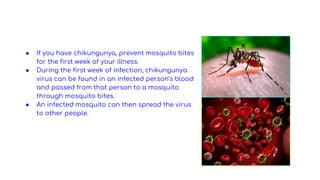
● If you have chikungunya, prevent mosquito bites
for the first week of your illness.
● During the first week of infection, chikungunya
virus can be found in an infected person’s blood
and passed from that person to a mosquito
through mosquito bites.
● An infected mosquito can then spread the virus
to other people.
❏ Prevention :
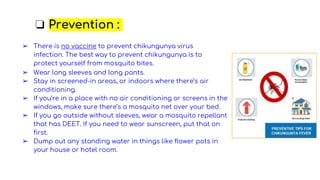
➢ There is no vaccine to prevent chikungunya virus
infection. The best way to prevent chikungunya is to
protect yourself from mosquito bites.
➢ Wear long sleeves and long pants.
➢ Stay in screened-in areas, or indoors where there’s air
conditioning.
➢ If you’re in a place with no air conditioning or screens in the
windows, make sure there’s a mosquito net over your bed.
➢ If you go outside without sleeves, wear a mosquito repellant
that has DEET. If you need to wear sunscreen, put that on
first.
➢ Dump out any standing water in things like flower pots in
your house or hotel room.
❏ inventions for detection :
➢ Indian scientists have developed a biosensor technique which can be potentially help in
detecting Chikungunya virus. According to the scientists, the technique can be used to
develop a point of care device for rapid identification of the dreaded disease.
➢ This technique is based on molybdenum disulphide nanosheets. The researchers
synthesized the nanosheets by chemical route and characterized them by using
scanning electron microscopy, transmission electron microscopy, UV-visible
spectroscopy, Raman spectroscopy and X-ray Diffraction.
➢ This study has been jointly carried out by researchers of Amity University, Noida, Jamia
Millia Islamia University, Delhi and Maharishi Dayanand University, Rohtak.
➢ Conventionally, Chikungunya is detected through RT-PCR (Real-time polymerase chain
reaction) from serum samples or by determination of serum antibodies. These methods
are time consuming and the procedure is cumbersome. Thus, there is a need for a rapid
and point-of-care diagnostic tool.
Thank you

What is Chikungunya disease

  • 1.
  • 2.
  • 3.
    ➢ Chikungunya ischaracterized by an abrupt onset of fever, frequently accompanied by joint pain. ➢ Chikungunya is a viral disease transmitted to humans by infected mosquitoes. It is caused by the chikungunya virus (CHIKV). ➢ The joint pain is often very debilitating; it usually lasts for a few days, but may be prolonged for weeks, months or even years. Hence, the virus can cause acute, subacute or chronic disease. ❏ What is Chikungunya:
  • 4.
    ➢ An infectedperson cannot directly transmit the virus to another person. The disease is spread when a mosquito feeds on a person with the virus circulating in their blood. The mosquito can pick up the virus and spread it to another person through its bite. ➢ Chikungunya virus is most often spread to people by Aedes aegypti and Aedes albopictus mosquitoes. These are the same mosquitoes that transmit dengue virus. ❏ Causation :
  • 5.
    ➢ The viruscauses a fever that lasts a few days and joint pain that can last weeks or months. ➢ The symptoms of chikungunya virus are similar to those of other diseases such as dengue fever. The symptoms normally appear just a few days after a mosquito has bitten an individual. The most common symptoms are: ➢ fever (sometimes as high as 104 °F) ➢ joint pain ➢ headache ➢ muscle pain ➢ rash ➢ swelling around the joints ➢ Less commonly, symptoms can be accompanied by a maculopapular rash (similar to measles or heat rash), conjunctivitis, nausea, and vomiting. ❏ signs and symptoms :
  • 6.
    ❏ Treatment : ➢There is no vaccine to prevent or medicine to treat chikungunya virus. ➢ Treat the symptoms: ● Get plenty of rest. ● Drink fluids to prevent dehydration. ● Take medicine such as acetaminophen (Tylenol®) or paracetamol to reduce fever and pain. ● Do not take aspirin and other non-steroidal anti- inflammatory drugs (NSAIDS until dengue is ruled out to reduce the risk of bleeding). ● If you are taking medicine for another medical condition, talk to your healthcare provider before taking additional medication.
  • 7.
    ● If youhave chikungunya, prevent mosquito bites for the first week of your illness. ● During the first week of infection, chikungunya virus can be found in an infected person’s blood and passed from that person to a mosquito through mosquito bites. ● An infected mosquito can then spread the virus to other people.
  • 8.
    ❏ Prevention : ➢There is no vaccine to prevent chikungunya virus infection. The best way to prevent chikungunya is to protect yourself from mosquito bites. ➢ Wear long sleeves and long pants. ➢ Stay in screened-in areas, or indoors where there’s air conditioning. ➢ If you’re in a place with no air conditioning or screens in the windows, make sure there’s a mosquito net over your bed. ➢ If you go outside without sleeves, wear a mosquito repellant that has DEET. If you need to wear sunscreen, put that on first. ➢ Dump out any standing water in things like flower pots in your house or hotel room.
  • 9.
    ❏ inventions fordetection : ➢ Indian scientists have developed a biosensor technique which can be potentially help in detecting Chikungunya virus. According to the scientists, the technique can be used to develop a point of care device for rapid identification of the dreaded disease. ➢ This technique is based on molybdenum disulphide nanosheets. The researchers synthesized the nanosheets by chemical route and characterized them by using scanning electron microscopy, transmission electron microscopy, UV-visible spectroscopy, Raman spectroscopy and X-ray Diffraction. ➢ This study has been jointly carried out by researchers of Amity University, Noida, Jamia Millia Islamia University, Delhi and Maharishi Dayanand University, Rohtak. ➢ Conventionally, Chikungunya is detected through RT-PCR (Real-time polymerase chain reaction) from serum samples or by determination of serum antibodies. These methods are time consuming and the procedure is cumbersome. Thus, there is a need for a rapid and point-of-care diagnostic tool.
  • 10.