Chikungunya
Dr.Shibasish Banerjee
MBBBS,MD(COMMUNITY MEDICINE)
What is Chikungunya
• An arboviral disease (genus Alphavirus)
• Transmitted to humans by infected
mosquitoes –Aedes aegypti and Aedes
albopictus.
• The name chikungunya originates from a verb
in the Kimakonde language, meaning 'to
become contorted'. This refers to the
'stooped' appearance of those suffering with
joint pain
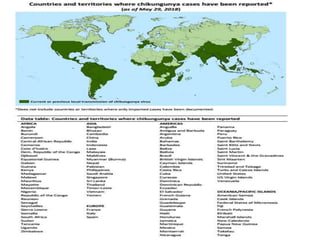
Geographical distribution
• First isolated Tanzania 1952
• Caused periodic outbreak Asia and Africa since
1960
• 2006: Outbreak in India, more than 1 500 000
cases of chikungunya were reported with Ae.
aegypti implicated as the vector.
• Between 2001 and 2011, a number of
countries reported on chikungunya outbreaks.
• 2016 at Delhi
Clinical Manifestation
• Incubation period: 3-7 days(may be 2-12 days)
• Acute phase: < 3weeks
• Sub-Acute phase: 3wks to 3 month
• Chronic phase: > 3 months
Symptoms
• High fever (40°C/ 104°F)
• Joint pain (lower back, ankle, knees, wrists or
phalanges)
• Joint swelling
• Rash
• Headache
• Muscle pain
• Nausea
• Fatigue
Some others symptoms in children
• Retro-orbital pain
• Photophobia
• Vomiting
• Diarrhea
• Meningeal syndrome
• Acute encephalopathy
Course of disease
• Chikungunya is rarely fatal.
• Symptoms are generally self-limiting and last for 2–3
days.
• The virus remains in the human system for 5-7 days
and mosquitoes feeding on an infected person during
this period can also become infected.
• Chikungunya shares some clinical signs with dengue
and can be misdiagnosed in areas where dengue is
common.
• Chikungunya can be detected using serological tests
• Recovery from an infection will confer life-long
immunity.
Case Definition by NVBDCP
• Probable or suspected case: a patient meeting
the clinical criteria only
• Confirmed (definitive) case: a patient meeting
both the clinical and laboratory criteria
Continued….
• Clinical criteria:Acute onset of fever and severe arthralgia / arthritis with or
without skin rash and residing or having left an epidemic area 15 days prior to
onset of symptoms
• Laboratory criteria: At least one of the following tests done in the acute phase of
illness 1.Direct evidence Virus isolation / Presence of viral RNA by RT-PCR
2.Indirect evidence
• Presence of virus specific IgM antibodies in single serum sample collected in
acute or convalescent stage.
• Four-fold increase in IgG values in samples collected at least three weeks apart.
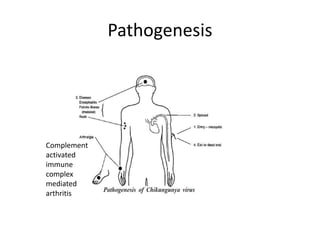
Pathogenesis
Complement
activated
immune
complex
mediated
arthritis
Differential Diagnosis
• Dengue Fever
• Malaria
• Leptospirosis
• Enteric Fever
• Rheumatic Fever
• Reactive arthritis
• Serum sickness illness
• Rickettsial disease
Laboratory diagnosis
• MAC-ELISA –IgM for CHIKV (AFTER 7 DAYS)
• Paired sera IgG(4 FOLD RISE)
• RT-PCR(POSITIVE ≤ 8DAYS): E1 and C genome
from serum,CSF
• VIRAL ISOLATION( TAKE LONG TIME)
Outbreak criteria:
• One or more cases in an area where no case was
reported before.
• For the Public Health action, it is not necessary to
confirm the diagnosis of each and everysuspected
Chikungunya case.
• Remedial measures for containment of the diseases,
• symptomatic treatment of the suspected Chikungunya
fever cases should be started immediately on the basis
of Epidemiological diagnosis of the disease
Treatment
• SUPPORTIVE
• Rest in Acute phase
• Paracetamol and NSAIDS
• Avoid Aspirin
• Plenty of water and adequate hydration
• Protection against mosquito bites
• Timely referral if indicated
• Cold compress to inflamed joint and physiotherapy
Indications for Referral to PHC
• Fever more than 5 days
• Hemorrhagic manifestation
• Reduced urine output
• Severe vomiting
• Altered sensorium
• Jaundice
• Postural dizziness ,cold extremities
Continued….
• Refer sooner at extreme of age, pregnancy
and significant comorbid illness
Management of chronic arthritis
• NSAIDS
• Short course of steroid ( In case of refractory
to NSAID after 2-3 weeks)
• HCQS ( During sub-acute stage)
• Physiotherapy
• Surgery
Prevention
• Personal protection(ITN,DEET,Full sleeve clothing)
• Integrated Vector Management
• Source Reduction
• Larvicidal agents (Temephos)
• Adult mosquito control(Pyrethrum extract)
• Biological Control
• Legislative measures
• Operational research
• Capacity building
Thanks……

Chikungunya

  • 1.
  • 2.
    What is Chikungunya •An arboviral disease (genus Alphavirus) • Transmitted to humans by infected mosquitoes –Aedes aegypti and Aedes albopictus. • The name chikungunya originates from a verb in the Kimakonde language, meaning 'to become contorted'. This refers to the 'stooped' appearance of those suffering with joint pain
  • 3.
    Geographical distribution • Firstisolated Tanzania 1952 • Caused periodic outbreak Asia and Africa since 1960 • 2006: Outbreak in India, more than 1 500 000 cases of chikungunya were reported with Ae. aegypti implicated as the vector. • Between 2001 and 2011, a number of countries reported on chikungunya outbreaks. • 2016 at Delhi
  • 5.
    Clinical Manifestation • Incubationperiod: 3-7 days(may be 2-12 days) • Acute phase: < 3weeks • Sub-Acute phase: 3wks to 3 month • Chronic phase: > 3 months
  • 6.
    Symptoms • High fever(40°C/ 104°F) • Joint pain (lower back, ankle, knees, wrists or phalanges) • Joint swelling • Rash • Headache • Muscle pain • Nausea • Fatigue
  • 7.
    Some others symptomsin children • Retro-orbital pain • Photophobia • Vomiting • Diarrhea • Meningeal syndrome • Acute encephalopathy
  • 8.
    Course of disease •Chikungunya is rarely fatal. • Symptoms are generally self-limiting and last for 2–3 days. • The virus remains in the human system for 5-7 days and mosquitoes feeding on an infected person during this period can also become infected. • Chikungunya shares some clinical signs with dengue and can be misdiagnosed in areas where dengue is common. • Chikungunya can be detected using serological tests • Recovery from an infection will confer life-long immunity.
  • 9.
    Case Definition byNVBDCP • Probable or suspected case: a patient meeting the clinical criteria only • Confirmed (definitive) case: a patient meeting both the clinical and laboratory criteria
  • 10.
    Continued…. • Clinical criteria:Acuteonset of fever and severe arthralgia / arthritis with or without skin rash and residing or having left an epidemic area 15 days prior to onset of symptoms • Laboratory criteria: At least one of the following tests done in the acute phase of illness 1.Direct evidence Virus isolation / Presence of viral RNA by RT-PCR 2.Indirect evidence • Presence of virus specific IgM antibodies in single serum sample collected in acute or convalescent stage. • Four-fold increase in IgG values in samples collected at least three weeks apart.
  • 11.
  • 12.
    Differential Diagnosis • DengueFever • Malaria • Leptospirosis • Enteric Fever • Rheumatic Fever • Reactive arthritis • Serum sickness illness • Rickettsial disease
  • 13.
    Laboratory diagnosis • MAC-ELISA–IgM for CHIKV (AFTER 7 DAYS) • Paired sera IgG(4 FOLD RISE) • RT-PCR(POSITIVE ≤ 8DAYS): E1 and C genome from serum,CSF • VIRAL ISOLATION( TAKE LONG TIME)
  • 14.
    Outbreak criteria: • Oneor more cases in an area where no case was reported before. • For the Public Health action, it is not necessary to confirm the diagnosis of each and everysuspected Chikungunya case. • Remedial measures for containment of the diseases, • symptomatic treatment of the suspected Chikungunya fever cases should be started immediately on the basis of Epidemiological diagnosis of the disease
  • 15.
    Treatment • SUPPORTIVE • Restin Acute phase • Paracetamol and NSAIDS • Avoid Aspirin • Plenty of water and adequate hydration • Protection against mosquito bites • Timely referral if indicated • Cold compress to inflamed joint and physiotherapy
  • 16.
    Indications for Referralto PHC • Fever more than 5 days • Hemorrhagic manifestation • Reduced urine output • Severe vomiting • Altered sensorium • Jaundice • Postural dizziness ,cold extremities
  • 17.
    Continued…. • Refer soonerat extreme of age, pregnancy and significant comorbid illness
  • 18.
    Management of chronicarthritis • NSAIDS • Short course of steroid ( In case of refractory to NSAID after 2-3 weeks) • HCQS ( During sub-acute stage) • Physiotherapy • Surgery
  • 19.
    Prevention • Personal protection(ITN,DEET,Fullsleeve clothing) • Integrated Vector Management • Source Reduction • Larvicidal agents (Temephos) • Adult mosquito control(Pyrethrum extract) • Biological Control • Legislative measures • Operational research • Capacity building
  • 20.

Editor's Notes