Marine palaeoclimatologyProfessor Simon K. HaslettCentre for Excellence in Learning and TeachingSimon.haslett@newport.ac.uk27th September 2010
IntroductionThe study of palaeoclimates enables us:to establish the limits of natural climatic variability;to establish climatic trends;to place present-day climate in context;to provide analogies for future climate and environment predictions; andto provide hindcast tests of predictive climate models.There are two approaches to studying palaeoclimates:palaeoclimaticmodelling: use GCMs to simulate past climates; andpalaeogeographic and palaeoecologic reconstruction: use proxy data to reconstruct palaeoclimate.This presentation describes how integrated records of marine and terrestrial environmental change are found in marine sediments.
Marine palaeoclimatologyMarine palaeoclimatology attempts to reconstruct palaeoclimates using marine geological phenomena, such as:marine sediments (including sedimentology, micropalaeontology, isotope analysis etc);
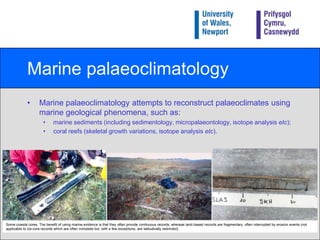
coral reefs (skeletal growth variations, isotope analysis etc).Some coastal cores. The benefit of using marine evidence is that they often provide continuous records, whereas land-based records are fragmentary, often interrupted by erosion events (not applicable to ice-core records which are often complete but, with a few exceptions, are latitudinally restricted).
Case study: the CLIMAP ProjectStands for Climate: Long-range Investigation Mapping and Prediction.Attempted to reconstruct seasonal changes (February and August) in global geography at the Last Glacial Maximum (LGM) (18+3 ka), by establishing global sea-surface temperatures (SSTs).Took place in the 1970s and 1980s and involved scientists from all over the world.
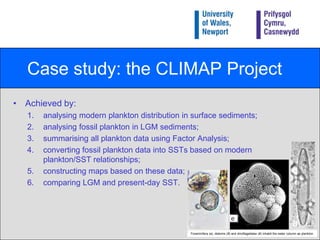
Case study: the CLIMAP ProjectAchieved by:analysing modern plankton distribution in surface sediments;analysing fossil plankton in LGM sediments;summarising all plankton data using Factor Analysis;converting fossil plankton data into SSTs based on modern plankton/SST relationships;constructing maps based on these data;comparing LGM and present-day SST.Foraminifera (e), diatoms (8) and dinoflagellates (6) inhabit the water column as plankton.
Case study: the CLIMAP ProjectCLIMAP (1976) was significant because:It was the first project to provide constraining data for GCMs (Dawson, 1992);It provided testable results which stimulated research into:refinement of existing, and development of new, techniques, including downcore applications.land-based records for land-ocean comparisons (e.g. Rind and Peteet, 1985; Haslett, 2002);Stimulated research into other climatically significant times, such as the mid-Pliocene (PRISM Project e.g.Dowsett, 1994), Plio-Pleistocene Boundary (Olduvai Project e.g.Funnellet al., 1996), last interglacial (Ruddiman, 1984), the Holocene (COHMAP Project, 1988), as well as continued research on the LGM (Wolff et al., 1998; EPILOG Project, Mix et al., 2001).  However, some of this further work has cast doubt over the CLIMAP Project results (e.g. Rind and Peteet, 1985), which has led to some controversy in the palaeoclimate community (Haslett, 2002).
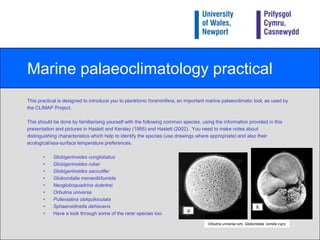
Marine palaeoclimatology practicalThis practical is designed to introduce you to planktonic foraminifera, an important marine palaeoclimatic tool, as used by the CLIMAP Project.This should be done by familiarising yourself with the following common species, using the informationprovided in this presentation and pictures in Haslett and Kersley (1995) and Haslett (2002).  You need to make notes about distinguishing characteristics which help to identify the species (use drawings where appropriate) and also their ecological/sea-surface temperature preferences.Globigerinoidesconglobatus
Globigerinoidesruber
Globigerinoidessacculifer

Marine palaeoclimatology

  • 1.
    Marine palaeoclimatologyProfessor SimonK. HaslettCentre for Excellence in Learning and TeachingSimon.haslett@newport.ac.uk27th September 2010
  • 2.
    IntroductionThe study ofpalaeoclimates enables us:to establish the limits of natural climatic variability;to establish climatic trends;to place present-day climate in context;to provide analogies for future climate and environment predictions; andto provide hindcast tests of predictive climate models.There are two approaches to studying palaeoclimates:palaeoclimaticmodelling: use GCMs to simulate past climates; andpalaeogeographic and palaeoecologic reconstruction: use proxy data to reconstruct palaeoclimate.This presentation describes how integrated records of marine and terrestrial environmental change are found in marine sediments.
  • 3.
    Marine palaeoclimatologyMarine palaeoclimatologyattempts to reconstruct palaeoclimates using marine geological phenomena, such as:marine sediments (including sedimentology, micropalaeontology, isotope analysis etc);
  • 4.
    coral reefs (skeletalgrowth variations, isotope analysis etc).Some coastal cores. The benefit of using marine evidence is that they often provide continuous records, whereas land-based records are fragmentary, often interrupted by erosion events (not applicable to ice-core records which are often complete but, with a few exceptions, are latitudinally restricted).
  • 5.
    Case study: theCLIMAP ProjectStands for Climate: Long-range Investigation Mapping and Prediction.Attempted to reconstruct seasonal changes (February and August) in global geography at the Last Glacial Maximum (LGM) (18+3 ka), by establishing global sea-surface temperatures (SSTs).Took place in the 1970s and 1980s and involved scientists from all over the world.
  • 6.
    Case study: theCLIMAP ProjectAchieved by:analysing modern plankton distribution in surface sediments;analysing fossil plankton in LGM sediments;summarising all plankton data using Factor Analysis;converting fossil plankton data into SSTs based on modern plankton/SST relationships;constructing maps based on these data;comparing LGM and present-day SST.Foraminifera (e), diatoms (8) and dinoflagellates (6) inhabit the water column as plankton.
  • 7.
    Case study: theCLIMAP ProjectCLIMAP (1976) was significant because:It was the first project to provide constraining data for GCMs (Dawson, 1992);It provided testable results which stimulated research into:refinement of existing, and development of new, techniques, including downcore applications.land-based records for land-ocean comparisons (e.g. Rind and Peteet, 1985; Haslett, 2002);Stimulated research into other climatically significant times, such as the mid-Pliocene (PRISM Project e.g.Dowsett, 1994), Plio-Pleistocene Boundary (Olduvai Project e.g.Funnellet al., 1996), last interglacial (Ruddiman, 1984), the Holocene (COHMAP Project, 1988), as well as continued research on the LGM (Wolff et al., 1998; EPILOG Project, Mix et al., 2001). However, some of this further work has cast doubt over the CLIMAP Project results (e.g. Rind and Peteet, 1985), which has led to some controversy in the palaeoclimate community (Haslett, 2002).
  • 8.
    Marine palaeoclimatology practicalThispractical is designed to introduce you to planktonic foraminifera, an important marine palaeoclimatic tool, as used by the CLIMAP Project.This should be done by familiarising yourself with the following common species, using the informationprovided in this presentation and pictures in Haslett and Kersley (1995) and Haslett (2002). You need to make notes about distinguishing characteristics which help to identify the species (use drawings where appropriate) and also their ecological/sea-surface temperature preferences.Globigerinoidesconglobatus
  • 9.
  • 10.