Biostratigraphy and MicrofossilsProfessor Simon K. HaslettCentre for Excellence in Learning and TeachingSimon.haslett@newport.ac.uk1st September 2010
IntroductionBiostratigraphy is the use of fossils to date sediments and reconstruct past environments, and enables ages to be applied to isolated samples.Any fossil has the potential of being used biostratigraphically, however, in deep-sea sediments retrieved using coring equipment, the best fossils to use are those that are small and abundant in the core samples.Microfossils are thus the most appropriate types of fossils to use when investigating DSDP (Deep Sea Drilling Project) and ODP (Ocean Drilling Program) material.In this presentation, some of the microfossils that can be derived from deep-sea sediments and used for biostratigraphical purposes are described.
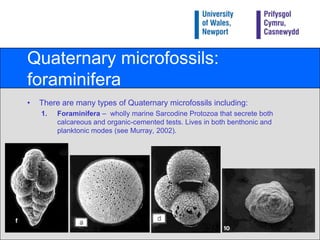
Quaternary microfossils: foraminiferaThere are many types of Quaternary microfossils including:Foraminifera –  wholly marine Sarcodine Protozoa that secrete both calcareous and organic-cemented tests. Lives in both benthonic and planktonic modes (see Murray, 2002).
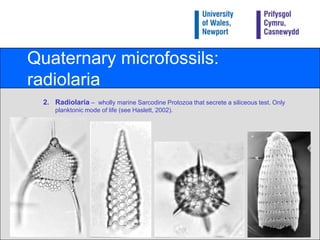
Quaternary microfossils: radiolariaRadiolaria –  wholly marine Sarcodine Protozoa that secrete a siliceous test. Only planktonic mode of life (see Haslett, 2002).
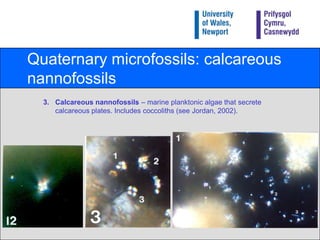
Quaternary microfossils: calcareous nannofossilsCalcareous nannofossils– marine planktonic algae that secrete calcareous plates. Includes coccoliths (see Jordan, 2002).
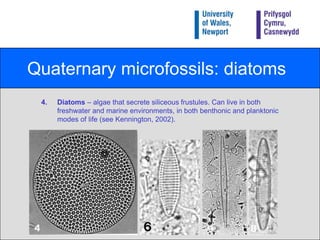
Quaternary microfossils: diatomsDiatoms – algae that secrete siliceous frustules. Can live in both freshwater and marine environments, in both benthonic and planktonic modes of life (see Kennington, 2002).
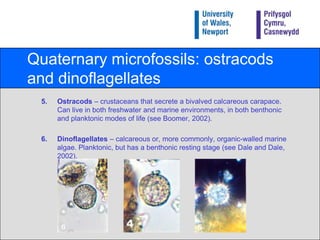
Quaternary microfossils: ostracods and dinoflagellatesOstracods – crustaceans that secrete a bivalved calcareous carapace. Can live in both freshwater and marine environments, in both benthonic and planktonic modes of life (see Boomer, 2002).Dinoflagellates – calcareous or, more commonly, organic-walled marine algae. Planktonic, but has a benthonic resting stage (see Dale and Dale, 2002).
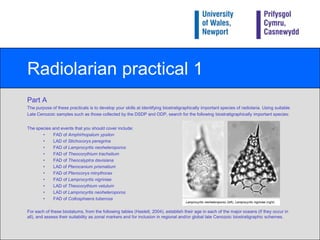
Radiolarian practical 1Part AThe purpose of these practicals is to develop your skills at identifying biostratigraphically important species of radiolaria. Using suitable Late Cenozoic samples such as those collected by the DSDP and ODP, search for the following biostratigraphically important species:The species and events that you should cover include:FAD of Amphirhopalumypsilon
LAD of Stichocorysperegrina
FAD of Lamprocyrtisneoheteroporos
FAD of Theocorythiumtrachelium
FAD of Theocalyptradavisiana
LAD of Pterocaniumprismatium

Biostratigraphy and microfossils

  • 1.
    Biostratigraphy and MicrofossilsProfessorSimon K. HaslettCentre for Excellence in Learning and TeachingSimon.haslett@newport.ac.uk1st September 2010
  • 2.
    IntroductionBiostratigraphy is theuse of fossils to date sediments and reconstruct past environments, and enables ages to be applied to isolated samples.Any fossil has the potential of being used biostratigraphically, however, in deep-sea sediments retrieved using coring equipment, the best fossils to use are those that are small and abundant in the core samples.Microfossils are thus the most appropriate types of fossils to use when investigating DSDP (Deep Sea Drilling Project) and ODP (Ocean Drilling Program) material.In this presentation, some of the microfossils that can be derived from deep-sea sediments and used for biostratigraphical purposes are described.
  • 3.
    Quaternary microfossils: foraminiferaThereare many types of Quaternary microfossils including:Foraminifera – wholly marine Sarcodine Protozoa that secrete both calcareous and organic-cemented tests. Lives in both benthonic and planktonic modes (see Murray, 2002).
  • 4.
    Quaternary microfossils: radiolariaRadiolaria– wholly marine Sarcodine Protozoa that secrete a siliceous test. Only planktonic mode of life (see Haslett, 2002).
  • 5.
    Quaternary microfossils: calcareousnannofossilsCalcareous nannofossils– marine planktonic algae that secrete calcareous plates. Includes coccoliths (see Jordan, 2002).
  • 6.
    Quaternary microfossils: diatomsDiatoms– algae that secrete siliceous frustules. Can live in both freshwater and marine environments, in both benthonic and planktonic modes of life (see Kennington, 2002).
  • 7.
    Quaternary microfossils: ostracodsand dinoflagellatesOstracods – crustaceans that secrete a bivalved calcareous carapace. Can live in both freshwater and marine environments, in both benthonic and planktonic modes of life (see Boomer, 2002).Dinoflagellates – calcareous or, more commonly, organic-walled marine algae. Planktonic, but has a benthonic resting stage (see Dale and Dale, 2002).
  • 8.
    Radiolarian practical 1PartAThe purpose of these practicals is to develop your skills at identifying biostratigraphically important species of radiolaria. Using suitable Late Cenozoic samples such as those collected by the DSDP and ODP, search for the following biostratigraphically important species:The species and events that you should cover include:FAD of Amphirhopalumypsilon
  • 9.
  • 10.
  • 11.
  • 12.
  • 13.
  • 14.
  • 15.
  • 16.
  • 17.
  • 18.
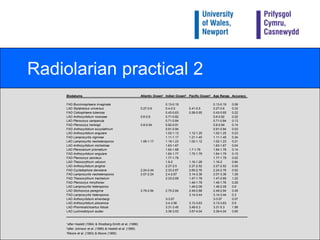
    FAD of CollosphaeratuberosaForeach of these biodatums, from the following tables (Haslett, 2004), establish their age in each of the major oceans (if they occur in all), and assess their suitability as zonal markers and for inclusion in regional and/or global late Cenozoic biostratigraphic schemes.Lamprocyrtisneoheteroporos(left), Lamprocyrtisnigriniae(right)
  • 19.
  • 20.
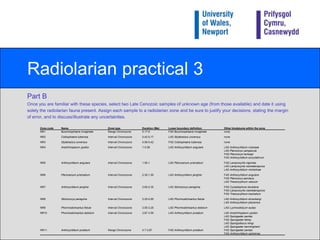
    Radiolarian practical 3PartBOnce you are familiar with these species, select two Late Cenozoic samples of unknown age (from those available) and date it using solely the radiolarian fauna present. Assign each sample to a radiolarian zone and be sure to justify your decisions, stating the margin of error, and to discuss/illustrate any uncertainties.
  • 21.
    SummaryBiostratigraphy is theuse of fossils to date sediments and reconstruct palaeoenvironments.Microfossils are the most common fossils in marine sediments. Some of the more important groups of microfossils include: foraminifera, radiolaria, calcareous nannofossils, diatoms, ostracods, and dinoflagellates.Each of these fossils have unique features which allow them to be placed at specific points in space and time.
  • 22.
    ReferencesBoomer, I. 2002.Environmental applications of marine and freshwater Ostracoda. pp. 115-138. In: Haslett, S.K. (ed.). Quaternary Environmental Micropalaeontology. Arnold, London, 340pp.Dale, B. and Dale, A.L. 2002. Environmental applications of dinoflagellate cysts and acritarchs. pp. 207-240. In: Haslett, S.K. (ed.). Quaternary Environmental Micropalaeontology. Arnold, London, 340pp.Haslett, S.K. 1994. Plio-Pleistocene radiolarian biostratigraphy and palaeoceanography of the mid-latitude North Atlantic (DSDP Site 609). Geological Magazine, 131: 57-66.Haslett, S.K., Kennington, K., Funnell, B.M. and Kersley, C.L. 1995. Pliocene-Pleistocene radiolarian and diatom biostratigraphy of ODP hole 709C (equatorial Indian Ocean). Journal of Micropalaeontology, 14: 135-143.Haslett, S.K. 2002. Palaeoceanographic applications of planktonic Sarcodine Protozoa: Radiolaria and Foraminifera. pp. 139-165. In: Haslett, S.K. (ed.). Quaternary Environmental Micropalaeontology. Arnold, London, 340pp.Haslett, S.K. 2004. Late Neogene-Quaternary radiolarian biostratigraphy: a brief review. Journal of Micropalaeontology, 23: 39-47.Johnson, D.A., Schneider, D.A., Nigrini, C.A., Caulet, J.P. and Kent, D.V. 1989. Pliocene-Pleistocene radiolarian events and magnetostratigraphic calibrations for the tropical Indian Ocean. Marine Micropalaeontology, 14: 33-66.Jordon, R.W. 2002. Environmental applications of calcareous nannofossils. pp. 185-206. In: Haslett, S.K. (ed.). Quaternary Environmental Micropalaeontology. Arnold, London, 340pp.Kennington, K. 2002. The environmental applications of diatoms. pp. 166-184. In: Haslett, S.K. (ed.). Quaternary Environmental Micropalaeontology. Arnold, London, 340pp.Moore, T.C. Jr. 1995. Radiolarian stratigraphy. Leg 138. Proceedings of the Ocean Drilling Program, Scientific Results, 138: 191-232.Moore, T.C. Jr., Skackleton, N.J. and Pisias, N.G.1993. Palaeoceanography and the diachrony of radiolarian events in the eastern equatorial Pacific. Palaeoceanography, 8: 567-586.Murray, J.W. 2002. Introduction to benthic foraminifera. pp. 5-13. In: Haslett, S.K. (ed.). Quaternary Environmental Micropalaeontology. Arnold, London, 340pp.Westberg-Smith, M.J., Tway, L.E. and Riedel, W.R. 1986. Radiolarians from the North Atlantic Ocean. Deep Sea Drilling Project Leg 94. Initial Reports of the Deep Sea Drilling Project, 94: 763-777.
  • 23.
    This resource wascreated by the University of Wales, Newport and released as an open educational resource through the 'C-change in GEES' project exploring the open licensing of climate change and sustainability resources in the Geography, Earth and Environmental Sciences. The C-change in GEES project was funded by HEFCE as part of the JISC/HE Academy UKOER programme and coordinated by the GEES Subject Centre. This resource is licensed under the terms of the Attribution-Non-Commercial-Share Alike 2.0 UK: England & Wales license (http://creativecommons.org/licenses/by-nc-sa/2.0/uk/). All images courtesy of Professor Simon Haslett. However the resource, where specified below, contains other 3rd party materials under their own licenses. The licenses and attributions are outlined below:The name of the University of Wales, Newport and its logos are unregistered trade marks of the University. The University reserves all rights to these items beyond their inclusion in these CC resources. The JISC logo, the C-change logo and the logo of the Higher Education Academy Subject Centre for the Geography, Earth and Environmental Sciences are licensed under the terms of the Creative Commons Attribution -non-commercial-No Derivative Works 2.0 UK England & Wales license. All reproductions must comply with the terms of that license.

Editor's Notes