Projection of Wales as an internationally
engaged/forward-looking nation
Professor Simon K. Haslett
Pro Vice-Chancellor (International and Enhancement)
Presented at the Universities as Global Communities event.
Session 2 – How can the sector develop a more distinctive international image?
13th February 2020, Bangor University
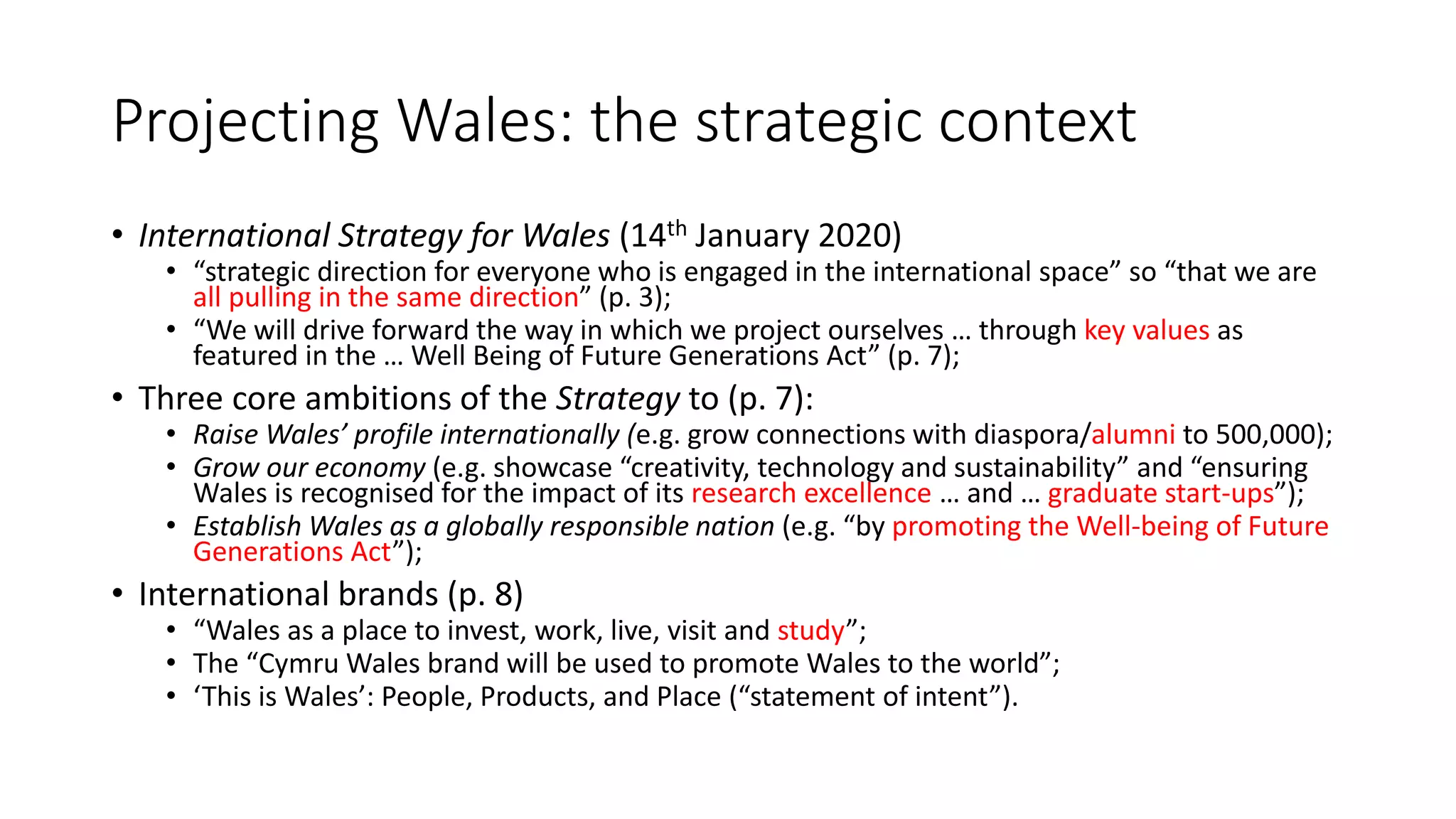
Projecting Wales: the strategic context
• International Strategy for Wales (14th January 2020)
• “strategic direction for everyone who is engaged in the international space” so “that we are
all pulling in the same direction” (p. 3);
• “We will drive forward the way in which we project ourselves … through key values as
featured in the … Well Being of Future Generations Act” (p. 7);
• Three core ambitions of the Strategy to (p. 7):
• Raise Wales’ profile internationally (e.g. grow connections with diaspora/alumni to 500,000);
• Grow our economy (e.g. showcase “creativity, technology and sustainability” and “ensuring
Wales is recognised for the impact of its research excellence … and … graduate start-ups”);
• Establish Wales as a globally responsible nation (e.g. “by promoting the Well-being of Future
Generations Act”);
• International brands (p. 8)
• “Wales as a place to invest, work, live, visit and study”;
• The “Cymru Wales brand will be used to promote Wales to the world”;
• ‘This is Wales’: People, Products, and Place (“statement of intent”).
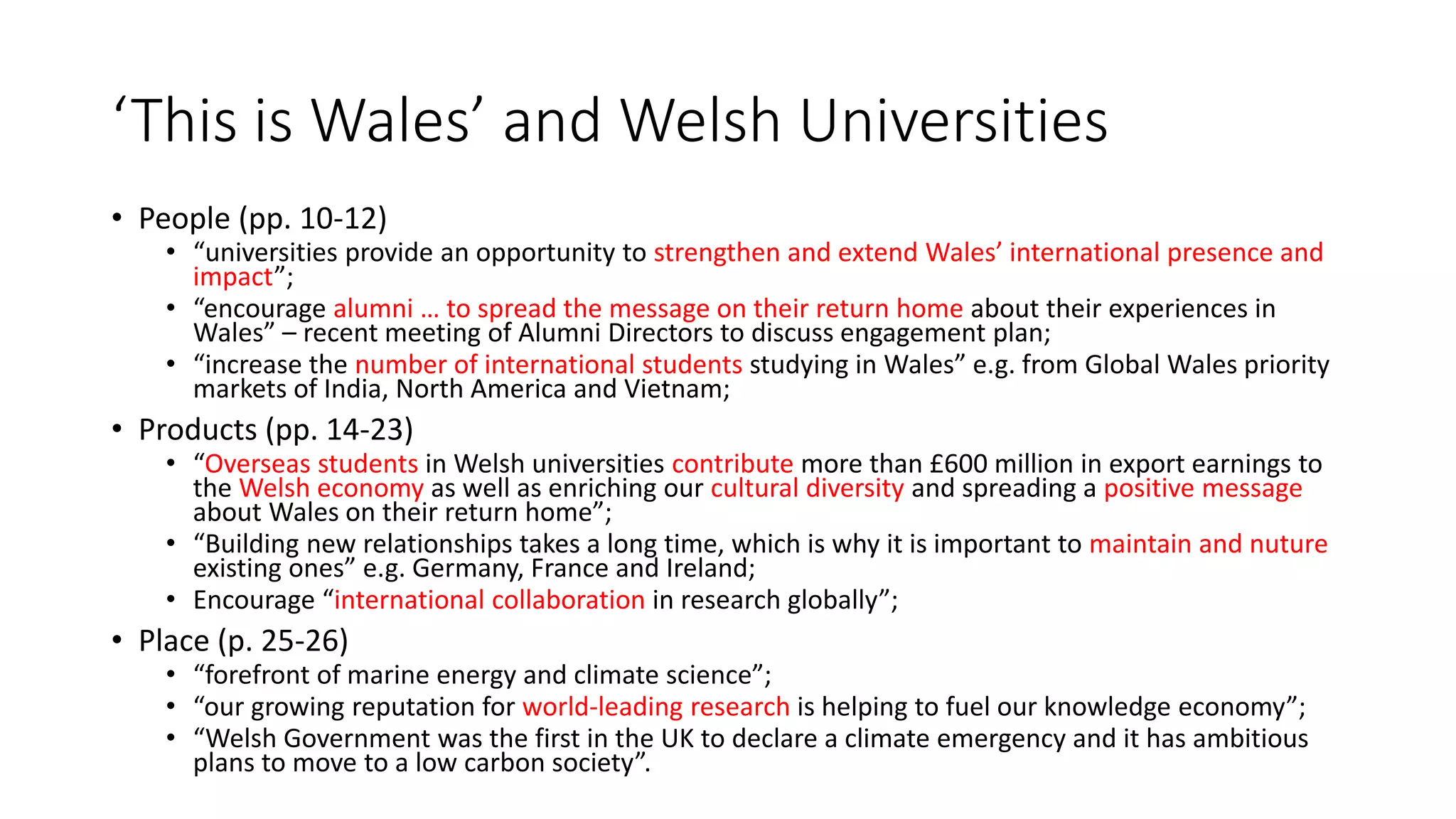
‘This is Wales’ and Welsh Universities
• People (pp. 10-12)
• “universities provide an opportunity to strengthen and extend Wales’ international presence and
impact”;
• “encourage alumni … to spread the message on their return home about their experiences in
Wales” – recent meeting of Alumni Directors to discuss engagement plan;
• “increase the number of international students studying in Wales” e.g. from Global Wales priority
markets of India, North America and Vietnam;
• Products (pp. 14-23)
• “Overseas students in Welsh universities contribute more than £600 million in export earnings to
the Welsh economy as well as enriching our cultural diversity and spreading a positive message
about Wales on their return home”;
• “Building new relationships takes a long time, which is why it is important to maintain and nuture
existing ones” e.g. Germany, France and Ireland;
• Encourage “international collaboration in research globally”;
• Place (p. 25-26)
• “forefront of marine energy and climate science”;
• “our growing reputation for world-leading research is helping to fuel our knowledge economy”;
• “Welsh Government was the first in the UK to declare a climate emergency and it has ambitious
plans to move to a low carbon society”.
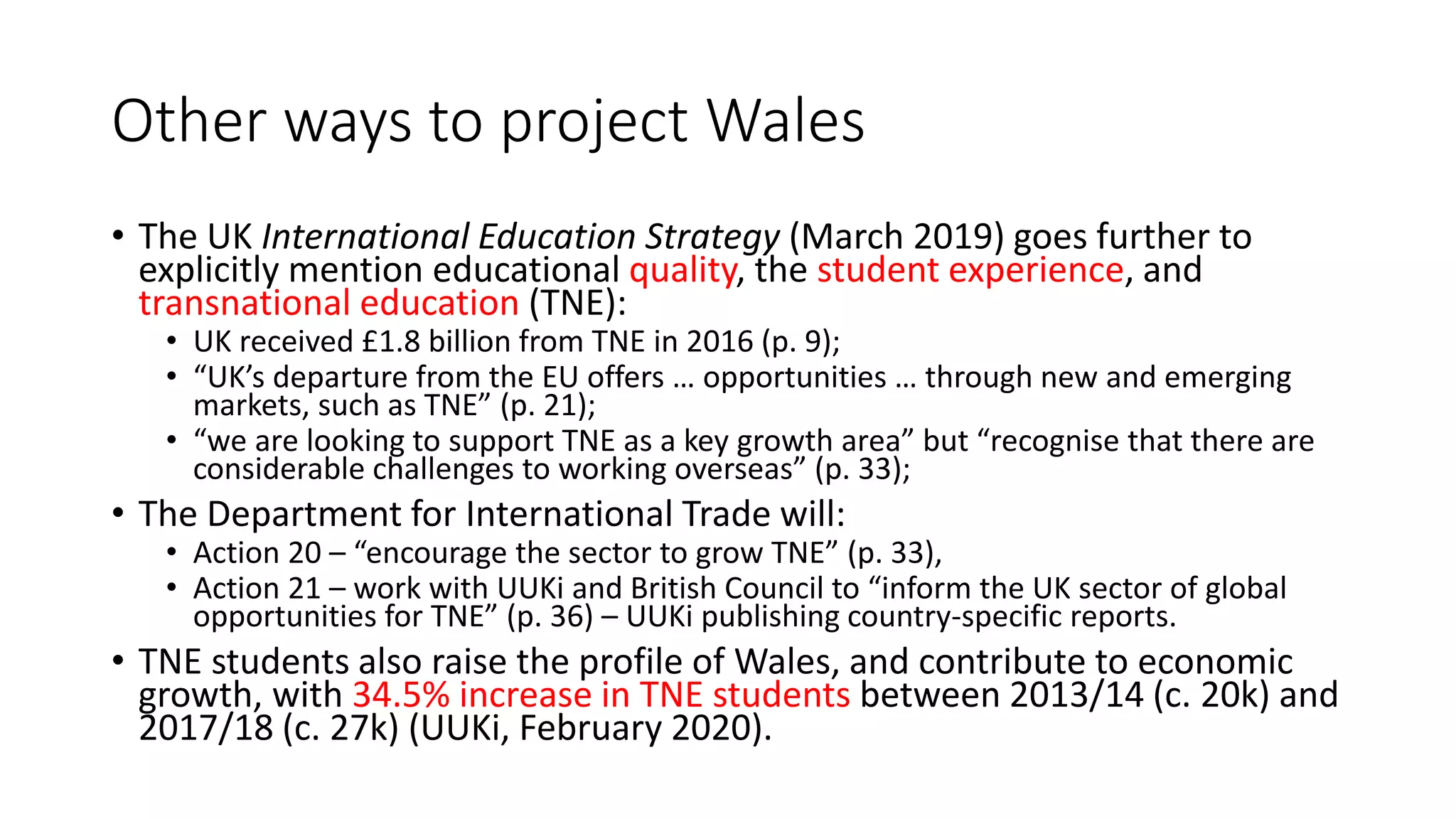
Other ways to project Wales
• The UK International Education Strategy (March 2019) goes further to
explicitly mention educational quality, the student experience, and
transnational education (TNE):
• UK received £1.8 billion from TNE in 2016 (p. 9);
• “UK’s departure from the EU offers … opportunities … through new and emerging
markets, such as TNE” (p. 21);
• “we are looking to support TNE as a key growth area” but “recognise that there are
considerable challenges to working overseas” (p. 33);
• The Department for International Trade will:
• Action 20 – “encourage the sector to grow TNE” (p. 33),
• Action 21 – work with UUKi and British Council to “inform the UK sector of global
opportunities for TNE” (p. 36) – UUKi publishing country-specific reports.
• TNE students also raise the profile of Wales, and contribute to economic
growth, with 34.5% increase in TNE students between 2013/14 (c. 20k) and
2017/18 (c. 27k) (UUKi, February 2020).
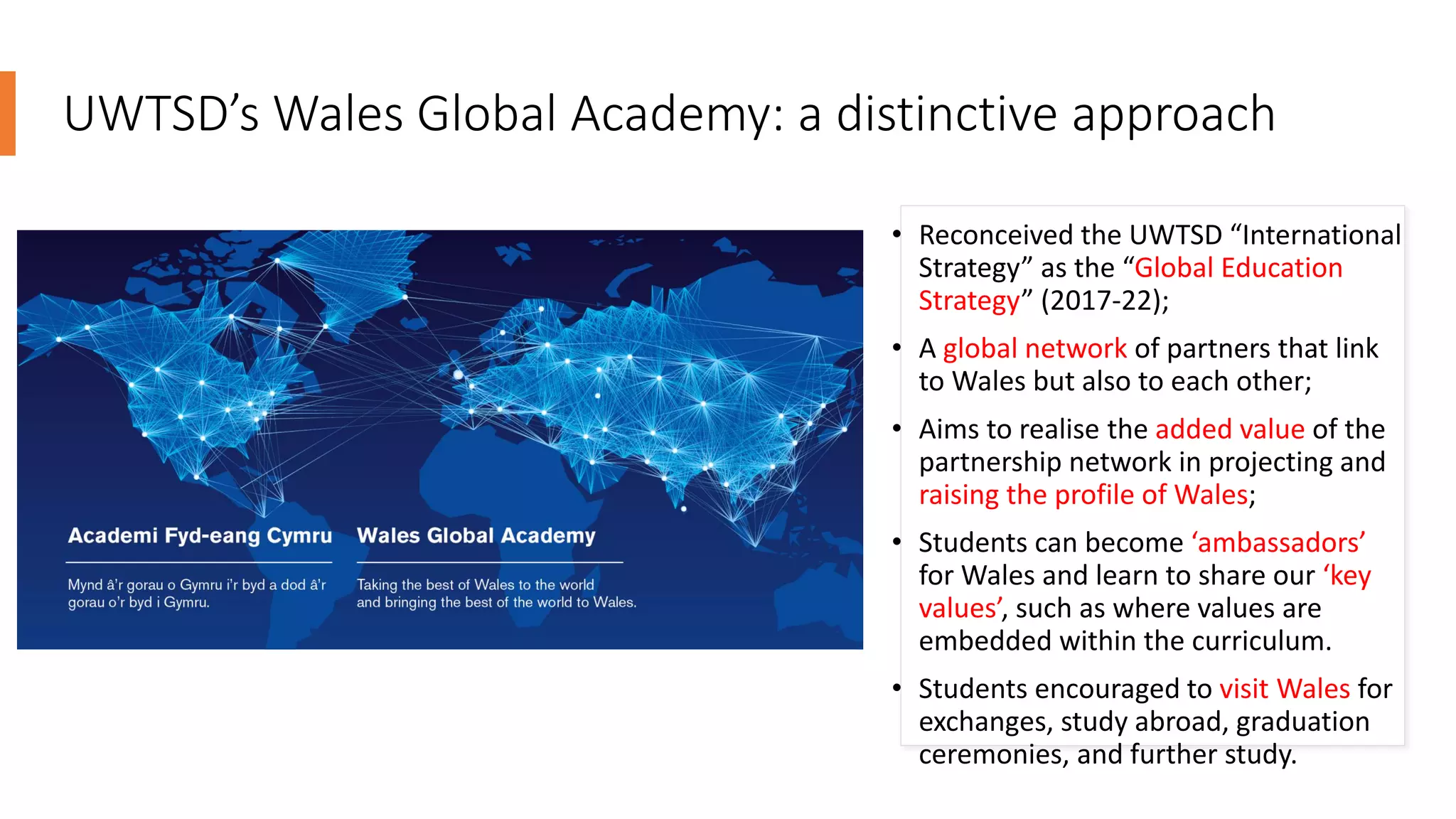
UWTSD’s Wales Global Academy: a distinctive approach
• Reconceived the UWTSD “International
Strategy” as the “Global Education
Strategy” (2017-22);
• A global network of partners that link
to Wales but also to each other;
• Aims to realise the added value of the
partnership network in projecting and
raising the profile of Wales;
• Students can become ‘ambassadors’
for Wales and learn to share our ‘key
values’, such as where values are
embedded within the curriculum.
• Students encouraged to visit Wales for
exchanges, study abroad, graduation
ceremonies, and further study.
Projecting Wales as an internationally
engaged/forward-looking nation through:
• (‘wet paint’ in terms of strategy, and refinement needed – Global Wales);
• our key values as featured in the Well Being of Future Generations Act;
• our declaration of a climate emergency and move to a low carbon society,
and being at the forefront of the green energy revolution;
• showcasing modern “creativity, technology and sustainability” examples;
• promoting our cultural assets, diversity, and natural beauty of Wales;
• pride in our educational quality and excellent student experience;
• celebrating the quality and impact of our research excellence;
• promoting global education opportunities and recognising that not all our
students will visit Wales, at least initially;
• growing and maintaining connections with alumni and empowering them
to be ‘ambassadors’ for Wales and our key values.
Citation:
Haslett, S. K., 2020. Projection of Wales as an internationally engaged/forward-looking nation
[PowerPoint Presentation]. Universities as Global Communities, Learned Society of Wales, 13th
February, Bangor, UK.

Projection of Wales as an internationally engaged/forward-looking nation.

  • 1.
    Projection of Walesas an internationally engaged/forward-looking nation Professor Simon K. Haslett Pro Vice-Chancellor (International and Enhancement) Presented at the Universities as Global Communities event. Session 2 – How can the sector develop a more distinctive international image? 13th February 2020, Bangor University
  • 2.
    Projecting Wales: thestrategic context • International Strategy for Wales (14th January 2020) • “strategic direction for everyone who is engaged in the international space” so “that we are all pulling in the same direction” (p. 3); • “We will drive forward the way in which we project ourselves … through key values as featured in the … Well Being of Future Generations Act” (p. 7); • Three core ambitions of the Strategy to (p. 7): • Raise Wales’ profile internationally (e.g. grow connections with diaspora/alumni to 500,000); • Grow our economy (e.g. showcase “creativity, technology and sustainability” and “ensuring Wales is recognised for the impact of its research excellence … and … graduate start-ups”); • Establish Wales as a globally responsible nation (e.g. “by promoting the Well-being of Future Generations Act”); • International brands (p. 8) • “Wales as a place to invest, work, live, visit and study”; • The “Cymru Wales brand will be used to promote Wales to the world”; • ‘This is Wales’: People, Products, and Place (“statement of intent”).
  • 3.
    ‘This is Wales’and Welsh Universities • People (pp. 10-12) • “universities provide an opportunity to strengthen and extend Wales’ international presence and impact”; • “encourage alumni … to spread the message on their return home about their experiences in Wales” – recent meeting of Alumni Directors to discuss engagement plan; • “increase the number of international students studying in Wales” e.g. from Global Wales priority markets of India, North America and Vietnam; • Products (pp. 14-23) • “Overseas students in Welsh universities contribute more than £600 million in export earnings to the Welsh economy as well as enriching our cultural diversity and spreading a positive message about Wales on their return home”; • “Building new relationships takes a long time, which is why it is important to maintain and nuture existing ones” e.g. Germany, France and Ireland; • Encourage “international collaboration in research globally”; • Place (p. 25-26) • “forefront of marine energy and climate science”; • “our growing reputation for world-leading research is helping to fuel our knowledge economy”; • “Welsh Government was the first in the UK to declare a climate emergency and it has ambitious plans to move to a low carbon society”.
  • 4.
    Other ways toproject Wales • The UK International Education Strategy (March 2019) goes further to explicitly mention educational quality, the student experience, and transnational education (TNE): • UK received £1.8 billion from TNE in 2016 (p. 9); • “UK’s departure from the EU offers … opportunities … through new and emerging markets, such as TNE” (p. 21); • “we are looking to support TNE as a key growth area” but “recognise that there are considerable challenges to working overseas” (p. 33); • The Department for International Trade will: • Action 20 – “encourage the sector to grow TNE” (p. 33), • Action 21 – work with UUKi and British Council to “inform the UK sector of global opportunities for TNE” (p. 36) – UUKi publishing country-specific reports. • TNE students also raise the profile of Wales, and contribute to economic growth, with 34.5% increase in TNE students between 2013/14 (c. 20k) and 2017/18 (c. 27k) (UUKi, February 2020).
  • 5.
    UWTSD’s Wales GlobalAcademy: a distinctive approach • Reconceived the UWTSD “International Strategy” as the “Global Education Strategy” (2017-22); • A global network of partners that link to Wales but also to each other; • Aims to realise the added value of the partnership network in projecting and raising the profile of Wales; • Students can become ‘ambassadors’ for Wales and learn to share our ‘key values’, such as where values are embedded within the curriculum. • Students encouraged to visit Wales for exchanges, study abroad, graduation ceremonies, and further study.
  • 6.
    Projecting Wales asan internationally engaged/forward-looking nation through: • (‘wet paint’ in terms of strategy, and refinement needed – Global Wales); • our key values as featured in the Well Being of Future Generations Act; • our declaration of a climate emergency and move to a low carbon society, and being at the forefront of the green energy revolution; • showcasing modern “creativity, technology and sustainability” examples; • promoting our cultural assets, diversity, and natural beauty of Wales; • pride in our educational quality and excellent student experience; • celebrating the quality and impact of our research excellence; • promoting global education opportunities and recognising that not all our students will visit Wales, at least initially; • growing and maintaining connections with alumni and empowering them to be ‘ambassadors’ for Wales and our key values.
  • 7.
    Citation: Haslett, S. K.,2020. Projection of Wales as an internationally engaged/forward-looking nation [PowerPoint Presentation]. Universities as Global Communities, Learned Society of Wales, 13th February, Bangor, UK.