Embedding and sustaining
inclusive STEM practices
Dr Alison Stokes
School of Geography, Earth
and Environmental Sciences
Plymouth University
Inclusive learning
“To be inclusive,
institutions should
consider the diversity of
the student body and
embed principles of
equality in the design,
planning and evaluation of
programmes, courses and
modules.” (Thomas &
May, 2010)
“The curriculum on paper
is only a script: the real
curriculum is acted out
and lived through.”
(Squires, 1987)
Call to action
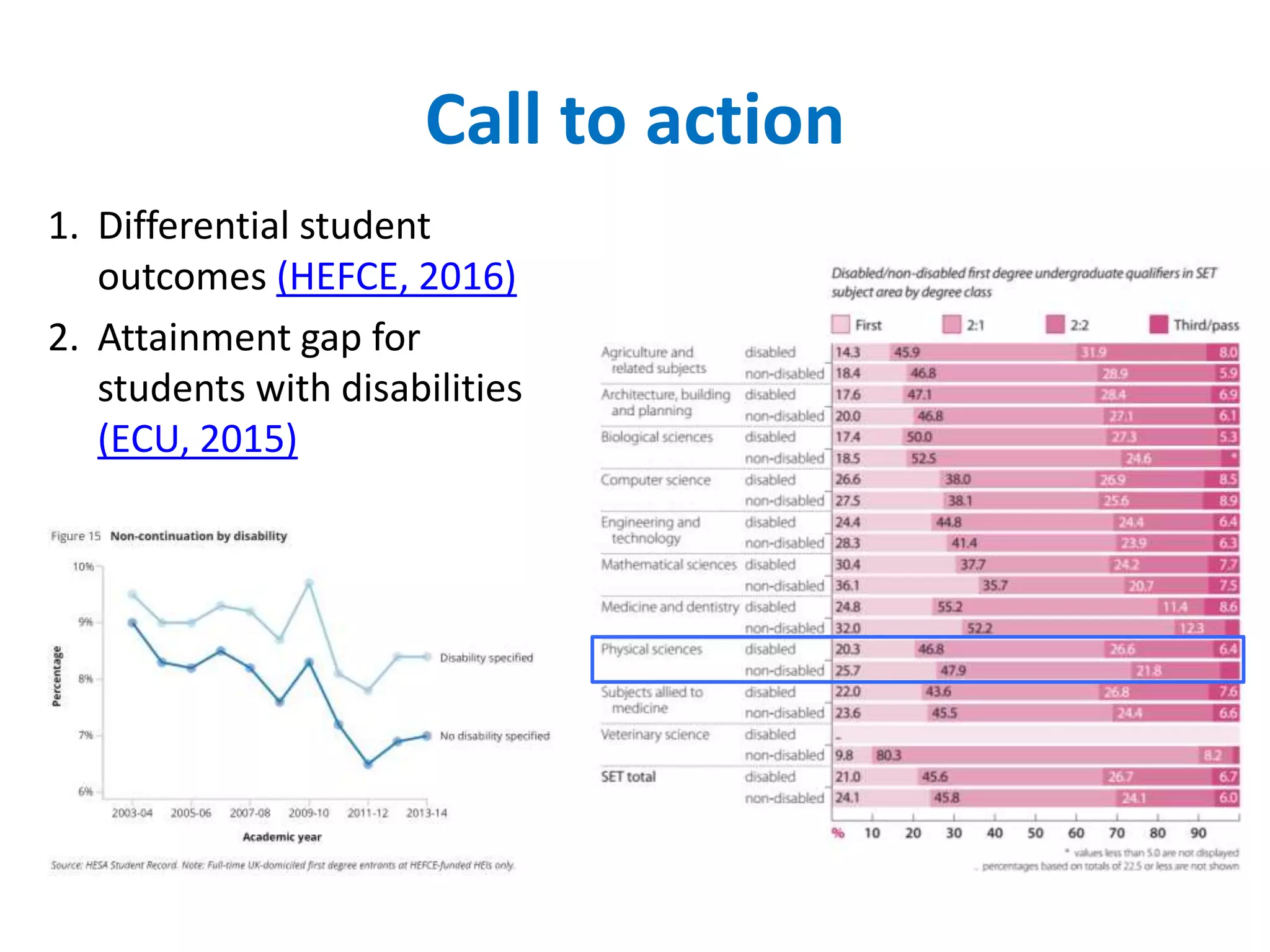
1. Differential student
outcomes (HEFCE, 2016)
2. Attainment gap for
students with disabilities
(ECU, 2015)
.
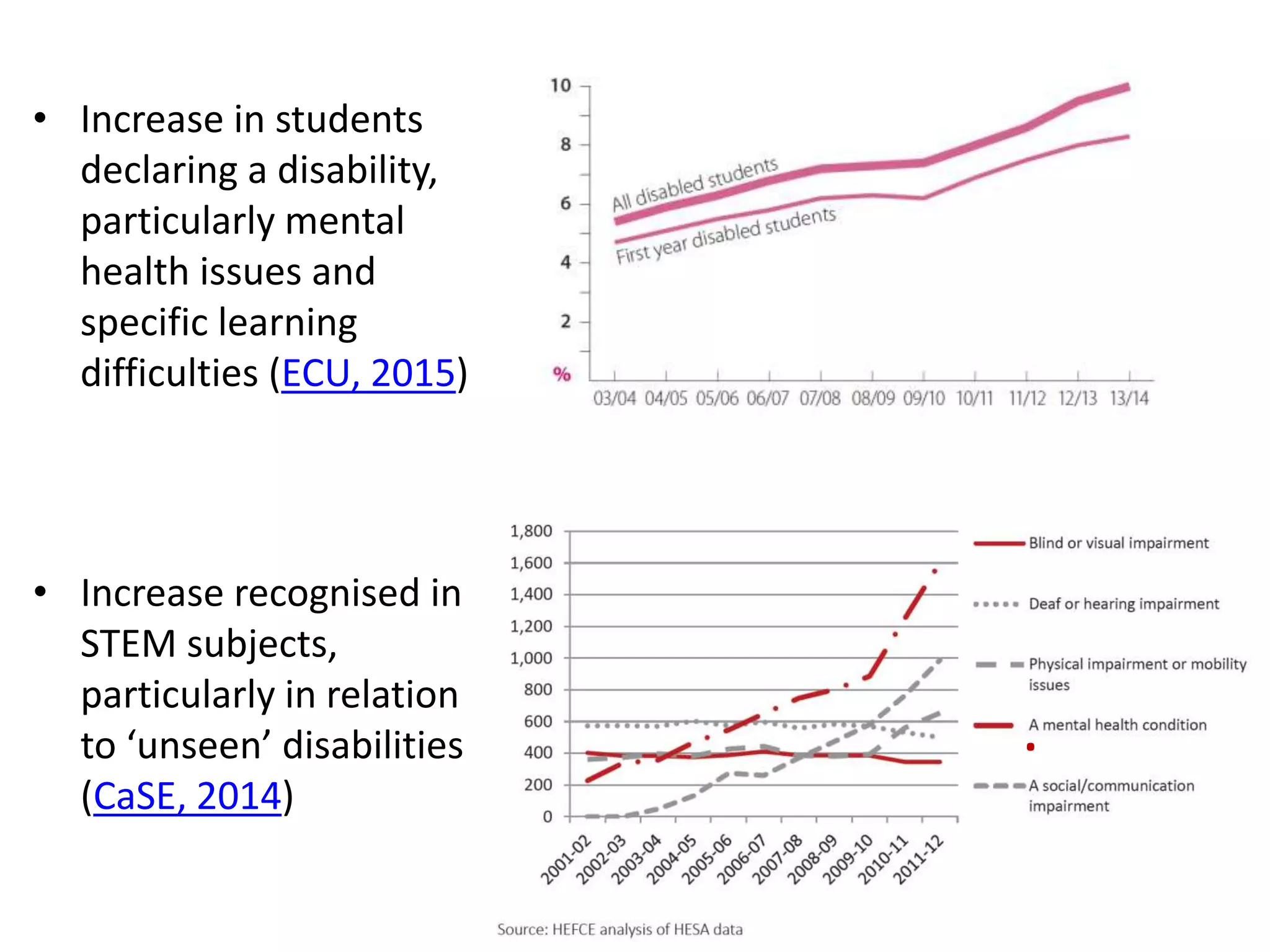
• Increase in students
declaring a disability,
particularly mental
health issues and
specific learning
difficulties (ECU, 2015)
• Increase recognised in
STEM subjects,
particularly in relation
to ‘unseen’ disabilities
(CaSE, 2014)
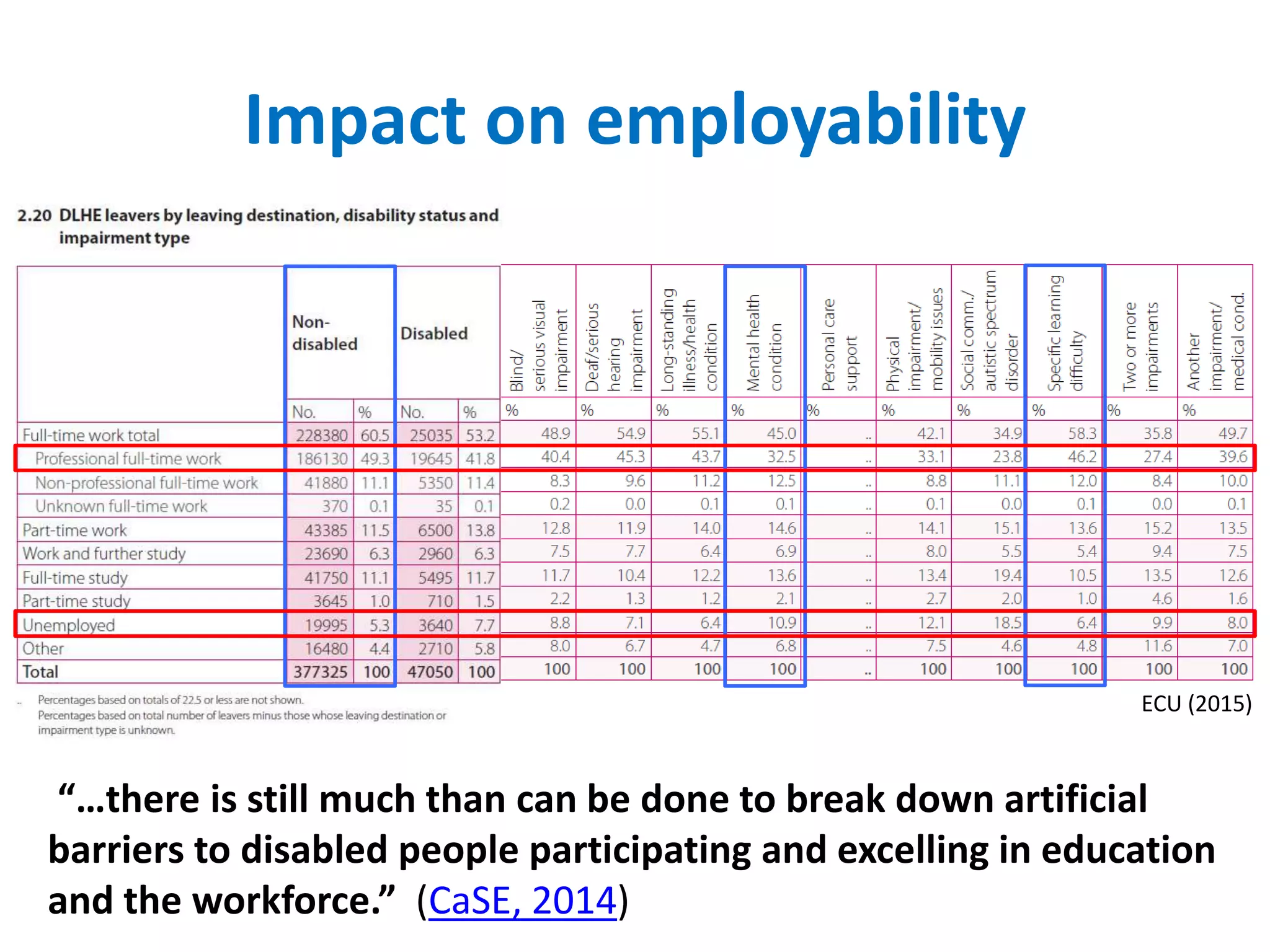
ECU (2015)
Impact on employability
“…there is still much than can be done to break down artificial
barriers to disabled people participating and excelling in education
and the workforce.” (CaSE, 2014)
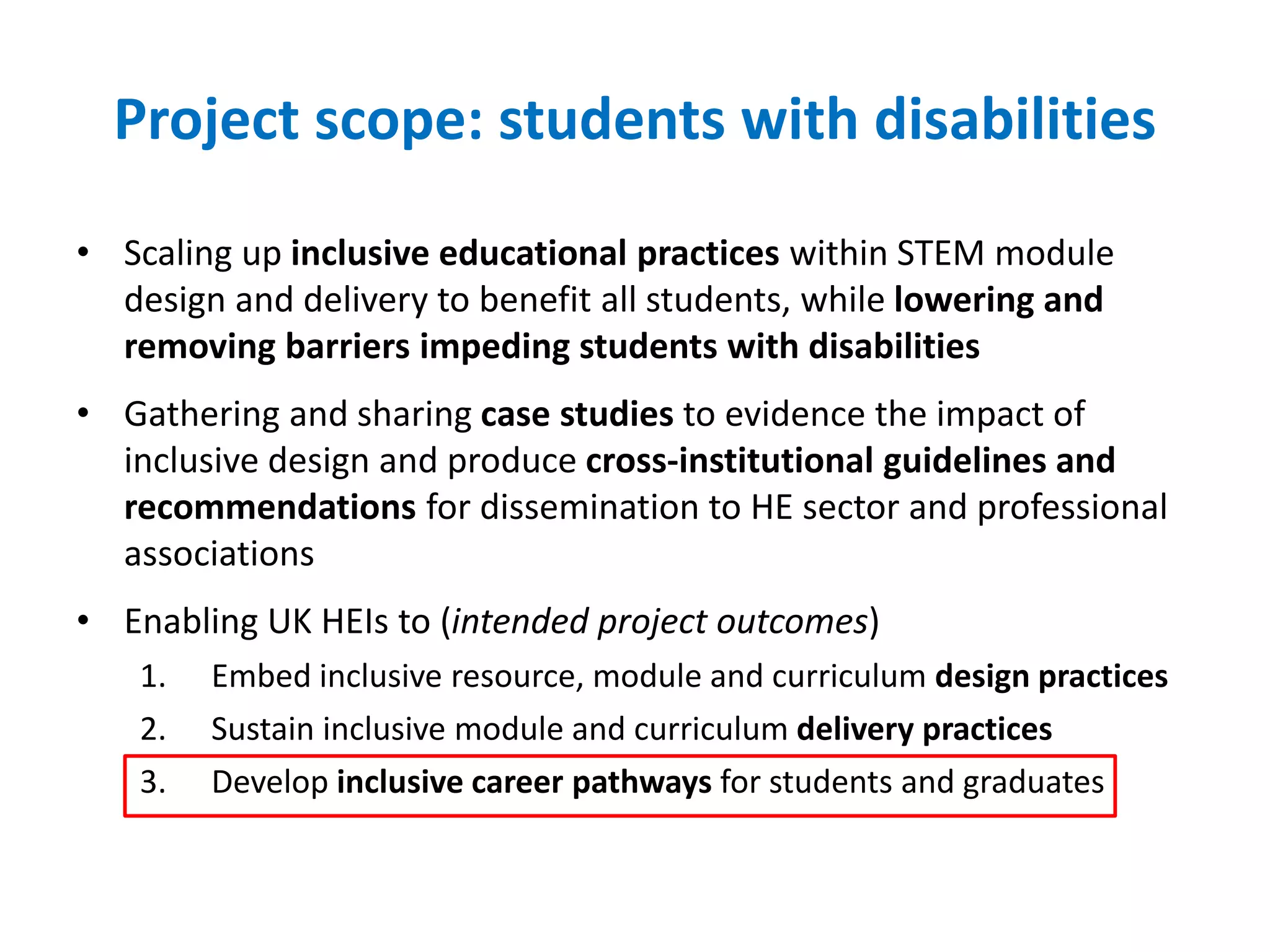
Project scope: students with disabilities
• Scaling up inclusive educational practices within STEM module
design and delivery to benefit all students, while lowering and
removing barriers impeding students with disabilities
• Gathering and sharing case studies to evidence the impact of
inclusive design and produce cross-institutional guidelines and
recommendations for dissemination to HE sector and professional
associations
• Enabling UK HEIs to (intended project outcomes)
1. Embed inclusive resource, module and curriculum design practices
2. Sustain inclusive module and curriculum delivery practices
3. Develop inclusive career pathways for students and graduates
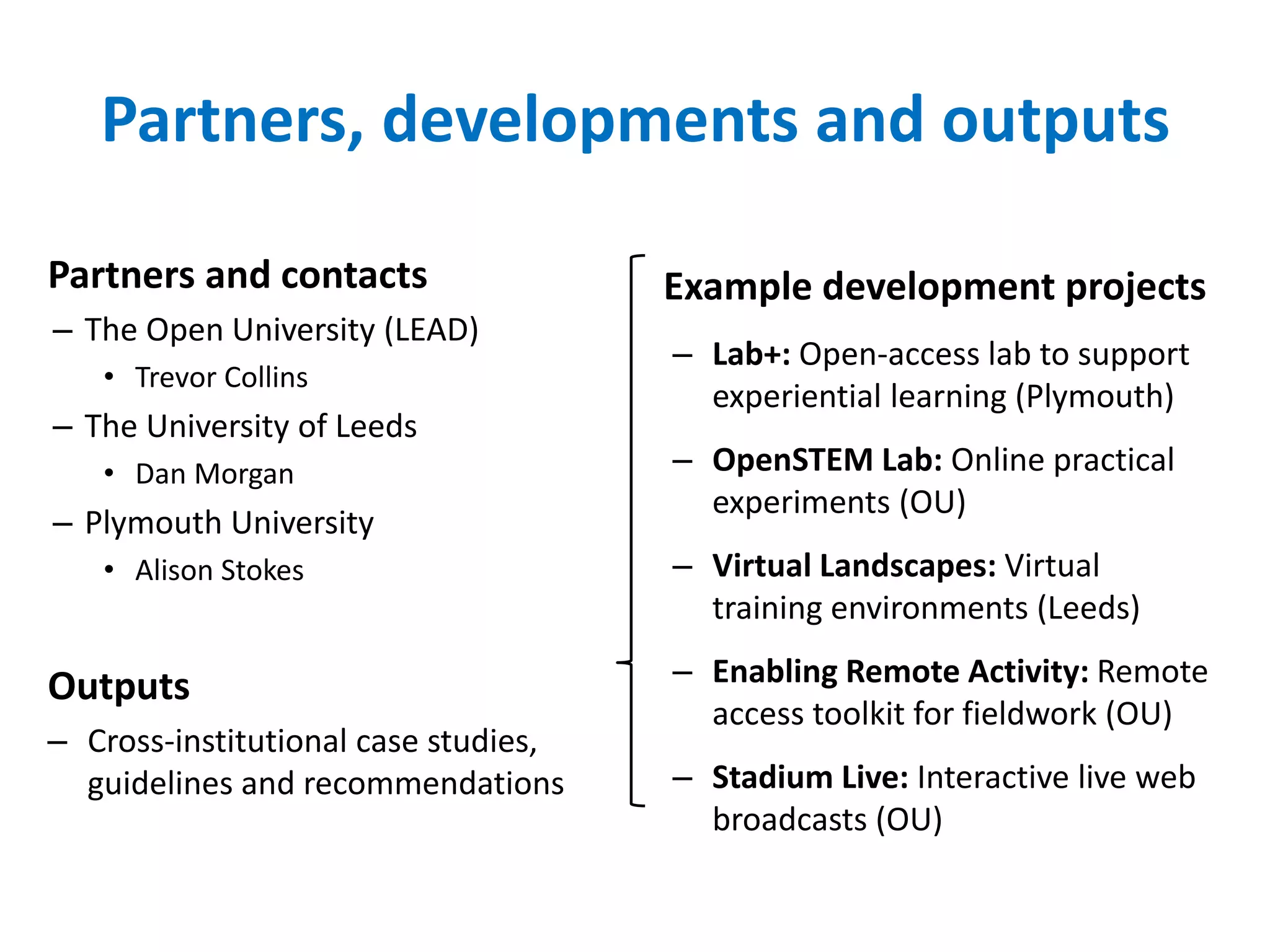
Partners, developments and outputs
Partners and contacts
– The Open University (LEAD)
• Trevor Collins
– The University of Leeds
• Dan Morgan
– Plymouth University
• Alison Stokes
Outputs
– Cross-institutional case studies,
guidelines and recommendations
Example development projects
– Lab+: Open-access lab to support
experiential learning (Plymouth)
– OpenSTEM Lab: Online practical
experiments (OU)
– Virtual Landscapes: Virtual
training environments (Leeds)
– Enabling Remote Activity: Remote
access toolkit for fieldwork (OU)
– Stadium Live: Interactive live web
broadcasts (OU)
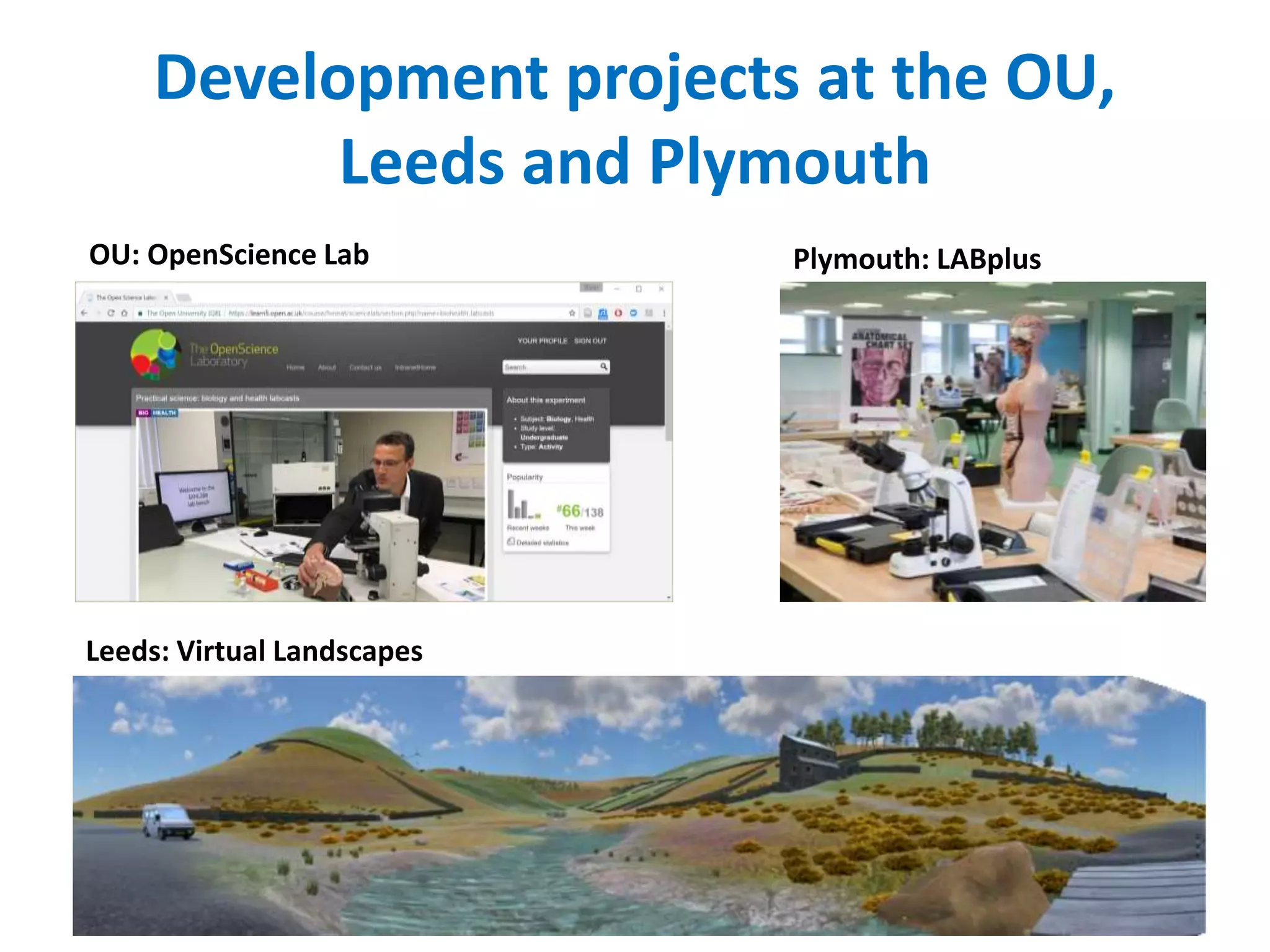
Development projects at the OU,
Leeds and Plymouth
OU: OpenScience Lab Plymouth: LABplus
Leeds: Virtual Landscapes
Engagement
• Institutional stakeholders
– Students
– Staff (e.g. lecturers, staff tutors, associate lecturers,
developers, designers, editors, disability support staff)
– External stakeholders
• Educational and professional networks
– Professional associations and accreditation bodies
– Disability support networks
Educational practitioner networks
• Accessing networks of senior staff for insight into needs and experiences in HE
• Engagement with project activities, e.g. accessible field course
• Immediate users of case studies produced by the project
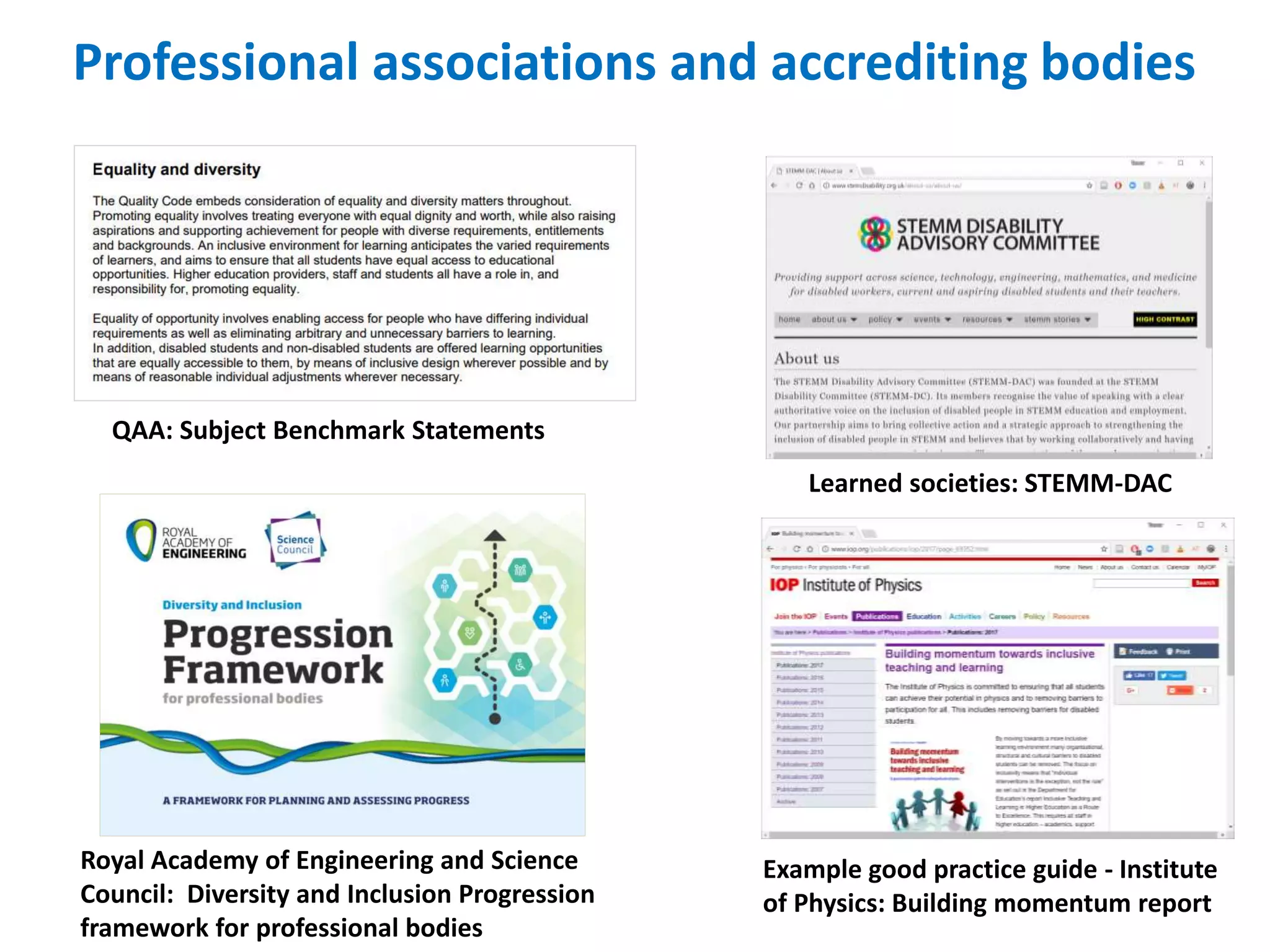
Professional associations and accrediting bodies
QAA: Subject Benchmark Statements
Learned societies: STEMM-DAC
Royal Academy of Engineering and Science
Council: Diversity and Inclusion Progression
framework for professional bodies
Example good practice guide - Institute
of Physics: Building momentum report
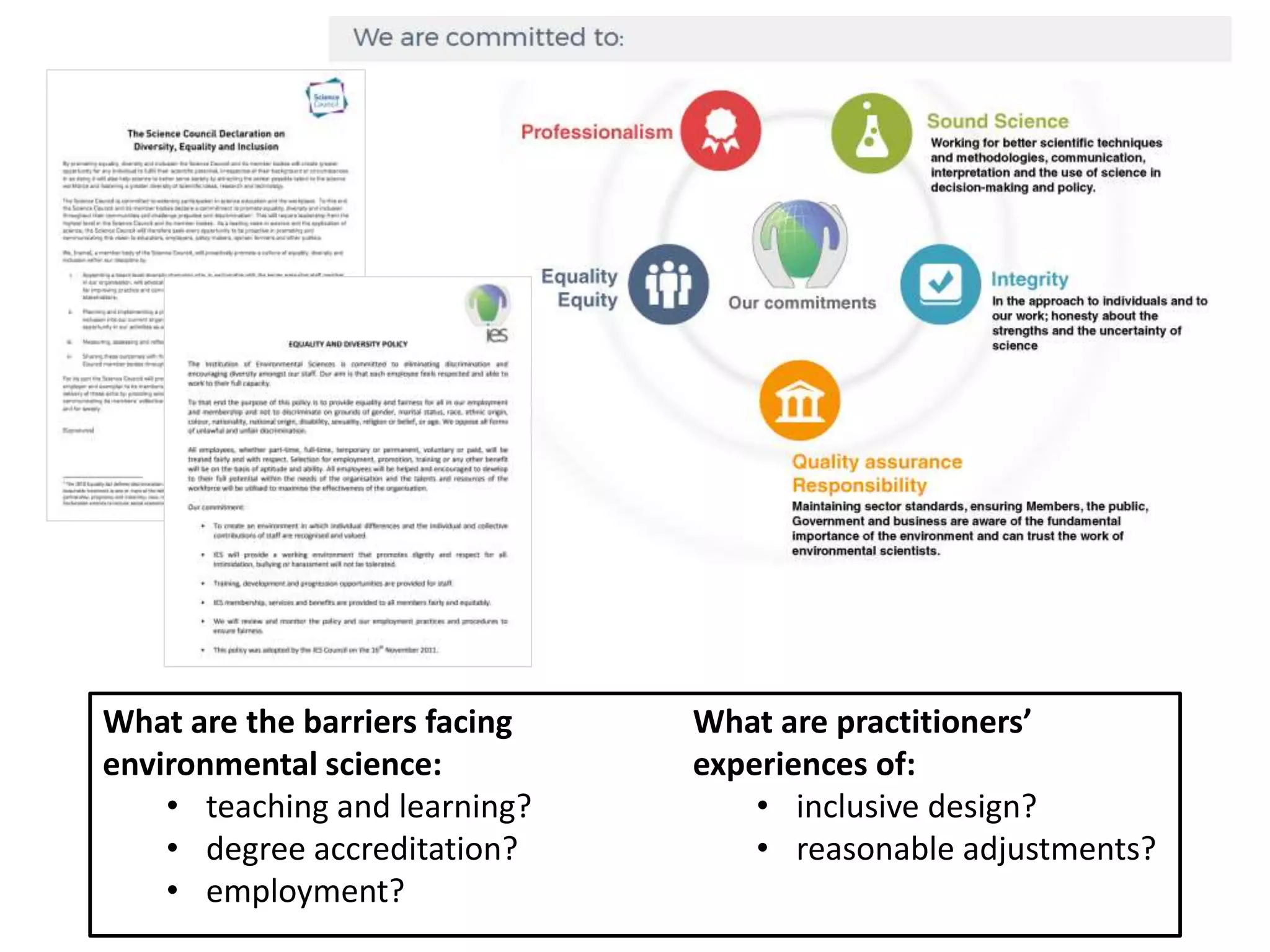
What are the barriers facing
environmental science:
• teaching and learning?
• degree accreditation?
• employment?
What are practitioners’
experiences of:
• inclusive design?
• reasonable adjustments?
Summary of progress to date
• Cross-institutional review of policy documentation,
procedures and development workflows re. inclusivity
• Baseline survey to capture awareness and attitudes of staff
and students re. inclusivity in the curriculum
• Scoping out of potential case studies to capture effective
practice
• Planning / scoping of accessible field course (Leeds)
• Initiating contact with practitioner networks and professional
/ accrediting bodies
Does accreditation help/hinder students and create/
dismantle barriers?
Some useful documents
• CaSE (2014) Improving Diversity in STEM. Campaign for Science and Engineering
Report.
• DSSLG (2017) Inclusive teaching and learning in higher education as a route to
excellence. A Department of Education report by the Disabled Student Sector
Leadership Group, January 2017.
• ECU (2015) Equality in higher education: statistical report 2015. Equality
Challenge Unit, November 2015.
• HEFCE (2016) Higher Education in England 2016 - HEFCE Key Facts report,
September 2016.
• IoP (2017) Building momentum towards inclusive teaching and learning: A guide
to good practice for undergraduate physics. Institute of Physics Report, April
2017. HEA report.
• Thomas, L. & May, H (2010) Inclusive learning and teaching in higher education.
• Squires, G. (1987) The curriculum, in: T. Becher (Ed.) British Higher Education,
pp.155-177 (London: Allen & Unwin).

Embedding and sustaining inclusive STEM practices

  • 1.
    Embedding and sustaining inclusiveSTEM practices Dr Alison Stokes School of Geography, Earth and Environmental Sciences Plymouth University
  • 2.
    Inclusive learning “To beinclusive, institutions should consider the diversity of the student body and embed principles of equality in the design, planning and evaluation of programmes, courses and modules.” (Thomas & May, 2010) “The curriculum on paper is only a script: the real curriculum is acted out and lived through.” (Squires, 1987)
  • 3.
    Call to action 1.Differential student outcomes (HEFCE, 2016) 2. Attainment gap for students with disabilities (ECU, 2015)
  • 4.
    . • Increase instudents declaring a disability, particularly mental health issues and specific learning difficulties (ECU, 2015) • Increase recognised in STEM subjects, particularly in relation to ‘unseen’ disabilities (CaSE, 2014)
  • 5.
    ECU (2015) Impact onemployability “…there is still much than can be done to break down artificial barriers to disabled people participating and excelling in education and the workforce.” (CaSE, 2014)
  • 6.
    Project scope: studentswith disabilities • Scaling up inclusive educational practices within STEM module design and delivery to benefit all students, while lowering and removing barriers impeding students with disabilities • Gathering and sharing case studies to evidence the impact of inclusive design and produce cross-institutional guidelines and recommendations for dissemination to HE sector and professional associations • Enabling UK HEIs to (intended project outcomes) 1. Embed inclusive resource, module and curriculum design practices 2. Sustain inclusive module and curriculum delivery practices 3. Develop inclusive career pathways for students and graduates
  • 7.
    Partners, developments andoutputs Partners and contacts – The Open University (LEAD) • Trevor Collins – The University of Leeds • Dan Morgan – Plymouth University • Alison Stokes Outputs – Cross-institutional case studies, guidelines and recommendations Example development projects – Lab+: Open-access lab to support experiential learning (Plymouth) – OpenSTEM Lab: Online practical experiments (OU) – Virtual Landscapes: Virtual training environments (Leeds) – Enabling Remote Activity: Remote access toolkit for fieldwork (OU) – Stadium Live: Interactive live web broadcasts (OU)
  • 8.
    Development projects atthe OU, Leeds and Plymouth OU: OpenScience Lab Plymouth: LABplus Leeds: Virtual Landscapes
  • 9.
    Engagement • Institutional stakeholders –Students – Staff (e.g. lecturers, staff tutors, associate lecturers, developers, designers, editors, disability support staff) – External stakeholders • Educational and professional networks – Professional associations and accreditation bodies – Disability support networks
  • 10.
    Educational practitioner networks •Accessing networks of senior staff for insight into needs and experiences in HE • Engagement with project activities, e.g. accessible field course • Immediate users of case studies produced by the project
  • 11.
    Professional associations andaccrediting bodies QAA: Subject Benchmark Statements Learned societies: STEMM-DAC Royal Academy of Engineering and Science Council: Diversity and Inclusion Progression framework for professional bodies Example good practice guide - Institute of Physics: Building momentum report
  • 12.
    What are thebarriers facing environmental science: • teaching and learning? • degree accreditation? • employment? What are practitioners’ experiences of: • inclusive design? • reasonable adjustments?
  • 13.
    Summary of progressto date • Cross-institutional review of policy documentation, procedures and development workflows re. inclusivity • Baseline survey to capture awareness and attitudes of staff and students re. inclusivity in the curriculum • Scoping out of potential case studies to capture effective practice • Planning / scoping of accessible field course (Leeds) • Initiating contact with practitioner networks and professional / accrediting bodies Does accreditation help/hinder students and create/ dismantle barriers?
  • 14.
    Some useful documents •CaSE (2014) Improving Diversity in STEM. Campaign for Science and Engineering Report. • DSSLG (2017) Inclusive teaching and learning in higher education as a route to excellence. A Department of Education report by the Disabled Student Sector Leadership Group, January 2017. • ECU (2015) Equality in higher education: statistical report 2015. Equality Challenge Unit, November 2015. • HEFCE (2016) Higher Education in England 2016 - HEFCE Key Facts report, September 2016. • IoP (2017) Building momentum towards inclusive teaching and learning: A guide to good practice for undergraduate physics. Institute of Physics Report, April 2017. HEA report. • Thomas, L. & May, H (2010) Inclusive learning and teaching in higher education. • Squires, G. (1987) The curriculum, in: T. Becher (Ed.) British Higher Education, pp.155-177 (London: Allen & Unwin).

Editor's Notes

  • #2 HEFCE Catalyst Fund Call B - 17 projects (£7.5M) Our project ~£460K Addressing barriers to student success 1st Mar 2017 to 28th Feb 2019 Project came about from recognition that STEM subjects can present barriers to students with disabilities, so by making teaching and learning more inclusive we should be able to improve recruitment and retention. Particularly important as we need STEM professionals.
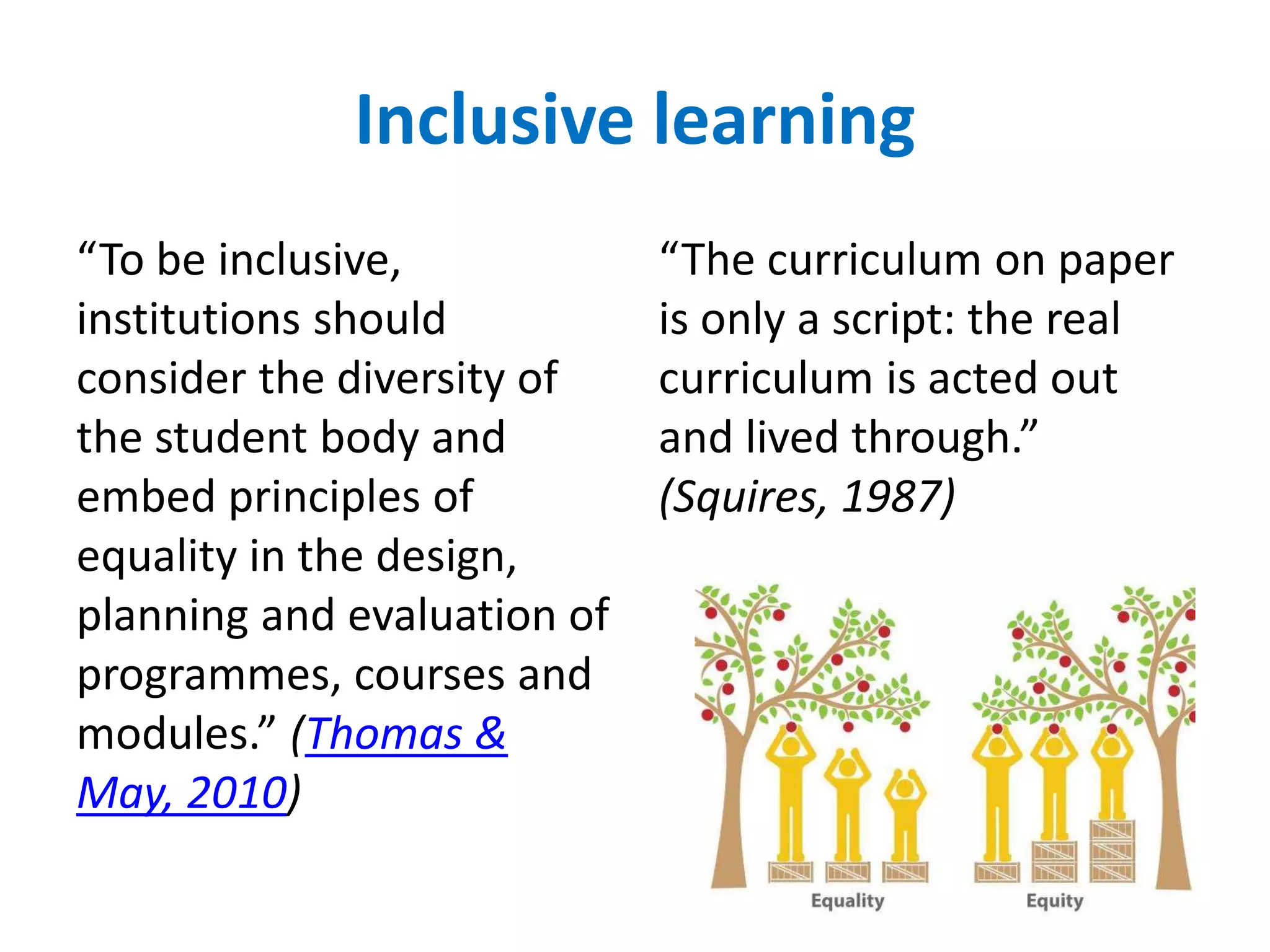
  • #3 A couple of quotes – the message here is that it’s one thing to embed inclusivity into curriculum design, but we also need to be inclusive in the way that we practice, and that’s often less straightforward. Interesting that the Thomas and May quote refers to equality (HEA report), whereas what we should really be considering is equity **find different quote?** **I CANNOT locate the source of the quote attributed to the HEA framework!** Equality = treating everyone the same Equity = giving everyone what they need to succeed
  • #4 HEFCE report: Differential student outcomes (attainment gaps): students from low socio-economic groups, students from black and minority ethnic groups, and students with disabilities. SWD less likely to progress in UG study If they do progress through to the end of a degree programme, they are less likely to come away with a ‘good’ degree, i.e. 1st or 2i.
  • #5 MH/SLD: focus specific by HEFCE Upward trend over the past decade in students with disabilities coming to university (averaged across all subjects) Currently in excess of 10% At Plymouth this is over so well over the national average (OU also high)!! Data specific to STEM students show: Significant increase in mental health, or social/communication impairment Unclear if increase in MHIs due to increased access to university, or increased levels of diagnosis and declaration Important = these conditions are typically UNSEEN **These are the conditions that we are most likely to encounter, so need to be particularly mindful of when designing fieldwork** Example – PU saw 45% between 2012-13 and 2013-14 in students declaring MH issues (all subjects) Majority (90%) are “unseen”
  • #6 Less likely to attain ‘good’ degree and less likely to move into FT professional work. Two issues: i) gaining a good degree, and ii) gaining employment Are there any changes to accreditation that could help to reduce the attainment gap? How can professional and accrediting bodies help to improve the employability of SWD? Disabled students without DSA have the lowest progression into jobs and graduate level outcomes, below the sector adjusted average (HEFCE report into differential outcomes, 2015)
  • #7 HEFCE Catalyst projects are all focused on attainment gap, but ours is specifically focused on SWD (and I think is the only one): MHI & SpLD Specific focus on STEM pedagogies involving labwork, fieldwork and online learning Staff and student knowledge, skills and attitudes Implications for accreditation (attainment) and employment
  • #8 Development projects: facilities already in existence to support LWD that will be used as a basis for case studies etc.
  • #9 OU: online practical experiments PU: open access, fully-resourced hands-on practice for skills devt Leeds: virtual training envts for hands-on fieldwork (cross-over) Full range of remote to hands-on engagement Mention Leeds accessible fieldcourse.
  • #10 External stakeholders = 3rd party providers of services, e.g. Moodle BUT: also other HEIs, e.g. we need other institutions to tell us what they already do well, what they need help with, perhaps contribute to a case study?
  • #11 The educational/practitioner networks (HUBS, UGUK) will hopefully give us access to a network of senior staff that can provide insight into the needs and experiences of HE lecturers in distinct discipline groups. They will be the immediate users of any case studies we produce regarding inclusive teaching and learning in HE, and are therefore a primary target group to engage with throughout the project (i.e. we should welcome contribution from them for case studies). Already met with HUBS, UGUK scheduled for November.
  • #12 The professional networks and accrediting bodies are being grouped together, but depending on the specific context they might have overlapping or distinct roles. In the contexts of degree accreditation we’re particularly interested in how the accreditation schemes engage with Equality and Diversity – some are more inclusive than others, but arguably if their schemes are accrediting courses with identifiable attainment gaps then they are not delivering what the QAA Subject Specifications requirements on Equality and Diversity. Many professional associations sign up to the Royal Society’s Equality and Diversity Manifesto (including Geol Soc and IES) but then do little or no further action to monitor or review inclusion (hence the new RAEng/Royal Society progression framework).
  • #13 The professional networks in some disciplines are very engaged with employers and CPD, but again the relative prominence of Equality, Diversity and Inclusion varies here. The Engineering Council for example have done extensive (and really good) work on Women in Engineering, but you’d be hard pushed to find much work on their website regarding people with disabilities. From the IES manifesto… Indicates a commitment to equality and equity. The IES is a signatory to the Science Council's Declaration on Diversity, Equality and Inclusion. Has an equality and diversity policy, but nothing specifically addressing disability? Women in ES Steering Group Not limiting relationships to just education or just diversity, i.e. could look to engage with both CHES and IES. Starting points for discussion might include….
  • #14 Final question: would welcome CHES/IES help in exploring this question!!