RURAL DEVELOPMENT PLANNING
 M.USAMA MANSOOR 110603010
 HINA SIDDIQUI 13011003003
RURAL DEVELOPMENT AND PLANNING
 Rural development and planning generally
refers to the process of improving the quality
of life and economic well-being of people
living in relatively isolated and sparsely
populated areas.
Moseley, Malcolm J. (2003). Rural development : principles and practice (1. publ. ed.). London [u.a.]: SAGE. p. 5. ISBN 0-7619-4766-3.
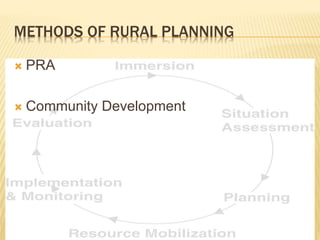
METHODS OF RURAL PLANNING
 PRA
 Community Development
PRA
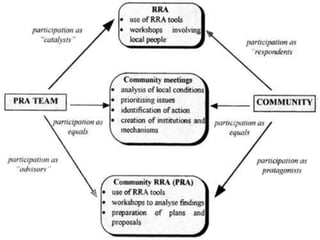
 Participatory rural appraisal (PRA) is an
approach used by non-governmental
organizations (NGOs) and other agencies
involved in international development. The
approach aims to incorporate the knowledge
and opinions of rural people in the planning
and management of development projects
and programmes.
METHODS USED IN PRA
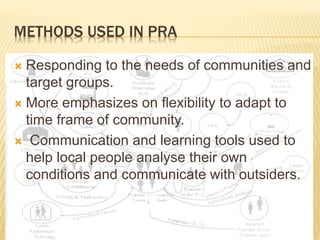
 Responding to the needs of communities and
target groups.
 More emphasizes on flexibility to adapt to
time frame of community.
 Communication and learning tools used to
help local people analyse their own
conditions and communicate with outsiders.
 Focus of PRA decided by communities.
 End product mainly used by community.
 Enables (empowers) communities to make
demands on development agencies and
institutions
 Closely linked to action or intervention and
requiring immediate availability of support for
decisions and conclusions reached by
communities as a result of the PRA
COMMUNITY DEVELOPMENT
 Community development can be tentatively defined as a process
designed to create conditions of economic and social progress for the
whole community with its active participation and the fullest possible
reliance upon the community's initiative. It includes
 a. Physical improvements such as roads, housing, irrigation, drainage
and better farming practices.
 b. Functional activities such as health, education and recreation.
 c. Community action involving group discussion Community action
involving group discussion Community analyses of local needs, the
setting up of committees, seeking of needed technical assistance and
the selection and training of personal through governmental
programmes or NGO’s.
 http://www.scribd.com/doc/18906031/Introduction-to-Rural-Community-
Development
IDENTIFYING PROBLEM
 Community Development is a continuous process of social action by which the
people of a Community.
 a. Define their common and group needs.
 b. Organize themselves formally and informally for democratic planning action.
 c. Make group and individual plans to meet their needs and solve their problems.
 d. Execute their plans with maximum reliance upon their own resources.
 e. Supplement their resources from outside the community, when, necessary,
with services and personnel.- International co-operation Administration.
 http://www.scribd.com/doc/18906031/Introduction-to-Rural-Community-
Development
MOBILIZATION OF RESOURCES THROUGH (TRAINING)
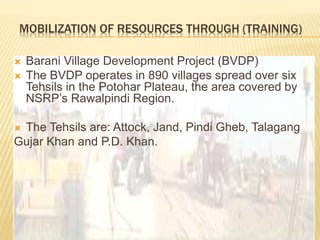
 Barani Village Development Project (BVDP)
 The BVDP operates in 890 villages spread over six
Tehsils in the Potohar Plateau, the area covered by
NSRP’s Rawalpindi Region.
 The Tehsils are: Attock, Jand, Pindi Gheb, Talagang
Gujar Khan and P.D. Khan.
CONCERN MINISTRIES ON AGRICULTURAL
DEVELOPMENT
 Following are the concern ministries on
Agriculture Development in Pakistan:
 Ministry of Planning, Development and
Reforms
 Punjab Agriculture Department
ROLE OF MINISTRY OF PLANNING, DEVELOPMENT AND REFORM IN AGRICULTURE
 After the devolution of agriculture sector to the
provinces under 18th amendment, food security
and coordination between federal and provincial
institutes engaged in agriculture research and
development has become very vital. In this
situation, there is a need to revamp the national
agricultural research system and boost activities
to improve coordination in order to avoid
duplication and overcome wastage of already
meager available resources.
 http://pc.gov.pk/annual%20plans/2013-14/8-Agriculture%20&%20Food%20Security.pdf
 Agriculture Productivity and Food Security
 Agriculture Marketing, Trade and
Competitiveness
 System Sustainability
 The Agriculture Department was established
in United India by the British regime during
1880s. The duties assigned were crop
improvement through the introduction of
improved varieties/breeds of crops and
cattle, development of forest cover on barren
lands and enhancement of cottage industry
in the country.
PROJECTS BY AGRICULTURAL DEPARTMENT PUNJAB
 Four projects are being completed in the district with the coordination of various
government agencies.
 Integration of Research and Extension Activities has successfully been
completed during 2002-005. Now rice transplanting technique was introduced
which save labor and time of the farmer community.
 Crop Maximization Project has been completed very successfully during 2002-
2006. Now the second phase has been launched in 72-Villages. In this project
justified use of inputs, provision of loans, provision of latest machinery and fist
hand information increased the farm income and the crop production was raised
by 25% in the project area.
 APL project of PARC/TTI has been completed in the Peero Chak Union Council
and the farmers were provided with latest technology of crop production and
animal husbandry
 Survey for the implementation of project Establishment of Agro Services Centres
in Satrah Markaz has been completed.
 http://punjab.gov.pk/sialkot_agriculture_department
Rural development planning

Rural development planning

  • 1.
    RURAL DEVELOPMENT PLANNING M.USAMA MANSOOR 110603010  HINA SIDDIQUI 13011003003
  • 2.
    RURAL DEVELOPMENT ANDPLANNING  Rural development and planning generally refers to the process of improving the quality of life and economic well-being of people living in relatively isolated and sparsely populated areas. Moseley, Malcolm J. (2003). Rural development : principles and practice (1. publ. ed.). London [u.a.]: SAGE. p. 5. ISBN 0-7619-4766-3.
  • 3.
    METHODS OF RURALPLANNING  PRA  Community Development
  • 4.
    PRA  Participatory ruralappraisal (PRA) is an approach used by non-governmental organizations (NGOs) and other agencies involved in international development. The approach aims to incorporate the knowledge and opinions of rural people in the planning and management of development projects and programmes.
  • 5.
    METHODS USED INPRA  Responding to the needs of communities and target groups.  More emphasizes on flexibility to adapt to time frame of community.  Communication and learning tools used to help local people analyse their own conditions and communicate with outsiders.
  • 6.
     Focus ofPRA decided by communities.  End product mainly used by community.  Enables (empowers) communities to make demands on development agencies and institutions  Closely linked to action or intervention and requiring immediate availability of support for decisions and conclusions reached by communities as a result of the PRA
  • 8.
    COMMUNITY DEVELOPMENT  Communitydevelopment can be tentatively defined as a process designed to create conditions of economic and social progress for the whole community with its active participation and the fullest possible reliance upon the community's initiative. It includes  a. Physical improvements such as roads, housing, irrigation, drainage and better farming practices.  b. Functional activities such as health, education and recreation.  c. Community action involving group discussion Community action involving group discussion Community analyses of local needs, the setting up of committees, seeking of needed technical assistance and the selection and training of personal through governmental programmes or NGO’s.  http://www.scribd.com/doc/18906031/Introduction-to-Rural-Community- Development
  • 9.
    IDENTIFYING PROBLEM  CommunityDevelopment is a continuous process of social action by which the people of a Community.  a. Define their common and group needs.  b. Organize themselves formally and informally for democratic planning action.  c. Make group and individual plans to meet their needs and solve their problems.  d. Execute their plans with maximum reliance upon their own resources.  e. Supplement their resources from outside the community, when, necessary, with services and personnel.- International co-operation Administration.  http://www.scribd.com/doc/18906031/Introduction-to-Rural-Community- Development
  • 10.
    MOBILIZATION OF RESOURCESTHROUGH (TRAINING)  Barani Village Development Project (BVDP)  The BVDP operates in 890 villages spread over six Tehsils in the Potohar Plateau, the area covered by NSRP’s Rawalpindi Region.  The Tehsils are: Attock, Jand, Pindi Gheb, Talagang Gujar Khan and P.D. Khan.
  • 11.
    CONCERN MINISTRIES ONAGRICULTURAL DEVELOPMENT  Following are the concern ministries on Agriculture Development in Pakistan:  Ministry of Planning, Development and Reforms  Punjab Agriculture Department
  • 12.
    ROLE OF MINISTRYOF PLANNING, DEVELOPMENT AND REFORM IN AGRICULTURE  After the devolution of agriculture sector to the provinces under 18th amendment, food security and coordination between federal and provincial institutes engaged in agriculture research and development has become very vital. In this situation, there is a need to revamp the national agricultural research system and boost activities to improve coordination in order to avoid duplication and overcome wastage of already meager available resources.  http://pc.gov.pk/annual%20plans/2013-14/8-Agriculture%20&%20Food%20Security.pdf
  • 13.
     Agriculture Productivityand Food Security  Agriculture Marketing, Trade and Competitiveness  System Sustainability
  • 14.
     The AgricultureDepartment was established in United India by the British regime during 1880s. The duties assigned were crop improvement through the introduction of improved varieties/breeds of crops and cattle, development of forest cover on barren lands and enhancement of cottage industry in the country.
  • 15.
    PROJECTS BY AGRICULTURALDEPARTMENT PUNJAB  Four projects are being completed in the district with the coordination of various government agencies.  Integration of Research and Extension Activities has successfully been completed during 2002-005. Now rice transplanting technique was introduced which save labor and time of the farmer community.  Crop Maximization Project has been completed very successfully during 2002- 2006. Now the second phase has been launched in 72-Villages. In this project justified use of inputs, provision of loans, provision of latest machinery and fist hand information increased the farm income and the crop production was raised by 25% in the project area.  APL project of PARC/TTI has been completed in the Peero Chak Union Council and the farmers were provided with latest technology of crop production and animal husbandry  Survey for the implementation of project Establishment of Agro Services Centres in Satrah Markaz has been completed.  http://punjab.gov.pk/sialkot_agriculture_department