What is a rural area?
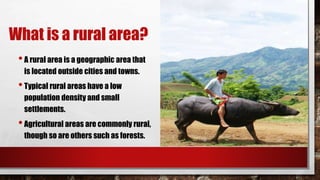
•A rural area is a geographic area that
is located outside cities and towns.
•Typical rural areas have a low
population density and small
settlements.
•Agricultural areas are commonly rural,
though so are others such as forests.
What is a rural area?
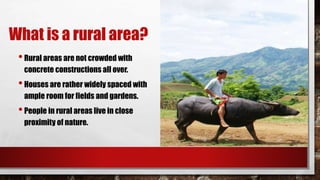
•Rural areas are not crowded with
concrete constructions all over.
•Houses are rather widely spaced with
ample room for fields and gardens.
•People in rural areas live in close
proximity of nature.
What is a rural area?
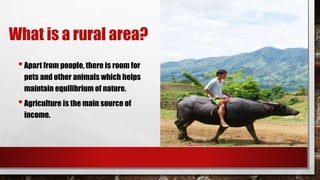
•Apart from people, there is room for
pets and other animals which helps
maintain equilibrium of nature.
•Agriculture is the main source of
income.
RURAL/URBAN CLASSIFICATION
•RURAL AREAS – all poblaciones or central districts and all barrios that do not
meet the requirements for classification of urban.
•CATEGORIES
•1. In their entirety, all municipal jurisdiction which whether designated
chartered cities, provincial capital or not, have a population density of at
least 1,000 person per square kilometers: all barangays;
•2. Poblaciones or central district of municipalities and cities with have a
population density of at least 500 persons square kilometer.
•3. Poblaciones or central district not included in (1) and (2) regardless of the
population size which have the following:
• Street pattern or network of streets in either parallel or right angle orientation
• At least six establishments (commercial, manufacturing, recreational and/or personal
services
RURAL/URBAN CLASSIFICATION
• AT LEAST THREE OF THE FOLLOWING:
• A. Town hall, church or chapel with religious service at least once a month
• B. A public plaza, park or cemetery
• C. A market place or building where trading activities are carried on at least once a
week
• D. A public building, like a school, hospital and health center or library
•4. Barangays having at least 1000 inhabitants with meets the condition
set forth in (3) above and where the occupation of the inhabitants is
predominantly non-farming or fishing.
RURAL/URBAN CLASSIFICATION
What is development?
•a process of continues rise in the capability of
the people to control their present and future
well being.
•Therefore, development as a process involves
both economic growth and social development.
DEVELOPMENT INCLUDES:
• The people (self esteem, dignity,
security, potential)
•The economy
•Technology
•Culture
•Moral values
•Environmental preservation
•Social justice
• literacy and education
• Change in social structure
• Equal distribution of wealth
• Organization
• Discipline
• Freedom (from servitude, debt, etc.)
• Control over political destiny
• Peace and order
Definition of Rural Development
•Rural development generally refers to the process of
improving the quality of life and economic well-being of
people living in relatively isolated and sparsely populated
areas.
•Rural development has traditionally centered on the
exploitation of land-intensive natural resources such as
agriculture and forestry
Definition of Rural Development
•Financial, human and management is the object of rural
development.
•The theory of regional development gives following definition
of rural development:
• a change which not only includes certain economic indicators but
also to increase the welfare of the rural population so as to solve
their basic problems and exploit opportunities for economic
growth.
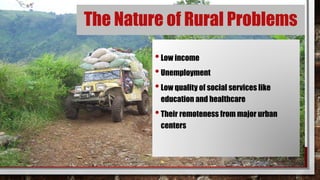
The Nature of Rural Problems
•Low income
•Unemployment
•Low quality of social services like
education and healthcare
•Their remoteness from major urban
centers
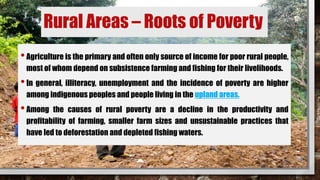
Rural Areas – Roots of Poverty
•Agriculture is the primary and often only source of income for poor rural people,
most of whom depend on subsistence farming and fishing for their livelihoods.
•In general, illiteracy, unemployment and the incidence of poverty are higher
among indigenous peoples and people living in the upland areas.
•Among the causes of rural poverty are a decline in the productivity and
profitability of farming, smaller farm sizes and unsustainable practices that
have led to deforestation and depleted fishing waters.
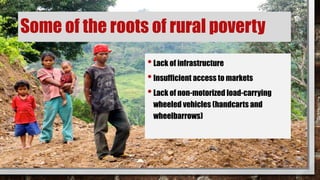
Some of the roots of rural poverty
•Lack of infrastructure
•Insufficient access to markets
•Lack of non-motorized load-carrying
wheeled vehicles (handcarts and
wheelbarrows)
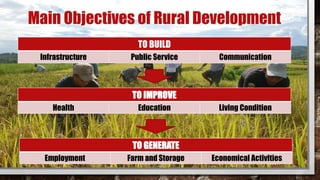
Main Objectives of Rural Development
TO BUILD
Infrastructure Public Service Communication
TO IMPROVE
Health Education Living Condition
TO GENERATE
Employment Farm and Storage Economical Activities
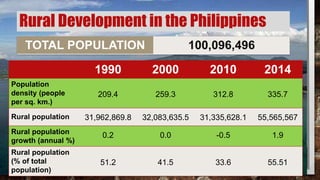
Rural Development in the Philippines
1990 2000 2010 2014
Population
density (people
per sq. km.)
209.4 259.3 312.8 335.7
Rural population 31,962,869.8 32,083,635.5 31,335,628.1 55,565,567
Rural population
growth (annual %)
0.2 0.0 -0.5 1.9
Rural population
(% of total
population)
51.2 41.5 33.6 55.51
TOTAL POPULATION 100,096,496
Rural Development in the Philippines
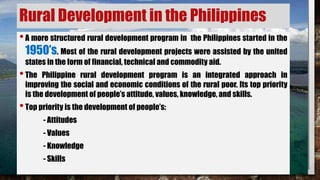
•A more structured rural development program in the Philippines started in the
1950’s. Most of the rural development projects were assisted by the united
states in the form of financial, technical and commodity aid.
•The Philippine rural development program is an integrated approach in
improving the social and economic conditions of the rural poor. Its top priority
is the development of people’s attitude, values, knowledge, and skills.
•Top priority is the development of people’s:
- Attitudes
- Values
- Knowledge
- Skills
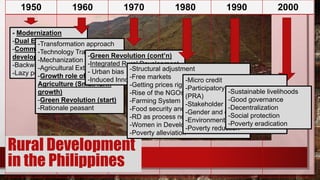
1950 1960 1970 1980 1990 2000
- Modernization
-Dual Economy model
-Community
development
-Backward agriculture
-Lazy peasant
-Transformation approach
-Technology Transfer
-Mechanization
-Agricultural Extension
-Growth role of
Agriculture (Small farm
growth)
-Green Revolution (start)
-Rationale peasant
-Green Revolution (cont’n)
-Integrated Rural Development
- Urban bias
-Induced Innovation
Rural Development
in the Philippines
-Structural adjustment
-Free markets
-Getting prices right
-Rise of the NGOs
-Farming System Research (FSR)
-Food security and famine analysis
-RD as process not product
-Women in Development
-Poverty alleviation
-Micro credit
-Participatory rural appraisal
(PRA)
-Stakeholder analysis
-Gender and development
-Environment and sustainability
-Poverty reduction
-Sustainable livelihoods
-Good governance
-Decentralization
-Social protection
-Poverty eradication
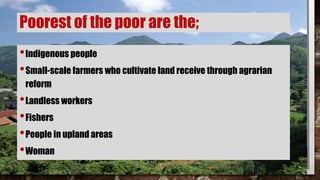
•Indigenous people
•Small-scale farmers who cultivate land receive through agrarian
reform
•Landless workers
•Fishers
•People in upland areas
•Woman
Poorest of the poor are the;
TheKey Programs of the Government for Rural
Development are:
•Agrarian Reform
•Cooperatives
•Labor-intensive industries
•Manpower development
•The KKK
The strategy for rural development takes
into consideration the needs, problems,
and resources of every region in the
country.
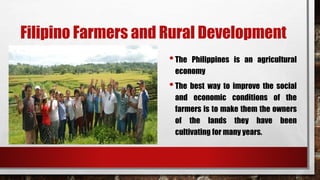
Filipino Farmers and Rural Development
•The Philippines is an agricultural
economy
•The best way to improve the social
and economic conditions of the
farmers is to make them the owners
of the lands they have been
cultivating for many years.
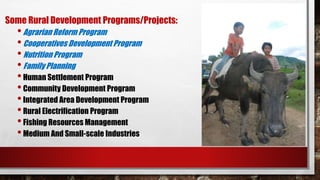
Some Rural Development Programs/Projects:
•Agrarian Reform Program
•Cooperatives Development Program
•Nutrition Program
•Family Planning
•Human Settlement Program
•Community Development Program
•Integrated Area Development Program
•Rural Electrification Program
•Fishing Resources Management
•Medium And Small-scale Industries
Comprehensive Agrarian Reform Program
•Commonly known as CARP, is an Agrarian Reform Law of the Philippines
passed In 1988 (Republic Act No. 6657). It is part of the long history of
attempts at land reform in the Philippines. The law was outlined by former
President Corazon C. Aquino through Presidential Proclamation 131 And
Executive Order 229 on June 22, 1987.
•In this program, all lands exceeding seven hectares were to be bought by
the government and sold to the landless farmers. Previous owners of the
land were paid in installments for 15 years
Cooperative Development Authority (CDA)
•Is a government agency created by virtue of Republic Act No. 6939 in
compliance with the Provisions of Section 15, Article XII of the Philippine
Constitution of 1987 which mandates Congress to create an agency to promote
the viability and growth of cooperatives as instruments for equity, social justice
and economic development. RA 6939 was signed into law on march 10, 1990.
Philippine Plan of Action for Nutrition
•Is the country's response to malnutrition.
•An integral component and as a companion plan of the Philippine Development
Plan (PDP), 2011-2016, PPAN provides the framework for improving the nutritional
status of Filipinos. The NNC believes that nutrition should and would have
influence and would be influenced by other concerns in the PDP -- from pursuit
of inclusive growth to macroeconomic policy, industry, agriculture and
fisheries, infrastructure, governance, peace and security, and environment and
natural resources.
The Philippine Family Planning Program (PFPP)
•Has been implemented for about 38 years which started from a
demographic perspective to a health intervention oriented
program.
•Four (4) Pillars / Guiding Principles OF THE PFPP
- Responsible parenthood
- Respect for life
- Birth spacing
- Informed choice
Philippine Rural Development Program
•The Rural Development Project for the Philippines aims to increase rural
incomes and enhance farm and fishery productivity in targeted areas by
supporting smallholders and fisheries to increase their marketable surpluses
and their access to markets.
•This will be achieved through: (a) supporting changes in agricultural and
fisheries planning, resource programming and implementation practices; and
(b) financing priority local investments in rural infrastructure and enterprise
development derived from agricultural and fisheries modernization plans, using
a value chain approach, and through stakeholder consultations.
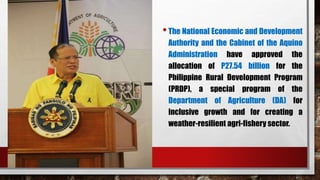
•The National Economic and Development
Authority and the Cabinet of the Aquino
Administration have approved the
allocation of P27.54 billion for the
Philippine Rural Development Program
(PRDP), a special program of the
Department of Agriculture (DA) for
inclusive growth and for creating a
weather-resilient agri-fishery sector.
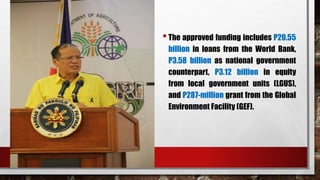
•The approved funding includes P20.55
billion in loans from the World Bank,
P3.58 billion as national government
counterpart, P3.12 billion in equity
from local government units (LGUS),
and P287-million grant from the Global
Environment Facility (GEF).
Rural Development

Rural Development

  • 3.
    What is arural area? •A rural area is a geographic area that is located outside cities and towns. •Typical rural areas have a low population density and small settlements. •Agricultural areas are commonly rural, though so are others such as forests.
  • 4.
    What is arural area? •Rural areas are not crowded with concrete constructions all over. •Houses are rather widely spaced with ample room for fields and gardens. •People in rural areas live in close proximity of nature.
  • 5.
    What is arural area? •Apart from people, there is room for pets and other animals which helps maintain equilibrium of nature. •Agriculture is the main source of income.
  • 6.
    RURAL/URBAN CLASSIFICATION •RURAL AREAS– all poblaciones or central districts and all barrios that do not meet the requirements for classification of urban. •CATEGORIES •1. In their entirety, all municipal jurisdiction which whether designated chartered cities, provincial capital or not, have a population density of at least 1,000 person per square kilometers: all barangays;
  • 7.
    •2. Poblaciones orcentral district of municipalities and cities with have a population density of at least 500 persons square kilometer. •3. Poblaciones or central district not included in (1) and (2) regardless of the population size which have the following: • Street pattern or network of streets in either parallel or right angle orientation • At least six establishments (commercial, manufacturing, recreational and/or personal services RURAL/URBAN CLASSIFICATION
  • 8.
    • AT LEASTTHREE OF THE FOLLOWING: • A. Town hall, church or chapel with religious service at least once a month • B. A public plaza, park or cemetery • C. A market place or building where trading activities are carried on at least once a week • D. A public building, like a school, hospital and health center or library •4. Barangays having at least 1000 inhabitants with meets the condition set forth in (3) above and where the occupation of the inhabitants is predominantly non-farming or fishing. RURAL/URBAN CLASSIFICATION
  • 9.
    What is development? •aprocess of continues rise in the capability of the people to control their present and future well being. •Therefore, development as a process involves both economic growth and social development.
  • 10.
    DEVELOPMENT INCLUDES: • Thepeople (self esteem, dignity, security, potential) •The economy •Technology •Culture •Moral values •Environmental preservation •Social justice • literacy and education • Change in social structure • Equal distribution of wealth • Organization • Discipline • Freedom (from servitude, debt, etc.) • Control over political destiny • Peace and order
  • 11.
    Definition of RuralDevelopment •Rural development generally refers to the process of improving the quality of life and economic well-being of people living in relatively isolated and sparsely populated areas. •Rural development has traditionally centered on the exploitation of land-intensive natural resources such as agriculture and forestry
  • 12.
    Definition of RuralDevelopment •Financial, human and management is the object of rural development. •The theory of regional development gives following definition of rural development: • a change which not only includes certain economic indicators but also to increase the welfare of the rural population so as to solve their basic problems and exploit opportunities for economic growth.
  • 13.
    The Nature ofRural Problems •Low income •Unemployment •Low quality of social services like education and healthcare •Their remoteness from major urban centers
  • 14.
    Rural Areas –Roots of Poverty •Agriculture is the primary and often only source of income for poor rural people, most of whom depend on subsistence farming and fishing for their livelihoods. •In general, illiteracy, unemployment and the incidence of poverty are higher among indigenous peoples and people living in the upland areas. •Among the causes of rural poverty are a decline in the productivity and profitability of farming, smaller farm sizes and unsustainable practices that have led to deforestation and depleted fishing waters.
  • 15.
    Some of theroots of rural poverty •Lack of infrastructure •Insufficient access to markets •Lack of non-motorized load-carrying wheeled vehicles (handcarts and wheelbarrows)
  • 16.
    Main Objectives ofRural Development TO BUILD Infrastructure Public Service Communication TO IMPROVE Health Education Living Condition TO GENERATE Employment Farm and Storage Economical Activities
  • 17.
    Rural Development inthe Philippines 1990 2000 2010 2014 Population density (people per sq. km.) 209.4 259.3 312.8 335.7 Rural population 31,962,869.8 32,083,635.5 31,335,628.1 55,565,567 Rural population growth (annual %) 0.2 0.0 -0.5 1.9 Rural population (% of total population) 51.2 41.5 33.6 55.51 TOTAL POPULATION 100,096,496
  • 18.
    Rural Development inthe Philippines •A more structured rural development program in the Philippines started in the 1950’s. Most of the rural development projects were assisted by the united states in the form of financial, technical and commodity aid. •The Philippine rural development program is an integrated approach in improving the social and economic conditions of the rural poor. Its top priority is the development of people’s attitude, values, knowledge, and skills. •Top priority is the development of people’s: - Attitudes - Values - Knowledge - Skills
  • 19.
    1950 1960 19701980 1990 2000 - Modernization -Dual Economy model -Community development -Backward agriculture -Lazy peasant -Transformation approach -Technology Transfer -Mechanization -Agricultural Extension -Growth role of Agriculture (Small farm growth) -Green Revolution (start) -Rationale peasant -Green Revolution (cont’n) -Integrated Rural Development - Urban bias -Induced Innovation Rural Development in the Philippines -Structural adjustment -Free markets -Getting prices right -Rise of the NGOs -Farming System Research (FSR) -Food security and famine analysis -RD as process not product -Women in Development -Poverty alleviation -Micro credit -Participatory rural appraisal (PRA) -Stakeholder analysis -Gender and development -Environment and sustainability -Poverty reduction -Sustainable livelihoods -Good governance -Decentralization -Social protection -Poverty eradication
  • 20.
    •Indigenous people •Small-scale farmerswho cultivate land receive through agrarian reform •Landless workers •Fishers •People in upland areas •Woman Poorest of the poor are the;
  • 21.
    TheKey Programs ofthe Government for Rural Development are: •Agrarian Reform •Cooperatives •Labor-intensive industries •Manpower development •The KKK The strategy for rural development takes into consideration the needs, problems, and resources of every region in the country.
  • 22.
    Filipino Farmers andRural Development •The Philippines is an agricultural economy •The best way to improve the social and economic conditions of the farmers is to make them the owners of the lands they have been cultivating for many years.
  • 23.
    Some Rural DevelopmentPrograms/Projects: •Agrarian Reform Program •Cooperatives Development Program •Nutrition Program •Family Planning •Human Settlement Program •Community Development Program •Integrated Area Development Program •Rural Electrification Program •Fishing Resources Management •Medium And Small-scale Industries
  • 24.
    Comprehensive Agrarian ReformProgram •Commonly known as CARP, is an Agrarian Reform Law of the Philippines passed In 1988 (Republic Act No. 6657). It is part of the long history of attempts at land reform in the Philippines. The law was outlined by former President Corazon C. Aquino through Presidential Proclamation 131 And Executive Order 229 on June 22, 1987. •In this program, all lands exceeding seven hectares were to be bought by the government and sold to the landless farmers. Previous owners of the land were paid in installments for 15 years
  • 25.
    Cooperative Development Authority(CDA) •Is a government agency created by virtue of Republic Act No. 6939 in compliance with the Provisions of Section 15, Article XII of the Philippine Constitution of 1987 which mandates Congress to create an agency to promote the viability and growth of cooperatives as instruments for equity, social justice and economic development. RA 6939 was signed into law on march 10, 1990.
  • 26.
    Philippine Plan ofAction for Nutrition •Is the country's response to malnutrition. •An integral component and as a companion plan of the Philippine Development Plan (PDP), 2011-2016, PPAN provides the framework for improving the nutritional status of Filipinos. The NNC believes that nutrition should and would have influence and would be influenced by other concerns in the PDP -- from pursuit of inclusive growth to macroeconomic policy, industry, agriculture and fisheries, infrastructure, governance, peace and security, and environment and natural resources.
  • 27.
    The Philippine FamilyPlanning Program (PFPP) •Has been implemented for about 38 years which started from a demographic perspective to a health intervention oriented program. •Four (4) Pillars / Guiding Principles OF THE PFPP - Responsible parenthood - Respect for life - Birth spacing - Informed choice
  • 28.
    Philippine Rural DevelopmentProgram •The Rural Development Project for the Philippines aims to increase rural incomes and enhance farm and fishery productivity in targeted areas by supporting smallholders and fisheries to increase their marketable surpluses and their access to markets. •This will be achieved through: (a) supporting changes in agricultural and fisheries planning, resource programming and implementation practices; and (b) financing priority local investments in rural infrastructure and enterprise development derived from agricultural and fisheries modernization plans, using a value chain approach, and through stakeholder consultations.
  • 29.
    •The National Economicand Development Authority and the Cabinet of the Aquino Administration have approved the allocation of P27.54 billion for the Philippine Rural Development Program (PRDP), a special program of the Department of Agriculture (DA) for inclusive growth and for creating a weather-resilient agri-fishery sector.
  • 30.
    •The approved fundingincludes P20.55 billion in loans from the World Bank, P3.58 billion as national government counterpart, P3.12 billion in equity from local government units (LGUS), and P287-million grant from the Global Environment Facility (GEF).