This document presents information about emulsions by Anirban Barman for his third year pharmacy course. It discusses the definition of emulsions, factors that affect emulsion stability such as cracking, creaming, and phase inversion. Cracking is the separation into two layers due to globule coalescence. Creaming is the upward movement of dispersed globules, affected by properties like density, viscosity, and temperature based on Stokes' law. Phase inversion is a change from one emulsion type to another, like oil-in-water to water-in-oil. Maintaining emulsion stability is important for ensuring product quality until expiration.
Presenter details and institutional affiliation of Anirban Barman, a third-year Pharmacy student under Dr. Santanu Chakraborty.
Introduction to emulsions, their stability, and common stability problems such as cracking, creaming, and phase inversion.
Definition of cracking as the separation of emulsion layers due to globule coalescence, with causes including emulsifier issues and temperature changes.
Definition of creaming as the upward movement of globules, factors affecting it like globule size and density differences, and Stoke's law relation.
Phase inversion refers to the transformation between oil-in-water and water-in-oil emulsions due to various factors including temperature and emulsifier changes.
Emulsions are significant in pharmaceuticals; stability issues must be managed for effective use, with references provided for further reading.
PRESENTEDBY:-
NAME-ANIRBAN BARMAN
Dr. B.C. ROY COLLEGE OF PHARMACY& ALLIED
HEALTH SCIENCES
STREAM-B PHARM
Year – 3rd ,
Semester – 6th
ROLL NO-18901915004
REGISTRATION NO-151890210004
underthe GUIDence of:-
Dr. SANTANU CHAKRABORTY
ASSOCIATE PROFESSOR
Dr. B. C. ROY COLLEGE OF PHARMACY & AHS
3.
EMULSION
STABILITYOF EMULION
STABILITY PROBLEM OF EMULION
CRACKING
CREAMING
PHASE INVERSION
4.
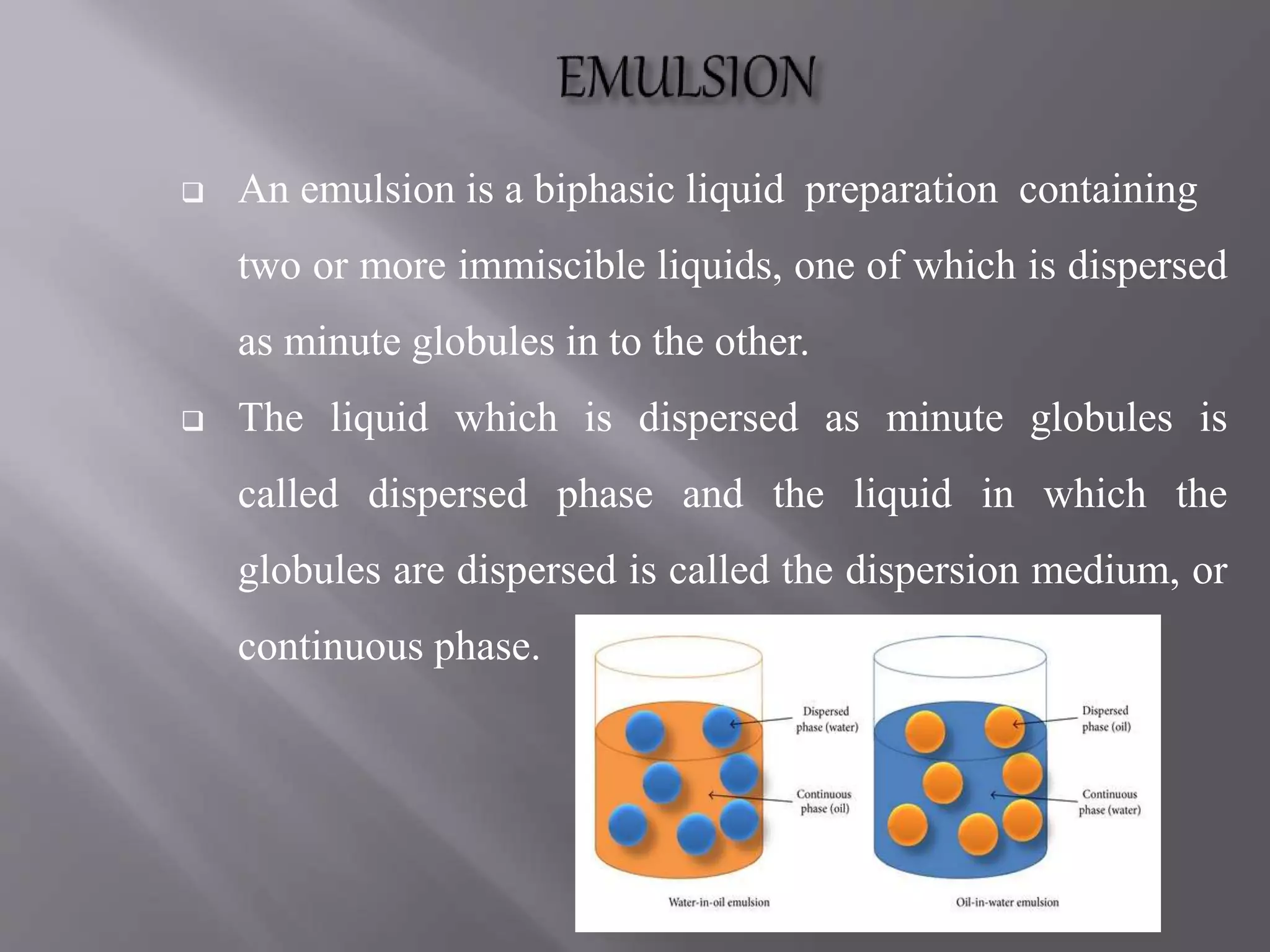
An emulsionis a biphasic liquid preparation containing
two or more immiscible liquids, one of which is dispersed
as minute globules in to the other.
The liquid which is dispersed as minute globules is
called dispersed phase and the liquid in which the
globules are dispersed is called the dispersion medium, or
continuous phase.
5.
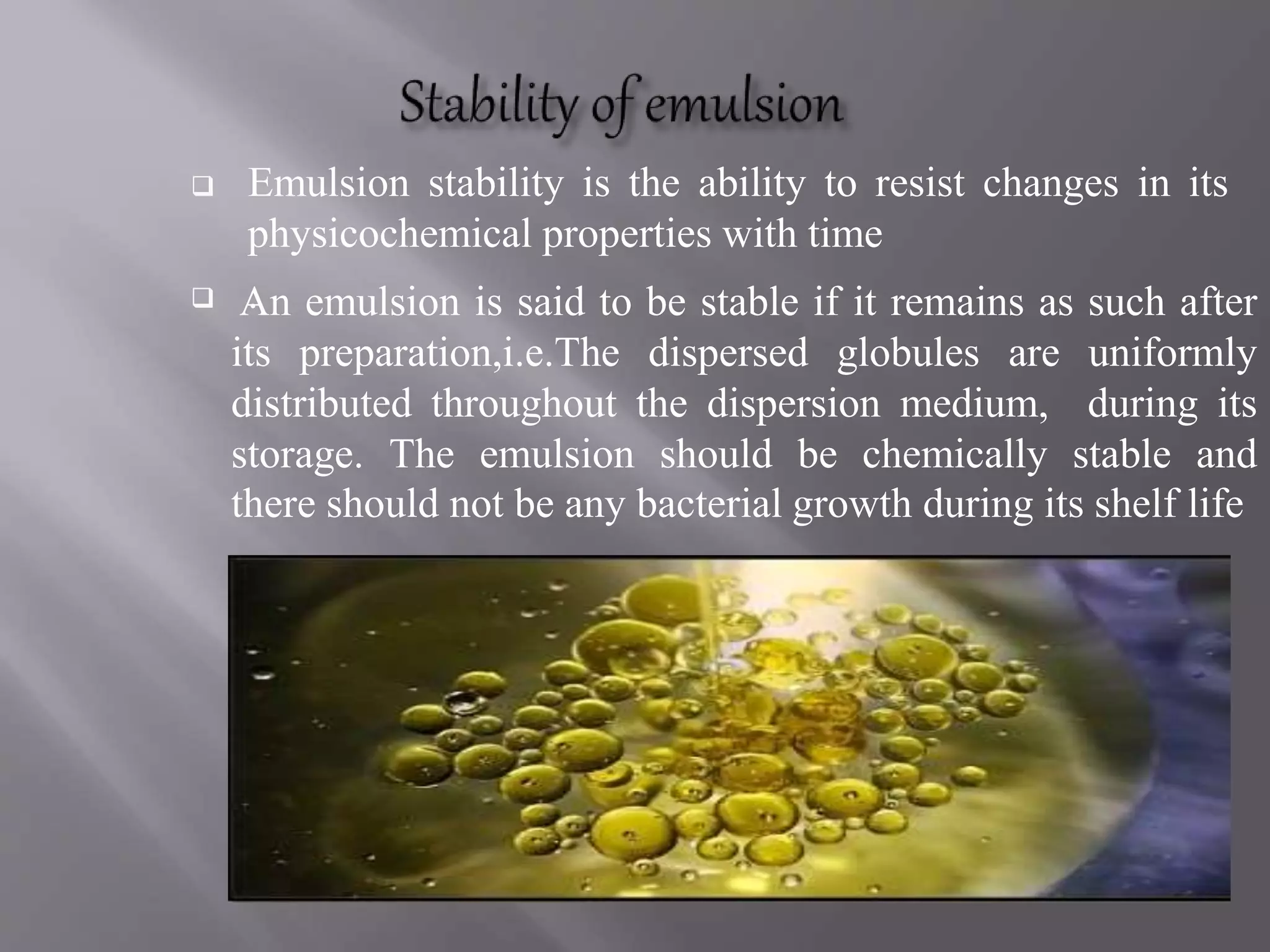
Emulsion stabilityis the ability to resist changes in its
physicochemical properties with time
.An emulsion is said to be stable if it remains as such after
its preparation,i.e.The dispersed globules are uniformly
distributed throughout the dispersion medium, during its
storage. The emulsion should be chemically stable and
there should not be any bacterial growth during its shelf life
6.
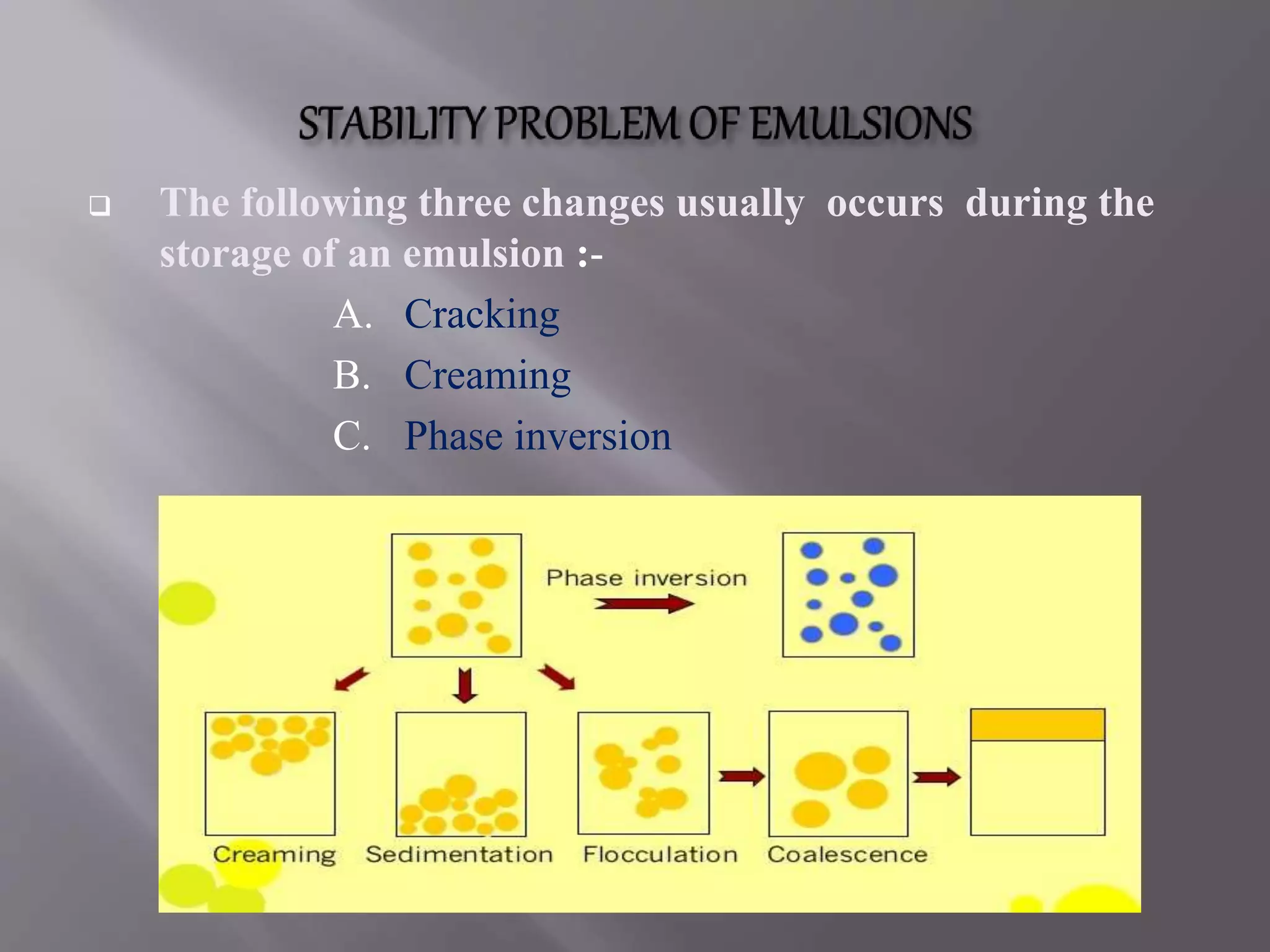
The followingthree changes usually occurs during the
storage of an emulsion :-
A. Cracking
B. Creaming
C. Phase inversion
7.
A. CRACKING:-
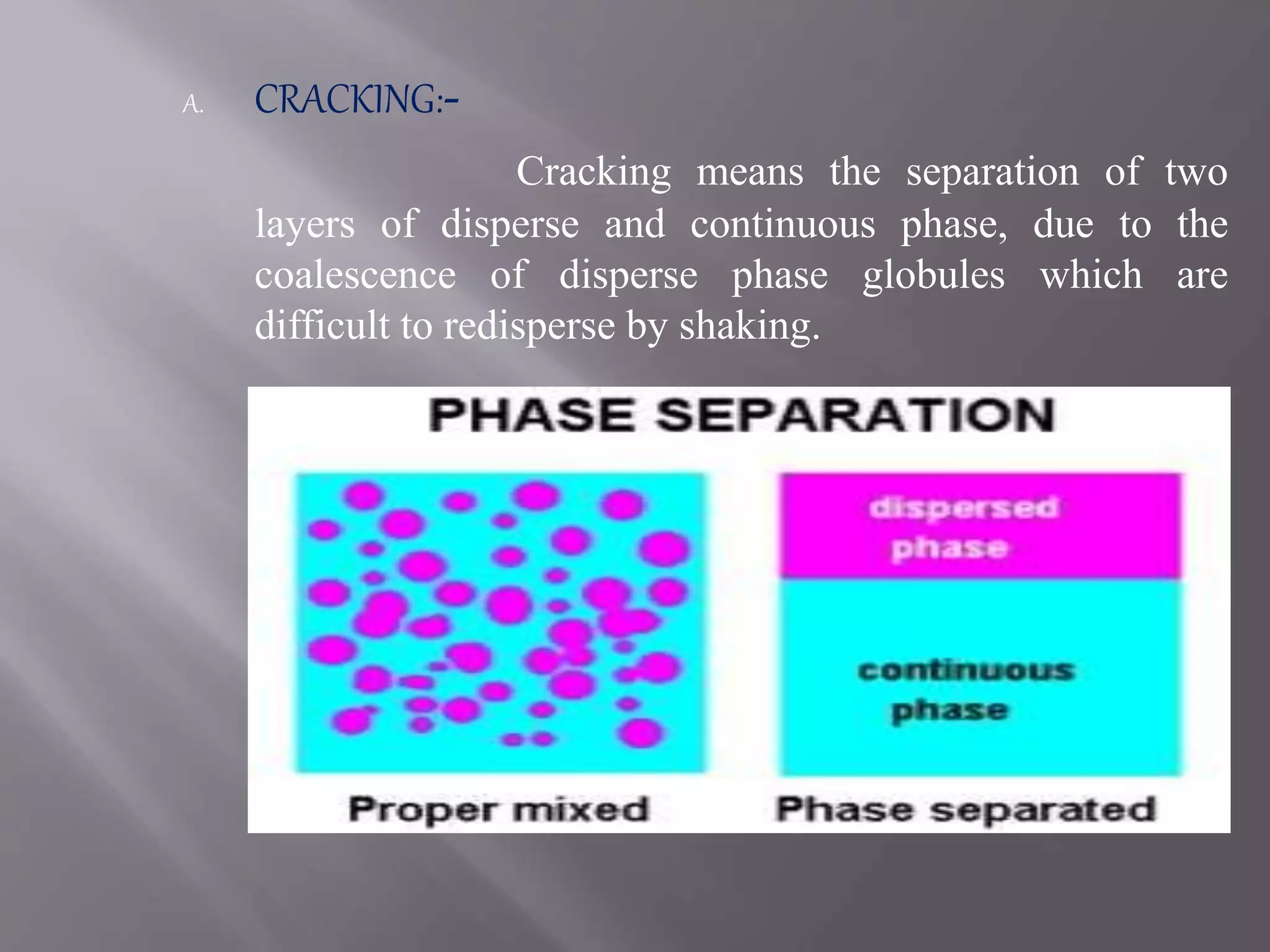
Cracking meansthe separation of two
layers of disperse and continuous phase, due to the
coalescence of disperse phase globules which are
difficult to redisperse by shaking.
8.
Cracking occurs dueto the following reasons:-
1) Addition of emulsifing agent of opposite type
2) Decomposition or precipitation of emulgent
3) Addition of common solvent
4) Microorganism
5) Change in temperature
9.
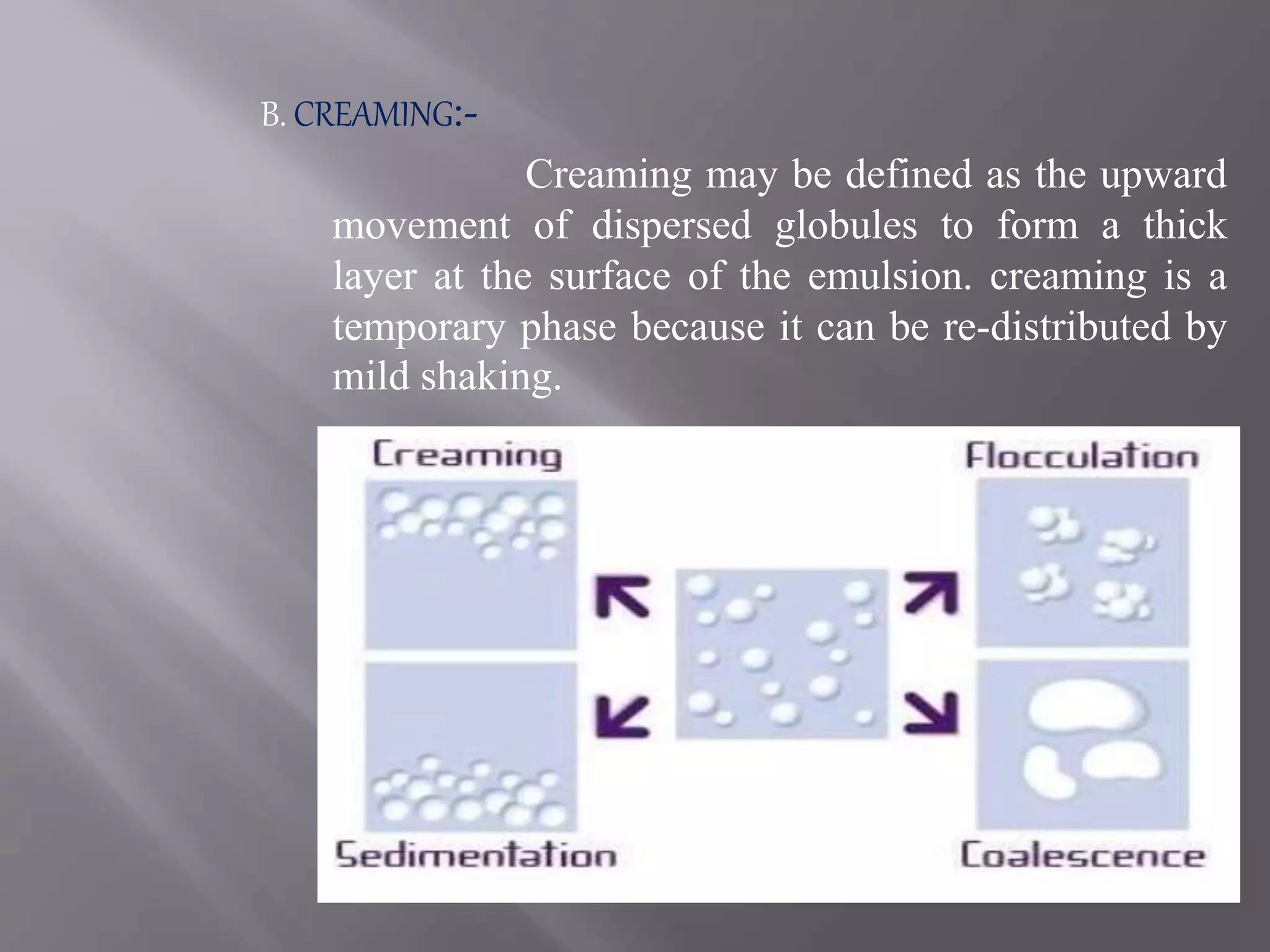
B. CREAMING:-
Creaming maybe defined as the upward
movement of dispersed globules to form a thick
layer at the surface of the emulsion. creaming is a
temporary phase because it can be re-distributed by
mild shaking.
10.
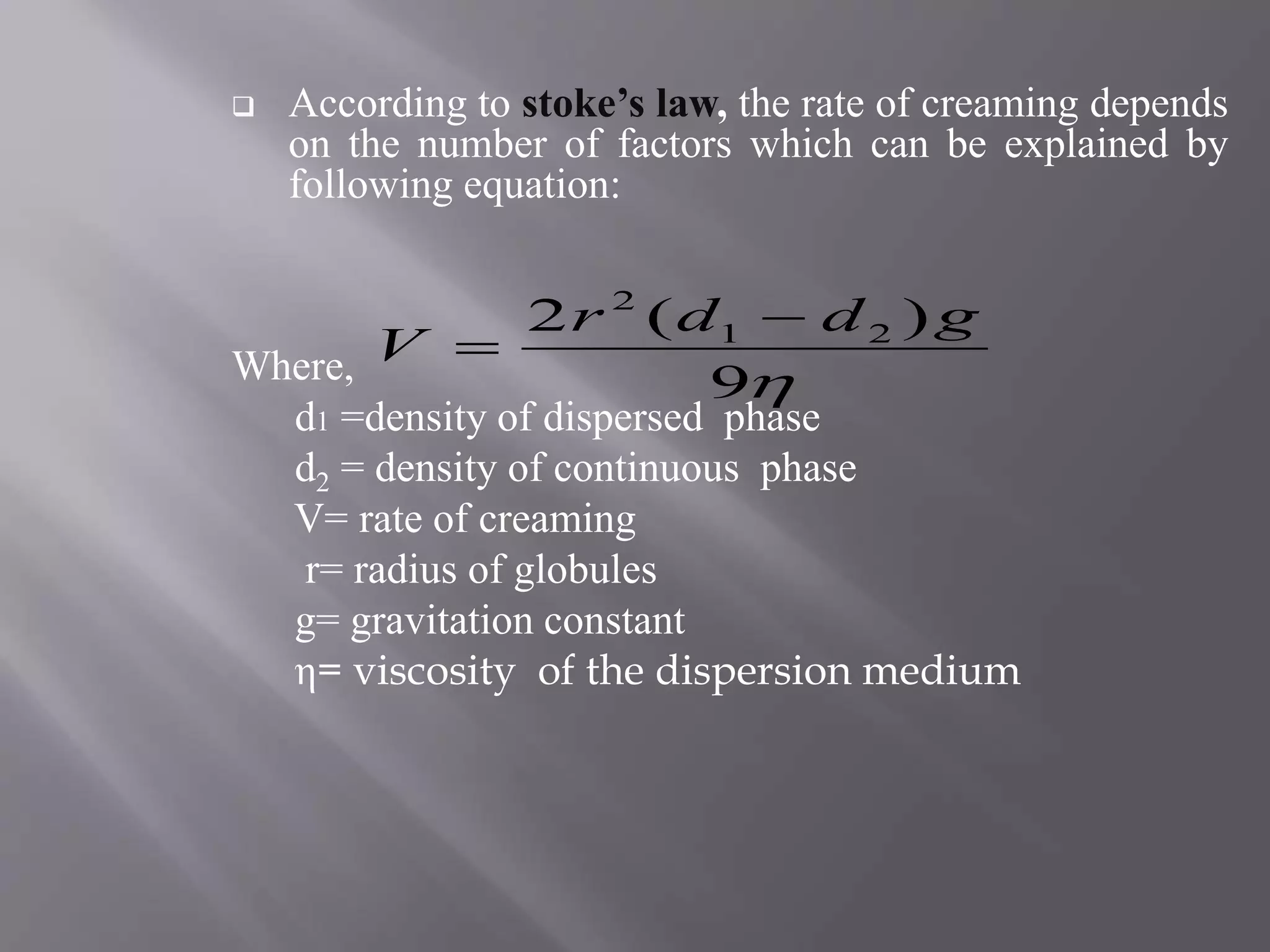
According tostoke’s law, the rate of creaming depends
on the number of factors which can be explained by
following equation:
Where,
d1 =density of dispersed phase
d2 = density of continuous phase
V= rate of creaming
r= radius of globules
g= gravitation constant
η= viscosity of the dispersion medium
9
)(2 21
2
gddr
V
11.
a) Radius ofglobules:-The rate of creaming is directly
proportional to the radius of globules.
b) Difference in density of disperse phase and
continuous phase:- The rate of creaming depends
upon the differences between the densities of disperse
phase and continuous phase.
c) Viscosity of the dispersion medium:- The rate of
creaming is inversely proportional to the viscosity of
the dispersion medium. The viscosity can be increased
by adding tragacanth and methyl cellulose.
d) Storage condition:- The emulsion should be stored in
a cool place because the rise in temperature reduces
the viscosity which may lead to creaming. The
freezing should be avoided because it may lead to
cracking
12.
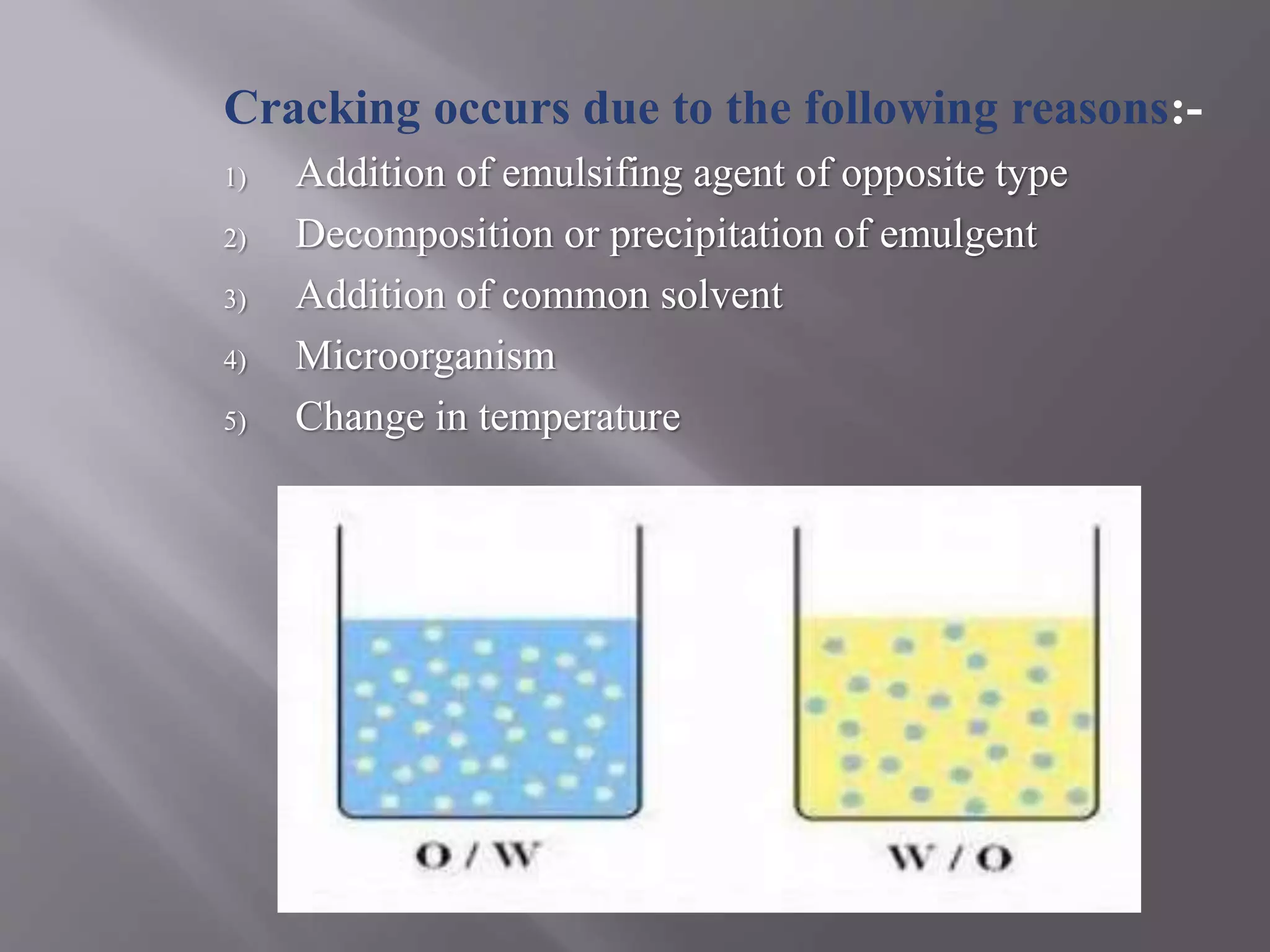
Phase inversionmeans the change of one type of
emulsion into the other type,i.e. Oil in water emulsion
changes into water in oil type and vice versa.
It may be due to following reasons:
a) By the addition of an electrolyte
b) By changing the phase –volume ratio
c) By temperature change
d) By changing the emulsifying agent
13.
CONCLUSION:-
Emulsion isa very widely used dosage from as it used
by both neonates and geriatrics.
Cracking, creaming and phase inversion should
be avoided to make the formulation prolonged up to
the expiry date.