Digital Literacy 2.0

   European Congress on E-Inclusion (ECEI12)
Session1: The value of partnerships with public libraries
         6th November 2012, Thon Hotel EU

     Susanne Bernsmann, Stiftung Digitale Chancen
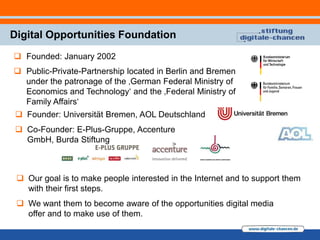
Digital Opportunities Foundation
 Founded: January 2002
 Public-Private-Partnership located in Berlin and Bremen
  under the patronage of the ‚German Federal Ministry of
  Economics and Technology„ and the ‚Federal Ministry of
  Family Affairs„
 Founder: Universität Bremen, AOL Deutschland
 Co-Founder: E-Plus-Gruppe, Accenture
  GmbH, Burda Stiftung


  Our goal is to make people interested in the Internet and to support them
   with their first steps.
  We want them to become aware of the opportunities digital media
   offer and to make use of them.
Social media…
   are a tool for taking part in social life.
   can be a powerful tool to address those who are not yet included in
    the communities they are living in and should be part of.
   lower the threshold to computer and Internet as they do not require
    a full range of technical skills and capabilities.
   lower the threshold to information and learning itself as they make
    it easier to obtain knowledge.

  Disadvantaged people can benefit from making use of the Internet
  and social media like everybody else.
  Libraries can play an important role in harvesting this potential.
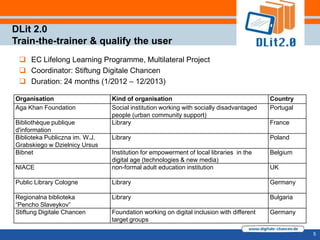
DLit 2.0
Train-the-trainer & qualify the user
  EC Lifelong Learning Programme, Multilateral Project
  Coordinator: Stiftung Digitale Chancen
  Duration: 24 months (1/2012 – 12/2013)

Organisation                    Kind of organisation                                     Country
Aga Khan Foundation             Social institution working with socially disadvantaged   Portugal
                                people (urban community support)
Bibliothèque publique           Library                                                  France
d'information
Biblioteka Publiczna im. W.J.   Library                                                  Poland
Grabskiego w Dzielnicy Ursus
Bibnet                          Institution for empowerment of local libraries in the    Belgium
                                digital age (technologies & new media)
NIACE                           non-formal adult education institution                   UK

Public Library Cologne          Library                                                  Germany

Regionalna biblioteka           Library                                                  Bulgaria
“Pencho Slaveykov”
Stiftung Digitale Chancen       Foundation working on digital inclusion with different   Germany
                                target groups

                                                                                                    5
Approach
DLit 2.0 aims to
    develop and implement an ICT based approach of lifelong learning
       for staff in non-formal learning settings;
       addressed to socially and educationally disadvantaged people

Two-step strategy:
     Training of staff at non-formal learning places for the provision of ICT
      based learning offers
      [focus: Web 2.0 applications and social media, methods how to make
      use of these tools to engage educationally disadvantaged adults]

     Adult learners from socially and educationally disadvantaged groups
      will be attracted to non-formal learning places by the use of Web 2.0
      thus improving their motivation to learn (in general) and empowering
      them to participate in social life
      (via issues that are meaningful for them)
Analysis of best practice strategies
    Stock-taking of ICT training campaigns and courses related to Digital
     Literacy provided so far in partner‟s institutions and beyond
    Gathering of consistent data about approaches that worked well
     (e.g. information about the target groups, the content, the training /
     learning materials, evaluation or dissemination)
    Collection of altogether 40 courses allowed to identify success criteria
     and pitfalls of the courses
    Analysis of practical experiences builds the basis for the development
     of the curriculum

    at the same time: user needs analysis based on the assessment of
     available statistics and data regards the current situation of Digital
     Inclusion in in the participating countries

    merge this information into a comprehensive and innovative
     approach
Analysis of best practice strategies

 Sample of findings
     Use the appropriate wording to achieve the respective target groups.
     Appoint staff as intermediaries who know about the skills and
      handicaps of their target groups;
      they are known by their clients as persons they can trust in.
     Collaborate with local institutions
      (exchange of experiences and resources / reach target groups)
     Define and provide structures for partnerships.
     Evaluate the participants‟ feedback to learn for prospective trainings.

 Public libraries can play a major role in initiating and seeking out
 new ways to support people in their community.
Thank you very much
 for your attention!

              Contact:
     Stiftung Digitale Chancen
        Susanne Bernsmann
 sbernsmann@digitale-chancen.de
 http://www.digital-literacy2020.eu

Susanne bernsmann, project manager, digital opportunities (de)

  • 1.
    Digital Literacy 2.0 European Congress on E-Inclusion (ECEI12) Session1: The value of partnerships with public libraries 6th November 2012, Thon Hotel EU Susanne Bernsmann, Stiftung Digitale Chancen
  • 2.
    Digital Opportunities Foundation Founded: January 2002  Public-Private-Partnership located in Berlin and Bremen under the patronage of the ‚German Federal Ministry of Economics and Technology„ and the ‚Federal Ministry of Family Affairs„  Founder: Universität Bremen, AOL Deutschland  Co-Founder: E-Plus-Gruppe, Accenture GmbH, Burda Stiftung  Our goal is to make people interested in the Internet and to support them with their first steps.  We want them to become aware of the opportunities digital media offer and to make use of them.
  • 4.
    Social media…  are a tool for taking part in social life.  can be a powerful tool to address those who are not yet included in the communities they are living in and should be part of.  lower the threshold to computer and Internet as they do not require a full range of technical skills and capabilities.  lower the threshold to information and learning itself as they make it easier to obtain knowledge. Disadvantaged people can benefit from making use of the Internet and social media like everybody else. Libraries can play an important role in harvesting this potential.
  • 5.
    DLit 2.0 Train-the-trainer &qualify the user  EC Lifelong Learning Programme, Multilateral Project  Coordinator: Stiftung Digitale Chancen  Duration: 24 months (1/2012 – 12/2013) Organisation Kind of organisation Country Aga Khan Foundation Social institution working with socially disadvantaged Portugal people (urban community support) Bibliothèque publique Library France d'information Biblioteka Publiczna im. W.J. Library Poland Grabskiego w Dzielnicy Ursus Bibnet Institution for empowerment of local libraries in the Belgium digital age (technologies & new media) NIACE non-formal adult education institution UK Public Library Cologne Library Germany Regionalna biblioteka Library Bulgaria “Pencho Slaveykov” Stiftung Digitale Chancen Foundation working on digital inclusion with different Germany target groups 5
  • 6.
    Approach DLit 2.0 aimsto  develop and implement an ICT based approach of lifelong learning for staff in non-formal learning settings; addressed to socially and educationally disadvantaged people Two-step strategy:  Training of staff at non-formal learning places for the provision of ICT based learning offers [focus: Web 2.0 applications and social media, methods how to make use of these tools to engage educationally disadvantaged adults]  Adult learners from socially and educationally disadvantaged groups will be attracted to non-formal learning places by the use of Web 2.0 thus improving their motivation to learn (in general) and empowering them to participate in social life (via issues that are meaningful for them)
  • 7.
    Analysis of bestpractice strategies  Stock-taking of ICT training campaigns and courses related to Digital Literacy provided so far in partner‟s institutions and beyond  Gathering of consistent data about approaches that worked well (e.g. information about the target groups, the content, the training / learning materials, evaluation or dissemination)  Collection of altogether 40 courses allowed to identify success criteria and pitfalls of the courses  Analysis of practical experiences builds the basis for the development of the curriculum  at the same time: user needs analysis based on the assessment of available statistics and data regards the current situation of Digital Inclusion in in the participating countries  merge this information into a comprehensive and innovative approach
  • 8.
    Analysis of bestpractice strategies Sample of findings  Use the appropriate wording to achieve the respective target groups.  Appoint staff as intermediaries who know about the skills and handicaps of their target groups; they are known by their clients as persons they can trust in.  Collaborate with local institutions (exchange of experiences and resources / reach target groups)  Define and provide structures for partnerships.  Evaluate the participants‟ feedback to learn for prospective trainings. Public libraries can play a major role in initiating and seeking out new ways to support people in their community.
  • 10.
    Thank you verymuch for your attention! Contact: Stiftung Digitale Chancen Susanne Bernsmann sbernsmann@digitale-chancen.de http://www.digital-literacy2020.eu