ePortfolio for International Cooperation ePortfolio and Digital Identity Oct 23rd, 2008, Maastricht, Netherlands Théo Bondolfi and Samantha Slade
ePortfolios helping cooperation and capacity building How can ePortfolio processes contribute to international development and cooperation?
IT and development 1.  United Nations Millennium Development Goals  for 2015 2.  Information and Communication Technologies for Development (ICT4D)  3.  Paris Declaration on Aid Effectiveness  (2005)
Swiss Agency for Development and Cooperation (SDC, vvww.deza.net)‏ Commissioned a study to gather information on 1)  ePortfolio processes  that could be of interest for them and to external organisations and 2) for developing  synergies of ePortfolio training
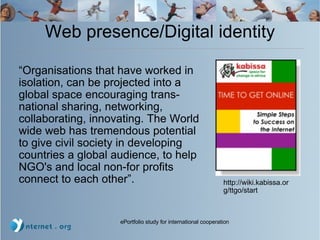
Web presence/Digital identity “ Organisations that have worked in isolation, can be projected into a global space encouraging trans-national sharing, networking, collaborating, innovating. The World wide web has tremendous potential to give civil society in developing countries a global audience, to help NGO's and local non-for profits connect to each other”. http://wiki.kabissa.org/ttgo/start
ePortfolio definition An ePortfolio is an online environment supporting processes that allow an individual, group or organisation to reflect and document and present who they are - their strengths, activities, experiences, challenges, goals, competences, values etc. and in so doing to become lifelong learners, learning organisations or learning regions.
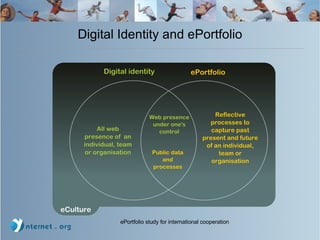
Digital Identity and ePortfolio
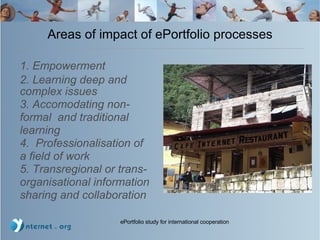
Areas of impact of ePortfolio processes 1. Empowerment 2. Learning deep and complex issues  3. Accomodating non-formal  and traditional learning 4.  Professionalisation of a field of work 5. Transregional or trans- organisational information sharing and collaboration
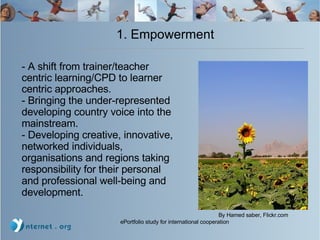
1. Empowerment  Flickr.com - A shift from trainer/teacher centric learning/CPD to learner centric approaches. - B ringing the under-represented developing country voice into the mainstream. - Developing creative, innovative, networked individuals, organisations and regions taking responsibility for their personal and professional well-being and development. By Hamed saber, Flickr.com
2. Supporting deep and complex learning - Create leaders who confront the root issues of crisis management,  health issues etc. able to uplift their communities and impart vision and purpose - CPD for capacity building is more than a cursus, it's effectively being able to contribute to sustainable change.  Flickr.com
3. Expanding types of learning - Capture and support formal, informal and non-formal learning in a structured and integrated way. - Facilitate the reflective practitioner, giving value to traditional knowledge...  Flickr.com
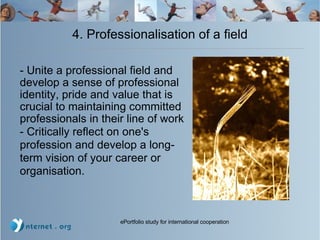
4. Professionalisation of a field - Unite a professional field and develop a sense of professional identity, pride and value that is crucial to maintaining committed professionals in their line of work - Critically reflect on one's profession and develop a long-term vision of your career or organisation.
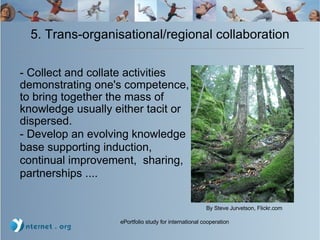
5. Trans-organisational/regional collaboration - Collect and collate activities demonstrating one's competence, to bring together the mass of knowledge usually either tacit or dispersed. - Develop an evolving knowledge base supporting induction, continual improvement,  sharing, partnerships .... By Steve Jurvetson, Flickr.com
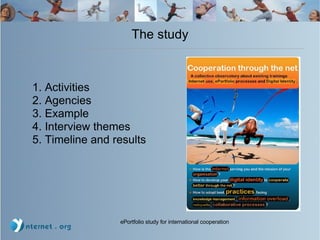
The study 1. Activities 2. Agencies 3. Example 4. Interview themes 5. Timeline and results
1. Activities Ynternet.org foundation for eCulture  is researching and interviewing developing agencies and civil society organisations  to identify and better understand  different best practices that map  onto these 5 areas of impact.
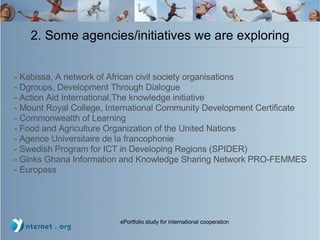
2. Some agencies/initiatives we are exploring - Kabissa, A network of African civil society organisations - Dgroups, Development Through Dialogue - Action Aid International,The knowledge initiative - Mount Royal College, International Community Development Certificate - Commonwealth of Learning - Food and Agriculture Organization of the United Nations  - Agence Universitaire de la francophonie - Swedish Program for ICT in Developing Regions (SPIDER)‏ - Ginks Ghana Information and Knowledge Sharing Network PRO-FEMMES - Europass
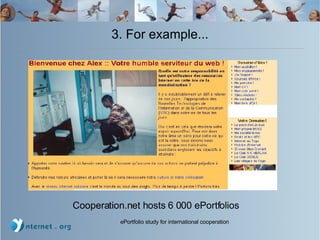
3. For example... Cooperation.net hosts 6 000 ePortfolios
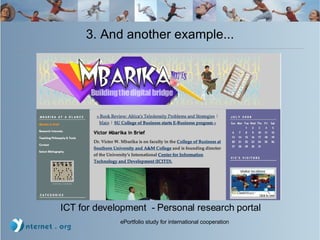
3. And another example... ICT for development  - Personal research portal
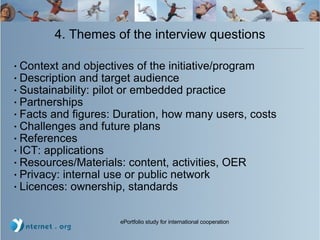
4. Themes of the interview questions Context and objectives of the initiative/program Description and target audience Sustainability: pilot or embedded practice  Partnerships Facts and figures: Duration, how many users, costs Challenges and future plans References ICT: applications Resources/Materials: content, activities, OER Privacy: internal use or public network Licences: ownership, standards
5. Timeline and Results The study will be completed  early 2009   and results will be available on the web  in English and French with a Spanish summary  into an OBSERVATORY OF ePORTFOLIOS INITIATIVES FOR COOPERATION THROUGH THE WEB VISIT WWW.YNTERNET.ORG/EPORTFOLIO  If you know of any initiatives/agencies that should be included in the study, please let us know
Preliminary findings 1. Partnerships 2. Digital ease 3. Culture of transparency
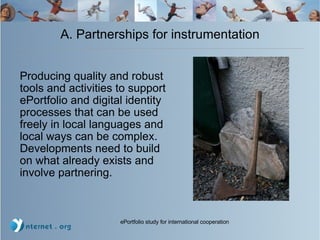
A. Partnerships for instrumentation Producing quality and robust tools and activities to support ePortfolio and digital identity processes that can be used freely in local languages and local ways can be complex.  Developments need to build on what already exists and involve partnering.
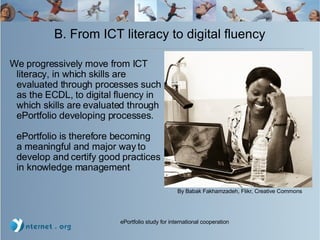
B. From ICT literacy to digital fluency We progressively move from ICT literacy, in which skills are evaluated through processes such as the ECDL, to digital fluency in which skills are evaluated through ePortfolio developing processes.  ePortfolio is therefore becoming  a meaningful and major way to develop and certify good practices in knowledge management By Babak Fakhamzadeh, Flikr, Creative Commons
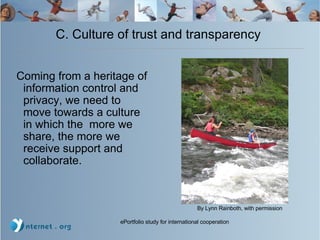
C. Culture of trust and transparency  Coming from a heritage of information control and privacy, we need to move towards a culture in which the  more we share, the more we receive support and collaborate. By Lynn Rainboth, with permission
ePortfolios, digital identity and cooperation? ePortfolios can contribute to working towards sustainable social and economic development. ICT needs to be optimized to connect, share, network, collaborate and innovate, supporting transnational integrated long term and scalable partnership approaches.
Not so much about technology, but rather... Organisations leveraging ePortfolios and digital identity to support attaining  Millenium Development Goals and actions of the Paris Declaration.  Reflecting and learning and developing for individuals, organisations and regions in a capacity building manner Entering and mobilising the public space of the web to enhance communication and collaboration.
Conclusion  There is an urgency to have judicious, skilled, aware, at ease internet users and internet using organisations who find their voice and take it publicly, address the complex and significant issues they are working with, tap into their local learning traditions, develop a sense of meaning and professional identity, and further their networking and knowledge sharing.  ePortfolios and digital identity are new models with incredible potential to support just that.
Théo Bondolfi and Samantha Slade Ynternet.org This presentation is available online at:  slideshare.com/sam5
References Millennium Development Goals http://www.un.org/millenniumgoals/ Global Alliance for ICT and Development http://www.un-gaid.org/ The Paris Declaration http://www.oecd.org/document/18/0,2340,en_2649_3236398_35401554_1_1_1_1,00.html

ePortfolios for International Cooperation

  • 1.
    ePortfolio for InternationalCooperation ePortfolio and Digital Identity Oct 23rd, 2008, Maastricht, Netherlands Théo Bondolfi and Samantha Slade
  • 2.
    ePortfolios helping cooperationand capacity building How can ePortfolio processes contribute to international development and cooperation?
  • 3.
    IT and development1. United Nations Millennium Development Goals for 2015 2. Information and Communication Technologies for Development (ICT4D) 3. Paris Declaration on Aid Effectiveness (2005)
  • 4.
    Swiss Agency forDevelopment and Cooperation (SDC, vvww.deza.net)‏ Commissioned a study to gather information on 1) ePortfolio processes that could be of interest for them and to external organisations and 2) for developing synergies of ePortfolio training
  • 5.
    Web presence/Digital identity“ Organisations that have worked in isolation, can be projected into a global space encouraging trans-national sharing, networking, collaborating, innovating. The World wide web has tremendous potential to give civil society in developing countries a global audience, to help NGO's and local non-for profits connect to each other”. http://wiki.kabissa.org/ttgo/start
  • 6.
    ePortfolio definition AnePortfolio is an online environment supporting processes that allow an individual, group or organisation to reflect and document and present who they are - their strengths, activities, experiences, challenges, goals, competences, values etc. and in so doing to become lifelong learners, learning organisations or learning regions.
  • 7.
  • 8.
    Areas of impactof ePortfolio processes 1. Empowerment 2. Learning deep and complex issues 3. Accomodating non-formal and traditional learning 4. Professionalisation of a field of work 5. Transregional or trans- organisational information sharing and collaboration
  • 9.
    1. Empowerment Flickr.com - A shift from trainer/teacher centric learning/CPD to learner centric approaches. - B ringing the under-represented developing country voice into the mainstream. - Developing creative, innovative, networked individuals, organisations and regions taking responsibility for their personal and professional well-being and development. By Hamed saber, Flickr.com
  • 10.
    2. Supporting deepand complex learning - Create leaders who confront the root issues of crisis management, health issues etc. able to uplift their communities and impart vision and purpose - CPD for capacity building is more than a cursus, it's effectively being able to contribute to sustainable change. Flickr.com
  • 11.
    3. Expanding typesof learning - Capture and support formal, informal and non-formal learning in a structured and integrated way. - Facilitate the reflective practitioner, giving value to traditional knowledge... Flickr.com
  • 12.
    4. Professionalisation ofa field - Unite a professional field and develop a sense of professional identity, pride and value that is crucial to maintaining committed professionals in their line of work - Critically reflect on one's profession and develop a long-term vision of your career or organisation.
  • 13.
    5. Trans-organisational/regional collaboration- Collect and collate activities demonstrating one's competence, to bring together the mass of knowledge usually either tacit or dispersed. - Develop an evolving knowledge base supporting induction, continual improvement, sharing, partnerships .... By Steve Jurvetson, Flickr.com
  • 14.
    The study 1.Activities 2. Agencies 3. Example 4. Interview themes 5. Timeline and results
  • 15.
    1. Activities Ynternet.orgfoundation for eCulture is researching and interviewing developing agencies and civil society organisations to identify and better understand different best practices that map onto these 5 areas of impact.
  • 16.
    2. Some agencies/initiativeswe are exploring - Kabissa, A network of African civil society organisations - Dgroups, Development Through Dialogue - Action Aid International,The knowledge initiative - Mount Royal College, International Community Development Certificate - Commonwealth of Learning - Food and Agriculture Organization of the United Nations - Agence Universitaire de la francophonie - Swedish Program for ICT in Developing Regions (SPIDER)‏ - Ginks Ghana Information and Knowledge Sharing Network PRO-FEMMES - Europass
  • 17.
    3. For example...Cooperation.net hosts 6 000 ePortfolios
  • 18.
    3. And anotherexample... ICT for development - Personal research portal
  • 19.
    4. Themes ofthe interview questions Context and objectives of the initiative/program Description and target audience Sustainability: pilot or embedded practice Partnerships Facts and figures: Duration, how many users, costs Challenges and future plans References ICT: applications Resources/Materials: content, activities, OER Privacy: internal use or public network Licences: ownership, standards
  • 20.
    5. Timeline andResults The study will be completed early 2009 and results will be available on the web in English and French with a Spanish summary into an OBSERVATORY OF ePORTFOLIOS INITIATIVES FOR COOPERATION THROUGH THE WEB VISIT WWW.YNTERNET.ORG/EPORTFOLIO If you know of any initiatives/agencies that should be included in the study, please let us know
  • 21.
    Preliminary findings 1.Partnerships 2. Digital ease 3. Culture of transparency
  • 22.
    A. Partnerships forinstrumentation Producing quality and robust tools and activities to support ePortfolio and digital identity processes that can be used freely in local languages and local ways can be complex. Developments need to build on what already exists and involve partnering.
  • 23.
    B. From ICTliteracy to digital fluency We progressively move from ICT literacy, in which skills are evaluated through processes such as the ECDL, to digital fluency in which skills are evaluated through ePortfolio developing processes. ePortfolio is therefore becoming a meaningful and major way to develop and certify good practices in knowledge management By Babak Fakhamzadeh, Flikr, Creative Commons
  • 24.
    C. Culture oftrust and transparency Coming from a heritage of information control and privacy, we need to move towards a culture in which the more we share, the more we receive support and collaborate. By Lynn Rainboth, with permission
  • 25.
    ePortfolios, digital identityand cooperation? ePortfolios can contribute to working towards sustainable social and economic development. ICT needs to be optimized to connect, share, network, collaborate and innovate, supporting transnational integrated long term and scalable partnership approaches.
  • 26.
    Not so muchabout technology, but rather... Organisations leveraging ePortfolios and digital identity to support attaining Millenium Development Goals and actions of the Paris Declaration. Reflecting and learning and developing for individuals, organisations and regions in a capacity building manner Entering and mobilising the public space of the web to enhance communication and collaboration.
  • 27.
    Conclusion Thereis an urgency to have judicious, skilled, aware, at ease internet users and internet using organisations who find their voice and take it publicly, address the complex and significant issues they are working with, tap into their local learning traditions, develop a sense of meaning and professional identity, and further their networking and knowledge sharing. ePortfolios and digital identity are new models with incredible potential to support just that.
  • 28.
    Conclusion Thereis an urgency to have judicious, skilled, aware, at ease internet users and internet using organisations who find their voice and take it publicly, address the complex and significant issues they are working with, tap into their local learning traditions, develop a sense of meaning and professional identity, and further their networking and knowledge sharing. ePortfolios and digital identity are new models with incredible potential to support just that.
  • 29.
    Théo Bondolfi andSamantha Slade Ynternet.org This presentation is available online at: slideshare.com/sam5
  • 30.
    References Millennium DevelopmentGoals http://www.un.org/millenniumgoals/ Global Alliance for ICT and Development http://www.un-gaid.org/ The Paris Declaration http://www.oecd.org/document/18/0,2340,en_2649_3236398_35401554_1_1_1_1,00.html