

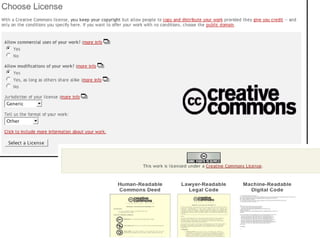
Technology and Education: The emergency of Openness Open Education 2009 Vancouver, August 11-14, 2009 UBC Carolina Rossini Fellow  Berkman Center – Harvard University
Open systems and open networks can create new modes of innovation New modes of innovation can be helped, or hurt, by institutional and government policies Brazil is experimenting with openness, but it is just in the beginning
OER- Brazil 4 main objectives: Green-Paper: Understand the reality and propose recommendations; Engage in debates on how “international” these recommendations can be Tool-Kit for professors/teachers: “train the trainer” (effort with UNESCO) Network: connect Brazilian efforts with foreign efforts International conference: discuss Br and foreign efforts; and validate recommendations. Present to Br congress representatives. (Oct/2009)
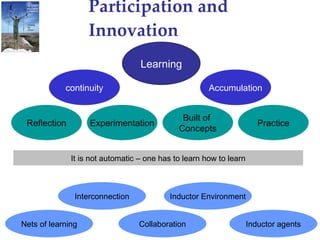
Participation and Innovation  Learning continuity Accumulation Experimentation Reflection Built of  Concepts Practice It is not automatic – one has to learn how to learn Nets of learning Interconnection Collaboration Inductor Environment Inductor agents
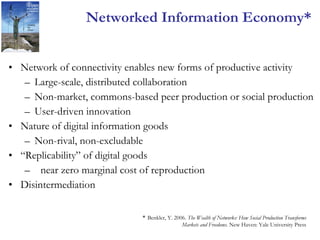
Networked Information Economy* Network of connectivity enables new forms of productive activity Large-scale, distributed collaboration Non-market, commons-based peer production or social production User-driven innovation Nature of digital information goods Non-rival, non-excludable “ Replicability” of digital goods near zero marginal cost of reproduction  Disintermediation *  Benkler, Y. 2006.  The Wealth of Networks: How Social Production Transforms Markets and Freedoms . New Haven: Yale University Press
Web 2.0 The rise of Web 2.0 has radically changed the way that online communities evolve and interact; From transactions to interactions
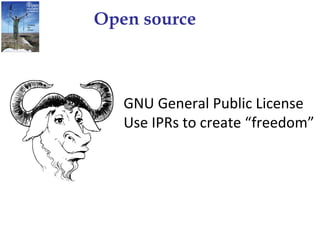
Open source GNU General Public License Use IPRs to create “freedom”
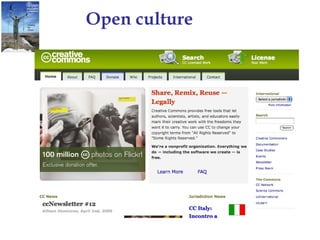
Open culture
Open Culture More than 200,000,000 objects More than 50 countries
 
Open Access free availability on the public internet,  permitting users to read, download, copy, distribute, print, search, or link to the full texts of these articles, crawl them for indexing, pass them as data to software,  or use them for any other lawful purpose,  without financial, legal or technical barriers  other than those inseparable from gaining  access to the internet itself .” (Budapest Declaration)
Reaction Open Access is a reaction to the persistence (in the face of ICT revolution) of traditional  models in scientific knowledge distribution,  which were characterized by centralized and  high cost journals
Why is important for developing countries?
Benefits of online journals Reduces costs Enlarge market However:  the PDF problem ( digitized but not digital ) The DRM problem  Restrictive licenses
Benefits of (truly) Open Access Journals Its is not free, it is freedom; Cost less for users; Grant re-use rights associated with “web culture”; Innovation in distribution and publishing models; They are peer-reviewed; And yes, they have great index of impact results.
Benefits of (truly) Open Access Journals Empower the individual Empower the society Empower institutions Manage the knowledge;  Foster partnerships; Strengthen scientific cooperation and collaborative approaches; Ex.: OER UNESCO community Ex.: UnB and USP OA community etc etc
Preliminary conclusion This is a new way of thinking about technology transfer,  not as a gift of “free stuff” without cost, but as a philosophy of knowledge distribution.
Open Access Journals Unprecedented public good: In Open Access the old tradition – to publish for the sake of inquiry, knowledge and peer acclaim – and a new technology – the Internet – have converged to make possible an unprecedented public good:   “ the world-wide electronic distribution of the peer-reviewed journal literature”
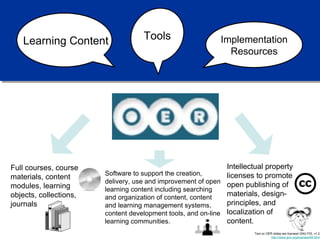
Implementation Resources Learning Content Tools Intellectual property licenses to promote open publishing of materials, design-principles, and localization of content. Full courses, course materials, content modules, learning objects, collections, journals Software to support the creation, delivery, use and improvement of open learning content including searching and organization of content, content and learning management systems, content development tools, and on-line learning communities. Text on OER slides are licensed GNU FDL v1.2 http://www.gnu.org/licenses/fdl.html
“… The open provision of educational resources enabled by information and education technologies, for consultation, use and adaptation by a community of users for non-commercial purposes…”
Examples Reference materials: Open textbooks/ learning materials:  Open courses: Tools:
Environmentalism for OER
 
 
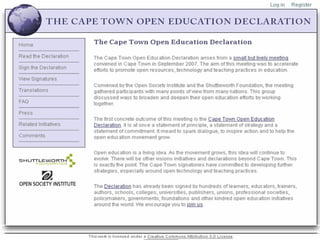
OSI-Cape Town Open Education Declaration  “ A revolution of sorts is sweeping education ...In another promising development, a coalition of educators, foundations and Internet pioneers in January signed a  declaration urging governments and publishers to make publicly funded educational material available free over the Internet . The Cape Town Open Education Declaration has so far been signed by more than 140 organizations and nearly 1,500 individuals.” Wall Street Journal, March 28, 2008
Strategies for OE Open education policy : Governments, school boards, colleges and universities should make taxpayer-funded educational resources OER. Open content licenses :  OER should be freely shared through open licenses which facilitate use, revision, translation, improvement and sharing. Collaborative production : Educators and students can participate in creating, using, adapting and improving OER.
Projects UNESCO-OER (2005) Cadernos Abertos (“open notebooks”)– FGV Law School Brazil (2006) Copyright for Librarians (2007) OSI-OER-Br: Challenges and Perspectives
Lessons learned Implementation needs to be relevant nation-to-nation; Implementation needs to be relevant to diferent institutional cultures; We need to build capacity inside the institutions;
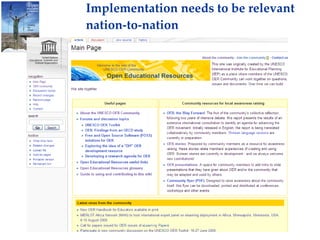
Implementation needs to be relevant nation-to-nation
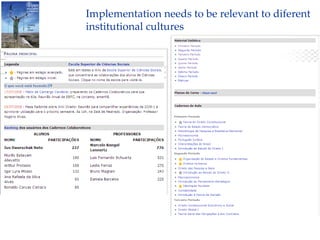
Implementation needs to be relevant to diferent institutional cultures
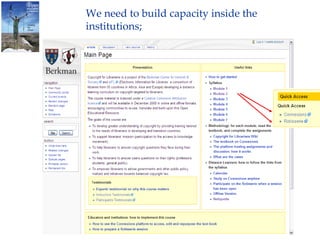
We need to build capacity inside the  institutions;
Why Share for Free? Reasons to join the OER movement: If you are public funded; Digital technology will surpass current teaching and learning structures; Cost implications on continuing to rely on Statutory License schemes and only very restrictive uses permitted (down size transaction costs); OER are easier to manage (down size transaction costs): No complex copying limits; No restrictions on audience ie. Parents, community members and lifelong learners; Allows teachers and students to modify and share resources.
Why Share for Free? 4. Public Access - Educational institutions (particularly those publicly funded) should leverage taxpayers money by allowing free sharing and reuse of resources. 5. Quality can be improved and costs of content development reduced by sharing and reusing. 6. Open sharing will speed up development of learning resources. 7. New opportunities for not main stream authors/content.
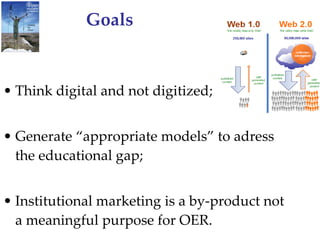
Goals Think digital and not digitized;  Generate “appropriate models” to adress the educational gap; Institutional marketing is a by-product not a meaningful purpose for OER.
Barriers to OER Legal – licenses  Economic - sustainability Social - fear


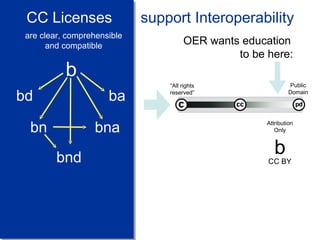
Text Text b CC   Li c enses   support   Interoperability bn bd ba bnd bna OER wants education  to be here:  “ All   rights   reserved” Publi c   Domain Attribution   Only are clear, comprehensible and compatible b CC BY
Emerging projects in Brazil
OER understood in the context of e-learning education. However, there is the necessity of adressing the case of textbooks.
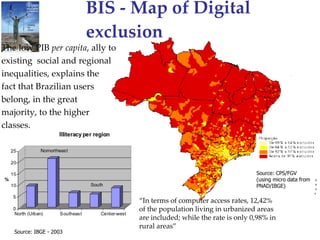
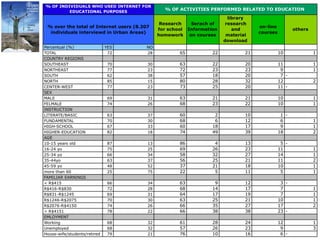
BIS - Map of Digital exclusion The low PIB  per capita , ally to existing  social and regional  inequalities, explains the  fact that Brazilian users  belong, in the great  majority, to the higher  classes.   Source: IBGE - 2003 “ In terms of computer access rates, 12,42% of the population living in urbanized areas are included; while the rate is only 0,98% in rural areas” Source: CPS/FGV (using micro data from PNAD/IBGE)


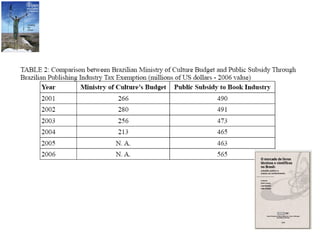
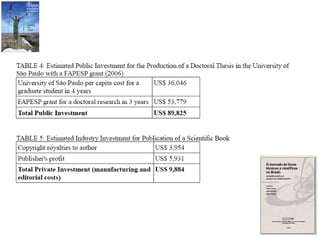
Debate around Textbooks The right to copy books; Value Chain of books  Production; Taxpayer funding; Government funding and buying.
 
 
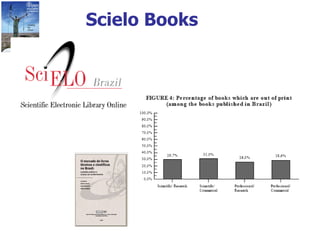
Scielo Books
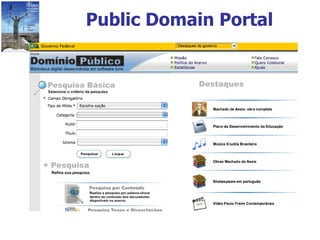
Public Domain Portal
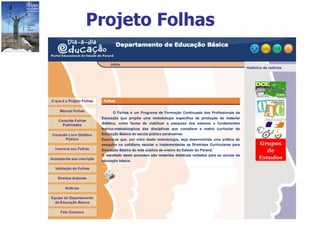
Projeto Folhas
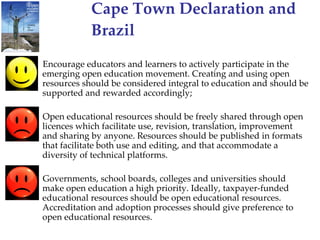
Cape Town Declaration and Brazil Encourage educators and learners to actively participate in the emerging open education movement. Creating and using open resources should be considered integral to education and should be supported and rewarded accordingly;  Open educational resources should be freely shared through open licences which facilitate use, revision, translation, improvement and sharing by anyone. Resources should be published in formats that facilitate both use and editing, and that accommodate a diversity of technical platforms. Governments, school boards, colleges and universities should make open education a high priority. Ideally, taxpayer-funded educational resources should be open educational resources. Accreditation and adoption processes should give preference to open educational resources.
Recommendations (1) I. Content / Technology policy Unify IR policies and create via OAI a single meta-index of all Brazilian e-theses
Recommendations (2) II. Content / Pedagogy policy Create online courses to train teachers in the use of online educational resources Create specific pedagogical resources in the use of OER Create metrics to reward teachers who not only use OER but re-contribute new OER
Recommendations 3 III. Content / Price Require publishers to disclose info on textbooks’ wholesale prices and revision histories; Recommend that institutions explore alternative textbook sources or otherwise innovate to reduce costs of educational materials (e.g. textbook rental programs); Regulate textbook prices in public institutions; Commission studies and reports to investigate high cost of textbooks; Require schools/bookstores to actively promote textbook buyback programs.
Recommendations 4 IV. Content / IPR Amend copyright law to expand and formalize exceptions and limitations related to education, libraries, etc. Establish a federal law/policy giving “open” and cost-free access to books, theses and articles necessary for higher-education produced by professors working full-time in public universities or students receiving full time scholarships from the government; 
Recommendations 4 IV. Content / IPR Establish a federal law/policy establishing “open” licensing (allowing all uses including commercial use, such as the Creative Commons Attribution license), and cost-free access to books and other educational resources, such as digital or analog learning objects, developed by and/or paid by the federal government and its sub-contractors; Unify copyright policy, specifically the establishment of an unified “open” license approach (allowing all uses including commercial use, such as the Creative Commons Attribution license) regarding projects developed by the federal government which aim to provide educational resources to all levels of education;
Lessons learned Implementation needs to be relevant nation-to-nation; Implementation needs to be relevant to diferent institutional cultures; We need to build capacity inside the institutions;
Open systems and open networks can create new modes of innovation New modes of innovation can be helped, or hurt, by institutional and government policies Brazil is experimenting with openness, but it is just in the beginning
“ Thus, this book speaks. It has a voice that allows you to read yourself and you are invited to contribute to its writing.” Pierre Lévy Thank you!!!! [email_address] [email_address]

OER Policy and Developing Countries

  • 1.
    Technology and Education:The emergency of Openness Open Education 2009 Vancouver, August 11-14, 2009 UBC Carolina Rossini Fellow Berkman Center – Harvard University
  • 2.
    Open systems andopen networks can create new modes of innovation New modes of innovation can be helped, or hurt, by institutional and government policies Brazil is experimenting with openness, but it is just in the beginning
  • 3.
    OER- Brazil 4main objectives: Green-Paper: Understand the reality and propose recommendations; Engage in debates on how “international” these recommendations can be Tool-Kit for professors/teachers: “train the trainer” (effort with UNESCO) Network: connect Brazilian efforts with foreign efforts International conference: discuss Br and foreign efforts; and validate recommendations. Present to Br congress representatives. (Oct/2009)
  • 4.
    Participation and Innovation Learning continuity Accumulation Experimentation Reflection Built of Concepts Practice It is not automatic – one has to learn how to learn Nets of learning Interconnection Collaboration Inductor Environment Inductor agents
  • 5.
    Networked Information Economy*Network of connectivity enables new forms of productive activity Large-scale, distributed collaboration Non-market, commons-based peer production or social production User-driven innovation Nature of digital information goods Non-rival, non-excludable “ Replicability” of digital goods near zero marginal cost of reproduction Disintermediation * Benkler, Y. 2006. The Wealth of Networks: How Social Production Transforms Markets and Freedoms . New Haven: Yale University Press
  • 6.
    Web 2.0 Therise of Web 2.0 has radically changed the way that online communities evolve and interact; From transactions to interactions
  • 7.
    Open source GNUGeneral Public License Use IPRs to create “freedom”
  • 8.
  • 9.
    Open Culture Morethan 200,000,000 objects More than 50 countries
  • 10.
  • 11.
    Open Access freeavailability on the public internet, permitting users to read, download, copy, distribute, print, search, or link to the full texts of these articles, crawl them for indexing, pass them as data to software, or use them for any other lawful purpose, without financial, legal or technical barriers other than those inseparable from gaining access to the internet itself .” (Budapest Declaration)
  • 12.
    Reaction Open Accessis a reaction to the persistence (in the face of ICT revolution) of traditional models in scientific knowledge distribution, which were characterized by centralized and high cost journals
  • 13.
    Why is importantfor developing countries?
  • 14.
    Benefits of onlinejournals Reduces costs Enlarge market However: the PDF problem ( digitized but not digital ) The DRM problem Restrictive licenses
  • 15.
    Benefits of (truly)Open Access Journals Its is not free, it is freedom; Cost less for users; Grant re-use rights associated with “web culture”; Innovation in distribution and publishing models; They are peer-reviewed; And yes, they have great index of impact results.
  • 16.
    Benefits of (truly)Open Access Journals Empower the individual Empower the society Empower institutions Manage the knowledge; Foster partnerships; Strengthen scientific cooperation and collaborative approaches; Ex.: OER UNESCO community Ex.: UnB and USP OA community etc etc
  • 17.
    Preliminary conclusion Thisis a new way of thinking about technology transfer, not as a gift of “free stuff” without cost, but as a philosophy of knowledge distribution.
  • 18.
    Open Access JournalsUnprecedented public good: In Open Access the old tradition – to publish for the sake of inquiry, knowledge and peer acclaim – and a new technology – the Internet – have converged to make possible an unprecedented public good: “ the world-wide electronic distribution of the peer-reviewed journal literature”
  • 19.
    Implementation Resources LearningContent Tools Intellectual property licenses to promote open publishing of materials, design-principles, and localization of content. Full courses, course materials, content modules, learning objects, collections, journals Software to support the creation, delivery, use and improvement of open learning content including searching and organization of content, content and learning management systems, content development tools, and on-line learning communities. Text on OER slides are licensed GNU FDL v1.2 http://www.gnu.org/licenses/fdl.html
  • 20.
    “… The openprovision of educational resources enabled by information and education technologies, for consultation, use and adaptation by a community of users for non-commercial purposes…”
  • 21.
    Examples Reference materials:Open textbooks/ learning materials: Open courses: Tools:
  • 22.
  • 23.
  • 24.
  • 25.
    OSI-Cape Town OpenEducation Declaration “ A revolution of sorts is sweeping education ...In another promising development, a coalition of educators, foundations and Internet pioneers in January signed a declaration urging governments and publishers to make publicly funded educational material available free over the Internet . The Cape Town Open Education Declaration has so far been signed by more than 140 organizations and nearly 1,500 individuals.” Wall Street Journal, March 28, 2008
  • 26.
    Strategies for OEOpen education policy : Governments, school boards, colleges and universities should make taxpayer-funded educational resources OER. Open content licenses : OER should be freely shared through open licenses which facilitate use, revision, translation, improvement and sharing. Collaborative production : Educators and students can participate in creating, using, adapting and improving OER.
  • 27.
    Projects UNESCO-OER (2005)Cadernos Abertos (“open notebooks”)– FGV Law School Brazil (2006) Copyright for Librarians (2007) OSI-OER-Br: Challenges and Perspectives
  • 28.
    Lessons learned Implementationneeds to be relevant nation-to-nation; Implementation needs to be relevant to diferent institutional cultures; We need to build capacity inside the institutions;
  • 29.
    Implementation needs tobe relevant nation-to-nation
  • 30.
    Implementation needs tobe relevant to diferent institutional cultures
  • 31.
    We need tobuild capacity inside the institutions;
  • 32.
    Why Share forFree? Reasons to join the OER movement: If you are public funded; Digital technology will surpass current teaching and learning structures; Cost implications on continuing to rely on Statutory License schemes and only very restrictive uses permitted (down size transaction costs); OER are easier to manage (down size transaction costs): No complex copying limits; No restrictions on audience ie. Parents, community members and lifelong learners; Allows teachers and students to modify and share resources.
  • 33.
    Why Share forFree? 4. Public Access - Educational institutions (particularly those publicly funded) should leverage taxpayers money by allowing free sharing and reuse of resources. 5. Quality can be improved and costs of content development reduced by sharing and reusing. 6. Open sharing will speed up development of learning resources. 7. New opportunities for not main stream authors/content.
  • 34.
    Goals Think digitaland not digitized; Generate “appropriate models” to adress the educational gap; Institutional marketing is a by-product not a meaningful purpose for OER.
  • 35.
    Barriers to OERLegal – licenses Economic - sustainability Social - fear
  • 36.
  • 37.
  • 38.
  • 39.
    Text Text bCC Li c enses support Interoperability bn bd ba bnd bna OER wants education to be here: “ All rights reserved” Publi c Domain Attribution Only are clear, comprehensible and compatible b CC BY
  • 40.
  • 41.
    OER understood inthe context of e-learning education. However, there is the necessity of adressing the case of textbooks.
  • 42.
    BIS - Mapof Digital exclusion The low PIB per capita , ally to existing social and regional inequalities, explains the fact that Brazilian users belong, in the great majority, to the higher classes. Source: IBGE - 2003 “ In terms of computer access rates, 12,42% of the population living in urbanized areas are included; while the rate is only 0,98% in rural areas” Source: CPS/FGV (using micro data from PNAD/IBGE)
  • 43.
  • 44.
  • 45.
  • 46.
    Debate around TextbooksThe right to copy books; Value Chain of books Production; Taxpayer funding; Government funding and buying.
  • 47.
  • 48.
  • 49.
  • 50.
  • 51.
  • 52.
    Cape Town Declarationand Brazil Encourage educators and learners to actively participate in the emerging open education movement. Creating and using open resources should be considered integral to education and should be supported and rewarded accordingly; Open educational resources should be freely shared through open licences which facilitate use, revision, translation, improvement and sharing by anyone. Resources should be published in formats that facilitate both use and editing, and that accommodate a diversity of technical platforms. Governments, school boards, colleges and universities should make open education a high priority. Ideally, taxpayer-funded educational resources should be open educational resources. Accreditation and adoption processes should give preference to open educational resources.
  • 53.
    Recommendations (1) I.Content / Technology policy Unify IR policies and create via OAI a single meta-index of all Brazilian e-theses
  • 54.
    Recommendations (2) II.Content / Pedagogy policy Create online courses to train teachers in the use of online educational resources Create specific pedagogical resources in the use of OER Create metrics to reward teachers who not only use OER but re-contribute new OER
  • 55.
    Recommendations 3 III.Content / Price Require publishers to disclose info on textbooks’ wholesale prices and revision histories; Recommend that institutions explore alternative textbook sources or otherwise innovate to reduce costs of educational materials (e.g. textbook rental programs); Regulate textbook prices in public institutions; Commission studies and reports to investigate high cost of textbooks; Require schools/bookstores to actively promote textbook buyback programs.
  • 56.
    Recommendations 4 IV.Content / IPR Amend copyright law to expand and formalize exceptions and limitations related to education, libraries, etc. Establish a federal law/policy giving “open” and cost-free access to books, theses and articles necessary for higher-education produced by professors working full-time in public universities or students receiving full time scholarships from the government; 
  • 57.
    Recommendations 4 IV.Content / IPR Establish a federal law/policy establishing “open” licensing (allowing all uses including commercial use, such as the Creative Commons Attribution license), and cost-free access to books and other educational resources, such as digital or analog learning objects, developed by and/or paid by the federal government and its sub-contractors; Unify copyright policy, specifically the establishment of an unified “open” license approach (allowing all uses including commercial use, such as the Creative Commons Attribution license) regarding projects developed by the federal government which aim to provide educational resources to all levels of education;
  • 58.
    Lessons learned Implementationneeds to be relevant nation-to-nation; Implementation needs to be relevant to diferent institutional cultures; We need to build capacity inside the institutions;
  • 59.
    Open systems andopen networks can create new modes of innovation New modes of innovation can be helped, or hurt, by institutional and government policies Brazil is experimenting with openness, but it is just in the beginning
  • 60.
    “ Thus, thisbook speaks. It has a voice that allows you to read yourself and you are invited to contribute to its writing.” Pierre Lévy Thank you!!!! [email_address] [email_address]

Editor's Notes

  • #9 More than 200,000,000 objects More than 50 countries
  • #12 Its is not free, it is freedom; Cost less for users; Grant re-use rights associated with “web culture”; Innovation in distribution and publishing models; They are peer-reviewed; And yes, they have great index of impact results.
  • #22 Some examples of OER are – Learning Activity Management System/ LAMS software
  • #27 Like the BOAI, the CTD lays out strategies for the development of Open ed – it recommends the adoption of -