Digital Literacy
WHY IT MATTERS
SLIDES FOR DISCUSSION
PAUL TREADWELL | FEBRUARY 2013
Why digital?


                         Digital technologies
                         are changing:
     The 3 r’s are no    •How we do business
    longer enough :      •How we do research
                         •How we interact with
                          each other


    New literacies are
      needed for
       successful
     participation in
   democratic society.
What does it mean to be
“literate?

   “Acquiring literacy does not involve memorising
    sentences, words or syllables … but rather an
    attitude of creation and re-creation, a self-
    transformation producing a stance of intervention in
    one's context." Paulo Freire, Education: The Practice of
    Freedom (1973)
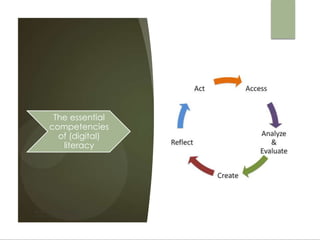
The essential
       competencies
         of (digital)
          literacy


Illustration from : Digital and Media Literacy: A
plan of action. (Hobbs, 2011)
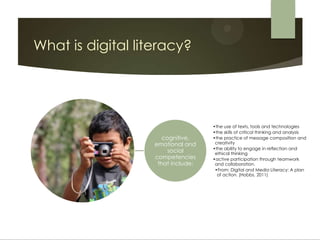
What is digital literacy?


                                    •the use of texts, tools and technologies
                                    •the skills of critical thinking and analysis
                      cognitive,    •the practice of message composition and
                   emotional and     creativity
                                    •the ability to engage in reflection and
                        social       ethical thinking
                   competencies     •active participation through teamwork
                    that include:    and collaboration.
                                     •From: Digital and Media Literacy: A plan
                                      of action. (Hobbs, 2011)
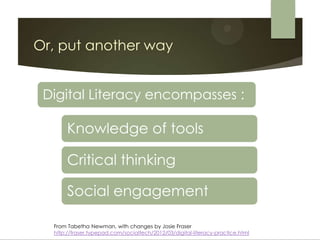
Or, put another way


 Digital Literacy encompasses :

       Knowledge of tools

       Critical thinking

       Social engagement

  From Tabetha Newman, with changes by Josie Fraser
  http://fraser.typepad.com/socialtech/2012/03/digital-literacy-practice.html
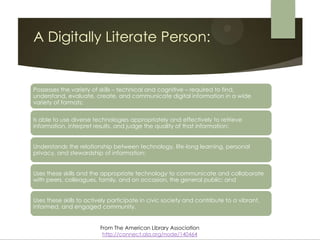
A Digitally Literate Person:


Possesses the variety of skills – technical and cognitive – required to find,
understand, evaluate, create, and communicate digital information in a wide
variety of formats;


Is able to use diverse technologies appropriately and effectively to retrieve
information, interpret results, and judge the quality of that information;


Understands the relationship between technology, life-long learning, personal
privacy, and stewardship of information;


Uses these skills and the appropriate technology to communicate and collaborate
with peers, colleagues, family, and on occasion, the general public; and


Uses these skills to actively participate in civic society and contribute to a vibrant,
informed, and engaged community.


                         From The American Library Association
                          http://connect.ala.org/node/140464
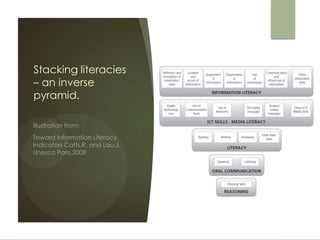
Stacking literacies
– an inverse
pyramid.

Illustration from:
Toward Information Literacy
Indicators Catts,R. and Lau,J.
Unesco Paris,2008
How we learn about
technology


Most adults born before 1968 learn computer skills informally,
or at work, while younger users are taught in school.
 •Strawn,C. The Relationship Between Literacy Proficiency and the Digital
  Divide Among Adults With Low Education Attainment. 2008

How do youth learn to use technology?


What are the implications of this for any digital literacy work?

 •Is ad hoc and peer learning adequate?
Ramping up   AKA “THE DIGITAL
access       DIVIDE”
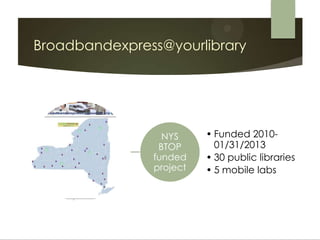
Broadbandexpress@yourlibrary


                 NYS     • Funded 2010-
                BTOP       01/31/2013
               funded    • 30 public libraries
               project   • 5 mobile labs
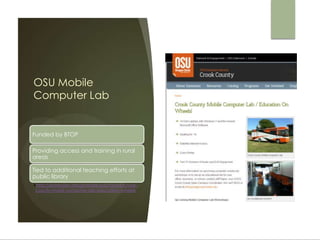
OSU Mobile
Computer Lab


Funded by BTOP

Providing access and training in rural
areas

Tied to additional teaching efforts at
public library
•http://extension.oregonstate.edu/crook/crook-
 county-mobil-computer-lab-education-wheels
Digital and local


   While technologies may “collapse distance”, we still
    live in a particular place at a specific time
   Balancing literacy educations to respect both the
    interconnectedness, and locality, of life is the
    challenge facing us today.
Challenges


New literacies bridge local and global
knowledge and concerns

We already participate in some facets of
this work
• Is new literacy education consistent with our
  mission?

And, digital literacy development alone
is not enough.
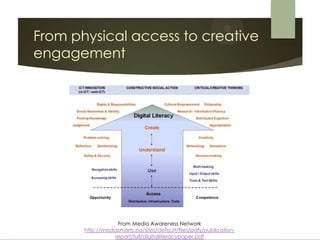
From physical access to creative
engagement


                   From Media Awareness Network
       http://mediasmarts.ca/sites/default/files/pdfs/publication-
                  report/full/digitalliteracypaper.pdf
Resources

   DigitalLiteracy.Gov       • http://www.digitalliteracy.gov/


 Digital Literacy in New
            York
                             • http://www.diglitny.org/


Digital Literacy Standards
     for New Yorkers
                             • http://bit.ly/VxEJP3


Microsoft Digital Literacy
      Curriculum
                             • http://bit.ly/WCtLW8


Digital & Medial Literacy:   • http://www.knightcomm.org/digital-and-
     A Plan of Action          media-literacy-a-plan-of-action/
Freire, P., & Macedo, D. P. (1987). Literacy: Reading the word & the world. South Hadley, Mass: Bergin &
Garvey Publishers.


London, R. A., M. Pastor, L. J. Servon, R. Rosner, and A. Wallace. “The Role of Community Technology Centers
in Promoting Youth Development.” Youth & Society 42, no. 2 (November 2009)

Mehra, B. “The Library-Community Convergence Framework for Community Action: Libraries as Catalysts.”
Libri 57, no. 3 (2007). http://late-dpedago.urv.cat/site_media/papers/The_library-
community_convergence_framework_for_community_action.pdf.

Maia, Ivan Ferrer, and José Armando Valente. Garden of Literacies: ICDT Contributing to the Construction of
New Realities for Digitally-Excluded Senior Citizens. Vol. 7. 1-2, 2011. http://www.ci-
journal.net/index.php/ciej/article/view/673/718.

Poore, Megan. “Digital Literacy:: Human Flourishing and Collective Intelligence in a Knowledge Society.”
Australian Journal of Language & Literacy no. 2 (2011): 20–26.


Tyner, K. (1998). Literacy in a digital world: Teaching and learning in the age of information. Mahwah, N.J:
Lawrence Erlbaum.


Williamson, Andy. 2007. “Empowering communities to action  Reclaiming local democracy through ICT.”
                                                           :
Pp. 1–10 in Communities and Action: Prato CIRN Conference 2007.
Contact


          Paul Treadwell
          •pt36@cornell.edu
          •@ptreadwell
          •http://www.paultreadwell.com

          •Digital literacy and extension: bookmarks
           •http://groups.diigo.com/group/digital-
            literacy_extension

Digital Literacy | Why it matters

  • 1.
    Digital Literacy WHY ITMATTERS SLIDES FOR DISCUSSION PAUL TREADWELL | FEBRUARY 2013
  • 2.
    Why digital? Digital technologies are changing: The 3 r’s are no •How we do business longer enough : •How we do research •How we interact with each other New literacies are needed for successful participation in democratic society.
  • 3.
    What does itmean to be “literate?  “Acquiring literacy does not involve memorising sentences, words or syllables … but rather an attitude of creation and re-creation, a self- transformation producing a stance of intervention in one's context." Paulo Freire, Education: The Practice of Freedom (1973)
  • 4.
    The essential competencies of (digital) literacy Illustration from : Digital and Media Literacy: A plan of action. (Hobbs, 2011)
  • 5.
    What is digitalliteracy? •the use of texts, tools and technologies •the skills of critical thinking and analysis cognitive, •the practice of message composition and emotional and creativity •the ability to engage in reflection and social ethical thinking competencies •active participation through teamwork that include: and collaboration. •From: Digital and Media Literacy: A plan of action. (Hobbs, 2011)
  • 6.
    Or, put anotherway Digital Literacy encompasses : Knowledge of tools Critical thinking Social engagement From Tabetha Newman, with changes by Josie Fraser http://fraser.typepad.com/socialtech/2012/03/digital-literacy-practice.html
  • 7.
    A Digitally LiteratePerson: Possesses the variety of skills – technical and cognitive – required to find, understand, evaluate, create, and communicate digital information in a wide variety of formats; Is able to use diverse technologies appropriately and effectively to retrieve information, interpret results, and judge the quality of that information; Understands the relationship between technology, life-long learning, personal privacy, and stewardship of information; Uses these skills and the appropriate technology to communicate and collaborate with peers, colleagues, family, and on occasion, the general public; and Uses these skills to actively participate in civic society and contribute to a vibrant, informed, and engaged community. From The American Library Association http://connect.ala.org/node/140464
  • 8.
    Stacking literacies – aninverse pyramid. Illustration from: Toward Information Literacy Indicators Catts,R. and Lau,J. Unesco Paris,2008
  • 9.
    How we learnabout technology Most adults born before 1968 learn computer skills informally, or at work, while younger users are taught in school. •Strawn,C. The Relationship Between Literacy Proficiency and the Digital Divide Among Adults With Low Education Attainment. 2008 How do youth learn to use technology? What are the implications of this for any digital literacy work? •Is ad hoc and peer learning adequate?
  • 10.
    Ramping up AKA “THE DIGITAL access DIVIDE”
  • 11.
    Broadbandexpress@yourlibrary NYS • Funded 2010- BTOP 01/31/2013 funded • 30 public libraries project • 5 mobile labs
  • 12.
    OSU Mobile Computer Lab Fundedby BTOP Providing access and training in rural areas Tied to additional teaching efforts at public library •http://extension.oregonstate.edu/crook/crook- county-mobil-computer-lab-education-wheels
  • 13.
    Digital and local  While technologies may “collapse distance”, we still live in a particular place at a specific time  Balancing literacy educations to respect both the interconnectedness, and locality, of life is the challenge facing us today.
  • 14.
    Challenges New literacies bridgelocal and global knowledge and concerns We already participate in some facets of this work • Is new literacy education consistent with our mission? And, digital literacy development alone is not enough.
  • 15.
    From physical accessto creative engagement From Media Awareness Network http://mediasmarts.ca/sites/default/files/pdfs/publication- report/full/digitalliteracypaper.pdf
  • 16.
    Resources DigitalLiteracy.Gov • http://www.digitalliteracy.gov/ Digital Literacy in New York • http://www.diglitny.org/ Digital Literacy Standards for New Yorkers • http://bit.ly/VxEJP3 Microsoft Digital Literacy Curriculum • http://bit.ly/WCtLW8 Digital & Medial Literacy: • http://www.knightcomm.org/digital-and- A Plan of Action media-literacy-a-plan-of-action/
  • 17.
    Freire, P., &Macedo, D. P. (1987). Literacy: Reading the word & the world. South Hadley, Mass: Bergin & Garvey Publishers. London, R. A., M. Pastor, L. J. Servon, R. Rosner, and A. Wallace. “The Role of Community Technology Centers in Promoting Youth Development.” Youth & Society 42, no. 2 (November 2009) Mehra, B. “The Library-Community Convergence Framework for Community Action: Libraries as Catalysts.” Libri 57, no. 3 (2007). http://late-dpedago.urv.cat/site_media/papers/The_library- community_convergence_framework_for_community_action.pdf. Maia, Ivan Ferrer, and José Armando Valente. Garden of Literacies: ICDT Contributing to the Construction of New Realities for Digitally-Excluded Senior Citizens. Vol. 7. 1-2, 2011. http://www.ci- journal.net/index.php/ciej/article/view/673/718. Poore, Megan. “Digital Literacy:: Human Flourishing and Collective Intelligence in a Knowledge Society.” Australian Journal of Language & Literacy no. 2 (2011): 20–26. Tyner, K. (1998). Literacy in a digital world: Teaching and learning in the age of information. Mahwah, N.J: Lawrence Erlbaum. Williamson, Andy. 2007. “Empowering communities to action  Reclaiming local democracy through ICT.” : Pp. 1–10 in Communities and Action: Prato CIRN Conference 2007.
  • 18.
    Contact Paul Treadwell •pt36@cornell.edu •@ptreadwell •http://www.paultreadwell.com •Digital literacy and extension: bookmarks •http://groups.diigo.com/group/digital- literacy_extension

Editor's Notes

  • #3 New literacies are emerging and needed for robust participation in civic life – if we view civic as encompassing a full range of activities [educational, governmental. Etc.] that create a public sphere. Digital is also interlocked with other literacy needs.
  • #5 Back to Freire and a “stance of intervention in one’s context.” The uncompleted cycle is the unrealized potential. Act and engagementIt is not enough to know how to send email, buy from amazon.
  • #6 In this report, the term “digital and media literacy” is used to encompass the full range of cognitive, emotional and social competencies that includes the use of texts, tools and technologies; the skills of critical thinking and analysis; the practice of message composition and creativity; the ability to engage in reflection and ethical thinking; as well as active participation through teamwork and collaboration. When people have digital and media literacy competencies, they recognize personal, corporate and political agendas and are empowered to speak out on behalf of the missing voices and omitted perspectives in our communities. By identifying and attempting to solve problems, people use their powerful voices and their rights under the law to improve the world around them.
  • #7 http://fraser.typepad.com/socialtech/2012/03/digital-literacy-practice.html
  • #8 http://connect.ala.org/node/140464 American Library AssociationMulti-literacies
  • #9 (there is a cultural bias here in the 3r’s – is it necessary to be able to read and write in order to be digitally literate?)http://www.ifla.org/files/assets/information-literacy/publications/towards-information-literacy_2008-en.pdf
  • #12 http://www.nysl.nysed.gov/libdev/nybbexpress/index.htmlBTOP Public Computer Center Criteria and Project Goals: • Increase public access to high speed broadband services in high-need communities • Serve vulnerable populations (unemployed, underemployed or other vulnerable populations: non-English speakers, seniors, disabled, etc.) • Provide technical support and other resources to support job search and career advancement through community anchor institutions such as libraries • Advance the use of E-services for training, employment, digital literacy, and education • Stimulate employment and provide job opportunities
  • #13 http://extension.oregonstate.edu/crook/crook-county-mobil-computer-lab-education-wheels grant through BTOP (the Broadband Technology Opportunity Program)  http://www.recovery.gov/Transparency/RecipientReportedData/pages/RecipientProjectSummary508.aspx?AwardIdSur=118519Currently, we travel to rural areas in our county to offer computer instruction and technology access. We also offer free classes every Monday at the Crook County library that focus on beginning computer concepts such as how to organize files and folders and how to set up an email account. The local community college offers community education classes for learners of different levels as well so our goal is to bridge the gap and help citizens who may have barriers that prevent them from attending the community college courses. These barriers could be financial, fear-based, or time constraints. - Stephanie ClymensCOCC Crook County Open Campus http://forums.techsoup.org/cs/community/f/16/p/36267/123608.aspx#123608
  • #14 The mono-culturing of the world. Assumption of shared norms across diverse context – and not just assumption but imposition through use of tech, constraints for engagement, etc…
  • #15 Issues with influx of new information and learning, social norms stability cultural, etc…indoctrination for consumption – which points out the necessity for robust literacies.Necessity of co-development of civic / participatory skills (literacies) for participation in digitally mediated egov, deliberation, etc.
  • #16 This figure is based on models from the Report of the Digital Britain Media Literacy Working Group. (March 2009), DigEuLit –a European Framework for Digital Literacy (2005), and Jenkins et al., (2006) Confronting the Challenges of Participatory Culture:Media Education for the 21st Century. http://www.newmedialiteracies.org/files/working/NMLWhitePaper.pdf