
Athens 8 October 2011ICT for learning: the experience of the Lifelong Learning ProgrammePeter BirchHead of Sector: ICT, Languages and RomaEducation Audiovisual and Culture Executive Agency
Opportunities and challengesMost knowledge is learning from the other across the border.Amartya Sen - Indian Economist Nobel-prize winnerBlogs have given people a chance to stop yelling at their TV and have a say in the process.				überblogger Glenn ReynoldsThe idea is to constantly learn. You are always taking an examination. There is no end to learning… There is no real end to what can be done by whom. 			Vivek Kulkarni – Manager of B2K in Bangalore talking about the 				market opportunities of personal remote executive assistance2
The Executive Agency
The programmes
Taking stock
What next?3
The Executive Agency
The programmes
Taking stock
What next?4
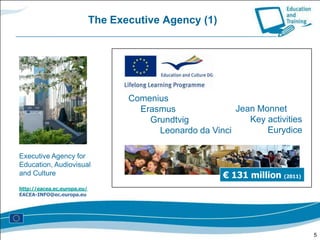
The Executive Agency (1)Comenius     Erasmus         Grundtvig             Leonardo da VinciJean Monnet      Key activities         	EurydiceExecutive Agency for Education, Audiovisual and Culturehttp://eacea.ec.europa.eu/EACEA-INFO@ec.europa.eu€ 131 million (2011)5
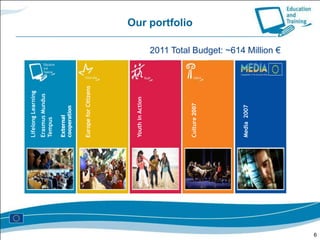
Lifelong LearningErasmus MundusTempusExternal cooperationEurope for CitizensYouth in ActionCulture 2007Media  2007Our portfolio2011 Total Budget: ~614 Million €6
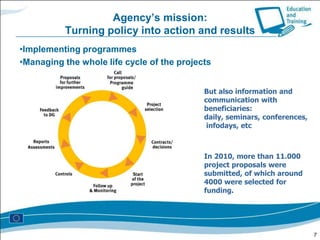
Agency’s mission:Turning policy into action and resultsImplementing programmesManaging the whole life cycle of the projectsBut also information and communication with beneficiaries: daily, seminars, conferences, infodays, etcIn 2010, more than 11.000 project proposals were submitted, of which around 4000 were selected for funding.7
The Executive Agency
The programmes
Taking stock
What next?8
The ExecutiveAgency
The programmes
Taking stock
What next?9
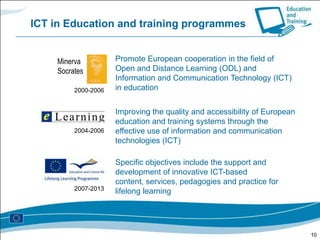
Promote European cooperation in the field of Open and Distance Learning (ODL) and Information and Communication Technology (ICT) in educationMinervaSocrates2000-2006Improving the quality and accessibility of European education and training systems through the effective use of information and communication technologies (ICT)2004-2006Specific objectives include the support and development of innovative ICT-based content, services, pedagogies and practice for lifelong learning2007-2013ICT in Education and training programmes10
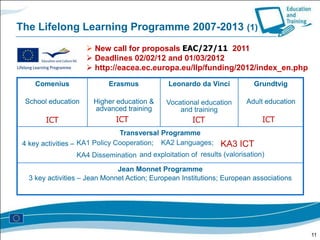
The Lifelong Learning Programme 2007-2013 (1)New call for proposals EAC/27/11 2011
 Deadlines 02/02/12 and 01/03/2012
 http://eacea.ec.europa.eu/llp/funding/2012/index_en.phpGrundtvigLeonardo daVinciErasmusComeniusGrundtvigLeonardo daVinciErasmusComeniusComeniusAdult education Higher education & School educationAdult education Higher education & School educationSchool educationVocational education advanced trainingadvanced trainingand trainingICTICTICTICTTransversal ProgrammeTransversal ProgrammeKA2 Languages; KA3 ICT KA1 Policy Cooperation; 4 key activities –4 key activities –KA4 Disseminationresults (valorisation)and exploitation of Jean Monnet ProgrammeJean Monnet Programme3 key activities –Jean Monnet Action; European Institutions; European associations 3 key activities –Jean Monnet Action; European Institutions; European associations 11
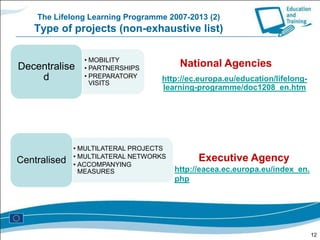
http://ec.europa.eu/education/lifelong-learning-programme/doc1208_en.htmThe Lifelong Learning Programme 2007-2013 (2) Type of projects (non-exhaustive list)http://eacea.ec.europa.eu/index_en.php12
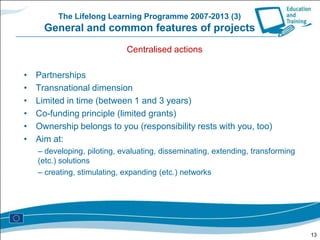
The Lifelong Learning Programme 2007-2013 (3) General and common features of projectsCentralised actionsPartnershipsTransnational dimensionLimited in time (between 1 and 3 years)Co-funding principle (limited grants)Ownership belongs to you (responsibility rests with you, too)Aim at: developing, piloting, evaluating, disseminating, extending, transforming (etc.) solutions creating, stimulating, expanding (etc.) networks13
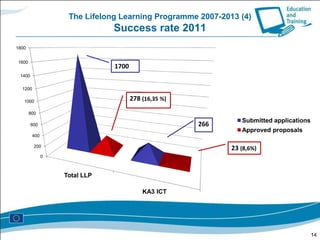
The Lifelong Learning Programme 2007-2013 (4)Success rate 201114
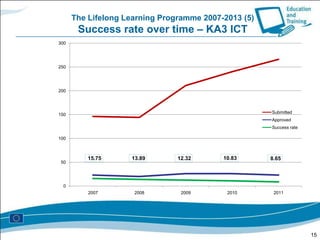
The Lifelong Learning Programme 2007-2013 (5)Success rate over time – KA3 ICT15
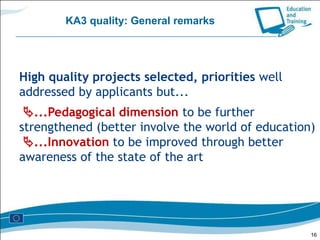
KA3 quality: General remarksHigh quality projects selected, priorities well addressed by applicants but......Pedagogical dimensionto be further strengthened (better involve the world of education)...Innovationto be improved through better awareness of the state of the art16
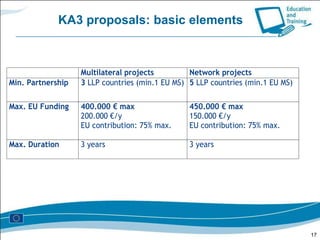
KA3 proposals: basic elements17
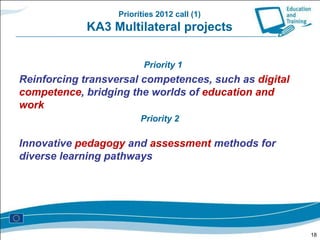
Priorities 2012 call (1)KA3 Multilateral projects	Priority 1	Reinforcing transversal competences, such as digital competence, bridging the worlds of education and workPriority 2Innovative pedagogy and assessment methods for diverse learning pathways18
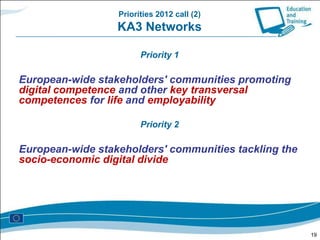
Priorities 2012 call (2)KA3 NetworksPriority 1European-wide stakeholders' communities promoting digital competence and other key transversal competences for life and employability Priority 2European-wide stakeholders' communities tackling the socio-economic digital divide19
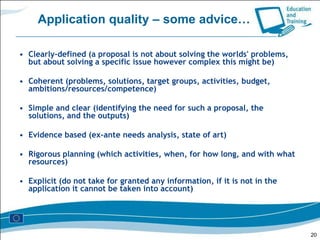
Application quality – some advice…Clearly-defined (a proposal is not about solving the worlds' problems, but about solving a specific issue however complex this might be)Coherent (problems, solutions, target groups, activities, budget, ambitions/resources/competence)Simple and clear (identifying the need for such a proposal, the solutions, and the outputs)Evidence based (ex-ante needs analysis, state of art)Rigorous planning (which activities, when, for how long, and with what resources)Explicit (do not take for granted any information, if it is not in the application it cannot be taken into account)20
The Agency
The programmes
Taking stock
What next?21
The Agency
The programmes
Taking stock

eLearning expo conference Athens 2011 - Peter Birch

  • 1.
    Athens 8 October2011ICT for learning: the experience of the Lifelong Learning ProgrammePeter BirchHead of Sector: ICT, Languages and RomaEducation Audiovisual and Culture Executive Agency
  • 2.
    Opportunities and challengesMostknowledge is learning from the other across the border.Amartya Sen - Indian Economist Nobel-prize winnerBlogs have given people a chance to stop yelling at their TV and have a say in the process. überblogger Glenn ReynoldsThe idea is to constantly learn. You are always taking an examination. There is no end to learning… There is no real end to what can be done by whom. Vivek Kulkarni – Manager of B2K in Bangalore talking about the market opportunities of personal remote executive assistance2
  • 3.
  • 4.
  • 5.
  • 6.
  • 7.
  • 8.
  • 9.
  • 10.
  • 11.
    The Executive Agency(1)Comenius Erasmus Grundtvig Leonardo da VinciJean Monnet Key activities EurydiceExecutive Agency for Education, Audiovisual and Culturehttp://eacea.ec.europa.eu/EACEA-INFO@ec.europa.eu€ 131 million (2011)5
  • 12.
    Lifelong LearningErasmus MundusTempusExternalcooperationEurope for CitizensYouth in ActionCulture 2007Media 2007Our portfolio2011 Total Budget: ~614 Million €6
  • 13.
    Agency’s mission:Turning policyinto action and resultsImplementing programmesManaging the whole life cycle of the projectsBut also information and communication with beneficiaries: daily, seminars, conferences, infodays, etcIn 2010, more than 11.000 project proposals were submitted, of which around 4000 were selected for funding.7
  • 14.
  • 15.
  • 16.
  • 17.
  • 18.
  • 19.
  • 20.
  • 21.
  • 22.
    Promote European cooperationin the field of Open and Distance Learning (ODL) and Information and Communication Technology (ICT) in educationMinervaSocrates2000-2006Improving the quality and accessibility of European education and training systems through the effective use of information and communication technologies (ICT)2004-2006Specific objectives include the support and development of innovative ICT-based content, services, pedagogies and practice for lifelong learning2007-2013ICT in Education and training programmes10
  • 23.
    The Lifelong LearningProgramme 2007-2013 (1)New call for proposals EAC/27/11 2011
  • 24.
    Deadlines 02/02/12and 01/03/2012
  • 25.
    http://eacea.ec.europa.eu/llp/funding/2012/index_en.phpGrundtvigLeonardo daVinciErasmusComeniusGrundtvigLeonardodaVinciErasmusComeniusComeniusAdult education Higher education & School educationAdult education Higher education & School educationSchool educationVocational education advanced trainingadvanced trainingand trainingICTICTICTICTTransversal ProgrammeTransversal ProgrammeKA2 Languages; KA3 ICT KA1 Policy Cooperation; 4 key activities –4 key activities –KA4 Disseminationresults (valorisation)and exploitation of Jean Monnet ProgrammeJean Monnet Programme3 key activities –Jean Monnet Action; European Institutions; European associations 3 key activities –Jean Monnet Action; European Institutions; European associations 11
  • 26.
    http://ec.europa.eu/education/lifelong-learning-programme/doc1208_en.htmThe Lifelong LearningProgramme 2007-2013 (2) Type of projects (non-exhaustive list)http://eacea.ec.europa.eu/index_en.php12
  • 27.
    The Lifelong LearningProgramme 2007-2013 (3) General and common features of projectsCentralised actionsPartnershipsTransnational dimensionLimited in time (between 1 and 3 years)Co-funding principle (limited grants)Ownership belongs to you (responsibility rests with you, too)Aim at: developing, piloting, evaluating, disseminating, extending, transforming (etc.) solutions creating, stimulating, expanding (etc.) networks13
  • 28.
    The Lifelong LearningProgramme 2007-2013 (4)Success rate 201114
  • 29.
    The Lifelong LearningProgramme 2007-2013 (5)Success rate over time – KA3 ICT15
  • 30.
    KA3 quality: GeneralremarksHigh quality projects selected, priorities well addressed by applicants but......Pedagogical dimensionto be further strengthened (better involve the world of education)...Innovationto be improved through better awareness of the state of the art16
  • 31.
  • 32.
    Priorities 2012 call(1)KA3 Multilateral projects Priority 1 Reinforcing transversal competences, such as digital competence, bridging the worlds of education and workPriority 2Innovative pedagogy and assessment methods for diverse learning pathways18
  • 33.
    Priorities 2012 call(2)KA3 NetworksPriority 1European-wide stakeholders' communities promoting digital competence and other key transversal competences for life and employability Priority 2European-wide stakeholders' communities tackling the socio-economic digital divide19
  • 34.
    Application quality –some advice…Clearly-defined (a proposal is not about solving the worlds' problems, but about solving a specific issue however complex this might be)Coherent (problems, solutions, target groups, activities, budget, ambitions/resources/competence)Simple and clear (identifying the need for such a proposal, the solutions, and the outputs)Evidence based (ex-ante needs analysis, state of art)Rigorous planning (which activities, when, for how long, and with what resources)Explicit (do not take for granted any information, if it is not in the application it cannot be taken into account)20
  • 35.
  • 36.
  • 37.
  • 38.
  • 39.
  • 40.
  • 41.