
PROJECT TITLE
AN INVESTIGATION OF FACTORS THAT LEAD
TO DELAYED FINAL ACCOUNT CONCLUSION
OF BUILDING PROJECTS IN MALAWI
CONSTRUCTION INDUSTRY
BY: LENSON MHANGO
(BQS/09/PE/016)
SUPERVISED BY: MR. C.I.M. CHIOCHA
PRESENTATION OUTLINE
Introduction
Problem Statement
Objectives of the study
Research design and Methodology
Results and Discussion
Conclusion and Recommendation
INTRODUCTION
 Delay can be defined as time overrun or extension of time to
complete the project.
 There are high possibilities that delay issues in final account
closing cannot be avoided in Malawi construction industry
 Delay in final account closing is a situation when the actual
planning (time and budget allocation) of a construction project
exceeds the planned schedule or on the other hand, final
account closing exceeds the time and other provisions specified
in the contract (Zarabizan et al., 2009).
 “Final Account” is taken in the construction contracts simply as a
mechanism for dealing with the final contract sum or final
payment due to the Contractor after the Final Measurement
Period or after the Maintenance / Defects Liability Period
INTRODUCTION (CONT’D)
 Construction projects generally comprise five stages(Rumus,
Birchall, Griffiths, 2008):
 initiation/planning,
 design,
 tender,
 construction and
 final account/defect liability stage
INTRODUCTION (CONT’D)
 The role and performance of project participants and contracting
parties in a construction project in each stage influence the project
success
 However, the importance of the final account closing in the stipulated
time frame and agreed contract cost is always being neglected
 Undue protracted inaction makes the closing of final account more
difficult and frequently leads to the emergence of unnecessary
dispute (Duncan Cartlidge, 2009).
PROBLEM STATEMENT
 In the Malawi Construction Industry, the period of final
payment after practical completion tends to be longer than
that stipulated in the terms and conditions of various
construction contracts.
 Most standard contract forms contain provisions where the
construction players are obliged to settle the final account and
issue a final payment certificate to the contractor within a
specified period of time after the receipt of the contractor’s
final account statement (PWD, 2010).
 Despite this, delays in final account closing continue to be a
problem (Zarabizan et al, 2009).
OBJECTIVES OF THE STUDY
 Main objective
 The main objective is to investigate the factors that lead to
delayed final account conclusion of building projects in Malawi
construction industry
OBJECTIVES (CONT’D)
 Specific objectives
 To determine how many contractors have had their final
account being paid on time in their respective contracts
over the past five years
 To identify the challenges that contractors face as a
result of delayed final account conclusion and the
suggested solutions to the challenges that the
contractors face due to delayed final account conclusion
 To determine the underlying factors leading to delayed
final account settlement of building projects in Malawi
construction industry
RESEARCH DESIGN AND METHODOLOGY
 LOCATION
 The study was carried out in the City of Blantyre.
 RESEARCH METHOD
 This study was based on quantitative assessments
 DATA SOURCES
 Data was collected from a range of sources including
literature (published and unpublished), and some building
contractors in the city of Blantyre
 SAMPLING TECHNIGUE
 This study adopted the random sampling technique
METHODOLOGY (CONT’D)
 SAMPLE SIZE
 The sample size for this study was 44 building Contractors from within
Blantyre City, Malawi
 DATA COLLECTION METHOD
 Primary data
 Structured questionnaire was used
 Secondary data
 Already published data like the internet, previous research papers,
newspapers and journals
 DATA ANALYSIS
 The main statistics calculated in the data analysis were the mean,
frequency and percentage scores with aid of SPSS software.
 The data has been presented Graphically, in Tables and Pie
charts
RESULTS AND DISCUSSION (OVERVIEW)
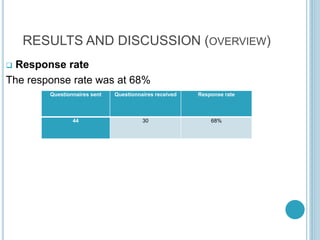
 Response rate
The response rate was at 68%
Questionnaires sent Questionnaires received Response rate
44 30 68%
RESULTS AND DISCUSSION CONT’D
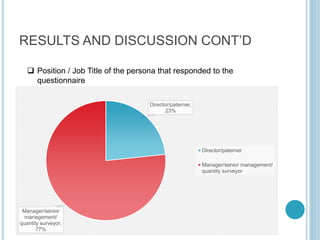
Director/paterner,
23%
Manager/senior
management/
quantity surveyor,
77%
Director/paterner
Manager/senior management/
quantity surveyor
 Position / Job Title of the persona that responded to the
questionnaire
RESULTS AND DISCUSSION CONT’D
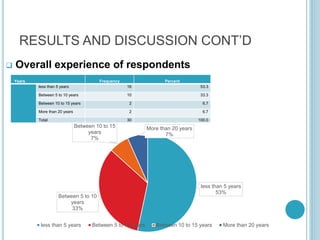
 Overall experience of respondents
less than 5 years
53%
Between 5 to 10
years
33%
Between 10 to 15
years
7%
More than 20 years
7%
less than 5 years Between 5 to 10 years Between 10 to 15 years More than 20 years
Years Frequency Percent
less than 5 years 16 53.3
Between 5 to 10 years 10 33.3
Between 10 to 15 years 2 6.7
More than 20 years 2 6.7
Total 30 100.0
RESULTS AND DISCUSSION CONT’D
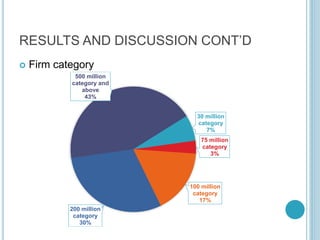
 Firm category
30 million
category
7%
75 million
category
3%
100 million
category
17%
200 million
category
30%
500 million
category and
above
43%
RESULTS AND DISCUSSION CONT’D
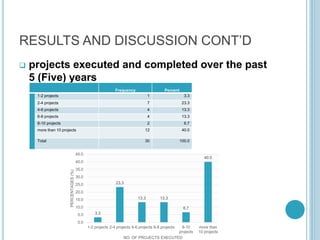
 projects executed and completed over the past
5 (Five) years
Frequency Percent
1-2 projects 1 3.3
2-4 projects 7 23.3
4-6 projects 4 13.3
6-8 projects 4 13.3
8-10 projects 2 6.7
more than 10 projects 12 40.0
Total 30 100.0
3.3
23.3
13.3 13.3
6.7
40.0
0.0
5.0
10.0
15.0
20.0
25.0
30.0
35.0
40.0
45.0
1-2 projects 2-4 projects 4-6 projects 6-8 projects 8-10
projects
more than
10 projects
PERCENTAGES(%)
NO. OF PROJECTS EXECUTED
RESULTS AND DISCUSSION CONT’D
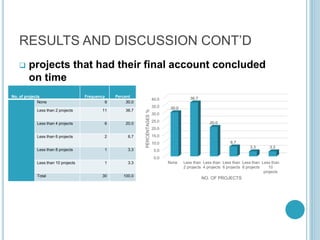
 projects that had their final account concluded
on time
No. of projects Frequency Percent
None 9 30.0
Less than 2 projects 11 36.7
Less than 4 projects 6 20.0
Less than 6 projects 2 6.7
Less than 8 projects 1 3.3
Less than 10 projects 1 3.3
Total 30 100.0
0.0
5.0
10.0
15.0
20.0
25.0
30.0
35.0
40.0
None Less than
2 projects
Less than
4 projects
Less than
6 projects
Less than
8 projects
Less than
10
projects
30.0
36.7
20.0
6.7
3.3 3.3PERCENTAGES%
NO. OF PROJECTS
RESULTS AND DISCUSSION CONT’D
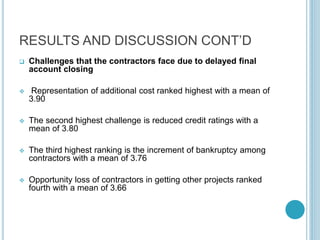
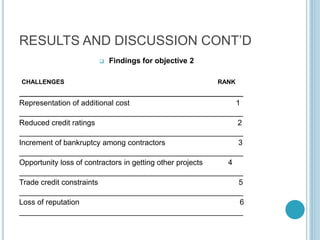
 Challenges that the contractors face due to delayed final
account closing
 Representation of additional cost ranked highest with a mean of
3.90
 The second highest challenge is reduced credit ratings with a
mean of 3.80
 The third highest ranking is the increment of bankruptcy among
contractors with a mean of 3.76
 Opportunity loss of contractors in getting other projects ranked
fourth with a mean of 3.66
RESULTS AND DISCUSSION CONT’D
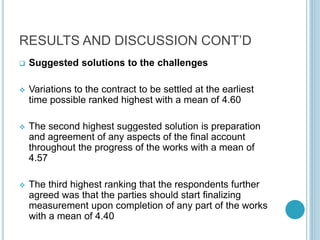
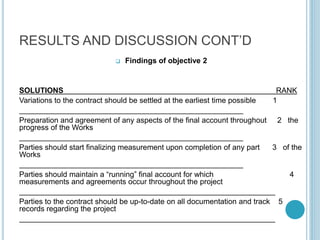
 Suggested solutions to the challenges
 Variations to the contract to be settled at the earliest
time possible ranked highest with a mean of 4.60
 The second highest suggested solution is preparation
and agreement of any aspects of the final account
throughout the progress of the works with a mean of
4.57
 The third highest ranking that the respondents further
agreed was that the parties should start finalizing
measurement upon completion of any part of the works
with a mean of 4.40
RESULTS AND DISCUSSION CONT’D
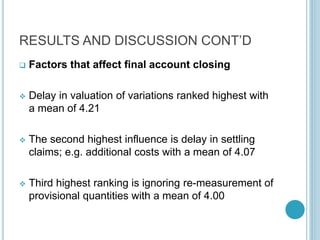
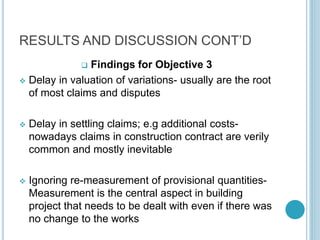
 Factors that affect final account closing
 Delay in valuation of variations ranked highest with
a mean of 4.21
 The second highest influence is delay in settling
claims; e.g. additional costs with a mean of 4.07
 Third highest ranking is ignoring re-measurement of
provisional quantities with a mean of 4.00
RESULTS AND DISCUSSION CONT’D
 Findings for objective 1
 From the survey, it has been considered that Final
Account, like construction dispute, is a difficult-to-
settle-task which is skills-oriented, adversarial,
repetitive, tactical, time consuming and, more
frequently, lack of appreciation
 This has echoed the common understanding in the
construction industry that most final accounts were
settled far beyond the period stated in the
respective contract.
RESULTS AND DISCUSSION CONT’D
 Findings for objective 2
CHALLENGES RANK
Representation of additional cost 1
Reduced credit ratings 2
Increment of bankruptcy among contractors 3
Opportunity loss of contractors in getting other projects 4
Trade credit constraints 5
Loss of reputation 6
RESULTS AND DISCUSSION CONT’D
 Findings of objective 2
SOLUTIONS RANK
Variations to the contract should be settled at the earliest time possible 1
Preparation and agreement of any aspects of the final account throughout 2 the
progress of the Works
Parties should start finalizing measurement upon completion of any part 3 of the
Works
Parties should maintain a “running” final account for which 4
measurements and agreements occur throughout the project
Parties to the contract should be up-to-date on all documentation and track 5
records regarding the project
RESULTS AND DISCUSSION CONT’D
 Findings for Objective 3
 Delay in valuation of variations- usually are the root
of most claims and disputes
 Delay in settling claims; e.g additional costs-
nowadays claims in construction contract are verily
common and mostly inevitable
 Ignoring re-measurement of provisional quantities-
Measurement is the central aspect in building
project that needs to be dealt with even if there was
no change to the works
RESULTS AND DISCUSSION CONT’D
 Findings for Objective 3
 Poor documentation and lack of Records- which is
common and essential in support of all aspects
forming the Final Account, in particular in relation
 to valuation of variations,
 substantiation of claims,
 measurement,
 day works and site works which bear significant
impact on the final contract sum
CONCLUSION
 For many years, the issue of delay in final account
closing of building projects in Malawi construction
projects has been recorded as unsatisfactory
phenomenal
 Client or paymasters should practice an efficient
system to make sure that the contractor receives
the payment accordingly
 Hence, delays of final accounts closing can be
resolved at the early stage if the documents are
kept properly
CONCLUSION CONT’D
 Delay in the closing of final accounts may also
cause problems to contractor in making working
capital and eventually lead to bankruptcy
 Personal in charge in the project should be
maintained especially the project manager until the
closing of final accounts is completed.
 Thus, project managers need to have better
understanding of critical success/failure factors in
the construction project and how to measure them
RECOMMENDATIONS
 In all circumstances, it is not suggested that final
account preparation should commence only upon
completion of the project
 Whilst this may be the case in most situations, it is
not good practice, as there is abundant opportunity
for final account measurement during the course of
the Works
 From what have learned through this research, it is
suggested that:
RECOMMENDATIONS CONT’D
 Variations to the contract should be settled at the
earliest time possible
 Preparation and agreement of any aspects of the
final account throughout the progress of the Works
 Parties should start finalizing measurement upon
completion of any part of the Works
 Parties should maintain a “running” final account for
which measurements and agreements occur
throughout the project
 Parties to the contract should be up-to-date on all
documentation and track records regarding the
project
THANK YOU
GOD BLESS YOU
ALL!!!!!!!!

FINAL ACCOUNT CONCLUSION OF BUILDING PROJECTS

  • 1.
    PROJECT TITLE AN INVESTIGATIONOF FACTORS THAT LEAD TO DELAYED FINAL ACCOUNT CONCLUSION OF BUILDING PROJECTS IN MALAWI CONSTRUCTION INDUSTRY BY: LENSON MHANGO (BQS/09/PE/016) SUPERVISED BY: MR. C.I.M. CHIOCHA
  • 2.
    PRESENTATION OUTLINE Introduction Problem Statement Objectivesof the study Research design and Methodology Results and Discussion Conclusion and Recommendation
  • 3.
    INTRODUCTION  Delay canbe defined as time overrun or extension of time to complete the project.  There are high possibilities that delay issues in final account closing cannot be avoided in Malawi construction industry  Delay in final account closing is a situation when the actual planning (time and budget allocation) of a construction project exceeds the planned schedule or on the other hand, final account closing exceeds the time and other provisions specified in the contract (Zarabizan et al., 2009).  “Final Account” is taken in the construction contracts simply as a mechanism for dealing with the final contract sum or final payment due to the Contractor after the Final Measurement Period or after the Maintenance / Defects Liability Period
  • 4.
    INTRODUCTION (CONT’D)  Constructionprojects generally comprise five stages(Rumus, Birchall, Griffiths, 2008):  initiation/planning,  design,  tender,  construction and  final account/defect liability stage
  • 5.
    INTRODUCTION (CONT’D)  Therole and performance of project participants and contracting parties in a construction project in each stage influence the project success  However, the importance of the final account closing in the stipulated time frame and agreed contract cost is always being neglected  Undue protracted inaction makes the closing of final account more difficult and frequently leads to the emergence of unnecessary dispute (Duncan Cartlidge, 2009).
  • 6.
    PROBLEM STATEMENT  Inthe Malawi Construction Industry, the period of final payment after practical completion tends to be longer than that stipulated in the terms and conditions of various construction contracts.  Most standard contract forms contain provisions where the construction players are obliged to settle the final account and issue a final payment certificate to the contractor within a specified period of time after the receipt of the contractor’s final account statement (PWD, 2010).  Despite this, delays in final account closing continue to be a problem (Zarabizan et al, 2009).
  • 7.
    OBJECTIVES OF THESTUDY  Main objective  The main objective is to investigate the factors that lead to delayed final account conclusion of building projects in Malawi construction industry
  • 8.
    OBJECTIVES (CONT’D)  Specificobjectives  To determine how many contractors have had their final account being paid on time in their respective contracts over the past five years  To identify the challenges that contractors face as a result of delayed final account conclusion and the suggested solutions to the challenges that the contractors face due to delayed final account conclusion  To determine the underlying factors leading to delayed final account settlement of building projects in Malawi construction industry
  • 9.
    RESEARCH DESIGN ANDMETHODOLOGY  LOCATION  The study was carried out in the City of Blantyre.  RESEARCH METHOD  This study was based on quantitative assessments  DATA SOURCES  Data was collected from a range of sources including literature (published and unpublished), and some building contractors in the city of Blantyre  SAMPLING TECHNIGUE  This study adopted the random sampling technique
  • 10.
    METHODOLOGY (CONT’D)  SAMPLESIZE  The sample size for this study was 44 building Contractors from within Blantyre City, Malawi  DATA COLLECTION METHOD  Primary data  Structured questionnaire was used  Secondary data  Already published data like the internet, previous research papers, newspapers and journals  DATA ANALYSIS  The main statistics calculated in the data analysis were the mean, frequency and percentage scores with aid of SPSS software.  The data has been presented Graphically, in Tables and Pie charts
  • 11.
    RESULTS AND DISCUSSION(OVERVIEW)  Response rate The response rate was at 68% Questionnaires sent Questionnaires received Response rate 44 30 68%
  • 12.
    RESULTS AND DISCUSSIONCONT’D Director/paterner, 23% Manager/senior management/ quantity surveyor, 77% Director/paterner Manager/senior management/ quantity surveyor  Position / Job Title of the persona that responded to the questionnaire
  • 13.
    RESULTS AND DISCUSSIONCONT’D  Overall experience of respondents less than 5 years 53% Between 5 to 10 years 33% Between 10 to 15 years 7% More than 20 years 7% less than 5 years Between 5 to 10 years Between 10 to 15 years More than 20 years Years Frequency Percent less than 5 years 16 53.3 Between 5 to 10 years 10 33.3 Between 10 to 15 years 2 6.7 More than 20 years 2 6.7 Total 30 100.0
  • 14.
    RESULTS AND DISCUSSIONCONT’D  Firm category 30 million category 7% 75 million category 3% 100 million category 17% 200 million category 30% 500 million category and above 43%
  • 15.
    RESULTS AND DISCUSSIONCONT’D  projects executed and completed over the past 5 (Five) years Frequency Percent 1-2 projects 1 3.3 2-4 projects 7 23.3 4-6 projects 4 13.3 6-8 projects 4 13.3 8-10 projects 2 6.7 more than 10 projects 12 40.0 Total 30 100.0 3.3 23.3 13.3 13.3 6.7 40.0 0.0 5.0 10.0 15.0 20.0 25.0 30.0 35.0 40.0 45.0 1-2 projects 2-4 projects 4-6 projects 6-8 projects 8-10 projects more than 10 projects PERCENTAGES(%) NO. OF PROJECTS EXECUTED
  • 16.
    RESULTS AND DISCUSSIONCONT’D  projects that had their final account concluded on time No. of projects Frequency Percent None 9 30.0 Less than 2 projects 11 36.7 Less than 4 projects 6 20.0 Less than 6 projects 2 6.7 Less than 8 projects 1 3.3 Less than 10 projects 1 3.3 Total 30 100.0 0.0 5.0 10.0 15.0 20.0 25.0 30.0 35.0 40.0 None Less than 2 projects Less than 4 projects Less than 6 projects Less than 8 projects Less than 10 projects 30.0 36.7 20.0 6.7 3.3 3.3PERCENTAGES% NO. OF PROJECTS
  • 17.
    RESULTS AND DISCUSSIONCONT’D  Challenges that the contractors face due to delayed final account closing  Representation of additional cost ranked highest with a mean of 3.90  The second highest challenge is reduced credit ratings with a mean of 3.80  The third highest ranking is the increment of bankruptcy among contractors with a mean of 3.76  Opportunity loss of contractors in getting other projects ranked fourth with a mean of 3.66
  • 18.
    RESULTS AND DISCUSSIONCONT’D  Suggested solutions to the challenges  Variations to the contract to be settled at the earliest time possible ranked highest with a mean of 4.60  The second highest suggested solution is preparation and agreement of any aspects of the final account throughout the progress of the works with a mean of 4.57  The third highest ranking that the respondents further agreed was that the parties should start finalizing measurement upon completion of any part of the works with a mean of 4.40
  • 19.
    RESULTS AND DISCUSSIONCONT’D  Factors that affect final account closing  Delay in valuation of variations ranked highest with a mean of 4.21  The second highest influence is delay in settling claims; e.g. additional costs with a mean of 4.07  Third highest ranking is ignoring re-measurement of provisional quantities with a mean of 4.00
  • 20.
    RESULTS AND DISCUSSIONCONT’D  Findings for objective 1  From the survey, it has been considered that Final Account, like construction dispute, is a difficult-to- settle-task which is skills-oriented, adversarial, repetitive, tactical, time consuming and, more frequently, lack of appreciation  This has echoed the common understanding in the construction industry that most final accounts were settled far beyond the period stated in the respective contract.
  • 21.
    RESULTS AND DISCUSSIONCONT’D  Findings for objective 2 CHALLENGES RANK Representation of additional cost 1 Reduced credit ratings 2 Increment of bankruptcy among contractors 3 Opportunity loss of contractors in getting other projects 4 Trade credit constraints 5 Loss of reputation 6
  • 22.
    RESULTS AND DISCUSSIONCONT’D  Findings of objective 2 SOLUTIONS RANK Variations to the contract should be settled at the earliest time possible 1 Preparation and agreement of any aspects of the final account throughout 2 the progress of the Works Parties should start finalizing measurement upon completion of any part 3 of the Works Parties should maintain a “running” final account for which 4 measurements and agreements occur throughout the project Parties to the contract should be up-to-date on all documentation and track 5 records regarding the project
  • 23.
    RESULTS AND DISCUSSIONCONT’D  Findings for Objective 3  Delay in valuation of variations- usually are the root of most claims and disputes  Delay in settling claims; e.g additional costs- nowadays claims in construction contract are verily common and mostly inevitable  Ignoring re-measurement of provisional quantities- Measurement is the central aspect in building project that needs to be dealt with even if there was no change to the works
  • 24.
    RESULTS AND DISCUSSIONCONT’D  Findings for Objective 3  Poor documentation and lack of Records- which is common and essential in support of all aspects forming the Final Account, in particular in relation  to valuation of variations,  substantiation of claims,  measurement,  day works and site works which bear significant impact on the final contract sum
  • 25.
    CONCLUSION  For manyyears, the issue of delay in final account closing of building projects in Malawi construction projects has been recorded as unsatisfactory phenomenal  Client or paymasters should practice an efficient system to make sure that the contractor receives the payment accordingly  Hence, delays of final accounts closing can be resolved at the early stage if the documents are kept properly
  • 26.
    CONCLUSION CONT’D  Delayin the closing of final accounts may also cause problems to contractor in making working capital and eventually lead to bankruptcy  Personal in charge in the project should be maintained especially the project manager until the closing of final accounts is completed.  Thus, project managers need to have better understanding of critical success/failure factors in the construction project and how to measure them
  • 27.
    RECOMMENDATIONS  In allcircumstances, it is not suggested that final account preparation should commence only upon completion of the project  Whilst this may be the case in most situations, it is not good practice, as there is abundant opportunity for final account measurement during the course of the Works  From what have learned through this research, it is suggested that:
  • 28.
    RECOMMENDATIONS CONT’D  Variationsto the contract should be settled at the earliest time possible  Preparation and agreement of any aspects of the final account throughout the progress of the Works  Parties should start finalizing measurement upon completion of any part of the Works  Parties should maintain a “running” final account for which measurements and agreements occur throughout the project  Parties to the contract should be up-to-date on all documentation and track records regarding the project
  • 29.
    THANK YOU GOD BLESSYOU ALL!!!!!!!!