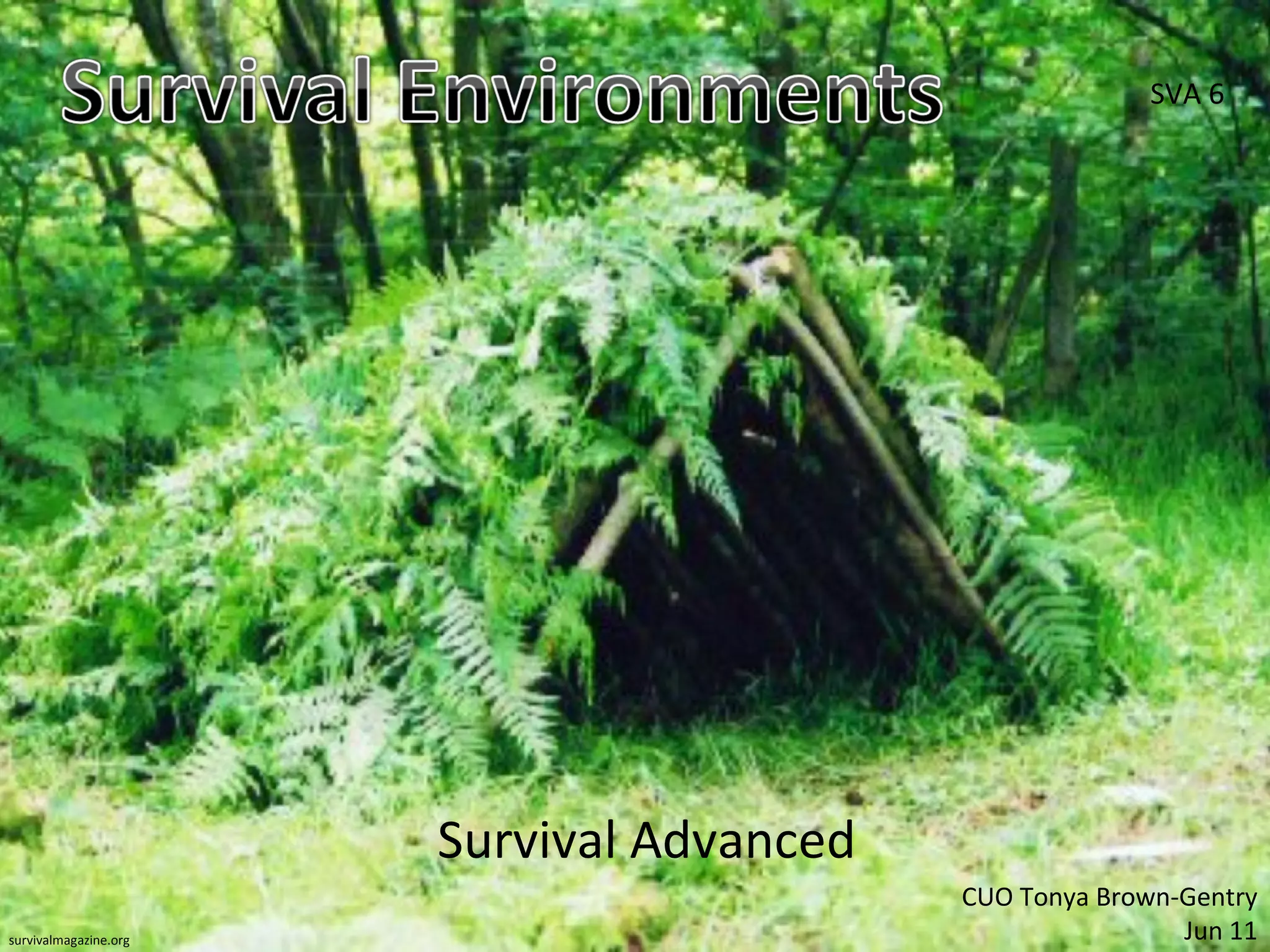
SVA 6 Survival Advanced CUO Tonya Brown-Gentry Jun 11 survivalmagazine.org
Objectives SVA 6 Introduction to Survival Environments Outline the characteristics, hazards and precautions associated with: a. Tropical scrub b. Cold weather c. Desert d. Sea and sea coast, and e. Natural disasters eg; flood, fire, storm etc.
Aim Cadets will be given the founding knowledge to allow them to survive in a variety of environments. The attitude that it will never happen to me is a sign of unpreparedness, which is the biggest killer in a survival situation.
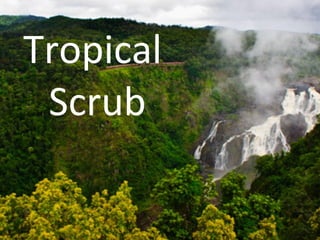
Tropical  Scrub
Introduction Takes several different forms dependant on: Altitude, Rainfall, Proximity to Equator, and whether coastal/inland. Each form creates its own environment that poses different advantages and disadvantages for survivors
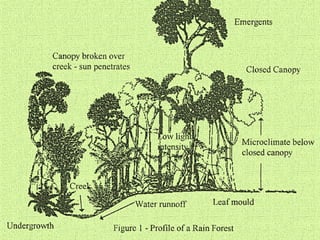
Tropical Rain Forests in Australia Occur mainly in the sub-tropical north W/in about 12% of the latitude of the equator In areas of high rainfall Temperatures remain constant ranging from ~ 18˚C (drier mid-year season) to 32˚C (wetter monsoon season) Vegetation – large trees, vines, ferns, thick scrubby undergrowth where sunshine penetrates _
Rain Forest Scrub Moving through – often hot and hard work Added hindrance of swarms of biting and annoying insect life Forest floor – leaf mould and other debris houses dangers such as death adder and other venomous snakes
 
Coastal Regions of Tropics Very different type of vegetation – thick scrub and mangroves Movement – slow and difficult Mangrove roots and scrub Tidal estuaries and mud flats (intrude for several km) Habitat of estuarine or salt water crocodile Aggressive and extremely dangerous to humans Food plentiful (fish, mud crabs, molluscs, mangrove worms, vegetation) and easy to obtain particularly at low tide.
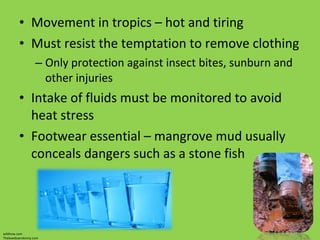
Movement in tropics – hot and tiring Must resist the temptation to remove clothing Only protection against insect bites, sunburn and other injuries Intake of fluids must be monitored to avoid heat stress Footwear essential – mangrove mud usually conceals dangers such as a stone fish wikihow.com Thelowdownskinny.com
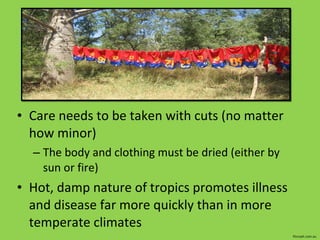
Care needs to be taken with cuts (no matter how minor) The body and clothing must be dried (either by sun or fire) Hot, damp nature of tropics promotes illness and disease far more quickly than in more temperate climates fitzroyfc.com.au
Protection Protect body against scratches, insects and other animal bites by covering as much of the body as possible. Prevent infections by treating all cuts, scratches, bites etc. as much as possible Check body regularly for parasites Construct shelter and bed. Clear Ground around shelter to avoid pests such as leeches.
Travel Better to stay with an aircraft/vehicle for at least five days. If a decision is made to travel, travel along animal tracks and rivers. Travel short distances and rest often - conserve energy. Avoid swamps, particularly mangrove swamps and bamboo forests by travelling  around them. Do not separate from other members of the group. If crossing a river greater than 12m wide, use a raft. _
theboldcorsicanflame.wordpress.com
Australia’s Extremely Cold Weather Occurs in mountainous alpine regions of Victoria, New South Wales, central and southern Tasmania Terrain – steep, precipitous, accessible only on foot Vegetation – low scrub, coarse grasses, occasional strands of snow gums, thick scrub in gullies and creek lines Weather conditions – unpredictable, sever storms can happen in summer months with no warning
Main Dangers Hypothermia or frost bite Described in first aid SVA3 Prevent dangers by being: Alert to weather change (e.g. sudden wind changes or intensity) Noticeable sharp drop in temperature Movement, or total lack of, birds and animals Best protection is having adequate shelter _
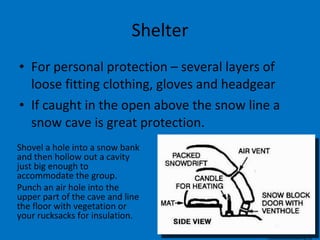
Shelter For personal protection – several layers of loose fitting clothing, gloves and headgear If caught in the open above the snow line a snow cave is great protection. Shovel a hole into a snow bank and then hollow out a cavity just big enough to accommodate the group.  Punch an air hole into the upper part of the cave and line the floor with vegetation or your rucksacks for  insulation. traditionalmountaineering.org
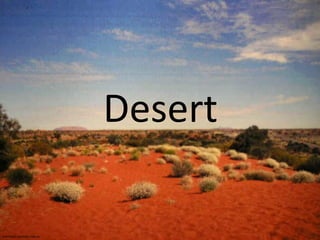
Desert members.ozemail.com.au
Inland Australia – Arid Desert Country Temperatures range from -2˚C and 40˚C Terrain – flat rocky plains, undulating country broken up with sand dunes, mountain ranges and dry, wide water ways Vegetation – spinifex grass, salt brush, mulga scrub, river red gums Food – not easy to obtain but is available Water supply more serious problem – taught in SVP
Survival Depends on how you plan your approach Situation is usually as a result of vehicle or aircraft breakdown/accident Can be utilised to improve your chances Doors and panels, shade and shelter Mirror and lights, signalling Tires and fuel, beacon fire or smoke plume Movement – restricted, should not be undertaken at all unless absolutely essential therefore in the evening and early morning _
Resting Throughout the day Sit or lie down in full shade and do not move around Tree does not provide enough shade, sunlight will still penetrate through the foliage Construct a shelter – even from clothing if it is all that is available
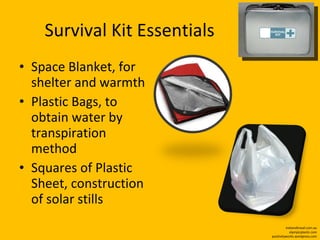
Survival Kit Essentials Space Blanket, for shelter and warmth Plastic Bags, to obtain water by transpiration method Squares of Plastic Sheet, construction of solar stills trekandtravel.com.au olympicplastic.com positivityworks.wordpress.com
Sea and Coast pixdaus.com
Survival Sea Survival Situations – will be as a result of some sort of catastrophe Falling overboard Sinking vessel Ditched aircraft Without survival craft survival time is governed by several factors including: Temperature, fitness, flotation devices, number of people
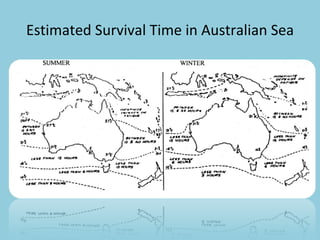
Estimated Survival Time in Australian Sea
Reducing Cooling from the Sea In very cold water (≤ 10˚C) the unprotected body will lose heat rapidly and victim will suffer hypothermia Survivor must delay cooling process for as long as possible so as to increase the chance of rescue Several measures can be used – as described in next few slides
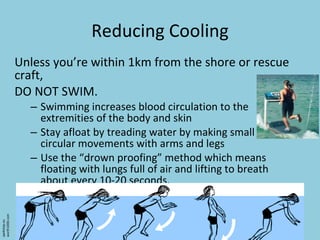
Reducing Cooling Unless you’re within 1km from the shore or rescue craft, DO NOT SWIM. Swimming increases blood circulation to the extremities of the body and skin Stay afloat by treading water by making small circular movements with arms and legs Use the “drown proofing” method which means floating with lungs full of air and lifting to breath about every 10-20 seconds. qwikstep.eu worth1000.com
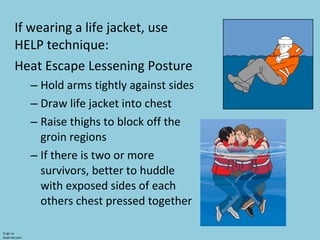
If wearing a life jacket, use HELP technique: Heat Escape Lessening Posture Hold arms tightly against sides Draw life jacket into chest Raise thighs to block off the groin regions If there is two or more survivors, better to huddle with exposed sides of each others chest pressed together tc.gc.ca boat-ed.com
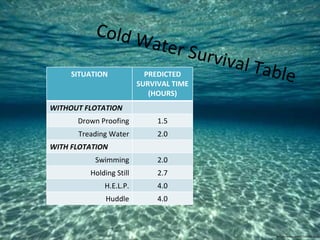
Cold Water Survival Table getatmeyouwont.tumblr.com SITUATION PREDICTED SURVIVAL TIME (HOURS) WITHOUT FLOTATION Drown Proofing 1.5 Treading Water 2.0 WITH FLOTATION Swimming 2.0 Holding Still 2.7 H.E.L.P. 4.0 Huddle 4.0
Survival Craft Life rafts, life boats and inflatable dinghies are purpose built, fitted with aids for survival. As soon as possible check items and make sure they’re securely stowed Check signalling devices are ready to use Post a look out and make up a roster so that 24 hour watch can be kept Food and water needs to be rationed Survival food usually concentrated and requires water to break it down, if there is a water shortage go sparingly on the eating
Craft are rated for a maximum number of occupants If limit is exceeded it may upset the craft to the detriment of all survivors Avoid overloading by having some in the water, secured to the side, and alternating Young children, the aged and injured should remain in the craft
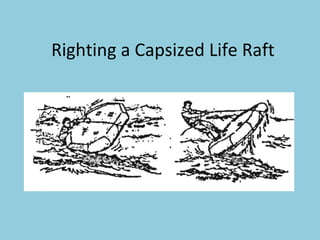
Righting a Capsized Life Raft
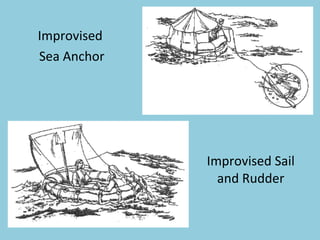
Navigating the Life Raft Raft is more difficult to navigate than a boat with a displacement hull Rafts are more susceptible to effects of wind, tide and currents Fitted with a sea anchor, looks like a wind sock or drogue, that should be streamed from the front of the raft
Improvised Sail and Rudder Improvised  Sea Anchor
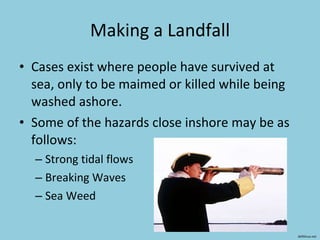
Making a Landfall Cases exist where people have survived at sea, only to be maimed or killed while being washed ashore.  Some of the hazards close inshore may be as follows: Strong tidal flows Breaking Waves Sea Weed deftlinux.net
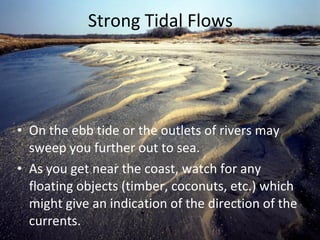
Strong Tidal Flows On the ebb tide or the outlets of rivers may sweep you further out to sea.  As you get near the coast, watch for any floating objects (timber, coconuts, etc.) which might give an indication of the direction of the currents. hoganphoto.com
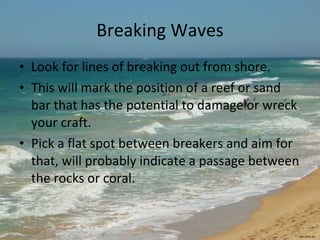
Breaking Waves Look for lines of breaking out from shore.  This will mark the position of a reef or sand bar that has the potential to damage or wreck your craft.  Pick a flat spot between breakers and aim for that, will probably indicate a passage between the  rocks or coral. rac.com.au
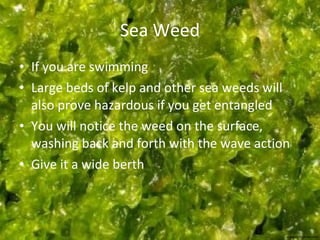
Sea Weed If you are swimming Large beds of kelp and other sea weeds will also prove hazardous if you get entangled You will notice the weed on the surface, washing back and forth with the wave action Give it a wide berth everystockphoto.com
Ashore Once the whole group is safely ashore, every effort must be made to contact locals and seek assistance.  If uninhabited or isolated, need to go into coastal survival mode.  All of the survival necessities concerning water and food procurement and shelter apply Revise SVP and SVA Cadet Notes.
Essential Actions After Landing Beach and secure the survival craft, useful as: temporary shelter fishing craft or  transport. Dry out and stow away any equipment from the craft Make a store for any of the  remaining food
Provide shelter and care for weak or injured members Allow people to rest and recuperate Organize 24 hour lookout roster to  watch rescue craft and  construct a beacon fire (with standing orders for lighting it). The beacon and lookout need to be on a prominent  high point of land.
Explore the area looking for  Potential hazards,  water supply,  food sources and  any suitable natural shelter, like caves and so on. Remember that you have the resources of both land and sea as a food supply.
Find a more suitable site and construct your permanent accommodation including sleeping, eating, ablution and food preparation areas. Prepare to improve your chances of rescue.  You might have to undertake another sea voyage in order to reach civilization.  This could mean the preserving of food and making sure the craft is suitably prepared. Establish a hierarchy,(who is in charge of what duties, etc.)
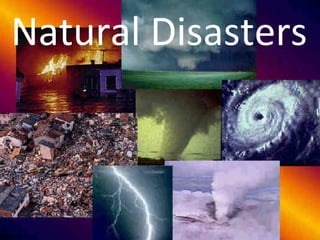
Natural Disasters armageddononline.org
Survival Vary with nature, location and local conditions at the time Several specialised organisations in all States and Territories of Australia, have the responsibility for the mitigation of various national disasters Best organisation to start with is the State/ Territory Emergency Service
Contact Services Western Australia State Emergency Service 132 500 South Australia State Emergency Service Victoria State Emergency Service Tasmania State Emergency Service New South Wales State Emergency Service Australian Capital Territory Emergency Service Queensland State Emergency Service Northern Territory Emergency Service Norfolk Island Fire and Rescue Service
Flood May be caused by: heavy rainfall,  coastal tide surge in conjunction with a cyclone,  abnormal damming of a river are just a few Onset  of most flooding is  gradual,  Best protection is to monitor the situation  Make sure that you leave plenty of time Move yourself and some essential survival equipment to higher ground You will need to work out well in advance which ground in the area will not become inundated.
Flash Flooding Much more a threat to safety Water from heavy downpour upstream is suddenly released, rushes down an otherwise dry  creek or river bed Wall of water has pressure behind it and will carry away anything in its path Never camp or halt  in a dry creek bed
Bush Fire Layout of the terrain, vegetation and the climatic circumstances will vary in their nature from one set of conditions to the next.  For example,  flames from a grass fire may pass you by in about 30 seconds, making survival chances very good whereas in thick scrub or heavy bush land it might take 3 to 5 minutes to pass.
Radiated Heat Primary killer in fires is radiated heat will cause severe burning and heat stroke the main cause of bushfire deaths.  Radiated heat is like light, it travels in a straight line and will not penetrate solid material.
Bushfire Survival Advice Conserve your mental and physical energy. Do not run uphill or away from the fire unless you are sure that there is a safe refuge in  that direction. Move across the slope out of the path of the fire front and work your way downhill towards the back of the fire.
Do not try to run through the flames Unless they are less than  2 metres high and  3 metres deep and  you can identify a definite clear path on the other side. If you cannot get out of the fire's path you must protect yourself against radiated heat.  Make heat shield from anything available, rocks, logs, earth, etc.  Or get into a depression or drain channel in the ground and cover yourself.  Do not panic and break cover when the fire approaches you.
Protection can be gained from ground water sources  waterholes, billabongs, creeks etc.  But never in elevated water storage tanks.  will heat up quite rapidly the human body, when immersed in lukewarm water cannot sweat  at 47˚C, a state of collapse is reached in about 3 minutes.
Back burn if possible probably the best method to ensure your survival Turn away from the fire and start one of your own on a wide a front as possible.  The wind will blow your fire in the same direction as the main fire and you can simply stem onto the burnt ground as the fire approaches
Storm and Tempest Hazards from severe storms include torrential rain,  very high winds,  a lowering of the temperature and  lightning strike.  Intensity and probability of these hazards vary w/ location State/Territory Emergency Service will assist with necessary information for area planning to operate.  Some general points for survival, a re explained in Lightning and High Speed Winds
Lightning Particularly prone to  high ground,  rocky outcrops,  tall trees and  any prominent features on the landscape The general rule is don't take shelter in any of those locations.
If caught in the open without any protection: head for the low ground lie flat Water is a conductor so: try to protect yourself by remaining dry sitting or lying on something dry, such as your pack, which may also have an insulating effect The procedure is to: sit on the object lift your feet clear of the ground hug your knees into your chest lower your head (like rolling up into a ball while sitting  down).
High Speed Winds Can occur anywhere on the continent or at sea High Speed Winds can gust up to 120  kph are usually associated with squalls and other severe rain storms  danger isn't so much the wind itself, but from being struck by wind bourn material. In the bush, protect yourself by sheltering In the bush protect by sheltering amongst large rocks or anything that shields from flying debris, preferably with  overhead protection as well.
Cyclones large revolving storms occur around the tropical and sub tropical regions from Western Australia to Queensland and sometimes to parts of New South  Wales. consist of extremely powerful winds sometimes > 300 kph rotate in a clock wise direction about an eye  Eye: very low pressure in which the wind is negligible (the calm eye). Happen during monsoon season Formation and movements are forecasted by the Bureau of Meteorology.  Cyclone warning systems apply in all affected areas of Australia and to find out about these, contact the local S / TES
Cyclones are destructive  The only method of protection is to  move inland as far and as fast as possible (150 km or more is necessary)  or to seek shelter Shelter must be very strong If out doors, cave will provide best protection or somewhere below ground.  The 'calm eye‘ may pass directly over you, so do not be fooled into thinking that the danger is passed. Remember also that this is a rotating storm and the wind will come from the opposite direction after the eye has passed.
Tornadoes Also rotating wind storms, but they are much smaller in diameter and far more fierce than a cyclone Often with winds > 600 kph. For protection get out of the path by moving as fast as possible at right angles to its apparent track
A tornado has the power to draw quite large objects into it  Shelter must be in a cave, reinforced building, etc. or below ground If caught in the open Lay flat (in a ditch or depression if possible)  And cover your head with your arms.  Tornados can be detected by dust and debris they carry and their loud noise, like the whirring of an engine.
Conclusion Cadets should now be able to outline the characteristic, hazards and precautions associated with a variety of Survival Environments relating to Australia.
AUSTRALIAN AIR FORCE CADETS 715 (City of Belmont) Squadron Join as a Cadet Aged 13 – 16 year old Join as an Adult Instructor Aged 19 years and above Friday Nights (in the school term) 1815h – 2200h Palmer Barracks, Barker Road, South Guildford

Survival Environments

  • 1.
    SVA 6 SurvivalAdvanced CUO Tonya Brown-Gentry Jun 11 survivalmagazine.org
  • 2.
    Objectives SVA 6Introduction to Survival Environments Outline the characteristics, hazards and precautions associated with: a. Tropical scrub b. Cold weather c. Desert d. Sea and sea coast, and e. Natural disasters eg; flood, fire, storm etc.
  • 3.
    Aim Cadets willbe given the founding knowledge to allow them to survive in a variety of environments. The attitude that it will never happen to me is a sign of unpreparedness, which is the biggest killer in a survival situation.
  • 4.
  • 5.
    Introduction Takes severaldifferent forms dependant on: Altitude, Rainfall, Proximity to Equator, and whether coastal/inland. Each form creates its own environment that poses different advantages and disadvantages for survivors
  • 6.
    Tropical Rain Forestsin Australia Occur mainly in the sub-tropical north W/in about 12% of the latitude of the equator In areas of high rainfall Temperatures remain constant ranging from ~ 18˚C (drier mid-year season) to 32˚C (wetter monsoon season) Vegetation – large trees, vines, ferns, thick scrubby undergrowth where sunshine penetrates _
  • 7.
    Rain Forest ScrubMoving through – often hot and hard work Added hindrance of swarms of biting and annoying insect life Forest floor – leaf mould and other debris houses dangers such as death adder and other venomous snakes
  • 8.
  • 9.
    Coastal Regions ofTropics Very different type of vegetation – thick scrub and mangroves Movement – slow and difficult Mangrove roots and scrub Tidal estuaries and mud flats (intrude for several km) Habitat of estuarine or salt water crocodile Aggressive and extremely dangerous to humans Food plentiful (fish, mud crabs, molluscs, mangrove worms, vegetation) and easy to obtain particularly at low tide.
  • 10.
    Movement in tropics– hot and tiring Must resist the temptation to remove clothing Only protection against insect bites, sunburn and other injuries Intake of fluids must be monitored to avoid heat stress Footwear essential – mangrove mud usually conceals dangers such as a stone fish wikihow.com Thelowdownskinny.com
  • 11.
    Care needs tobe taken with cuts (no matter how minor) The body and clothing must be dried (either by sun or fire) Hot, damp nature of tropics promotes illness and disease far more quickly than in more temperate climates fitzroyfc.com.au
  • 12.
    Protection Protect bodyagainst scratches, insects and other animal bites by covering as much of the body as possible. Prevent infections by treating all cuts, scratches, bites etc. as much as possible Check body regularly for parasites Construct shelter and bed. Clear Ground around shelter to avoid pests such as leeches.
  • 13.
    Travel Better tostay with an aircraft/vehicle for at least five days. If a decision is made to travel, travel along animal tracks and rivers. Travel short distances and rest often - conserve energy. Avoid swamps, particularly mangrove swamps and bamboo forests by travelling around them. Do not separate from other members of the group. If crossing a river greater than 12m wide, use a raft. _
  • 14.
  • 15.
    Australia’s Extremely ColdWeather Occurs in mountainous alpine regions of Victoria, New South Wales, central and southern Tasmania Terrain – steep, precipitous, accessible only on foot Vegetation – low scrub, coarse grasses, occasional strands of snow gums, thick scrub in gullies and creek lines Weather conditions – unpredictable, sever storms can happen in summer months with no warning
  • 16.
    Main Dangers Hypothermiaor frost bite Described in first aid SVA3 Prevent dangers by being: Alert to weather change (e.g. sudden wind changes or intensity) Noticeable sharp drop in temperature Movement, or total lack of, birds and animals Best protection is having adequate shelter _
  • 17.
    Shelter For personalprotection – several layers of loose fitting clothing, gloves and headgear If caught in the open above the snow line a snow cave is great protection. Shovel a hole into a snow bank and then hollow out a cavity just big enough to accommodate the group. Punch an air hole into the upper part of the cave and line the floor with vegetation or your rucksacks for insulation. traditionalmountaineering.org
  • 18.
  • 19.
    Inland Australia –Arid Desert Country Temperatures range from -2˚C and 40˚C Terrain – flat rocky plains, undulating country broken up with sand dunes, mountain ranges and dry, wide water ways Vegetation – spinifex grass, salt brush, mulga scrub, river red gums Food – not easy to obtain but is available Water supply more serious problem – taught in SVP
  • 20.
    Survival Depends onhow you plan your approach Situation is usually as a result of vehicle or aircraft breakdown/accident Can be utilised to improve your chances Doors and panels, shade and shelter Mirror and lights, signalling Tires and fuel, beacon fire or smoke plume Movement – restricted, should not be undertaken at all unless absolutely essential therefore in the evening and early morning _
  • 21.
    Resting Throughout theday Sit or lie down in full shade and do not move around Tree does not provide enough shade, sunlight will still penetrate through the foliage Construct a shelter – even from clothing if it is all that is available
  • 22.
    Survival Kit EssentialsSpace Blanket, for shelter and warmth Plastic Bags, to obtain water by transpiration method Squares of Plastic Sheet, construction of solar stills trekandtravel.com.au olympicplastic.com positivityworks.wordpress.com
  • 23.
    Sea and Coastpixdaus.com
  • 24.
    Survival Sea SurvivalSituations – will be as a result of some sort of catastrophe Falling overboard Sinking vessel Ditched aircraft Without survival craft survival time is governed by several factors including: Temperature, fitness, flotation devices, number of people
  • 25.
    Estimated Survival Timein Australian Sea
  • 26.
    Reducing Cooling fromthe Sea In very cold water (≤ 10˚C) the unprotected body will lose heat rapidly and victim will suffer hypothermia Survivor must delay cooling process for as long as possible so as to increase the chance of rescue Several measures can be used – as described in next few slides
  • 27.
    Reducing Cooling Unlessyou’re within 1km from the shore or rescue craft, DO NOT SWIM. Swimming increases blood circulation to the extremities of the body and skin Stay afloat by treading water by making small circular movements with arms and legs Use the “drown proofing” method which means floating with lungs full of air and lifting to breath about every 10-20 seconds. qwikstep.eu worth1000.com
  • 28.
    If wearing alife jacket, use HELP technique: Heat Escape Lessening Posture Hold arms tightly against sides Draw life jacket into chest Raise thighs to block off the groin regions If there is two or more survivors, better to huddle with exposed sides of each others chest pressed together tc.gc.ca boat-ed.com
  • 29.
    Cold Water SurvivalTable getatmeyouwont.tumblr.com SITUATION PREDICTED SURVIVAL TIME (HOURS) WITHOUT FLOTATION Drown Proofing 1.5 Treading Water 2.0 WITH FLOTATION Swimming 2.0 Holding Still 2.7 H.E.L.P. 4.0 Huddle 4.0
  • 30.
    Survival Craft Liferafts, life boats and inflatable dinghies are purpose built, fitted with aids for survival. As soon as possible check items and make sure they’re securely stowed Check signalling devices are ready to use Post a look out and make up a roster so that 24 hour watch can be kept Food and water needs to be rationed Survival food usually concentrated and requires water to break it down, if there is a water shortage go sparingly on the eating
  • 31.
    Craft are ratedfor a maximum number of occupants If limit is exceeded it may upset the craft to the detriment of all survivors Avoid overloading by having some in the water, secured to the side, and alternating Young children, the aged and injured should remain in the craft
  • 32.
  • 33.
    Navigating the LifeRaft Raft is more difficult to navigate than a boat with a displacement hull Rafts are more susceptible to effects of wind, tide and currents Fitted with a sea anchor, looks like a wind sock or drogue, that should be streamed from the front of the raft
  • 34.
    Improvised Sail andRudder Improvised Sea Anchor
  • 35.
    Making a LandfallCases exist where people have survived at sea, only to be maimed or killed while being washed ashore. Some of the hazards close inshore may be as follows: Strong tidal flows Breaking Waves Sea Weed deftlinux.net
  • 36.
    Strong Tidal FlowsOn the ebb tide or the outlets of rivers may sweep you further out to sea. As you get near the coast, watch for any floating objects (timber, coconuts, etc.) which might give an indication of the direction of the currents. hoganphoto.com
  • 37.
    Breaking Waves Lookfor lines of breaking out from shore. This will mark the position of a reef or sand bar that has the potential to damage or wreck your craft. Pick a flat spot between breakers and aim for that, will probably indicate a passage between the rocks or coral. rac.com.au
  • 38.
    Sea Weed Ifyou are swimming Large beds of kelp and other sea weeds will also prove hazardous if you get entangled You will notice the weed on the surface, washing back and forth with the wave action Give it a wide berth everystockphoto.com
  • 39.
    Ashore Once thewhole group is safely ashore, every effort must be made to contact locals and seek assistance. If uninhabited or isolated, need to go into coastal survival mode. All of the survival necessities concerning water and food procurement and shelter apply Revise SVP and SVA Cadet Notes.
  • 40.
    Essential Actions AfterLanding Beach and secure the survival craft, useful as: temporary shelter fishing craft or transport. Dry out and stow away any equipment from the craft Make a store for any of the remaining food
  • 41.
    Provide shelter andcare for weak or injured members Allow people to rest and recuperate Organize 24 hour lookout roster to watch rescue craft and construct a beacon fire (with standing orders for lighting it). The beacon and lookout need to be on a prominent high point of land.
  • 42.
    Explore the arealooking for Potential hazards, water supply, food sources and any suitable natural shelter, like caves and so on. Remember that you have the resources of both land and sea as a food supply.
  • 43.
    Find a moresuitable site and construct your permanent accommodation including sleeping, eating, ablution and food preparation areas. Prepare to improve your chances of rescue. You might have to undertake another sea voyage in order to reach civilization. This could mean the preserving of food and making sure the craft is suitably prepared. Establish a hierarchy,(who is in charge of what duties, etc.)
  • 44.
  • 45.
    Survival Vary withnature, location and local conditions at the time Several specialised organisations in all States and Territories of Australia, have the responsibility for the mitigation of various national disasters Best organisation to start with is the State/ Territory Emergency Service
  • 46.
    Contact Services WesternAustralia State Emergency Service 132 500 South Australia State Emergency Service Victoria State Emergency Service Tasmania State Emergency Service New South Wales State Emergency Service Australian Capital Territory Emergency Service Queensland State Emergency Service Northern Territory Emergency Service Norfolk Island Fire and Rescue Service
  • 47.
    Flood May becaused by: heavy rainfall, coastal tide surge in conjunction with a cyclone, abnormal damming of a river are just a few Onset of most flooding is gradual, Best protection is to monitor the situation Make sure that you leave plenty of time Move yourself and some essential survival equipment to higher ground You will need to work out well in advance which ground in the area will not become inundated.
  • 48.
    Flash Flooding Muchmore a threat to safety Water from heavy downpour upstream is suddenly released, rushes down an otherwise dry creek or river bed Wall of water has pressure behind it and will carry away anything in its path Never camp or halt in a dry creek bed
  • 49.
    Bush Fire Layoutof the terrain, vegetation and the climatic circumstances will vary in their nature from one set of conditions to the next. For example, flames from a grass fire may pass you by in about 30 seconds, making survival chances very good whereas in thick scrub or heavy bush land it might take 3 to 5 minutes to pass.
  • 50.
    Radiated Heat Primarykiller in fires is radiated heat will cause severe burning and heat stroke the main cause of bushfire deaths. Radiated heat is like light, it travels in a straight line and will not penetrate solid material.
  • 51.
    Bushfire Survival AdviceConserve your mental and physical energy. Do not run uphill or away from the fire unless you are sure that there is a safe refuge in that direction. Move across the slope out of the path of the fire front and work your way downhill towards the back of the fire.
  • 52.
    Do not tryto run through the flames Unless they are less than 2 metres high and 3 metres deep and you can identify a definite clear path on the other side. If you cannot get out of the fire's path you must protect yourself against radiated heat. Make heat shield from anything available, rocks, logs, earth, etc. Or get into a depression or drain channel in the ground and cover yourself. Do not panic and break cover when the fire approaches you.
  • 53.
    Protection can begained from ground water sources waterholes, billabongs, creeks etc. But never in elevated water storage tanks. will heat up quite rapidly the human body, when immersed in lukewarm water cannot sweat at 47˚C, a state of collapse is reached in about 3 minutes.
  • 54.
    Back burn ifpossible probably the best method to ensure your survival Turn away from the fire and start one of your own on a wide a front as possible. The wind will blow your fire in the same direction as the main fire and you can simply stem onto the burnt ground as the fire approaches
  • 55.
    Storm and TempestHazards from severe storms include torrential rain, very high winds, a lowering of the temperature and lightning strike. Intensity and probability of these hazards vary w/ location State/Territory Emergency Service will assist with necessary information for area planning to operate. Some general points for survival, a re explained in Lightning and High Speed Winds
  • 56.
    Lightning Particularly proneto high ground, rocky outcrops, tall trees and any prominent features on the landscape The general rule is don't take shelter in any of those locations.
  • 57.
    If caught inthe open without any protection: head for the low ground lie flat Water is a conductor so: try to protect yourself by remaining dry sitting or lying on something dry, such as your pack, which may also have an insulating effect The procedure is to: sit on the object lift your feet clear of the ground hug your knees into your chest lower your head (like rolling up into a ball while sitting down).
  • 58.
    High Speed WindsCan occur anywhere on the continent or at sea High Speed Winds can gust up to 120 kph are usually associated with squalls and other severe rain storms danger isn't so much the wind itself, but from being struck by wind bourn material. In the bush, protect yourself by sheltering In the bush protect by sheltering amongst large rocks or anything that shields from flying debris, preferably with overhead protection as well.
  • 59.
    Cyclones large revolvingstorms occur around the tropical and sub tropical regions from Western Australia to Queensland and sometimes to parts of New South Wales. consist of extremely powerful winds sometimes > 300 kph rotate in a clock wise direction about an eye Eye: very low pressure in which the wind is negligible (the calm eye). Happen during monsoon season Formation and movements are forecasted by the Bureau of Meteorology. Cyclone warning systems apply in all affected areas of Australia and to find out about these, contact the local S / TES
  • 60.
    Cyclones are destructive The only method of protection is to move inland as far and as fast as possible (150 km or more is necessary) or to seek shelter Shelter must be very strong If out doors, cave will provide best protection or somewhere below ground. The 'calm eye‘ may pass directly over you, so do not be fooled into thinking that the danger is passed. Remember also that this is a rotating storm and the wind will come from the opposite direction after the eye has passed.
  • 61.
    Tornadoes Also rotatingwind storms, but they are much smaller in diameter and far more fierce than a cyclone Often with winds > 600 kph. For protection get out of the path by moving as fast as possible at right angles to its apparent track
  • 62.
    A tornado hasthe power to draw quite large objects into it Shelter must be in a cave, reinforced building, etc. or below ground If caught in the open Lay flat (in a ditch or depression if possible) And cover your head with your arms. Tornados can be detected by dust and debris they carry and their loud noise, like the whirring of an engine.
  • 63.
    Conclusion Cadets shouldnow be able to outline the characteristic, hazards and precautions associated with a variety of Survival Environments relating to Australia.
  • 64.
    AUSTRALIAN AIR FORCECADETS 715 (City of Belmont) Squadron Join as a Cadet Aged 13 – 16 year old Join as an Adult Instructor Aged 19 years and above Friday Nights (in the school term) 1815h – 2200h Palmer Barracks, Barker Road, South Guildford