FIRE;
CAUSES AND
PREVENTION
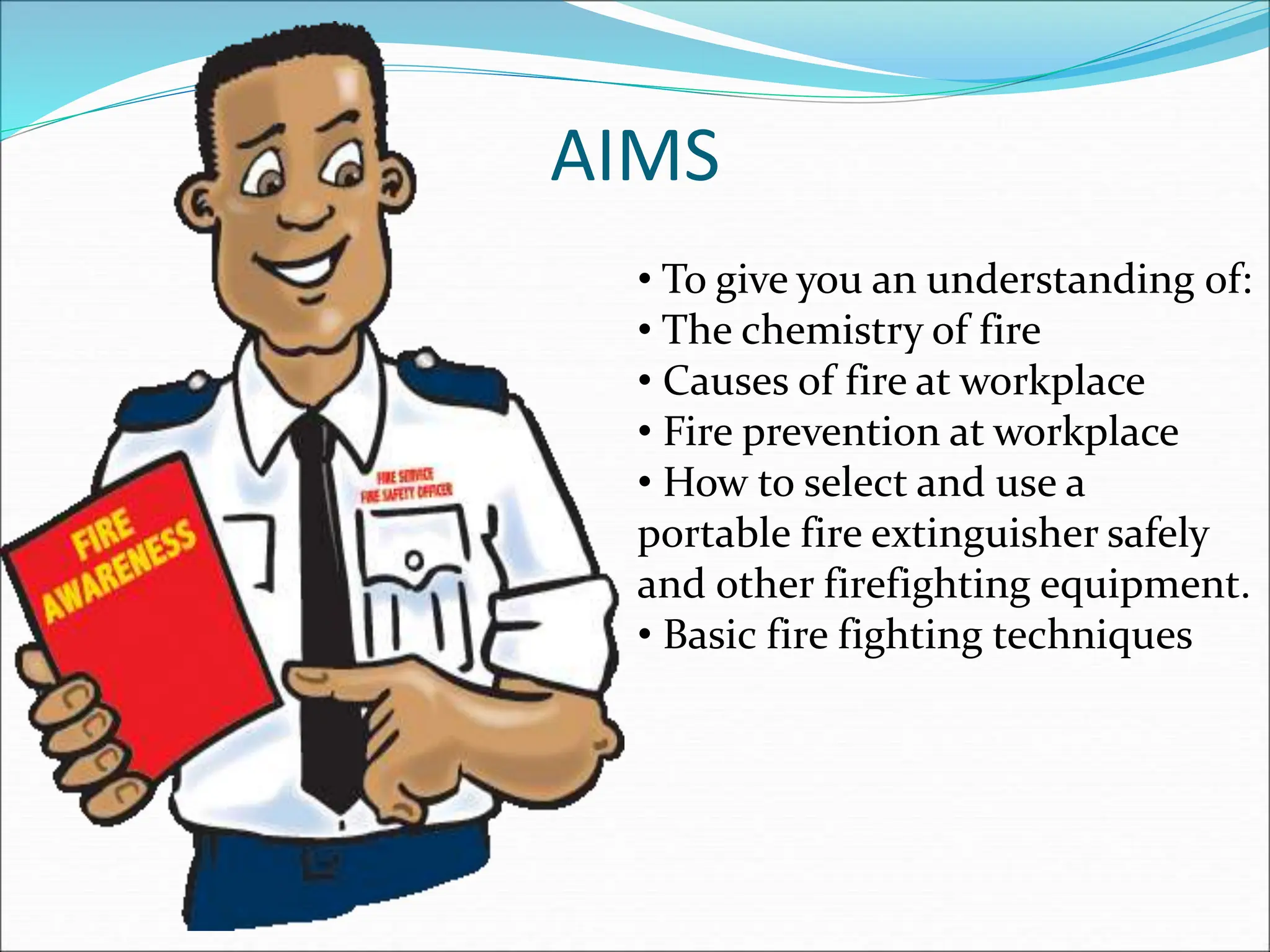
AIMS
• To give you an understanding of:
• The chemistry of fire
• Causes of fire at workplace
• Fire prevention at workplace
• How to select and use a
portable fire extinguisher safely
and other firefighting equipment.
• Basic fire fighting techniques
OBJECTIVES
At the end of this sensitization you will
 Have an understanding of fire concept and behavior
 Be able to reduce the risk of fire
 Know what to do when the fire alarm sounds
 Know what to do if you find a fire
 Be able to correctly and safely select and use a fire
extinguisher and other fire fighting equipment
installed within your workplace/facility.
FIRE AWARENESS
To safeguard lives (moral).
To minimize damage to
property( financial).
To safeguard our Jobs!
To comply with the law
(legal)
Of fire & life safety
regulation.
WHAT IS FIRE?
Fire is a friend and it is very useful,
when it is under our control.
Fire is an enemy and it destroys
everything within a short period of
time, when it is out of our control
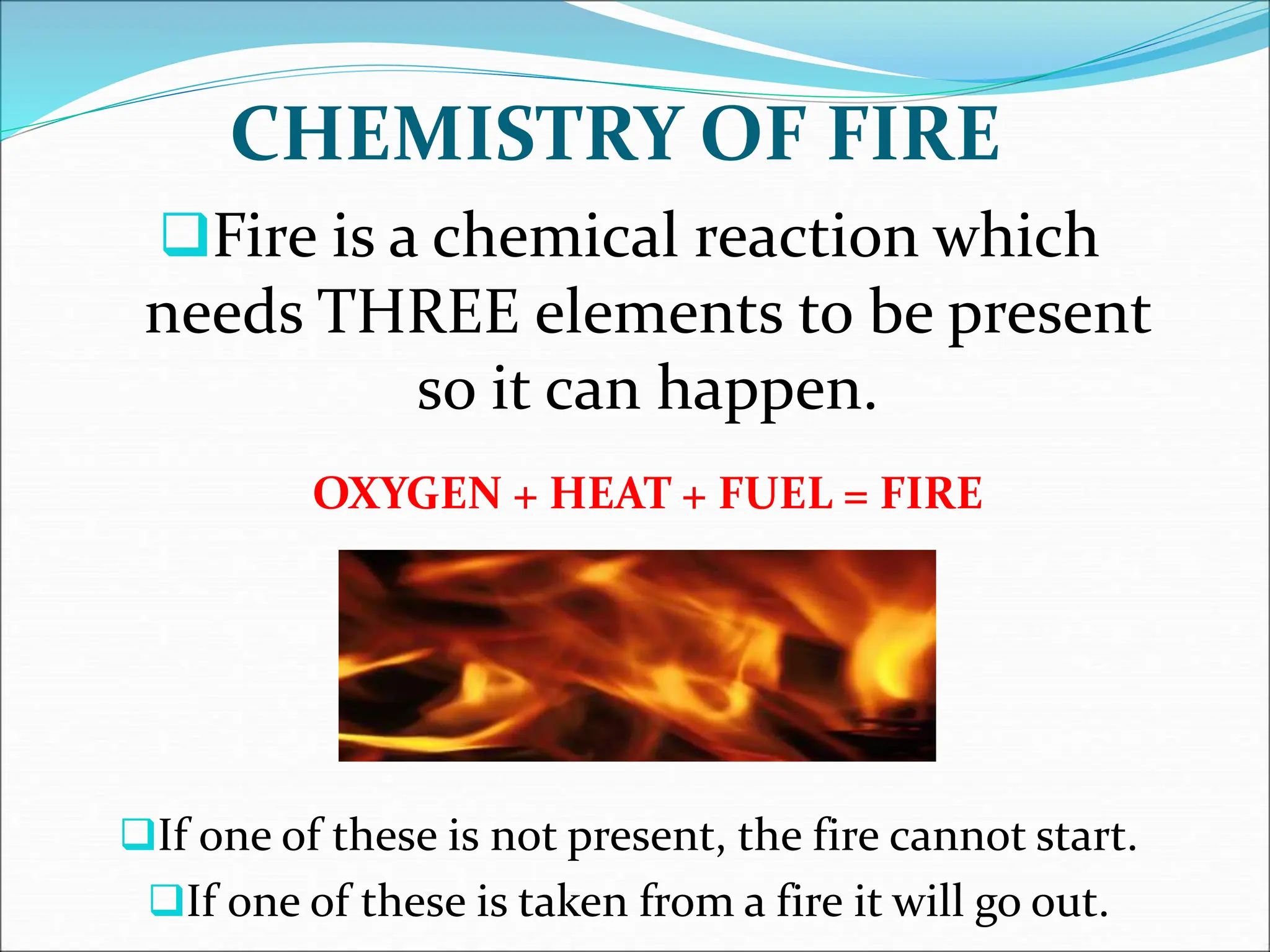
CHEMISTRY OF FIRE
Fire is a chemical reaction which
needs THREE elements to be present
so it can happen.
OXYGEN + HEAT + FUEL = FIRE
If one of these is not present, the fire cannot start.
If one of these is taken from a fire it will go out.
CAUSES OF FIRES
Source of Ignition
Smoking
Electrical equipment
Heaters
Contractors tools and equipment
Arson
HOW FIRES ARE STARTED
OXYGEN – The air we breath is about 21 percent oxygen, fire only needs an
atmosphere with at least 16 percent oxygen.
FUEL – Fuel can be any combustible material: solid, liquid or gas. Most solids
and liquids become a vapor or gas before they will burn.
HEAT – Heat is the energy necessary to increase the temperature of the fuel
to a point where sufficient vapors are given off for ignition to occur.
CHEMICAL REACTION – A chain reaction must form or the fire will just
burn out. This occurs when the three elements of fire are present in the
proper conditions and proportions.
Take any one of these factors away, and the fire cannot occur or will be
extinguished if it was already burning.
9
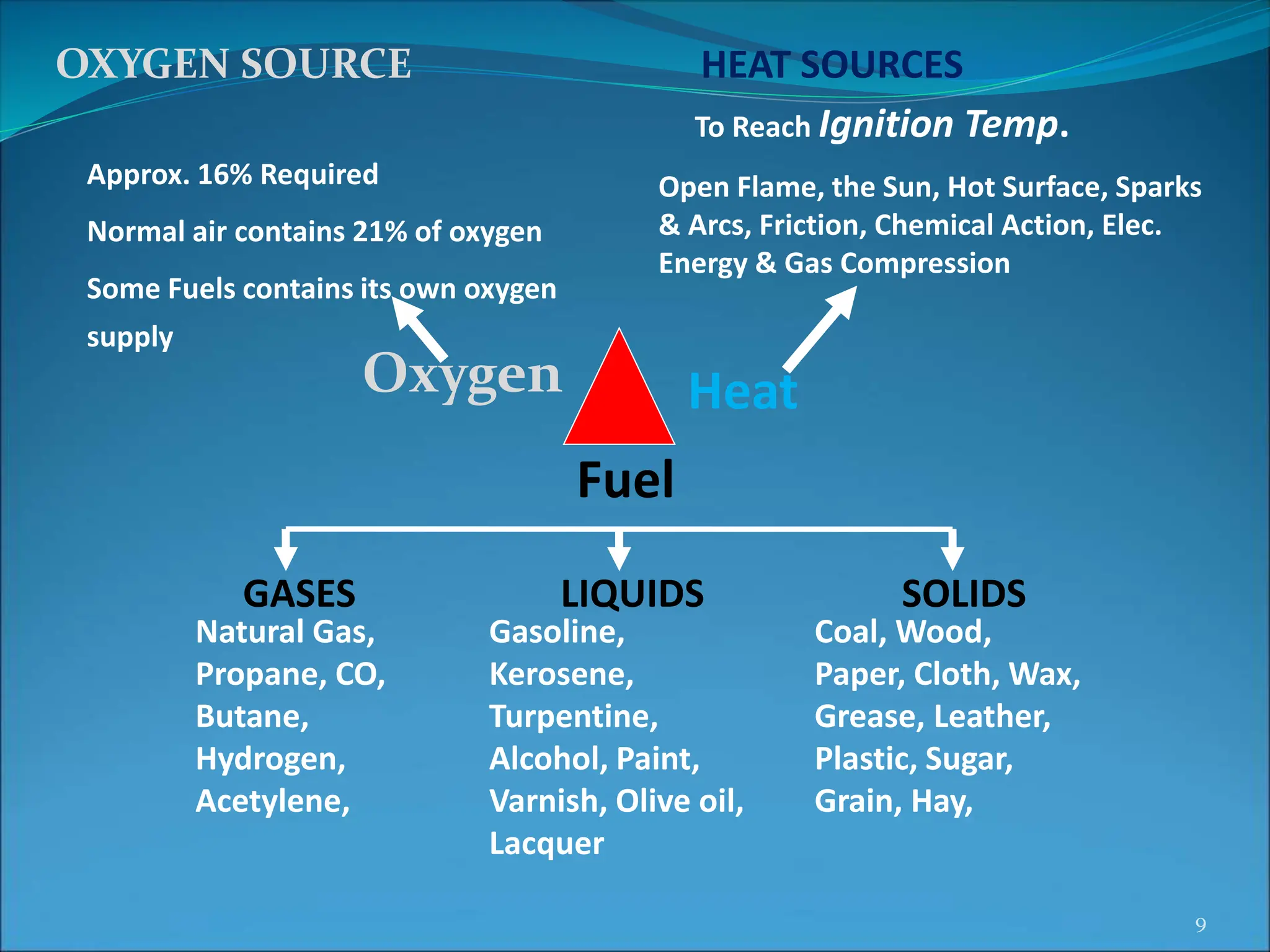
Oxygen Heat
Fuel
OXYGEN SOURCE HEAT SOURCES
Approx. 16% Required
Normal air contains 21% of oxygen
Some Fuels contains its own oxygen
supply
GASES
To Reach Ignition Temp.
Open Flame, the Sun, Hot Surface, Sparks
& Arcs, Friction, Chemical Action, Elec.
Energy & Gas Compression
LIQUIDS SOLIDS
Natural Gas,
Propane, CO,
Butane,
Hydrogen,
Acetylene,
Gasoline,
Kerosene,
Turpentine,
Alcohol, Paint,
Varnish, Olive oil,
Lacquer
Coal, Wood,
Paper, Cloth, Wax,
Grease, Leather,
Plastic, Sugar,
Grain, Hay,
FIRE TRIANGLE
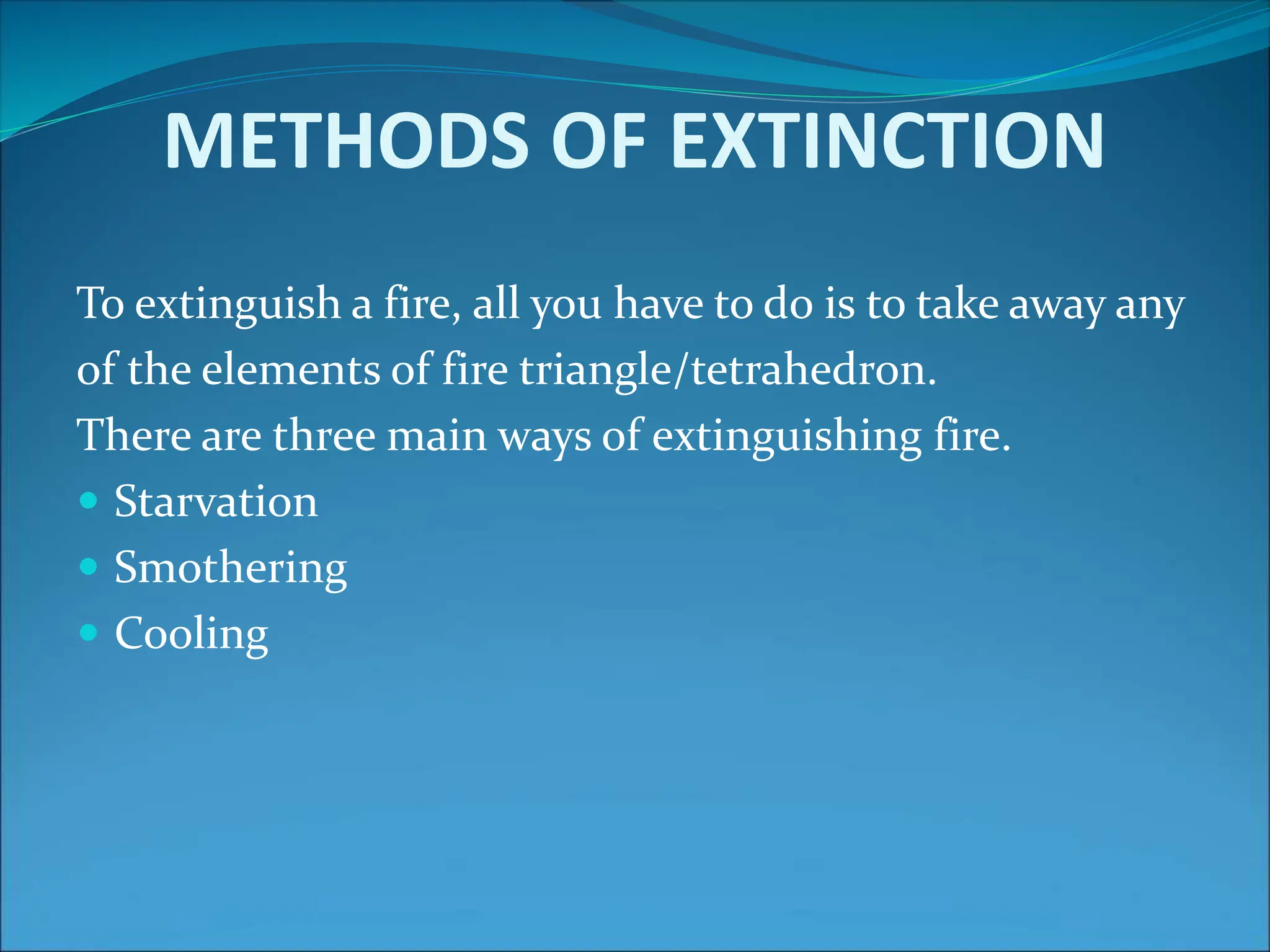
METHODS OF EXTINCTION
To extinguish a fire, all you have to do is to take away any
of the elements of fire triangle/tetrahedron.
There are three main ways of extinguishing fire.
 Starvation
 Smothering
 Cooling
FIRE EXTINCTION CONT’D…
1. Cooling
Removal of heat
from the burning
material/fire area.
FIRE EXTINCTION CONT’D…
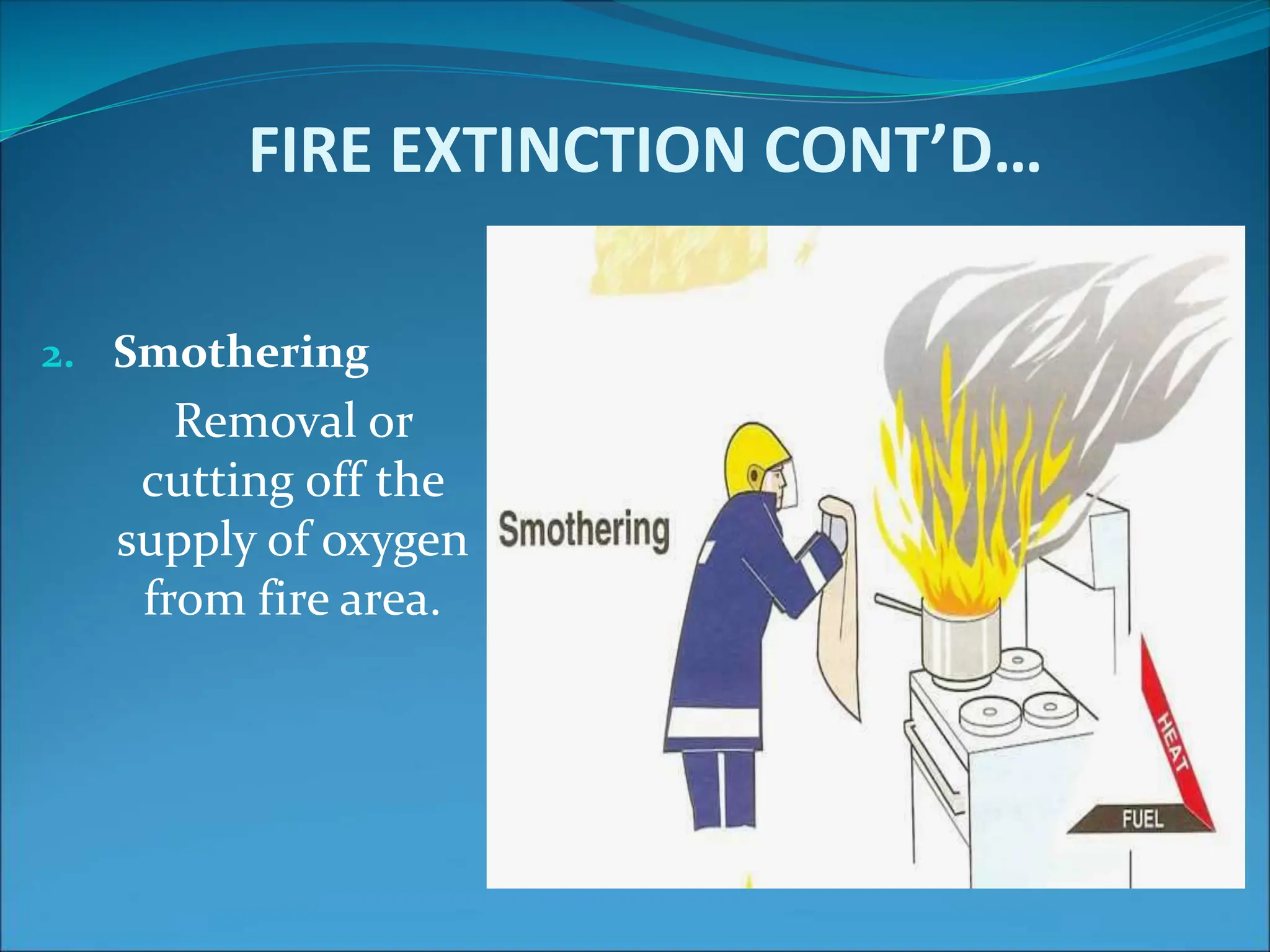
2. Smothering
Removal or
cutting off the
supply of oxygen
from fire area.
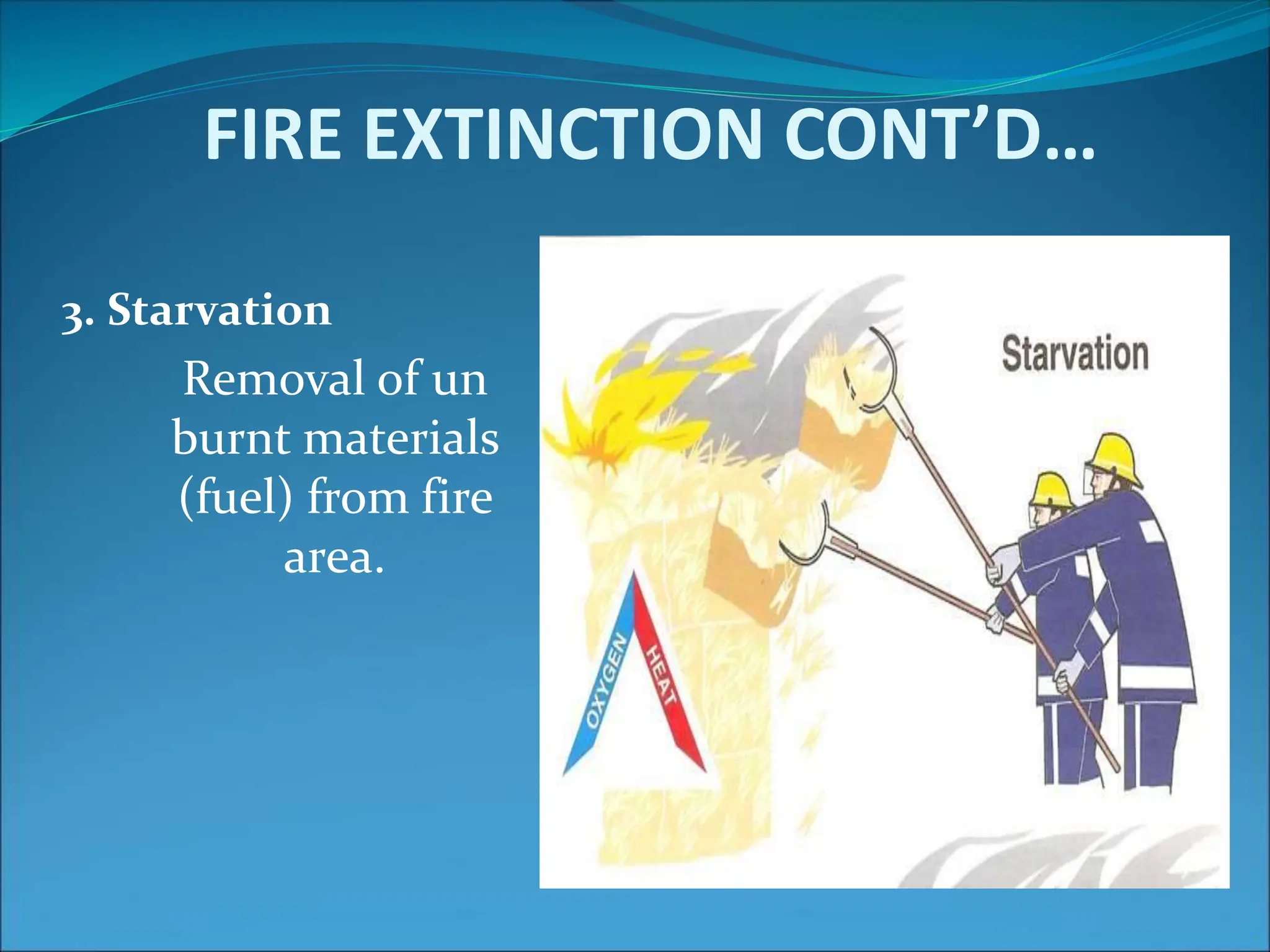
3. Starvation
Removal of un
burnt materials
(fuel) from fire
area.
FIRE EXTINCTION CONT’D…
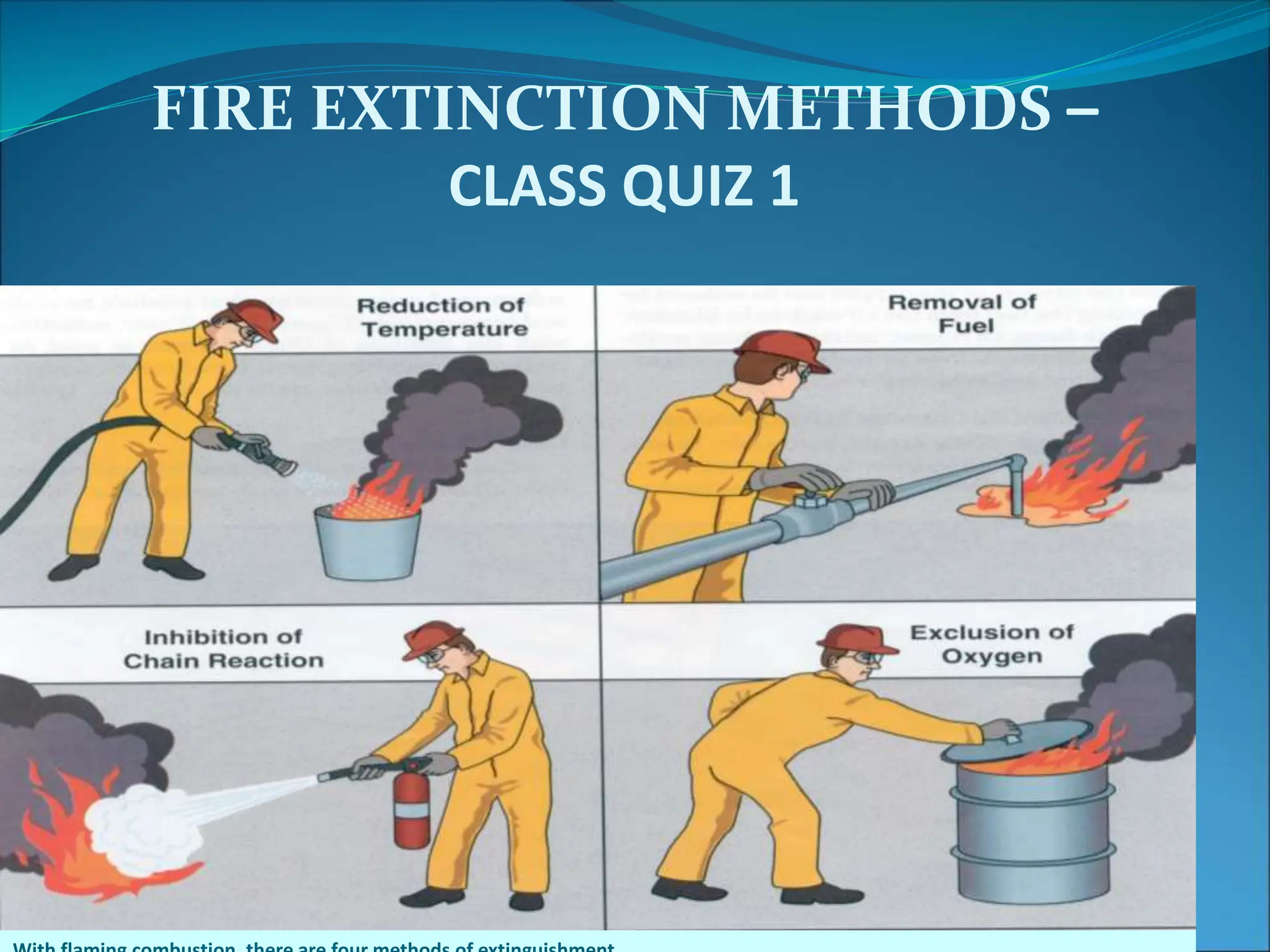
FIRE EXTINCTION METHODS –
CLASS QUIZ 1
USA CLASSIFICATION OF FIRE
Class A – Ordinary combustibles
involving dead and dry organic
materials e.g. wood, paper, fabric etc
Class B – Flammable combustible liquids
& gases such as hydrocarbons,
kerosene, paint, thinners and
Class C – Energized electrical equipment
Class D – Certain combustible metals
Class K – Industrial kitchen fires
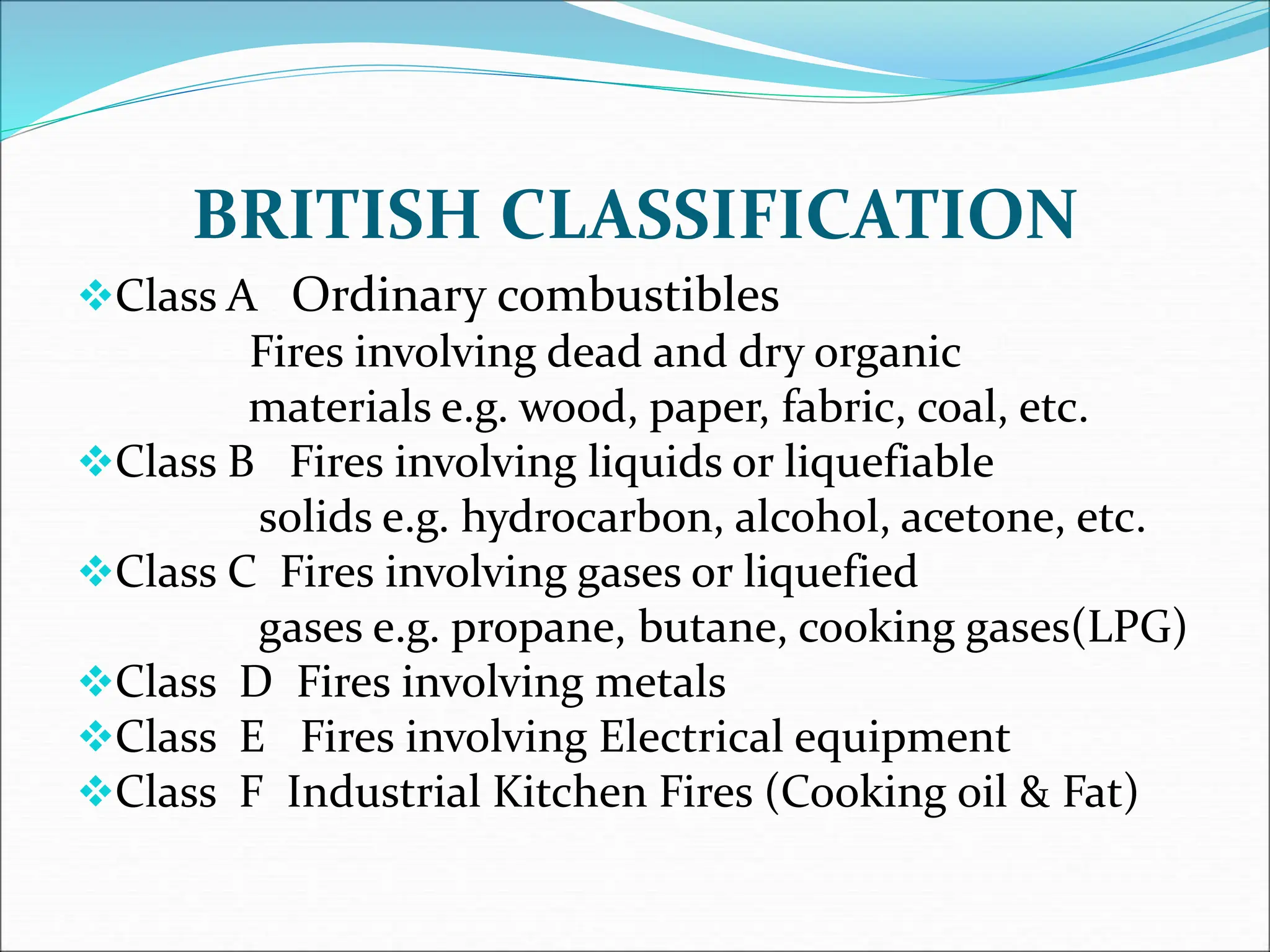
BRITISH CLASSIFICATION
Class A Ordinary combustibles
Fires involving dead and dry organic
materials e.g. wood, paper, fabric, coal, etc.
Class B Fires involving liquids or liquefiable
solids e.g. hydrocarbon, alcohol, acetone, etc.
Class C Fires involving gases or liquefied
gases e.g. propane, butane, cooking gases(LPG)
Class D Fires involving metals
Class E Fires involving Electrical equipment
Class F Industrial Kitchen Fires (Cooking oil & Fat)
FIRE FIGHTING MEDIA
The decision to choose the right extinguishing media
when attending fires incidents rest on personnel who
are able to make a quick and accurate assessment of the
situation . It is important to state that the right choice of
extinguisher can only be made if the personnel
concerned really understand the effectiveness, the
limitations, the advantages, disadvantages, of each of
the media available.
FIRE FIGHTING MEDIA CONT.
Fire Fighting Media is divided into two. They are:
1. The primary Media and
2. Complimentary or Secondary Media.
The primary media is Water while the secondary
media includes,
 Foam
 Dry Chemical Powder (DCP)
 Carbon dioxide (CO2) and
 Halons (BCF)
FIRE EXTINGUISHERS
 Extinguishers should be tested regularly (annually) by a competent
person
 Extinguishers should be visually examined by a competent person on a
monthly basis to ensure they are still serviceable.
 They should be on wall bracket or in a stand
 Extinguishers should not be used to hold open a door.
To do so is a criminal offence.
Employee do not have to tackle any fire if they do not wish to
do so, but should know the location of their nearest
extinguishers and the types of extinguisher, so as to assist a trained or
competent person who is willing to tackle the fire.
TYPES OF EXTINGUISHERS
 Red body
 For use on Class A Fires only
 Not suitable for combustible
liquids, cooking fats etc.
 Never use on electrical
equipment or flammable liquids
 Aim at the base of fire
 Extinguishes by cooling
WATER
EXTINGUISHERS
FOAM EXTINGUISHERS
 Cream body (Old type) or Red Body
 with Cream label
 Suitable for Class A and B Fires.
 Not suitable for use on fires involving
electricity
 Extinguishes by cooling and sealing
 the surface of a burning liquid
TYPES OF EXTINGUISHERS CONTINUED
 Use on class A, B & C fires,
 Blue body (Old type) or Red body
with blue label.
 Best on Class B fires but safe to use
on any type of fire (LPG).
 No cooling effect, so re-ignition is
possible, particularly with Class A
materials.
DRY POWDER EXTINGUISHER CARBON DIOXIDE EXTINGUISHERS
Black body (Old type) or red body with
black label (New type)
Use on Class B & C fires and electrical
fires
Extremely noisy
Use caution in confined spaces due
to asphyxiating effects of CO2
Extinguishes by reducing oxygen level
and cooling
FIRE BLANKETS
Any colour body or label but
they are usually red or white
For use on any type of fire but
best on small contained class B
fires and people on fire.
Extinguishes by asphyxiating
Class Quiz 2
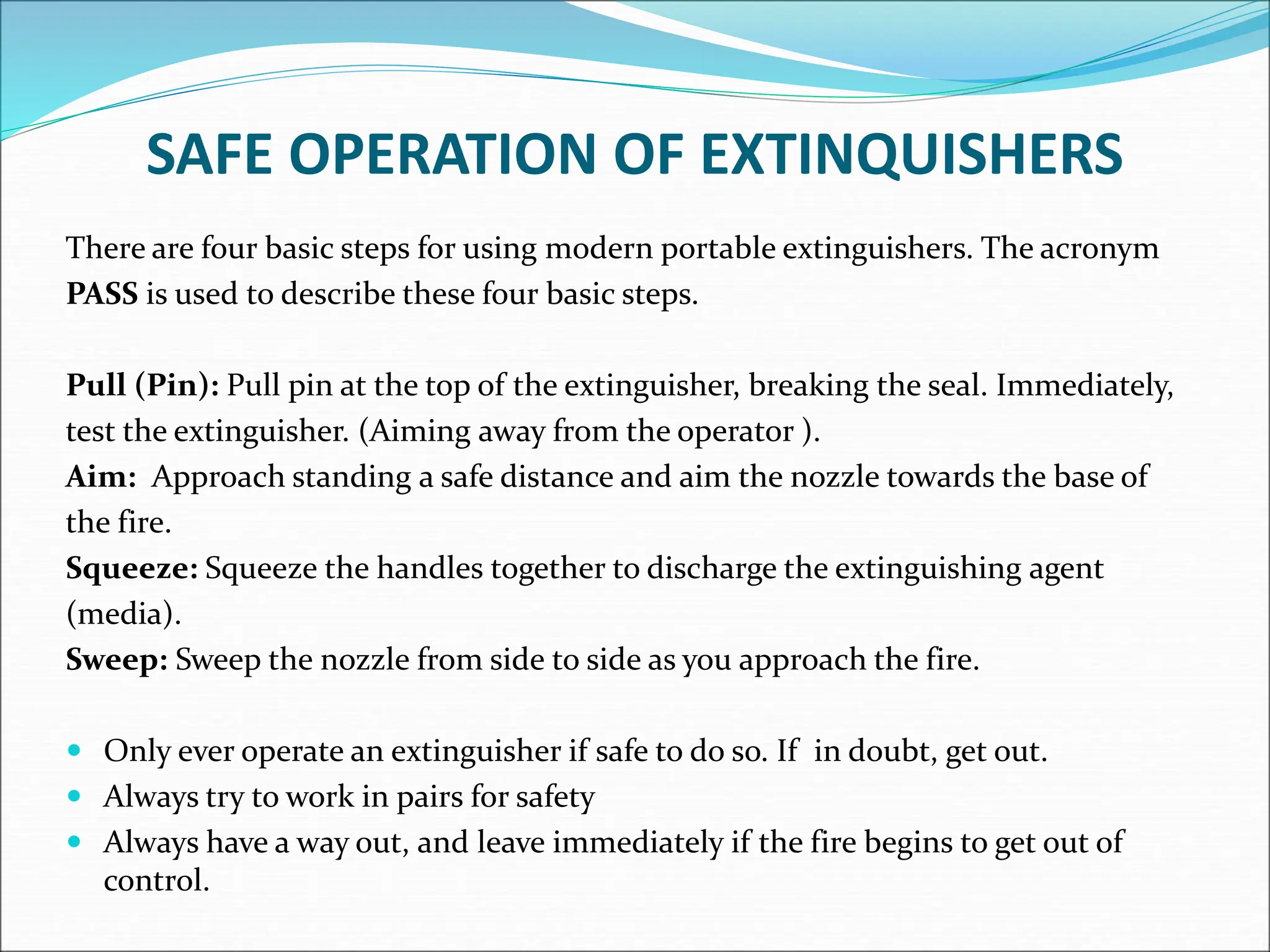
SAFE OPERATION OF EXTINQUISHERS
There are four basic steps for using modern portable extinguishers. The acronym
PASS is used to describe these four basic steps.
Pull (Pin): Pull pin at the top of the extinguisher, breaking the seal. Immediately,
test the extinguisher. (Aiming away from the operator ).
Aim: Approach standing a safe distance and aim the nozzle towards the base of
the fire.
Squeeze: Squeeze the handles together to discharge the extinguishing agent
(media).
Sweep: Sweep the nozzle from side to side as you approach the fire.
 Only ever operate an extinguisher if safe to do so. If in doubt, get out.
 Always try to work in pairs for safety
 Always have a way out, and leave immediately if the fire begins to get out of
control.
DISCOVERING A SMALL FIRE (BASICS)
Sound or raise the alarm
Call or initiate call to the fire services
Use an appropriate fire extinguisher if
 It is safe to do so
 You have been trained to use it
Fire extinguishers should be tested in a
safe place before using it on a fire.
Leave the building/facility to the assembly point
DISCOVERING A LARGE FIRE (BASICS)
Sound or raise the alarm
Close the door
Leave immediately
Proceed to assembly point
Call or initiate call to the fire services
Report to persons in charge for
roll call
Do not return to building/facility
until been told
ACTION ON HEARING ALARM
 React immediately
 Visual inspect escape routes for smoke or flames
 Prepare everybody in your care for evacuation
 Take shortest travel distance to closest exit by making
use of available stairways, exit doors etc.
 Follow direction of illuminating lightings and
signage's in case of power outbreak.
 Ensure existing fire doors and windows are shut when
leaving your offices.
 Proceed to designated assembly point
Trapped in a Burning Building
 If you are trying to escape a fire, never open a closed door
without feeling it first.
 Use the back off your hand to prevent burning your palm.
 If the door is hot, try another exit.
 If none exists, seal the cracks around the door and vents
with anything available.
 If trapped, look for a nearby phone and call the fire
department, giving them your exact location.
 If breathing is difficult, try to ventilate the room, but don’t
wait for an emergency to discover that windows can’t be
opened.
Fire Exit & Directional Signs
 Means of Escape (MEO)
 Entrances
 Exits
 Circulation areas
NOTE:
All these should be utilised as much as possible
for emergency evacuation.
Gas Cylinder (LPG)
 Don't store cylinders indoors – including the garage,
shed or under the house.
 Keep them outdoors so any gas leak will vent safely.
Always keep LPG cylinders upright – they shouldn't
be laid on their side.
 When transporting a cylinder, make sure it's well
secured so it can't roll around
 Check valves regularly
 Avoid the use of mobile phones near a gas cylinder
FIRE
AND SAFETY
CAMPAIGN AND
AWARENES
30th, oct.2020

Fire Prevention and Safety _041840.pptx

  • 1.
  • 2.
    AIMS • To giveyou an understanding of: • The chemistry of fire • Causes of fire at workplace • Fire prevention at workplace • How to select and use a portable fire extinguisher safely and other firefighting equipment. • Basic fire fighting techniques
  • 3.
    OBJECTIVES At the endof this sensitization you will  Have an understanding of fire concept and behavior  Be able to reduce the risk of fire  Know what to do when the fire alarm sounds  Know what to do if you find a fire  Be able to correctly and safely select and use a fire extinguisher and other fire fighting equipment installed within your workplace/facility.
  • 4.
    FIRE AWARENESS To safeguardlives (moral). To minimize damage to property( financial). To safeguard our Jobs! To comply with the law (legal) Of fire & life safety regulation.
  • 5.
    WHAT IS FIRE? Fireis a friend and it is very useful, when it is under our control. Fire is an enemy and it destroys everything within a short period of time, when it is out of our control
  • 6.
    CHEMISTRY OF FIRE Fireis a chemical reaction which needs THREE elements to be present so it can happen. OXYGEN + HEAT + FUEL = FIRE If one of these is not present, the fire cannot start. If one of these is taken from a fire it will go out.
  • 7.
    CAUSES OF FIRES Sourceof Ignition Smoking Electrical equipment Heaters Contractors tools and equipment Arson
  • 8.
    HOW FIRES ARESTARTED OXYGEN – The air we breath is about 21 percent oxygen, fire only needs an atmosphere with at least 16 percent oxygen. FUEL – Fuel can be any combustible material: solid, liquid or gas. Most solids and liquids become a vapor or gas before they will burn. HEAT – Heat is the energy necessary to increase the temperature of the fuel to a point where sufficient vapors are given off for ignition to occur. CHEMICAL REACTION – A chain reaction must form or the fire will just burn out. This occurs when the three elements of fire are present in the proper conditions and proportions. Take any one of these factors away, and the fire cannot occur or will be extinguished if it was already burning.
  • 9.
    9 Oxygen Heat Fuel OXYGEN SOURCEHEAT SOURCES Approx. 16% Required Normal air contains 21% of oxygen Some Fuels contains its own oxygen supply GASES To Reach Ignition Temp. Open Flame, the Sun, Hot Surface, Sparks & Arcs, Friction, Chemical Action, Elec. Energy & Gas Compression LIQUIDS SOLIDS Natural Gas, Propane, CO, Butane, Hydrogen, Acetylene, Gasoline, Kerosene, Turpentine, Alcohol, Paint, Varnish, Olive oil, Lacquer Coal, Wood, Paper, Cloth, Wax, Grease, Leather, Plastic, Sugar, Grain, Hay,
  • 10.
  • 11.
    METHODS OF EXTINCTION Toextinguish a fire, all you have to do is to take away any of the elements of fire triangle/tetrahedron. There are three main ways of extinguishing fire.  Starvation  Smothering  Cooling
  • 12.
    FIRE EXTINCTION CONT’D… 1.Cooling Removal of heat from the burning material/fire area.
  • 13.
    FIRE EXTINCTION CONT’D… 2.Smothering Removal or cutting off the supply of oxygen from fire area.
  • 14.
    3. Starvation Removal ofun burnt materials (fuel) from fire area. FIRE EXTINCTION CONT’D…
  • 15.
    FIRE EXTINCTION METHODS– CLASS QUIZ 1
  • 16.
    USA CLASSIFICATION OFFIRE Class A – Ordinary combustibles involving dead and dry organic materials e.g. wood, paper, fabric etc Class B – Flammable combustible liquids & gases such as hydrocarbons, kerosene, paint, thinners and Class C – Energized electrical equipment Class D – Certain combustible metals Class K – Industrial kitchen fires
  • 17.
    BRITISH CLASSIFICATION Class AOrdinary combustibles Fires involving dead and dry organic materials e.g. wood, paper, fabric, coal, etc. Class B Fires involving liquids or liquefiable solids e.g. hydrocarbon, alcohol, acetone, etc. Class C Fires involving gases or liquefied gases e.g. propane, butane, cooking gases(LPG) Class D Fires involving metals Class E Fires involving Electrical equipment Class F Industrial Kitchen Fires (Cooking oil & Fat)
  • 18.
    FIRE FIGHTING MEDIA Thedecision to choose the right extinguishing media when attending fires incidents rest on personnel who are able to make a quick and accurate assessment of the situation . It is important to state that the right choice of extinguisher can only be made if the personnel concerned really understand the effectiveness, the limitations, the advantages, disadvantages, of each of the media available.
  • 19.
    FIRE FIGHTING MEDIACONT. Fire Fighting Media is divided into two. They are: 1. The primary Media and 2. Complimentary or Secondary Media. The primary media is Water while the secondary media includes,  Foam  Dry Chemical Powder (DCP)  Carbon dioxide (CO2) and  Halons (BCF)
  • 20.
    FIRE EXTINGUISHERS  Extinguishersshould be tested regularly (annually) by a competent person  Extinguishers should be visually examined by a competent person on a monthly basis to ensure they are still serviceable.  They should be on wall bracket or in a stand  Extinguishers should not be used to hold open a door. To do so is a criminal offence. Employee do not have to tackle any fire if they do not wish to do so, but should know the location of their nearest extinguishers and the types of extinguisher, so as to assist a trained or competent person who is willing to tackle the fire.
  • 21.
    TYPES OF EXTINGUISHERS Red body  For use on Class A Fires only  Not suitable for combustible liquids, cooking fats etc.  Never use on electrical equipment or flammable liquids  Aim at the base of fire  Extinguishes by cooling WATER EXTINGUISHERS FOAM EXTINGUISHERS  Cream body (Old type) or Red Body  with Cream label  Suitable for Class A and B Fires.  Not suitable for use on fires involving electricity  Extinguishes by cooling and sealing  the surface of a burning liquid
  • 22.
    TYPES OF EXTINGUISHERSCONTINUED  Use on class A, B & C fires,  Blue body (Old type) or Red body with blue label.  Best on Class B fires but safe to use on any type of fire (LPG).  No cooling effect, so re-ignition is possible, particularly with Class A materials. DRY POWDER EXTINGUISHER CARBON DIOXIDE EXTINGUISHERS Black body (Old type) or red body with black label (New type) Use on Class B & C fires and electrical fires Extremely noisy Use caution in confined spaces due to asphyxiating effects of CO2 Extinguishes by reducing oxygen level and cooling
  • 23.
    FIRE BLANKETS Any colourbody or label but they are usually red or white For use on any type of fire but best on small contained class B fires and people on fire. Extinguishes by asphyxiating
  • 24.
  • 26.
    SAFE OPERATION OFEXTINQUISHERS There are four basic steps for using modern portable extinguishers. The acronym PASS is used to describe these four basic steps. Pull (Pin): Pull pin at the top of the extinguisher, breaking the seal. Immediately, test the extinguisher. (Aiming away from the operator ). Aim: Approach standing a safe distance and aim the nozzle towards the base of the fire. Squeeze: Squeeze the handles together to discharge the extinguishing agent (media). Sweep: Sweep the nozzle from side to side as you approach the fire.  Only ever operate an extinguisher if safe to do so. If in doubt, get out.  Always try to work in pairs for safety  Always have a way out, and leave immediately if the fire begins to get out of control.
  • 27.
    DISCOVERING A SMALLFIRE (BASICS) Sound or raise the alarm Call or initiate call to the fire services Use an appropriate fire extinguisher if  It is safe to do so  You have been trained to use it Fire extinguishers should be tested in a safe place before using it on a fire. Leave the building/facility to the assembly point
  • 28.
    DISCOVERING A LARGEFIRE (BASICS) Sound or raise the alarm Close the door Leave immediately Proceed to assembly point Call or initiate call to the fire services Report to persons in charge for roll call Do not return to building/facility until been told
  • 29.
    ACTION ON HEARINGALARM  React immediately  Visual inspect escape routes for smoke or flames  Prepare everybody in your care for evacuation  Take shortest travel distance to closest exit by making use of available stairways, exit doors etc.  Follow direction of illuminating lightings and signage's in case of power outbreak.  Ensure existing fire doors and windows are shut when leaving your offices.  Proceed to designated assembly point
  • 30.
    Trapped in aBurning Building  If you are trying to escape a fire, never open a closed door without feeling it first.  Use the back off your hand to prevent burning your palm.  If the door is hot, try another exit.  If none exists, seal the cracks around the door and vents with anything available.  If trapped, look for a nearby phone and call the fire department, giving them your exact location.  If breathing is difficult, try to ventilate the room, but don’t wait for an emergency to discover that windows can’t be opened.
  • 31.
    Fire Exit &Directional Signs  Means of Escape (MEO)  Entrances  Exits  Circulation areas NOTE: All these should be utilised as much as possible for emergency evacuation.
  • 32.
    Gas Cylinder (LPG) Don't store cylinders indoors – including the garage, shed or under the house.  Keep them outdoors so any gas leak will vent safely. Always keep LPG cylinders upright – they shouldn't be laid on their side.  When transporting a cylinder, make sure it's well secured so it can't roll around  Check valves regularly  Avoid the use of mobile phones near a gas cylinder
  • 35.