11-11


              First Aid :
          INSECT AND
         ANIMAL BITES
Insects and animals are part of our lives in villages. As health
workers we will often come across people who will seek our help
for insect and animal bites. While people could even die from
some bites, most cause only pain and irritation, but are serious
enough to need our help.


    Here, we will learn to deal with some
    common bites:
    1. Bee bites/insect/wasp bites
    2. Snake bites
    3. Scorpion bites
    4. Dog bites
    5. Poisonous plants/mushrooms
11-12
                            Insect Bites
Let us start with insect bites. Mosquitoes are the most common insects
that bite humans. But these bites can be said to be of low importance
since the bites usually cause no more than pain at the time of biting
and later on, some itching. We need not treat the bite itself as it is not
dangerous though it can cause troublesome diseases like malaria &
filaria later. But bites of some insects will need looking into.


                                      1. Bee Bites
         Bees are usually not                                What to do when bees bite?
         known to bite on their own
         unless their hive is dis-                           Bees usually leave behind their sting
turbed. When they bite, they tend                    along with the poison gland. Do not try to pull
to cause severe swelling locally, a                  the sting out as it may squeeze the poison out
sense of tightness in the bitten part                into the person. Instead, get the sting out by
and considerable pain that lasts                     scraping the area with the blunt end of a knife or
from a few hours to a few days!                      any other flat metal.
Some people who are allergic to bee
bites may even develop severe                               Apply Baking soda (also called sodium or
reactions like massive swelling of                   soda bicarbonate) used for cooking purposes at the
the face and neck, difficulty in                     Bee bite. If Soda is not easily available, washing the
breathing          and          even                 area with soda water may also help. This helps to
unconsciousness. Such allergy may                    quickly reduce the swelling and the pain. Repeat
lead to death.                                       after a few hours if necessary.


                  Wasps
                  Wasps are known to bite even when not troubled, but this is rare. Yellow or black in
                  colour, wasps move much slowly. They make nests with caked mud in shaded corners of
                  houses, roofs, letterboxes, etc. Their sting also may be removed with the blunt side of a
                  knife or key. A wasp bite may also lead to local pain and swelling. Unlike a bee bite, pain
                  and swelling from a wasp bite comes down rapidly when vinegar or acetic acid is applied
                  at the site of bite.


          Remember: B(icarbonate) for Bee and V(inegar) for V(W)asp bite!


                           Other Insect Bites
Insects like mosquitoes and flies and mites, ticks, etc., may also bite and
cause swelling and itching. When we scratch it could cause infection.

Try not to scratch with bare nails. Applying some coconut oil or wet mud
may help reduce itching. CHLORPHENIRAMINE helps in rare cases where
the itching and swelling are beyond tolerance.
11-13
                                          Snake bites
Only one out of twenty snakebites belong to poisonous snakes. There are only four
varieties of snakes that are poisonous. Of all poisonous snakebites, only half of the bites
have enough poison injected that may be dangerous to life. So, never get scared of
snake bites - there are more chances of surviving than of dying by snakebites.

Poisonous Or Non-Poisonous Snake Bite?
                      1.   Check the Teeth Marks : One can make out a poisonous snake
                      from a non-poisonous snake from the “teeth” (called fangs) ) marks where
                      the snake has bitten. A poisonous snake’s fang marks have only one or
                      two puncture sites while the other shows many teeth punctures in the
                      shape of its jaw.

                      2. Checking the Skin of the Snake : In case the snake has been killed, there is
                      another way to make out whether the snake is poisonous or not. You will have to
                      carefully turn the dead snake on its belly, but make sure it is dead – snakes’ jaws may
        bite up to half an hour after they are dead. Poisonous snakes have a broad band running across the width
        of its belly.

 NOTE : Nowadays, we do have good injections that can take away the poison of a poisonous snakebite. However,
 they may be costly. Also, they may lead to serious reactions. So, unless we are sure that the bite is poisonous one
                                        should not just give the injections.


Learn To Make Out The Signs Of A
Bite                                                              Types Of Poisonous Snakes
A person can die immediately if the snake has
bitten directly into the vein. But such occa-
sions are rare. Usually there is pain in the area
bitten and this pain increases and spreads to
other areas. But it is not only poison but also
fear which creates problems.                                                               Viper
                                                                           Banded
We see many people who even without poi-
son may have problems. They show breath-                                    Krait
lessness, tight feeling in chest, palpitation and
flushing of face. Nausea and vomiting are
very common signs of bites from poisonous
snakes. Apart from these, just by the signs              Cobra
shown we can make out the variety of snake
that has bitten the person. These are explained
below.
1. Cobra group (including Kraits)                               2. Viper group (snakes that give birth to
Local swelling, pain                                            young ones and do not give eggs).
Initial Signs        : Vomiting, heaviness of eye-              Swelling of bitten part; pain increasing in area
lids, blurred sight, tingling around mouth.                     and intensity; bleeding under skin.
Later Signs : Closing of eyelids, inability to                  Later bleeding from fang site, gums, nose and
speak and to swallow, inability to move chest and               ears, with vomiting and shitting. Last, inability
breathe.                                                        to sit up, giddiness and weak pulse and low BP.
The first symptoms of cobra group’s bite like                   If no swelling within two hours, probably no
drooping eyes, etc. usually start within 15 min-                poison has entered. Bleeding and other problems
utes of bite – latest by 10 hours.                              may take 3 to 5 days to start.


3. Sea snakes (found only in sea water)                         4. River snakes
Headache, feeling of “thick tongue,” thirst,                    They are non-poisonous. But poisonous snakes
sweating and vomiting are immediate. Later,                     may be washed out in floods and heavy rains
within half to three hours muscle stiffness, pain               and their bites can be dangerous.
in muscles and later bleeding with urine, no urine
as kidney fails.
11-14
         First aid for snakebite                                 Bandaging A Snake Bite
   1. Reassure patient that most snakebites
      are non poisonous and many non poi-
      sonous snakes also look like poisonous
      snakes.

   2. RUSH TO A DOCTOR IN A HOSPITAL
      quickly, comfortably and passively —
      the leg or hand with the bite should not
      exercise. Preferably splint it or put it in
      a sling.

   3. DO NOT cut the area – usually it does
      more harm than good most often.

   4. DO NOT tie a string or tourniquet – usu-
      ally it gets too tight and damages the
      leg or arm permanently.

   5. DO NOT go after the snake to kill it. If
      killed already, try to carry it to the hos-
      pital but do not handle it – dead heads
      of snakes also cause bites!

   6. For pain, give PARACETAMOL and not                    Wrap a firm (but not tight) bandage. It
      Aspirin.                                              should start from the bite area and then
                                                            wrap around the leg (or arm) above the
                                                            next joint to cover the leg or arm. This
Anti-Venin Serum (against snake poison) in-
                                                            helps in delaying the poison from getting
jections are costly. Each injection that can                into the body altogether and helps the
destroy the poison of most Indian snakes costs              liver in destroying the poison safely. If
about Rs 200 and 10 such injections may be                  this is not done within the first hour or
required to start treatment. Collect enough                 so, there is no need to try it, as the poison
                                                            must have already spread in the body.
money with the patient.


Scorpion Bites
Usually, most scorpions do no more than cause severe pain in the area of bite. Reassurance
and PARACETAMOL are about all that is required. If sleep is
affected for more than a night, a doctor may be contacted to
give an injection in the area of bite that can remove the sensa-
tion from the area.

Only one species of scorpion in India is known to be poisonous
enough to cause death, but it is rare and found only in some
areas. This usually kills by affecting the heart. After any scor-
pion bite, it may be good idea to feel the pulse every hour or so
to avoid chances of poisoning. If too slow (below 55 per minute)
or too fast (above 90 per minute or so), such a person having scorpion bite may be rushed to
a doctor in hospital.
11-15
                                   Dog bites
Dog bites are considered dangerous. Though uncommon, they can lead
to Rabies, a disease that has almost no chance of surviving anywhere in
the world. We have no treatment for it. This makes people fear dog bites.

If a dog has Rabies or gets Rabies within 10 days of a bite, it must be
taken seriously. Management and first aid as below should be followed.
If one is not sure about the dog whether it is immunised against Rabies or
not, it must be presumed to be having Rabies unless proved otherwise.
If the dog can be watched for 10 days and if the dog does not develop
Rabies, there is no need for Anti Rabies injections. First Aid in such cases is enough treatment.


 How To Know If The Dog Has Rabies?                                        What Happens To
Out of all dogs having rabies, only 1 out of                            A Person With Rabies ?
4 will actually behave “madly” – run                         Starting within 3 weeks to 3 months, the per-
around, bark, bite etc.                                      son getting Rabies after a dogbite feels itch-
                                                             ing, pain and tingling at the site of the dog
A rabid dog has difficulty in swallowing,                    bite. Later, the person may get headache, ir-
barking, eating and its eyelids may droop.                   ritability and inability to look at light. Still
A bark different from their normal bark and                  later, the person may not be able to drink
paralysis of the jaw, neck and back legs are                 water or to tolerate cold wind. Even the
how we can spot a dog with Rabies. Lots of                   thought of drinking water may produce fits
saliva, red eyes, itching, shivering, trembling,             or convulsions.
snapping at imaginary objects and altered
taste of the dog, and extreme restlessness                   In some people, “Dumb” Rabies may de-
(causing the animal to wander miles from                     velop. Such persons may get fever, headache
home ) all are signs of Rabies in dogs. Dogs                 and tingling. Later a ‘limp’ paralysis may be
with furious rabies attack lifeless objects, of-             seen gradually increasing in affected area
ten seriously injuring their mouths in the                   until the patient dies.
process.
                          What To Do For Rabies?
                          Once Rabies starts, we have NO treatment. To perevent the virus from en-
                          tering the brain and developing rabies, we must group the bites differently as
                          each has to be dealt with differently.

                          As first aid, wash wound at the earliest with soap /detergent and water under
                          a tap or stream of water for at least five minutes.

                          Leave the bite wound open. DO NOT COVER IT.

      Type          Type of bite                Old vaccine            New vaccine (Rs.300/- per
                                                                                            injection)
      Type I        Licks on skin that may For 10 days                 On 0, 3, 7, 14, 30 and 90 days
                    be scratched
      Type II       Less than five bites – not For 14 days               As above
                    on face or hands
      Type III      More than five bites For 14 days*                    For six days as above*
                    anywhere; even a single
                    bite on face
                   * Add Rabies I-globulin for this type of bites. Treat at hospital.

                                                   NOTE:
                 1. The old vaccine MUST be available at each Block PHC. It may be more
                    trouble in taking but the poor can afford it.
                 2. If the dog remains alive, later treatment against Rabies may be stopped.
11-16
                                   Plants with poisons
Mushroom
Mushroom is the commonest plant leading to poisoning. Although usually people know which
mushrooms to eat or not to eat, the same mushroom may become poisonous at a different place
or in a different season. The commonly cultivated mushroom also rarely may lead to poisoning
especially if it is old, damaged, raw or not cooked properly.


What Happens If We Eat Poisonous Mushrooms?
Cases of mushroom poisoning can be grouped into those:
1. Develop signs of poisoning within 2 hours
(a)mainly nausea, vomiting, diarrhoea and pain in abdomen.
(b)sweating, giddiness
(c)irrelevant talk in half – sleep.
(d)deep sleep
(d)fearful imagination
(e)as if person has taken lots of alcohol.

2. Develop signs of poisoning after 6 hours or up to several days
(a)severe vomiting and diarrhoea
(b)less or no urine.
(c)abdominal discomfort, severe headache

The common thing to happen is that our digestion gets upset. Within 2 hours, we may get
vomiting and diarrhoea. This may remove most of the poison so that most patients require little
or no treatment.

But at times, serious conditions (especially liver and kidney failure) follow apparent recovery
from gastrointestinal symptoms. They start 6 to 24 hours after eating the mushroom or may occur
after a problem free period of several days’ duration. In case such serious signs are present after a
person has eaten mushrooms, rush the person to a doctor.

Rarely, allergic reactions may also develop. After taking a mushroom for years, a person may get
severe allergy in which the body reacts to the mushroom abnormally and causes the blood to
break down. Also, blisters and rash on the skin may appear after taking mushrooms due to al-
lergy.

First Aid for Mushroom Poisoning                                    Poisonous Plants
       Commonly, giving warm water with a
       lot of salt may help in getting the per-               Poison ivy and some other leaves
       son to vomit out the poisonous mush-                   when touched may cause redness,
       rooms.                                                 itching and pain in the area around
                                                              the place of contact. Applying a paste
                  If the person has diarrhoea,                of mud on the affected part helps to
               help in cleaning the system by
                                                              soothe.
               giving lots of water and fluids.

             If allergy of skin is seen, give                 CHLORPHENIRAMINE along
       CHLORPHENIRAMINE.                                             with IBUPROFEN or
                                                                     PARACETAMOL may
       If symptoms of poisoning as given                             be given to decrease pain
       above appear, send for a doctor.                              and swelling.
11-17


  First Aid :
Unconsciousness
11-18
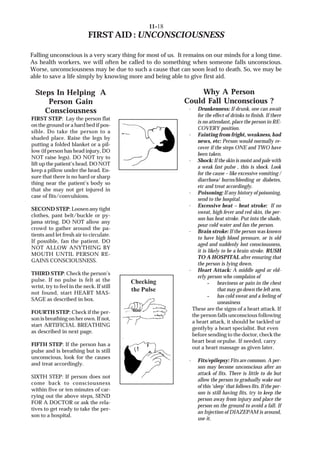
                            FIRST AID : UNCONSCIOUSNESS

Falling unconscious is a very scary thing for most of us. It remains on our minds for a long time.
As health workers, we will often be called to do something when someone falls unconscious.
Worse, unconsciousness may be due to such a cause that can soon lead to death. So, we may be
able to save a life simply by knowing more and being able to give first aid.

  Steps In Helping A                                            Why A Person
      Person Gain                                          Could Fall Unconscious ?
     Consciousness                                           ·  Drunkenness: If drunk, one can await
                                                                for the effect of drinks to finish. If there
FIRST STEP: Lay the person flat
                                                                is no attendant, place the person in RE-
on the ground or a hard bed if pos-
                                                                COVERY position.
sible. Do take the person to a
                                                             · Fainting from fright, weakness, bad
shaded place. Raise the legs by
                                                                news, etc: Person would normally re-
putting a folded blanket or a pil-
                                                                cover if the steps ONE and TWO have
low (if person has head injury, DO
                                                                been taken.
NOT raise legs). DO NOT try to
                                                             · Shock: If the skin is moist and pale with
lift up the patient’s head. DO NOT
                                                                a weak fast pulse , this is shock. Look
keep a pillow under the head. En-
                                                                for the cause – like excessive vomiting /
sure that there is no hard or sharp
                                                                diarrhoea/ burns/bleeding or diabetes,
thing near the patient’s body so
                                                                etc and treat accordingly.
that she may not get injured in
                                                             · Poisoning: If any history of poisoning,
case of fits/convulsions.
                                                                send to the hospital.
                                                             · Excessive heat – heat stroke: If no
SECOND STEP: Loosen any tight
                                                                sweat, high fever and red skin, the per-
clothes, pant belt/buckle or py-
                                                                son has heat stroke. Put into the shade,
jama string. DO NOT allow any
                                                                pour cold water and fan the person.
crowd to gather around the pa-
                                                             · Brain stroke: If the person was known
tients and let fresh air to circulate.
                                                                to have high blood pressure, or is old
If possible, fan the patient. DO
                                                                aged and suddenly lost consciousness,
NOT ALLOW ANYTHING BY
                                                                it is likely to be a brain stroke. RUSH
MOUTH UNTIL PERSON RE-
                                                                TO A HOSPITAL after ensuring that
GAINS CONSCIOUSNESS.
                                                                the person is lying down.
                                                             · Heart Attack: A middle aged or eld-
THIRD STEP: Check the person’s
                                                                erly person who complains of
pulse. If no pulse is felt at the          Checking                   - heaviness or pain in the chest
wrist, try to feel in the neck. If still
not found, start HEART MAS-
                                           the Pulse                       that may go down the left arm,
                                                                      - has cold sweat and a feeling of
SAGE as described in box.
                                                                           uneasiness
                                                              These are the signs of a heart attack. If
FOURTH STEP: Check if the per-
                                                              the person falls unconscious following
son is breathing on her own. If not,
                                                              a heart attack, it should be tackled ur
start ARTIFICIAL BREATHING
                                                              gentlyby a heart specialist. But even
as described in next page.
                                                              before sending to the doctor, check the
                                                              heart beat orpulse. If needed, carry
FIFTH STEP: If the person has a
                                                              out a heart massage as given later.
pulse and is breathing but is still
unconscious, look for the causes
                                                             ·   Fits/epilepsy: Fits are common. A per-
and treat accordingly.
                                                                 son may become unconscious after an
                                                                 attack of fits. There is little to do but
SIXTH STEP: If person does not
                                                                 allow the person to gradually wake out
come back to consciousness
                                                                 of this ‘sleep’ that follows fits. If the per-
within five or ten minutes of car-
                                                                 son is still having fits, try to keep the
rying out the above steps, SEND
                                                                 person away from injury and place the
FOR A DOCTOR or ask the rela-
                                                                 person on the ground to avoid a fall. If
tives to get ready to take the per-
                                                                 an Injection of DIAZEPAM is around,
son to a hospital.
                                                                 use it.
11-19
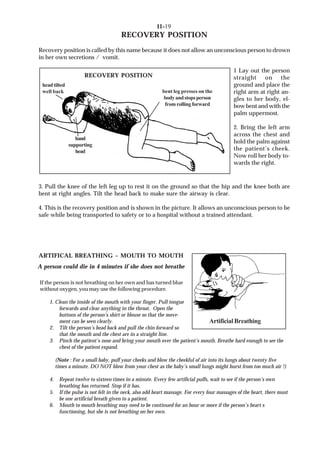
                                       RECOVERY POSITION
Recovery position is called by this name because it does not allow an unconscious person to drown
in her own secretions / vomit.

                                                                                             1 Lay out the person
                      RECOVERY POSITION                                                      straight on the
 head tilted                                                                                 ground and place the
 well back                                                 bent leg presses on the           right arm at right an-
                                                           body and stops person             gles to her body, el-
                                                            from rolling forward             bow bent and with the
                                                                                             palm uppermost.

                                                                                             2. Bring the left arm
                                                                                             across the chest and
                  hand
                                                                                             hold the palm against
               supporting
                  head                                                                       the patient’s cheek.
                                                                                             Now roll her body to-
                                                                                             wards the right.


3. Pull the knee of the left leg up to rest it on the ground so that the hip and the knee both are
bent at right angles. Tilt the head back to make sure the airway is clear.

4. This is the recovery position and is shown in the picture. It allows an unconscious person to be
safe while being transported to safety or to a hospital without a trained attendant.


ARTIFICAL BREATHING – MOUTH TO MOUTH
A person could die in 4 minutes if she does not breathe

If the person is not breathing on her own and has turned blue
without oxygen, you may use the following procedure.

    1. Clean the inside of the mouth with your finger. Pull tongue
        forwards and clear anything in the throat. Open the
        buttons of the person’s shirt or blouse so that the move-
        ment can be seen clearly.                                          Artificial Breathing
    2. Tilt the person’s head back and pull the chin forward so
        that the mouth and the chest are in a straight line.
    3. Pinch the patient’s nose and bring your mouth over the patient’s mouth. Breathe hard enough to see the
        chest of the patient expand.

         (Note : For a small baby, puff your cheeks and blow the cheekful of air into its lungs about twenty five
         times a minute. DO NOT blow from your chest as the baby’s small lungs might burst from too much air !)

    4.    Repeat twelve to sixteen times in a minute. Every few artificial puffs, wait to see if the person’s own
          breathing has returned. Stop if it has.
    5.    If the pulse is not felt in the neck, also add heart massage. For every four massages of the heart, there must
          be one artificial breath given to a patient.
    6.    Mouth to mouth breathing may need to be continued for an hour or more if the person’s heart s
          functioning, but she is not breathing on her own.
11-20
                              HEART MASSAGE
1. Check for pulse at the neck. If it is absent, you may start a heart massage as below.
   If any relatives are around, explain that the LIFESAVING procedure that you are
   about to start may be difficult for them to bear and they may like to move out of the
   room.

2. Heart thump : Close your fist and bring it down firmly from a height of two feet on
   the patient’s chest in the area of the heart (lower chest to the right side of the pa-
   tient.) This is called the ‘heart thump.’


                                             Heart Massage


                    put the heel of one
                    palm ovre the chest
                    and cover with the
                    other hand


3. Heart Massage : If the patient is on the ground, it may be better to kneel besides
   the patient (to her right if you are right handed). Place the heel of your right palm
   over the lower end of the breastbone in the midline of the chest. Place the heel of
   our other palm over this. Now press firmly without bending your elbows. The
   pressure should come from your body. This is what is called a heart massage.

  The chest must be pressed down one to two inches with each massage.
  Repeat the massage sixty times in a minute.

  (Note : For a small baby, pressing with the thumb of one hand will be enough!).

4. Artificial Breathing : If there is a need to provide artificial breathing and you have
   no help, puff one breath for every four chest massage.

5. At the end of five minutes of such a procedure, the person’s own pulse at the neck
   (and own breathing) must return. Check every 5 minutes if pulse & breathing
   have returned. Continue up to 30 minutes. If it still does not return, there is no need
   to go on and on. Without blood for three minutes, the brain cannot survive and the
   person is dead. Please explain this to the relatives.

11 first aid 2

  • 1.
    11-11 First Aid : INSECT AND ANIMAL BITES Insects and animals are part of our lives in villages. As health workers we will often come across people who will seek our help for insect and animal bites. While people could even die from some bites, most cause only pain and irritation, but are serious enough to need our help. Here, we will learn to deal with some common bites: 1. Bee bites/insect/wasp bites 2. Snake bites 3. Scorpion bites 4. Dog bites 5. Poisonous plants/mushrooms
  • 2.
    11-12 Insect Bites Let us start with insect bites. Mosquitoes are the most common insects that bite humans. But these bites can be said to be of low importance since the bites usually cause no more than pain at the time of biting and later on, some itching. We need not treat the bite itself as it is not dangerous though it can cause troublesome diseases like malaria & filaria later. But bites of some insects will need looking into. 1. Bee Bites Bees are usually not What to do when bees bite? known to bite on their own unless their hive is dis- Bees usually leave behind their sting turbed. When they bite, they tend along with the poison gland. Do not try to pull to cause severe swelling locally, a the sting out as it may squeeze the poison out sense of tightness in the bitten part into the person. Instead, get the sting out by and considerable pain that lasts scraping the area with the blunt end of a knife or from a few hours to a few days! any other flat metal. Some people who are allergic to bee bites may even develop severe Apply Baking soda (also called sodium or reactions like massive swelling of soda bicarbonate) used for cooking purposes at the the face and neck, difficulty in Bee bite. If Soda is not easily available, washing the breathing and even area with soda water may also help. This helps to unconsciousness. Such allergy may quickly reduce the swelling and the pain. Repeat lead to death. after a few hours if necessary. Wasps Wasps are known to bite even when not troubled, but this is rare. Yellow or black in colour, wasps move much slowly. They make nests with caked mud in shaded corners of houses, roofs, letterboxes, etc. Their sting also may be removed with the blunt side of a knife or key. A wasp bite may also lead to local pain and swelling. Unlike a bee bite, pain and swelling from a wasp bite comes down rapidly when vinegar or acetic acid is applied at the site of bite. Remember: B(icarbonate) for Bee and V(inegar) for V(W)asp bite! Other Insect Bites Insects like mosquitoes and flies and mites, ticks, etc., may also bite and cause swelling and itching. When we scratch it could cause infection. Try not to scratch with bare nails. Applying some coconut oil or wet mud may help reduce itching. CHLORPHENIRAMINE helps in rare cases where the itching and swelling are beyond tolerance.
  • 3.
    11-13 Snake bites Only one out of twenty snakebites belong to poisonous snakes. There are only four varieties of snakes that are poisonous. Of all poisonous snakebites, only half of the bites have enough poison injected that may be dangerous to life. So, never get scared of snake bites - there are more chances of surviving than of dying by snakebites. Poisonous Or Non-Poisonous Snake Bite? 1. Check the Teeth Marks : One can make out a poisonous snake from a non-poisonous snake from the “teeth” (called fangs) ) marks where the snake has bitten. A poisonous snake’s fang marks have only one or two puncture sites while the other shows many teeth punctures in the shape of its jaw. 2. Checking the Skin of the Snake : In case the snake has been killed, there is another way to make out whether the snake is poisonous or not. You will have to carefully turn the dead snake on its belly, but make sure it is dead – snakes’ jaws may bite up to half an hour after they are dead. Poisonous snakes have a broad band running across the width of its belly. NOTE : Nowadays, we do have good injections that can take away the poison of a poisonous snakebite. However, they may be costly. Also, they may lead to serious reactions. So, unless we are sure that the bite is poisonous one should not just give the injections. Learn To Make Out The Signs Of A Bite Types Of Poisonous Snakes A person can die immediately if the snake has bitten directly into the vein. But such occa- sions are rare. Usually there is pain in the area bitten and this pain increases and spreads to other areas. But it is not only poison but also fear which creates problems. Viper Banded We see many people who even without poi- son may have problems. They show breath- Krait lessness, tight feeling in chest, palpitation and flushing of face. Nausea and vomiting are very common signs of bites from poisonous snakes. Apart from these, just by the signs Cobra shown we can make out the variety of snake that has bitten the person. These are explained below. 1. Cobra group (including Kraits) 2. Viper group (snakes that give birth to Local swelling, pain young ones and do not give eggs). Initial Signs : Vomiting, heaviness of eye- Swelling of bitten part; pain increasing in area lids, blurred sight, tingling around mouth. and intensity; bleeding under skin. Later Signs : Closing of eyelids, inability to Later bleeding from fang site, gums, nose and speak and to swallow, inability to move chest and ears, with vomiting and shitting. Last, inability breathe. to sit up, giddiness and weak pulse and low BP. The first symptoms of cobra group’s bite like If no swelling within two hours, probably no drooping eyes, etc. usually start within 15 min- poison has entered. Bleeding and other problems utes of bite – latest by 10 hours. may take 3 to 5 days to start. 3. Sea snakes (found only in sea water) 4. River snakes Headache, feeling of “thick tongue,” thirst, They are non-poisonous. But poisonous snakes sweating and vomiting are immediate. Later, may be washed out in floods and heavy rains within half to three hours muscle stiffness, pain and their bites can be dangerous. in muscles and later bleeding with urine, no urine as kidney fails.
  • 4.
    11-14 First aid for snakebite Bandaging A Snake Bite 1. Reassure patient that most snakebites are non poisonous and many non poi- sonous snakes also look like poisonous snakes. 2. RUSH TO A DOCTOR IN A HOSPITAL quickly, comfortably and passively — the leg or hand with the bite should not exercise. Preferably splint it or put it in a sling. 3. DO NOT cut the area – usually it does more harm than good most often. 4. DO NOT tie a string or tourniquet – usu- ally it gets too tight and damages the leg or arm permanently. 5. DO NOT go after the snake to kill it. If killed already, try to carry it to the hos- pital but do not handle it – dead heads of snakes also cause bites! 6. For pain, give PARACETAMOL and not Wrap a firm (but not tight) bandage. It Aspirin. should start from the bite area and then wrap around the leg (or arm) above the next joint to cover the leg or arm. This Anti-Venin Serum (against snake poison) in- helps in delaying the poison from getting jections are costly. Each injection that can into the body altogether and helps the destroy the poison of most Indian snakes costs liver in destroying the poison safely. If about Rs 200 and 10 such injections may be this is not done within the first hour or required to start treatment. Collect enough so, there is no need to try it, as the poison must have already spread in the body. money with the patient. Scorpion Bites Usually, most scorpions do no more than cause severe pain in the area of bite. Reassurance and PARACETAMOL are about all that is required. If sleep is affected for more than a night, a doctor may be contacted to give an injection in the area of bite that can remove the sensa- tion from the area. Only one species of scorpion in India is known to be poisonous enough to cause death, but it is rare and found only in some areas. This usually kills by affecting the heart. After any scor- pion bite, it may be good idea to feel the pulse every hour or so to avoid chances of poisoning. If too slow (below 55 per minute) or too fast (above 90 per minute or so), such a person having scorpion bite may be rushed to a doctor in hospital.
  • 5.
    11-15 Dog bites Dog bites are considered dangerous. Though uncommon, they can lead to Rabies, a disease that has almost no chance of surviving anywhere in the world. We have no treatment for it. This makes people fear dog bites. If a dog has Rabies or gets Rabies within 10 days of a bite, it must be taken seriously. Management and first aid as below should be followed. If one is not sure about the dog whether it is immunised against Rabies or not, it must be presumed to be having Rabies unless proved otherwise. If the dog can be watched for 10 days and if the dog does not develop Rabies, there is no need for Anti Rabies injections. First Aid in such cases is enough treatment. How To Know If The Dog Has Rabies? What Happens To Out of all dogs having rabies, only 1 out of A Person With Rabies ? 4 will actually behave “madly” – run Starting within 3 weeks to 3 months, the per- around, bark, bite etc. son getting Rabies after a dogbite feels itch- ing, pain and tingling at the site of the dog A rabid dog has difficulty in swallowing, bite. Later, the person may get headache, ir- barking, eating and its eyelids may droop. ritability and inability to look at light. Still A bark different from their normal bark and later, the person may not be able to drink paralysis of the jaw, neck and back legs are water or to tolerate cold wind. Even the how we can spot a dog with Rabies. Lots of thought of drinking water may produce fits saliva, red eyes, itching, shivering, trembling, or convulsions. snapping at imaginary objects and altered taste of the dog, and extreme restlessness In some people, “Dumb” Rabies may de- (causing the animal to wander miles from velop. Such persons may get fever, headache home ) all are signs of Rabies in dogs. Dogs and tingling. Later a ‘limp’ paralysis may be with furious rabies attack lifeless objects, of- seen gradually increasing in affected area ten seriously injuring their mouths in the until the patient dies. process. What To Do For Rabies? Once Rabies starts, we have NO treatment. To perevent the virus from en- tering the brain and developing rabies, we must group the bites differently as each has to be dealt with differently. As first aid, wash wound at the earliest with soap /detergent and water under a tap or stream of water for at least five minutes. Leave the bite wound open. DO NOT COVER IT. Type Type of bite Old vaccine New vaccine (Rs.300/- per injection) Type I Licks on skin that may For 10 days On 0, 3, 7, 14, 30 and 90 days be scratched Type II Less than five bites – not For 14 days As above on face or hands Type III More than five bites For 14 days* For six days as above* anywhere; even a single bite on face * Add Rabies I-globulin for this type of bites. Treat at hospital. NOTE: 1. The old vaccine MUST be available at each Block PHC. It may be more trouble in taking but the poor can afford it. 2. If the dog remains alive, later treatment against Rabies may be stopped.
  • 6.
    11-16 Plants with poisons Mushroom Mushroom is the commonest plant leading to poisoning. Although usually people know which mushrooms to eat or not to eat, the same mushroom may become poisonous at a different place or in a different season. The commonly cultivated mushroom also rarely may lead to poisoning especially if it is old, damaged, raw or not cooked properly. What Happens If We Eat Poisonous Mushrooms? Cases of mushroom poisoning can be grouped into those: 1. Develop signs of poisoning within 2 hours (a)mainly nausea, vomiting, diarrhoea and pain in abdomen. (b)sweating, giddiness (c)irrelevant talk in half – sleep. (d)deep sleep (d)fearful imagination (e)as if person has taken lots of alcohol. 2. Develop signs of poisoning after 6 hours or up to several days (a)severe vomiting and diarrhoea (b)less or no urine. (c)abdominal discomfort, severe headache The common thing to happen is that our digestion gets upset. Within 2 hours, we may get vomiting and diarrhoea. This may remove most of the poison so that most patients require little or no treatment. But at times, serious conditions (especially liver and kidney failure) follow apparent recovery from gastrointestinal symptoms. They start 6 to 24 hours after eating the mushroom or may occur after a problem free period of several days’ duration. In case such serious signs are present after a person has eaten mushrooms, rush the person to a doctor. Rarely, allergic reactions may also develop. After taking a mushroom for years, a person may get severe allergy in which the body reacts to the mushroom abnormally and causes the blood to break down. Also, blisters and rash on the skin may appear after taking mushrooms due to al- lergy. First Aid for Mushroom Poisoning Poisonous Plants Commonly, giving warm water with a lot of salt may help in getting the per- Poison ivy and some other leaves son to vomit out the poisonous mush- when touched may cause redness, rooms. itching and pain in the area around the place of contact. Applying a paste If the person has diarrhoea, of mud on the affected part helps to help in cleaning the system by soothe. giving lots of water and fluids. If allergy of skin is seen, give CHLORPHENIRAMINE along CHLORPHENIRAMINE. with IBUPROFEN or PARACETAMOL may If symptoms of poisoning as given be given to decrease pain above appear, send for a doctor. and swelling.
  • 7.
    11-17 FirstAid : Unconsciousness
  • 8.
    11-18 FIRST AID : UNCONSCIOUSNESS Falling unconscious is a very scary thing for most of us. It remains on our minds for a long time. As health workers, we will often be called to do something when someone falls unconscious. Worse, unconsciousness may be due to such a cause that can soon lead to death. So, we may be able to save a life simply by knowing more and being able to give first aid. Steps In Helping A Why A Person Person Gain Could Fall Unconscious ? Consciousness · Drunkenness: If drunk, one can await for the effect of drinks to finish. If there FIRST STEP: Lay the person flat is no attendant, place the person in RE- on the ground or a hard bed if pos- COVERY position. sible. Do take the person to a · Fainting from fright, weakness, bad shaded place. Raise the legs by news, etc: Person would normally re- putting a folded blanket or a pil- cover if the steps ONE and TWO have low (if person has head injury, DO been taken. NOT raise legs). DO NOT try to · Shock: If the skin is moist and pale with lift up the patient’s head. DO NOT a weak fast pulse , this is shock. Look keep a pillow under the head. En- for the cause – like excessive vomiting / sure that there is no hard or sharp diarrhoea/ burns/bleeding or diabetes, thing near the patient’s body so etc and treat accordingly. that she may not get injured in · Poisoning: If any history of poisoning, case of fits/convulsions. send to the hospital. · Excessive heat – heat stroke: If no SECOND STEP: Loosen any tight sweat, high fever and red skin, the per- clothes, pant belt/buckle or py- son has heat stroke. Put into the shade, jama string. DO NOT allow any pour cold water and fan the person. crowd to gather around the pa- · Brain stroke: If the person was known tients and let fresh air to circulate. to have high blood pressure, or is old If possible, fan the patient. DO aged and suddenly lost consciousness, NOT ALLOW ANYTHING BY it is likely to be a brain stroke. RUSH MOUTH UNTIL PERSON RE- TO A HOSPITAL after ensuring that GAINS CONSCIOUSNESS. the person is lying down. · Heart Attack: A middle aged or eld- THIRD STEP: Check the person’s erly person who complains of pulse. If no pulse is felt at the Checking - heaviness or pain in the chest wrist, try to feel in the neck. If still not found, start HEART MAS- the Pulse that may go down the left arm, - has cold sweat and a feeling of SAGE as described in box. uneasiness These are the signs of a heart attack. If FOURTH STEP: Check if the per- the person falls unconscious following son is breathing on her own. If not, a heart attack, it should be tackled ur start ARTIFICIAL BREATHING gentlyby a heart specialist. But even as described in next page. before sending to the doctor, check the heart beat orpulse. If needed, carry FIFTH STEP: If the person has a out a heart massage as given later. pulse and is breathing but is still unconscious, look for the causes · Fits/epilepsy: Fits are common. A per- and treat accordingly. son may become unconscious after an attack of fits. There is little to do but SIXTH STEP: If person does not allow the person to gradually wake out come back to consciousness of this ‘sleep’ that follows fits. If the per- within five or ten minutes of car- son is still having fits, try to keep the rying out the above steps, SEND person away from injury and place the FOR A DOCTOR or ask the rela- person on the ground to avoid a fall. If tives to get ready to take the per- an Injection of DIAZEPAM is around, son to a hospital. use it.
  • 9.
    11-19 RECOVERY POSITION Recovery position is called by this name because it does not allow an unconscious person to drown in her own secretions / vomit. 1 Lay out the person RECOVERY POSITION straight on the head tilted ground and place the well back bent leg presses on the right arm at right an- body and stops person gles to her body, el- from rolling forward bow bent and with the palm uppermost. 2. Bring the left arm across the chest and hand hold the palm against supporting head the patient’s cheek. Now roll her body to- wards the right. 3. Pull the knee of the left leg up to rest it on the ground so that the hip and the knee both are bent at right angles. Tilt the head back to make sure the airway is clear. 4. This is the recovery position and is shown in the picture. It allows an unconscious person to be safe while being transported to safety or to a hospital without a trained attendant. ARTIFICAL BREATHING – MOUTH TO MOUTH A person could die in 4 minutes if she does not breathe If the person is not breathing on her own and has turned blue without oxygen, you may use the following procedure. 1. Clean the inside of the mouth with your finger. Pull tongue forwards and clear anything in the throat. Open the buttons of the person’s shirt or blouse so that the move- ment can be seen clearly. Artificial Breathing 2. Tilt the person’s head back and pull the chin forward so that the mouth and the chest are in a straight line. 3. Pinch the patient’s nose and bring your mouth over the patient’s mouth. Breathe hard enough to see the chest of the patient expand. (Note : For a small baby, puff your cheeks and blow the cheekful of air into its lungs about twenty five times a minute. DO NOT blow from your chest as the baby’s small lungs might burst from too much air !) 4. Repeat twelve to sixteen times in a minute. Every few artificial puffs, wait to see if the person’s own breathing has returned. Stop if it has. 5. If the pulse is not felt in the neck, also add heart massage. For every four massages of the heart, there must be one artificial breath given to a patient. 6. Mouth to mouth breathing may need to be continued for an hour or more if the person’s heart s functioning, but she is not breathing on her own.
  • 10.
    11-20 HEART MASSAGE 1. Check for pulse at the neck. If it is absent, you may start a heart massage as below. If any relatives are around, explain that the LIFESAVING procedure that you are about to start may be difficult for them to bear and they may like to move out of the room. 2. Heart thump : Close your fist and bring it down firmly from a height of two feet on the patient’s chest in the area of the heart (lower chest to the right side of the pa- tient.) This is called the ‘heart thump.’ Heart Massage put the heel of one palm ovre the chest and cover with the other hand 3. Heart Massage : If the patient is on the ground, it may be better to kneel besides the patient (to her right if you are right handed). Place the heel of your right palm over the lower end of the breastbone in the midline of the chest. Place the heel of our other palm over this. Now press firmly without bending your elbows. The pressure should come from your body. This is what is called a heart massage. The chest must be pressed down one to two inches with each massage. Repeat the massage sixty times in a minute. (Note : For a small baby, pressing with the thumb of one hand will be enough!). 4. Artificial Breathing : If there is a need to provide artificial breathing and you have no help, puff one breath for every four chest massage. 5. At the end of five minutes of such a procedure, the person’s own pulse at the neck (and own breathing) must return. Check every 5 minutes if pulse & breathing have returned. Continue up to 30 minutes. If it still does not return, there is no need to go on and on. Without blood for three minutes, the brain cannot survive and the person is dead. Please explain this to the relatives.