CONTENTS
 INTRODUCTION
 PROBLEM - WORLD
- INDIA
 CLASSIFICATION
 CAUSES
 DEHYDRATION
 CLASSIFICATION OF DEHYDRATION
 PRINCIPLES OF MANAGEMENT
CONTENTS
 ROLE OF ZINC
 ROLE OF PROBIOTICS
 DDCP
 IMNCI
 F-IMNCI
INTRODUCTION
 Diarrhoea is defined as passage of unusually loose or
watery stools usually at least three times in a 24 hour
period. (WHO)
 However it is the consistency of the stools rather than
the number that is more important.
 Passage of even one large watery stool in young child is
diarrhoea.
 Frequent passage of normal stool is no diarrhoea.
 6-12 months of age are affected severely & account for
high mortality.
 Dehydration occurs when water & salts are not replaced
adequately -may lead to shock & death.
 Diarrhoea also produces under nutrition and growth
failure.
 Diarrhoeal disease constitute one of the important
“nutritional leak” in young children.
 Even a brief episode of diarrhoea leads to the loss of 1-2
% of body weight in children.
INTRODUCTION
MAGNITUDE OF THE PROBLEM: WORLD
 Diarrhoeal disease is the 2nd leading cause of death in
children under 5 yrs of age.
 Globally, there are about 2 Bn cases of diarrhoeal disease
every yr.
 Diarrhoeal disease kills 1.5 Mn children every yr.
 African and South-East Asian regions together account
for nearly 78% of them.
 India alone contributes about 20% of all global under-5
diarrhoeal deaths.
 It is both preventable and treatable.
 In developing countries, children under three years old
experience on an average three episodes of diarrhoea
every year
 Each episode deprives the child of the nutrition
necessary for growth
 As a result, diarrhoea is a major cause of malnutrition,
and malnourished children are more likely to fall ill
from diarrhoea. It makes a vicious cycle
MAGNITUDE OF THE PROBLEM: WORLD
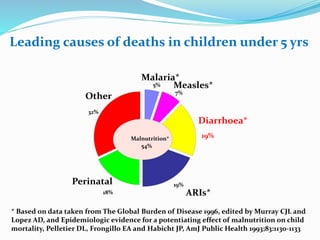
ARIs*
19%
Diarrhoea*
19%
Measles*
Malaria*
5%
Other
32%
Perinatal
18%
Malnutrition*
54%
* Based on data taken from The Global Burden of Disease 1996, edited by Murray CJL and
Lopez AD, and Epidemiologic evidence for a potentiating effect of malnutrition on child
mortality, Pelletier DL, Frongillo EA and Habicht JP, AmJ Public Health 1993;83:1130-1133
7%
Leading causes of deaths in children under 5 yrs
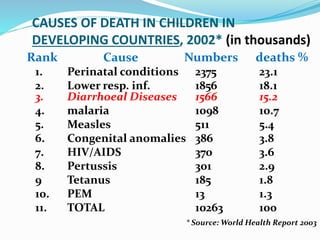
CAUSES OF DEATH IN CHILDREN IN
DEVELOPING COUNTRIES, 2002* (in thousands)
Rank Cause Numbers deaths %
1. Perinatal conditions 2375 23.1
2. Lower resp. inf. 1856 18.1
3. Diarrhoeal Diseases 1566 15.2
4. malaria 1098 10.7
5. Measles 511 5.4
6. Congenital anomalies 386 3.8
7. HIV/AIDS 370 3.6
8. Pertussis 301 2.9
9 Tetanus 185 1.8
10. PEM 13 1.3
11. TOTAL 10263 100
* Source: World Health Report 2003
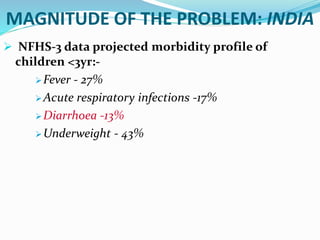
MAGNITUDE OF THE PROBLEM: INDIA
 NFHS-3 data projected morbidity profile of
children <3yr:-
Fever - 27%
Acute respiratory infections -17%
Diarrhoea -13%
Underweight - 43%
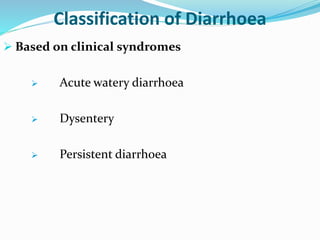
Classification of Diarrhoea
 Based on clinical syndromes
 Acute watery diarrhoea
 Dysentery
 Persistent diarrhoea
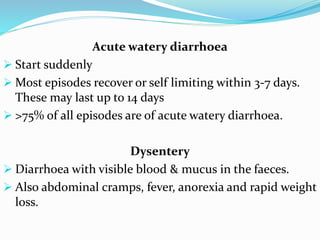
Acute watery diarrhoea
 Start suddenly
 Most episodes recover or self limiting within 3-7 days.
These may last up to 14 days
 >75% of all episodes are of acute watery diarrhoea.
Dysentery
 Diarrhoea with visible blood & mucus in the faeces.
 Also abdominal cramps, fever, anorexia and rapid weight
loss.
Persistent Diarrhoea
 Diarrhoea which lasts for > 14 days
 Incidence is around 5% i.e. 5% of acute diarrhoea
may persist beyond 2 weeks
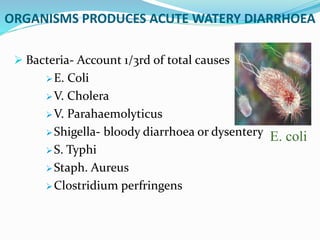
ORGANISMS PRODUCES ACUTE WATERY DIARRHOEA
 Bacteria- Account 1/3rd of total causes
E. Coli
V. Cholera
V. Parahaemolyticus
Shigella- bloody diarrhoea or dysentery
S. Typhi
Staph. Aureus
Clostridium perfringens
E. coli
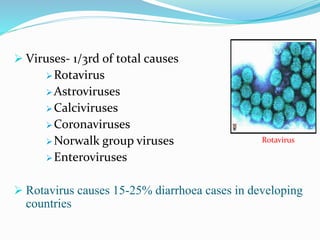
 Viruses- 1/3rd of total causes
Rotavirus
Astroviruses
Calciviruses
Coronaviruses
Norwalk group viruses
Enteroviruses
 Rotavirus causes 15-25% diarrhoea cases in developing
countries
Rotavirus
 Parasites-
E. histolytica- Dysentery
Giardia intestinalis
Trichuriasis
Cryptosporidium parvum
 1/3rd causes can’t be pin pointed
RISK FACTORS OF DIARRHOEA
 Bottle fed babies have more chances to develop
diarrhoea because of unclean bottles
 Flies can also bring germs to uncovered food
 Drinking contaminated water
 Unclean food, milk, unclean hands & unclean utensils
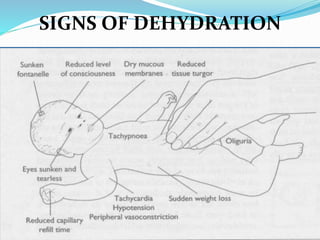
SIGNS OF DEHYDRATION
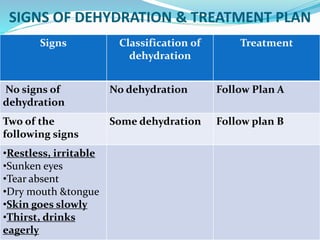
SIGNS OF DEHYDRATION & TREATMENT PLAN
 Reflected by the following signs in addition to above
signs
Lethargic or unconscious , difficult to wake
Floppy
Refusal for feed/breastfeed in young infant and
Unable to drink.
Signs Classification of
dehydration
Treatment
No signs of
dehydration
No dehydration Follow Plan A
Two of the
following signs
Some dehydration Follow plan B
•Restless, irritable
•Sunken eyes
•Tear absent
•Dry mouth &tongue
•Skin goes slowly
•Thirst, drinks
eagerly
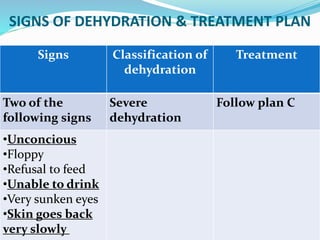
SIGNS OF DEHYDRATION & TREATMENT PLAN
 Reflected by the following signs in addition to above
signs
Lethargic or unconscious , difficult to wake
Floppy
Refusal for feed/breastfeed in young infant and
Unable to drink.
Signs Classification of
dehydration
Treatment
Two of the
following signs
Severe
dehydration
Follow plan C
•Unconcious
•Floppy
•Refusal to feed
•Unable to drink
•Very sunken eyes
•Skin goes back
very slowly
PRINCIPLES OF MANAGEMENT OF
ACUTE DIARRHOEA
 In early stages of diarrhoea when ORS packets are not
immediately available, HAF is given and continue
feeding
 CONTINUE BREAST FEEDING
BUT
-Soft drinks
-Sweetened fruit juices
-Sweetened tea should not be used.
These have high osmolarity and can lead to worsening of
diarrhoea and further leading to dehydration.
PRINCIPLES OF MANAGEMENT OF
ACUTE DIARRHOEA
 Rationale use of drugs
ORS is the drug of choice for all cases of
diarrhoea
It is life saving when used timely, in adequate
quantities
Only a small proportion of cases of diarrhoea
(dysentery, cholera and associated illnesses) need
specific antimicrobials
PRINCIPLES OF MANAGEMENT OF
ACUTE DIARRHOEA
 Drugs Like
- Anti-motility drugs
- Stimulants
- Steroids
MUST NOT BE USED
 as they provide pseudo sense of protection among
mothers and distract their attention from correct
treatment
 Their marketing has been banned in India
ORAL REHYDRATION SALT(ORS)
 It is a balanced mixture of glucose and electrolytes
 Almost all deaths from diarrhoea can be prevented by
ORS
MECHANISM OF ACTION
 Sodium promotes absorption of water from the
intestine
 Glucose promotes the absorption of sodium and water
from the intestine
Cases with No Signs of Dehydration
Plan A
 In early stages, when fluid loss is <5% of the body
weight, children may not show any clinical signs of
dehydration
 Give HAF or ORS
 Plan A involves counselling the child's mother about
the 3 Rules of Home treatment.
 GIVE EXTRA FLUID (as much as the child will take)
 CONTINUE FEEDING
 WHEN TO RETURN
Cases with signs of Some Dehydration
 Children who have dehydration should be kept under
observation in the hospital/ health center for a few
hours and given prepared ORS solution during the
period
Purpose:
 Correct fluid deficit and ongoing fluid losses
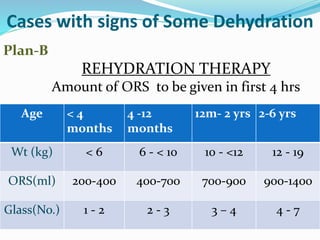
Cases with signs of Some Dehydration
Plan-B
REHYDRATION THERAPY
Amount of ORS to be given in first 4 hrs
Age < 4
months
4 -12
months
12m- 2 yrs 2-6 yrs
Wt (kg) < 6 6 - < 10 10 - <12 12 - 19
ORS(ml) 200-400 400-700 700-900 900-1400
Glass(No.) 1 - 2 2 - 3 3 – 4 4 - 7
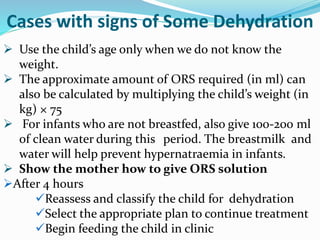
 Use the child’s age only when we do not know the
weight.
 The approximate amount of ORS required (in ml) can
also be calculated by multiplying the child’s weight (in
kg) × 75
 For infants who are not breastfed, also give 100-200 ml
of clean water during this period. The breastmilk and
water will help prevent hypernatraemia in infants.
 Show the mother how to give ORS solution
After 4 hours
Reassess and classify the child for dehydration
Select the appropriate plan to continue treatment
Begin feeding the child in clinic
Cases with signs of Some Dehydration
Cases with signs of severe dehydration
Plan-C
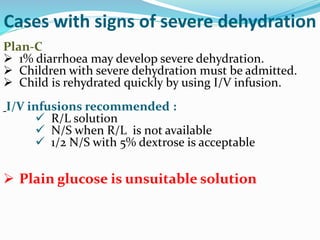
 1% diarrhoea may develop severe dehydration.
 Children with severe dehydration must be admitted.
 Child is rehydrated quickly by using I/V infusion.
I/V infusions recommended :
 R/L solution
 N/S when R/L is not available
 1/2 N/S with 5% dextrose is acceptable
 Plain glucose is unsuitable solution
Plan-C
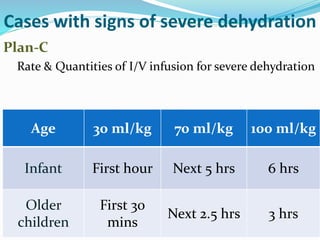
Rate & Quantities of I/V infusion for severe dehydration
Age 30 ml/kg 70 ml/kg 100 ml/kg
Infant First hour Next 5 hrs 6 hrs
Older
children
First 30
mins
Next 2.5 hrs 3 hrs
Cases with signs of severe dehydration
Plan-C
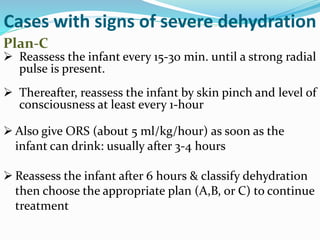
 Reassess the infant every 15-30 min. until a strong radial
pulse is present.
 Thereafter, reassess the infant by skin pinch and level of
consciousness at least every 1-hour
 Also give ORS (about 5 ml/kg/hour) as soon as the
infant can drink: usually after 3-4 hours
 Reassess the infant after 6 hours & classify dehydration
then choose the appropriate plan (A,B, or C) to continue
treatment
Cases with signs of severe dehydration
 After signs of severe dehydration disappear & child is
able to drink, further therapy should be continued with
ORS as per plan A or B
 Before the mother leaves the hospital two packets of
ORS must be given.
Cases with signs of severe dehydration
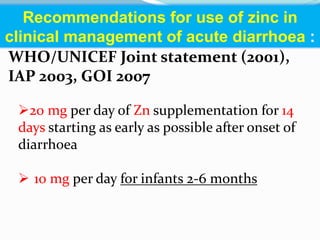
20 mg per day of Zn supplementation for 14
days starting as early as possible after onset of
diarrhoea
 10 mg per day for infants 2-6 months
WHO/UNICEF Joint statement (2001),
IAP 2003, GOI 2007
Recommendations for use of zinc in
clinical management of acute diarrhoea :
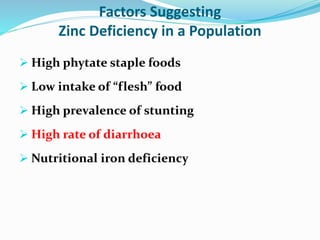
Factors Suggesting
Zinc Deficiency in a Population
 High phytate staple foods
 Low intake of “flesh” food
 High prevalence of stunting
 High rate of diarrhoea
 Nutritional iron deficiency
Role of Probiotics
Probiotics:
 - means "for life" and is currently used
to name bacteria associated with
beneficial effects for humans and
animals.
 Coined in 1960 to name substances
which promoted the growth of other
organisms.
Effect of probiotics in diarrhoea-
 The strongest evidence of a beneficial
effect has been for the following
probiotics - Lactobacillus rhamnosus
GG and Bifidobacterium lactis BB-12
 These probiotics are effective for both
treatment and prevention of acute
diarrhoea caused mainly by rotavirus
in children
 Antibiotic associated diarrhoea has
also been found to respond when
probiotics have been used as
prophylaxis and also for therapy
Probiotic strains
- Can inhibit the growth and adhesion of a
range of entero-pathogens
- Animal studies have indicated beneficial
effect in Salmonella.
 Traveler's diarrhoea due to bacterial
infection has been benefited
The most highlighted beneficial effect of
probiotics has been on acute diarrhoea
caused by rotavirus in children.
POTENTIAL USES OF PROBIOTICS
 -diarrhoea
 -Helicobacter pylori infection
 -Inflammatory bowel disease
 -Cancers
 -To increase Immunity
 -Allergy
 -Heart disease
 -Urogenital tract infections
FEEDING IN DIARRHOEA
 Children should continue to be fed during diarrhoea.
 Milk should not be diluted with water during any phase
of acute diarrhoea.
 Milk can also be given as milk cereal mixture e.g. dalia,
milk-rice mixture.
 This technique reduces the lactose load & preserving
energy density.
 To make foods-energy dense some of preparation are:-
- Khichri with oil
- Rice with curd & sugar
- Mashed banana with milk or curd
- Mashed potatoes with oil.
Breast feeding should be continued uninterrupted even
during rehydration with ORS.
FEEDING IN DIARRHOEA
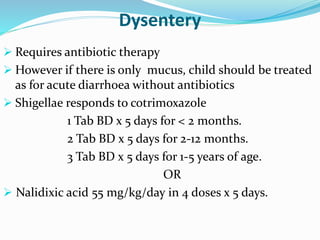
Dysentery
 Requires antibiotic therapy
 However if there is only mucus, child should be treated
as for acute diarrhoea without antibiotics
 Shigellae responds to cotrimoxazole
1 Tab BD x 5 days for < 2 months.
2 Tab BD x 5 days for 2-12 months.
3 Tab BD x 5 days for 1-5 years of age.
OR
 Nalidixic acid 55 mg/kg/day in 4 doses x 5 days.
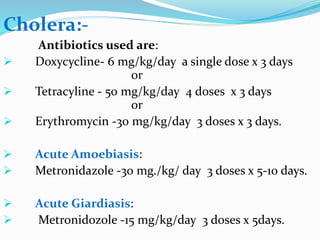
Cholera:-
Antibiotics used are:
 Doxycycline- 6 mg/kg/day a single dose x 3 days
or
 Tetracyline - 50 mg/kg/day 4 doses x 3 days
or
 Erythromycin -30 mg/kg/day 3 doses x 3 days.
 Acute Amoebiasis:
 Metronidazole -30 mg./kg/ day 3 doses x 5-10 days.
 Acute Giardiasis:
 Metronidozole -15 mg/kg/day 3 doses x 5days.
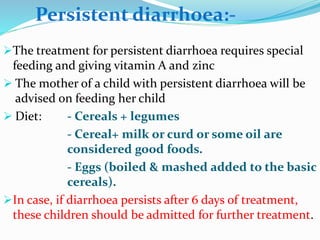
The treatment for persistent diarrhoea requires special
feeding and giving vitamin A and zinc
 The mother of a child with persistent diarrhoea will be
advised on feeding her child
 Diet: - Cereals + legumes
- Cereal+ milk or curd or some oil are
considered good foods.
- Eggs (boiled & mashed added to the basic
cereals).
In case, if diarrhoea persists after 6 days of treatment,
these children should be admitted for further treatment.
Persistent diarrhoea:-
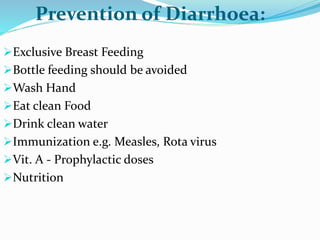
Exclusive Breast Feeding
Bottle feeding should be avoided
Wash Hand
Eat clean Food
Drink clean water
Immunization e.g. Measles, Rota virus
Vit. A - Prophylactic doses
Nutrition
Prevention of Diarrhoea:
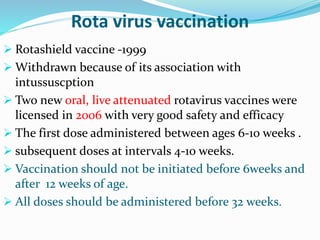
Rota virus vaccination
 Rotashield vaccine -1999
 Withdrawn because of its association with
intussuscption
 Two new oral, live attenuated rotavirus vaccines were
licensed in 2006 with very good safety and efficacy
 The first dose administered between ages 6-10 weeks .
 subsequent doses at intervals 4-10 weeks.
 Vaccination should not be initiated before 6weeks and
after 12 weeks of age.
 All doses should be administered before 32 weeks.
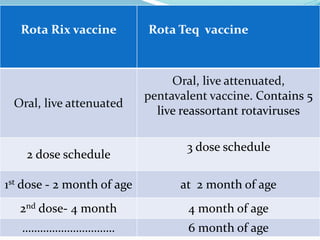
Rota Rix vaccine Rota Teq vaccine
Oral, live attenuated
Oral, live attenuated,
pentavalent vaccine. Contains 5
live reassortant rotaviruses
2 dose schedule
3 dose schedule
1st dose - 2 month of age at 2 month of age
2nd dose- 4 month 4 month of age
…………………………. 6 month of age
 -
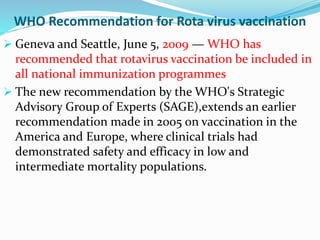
WHO Recommendation for Rota virus vaccination
 Geneva and Seattle, June 5, 2009 — WHO has
recommended that rotavirus vaccination be included in
all national immunization programmes
 The new recommendation by the WHO's Strategic
Advisory Group of Experts (SAGE),extends an earlier
recommendation made in 2005 on vaccination in the
America and Europe, where clinical trials had
demonstrated safety and efficacy in low and
intermediate mortality populations.
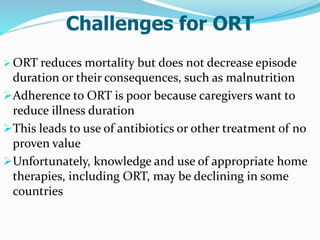
Challenges for ORT
 ORT reduces mortality but does not decrease episode
duration or their consequences, such as malnutrition
Adherence to ORT is poor because caregivers want to
reduce illness duration
This leads to use of antibiotics or other treatment of no
proven value
Unfortunately, knowledge and use of appropriate home
therapies, including ORT, may be declining in some
countries
SEARCH FOR ADJUNCT THERAPIES
 12-59 months old Indian children with zinc deficiency
had 1.5 times more diarrhoea and 3.5 times more ALRI
than non zinc deficient children.
NATIONAL DIARRHOEAL DISEASE CONTROL
PROGRAMME
 NDDCP was launched in 1981
 Main objective were reduction of mortality through
introduction of ORT.
Goals were:
Reduce diarrhoeal associated mortality in children <5
years by 30% by 1995 and by 70% by 2000 A.D.
Reducing CFR to less than 1%.
Improvement in water and sanitation facilities was the
long term goal of NDDCP
 National ORT Programme was incepted in 1985- 86
 From 1992-93 the programme has become a part of
CSSM Programme.
 CSSM programme become a part of RCH programme in
1997
 In RCH Programme, policy of IMCI was adopted
 Strategy of IMCI was to address all children and not only
sick children
 IMCI focused on life threatening illnesses-diarrhoea,
Pneumonia, Measles, Malaria etc.
NATIONAL DIARRHOEAL DISEASE CONTROL
PROGRAMME
 Contd.
 Indian version of IMCI guidelines renamed as IMNCI.
 Since 2003 - DDCP included in IMNCI which includes
- Neonates of 0-7 days
- Incorporating national guidelines on
diarrhoea, ARI ,Malaria, Anaemia, Vit. A
supplementation & Immunizations.
STRATEGIES OF IMNCI
 Ensure standard case management of diarrhoea by
training of medical and other health personnel.
 Promote standard case management practices among
private practitioners through IMA and IAP.
 Improve maternal knowledge on home management
and recognition of danger signs of diarrhoea for
immediate medical care.
 Increase availability of ORS by providing free ORS
packets at health facilities and outreach depots.
 Increase accessibility by marketing ORS through the
PDS and commercial outlets.
 Monitor hospital based data on ORS use rate, CFR &
other parameters.
 Promote exclusive breast feeding for the first 6 months,
proper weaning, infant immunization including measles
immunization and Vit A prophylaxis.
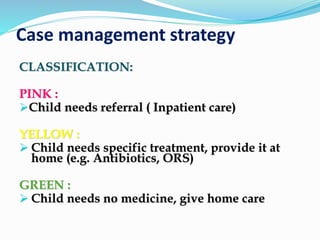
Case management strategy
CLASSIFICATION:
PINK :
Child needs referral ( Inpatient care)
YELLOW :
 Child needs specific treatment, provide it at
home (e.g. Antibiotics, ORS)
GREEN :
 Child needs no medicine, give home care
Limitations of IMNCI
 Outpatient Facility Based
 Community activities not given adequate focus
 Vertical initiatives in Non IMNCI districts sorely
lacking
F-IMNCI
 From November 2009 - IMNCI has been re -
baptized as F-IMNCI, (F -Facility) with added
component of:
 Asphyxia Management and
 Care of Sick new born at facility level, besides
all other components included under IMNCI
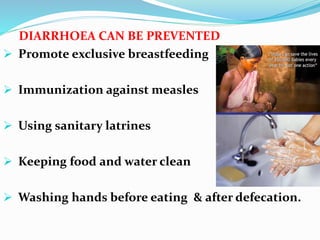
DIARRHOEA CAN BE PREVENTED
 Promote exclusive breastfeeding
 Immunization against measles
 Using sanitary latrines
 Keeping food and water clean
 Washing hands before eating & after defecation.
 MESSAGES:
 ORS is best drink.
 A child with diarrhoea needs more food and
frequent breast feeding.
 A child who is recovering from diarrhoea needs an
extra meal every day for at least 2 weeks.
 Medicine other than ORS should not be used
except on medical advice.
REFERENCES
MODULES of IMNCI 2003
K.PARK , TEXTBOOK OF COMMUNITY MEDICINE
SUNDER LAL, TEXTBOOK OF COMMUNITY
MADICINE.
HARRISONS PRINCIPLES OF INTERNAL MEDICINE
17th edition
IAP GUIDELINES FOR MANAGEMENT OF
DIARRHEA
WORLD HEALTH ORGANIZATION (WHO)
GUIDELINES ON TREATMENT OF DIARRHEA (2005
T
h
a
n
k
s

Diarrhoea prevention and control

  • 2.
    CONTENTS  INTRODUCTION  PROBLEM- WORLD - INDIA  CLASSIFICATION  CAUSES  DEHYDRATION  CLASSIFICATION OF DEHYDRATION  PRINCIPLES OF MANAGEMENT
  • 3.
    CONTENTS  ROLE OFZINC  ROLE OF PROBIOTICS  DDCP  IMNCI  F-IMNCI
  • 4.
    INTRODUCTION  Diarrhoea isdefined as passage of unusually loose or watery stools usually at least three times in a 24 hour period. (WHO)  However it is the consistency of the stools rather than the number that is more important.  Passage of even one large watery stool in young child is diarrhoea.  Frequent passage of normal stool is no diarrhoea.
  • 5.
     6-12 monthsof age are affected severely & account for high mortality.  Dehydration occurs when water & salts are not replaced adequately -may lead to shock & death.  Diarrhoea also produces under nutrition and growth failure.  Diarrhoeal disease constitute one of the important “nutritional leak” in young children.  Even a brief episode of diarrhoea leads to the loss of 1-2 % of body weight in children. INTRODUCTION
  • 6.
    MAGNITUDE OF THEPROBLEM: WORLD  Diarrhoeal disease is the 2nd leading cause of death in children under 5 yrs of age.  Globally, there are about 2 Bn cases of diarrhoeal disease every yr.  Diarrhoeal disease kills 1.5 Mn children every yr.  African and South-East Asian regions together account for nearly 78% of them.  India alone contributes about 20% of all global under-5 diarrhoeal deaths.  It is both preventable and treatable.
  • 7.
     In developingcountries, children under three years old experience on an average three episodes of diarrhoea every year  Each episode deprives the child of the nutrition necessary for growth  As a result, diarrhoea is a major cause of malnutrition, and malnourished children are more likely to fall ill from diarrhoea. It makes a vicious cycle MAGNITUDE OF THE PROBLEM: WORLD
  • 8.
    ARIs* 19% Diarrhoea* 19% Measles* Malaria* 5% Other 32% Perinatal 18% Malnutrition* 54% * Based ondata taken from The Global Burden of Disease 1996, edited by Murray CJL and Lopez AD, and Epidemiologic evidence for a potentiating effect of malnutrition on child mortality, Pelletier DL, Frongillo EA and Habicht JP, AmJ Public Health 1993;83:1130-1133 7% Leading causes of deaths in children under 5 yrs
  • 9.
    CAUSES OF DEATHIN CHILDREN IN DEVELOPING COUNTRIES, 2002* (in thousands) Rank Cause Numbers deaths % 1. Perinatal conditions 2375 23.1 2. Lower resp. inf. 1856 18.1 3. Diarrhoeal Diseases 1566 15.2 4. malaria 1098 10.7 5. Measles 511 5.4 6. Congenital anomalies 386 3.8 7. HIV/AIDS 370 3.6 8. Pertussis 301 2.9 9 Tetanus 185 1.8 10. PEM 13 1.3 11. TOTAL 10263 100 * Source: World Health Report 2003
  • 10.
    MAGNITUDE OF THEPROBLEM: INDIA  NFHS-3 data projected morbidity profile of children <3yr:- Fever - 27% Acute respiratory infections -17% Diarrhoea -13% Underweight - 43%
  • 11.
    Classification of Diarrhoea Based on clinical syndromes  Acute watery diarrhoea  Dysentery  Persistent diarrhoea
  • 12.
    Acute watery diarrhoea Start suddenly  Most episodes recover or self limiting within 3-7 days. These may last up to 14 days  >75% of all episodes are of acute watery diarrhoea. Dysentery  Diarrhoea with visible blood & mucus in the faeces.  Also abdominal cramps, fever, anorexia and rapid weight loss.
  • 13.
    Persistent Diarrhoea  Diarrhoeawhich lasts for > 14 days  Incidence is around 5% i.e. 5% of acute diarrhoea may persist beyond 2 weeks
  • 14.
    ORGANISMS PRODUCES ACUTEWATERY DIARRHOEA  Bacteria- Account 1/3rd of total causes E. Coli V. Cholera V. Parahaemolyticus Shigella- bloody diarrhoea or dysentery S. Typhi Staph. Aureus Clostridium perfringens E. coli
  • 15.
     Viruses- 1/3rdof total causes Rotavirus Astroviruses Calciviruses Coronaviruses Norwalk group viruses Enteroviruses  Rotavirus causes 15-25% diarrhoea cases in developing countries Rotavirus
  • 16.
     Parasites- E. histolytica-Dysentery Giardia intestinalis Trichuriasis Cryptosporidium parvum  1/3rd causes can’t be pin pointed
  • 17.
    RISK FACTORS OFDIARRHOEA  Bottle fed babies have more chances to develop diarrhoea because of unclean bottles  Flies can also bring germs to uncovered food  Drinking contaminated water  Unclean food, milk, unclean hands & unclean utensils
  • 18.
  • 19.
    SIGNS OF DEHYDRATION& TREATMENT PLAN  Reflected by the following signs in addition to above signs Lethargic or unconscious , difficult to wake Floppy Refusal for feed/breastfeed in young infant and Unable to drink. Signs Classification of dehydration Treatment No signs of dehydration No dehydration Follow Plan A Two of the following signs Some dehydration Follow plan B •Restless, irritable •Sunken eyes •Tear absent •Dry mouth &tongue •Skin goes slowly •Thirst, drinks eagerly
  • 20.
    SIGNS OF DEHYDRATION& TREATMENT PLAN  Reflected by the following signs in addition to above signs Lethargic or unconscious , difficult to wake Floppy Refusal for feed/breastfeed in young infant and Unable to drink. Signs Classification of dehydration Treatment Two of the following signs Severe dehydration Follow plan C •Unconcious •Floppy •Refusal to feed •Unable to drink •Very sunken eyes •Skin goes back very slowly
  • 21.
    PRINCIPLES OF MANAGEMENTOF ACUTE DIARRHOEA  In early stages of diarrhoea when ORS packets are not immediately available, HAF is given and continue feeding  CONTINUE BREAST FEEDING BUT -Soft drinks -Sweetened fruit juices -Sweetened tea should not be used. These have high osmolarity and can lead to worsening of diarrhoea and further leading to dehydration.
  • 23.
    PRINCIPLES OF MANAGEMENTOF ACUTE DIARRHOEA  Rationale use of drugs ORS is the drug of choice for all cases of diarrhoea It is life saving when used timely, in adequate quantities Only a small proportion of cases of diarrhoea (dysentery, cholera and associated illnesses) need specific antimicrobials
  • 24.
    PRINCIPLES OF MANAGEMENTOF ACUTE DIARRHOEA  Drugs Like - Anti-motility drugs - Stimulants - Steroids MUST NOT BE USED  as they provide pseudo sense of protection among mothers and distract their attention from correct treatment  Their marketing has been banned in India
  • 25.
    ORAL REHYDRATION SALT(ORS) It is a balanced mixture of glucose and electrolytes  Almost all deaths from diarrhoea can be prevented by ORS MECHANISM OF ACTION  Sodium promotes absorption of water from the intestine  Glucose promotes the absorption of sodium and water from the intestine
  • 26.
    Cases with NoSigns of Dehydration Plan A  In early stages, when fluid loss is <5% of the body weight, children may not show any clinical signs of dehydration  Give HAF or ORS  Plan A involves counselling the child's mother about the 3 Rules of Home treatment.  GIVE EXTRA FLUID (as much as the child will take)  CONTINUE FEEDING  WHEN TO RETURN
  • 27.
    Cases with signsof Some Dehydration  Children who have dehydration should be kept under observation in the hospital/ health center for a few hours and given prepared ORS solution during the period Purpose:  Correct fluid deficit and ongoing fluid losses
  • 28.
    Cases with signsof Some Dehydration Plan-B REHYDRATION THERAPY Amount of ORS to be given in first 4 hrs Age < 4 months 4 -12 months 12m- 2 yrs 2-6 yrs Wt (kg) < 6 6 - < 10 10 - <12 12 - 19 ORS(ml) 200-400 400-700 700-900 900-1400 Glass(No.) 1 - 2 2 - 3 3 – 4 4 - 7
  • 29.
     Use thechild’s age only when we do not know the weight.  The approximate amount of ORS required (in ml) can also be calculated by multiplying the child’s weight (in kg) × 75  For infants who are not breastfed, also give 100-200 ml of clean water during this period. The breastmilk and water will help prevent hypernatraemia in infants.  Show the mother how to give ORS solution After 4 hours Reassess and classify the child for dehydration Select the appropriate plan to continue treatment Begin feeding the child in clinic Cases with signs of Some Dehydration
  • 30.
    Cases with signsof severe dehydration Plan-C  1% diarrhoea may develop severe dehydration.  Children with severe dehydration must be admitted.  Child is rehydrated quickly by using I/V infusion. I/V infusions recommended :  R/L solution  N/S when R/L is not available  1/2 N/S with 5% dextrose is acceptable  Plain glucose is unsuitable solution
  • 31.
    Plan-C Rate & Quantitiesof I/V infusion for severe dehydration Age 30 ml/kg 70 ml/kg 100 ml/kg Infant First hour Next 5 hrs 6 hrs Older children First 30 mins Next 2.5 hrs 3 hrs Cases with signs of severe dehydration
  • 32.
    Plan-C  Reassess theinfant every 15-30 min. until a strong radial pulse is present.  Thereafter, reassess the infant by skin pinch and level of consciousness at least every 1-hour  Also give ORS (about 5 ml/kg/hour) as soon as the infant can drink: usually after 3-4 hours  Reassess the infant after 6 hours & classify dehydration then choose the appropriate plan (A,B, or C) to continue treatment Cases with signs of severe dehydration
  • 33.
     After signsof severe dehydration disappear & child is able to drink, further therapy should be continued with ORS as per plan A or B  Before the mother leaves the hospital two packets of ORS must be given. Cases with signs of severe dehydration
  • 34.
    20 mg perday of Zn supplementation for 14 days starting as early as possible after onset of diarrhoea  10 mg per day for infants 2-6 months WHO/UNICEF Joint statement (2001), IAP 2003, GOI 2007 Recommendations for use of zinc in clinical management of acute diarrhoea :
  • 35.
    Factors Suggesting Zinc Deficiencyin a Population  High phytate staple foods  Low intake of “flesh” food  High prevalence of stunting  High rate of diarrhoea  Nutritional iron deficiency
  • 36.
  • 37.
    Probiotics:  - means"for life" and is currently used to name bacteria associated with beneficial effects for humans and animals.  Coined in 1960 to name substances which promoted the growth of other organisms.
  • 38.
    Effect of probioticsin diarrhoea-  The strongest evidence of a beneficial effect has been for the following probiotics - Lactobacillus rhamnosus GG and Bifidobacterium lactis BB-12  These probiotics are effective for both treatment and prevention of acute diarrhoea caused mainly by rotavirus in children  Antibiotic associated diarrhoea has also been found to respond when probiotics have been used as prophylaxis and also for therapy
  • 39.
    Probiotic strains - Caninhibit the growth and adhesion of a range of entero-pathogens - Animal studies have indicated beneficial effect in Salmonella.  Traveler's diarrhoea due to bacterial infection has been benefited The most highlighted beneficial effect of probiotics has been on acute diarrhoea caused by rotavirus in children.
  • 40.
    POTENTIAL USES OFPROBIOTICS  -diarrhoea  -Helicobacter pylori infection  -Inflammatory bowel disease  -Cancers  -To increase Immunity  -Allergy  -Heart disease  -Urogenital tract infections
  • 41.
    FEEDING IN DIARRHOEA Children should continue to be fed during diarrhoea.  Milk should not be diluted with water during any phase of acute diarrhoea.  Milk can also be given as milk cereal mixture e.g. dalia, milk-rice mixture.  This technique reduces the lactose load & preserving energy density.
  • 42.
     To makefoods-energy dense some of preparation are:- - Khichri with oil - Rice with curd & sugar - Mashed banana with milk or curd - Mashed potatoes with oil. Breast feeding should be continued uninterrupted even during rehydration with ORS. FEEDING IN DIARRHOEA
  • 43.
    Dysentery  Requires antibiotictherapy  However if there is only mucus, child should be treated as for acute diarrhoea without antibiotics  Shigellae responds to cotrimoxazole 1 Tab BD x 5 days for < 2 months. 2 Tab BD x 5 days for 2-12 months. 3 Tab BD x 5 days for 1-5 years of age. OR  Nalidixic acid 55 mg/kg/day in 4 doses x 5 days.
  • 44.
    Cholera:- Antibiotics used are: Doxycycline- 6 mg/kg/day a single dose x 3 days or  Tetracyline - 50 mg/kg/day 4 doses x 3 days or  Erythromycin -30 mg/kg/day 3 doses x 3 days.  Acute Amoebiasis:  Metronidazole -30 mg./kg/ day 3 doses x 5-10 days.  Acute Giardiasis:  Metronidozole -15 mg/kg/day 3 doses x 5days.
  • 45.
    The treatment forpersistent diarrhoea requires special feeding and giving vitamin A and zinc  The mother of a child with persistent diarrhoea will be advised on feeding her child  Diet: - Cereals + legumes - Cereal+ milk or curd or some oil are considered good foods. - Eggs (boiled & mashed added to the basic cereals). In case, if diarrhoea persists after 6 days of treatment, these children should be admitted for further treatment. Persistent diarrhoea:-
  • 46.
    Exclusive Breast Feeding Bottlefeeding should be avoided Wash Hand Eat clean Food Drink clean water Immunization e.g. Measles, Rota virus Vit. A - Prophylactic doses Nutrition Prevention of Diarrhoea:
  • 47.
    Rota virus vaccination Rotashield vaccine -1999  Withdrawn because of its association with intussuscption  Two new oral, live attenuated rotavirus vaccines were licensed in 2006 with very good safety and efficacy  The first dose administered between ages 6-10 weeks .  subsequent doses at intervals 4-10 weeks.  Vaccination should not be initiated before 6weeks and after 12 weeks of age.  All doses should be administered before 32 weeks.
  • 48.
    Rota Rix vaccineRota Teq vaccine Oral, live attenuated Oral, live attenuated, pentavalent vaccine. Contains 5 live reassortant rotaviruses 2 dose schedule 3 dose schedule 1st dose - 2 month of age at 2 month of age 2nd dose- 4 month 4 month of age …………………………. 6 month of age
  • 49.
  • 50.
    WHO Recommendation forRota virus vaccination  Geneva and Seattle, June 5, 2009 — WHO has recommended that rotavirus vaccination be included in all national immunization programmes  The new recommendation by the WHO's Strategic Advisory Group of Experts (SAGE),extends an earlier recommendation made in 2005 on vaccination in the America and Europe, where clinical trials had demonstrated safety and efficacy in low and intermediate mortality populations.
  • 51.
    Challenges for ORT ORT reduces mortality but does not decrease episode duration or their consequences, such as malnutrition Adherence to ORT is poor because caregivers want to reduce illness duration This leads to use of antibiotics or other treatment of no proven value Unfortunately, knowledge and use of appropriate home therapies, including ORT, may be declining in some countries
  • 52.
    SEARCH FOR ADJUNCTTHERAPIES  12-59 months old Indian children with zinc deficiency had 1.5 times more diarrhoea and 3.5 times more ALRI than non zinc deficient children.
  • 53.
    NATIONAL DIARRHOEAL DISEASECONTROL PROGRAMME  NDDCP was launched in 1981  Main objective were reduction of mortality through introduction of ORT. Goals were: Reduce diarrhoeal associated mortality in children <5 years by 30% by 1995 and by 70% by 2000 A.D. Reducing CFR to less than 1%. Improvement in water and sanitation facilities was the long term goal of NDDCP
  • 54.
     National ORTProgramme was incepted in 1985- 86  From 1992-93 the programme has become a part of CSSM Programme.  CSSM programme become a part of RCH programme in 1997  In RCH Programme, policy of IMCI was adopted  Strategy of IMCI was to address all children and not only sick children  IMCI focused on life threatening illnesses-diarrhoea, Pneumonia, Measles, Malaria etc. NATIONAL DIARRHOEAL DISEASE CONTROL PROGRAMME
  • 55.
     Contd.  Indianversion of IMCI guidelines renamed as IMNCI.  Since 2003 - DDCP included in IMNCI which includes - Neonates of 0-7 days - Incorporating national guidelines on diarrhoea, ARI ,Malaria, Anaemia, Vit. A supplementation & Immunizations.
  • 56.
    STRATEGIES OF IMNCI Ensure standard case management of diarrhoea by training of medical and other health personnel.  Promote standard case management practices among private practitioners through IMA and IAP.  Improve maternal knowledge on home management and recognition of danger signs of diarrhoea for immediate medical care.
  • 57.
     Increase availabilityof ORS by providing free ORS packets at health facilities and outreach depots.  Increase accessibility by marketing ORS through the PDS and commercial outlets.  Monitor hospital based data on ORS use rate, CFR & other parameters.  Promote exclusive breast feeding for the first 6 months, proper weaning, infant immunization including measles immunization and Vit A prophylaxis.
  • 58.
    Case management strategy CLASSIFICATION: PINK: Child needs referral ( Inpatient care) YELLOW :  Child needs specific treatment, provide it at home (e.g. Antibiotics, ORS) GREEN :  Child needs no medicine, give home care
  • 59.
    Limitations of IMNCI Outpatient Facility Based  Community activities not given adequate focus  Vertical initiatives in Non IMNCI districts sorely lacking
  • 60.
    F-IMNCI  From November2009 - IMNCI has been re - baptized as F-IMNCI, (F -Facility) with added component of:  Asphyxia Management and  Care of Sick new born at facility level, besides all other components included under IMNCI
  • 61.
    DIARRHOEA CAN BEPREVENTED  Promote exclusive breastfeeding  Immunization against measles  Using sanitary latrines  Keeping food and water clean  Washing hands before eating & after defecation.
  • 62.
     MESSAGES:  ORSis best drink.  A child with diarrhoea needs more food and frequent breast feeding.  A child who is recovering from diarrhoea needs an extra meal every day for at least 2 weeks.  Medicine other than ORS should not be used except on medical advice.
  • 63.
    REFERENCES MODULES of IMNCI2003 K.PARK , TEXTBOOK OF COMMUNITY MEDICINE SUNDER LAL, TEXTBOOK OF COMMUNITY MADICINE. HARRISONS PRINCIPLES OF INTERNAL MEDICINE 17th edition IAP GUIDELINES FOR MANAGEMENT OF DIARRHEA WORLD HEALTH ORGANIZATION (WHO) GUIDELINES ON TREATMENT OF DIARRHEA (2005
  • 64.