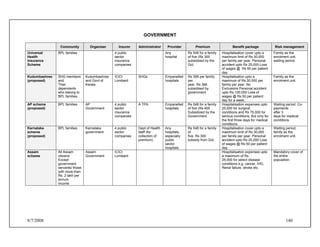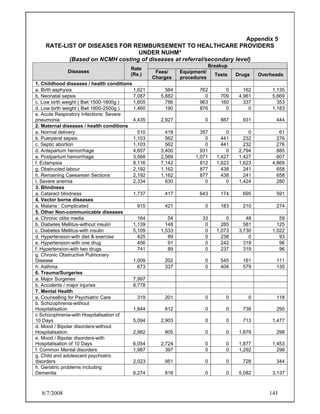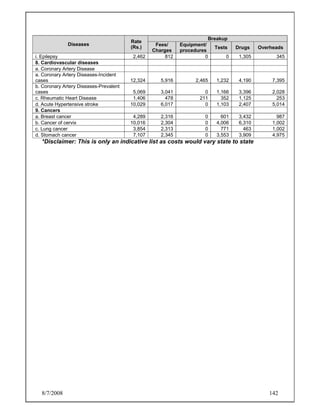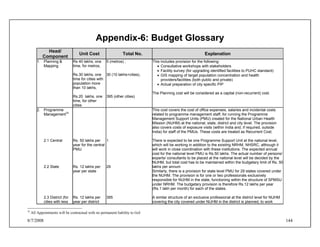



8/7/2008
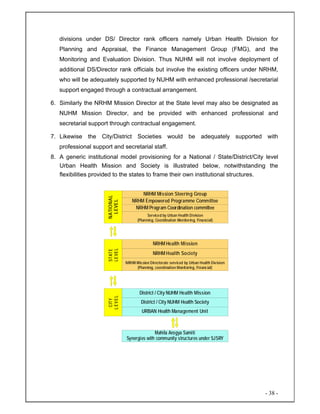
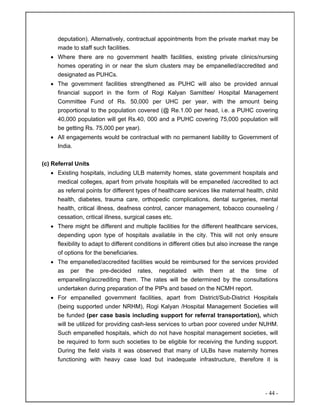
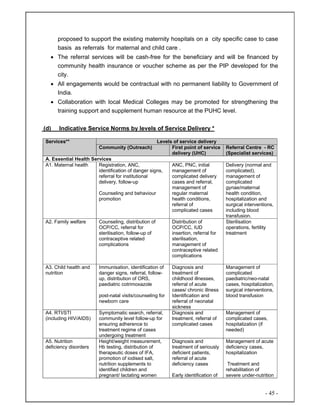
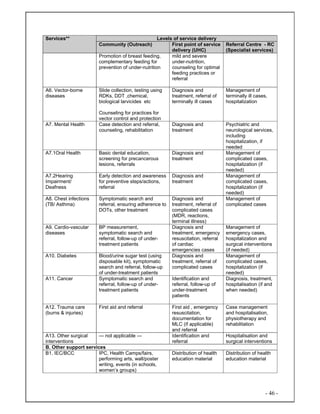
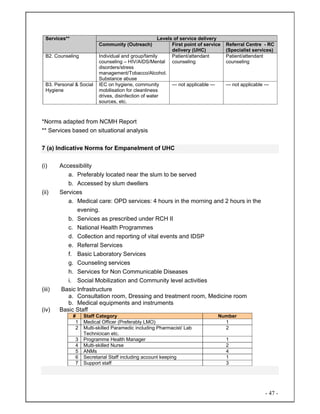
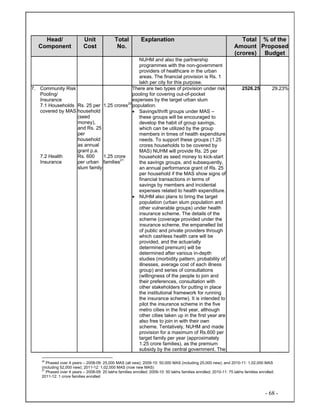
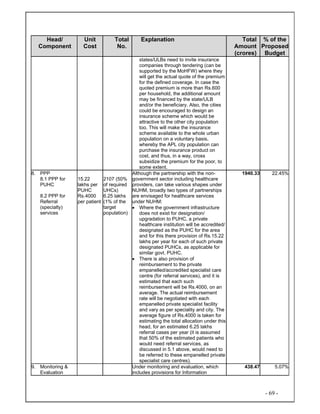
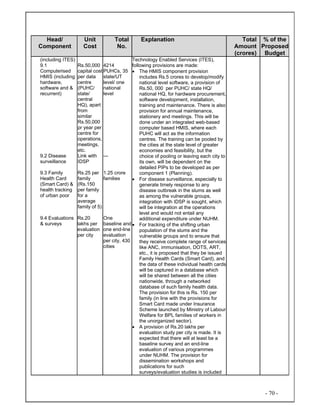
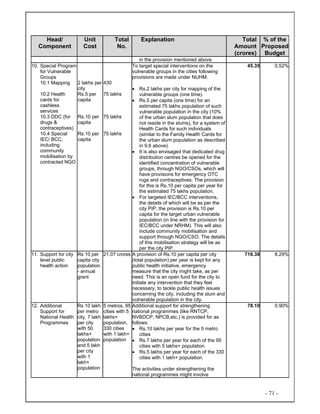
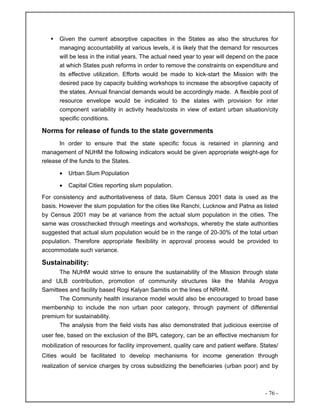
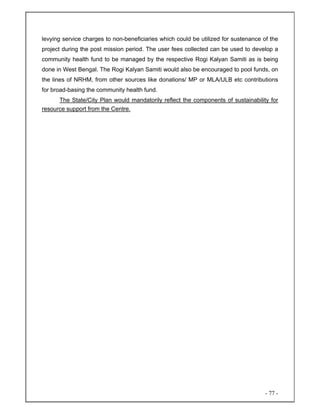
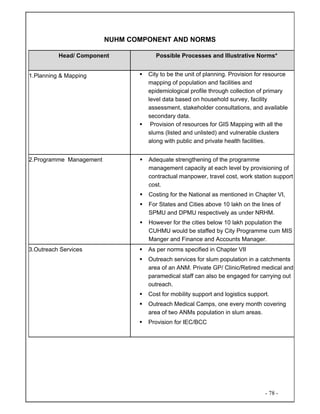
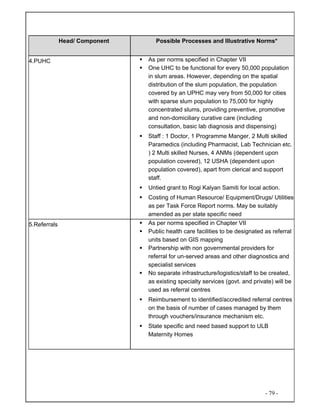
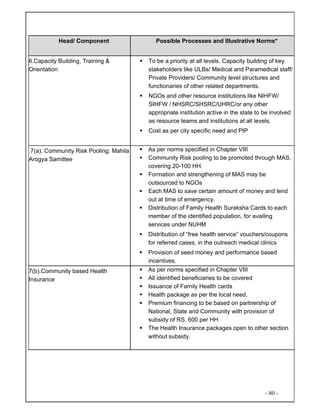
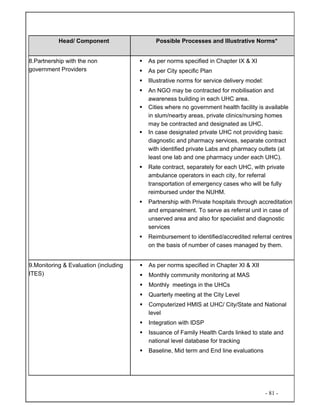
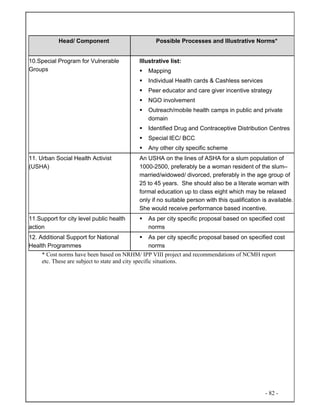
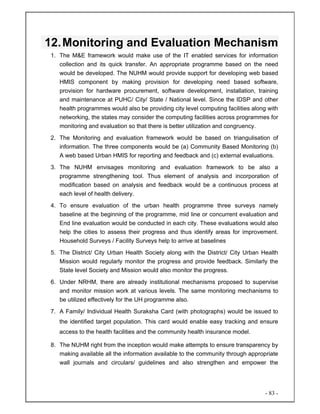
- 2 -
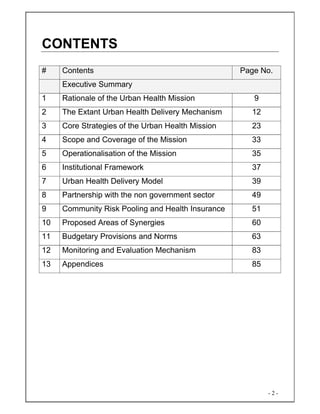
CONTENTS
# Contents Page No.
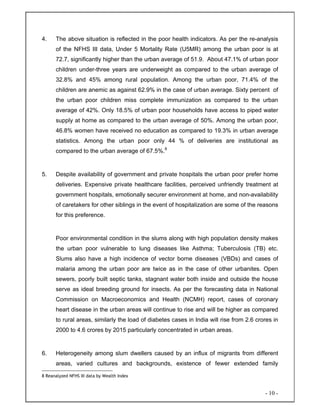
Executive Summary
1 Rationale of the Urban Health Mission 9
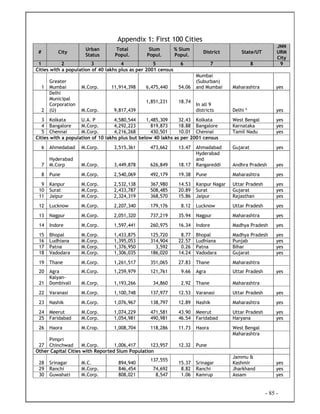
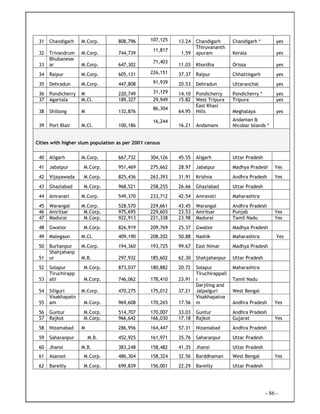
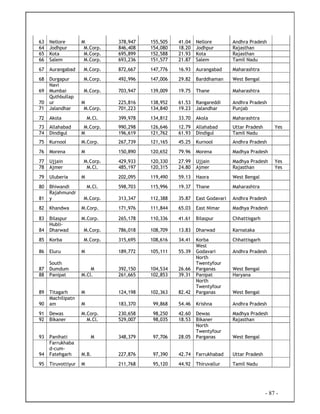
2 The Extant Urban Health Delivery Mechanism 12
3 Core Strategies of the Urban Health Mission 23
4 Scope and Coverage of the Mission 33
5 Operationalisation of the Mission 35
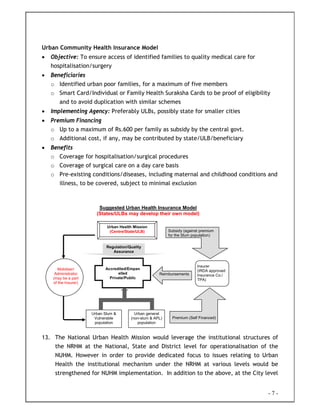
6 Institutional Framework 37
7 Urban Health Delivery Model 39
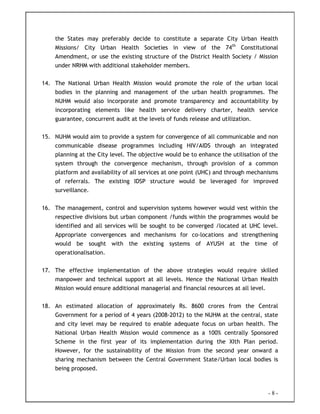
8 Partnership with the non government sector 49
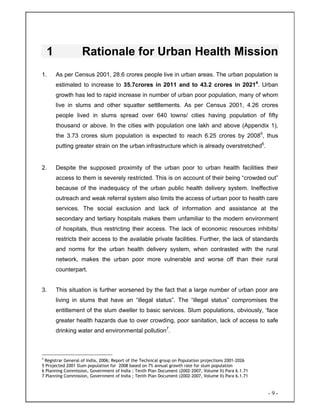
9 Community Risk Pooling and Health Insurance 51
10 Proposed Areas of Synergies 60
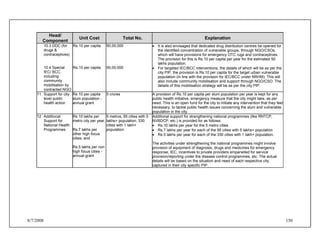
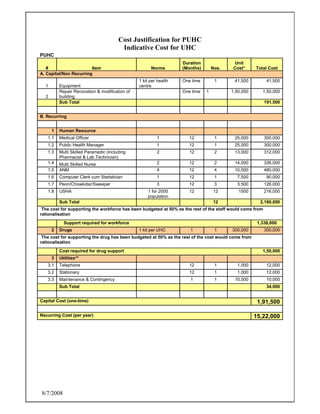
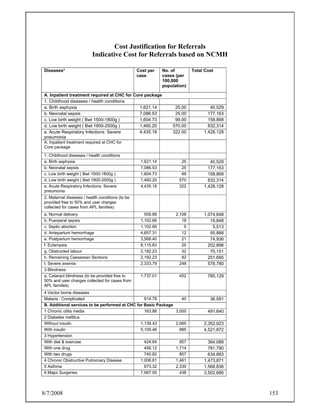
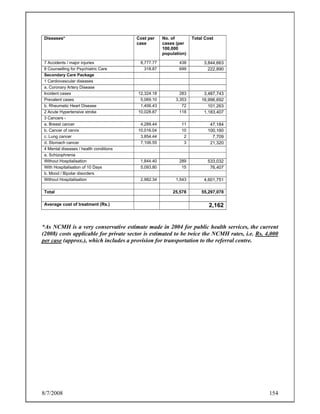
11 Budgetary Provisions and Norms 63
12 Monitoring and Evaluation Mechanism 83
13 Appendices 85
- 3 -
EXECUTIVE SUMMARY OF THE PROPOSED NATIONAL URBAN HEALTH
MISSION
1. As per Census 2001 currently 28.6 crores people lived in urban areas. It is
estimated that the urban population of country will increase to 43.2 crores by
2021. The urban growth has also led to increase in number of urban poor
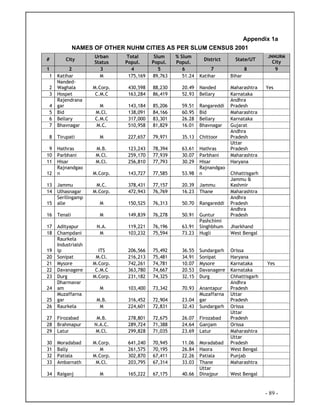
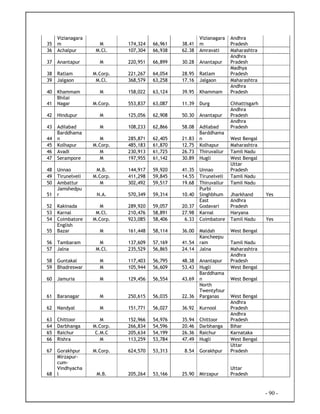
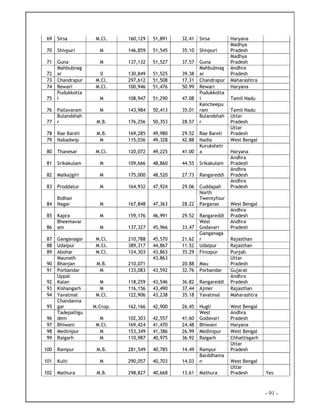
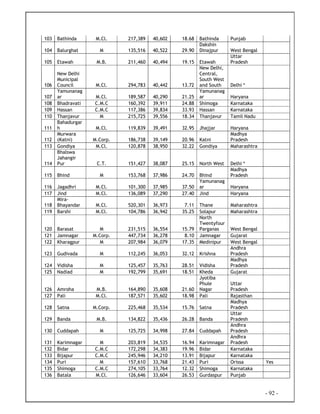
population, especially those living in slums. The slum population of 3.73 crores in
cities with population one lakh and above, is expected to reach 6.25 crores by
2007-081
, thus putting greater strain on the urban infrastructure which had serious
deficiencies already2
.
2. Despite the supposed proximity of the urban poor to urban health facilities their
access to them is severely restricted. This is on account of their being “crowded
out” because of the inadequacy of the urban public health delivery system.
Ineffective outreach and weak referral system also limits the access of urban poor
to health care services. The social exclusion and lack of information and assistance
at the secondary and tertiary hospitals makes them unfamiliar to the modern
environment of hospitals, thus restricting their access. The lack of economic
resources inhibits/ restricts their access to the available private facilities. Further,
the lack of standards and norms for the urban health delivery system when
contrasted with the rural network makes the urban poor more vulnerable and
worse off than his rural counterpart.
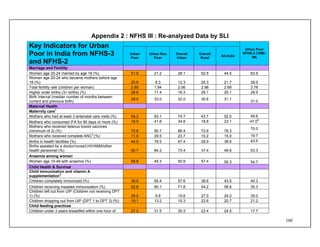
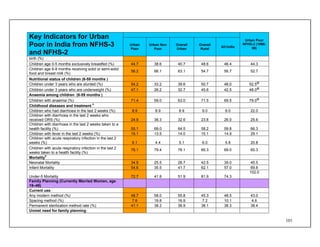
3. The urban poor suffer from poor health status, as per NFHS III data under 5
Mortality Rate (U5MR) among the urban poor at 72.7, is significantly higher than
the urban average of 51.9, More than 50% of urban poor children are underweight
and almost 60% of urban poor children miss total immunization before completing 1
year. Poor environmental condition in the slums along with high population density
makes them vulnerable to lung diseases like Asthma; Tuberculosis (TB) etc. Slums
also have a high-incidence of vector borne diseases (VBDs) and cases of malaria
among the urban poor are twice as many than other urbanites.
4. In order to effectively address the health concerns of the urban poor population,
the Ministry proposes to launch a National Urban Health Mission (NUHM). The
duration of the Mission would be the remaining period of 11th Five Year Plan (2008-
2012)
1 Projections for 2008 based on 7% annual growth rate for slum population
2 Planning Commission, Government of India ; Tenth Plan Document (2002-2007, Volume II) Para 6.1.71
- 4 -
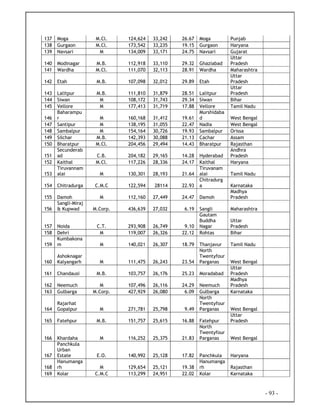
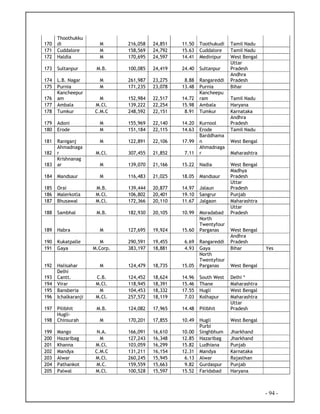
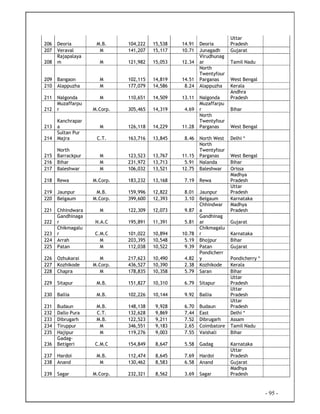
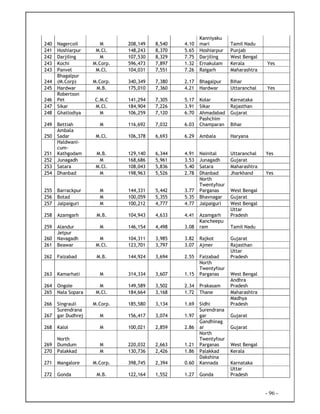
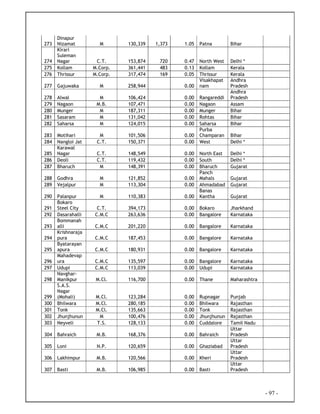
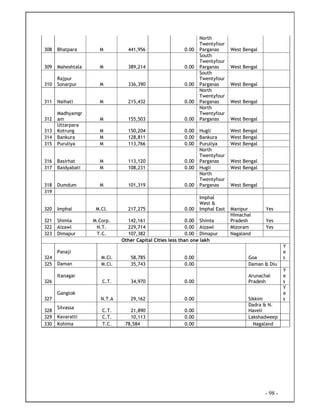
5. The NUHM would cover all Cities (430 in total) with population above 1 lakh and
state capitals during phase I. District Head Quarter towns with population less than
one lakh would be covered under Phase II of the Mission. The NUHM would have
high focus on
Urban Poor Population living in listed and unlisted slums
All other vulnerable population such as homeless, rag-pickers, street children,
rickshaw pullers, construction and brick and lime kiln workers, sex workers, any
other temporary migrants
6. Though the Mission would cover all the state capitals and cities with population one
lakh and above, priority would be accorded to the 100 cities listed in appendix 1 in
the first year for initiating the mission. All cities with population less than one lakh
are being covered under NRHM hence the strategies and norms of service delivery
as proposed under the NUHM may also be applied in cities with population less than
one lakh.
7. The National Urban Health Mission therefore aims to address the health concerns of
the urban poor through facilitating equitable access to available health facilities by
rationalizing and strengthening of the existing capacity of health delivery for
improving the health status of the urban poor. The existing gaps are planned to be
filled up through partnership with non government providers. This will be done in a
manner to ensure well identified facilities are set up for each segment of target
population which can be accessed as a matter of right.
8. Acknowledging the diversity of the available facilities in the cities, flexible city
specific models led by the urban local bodies would be needed. The NUHM will
leverage the institutional structures of NRHM for administration and
operationalisation of the Mission. It will also establish synergies with programmes
with similar objectives like JNNURM, SJSRY, ICDS to optimize the outcomes.
9. The National Urban Health Mission based on the key characteristics of the existing
urban health delivery system proposes a broad framework for strengthening the
extant primary public health systems, rationalizing the available manpower and
resources, filling the gaps in service delivery through private partnerships through a
regulatory framework and also through a communitised risk pooling / insurance
mechanism with IT enablement, capacity building of key stakeholders, and by
making special provision for inclusion of the most vulnerable amongst the poor. The
quality of the services provided will be constantly monitored for improvement
(IPHS/ Revised IPHS for Urban areas etc.)
- 5 -
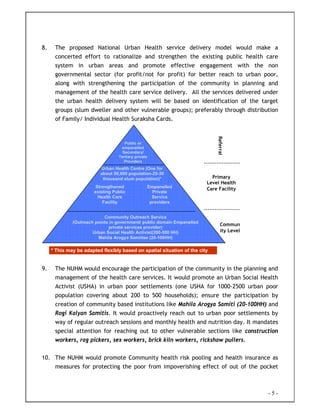
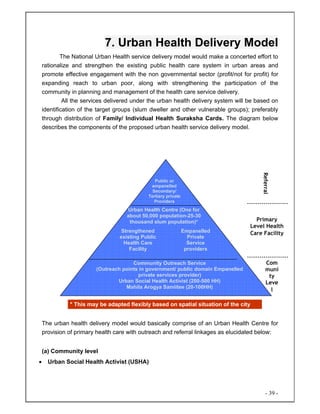
8. The proposed National Urban Health service delivery model would make a
concerted effort to rationalize and strengthen the existing public health care
system in urban areas and promote effective engagement with the non
governmental sector (for profit/not for profit) for better reach to urban poor,
along with strengthening the participation of the community in planning and
management of the health care service delivery. All the services delivered under
the urban health delivery system will be based on identification of the target
groups (slum dweller and other vulnerable groups); preferably through distribution
of Family/ Individual Health Suraksha Cards.
9. The NUHM would encourage the participation of the community in the planning and
management of the health care services. It would promote an Urban Social Health
Activist (USHA) in urban poor settlements (one USHA for 1000-2500 urban poor
population covering about 200 to 500 households); ensure the participation by
creation of community based institutions like Mahila Arogya Samiti (20-100HH) and
Rogi Kalyan Samitis. It would proactively reach out to urban poor settlements by
way of regular outreach sessions and monthly health and nutrition day. It mandates
special attention for reaching out to other vulnerable sections like construction
workers, rag pickers, sex workers, brick kiln workers, rickshaw pullers.
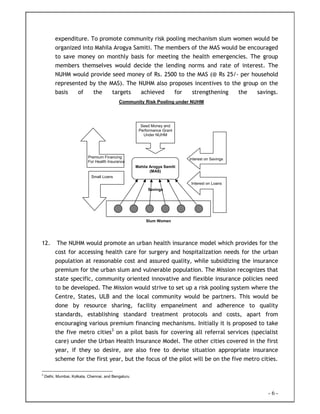
10. The NUHM would promote Community health risk pooling and health insurance as
measures for protecting the poor from impoverishing effect of out of the pocket
Public or
empanelled
Secondary/
Tertiary private
Providers
Urban Health Centre (One for
about 50,000 population-25-30
thousand slum population)*
Strengthened
existing Public
Health Care
Facility
Empanelled
Private
Service
providers
Community Outreach Service
(Outreach points in government/ public domain Empanelled
private services provider)
Urban Social Health Activist(200-500 HH)
Mahila Arogya Samiitee (20-100HH)
Referral
Primary
Level Health
Care Facility
Commun
ity Level
--------------------
--------------------
* This may be adapted flexibly based on spatial situation of the city
- 6 -
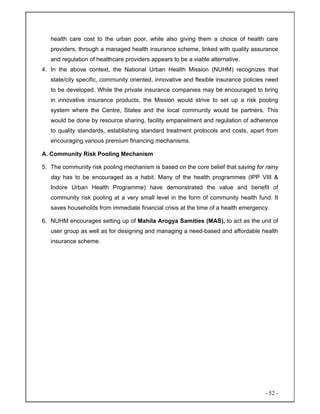
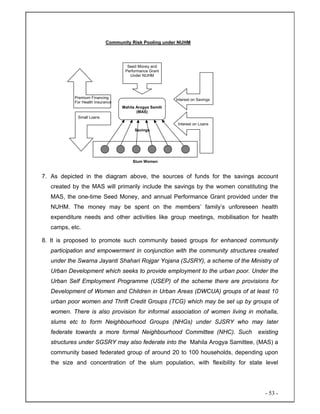
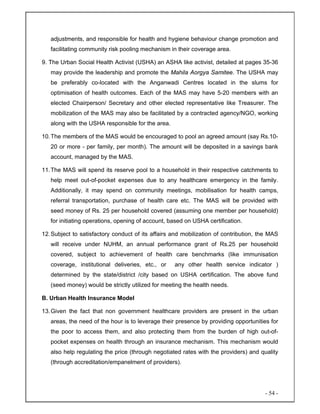
expenditure. To promote community risk pooling mechanism slum women would be
organized into Mahila Arogya Samiti. The members of the MAS would be encouraged
to save money on monthly basis for meeting the health emergencies. The group
members themselves would decide the lending norms and rate of interest. The
NUHM would provide seed money of Rs. 2500 to the MAS (@ Rs 25/- per household
represented by the MAS). The NUHM also proposes incentives to the group on the
basis of the targets achieved for strengthening the savings.
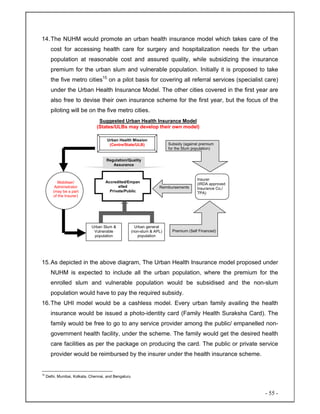
12. The NUHM would promote an urban health insurance model which provides for the
cost for accessing health care for surgery and hospitalization needs for the urban
population at reasonable cost and assured quality, while subsidizing the insurance
premium for the urban slum and vulnerable population. The Mission recognizes that
state specific, community oriented innovative and flexible insurance policies need
to be developed. The Mission would strive to set up a risk pooling system where the
Centre, States, ULB and the local community would be partners. This would be
done by resource sharing, facility empanelment and adherence to quality
standards, establishing standard treatment protocols and costs, apart from
encouraging various premium financing mechanisms. Initially it is proposed to take
the five metro cities3
on a pilot basis for covering all referral services (specialist
care) under the Urban Health Insurance Model. The other cities covered in the first
year, if they so desire, are also free to devise situation appropriate insurance
scheme for the first year, but the focus of the pilot will be on the five metro cities.
3
Delhi, Mumbai, Kolkata, Chennai, and Bengaluru
Community Risk Pooling under NUHM
Mahila Arogya Samiti
(MAS)
Savings
Interest on Loans
Interest on Savings
Small Loans
Premium Financing
For Health Insurance
Seed Money and
Performance Grant
Under NUHM
Slum Women
- 7 -
Urban Community Health Insurance Model
• Objective: To ensure access of identified families to quality medical care for
hospitalisation/surgery
• Beneficiaries
o Identified urban poor families, for a maximum of five members
o Smart Card/Individual or Family Health Suraksha Cards to be proof of eligibility
and to avoid duplication with similar schemes
• Implementing Agency: Preferably ULBs, possibly state for smaller cities
• Premium Financing
o Up to a maximum of Rs.600 per family as subsidy by the central govt.
o Additional cost, if any, may be contributed by state/ULB/beneficiary
• Benefits
o Coverage for hospitalisation/surgical procedures
o Coverage of surgical care on a day care basis
o Pre-existing conditions/diseases, including maternal and childhood conditions and
illness, to be covered, subject to minimal exclusion
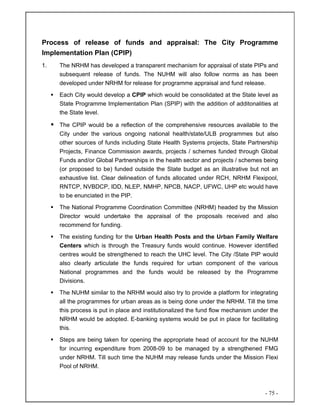
13. The National Urban Health Mission would leverage the institutional structures of
the NRHM at the National, State and District level for operationalisation of the
NUHM. However in order to provide dedicated focus to issues relating to Urban
Health the institutional mechanism under the NRHM at various levels would be
strengthened for NUHM implementation. In addition to the above, at the City level
Suggested Urban Health Insurance Model
(States/ULBs may develop their own model)
Urban Slum &
Vulnerable
population
Urban general
(non-slum & APL)
population
Accredited/Empan
elled
Private/Public
Insurer
(IRDA approved
Insurance Co./
TPA)
Reimbursements
Premium (Self Financed)
Subsidy (against premium
for the Slum population)
Urban Health Mission
(Centre/State/ULB)
Mobiliser/
Administrator
(may be a part
of the Insurer)
Regulation/Quality
Assurance
- 8 -
the States may preferably decide to constitute a separate City Urban Health
Missions/ City Urban Health Societies in view of the 74th
Constitutional
Amendment, or use the existing structure of the District Health Society / Mission
under NRHM with additional stakeholder members.
14. The National Urban Health Mission would promote the role of the urban local
bodies in the planning and management of the urban health programmes. The
NUHM would also incorporate and promote transparency and accountability by
incorporating elements like health service delivery charter, health service
guarantee, concurrent audit at the levels of funds release and utilization.
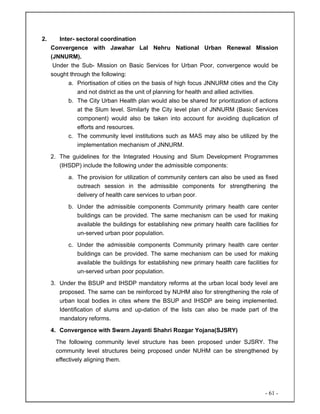
15. NUHM would aim to provide a system for convergence of all communicable and non
communicable disease programmes including HIV/AIDS through an integrated
planning at the City level. The objective would be to enhance the utilisation of the
system through the convergence mechanism, through provision of a common
platform and availability of all services at one point (UHC) and through mechanisms
of referrals. The existing IDSP structure would be leveraged for improved
surveillance.
16. The management, control and supervision systems however would vest within the
respective divisions but urban component /funds within the programmes would be
identified and all services will be sought to be converged /located at UHC level.
Appropriate convergences and mechanisms for co-locations and strengthening
would be sought with the existing systems of AYUSH at the time of
operationalisation.
17. The effective implementation of the above strategies would require skilled
manpower and technical support at all levels. Hence the National Urban Health
Mission would ensure additional managerial and financial resources at all level.
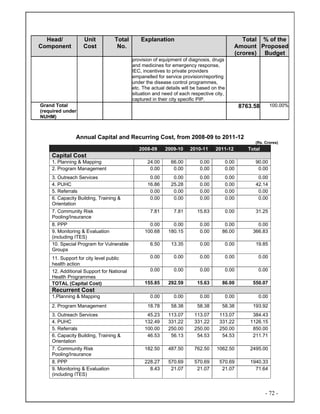
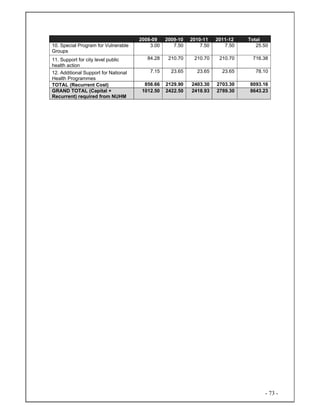
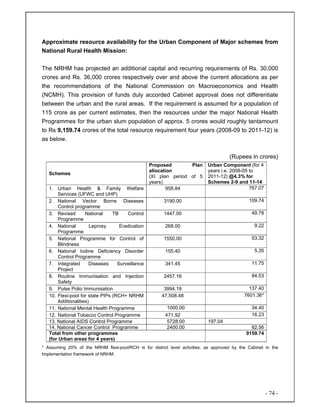
18. An estimated allocation of approximately Rs. 8600 crores from the Central
Government for a period of 4 years (2008-2012) to the NUHM at the central, state
and city level may be required to enable adequate focus on urban health. The
National Urban Health Mission would commence as a 100% centrally Sponsored
Scheme in the first year of its implementation during the XIth Plan period.
However, for the sustainability of the Mission from the second year onward a
sharing mechanism between the Central Government State/Urban local bodies is
being proposed.
- 9 -
1 Rationale for Urban Health Mission
1. As per Census 2001, 28.6 crores people live in urban areas. The urban population is
estimated to increase to 35.7crores in 2011 and to 43.2 crores in 20214
. Urban
growth has led to rapid increase in number of urban poor population, many of whom
live in slums and other squatter settllements. As per Census 2001, 4.26 crores
people lived in slums spread over 640 towns/ cities having population of fifty
thousand or above. In the cities with population one lakh and above (Appendix 1),
the 3.73 crores slum population is expected to reach 6.25 crores by 20085
, thus
putting greater strain on the urban infrastructure which is already overstretched6
.
2. Despite the supposed proximity of the urban poor to urban health facilities their
access to them is severely restricted. This is on account of their being “crowded out”
because of the inadequacy of the urban public health delivery system. Ineffective
outreach and weak referral system also limits the access of urban poor to health care
services. The social exclusion and lack of information and assistance at the
secondary and tertiary hospitals makes them unfamiliar to the modern environment
of hospitals, thus restricting their access. The lack of economic resources inhibits/
restricts their access to the available private facilities. Further, the lack of standards
and norms for the urban health delivery system, when contrasted with the rural
network, makes the urban poor more vulnerable and worse off than their rural
counterpart.
3. This situation is further worsened by the fact that a large number of urban poor are
living in slums that have an “illegal status”. The “illegal status” compromises the
entitlement of the slum dweller to basic services. Slum populations, obviously, ‘face
greater health hazards due to over crowding, poor sanitation, lack of access to safe
drinking water and environmental pollution7
.
4
Registrar General of India, 2006; Report of the Technical group on Population projections 2001-2026
5 Projected 2001 Slum population for 2008 based on 7% annual growth rate for slum population
6 Planning Commission, Government of India ; Tenth Plan Document (2002-2007, Volume II) Para 6.1.71
7 Planning Commission, Government of India ; Tenth Plan Document (2002-2007, Volume II) Para 6.1.71
- 10 -
4. The above situation is reflected in the poor health indicators. As per the re-analysis
of the NFHS III data, Under 5 Mortality Rate (U5MR) among the urban poor is at
72.7, significantly higher than the urban average of 51.9. About 47.1% of urban poor
children under-three years are underweight as compared to the urban average of
32.8% and 45% among rural population. Among the urban poor, 71.4% of the
children are anemic as against 62.9% in the case of urban average. Sixty percent of
the urban poor children miss complete immunization as compared to the urban
average of 42%. Only 18.5% of urban poor households have access to piped water
supply at home as compared to the urban average of 50%. Among the urban poor,
46.8% women have received no education as compared to 19.3% in urban average
statistics. Among the urban poor only 44 % of deliveries are institutional as
compared to the urban average of 67.5%.8
5. Despite availability of government and private hospitals the urban poor prefer home
deliveries. Expensive private healthcare facilities, perceived unfriendly treatment at
government hospitals, emotionally securer environment at home, and non-availability
of caretakers for other siblings in the event of hospitalization are some of the reasons
for this preference.
Poor environmental condition in the slums along with high population density makes
the urban poor vulnerable to lung diseases like Asthma; Tuberculosis (TB) etc.
Slums also have a high incidence of vector borne diseases (VBDs) and cases of
malaria among the urban poor are twice as in the case of other urbanites. Open
sewers, poorly built septic tanks, stagnant water both inside and outside the house
serve as ideal breeding ground for insects. As per the forecasting data in National
Commission on Macroeconomics and Health (NCMH) report, cases of coronary
heart disease in the urban areas will continue to rise and will be higher as compared
to rural areas, similarly the load of diabetes cases in India will rise from 2.6 crores in
2000 to 4.6 crores by 2015 particularly concentrated in urban areas.
6. Heterogeneity among slum dwellers caused by an influx of migrants from different
areas, varied cultures and backgrounds, existence of fewer extended family
8 Reanalyzed NFHS III data by Wealth Index
- 11 -
connections, engagement and preoccupation of more women in work leads to lesser
willingness and fewer occasions that can enable the slum community as a strong
collective unit.
7. The traditional temporary migration of pregnant women for delivery results in their
missing out on services at either of the residences. The mother and the infant do not
receive services in the village due to non-availability of previous record of services
received.
8. There are particular occupations such as rickshaw pullers, rag pickers, sex workers,
and other urban poor categories like beggars and destitutes, construction workers,
street children who are also a highly vulnerable group especially at greater risk to
RTI/STI and HIV/AIDs.
9. The National Urban Health Mission therefore seeks to address the health
concerns of the urban poor by facilitating equitable access to available health
facilities by rationalizing and strengthening of the existing capacity of health
delivery for improving the health status of the urban poor. The available gaps
are planned to be filled by partnership with non government providers. This
will be done in a manner so as to ensure well identified facilities are set up for
each segment of target population which can be accessed as a matter of right.
- 12 -
2 The Extant Urban Health Delivery
Mechanism
1. Central Assistance for primary health care
(i) The process of developing a health care delivery system in urban areas has not as
yet received the desired attention. The Tenth Plan Document observes that ‘unlike
the rural health services there have been no efforts to provide well-planned and
organized primary, secondary and tertiary care services in geographically
delineated urban areas. As a result, in many areas primary health facilities are not
available; some of the existing institutions are underutilized while there is over-
crowding in most of the secondary and tertiary centers’9
.
(ii) The Government of India in the First Five Year Plan established 126 urban clinics
of four types to strengthen the delivery of Family Welfare services in urban areas.
In 1976 these were reorganized into three types, by the Department with a staffing
pattern as indicated in the table below; At present there are 1083 centers
functioning in various states and UTs10
. An amount of Rs. 473.15 crores has been
proposed in the XIth Plan presently under consideration.
Table 1: Types of Urban Family Welfare Centers (UFWC)
Category Number Pop. Cov.(in
‘000)
UFWC Staffing Pattern
Type I 326 10-25 ANM (1) / FP Field Worker Male (1)
Type II 125 25-50
FP Ext. Edu./LHV (1) in addition to
the above
Type III 632 Above 50
MO – Preferable Female (1), ANM
and Store Keeper cum Clerk (1)
TOTAL 1083
Source: MOHFW, GOI: Annual Report on Special Schemes, 2000
(iii) On the recommendations of the Krishnan Committee, under the Revamping
scheme in 1983, the Government established four types of Health Posts (UHP) in
10 States and Union Territories with a precondition of locating them in slums or in
9
Planning Commission, Government of India ; Tenth Plan Document (2002-2007, Volume II)
10
MOHFW, GOI : Annual Report on Special Schemes, 1999-2000,
- 13 -
the vicinity of slums. The main functions of the urban health posts are to provide
outreach, primary health care, and family welfare and MCH services. The table
blow details the manpower along with the population coverage of health posts. At
present there are 871 health posts in various states and UTs11
, functioning not very
satisfactorily. An amount of Rs. 403.10 crores as been proposed in the XIth Plan
presently under consideration.
Table 2: Types of Urban Health Posts (UHP)
Category Number Population
covered
Staffing Pattern
Type A 65 Less than 5000 ANM (1)
Type B 76 5,000 – 10,000
ANM (1) , Multiple Worker – Male
(1)
Type C 165 10,000 – 20,000
ANM (2), Multiple Worker – Male
(2)
Type D
565 25,000 – 50,000
Lady MO (1), PHN (1), ANM (3-4)
Multiple Worker – Male (3-4),
Class-IV Women (1)
TOTAL 871
Source: MOHFW, GOI: Annual Report on Special Schemes, 2000
The Indian Institute of Population Studies (IIPS) undertook an evaluation of the functioning
of UHP and UFWCs and came out with following findings.
IIPS evaluation of the UFWC and UHP scheme: Key findings12
• In terms of functioning, 497 (30%) UHPs and UFWCs were ranked
good, 540(35%) were average and 492(32%) as below average or poor.
• Weak Referral Mechanism
• Provision of only RCH services
• Inadequate trained staff
• In 30% of the facilities the sanctioned post of Medical Officer is vacant/
others mostly relocated.
• Lack of equipments, medicines and other related supplies
• Unequal distribution of facilities among states e.g. in Bihar one centre
covers 1, 10,000 urban poor while in Rajasthan average population
coverage is 5535.
• Irregular and insufficient outreach activities by health workers
11 MOHFW, GOI Annual Report on Special Schemes 1999-2000
12 Indian Institute of Population Studies 2005; National Report on Evaluation of functioning of UHPs/UFWCs in India
- 14 -
(iv) Urban towns with population less than 100,000 are being taken up under the
National Rural Health Mission (NRHM). However, norms for the urban slums in
these townships have not been defined for support. The District/ Taluka Hospitals
which usually are in the urban areas are also being strengthened under NRHM. As
part of the urban component of RCH-II, there is provision for strengthening delivery
of RCH services in cities with population between 1-10 lakhs. The programme thus
provides for support to the urban poor but restricts it to reproductive and child
health services. However, the limited kitty of the flexible fund under this scheme
has relegated this component to the background of the scheme. Some of the
National Diseases Control programmes also have an urban component, though not
very well defined.
(v) The implementation mechanism of most of the programmes except for the UFWC
and UHP schemes of GoI is through the district institutional and planning
mechanism. Therefore resources get disaggregated in terms of districts and not
cities. Implementation in cities thus appears to be fragmented and patchy. As such
the absence of institutional/ planning mechanisms in cities therefore restricts
institutionalized access of the urban poor to the programmes.
2. The India Population Project (IPP) V and VIII
Due to rapid growth of urban population, efforts were made in the cities of Chennai,
Bengaluru, Kolkata, Hyderabad, Delhi and Mumbai for improving the health care
delivery in the urban areas through World Bank supported India Population Projects
(IPP). Thus in six cities 479 Urban Health Posts , 85 Maternity Homes and 244 Sub
Centers were created, in Mumbai & Chennai (as part of IPP V) and in Delhi,
Bengaluru, Hyderabad and Kolkata (as part of IPP VIII).
These, to a limited extent, resulted in enhanced service delivery and also better
capacity of urban local bodies to plan and manage the urban health programmes in
these cities. They are presently however, facing shortage of manpower and
resources. An examination of an extended IPP VIII project in Khamam town of
Andhra Pradesh has also identified management issues like lack of financial
- 15 -
flexibility/ long term financial sustainability, and lack of need based management
models as constraints which needs to be redressed in any urban health initiative13
.
3. State and Urban Local Body Initiatives
The State government and urban local bodies have also made efforts to improve
the service delivery in urban areas. However, these efforts have been proportional
to the fiscal and management capacity of the State Government and the urban
local bodies. In order to understand the existing urban health situation field visits by
the teams of Ministry were undertaken to twenty cities which provided very valuable
insights into the functioning of the urban health system in these cities.
Based on the visits, the urban health care delivery systems have been broadly
categorized as follows:
Group Cities Type of Health
care System of
the ULBs
Gaps and Constraints
A IPP CITIES
Mumbai,
Bengaluru,
Hyderabad
Delhi,
Kolkatta,
Chennai
Three tier
structure
comprising of
UHP/ UFWC and
Dispensary/
Maternity
Homes/ and
Tertiary / Super-
speciality
Hospitals.
Community
level volunteers.
Presence of vast
network of
private
providers /NGOs
and Charitable
trusts
Inequitable spatial distribution of
facilities with multiple service
providers
Unsuitable timings and distance
from urban poor areas,
Overload on tertiary institutions
and under utilized primary
institutions primarily due to weak
referral system.
Non integrated service delivery
with focus mostly on RCH
activities, very few lab facilities,
shortage of
medicines,drugs,equipment,
limited capacity of health care
professionals and demotivation,
Skewed priority to the tertiary
sector by the ULBs,
High turnover of medical
professionals, issues of career
progression, incentives and
salaries, disconnect between
doctors on deputation and
municipal doctors
13 ECTA Working Papers 2000/31 ; Urban Primary Health Systems : Management Issues, September 2000
- 16 -
Group Cities Type of Health
care System of
the ULBs
Gaps and Constraints
Limited community linkages and
outreach
Limited identification of the urban
poor for health
In many instances the first
interface is with non qualified
medical practitioners
B Surat,
Thane,
Ahemdabad
UHP/UFWCs,
Dispensary /
Maternity
Homes / Tertiary
Hospitals.
The Health care delivery
infrastructure is better planned and
managed due to personal initiative
of the ULBs. However the aforesaid
constraints remain.
C Agra
Indore
Patna
Chengelpet
Madhyamgram,
Bhuwaneshwar
Udaipur,
Jabalpur,
Cuttack
Guwahati
Raipur
UHP/UFWC / a
few Maternity
Homes
Presence of
private
providers
Few NGOs and
Charitable trusts
Dependent on State support for
health activities in the cities
Weak fiscal capacity of the ULBs to
plan for urban health.
Health low on priority of ULBs
except in Madhyamgram
Poor availability of doctors and
staff in facilities. Few found
relocated to secondary and tertiary
facilities. Poor state of
infrastructure in the facilities
D Ranchi, UFWC/ UHP
Large presence
of Charitable
and NGOs
Non existent urban local body
Limited State level initiatives
4. Key characteristics of the extant situation
1. The Diversity of the Urban Situation
The urban health situation in the cities is characterized by marked diversities in the
organization of health delivery system in terms of provisioning of health care services,
management, availability of private providers, finances etc. In cities like Mumbai, Kolkata,
Chennai, Bengaluru, Ahmedabad, etc, it is primarily the urban local bodies (ULBs) in line
with the mandate of the 74th
Amendment, which are responsible for the management of
the primary health care services. However in many other cities including the cities of Delhi,
along with the urban local body i.e. the Municipal Corporation of Delhi (MCD) , other
- 17 -
parastatal agencies like the New Delhi Municipal Corporation (NDMC), Delhi Cantonment
Board etc with the State Government jointly provide primary health care services. In city
like Ranchi however the urban local body is non existent and it is the State Department of
Health and Family Welfare which manages primary health care. In cities like Patna, Agra,
Indore, Guwahati despite the presence of ULBs, the provision of primary health services
still vests with the State Government through its district structures. Sanitation and
conservancy which are integral to public health, however, are in the domain of municipal
bodies in most cities.
STUDY IN CONTRAST : BRIHAN MUMBAI MUNICIPAL CORPORATION AND
MIRA BYANDAR MUNICIPAL CORPORATION IN MAHARASHTRA*
The Brihan Mumbai Municipal Corporation (BMC), with a population of 1.19 crores
(2001) and a slum population of about 60 lakhs, is the largest Municipal Corporation in
India, and a major provider of public health-care services at Mumbai. It has a network of
teaching hospitals, Municipal General Hospitals and Maternity Homes across Mumbai.
Apart from these there are Municipal Dispensaries and Health Posts to provide outpatient
care services and promote public health activities in the city. However Mira Byandar
Corporation at the outskirts of Mumbai city and growing at a decadal growth rate of 196%
from 1991-2001(from 1.75lakhs to 5.20 lakhs) with 40% slum population has only first tier
structures, namely 7 Urban Health Posts and 2 PHCs( to be shortly transferred from the
Zilla Parishad) , in the government system. However as informed there are approximately
1000 beds in the private sector in this city.
On the one hand there is a BMC with a 900 crore health budget (9% of total BMC
Budget of which 300 crores is on medical education), many times the health budget of a
some of the smaller states, and on the other, there is another Corporation still struggling
to emerge from the rural - urban continuum. While ADC heading the health division of BMC
is a very senior civil servant, the Chief Health Officer of Mira Byandar Corporation is a
recently regularized doctor with around three years experience in the Corporation.
For the ADC of BMC, major health areas requiring policy attention apart from
financial assistance from the Centre relate to guidelines for system improvement for
health delivery esp. vis a vis issues of Town Planning, land ownership, governance,
recruitment structures, reservation policies, migrants , instability of slums, high turnover of
workforce in Corporations which often come in the way of providing health care to the poor
along with the challenge of getting skilled human resources, which despite repeated
advertisements still remain vacant in BMC. There are 8-9% vacancy in the municipal cadres
of ANM.
The chief concern of the Mira Byandar Corporation on the other hand is to
construct a 200 bedded Hospital, as a Municipal Hospital offers high visibility and also
because the poor find it difficult to access the private facility due to high cost of services
and therefore are referred to Mumbai which is 40 kms away..
* Observations on field visit to cities in September 2007 for stakeholder consultation by officials of MoH&FW
- 18 -
2. Weak Capacity of Urban Local Bodies to manage primary health care
Two models of service delivery are seen to be prevalent in urban areas. In states like Uttar
Pradesh, Bihar and Madhya Pradesh health care programmes are being planned and
managed by the State government; the involvement of the urban local bodies is limited to
the provisioning of public health initiatives like sanitation, provision of potable water and
fogging for malaria. In other states like Karnataka, West Bengal, Tamil Nadu and Gujarat
the health care programmes are being primarily planned and managed by the urban local
bodies. In some of the bigger Municipal bodies like Ahmedabad, Chennai, Surat, Delhi
and Mumbai the Medical/Health officers are employed by the local body whereas in
smaller bodies, health officers are mostly on deputation from the State health department.
Though bigger corporations demonstrate improved capacity to manage their health
programmes, there is still a need to build their capacity. The IPP VIII Project Completion
Report (IPPCR) has also emphasized the capacity and commitment of political leadership
as one of the critical factors for the efficacy of the health system. In Kolkata, strong
political ownership by elected representatives has played a positive role in the smooth
implementation of the project and sustainability of the reforms introduced. On the other
hand, in Delhi, despite efforts by the project team, effective coordination between different
agencies and levels could not develop a common understanding on improving service
delivery and promoting initiatives crucial for sustainability. The experiences in Hyderabad
and Bengaluru were mixed, but mostly driven by a few committed individuals.
The situation in most cities also revealed that there was a lack of effective coordination
among the departments that lead to inadequate focus on critical aspects of public health
such as access to clean drinking water, environmental sanitation and nutrition.
3. Data inadequacy in Planning
Urban population, unlike the rural population, is highly heterogeneous. Most published
data does not capture the heterogeneity as it is often not disaggregated by the Standard
of Living Index. It therefore masks the health condition of the urban poor. The informal or
often illegal status of low income urban clusters results in public authorities not having any
mandate to collect data on urban poor population. This often reflects in health planning not
being based on community needs. It was seen that mental health which was an
observable problem of the urban slums was not reflecting in the city data profile. Most
cities visited were found lacking in city specific epidemiological data, inadequate
- 19 -
information on the urban poor and illegal clusters, inadequate information on existing
health facilities esp. in the private sector.
Data collection at the local /city level is therefore necessary to correctly comprehend the
status of urban health and to assess the urban community needs for health care services.
4. Multiplicity of service providers and dysfunctional referral systems
The multiplicity of service providers in the urban areas, with the ULBs and State
Governments jointly provisioning even primary health care, has led to a dysfunctional
referral system and a consequent overload on tertiary hospitals and underutilized primary
health facilities. Even in states where ULBs manage primary health care with secondary
and tertiary in the State domain, there are problems in referral management. Similar
observations have also been made in IPP VIII completion report which states that
multiplicity of agencies providing health services posed management and implementation
problems in all project cities: In Delhi, there were coordination problems for health service
among different agencies, such as Municipal Corporation of Delhi (MCD), New Delhi
Municipal Corporation (NDMC), Delhi Cantonment Board, Delhi Jal Board (DJB), Delhi
Government, and Employees State Insurance (ESI) Corporation. Similarly, in Hyderabad,
coordination of the project with secondary and tertiary facilities under different
managements constrained effective referral linkages. Bengaluru and Kolkata had fully
dedicated maternity homes in adequate numbers that facilitated better follow-up care.
However, even in these two places, linkages with district and tertiary hospitals, not under
the control of the municipalities, remained weak.
5. Weak community capacity to demand and access health care:
Heterogeneity among slum dwellers due to in-migration from different areas, instability of
slums, varied cultures, fewer extended family connections, and more women engaged in
work, has lead to lesser willingness and fewer occasions to build urban slum community
as a strong collective unit, which is seen a as one of the major public health challenge in
improving the access . Even the migratory nature of the population poses a problem in
delivery of services. Similar concerns have also been raised in the IPP VIII completion
report which states lack of homogeneity among slum residents, coming from neighboring
states/countries to the large metropolitan cities, made planning and implementation of
social mobilization activities very challenging.
- 20 -
6. Strengthening community capacity increases utilization of services
The Urban Health programmes in Indore and Agra have demonstrated that the process of
strengthening community capacity either through Link worker or a Community Based
Organization (CBO) helps in improving the utilization of services. The IPP VIII project has
also demonstrated that the use of female voluntary health workers viz. Link workers, Basti
Sewikas etc. selected from the local community played an important role in extending
outreach services to the door steps of the slums which helps in creating a demand base
and ensuring people’s satisfaction. It was also observed that the collective community
efforts played an important role in improving access to drinking water sanitation nutrition
services and livelihood.
During the field visits there was consensus during all discussions that some form of
community linkage mechanism and collective community effort was an important strategy
for improving health of the urban poor. However, this strategy also had to be area specific
as it would succeed in stable slums and not where slums were temporary structures under
constant threat of demolition.
7. Large presence of for profit/not for profit private providers.
The urban areas are characterized by presence of large number of for profit/not for profit
private providers. These providers are frequently visited by the urban poor for meeting
their health needs. The first interface for OPD services for the urban poor in many cities
visited was the private sector, chiefly due to inadequacy of infrastructure of the public
system and non responsive working hours of the facilities. Partnership with
private/charitable/NGOs can help in expanding services as was evident in Agra where
NGO managed health care facilities were reaching out to large un-served areas. Even in
Bengaluru, the management of health facilities had been handed over to NGOs. In several
IPP VIII cities partnerships with profit/not for profit providers has helped in expanding the
services. Kolkata had the distinction of implementing the programme through
establishment of an effective partnership with private medical officer and specialists on a
part time basis, fees sharing basis in different health facilities resulting in ensuring
community participation and enhancing the scope of fund generation. Andhra Pradesh has
completely outsourced service delivery in the newly created 191 Urban Health Posts in 73
- 21 -
towns to NGOs. The experimentation it appears has been quite satisfactory with reduced
cost.
8. Focus on RCH services and inadequate attention to public health
The existing health care service delivery mechanism is mostly focused on reproductive
and child health services, conservancy, provision of potable water and fogging for malaria.
The recent outbreaks of Dengue and Chikungunya in urban areas and the poor health
status of urban poor clearly articulate the need for a broad based public health programme
focused on the urban poor. It stresses upon the need to effectively infuse public health
focus along with curative functions. The urban health programmes in Surat and
Ahmedabad have been able to effectively integrate the two aspects. There is also need to
integrate the implementation of the National programmes like National Vector Borne
Disease Control Programme (NVBDCP), Revised National Tuberculosis Control
Programme(RNTCP), Integrated Disease Control Project ( IDSP), National Leprosy
Elimination Programme (NLEP) , National Mental Health Programme (NMHP), National
Deafness Control Programme (NDCP) , National Tobacco Control Programme (NTCP)and
other Communicable and Non communicable diseases for providing an effective urban
health platform for the urban poor. The urban poor suffers an equally high burden of ‘life
style” associated disease burden due to high intake of tobacco (both smoking and
chewing), alcohol. The limited income coupled with very high out-of-pocket expenditure on
substance abuse creates a vicious cycle of poverty and disease. There is also the added
burden of domestic violence and stress. Studies also indicate the need for early detection
of hypertension in the urban poor, as it is a common cause of stroke and other cardio-
neurological disorders.
The high incidence of communicable diseases emphasizes the need for strengthening the
preventive and promotive aspects for improved health of urban poor. It also becomes
critical that the outreach of services which have an important bearing on health like safe
drinking water, environmental sanitation, protection from pollutants and nutrition services
is improved.
9. Lack of comprehensive strategy to ensure equitable access to the most
vulnerable sections
Though the urban health programmes have a mandate to provide outreach services as
envisaged by the Krishnan Committee, at present very limited outreach activities were
- 22 -
being undertaken by the ULBs. It is only the IPP cities which were conducting some
outreach activities as community Link workers were employed to strengthen demand and
access. Limited outreach activities through provision of link volunteers under RCH were
visible in Indore, Agra and Ahmedabad and Surat.
Another challenge facing the urban health programmes is inadequate methodology for
identification of the most marginalized poor. None of the cities, except Thane which had a
scheme for ragpickers, had any operational strategy for the highly vulnerable section.
10. The National Urban Health Mission based on the key characteristics of the
existing urban health delivery system ,therefore proposes a broad framework for
strengthening the extant primary public health systems, rationalizing the available
manpower and resources, filling the gaps in service delivery through private
partnerships through a regulatory framework and also through a communitised risk
pooling / insurance mechanism with IT enablement, capacity building of key
stakeholders, and by making special provision for inclusion of the most vulnerable
amongst the poor. The quality of the services provided will be constantly monitored
for improvement (IPHS/ Revised IPHS for Urban areas etc.)
11. Acknowledging the diversity of the available facilities in the cities, flexible
city specific models led by the urban local bodies would be needed. The NUHM will
leverage the institutional structures of NRHM for administration and
operationalisation of the Mission. It will also establish synergies with programmes
with similar objectives like JNNURM, SJSRY, ICDS etc to optimize the outcomes.
Based on the above situational analysis, the goal, strategies and the outcomes
which emerge are elucidated in the next section.
- 23 -
3 Goal, Strategies and Outcomes
III (a) Goal
The National Urban Health Mission would aim to improve the health status of the
urban poor particularly the slum dwellers and other disadvantaged sections, by facilitating
equitable access to quality health care through a revamped public health system,
partnerships, community based risk pooling and insurance mechanism with the active
involvement of the urban local bodies.
III (b) Core Strategies
The exigencies of the situation as detailed in the aforesaid chapters merit the
consideration of the following strategies:
(i) Improving the efficiency of public health system in the cities by strengthening,
revamping and rationalizing urban primary health structure
The situational analysis has clearly revealed that most of the existing primary health
facilities, namely, the Urban Health Centres (UHCs) /Urban Family Welfare Centres
(UFWC)/ Dispensaries are functioning sub- optimally due to problems of infrastructure,
human resources, referrals, diagnostics, case load, spatial distribution, and
inconvenient working hours. The NUHM therefore proposes to strengthen and revamp
the existing facilities into a “Primary Urban Health Centre” with outreach and
referral facilities, to be functional for every 50,000 population on an average.
However, depending on the spatial distribution of the slum population, the population
covered by an PUHC may very from 5000 for cities with sparse slum population to
75,000 for highly concentrated slums. The PUHC may cater to a slum population
between 20000-30000, with provision for evening OPD, providing preventive,
promotive and non-domiciliary curative care (including consultation, basic lab diagnosis
and dispensing). The NUHM would improve the efficiency of the existing system by
making provision for a need based contractual human resource, equipments and
drugs. Provision of Rogi Kalyan Samiti is also being made for promoting local action.
The provision of health care delivery with the help of outreach sessions in the slums
would also strengthen the delivery of health care services. On the basis of the GIS
map the referrals would also be clearly defined and communicated to the community
thus facilitating their easy access.
- 24 -
The eligibility criterion for resource support under the Mission however would be
rationalization of the existing public health care facilities and human resources in
addition to mapping of unlisted slums and clusters.
(ii) Partnership with non government providers for filling up of the health
delivery gaps:
Analysis has also revealed that a large number of urban slum clusters do not have
physical access to public health facilities whereas there are non government providers
being accessed by the urban poor. It has also been observed that specialized care,
diagnostics and referral transport is prominently available in the non government sector. It
is therefore proposed to leverage the existing non government providers to improve
access to curative care.
It was also observed that urban population living in slums lack health awareness
and organizational capacity which the existing public health system is not able to deal
with. However it was seen that in many cities non government agencies/ civil society
groups are playing a significant role in community mobilization. It is thus proposed to forge
partnership with this sector to promote active community participation and ownership.
(iii) Promotion of access to improved health care at household level through
community based groups : Mahila Arogya Samittees
The ‘Mahila Bachat Gat’ scheme in Maharashtra and urban health initiatives in
Indore and Agra have demonstrated the efficacy of women led thrift/self help groups in
meeting urgent cash needs in times of health emergency and also empowering them to
demand improved health services.
In view of the visible usefulness of such women led community/ self help groups; it is
proposed to promote such community based groups for enhanced community participation
and empowerment in conjunction with the community structures created under the Swarna
Jayanti Shahari Rojgar Yojana (SJSRY), a scheme of the Ministry of Urban Development
which seeks to provide employment to the urban poor. Under the Urban Self Employment
Programme (USEP) of the scheme there are provisions for Development of Women and
Children in Urban Areas (DWCUA) groups of at least 10 urban poor women and Thrift
Credit Groups (TCG) which may be set up by groups of women. There is also provision for
informal association of women living in mohalla, slums etc to form Neighbourhood Groups
(NHGs) under SJSRY who may later federate towards a more formal Neighbourhood
Committee (NHC). Such existing structures under SJSRY may also federate into Mahila
- 25 -
Arogya Samittee, (MAS) a community based federated group of around 20 to 100
households, depending upon the size and concentration of the slum population, with
flexibility for state level adjustments, and be responsible for health and hygiene behaviour
change promotion and facilitating community risk pooling mechanism in their coverage
area. The Urban Social Health Activist (USHA) an ASHA like activist, detailed in the
following pages, may provide the leadership and promote the Mahila Aorgya Samitee. The
USHA may be preferably co-located with the Anganwadi Centres located in the slums for
optimisation of health outcomes. Each of the MAS may have 5-20 members with an
elected Chairperson/ Secretary and other elected representative like Treasurer. The
mobilization of the MAS may also be facilitated by a contracted agency/NGO, working
along with the USHA responsible for the area.
(iv) Strengthening public health through preventive and promotive action
Urban Poor face greater environmental health risks due to poor sanitation, lack of
safe drinking water, poor drainage, high density of population etc. There is a significant
correlation between morbidity due to diarrhea, acute respiratory infections and household
hygiene behavior, environmental sanitation, and safe water availability. Thus
strengthening promotive action for improved health and nutrition and prevention of
diseases will be a major focus of the Mission. The Mission would also provide a
framework for pro active partnership with NGOs/civil society groups for strengthening the
preventive and promotive actions at the community level. The USHA, in coordination with
the members of the MAS would promote proactive community action in partnership with
the urban local bodies for improved water and environmental sanitation, nutrition and
other aspects having a bearing on health. Resources for public health action would be
provided as per city specific need.
(v) Increased access to health care through risk pooling and community health
insurance models
As substantiated by various studies (" Morbidity and Treatment of Ailments" NSS
Report Number- 441(52/25.0/1) based on 52nd
round) the urban poor incur high out-of-
pocket expenditure often leading to indebtedness and impoverishment. To mitigate this
risk, it is proposed to encourage Mahila Arogya Samitis to “save for a rainy day” for
meeting urgent health needs. NUHM also proposes to promote Community based Health
Insurance models to meet costs arising out of hospitalization and critical illnesses.
- 26 -
(vi) IT enabled services (ITES) and e- governance for improving access improved
surveillance and monitoring
Various studies (Conditions of Urban Slums, 2002, NSSO Report Number
486(58/0.21/1) based on 58th
round) have shown that the informal status and migratory
nature of majority of the urban poor, compromises their entitlement and access to health
services. It also poses a challenge in tracking and provisioning for their health care.
Studies have also highlighted that the private providers, which the majority of the
urban poor access for OPD services, remain outside the public disease surveillance
network. This leads to compromised reporting of diseases and outbreaks in urban slums
thereby adversely affecting timely intervention by the public authorities.
The availability of ITES in the urban areas makes it a useful tool for effective
tracking, monitoring and timely intervention for the urban poor. The NUHM would provide
software and hardware support for developing web based HMIS for quick transfer of data
and required action.
The States would also be encouraged to develop strategies for effecting an urban
disease surveillance system and a plan for rapid response in times of disasters and
outbreaks. It is envisioned that the GIS system envisioned would be integrated into a
system of reporting alerts and incidence of diseases on a regular basis. This system would
also be synchronized with the IDSP surveillance system.
As per the current status, the IDSP is already at an advanced stage of
implementing urban surveillance in 4 mega cities of the country by combining the existing
Urban Health Posts with newly established epidemiology analysis units at intermediate
and apex levels in these cities. There is a plan to upscale this model to include 23 more,
million- plus cities, by the middle of calendar year 2008. Also a surveillance reporting
network of 8 major infectious diseases hospitals located across the length and breadth of
the country is being established that would act as state of the art surveillance centers for
epidemics.
It is envisioned that as the NUHM becomes operational there would natural
synergies with the IDSP urban surveillance set up.
(vii) Capacity building of stakeholders
It was observed that except for a few, provisioning of primary health care was low
on priority for most of the urban local bodies with many Counsellors showing a clear
proclivity for development of tertiary facilities. This skewed prioritization appears to have
clearly affected the primary health delivery system in the urban local bodies, also
- 27 -
adversely affecting skill sets of the workforce and limiting technical and managerial
capacities to manage health. NUHM thus proposes to build managerial, technical and
public health competencies among the health care providers and the ULBs through
capacity building, monetary and non monetary incentives, and managerial support.
(viii) Prioritizing the most vulnerable amongst the poor
It is seen that a fraction of the urban poor who normally do not reside in slum, but in
temporary settlement or are homeless, comprise the most disadvantaged section. Under
the NUHM special emphasis would be on improving the reach of health care services to
these vulnerable among the urban poor, falling in the category of destitute, beggars, street
children, construction workers, coolies, rickshaw pullers, sex workers, street vendors and
other such migrant workers. Support would be through city specific strategy with a cap of
10% of the city budget.
(ix) Ensuring quality health care services
NUHM would aim to ensure quality health services by a) defining Indian Public
Health Standards suitably modified for urban areas wherever required b) defining
parameters for empanelment/regulation/accreditation of non-government providers, c)
developing capacity of public and private providers for providing quality health care, d)
encouraging the acceptance and enforcement of local public health acts d) ensuring
citizen charters in facilities e) encouraging development of standard treatment protocols.
III (c) Outcomes
The NUHM would strive to put in place a sustainable urban health delivery system
for addressing the health concerns of the urban poor. Since NUHM would complement
the efforts of NRHM, the expected health outcomes of the NRHM would also be
applicable for NUHM. The NUHM would therefore be expected to achieve the following
targets in urban areas:
• IMR reduced to 30/1000 live births by 2012.
• Maternal Mortality reduced to 100/100,000 live births by 2012.
• TFR reduced to 2.1 by 2012.
• Reduction in Malaria Mortality by 50% by 2015
• 25 % reduction in malaria morbidity and mortality up to 2010, additional 20% by
2012.
- 28 -
• Kala Azar Mortality Reduction Rate - 100% by 2010 and sustaining elimination until
2012.
• Filaria/Microfilaria Reduction Rate - 70% by 2010, 80% by 2012 and elimination by
2015.
• Filariasis: Coverage of more than 80% under MDA
• Reduction in case fatality rate and reduction in number of outbreaks of dengue
• Dengue Mortality Reduction Rate - 50% by 2010 and sustaining at that level.
• Chikungunya: Reduction in number of outbreaks and morbidity due to Chikungunya
by prevention and control strategy
• Leprosy Prevalence Rate –reduced from 1.8 per 10,000 in 2005 to less than 1 per
10,000 thereafter.
• Tuberculosis DOTS series - maintain 85% cure rate through the entire Mission
Period and also sustain planned case detection rate.
• Reduce the prevalence of deafness by 25% (from existing levels) by 2012
(d) Measurable Indicators of improved health of the urban poor at the City Level is also
proposed to be assessed annually through e- enabled HMIS and surveys. Convergence
would also be sought with the NRHM HMIS.
A few of the measurable outputs are indicated in the table below to be assessed by
each city from the current status:
Cities/population with all slums and facilities mapped
Number cities/population where Mission has been initiated
Increase in OPD attendance
Increase in BPL referrals from UHCs
Increase in BPL referrals availed at referral units
Number of Slum/ Cluster level Health and Sanitation Day
Number of USHA receiving full honorarium
Number of MAS formed
Number of UHCs with Programme Manager
Increase in ANC check-up of pregnant women
Increased Tetanus toxoid (2nd dose) coverage among pregnant women
Increase in institutional deliveries as percentage of total deliveries
Increase in complete immunization among children < 12mnths
- 29 -
Increase in case detection for malaria through blood examination
Increase in case detection of TB through identification of chest symptomatic
increase in referral for sputum microscopy examination for TB
Increase in number of cases screened and treated for dental ailments
Increase inn number of cases screened for diabetes at UHCs
Increase in number of cases referred and operated for heart related ailments
Increase in first aid and referral of burns and injury cases
Increase in number of mental health services at primary health care level in urban
health settings.
Increase in the awareness of community about tobacco products/alcohol and
substance abuse.
Projected Timelines
(2008-09 to 2011-12)
COMPONENTS 2008-09 2009-10 2010-11 2011-2012
1. Planning &
Mapping
• Urban Health
Planning in 100
cities initiated
(including GIS
mapping)
• City level urban
health plan for 330
cities available
• City level Urban
Health Plans for
430 cities available
2. Program
Management
• MOU with all the
states signed
• MOU with 35 cites
signed (million plus
cities)
• City Level Urban
Health Mission
formed in 35 cities
• Urban Health
Division in the
Ministry
strengthened
• State level Urban
Health Programme
Management Unit
established in
states
• Notification for
establishing City
level Urban Health
Programme
Management unit in
35 cities issued.
• 2 National level
workshops held
• 4 regional
workshops held
• MOU with 69 cites
signed (all cities
with 5 lakh
population).
• City Level Urban
Health Mission
formed in 69 cities
• State level Urban
Health Programme
Management Unit
strengthened by
placement of
Consultants
• City level Urban
Health Programme
Management unit
strengthened by
placement of
Consultants in 35
cities
• 10 State level
workshops
organized
• 15 orientation
workshops for ULBs
(one per two million
plus city)
• MOU with 114 cities
signed (all cities
with more than 3
lakh population)
• City Level Urban
Health Mission
formed in 114 cities
(all cities with 3 lakh
population)
• State level Urban
Health Programme
Management Unit
strengthened by
placement of
Consultants
• City level Urban
Health Programme
Management unit
strengthened by
placement of
Consultants in 64
cities
• 1 National level
review workshop
held
• 4 regional level
review workshops
held
35 State level
review
workshops
held.
- 30 -
3. Strengthening
of existing
government
Health facilities
• Assessment of
existing health
facilities and plan
for their
strengthening
developed (35
cities).
• Process of
rationalization of
manpower and
existing health care
facilities initiated
• 800 PUHC
strengthened ( all
million plus cities )
• 660 PUHC
strengthened (all
cities with more
than 5 lakh)
2107 PUHC
strengthened
4. Referrals • • 80 referral units
established ( all
million plus cities )
• 250 referral units
established (all
cities with more
than 5 lakh)
800 referral
unit
established
5. Community
Risk
Pooling/Insurance
• • 15000 MAS formed
(for urban poor
population in Million
Plus cities)
• Process for
covering 13 lakh
families under
Urban Health
Insurance scheme
initiated (50% of
families in 5 Mega
cities and
Hyderabad and
Ahemdabad)
• 25000 MAS formed
• 26 lakh families
covered with Urban
Health Insurance
scheme.
• 50000 MAS
formed
• 50 lakh
families
covered
with Urban
Health
Insurance
scheme
(50% of
total
projected).
6. PPP • • Process for
establishing 400
UHC under PPP
initiated
• 500 PPP based
PUHC established
• 800
PPP based
PUHC
established
7. Monitoring &
Evaluation
(including ITES)
• • Software for
Integrated HMIS
developed for
tracking healthcare
received by Urban
slum population
• 36 Computerised
HMIS data centres
at National and
State level
established
• Process initiated for
issuing Family
Health Card (Smart
Card) to 13 lakh
urban poor
identified families
• 100 Baseline
surveys (city
specific) initiated
• 100 Computerized
HMIS data centres
established (100 at
city level)
• 25 lakhs families
covered by Family
Health Card (Smart
Card)
• 100 Baseline
surveys (city
specific) conducted
• 50
lakhs
families
covered by
Family
Health
Card
(Smart
Card)
• 225
Baseline
surveys
(city
specific)
conducted
• 100 End
line
surveys
initiated
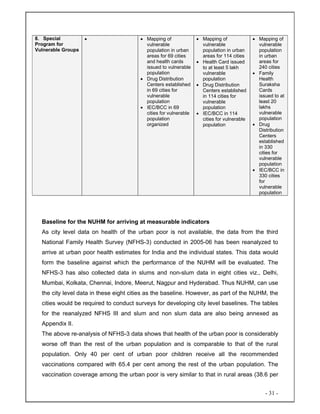
- 31 -
8. Special
Program for
Vulnerable Groups
• • Mapping of
vulnerable
population in urban
areas for 69 cities
and health cards
issued to vulnerable
population
• Drug Distribution
Centers established
in 69 cities for
vulnerable
population
• IEC/BCC in 69
cities for vulnerable
population
organized
• Mapping of
vulnerable
population in urban
areas for 114 cities
• Health Card issued
to at least 5 lakh
vulnerable
population
• Drug Distribution
Centers established
in 114 cities for
vulnerable
population
• IEC/BCC in 114
cities for vulnerable
population
• Mapping of
vulnerable
population
in urban
areas for
240 cities
• Family
Health
Suraksha
Cards
issued to at
least 20
lakhs
vulnerable
population
• Drug
Distribution
Centers
established
in 330
cities for
vulnerable
population
• IEC/BCC in
330 cities
for
vulnerable
population
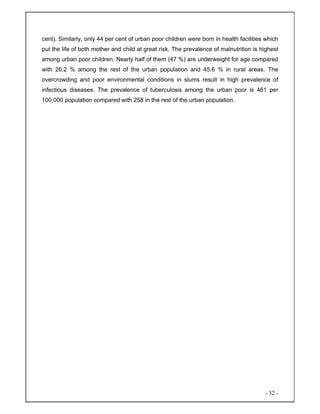
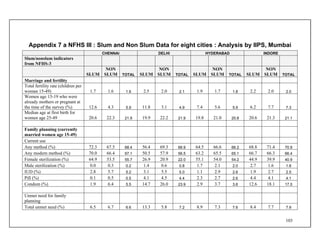
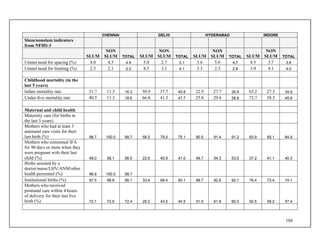
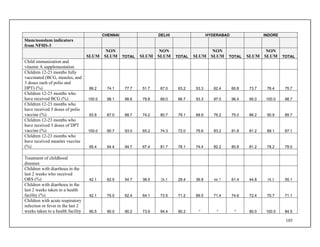
Baseline for the NUHM for arriving at measurable indicators
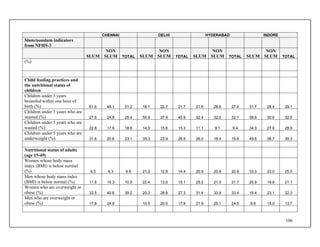
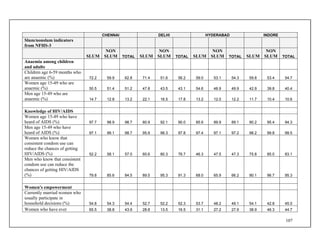
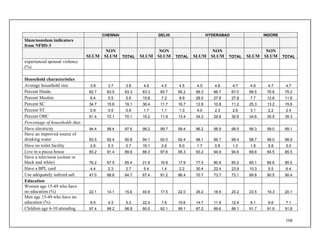
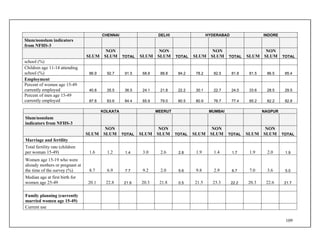
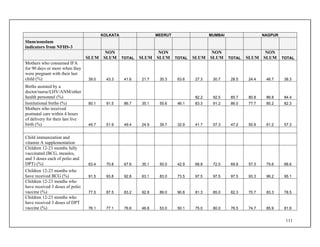
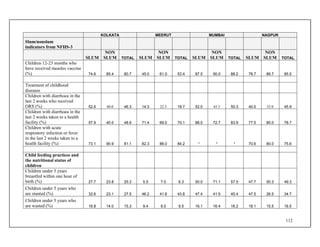
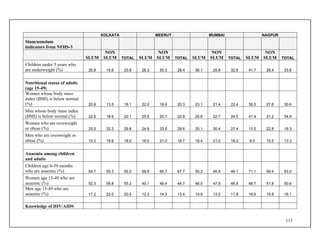
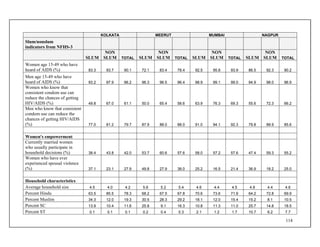
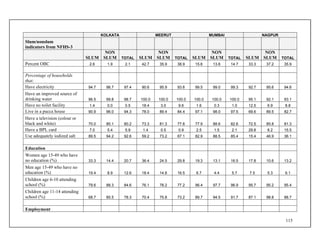
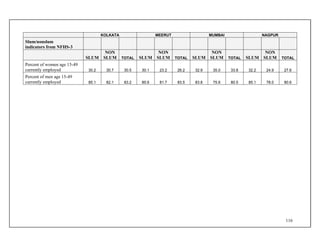
As city level data on health of the urban poor is not available, the data from the third
National Family Health Survey (NFHS-3) conducted in 2005-06 has been reanalyzed to
arrive at urban poor health estimates for India and the individual states. This data would
form the baseline against which the performance of the NUHM will be evaluated. The
NFHS-3 has also collected data in slums and non-slum data in eight cities viz., Delhi,
Mumbai, Kolkata, Chennai, Indore, Meerut, Nagpur and Hyderabad. Thus NUHM, can use
the city level data in these eight cities as the baseline. However, as part of the NUHM, the
cities would be required to conduct surveys for developing city level baselines. The tables
for the reanalyzed NFHS III and slum and non slum data are also being annexed as
Appendix II.
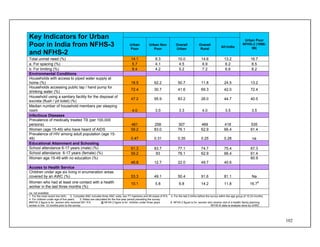
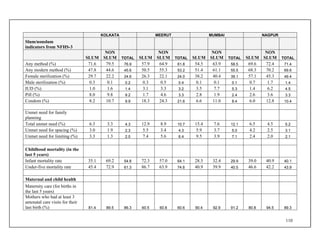
The above re-analysis of NFHS-3 data shows that health of the urban poor is considerably
worse off than the rest of the urban population and is comparable to that of the rural
population. Only 40 per cent of urban poor children receive all the recommended
vaccinations compared with 65.4 per cent among the rest of the urban population. The
vaccination coverage among the urban poor is very similar to that in rural areas (38.6 per
- 32 -
cent). Similarly, only 44 per cent of urban poor children were born in health facilities which
put the life of both mother and child at great risk. The prevalence of malnutrition is highest
among urban poor children. Nearly half of them (47 %) are underweight for age compared
with 26.2 % among the rest of the urban population and 45.6 % in rural areas. The
overcrowding and poor environmental conditions in slums result in high prevalence of
infectious diseases. The prevalence of tuberculosis among the urban poor is 461 per
100,000 population compared with 258 in the rest of the urban population.
- 33 -
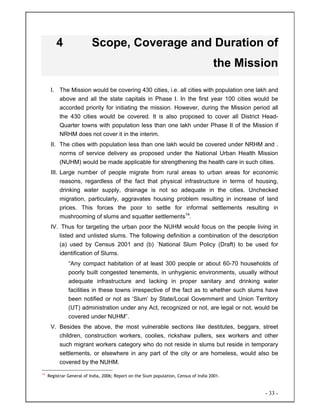
4 Scope, Coverage and Duration of
the Mission
I. The Mission would be covering 430 cities, i.e. all cities with population one lakh and
above and all the state capitals in Phase I. In the first year 100 cities would be
accorded priority for initiating the mission. However, during the Mission period all
the 430 cities would be covered. It is also proposed to cover all District Head-
Quarter towns with population less than one lakh under Phase II of the Mission if
NRHM does not cover it in the interim.
II. The cities with population less than one lakh would be covered under NRHM and .
norms of service delivery as proposed under the National Urban Health Mission
(NUHM) would be made applicable for strengthening the health care in such cities.
III. Large number of people migrate from rural areas to urban areas for economic
reasons, regardless of the fact that physical infrastructure in terms of housing,
drinking water supply, drainage is not so adequate in the cities. Unchecked
migration, particularly, aggravates housing problem resulting in increase of land
prices. This forces the poor to settle for informal settlements resulting in
mushrooming of slums and squatter settlements14
.
IV. Thus for targeting the urban poor the NUHM would focus on the people living in
listed and unlisted slums. The following definition a combination of the description
(a) used by Census 2001 and (b) `National Slum Policy (Draft) to be used for
identification of Slums.
“Any compact habitation of at least 300 people or about 60-70 households of
poorly built congested tenements, in unhygienic environments, usually without
adequate infrastructure and lacking in proper sanitary and drinking water
facilities in these towns irrespective of the fact as to whether such slums have
been notified or not as ‘Slum’ by State/Local Government and Union Territory
(UT) administration under any Act, recognized or not, are legal or not, would be
covered under NUHM”.
V. Besides the above, the most vulnerable sections like destitutes, beggars, street
children, construction workers, coolies, rickshaw pullers, sex workers and other
such migrant workers category who do not reside in slums but reside in temporary
settlements, or elsewhere in any part of the city or are homeless, would also be
covered by the NUHM.
14
Registrar General of India, 2006; Report on the Slum population, Census of India 2001.
- 34 -
VI. The duration of the Mission would be for the remaining period of the 11th
Plan
(2008-2012). While the initial focus would be on the urban slums it is envisioned
that as the capacity at city level grows the scope may be broadened based on Mid-
Term Appraisal to cover the entire urban poor population.
- 35 -
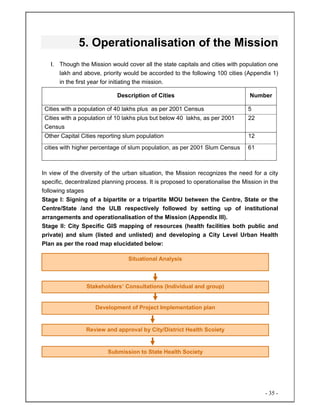
5. Operationalisation of the Mission
I. Though the Mission would cover all the state capitals and cities with population one
lakh and above, priority would be accorded to the following 100 cities (Appendix 1)
in the first year for initiating the mission.
Description of Cities Number
Cities with a population of 40 lakhs plus as per 2001 Census 5
Cities with a population of 10 lakhs plus but below 40 lakhs, as per 2001
Census
22
Other Capital Cities reporting slum population 12
cities with higher percentage of slum population, as per 2001 Slum Census 61
In view of the diversity of the urban situation, the Mission recognizes the need for a city
specific, decentralized planning process. It is proposed to operationalise the Mission in the
following stages
Stage I: Signing of a bipartite or a tripartite MOU between the Centre, State or the
Centre/State /and the ULB respectively followed by setting up of institutional
arrangements and operationalisation of the Mission (Appendix III).
Stage II: City Specific GIS mapping of resources (health facilities both public and
private) and slum (listed and unlisted) and developing a City Level Urban Health
Plan as per the road map elucidated below:
Situational Analysis
Stakeholders’ Consultations (Individual and group)
Development of Project Implementation plan
Review and approval by City/District Health Scoiety
Submission to State Health Society
- 36 -
Stage III: Rationalisation and strengthening of existing health care facilities
Stage IV: Gap filling and scaling up
a. As in Urban areas there are different types of facilities operating with different service
guarantee and manpower provisioning (UHP/UFWC/Dispensary/ ESI etc.) along with
large number of non government providers, Central Government and PSU supported
health care facilities, the first step would be to develop a GIS map of the existing health
care infrastructure and slums (listed / unlisted). The GIS based mapping would enable
the city level planning team to
Analyse of proximity and accessibility of health services
Identify the areas which are un-served and areas which have more number
of health facilities
Determine the availability of specialist services (Public and private)
Define referral mechanisms
Identify potential non government partners for either tier
Plan for Improved monitoring
b. Using this map, the cities should reorganize and restructure the existing service
delivery system to serve a defined geographical area and its population. While
planning the cities should take due cognizance of the existing health infrastructure
(including the manpower component) and ensure that it is effectively and optimally
utilized. Such restructuring should be the first precondition for any central assistance.
Once standardized, the UHC and FRUs would be strengthened, and made to conform
to a set of simplified standards like service package, staff, equipment and drugs.
c. Identifying potential private partners for first and second tiers and tapping them
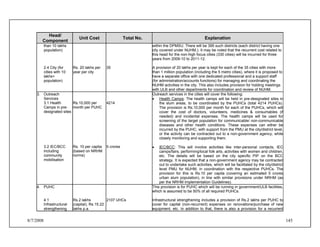
optimally for improving the quality of health care of the urban poor population by
capitalizing on the skills and resources of potential partners. Ensure convergence with
other central government facilities like ESI, Railways and Army etc., by developing a
mutual partnership. Co-location of the existing AYUSH centers, RNTCP Microscopy
centers (TB), ICTC centers (HIV/AIDS) etc. under the existing National Health
Programmes would be desirable.
d. The UHCs must ideally be located in the most vulnerable slums from health
perspective, or if unavoidable, these may be located in close proximity ( half a
kilometer radius or so) or appropriately located in terms of physical location of the
concerned slums.
- 37 -
6 Institutional Framework
1. The National Urban Health Mission would leverage the institutional structures of the
NRHM at the National, State and District level for operationalisation of the NUHM.
However, in order to provide dedicated focus to issues relating to Urban Health the
institutional mechanism under the NRHM at various levels would be strengthened
for NUHM implementation.
2. At the central level the Mission Steering Group under the Union Health Minister, the
Empowered Programme Committee under the Secretary (H&FW), the National
Programme Coordination Committee under the Mission Director would be
strengthened by incorporating additional government and non government and
urban stakeholders , professionals and urban health experts. At the State level, the
State Health Mission under the Chief Minister, the State Health Society under the
Chief Secretary and the State Mission Directorate would also be similarly
strengthened.
3. In addition to the above, at the City level, the States may either decide to constitute
a separate City Urban Health Missions/ City Urban Health Societies or use the
existing structure of the District Health Society / Mission under NRHM with
additional stakeholder members.
4. It is proposed that the City structure may be ULB led in metros and in cities with a
population 10 lakhs and above or where ULBs are actively involved in managing
primary health effectively. In such situations a Tripartite MoU instead of a Bipartite
MoU would be required. For cities with population below 10 lakhs or where ULB
structures are weak in managing primary health care, the states may co-
locate/amalgamate the Urban Health Mission/Societies with the District Health
Mission/Societies under NRHM as an interim measure till the development of
independent city structures in the future. In view of the extant urban situation and
multiplicity of local bodies in cities like Delhi etc. flexibility would be accorded to the
States to decide on the city level institutional mechanism. The states can suitably
adapt the by-laws of District Health Mission/Societies as developed under NRHM
for the City Health Missions/ Societies.
5. The institutional framework would be strengthened at each level for providing
leadership to the urban health initiatives. At the National level the existing Urban
Health Division would be revamped with the Joint Secretary of the Division as the
Head, reporting to the Mission Director of NRHM involving the three existing
- 38 -
NATIONAL
LEVEL
NRHM Mission Steering Group
NRHM Empowered Programme Committee
Serviced by Urban Health Division
(Planning, Coordination Monitoring, Financial)
NRHM Program Coordination committee
NRHM Health Mission
NRHM Health Society
NRHM Mission Directorate serviced by Urban Health Division
(Planning, coordination Monitoring, Financial)
STATE
LEVEL
Mahila Arogya Samiti
Synergies with community structures under SJSRY
CITY
LEVEL
District / City NUHM Health Mission
District / City NUHM Health Society
URBAN Health Management Unit
divisions under DS/ Director rank officers namely Urban Health Division for
Planning and Appraisal, the Finance Management Group (FMG), and the
Monitoring and Evaluation Division. Thus NUHM will not involve deployment of
additional DS/Director rank officials but involve the existing officers under NRHM,
who will be adequately supported by NUHM with enhanced professional /secretarial
support engaged through a contractual arrangement.
6. Similarly the NRHM Mission Director at the State level may also be designated as
NUHM Mission Director, and be provided with enhanced professional and
secretarial support through contractual engagement.
7. Likewise the City/District Societies would be adequately supported with
professional support and secretarial staff.
8. A generic institutional model provisioning for a National / State/District/City level
Urban Health Mission and Society is illustrated below, notwithstanding the
flexibilities provided to the states to frame their own institutional structures.
- 39 -
7. Urban Health Delivery Model
The National Urban Health service delivery model would make a concerted effort to
rationalize and strengthen the existing public health care system in urban areas and
promote effective engagement with the non governmental sector (profit/not for profit) for
expanding reach to urban poor, along with strengthening the participation of the
community in planning and management of the health care service delivery.
All the services delivered under the urban health delivery system will be based on
identification of the target groups (slum dweller and other vulnerable groups); preferably
through distribution of Family/ Individual Health Suraksha Cards. The diagram below
describes the components of the proposed urban health service delivery model.
The urban health delivery model would basically comprise of an Urban Health Centre for
provision of primary health care with outreach and referral linkages as elucidated below:
(a) Community level
• Urban Social Health Activist (USHA)
Public or
empanelled
Secondary/
Tertiary private
Providers
Urban Health Centre (One for
about 50,000 population-25-30
thousand slum population)*
Strengthened
existing Public
Health Care
Facility
Empanelled
Private
Service
providers
Community Outreach Service
(Outreach points in government/ public domain Empanelled
private services provider)
Urban Social Health Activist (200-500 HH)
Mahila Arogya Samiitee (20-100HH)
Referral
Primary
Level Health
Care Facility
Com
muni
ty
Leve
l
--------------------
--------------------
* This may be adapted flexibly based on spatial situation of the city
- 40 -
Each slum/community would have a well defined grass root level area covering about
1000-2,500 beneficiaries, between 200-500 households based on spatial consideration,
preferably co-located at the Anganwadi Centre functional at the slum level, for delivery of
services at the door steps. One frontline community worker called USHA on the lines of
ASHA under NRHM would remain in charge of each area and serve as an effective and
demand–generating link between the health facility (Primary Urban Health Centre) and the
urban slum populations. She would maintain interpersonal communication with the
beneficiary families and the Mahila Arogya Samitties for which they are earmarked.
The USHA on the lines of ASHA, would preferably be a woman resident of the slum–
married/widowed/ divorced, preferably in the age group of 25 to 45 years. She should
also be a literate woman with formal education up to class eight which may be relaxed
only if no suitable person with this qualification is available. She would be chosen through
a rigorous community driven process involving ULB Counsellors, community groups, self-
help groups, Anganwadis, ANMs. A team of five facilitators may be identified in each UHC
catchment area with the help of an NGO, through a consultative process, for facilitating
the selection of the USHA. The facilitators would preferably be women from local NGOs;
community based groups, Anganwadis or Civil Society Institutions. In case none of these
is available in the area, the officers of other Departments at the slum level/local school
teachers may be taken as facilitators. The selection process for ASHA in NRHM may be
suitably modified as per the local condition and adopted for selection of the USHAs.
The USHA would actually be the nerve centres for delivering outreach services in
the vicinity of the door steps of the beneficiaries. Preferably some suitable identified place
for USHA may be arranged in the slums which may be AWW centres, clubs, community
premises set up under the JNNURUM , Sub Health Posts set up in IPP cities ,municipal
premises etc, or even her own residence. A USHA mentoring system on the lines of
NRHM may be put in place involving dedicated community level volunteers/professionals
preferably through the local NGO at the PUHC level, for supporting and coordinating the
activities of the USHA. The states may also consider the option of Community Organiser
for 10 USHA for more effective coordination and mentoring, preferably located at the
mentoring NGO. The Community organizer along with the ANM may be designated as the
mentoring and management team at the slum level for the USHAs.
The essential services to be rendered by the USHA may be as follows:
• Active promoter of good health practices and enjoying community support.
- 41 -
• Facilitate awareness on essential RCH services, sexuality, and gender equality
age at marriage/pregnancy. Motivation on contraception adoption, medical
termination of pregnancy, sterilization, spacing methods. Distribution of
condoms and oral contraceptive Pills. Early restriction of pregnancies,
pregnancy care, clean and safe delivery, nutritional care during pregnancy,
identification of danger signs during pregnancy. Counselling on immunisation,
ANC, PNC etc. act as a depot holder for essential provisions like Oral Re-
hydration Therapy (ORS), Iron Folic Acid Tablet(IFA), chloroquine, Oral Pills &
Condoms, etc. Identification of target beneficiaries and support the ANM in
conducting regular monthly outreach sessions and tracking service coverage.
• Facilitate access to health related services available at the Anganwadi/Primary
Urban Health Centres/ULBs, and other services being provided by the
ULB/State/ Central Government.
• Formation and promotion of Mahila Arogya Samittees in her community.
• Arrange escort/accompany pregnant women and children requiring treatment to
the nearest Primary Urban Health Centre, secondary/tertiary level health care
facility.
• Reinforcement of community action for immunization, prevention of water borne
and other communicable diseases like TB (DOTS), Malaria, Chikungunya and
Japanese Encephalitis.
• Carrying out preventive and promotive health activities with AWW/ Mahila
Arogya Samiti.
• Maintenance of necessary information and records about births & deaths,
immunization, antenatal services in her assigned locality as also about any
unusual health problem or disease outbreak in the slum and share it with the
ANM in charge of the area .
• Provision for a minimum package of curative care empowered with minimum
knowledge for timely referrals equipped with an ASHA like drug kit.
In return for the services rendered, she would receive a performance based incentive.
For this purpose a revolving fund would be kept with the ANM at the PUHC which would
be replenished from time to time.
The following performance based incentive package is suggested subject to modifications
by the State.
- 42 -
Activity Proposed Incentive per month (Rs)
1 Organization of outreach
sessions
200
2 Organization of monthly meeting
of MAS
100
3 Attend monthly meeting at UHC 200
4 Organize Health & Nutrition day
in collaboration with AWW
100
5 Organize community meeting for
strengthening preventive and
promotive aspects
50 per meeting (200 upper limit)
6 Provide support to Baseline
survey and filling up of family
Health Register
5 per Household (once a year)
7 Maintain records as per the
desired norms like Household
Registers, Meeting Minutes,
Outreach Camps registers
Rs.50 per month
8 Additional Immunisation
incentives for achieving complete
immunisation in among the
children in her area of
responsibility:
Rs. 5 per child
9. Incentives/compensation in built
in national schemes for ASHA
under JSY, RNTCP, NVBDCP,
Sterilisation etc. any other
National programme
Similar norms would be applicable for
USHA. The respective programme
would be requested to issue
necessary instructions in this regard.
• During the field visits it was observed that provision of a photo identity card to the
community volunteers greatly boosts their self esteem. The states/cities can also
explore the option of providing USHAs with Photo ID card.
• Mahila Arogya Samiti (MAS) – acts as community based peer education group,
involved in community monitoring and referral. The MAS may consist of 20-100
households (HH) with an elected Chairperson and a Treasurer, supported by an
USHA. This group would focus on preventive and promotive care, facilitating
access to identified facilities, risk pooling fund and health insurance.
• ANM – Providing preventive and promotive healthcare services at the household
level through regular visits and outreach sessions. Each ANM will organize a
minimum of one outreach session in the coverage population of the USHA. Four
ANMs will be posted in each UHC.
• Outreach Medical Camps – Once in a month the MO would accompany the ANMs
to the outreach sessions (may be called Outreach camps). It will include OPD
(consultation), basic lab investigations (using mobile/disposable kits), and drug
- 43 -
dispensing, apart from counseling. Each camp will be covering a responsibility area
of two ANMs working in a UHC. The UHC can also partner with local General
Practitioner for the camp.
• These could be organized at designated locations mentioned in the aforesaid paras
in coordination with USHA and MAS members.
• All engagements would be contractual with no permanent liability to Government of
India.
(b) Primary Urban Health Centre
• Functional for a population of around approximately 50,000, the PUHC may be
located preferably within a slum or a half kilometer radius, catering to a slum
population of approximately 20000-30000, with provision for evening OPD also. The
cities, based upon the local situation may establish a UHC for 75,000 for areas with
very high density and can also establish one for around 5000-10,000, slum
population for isolated slum clusters.
• Act as first point for curative healthcare.
• At the PUHC level services provided will include OPD (consultation), basic lab
diagnosis, drug /contraceptive dispensing, apart from distribution of health education
material and counseling for all communicable and non communicable diseases. In
order to ensure access to the urban slum population at convenient timings, the UHC
may provide services for 4 hrs in the morning and 2 hrs in the evening. For provision
of certain services evening OPD if required, partnership with local General
Practitioners through benchmarked performance indicators may also be explored.
• It will ordinarily not include in-patient care.
• It will staffed by a 1 Doctor, 2 multi skilled paramedics (including lab technician and
pharmacist), 2 multi-skilled nurse, up to 4 ANMs (depending upon the population
covered), apart from clerical and support staff (peons, sweepers etc) and one
Programme Manager for monitoring community mobilization, capacity building
efforts and strengthening the referrals.
• The option of co-locating the AYUSH centre with UHC may also be explored, thus
enabling the placement of AYUSH doctor and other AYUSH paramedic staff in the
UHC.
• The NUHM would provide support to the existing government health facilities in the
urban areas (UHP,,UFWC, and Dispensaries etc) as required for strengthening
them to PUHC standard.
• Where there is non-functional government health facility, required staff may be
posted from medical/paramedical/nursing colleges/state government (on
- 44 -
deputation). Alternatively, contractual appointments from the private market may be
made to staff such facilities.
• Where there are no government health facilities, existing private clinics/nursing
homes operating in or near the slum clusters may be empanelled/accredited and
designated as PUHCs.
• The government facilities strengthened as PUHC will also be provided annual
financial support in the form of Rogi Kalyan Samittee/ Hospital Management
Committee Fund of Rs. 50,000 per UHC per year, with the amount being
proportional to the population covered (@ Re.1.00 per head, i.e. a PUHC covering
40,000 population will get Rs.40, 000 and a PUHC covering 75,000 population will
be getting Rs. 75,000 per year).
• All engagements would be contractual with no permanent liability to Government of
India.
(c) Referral Units
• Existing hospitals, including ULB maternity homes, state government hospitals and
medical colleges, apart from private hospitals will be empanelled /accredited to act
as referral points for different types of healthcare services like maternal health, child
health, diabetes, trauma care, orthopedic complications, dental surgeries, mental
health, critical illness, deafness control, cancer management, tobacco counseling /
cessation, critical illness, surgical cases etc.
• There might be different and multiple facilities for the different healthcare services,
depending upon type of hospitals available in the city. This will not only ensure
flexibility to adapt to different conditions in different cities but also increase the range
of options for the beneficiaries.
• The empanelled/accredited facilities would be reimbursed for the services provided
as per the pre-decided rates, negotiated with them at the time of
empanelling/accrediting them. The rates will be determined by the consultations
undertaken during preparation of the PIPs and based on the NCMH report.
• For empanelled government facilities, apart from District/Sub-District Hospitals
(being supported under NRHM), Rogi Kalyan /Hospital Management Societies will
be funded (per case basis including support for referral transportation), which
will be utilized for providing cash-less services to urban poor covered under NUHM.
Such empanelled hospitals, which do not have hospital management societies, will
be required to form such societies to be eligible for receiving the funding support.
During the field visits it was observed that many of ULBs have maternity homes
functioning with heavy case load but inadequate infrastructure, therefore it is
- 45 -
proposed to support the existing maternity hospitals on a city specific case to case
basis as referrals for maternal and child care .
• The referral services will be cash-free for the beneficiary and will be financed by
community health insurance or voucher scheme as per the PIP developed for the
city.
• All engagements would be contractual with no permanent liability to Government of
India.
• Collaboration with local Medical Colleges may be promoted for strengthening the
training support and supplement human resource at the PUHC level.
(d) Indicative Service Norms by levels of Service Delivery *
Levels of service deliveryServices**
Community (Outreach) First point of service
delivery (UHC)
Referral Centre - RC
(Specialist services)
A. Essential Health Services
A1. Maternal health Registration, ANC,
identification of danger signs,
referral for institutional
delivery, follow-up
Counseling and behaviour
promotion
ANC, PNC, initial
management of
complicated delivery
cases and referral,
management of
regular maternal
health conditions,
referral of
complicated cases
Delivery (normal and
complicated),
management of
complicated
gynae/maternal
health condition,
hospitalization and
surgical interventions,
including blood
transfusion.
A2. Family welfare Counseling, distribution of
OCP/CC, referral for
sterilisation, follow-up of
contraceptive related
complications
Distribution of
OCP/CC, IUD
insertion, referral for
sterilisation,
management of
contraceptive related
complications
Sterilisation
operations, fertility
treatment
A3. Child health and
nutrition
Immunisation, identification of
danger signs, referral, follow-
up, distribution of ORS,
paediatric cotrimoxazole
post-natal visits/counseling for
newborn care
Diagnosis and
treatment of
childhood illnesses,
referral of acute
cases/ chronic illness
Identification and
referral of neonatal
sickness
Management of
complicated
paediatric/neo-natal
cases, hospitalization,
surgical interventions,
blood transfusion
A4. RTI/STI
(including HIV/AIDS)
Symptomatic search, referral,
community level follow-up for
ensuring adherence to
treatment regime of cases
undergoing treatment
Diagnosis and
treatment, referral of
complicated cases
Management of
complicated cases,
hospitalization (if
needed)
A5. Nutrition
deficiency disorders
Height/weight measurement,
Hb testing, distribution of
therapeutic doses of IFA,
promotion of iodised salt,
nutrition supplements to
identified children and
pregnant/ lactating women
Diagnosis and
treatment of seriously
deficient patients,
referral of acute
deficiency cases
Early identification of
Management of acute
deficiency cases,
hospitalization
Treatment and
rehabilitation of
severe under-nutrition
- 46 -
Levels of service deliveryServices**
Community (Outreach) First point of service
delivery (UHC)
Referral Centre - RC
(Specialist services)
Promotion of breast feeding,
complementary feeding for
prevention of under-nutrition
mild and severe
under-nutrition,
counseling for optimal
feeding practices or
referral
A6. Vector-borne
diseases
Slide collection, testing using
RDKs, DDT ,chemical,
biological larvicides etc
Counseling for practices for
vector control and protection
Diagnosis and
treatment, referral of
terminally ill cases
Management of
terminally ill cases,
hospitalization
A7. Mental Health Case detection and referral,
counseling, rehabilitation
Diagnosis and
treatment
Psychiatric and
neurological services,
including
hospitalization, if
needed
A7.1Oral Health Basic dental education,
screening for precancerous
lesions, referrals
Diagnosis and
treatment
Management of
complicated cases,
hospitalization (if
needed)
A7.2Hearing
Impairment/
Deafness
Early detection and awareness
for preventive steps/actions,
referral
Diagnosis and
treatment
Management of
complicated cases,
hospitalization (if
needed)
A8. Chest infections
(TB/ Asthma)
Symptomatic search and
referral, ensuring adherence to
DOTs, other treatment
Diagnosis and
treatment, referral of
complicated cases
(MDR, reactions,
terminal illness)
Management of
complicated cases
A9. Cardio-vascular
diseases
BP measurement,
symptomatic search and
referral, follow-up of under-
treatment patients
Diagnosis and
treatment, emergency
resuscitation, referral
of cardiac
emergencies cases
Management of
emergency cases,
hospitalization and
surgical interventions
(if needed)
A10. Diabetes Blood/urine sugar test (using
disposable kit), symptomatic
search and referral, follow-up
of under-treatment patients
Diagnosis and
treatment, referral of
complicated cases
Management of
complicated cases,
hospitalization (if
needed)
A11. Cancer Symptomatic search and
referral, follow-up of under-
treatment patients
Identification and
referral, follow-up of
under-treatment
patients
Diagnosis, treatment,
hospitalisation (if and
when needed)
A12. Trauma care
(burns & injuries)
First aid and referral First aid , emergency
resuscitation,
documentation for
MLC (if applicable)
and referral
Case management
and hospitalisation,
physiotherapy and
rehabilitation
A13. Other surgical
interventions
--- not applicable --- Identification and
referral
Hospitalisation and
surgical interventions
B. Other support services
B1. IEC/BCC IPC, Health Camps/fairs,
performing arts, wall/poster
writing, events (in schools,
women’s groups)
Distribution of health
education material
Distribution of health
education material
- 47 -
Levels of service deliveryServices**
Community (Outreach) First point of service
delivery (UHC)
Referral Centre - RC
(Specialist services)
B2. Counseling Individual and group/family
counseling – HIV/AIDS/Mental
disorders/stress
management/Tobacco/Alcohol.
Substance abuse
Patient/attendant
counseling
Patient/attendant
counseling
B3. Personal & Social
Hygiene
IEC on hygiene, community
mobilisation for cleanliness
drives, disinfection of water
sources, etc.
--- not applicable --- --- not applicable ---
*Norms adapted from NCMH Report
** Services based on situational analysis
7 (a) Indicative Norms for Empanelment of UHC
(i) Accessibility
a. Preferably located near the slum to be served
b. Accessed by slum dwellers
(ii) Services
a. Medical care: OPD services: 4 hours in the morning and 2 hours in the
evening.
b. Services as prescribed under RCH II
c. National Health Programmes
d. Collection and reporting of vital events and IDSP
e. Referral Services
f. Basic Laboratory Services
g. Counseling services
h. Services for Non Communicable Diseases
i. Social Mobilization and Community level activities
(iii) Basic Infrastructure
a. Consultation room, Dressing and treatment room, Medicine room
b. Medical equipments and instruments
(iv) Basic Staff
# Staff Category Number
1 Medical Officer (Preferably LMO) 1
2 Multi-skilled Paramedic including Pharmacist/ Lab
Technicican etc.
2
3 Programme Health Manager 1
4 Multi-skilled Nurse 2
5 ANMs 4
6 Secretarial Staff including account keeping 1
7 Support staff 3
- 48 -
7 (b) Indicative Norms for Empanelment of Referral Unit
As the partnership for the referral unit would be need based, empanelment criteria can be
developed based upon the norms prescribed by the IPHS for hospitals. Some of the
suggested criteria can be
a. Accessibility
i. The Hospital/ Nursing home to be easily accessible for the served population.
ii. Willingness to provide services at the rates negotiated
b. Facilities :
i. As per IPHS norm for Hospitals locally adapted as per need
ii. Round the clock availability of services
c. Availability of Specialties services for which the partnership is being entered. Some of
it may be
i. Obstetrics and Gynecology
ii. Pediatrics
iii. General Surgery
iv. Ophthalmology
v. ENT
vi. Orthopedics
vii. Dermatology
viii. CVD
ix. Endocrinology (Diabetes, Thyroid)
x. Mental Health
xi. General Medicine
xii. Dental
xiii. Any other based on epidemiological profile of the City
d. Diagnostic facilities: As per the requirement. Some of it can be
i. Fully equipped laboratory for biochemistry, microbiology and hematology
ii. X- Ray machine with minimum capacity of 60 MA
iii. Ultra-Sonography
iv. Any other based on epidemiological profile of the City
- 49 -
8. Partnership with the non government
sector
1. The situational analysis has clearly revealed the efficacy of non government
partnership in augmenting health care delivery for the urban poor. There is scope for
partnerships with non governmental providers for public health goals given the large
presence of the private sector in urban India. Many state governments have already
engaged with the sector under the existing health programmes with varied levels of
success. The experience of the existing models would be leveraged for development
of city specific models which would be supported under NUHM. The matrix in
Appendix 4 provides a tabular representation of a few PPP models operational in the
country.
2. The effectiveness of partnership would depend on an enabling environment with
engagement through a transparent criterion, clearly specified terms of engagement
(preferably through a clearly spelt out Memorandum of Understanding), operational
freedom (through an independent Project management Unit), continued fund flow
and an independent monitoring mechanism.
3. Appropriate mechanisms for partnering (or entering into agreement) with the non
government sector may be considered, including empanelment/accreditation for
ensuring quality.
4. An assessment of various models of PPP in operation reveals that partnerships
wherein the community and other stakeholders have not been consulted have not
worked satisfactorily in the long run. Hence involvement of the Rogi Kalyan Samitis/
Hospital Management Committees/ Urban local bodies/ beneficiaries, as appropriate,
in the deliberations and consultations, may be considered.
5. NUHM would seek to build partnership with NGOs and Civil Society groups as a
monitoring and feedback mechanism for the government.
- 50 -
AN INDICATIVE LIST OF PARTNERSHIPS FOR THE SERVICE DELIVERY
MODEL BASED ON RECOMMENDATIONS OF TASK FORCE REPORT ON
URBAN HEALTH of MOHFW
In cities or parts of a city where no public sector first tier facility is
available, the entire first tier service delivery component may be
transferred to a non government provider with requisite capacity.
Private medical practitioners may also be engaged on part-time basis for
first as well as second tier facilities (based on the experience in IPP VIII in
Kolkata and neighboring cities).
The FRU level services and diagnostic services may be outsourced to
private medical facility on reimbursement basis. A uniform rate list needs
to be developed in mutual consultations. The NCMH costing as provided
in the Appendix IV may be a good source to begin with. Wherever
worthwhile and feasible, second tier services can also be contracted out to
private/ charitable hospitals, with proven credentials.
Government may transfer an existing health care facility to non
government agency with some infrastructure (including drugs/ equipment)
support and the non government provider may take responsibility of
management including staff and supplies.
Partnership with NGOs for social mobilization and strengthening of
community level structures like MAS and focusing on preventive and
promotive aspects,
The most vulnerable may be reached through outreach clinics and mobile
vans. Partnership with the Corporate Sector for mobile vans under the
Corporate Social Responsibility may be examined. Partnerships with the
NGOs working with the vulnerable section for expanding the reach of
health care services to them may also be explored.
- 51 -
9. Community Risk Pooling and Health
Insurance
1. Poverty underlines the poor health status in the urban slums. Poverty entails chronic
undernourishment of especially the poor urban women and children; it implies
negligible access to affordable and adequate housing and resultant consequences of
overcrowding; it also underlines lack of access to affordable health care, and exclusion
from the formal economic sector and from benefits of urban development. Specific
poverty-driven conditions, such as child labour, sex trade, domestic violence and
substance abuse, exploitation by unqualified providers, use of hazardous biomass
fuels for cooking, all that have direct health consequences, get exacerbated in slum
living . Search for “livelihood” determines the life of the urban poor. Poor households
are more likely to send their children to work (rather than to school), to cut back on
expenses. Health improvement efforts therefore are more effective if associated with
livelihood improvement and local empowerment strategies and therefore the need for
development of community based health insurance models managed by the poor.
2. Many poor urban households have also been found to be women-headed and
difficulties in their legal status and discrimination often prevent them from being able to
access sources of credit. Additionally, it often appears that the time and money costs
of access to services are seen by women more as social barriers and less as
economic barriers since women must often negotiate for money from the husbands
and other family members (the “decision makers”) to access services that require
payment. Therefore, the need for initiating micro-credit and savings mechanism to
encourage the women to save a part of their incomes to cater to the health and other
needs of the family.
3. While spatial access to health services is better in urban areas in comparison to the
rural, access to the poor remains limited. The non government sector has a prominent
presence in urban health care offering a range of providers from traditional healers to
highly trained specialists. Fee-for-service is the focus of the for- profit private sector
which limits the ability of the urban poor to pay. Also, the large presence of non
government health care providers in the urban areas makes it a cost efficient
alternative for financing health care for the urban poor. Therefore, subsidizing the
- 52 -
health care cost to the urban poor, while also giving them a choice of health care
providers, through a managed health insurance scheme, linked with quality assurance
and regulation of healthcare providers appears to be a viable alternative.
4. In the above context, the National Urban Health Mission (NUHM) recognizes that
state/city specific, community oriented, innovative and flexible insurance policies need
to be developed. While the private insurance companies may be encouraged to bring
in innovative insurance products, the Mission would strive to set up a risk pooling
system where the Centre, States and the local community would be partners. This
would be done by resource sharing, facility empanelment and regulation of adherence
to quality standards, establishing standard treatment protocols and costs, apart from
encouraging various premium financing mechanisms.
A. Community Risk Pooling Mechanism
5. The community risk pooling mechanism is based on the core belief that saving for rainy
day has to be encouraged as a habit. Many of the health programmes (IPP VIII &
Indore Urban Health Programme) have demonstrated the value and benefit of
community risk pooling at a very small level in the form of community health fund. It
saves households from immediate financial crisis at the time of a health emergency.
6. NUHM encourages setting up of Mahila Arogya Samities (MAS), to act as the unit of
user group as well as for designing and managing a need-based and affordable health
insurance scheme.
- 53 -
7. As depicted in the diagram above, the sources of funds for the savings account
created by the MAS will primarily include the savings by the women constituting the
MAS, the one-time Seed Money, and annual Performance Grant provided under the
NUHM. The money may be spent on the members’ family’s unforeseen health
expenditure needs and other activities like group meetings, mobilisation for health
camps, etc.
8. It is proposed to promote such community based groups for enhanced community
participation and empowerment in conjunction with the community structures created
under the Swarna Jayanti Shahari Rojgar Yojana (SJSRY), a scheme of the Ministry of
Urban Development which seeks to provide employment to the urban poor. Under the
Urban Self Employment Programme (USEP) of the scheme there are provisions for
Development of Women and Children in Urban Areas (DWCUA) groups of at least 10
urban poor women and Thrift Credit Groups (TCG) which may be set up by groups of
women. There is also provision for informal association of women living in mohalla,
slums etc to form Neighbourhood Groups (NHGs) under SJSRY who may later
federate towards a more formal Neighbourhood Committee (NHC). Such existing
structures under SGSRY may also federate into the Mahila Arogya Samittee, (MAS) a
community based federated group of around 20 to 100 households, depending upon
the size and concentration of the slum population, with flexibility for state level
Community Risk Pooling under NUHM
Mahila Arogya Samiti
(MAS)
Savings
Interest on Loans
Interest on Savings
Small Loans
Premium Financing
For Health Insurance
Seed Money and
Performance Grant
Under NUHM
Slum Women
- 54 -
adjustments, and responsible for health and hygiene behaviour change promotion and
facilitating community risk pooling mechanism in their coverage area.
9. The Urban Social Health Activist (USHA) an ASHA like activist, detailed at pages 35-36
may provide the leadership and promote the Mahila Aorgya Samitee. The USHA may
be preferably co-located with the Anganwadi Centres located in the slums for
optimisation of health outcomes. Each of the MAS may have 5-20 members with an
elected Chairperson/ Secretary and other elected representative like Treasurer. The
mobilization of the MAS may also be facilitated by a contracted agency/NGO, working
along with the USHA responsible for the area.
10.The members of the MAS would be encouraged to pool an agreed amount (say Rs.10-
20 or more - per family, per month). The amount will be deposited in a savings bank
account, managed by the MAS.
11.The MAS will spend its reserve pool to a household in their respective catchments to
help meet out-of-pocket expenses due to any healthcare emergency in the family.
Additionally, it may spend on community meetings, mobilisation for health camps,
referral transportation, purchase of health care etc. The MAS will be provided with
seed money of Rs. 25 per household covered (assuming one member per household)
for initiating operations, opening of account, based on USHA certification.
12.Subject to satisfactory conduct of its affairs and mobilization of contribution, the MAS
will receive under NUHM, an annual performance grant of Rs.25 per household
covered, subject to achievement of health care benchmarks (like immunisation
coverage, institutional deliveries, etc., or any other health service indicator )
determined by the state/district /city based on USHA certification. The above fund
(seed money) would be strictly utilized for meeting the health needs.
B. Urban Health Insurance Model
13.Given the fact that non government healthcare providers are present in the urban
areas, the need of the hour is to leverage their presence by providing opportunities for
the poor to access them, and also protecting them from the burden of high out-of-
pocket expenses on health through an insurance mechanism. This mechanism would
also help regulating the price (through negotiated rates with the providers) and quality
(through accreditation/empanelment of providers).
- 55 -
14.The NUHM would promote an urban health insurance model which takes care of the
cost for accessing health care for surgery and hospitalization needs for the urban
population at reasonable cost and assured quality, while subsidizing the insurance
premium for the urban slum and vulnerable population. Initially it is proposed to take
the five metro cities15
on a pilot basis for covering all referral services (specialist care)
under the Urban Health Insurance Model. The other cities covered in the first year are
also free to devise their own insurance scheme for the first year, but the focus of the
piloting will be on the five metro cities.
15.As depicted in the above diagram, The Urban Health Insurance model proposed under
NUHM is expected to include all the urban population, where the premium for the
enrolled slum and vulnerable population would be subsidised and the non-slum
population would have to pay the required subsidy.
16.The UHI model would be a cashless model. Every urban family availing the health
insurance would be issued a photo-identity card (Family Health Suraksha Card). The
family would be free to go to any service provider among the public/ empanelled non-
government health facility, under the scheme. The family would get the desired health
care facilities as per the package on producing the card. The public or private service
provider would be reimbursed by the insurer under the health insurance scheme.
15
Delhi, Mumbai, Kolkata, Chennai, and Bengaluru
Suggested Urban Health Insurance Model
(States/ULBs may develop their own model)
Urban Slum &
Vulnerable
population
Urban general
(non-slum & APL)
population
Accredited/Empan
elled
Private/Public
Insurer
(IRDA approved
Insurance Co./
TPA)
Reimbursements
Premium (Self Financed)
Subsidy (against premium
for the Slum population)
Urban Health Mission
(Centre/State/ULB)
Mobiliser/
Administrator
(may be a part
of the Insurer)
Regulation/Quality
Assurance
- 56 -
17.The states/districts/cities would be encouraged to design an insurance scheme which
would be attractive to the general city population too. This would make the insurance
scheme available to the whole urban population on a voluntary basis, whereby the non
urban poor population can purchase the insurance product on cost, and thus, in a way,
cross subsidize the premium for the poor, to some extent. It is not expected that the
cross subsidy would cover the complete premium required for the poor, and the other
premium financing mechanisms would have to be put in place for covering the rest.
The inclusion of the rest of the urban population would help in risk diversification and
thus reduce the actuarially necessary premium.
Target Community
18.The target community under the Urban Health Insurance model proposed under
NUHM is the urban population. The insurance scheme will be open to all of the urban
population, where the government (central and state) and civic bodies (ULBs), through
NUHM, will subsidise the premium for the urban slum and vulnerable population, who
enroll for the insurance scheme.
19.The Urban Local Body may be primarily responsible for managing the scheme and
also identification of beneficiaries. All identified beneficiaries to be issued a Family
Health Suraksha Card, which will entitle them to access the insurance.
Benefit package
19.The health conditions and diseases to be covered under the insurance scheme will
include hospitalization/surgical cases, including maternal and childhood conditions and
illnesses.
20.Coverage will include Inpatient treatment requiring hospitalization for more than 24
hours. It would include consultation, investigation and room charges and medicines
and surgical/medical procedures. The surgical package may include all categories of
complex and common surgeries including OBG, General surgery, Gastroenterology,
Orthopaedics, ENT, Cardiology including Bypass. Surgical care required on a day care
basis will also be covered under the scheme.
21. The monetary coverage is up-to a maximum of Rs.50,000 per year per enrolled
household (on a floater basis) for the above mentioned types of cases/conditions.
22.The amount will not be paid to the beneficiary, but will be directly paid to the health
care provider, as per the bill raised and claimed by the provider.
- 57 -
23.Hospitals covered under the scheme would include empanelled public and private
providers. Cities/States would need to develop empanelment criteria and rates for
reimbursement to the providers for treatment.
24.There may be minimal exclusions under the insurance scheme, which may include the
following as an indicative list :
• Conditions that do not require hospitalisation
• Congenital external diseases
• Sterilisation and fertility related procedures
• Vaccinations
• War/nuclear invasion
• Suicide
• AYUSH systems
• HIV/AIDS
However the State / ULB may modify the exclusions to include OPD, etc and even
the maximum coverage of 50,000, at it’s own cost.
Premium
25.The premium under the scheme may be decided by the ULB/district/state through a
tendering process involving the insurance companies, for the given broad coverage
mentioned above. The ULB/districts/states are free to add/delete specific
illnesses/coverage as per the local needs. MoHFW may also provide technical
assistance to the states in designing and/or tendering for the insurance scheme.
NUHM commits a subsidy of a maximum of Rs.600 as central contribution, for
subsidizing the premium for the urban slum population and other vulnerable groups.
Additional cost of the subsidy (if premium quoted by insurance company is higher than
Rs.600 per family) may be paid by the state/district/ULB and/or the beneficiaries
themselves.
26.The subsidy from the Central government would be limited to the persons covered in
the Mission as indicated earlier. However, the non poor would be free to pay the
premium and avail the insurance coverage from insurance provider which may help in
raising the coverage and reducing the premium cost.
27.The administrator of the scheme would ensure regulation and, assist the state
government/District Health Society/ULB in grievance redressal.
- 58 -
28.Premium collection will be during a fixed period. And as per the policy, there would be
a waiting period of 30 days. The premium would be applicable annually, but the
scheme would be valid for a minimum of three years duration, with provision for
termination on the basis of non-collection, non-performance, the procedure for which
will be decided while designing the scheme at the state/ULB level.
29.Each scheme would explore various premium financing options, which may include but
not be restricted to the following:
a. Linkage with other social protection schemes (like Mukhya Mantri Jeevan
Raksha Kosh in Rajasthan, Jharkhand, etc.)
b. Soft loans (for annual premiums, loan by the MAS, cooperative banks, MFIs
etc.)
c. Donors (bilateral/multilateral donors, industrial houses, state cooperatives,
public sector undertakings, etc.)
d. Subsidy (by central, state governments, ULBs)
e. Health Savings Account (linking with savings/interest earnings of MAS)
Insurance Mechanism
30.The insurance companies, accredited by IRDA for underwriting health insurance
products, contracted by the State/District/ULB, may be the insurer of the product and
they may take the risk.
31.The state/district/ULB may need to devise a mechanism for facilitating the scheme by
putting in place structures/institutions for the following:
• Assisting the state government/district/ULB in grievance redressal
• Coordinating with the network hospitals and insurance company to facilitate their
operations
• Creating awareness about the Insurance Plan
• Marketing the plan to the urban slum and vulnerable groups.
• Having a desk in some of the important hospitals for counseling/guidance of the
insured patients
• Monitoring the programme
• Conducting medical / chart audits on a random basis
32.In case the state/district/ULB decides to contract out the facilitation to a non-
government agency, the fee may be negotiated through an open tendering process.
- 59 -
Linkage with other insurance schemes
33.The Urban Health Insurance model will not duplicate the efforts of other health
insurance schemes launched by other ministries/departments like the proposed
schemes of the Ministry of Labour, (Swasthya Bima Yojana), Ministry of Social
Welfare, etc.
34.Only those households which do not have an identity card issued for health insurance
by any other scheme, family health suraksha card/ Smart card will be issued under the
Urban Health Insurance. The smart card will keep track of the health services availed
by the household members and help avoid duplication.
Suggested steps for implementation of the Insurance scheme
a. Consultation with user groups for determining their preferences and participation.
b. Sample household survey (as part of the baseline survey under M&E component) for
determining the health care seeking behaviour and household health expenditure
pattern.
c. Facility survey (as part of facility mapping and empanelment exercise)
d. Negotiation with public/private providers on cost of treatment of identified
diseases/health care
e. Finalization of insurance package, with inputs from professional groups (insurance
consultants, actuaries, etc.).
f. The insurance package would be graded and the premium would be fixed as per the
package.
The package to be covered for the CHI model would be worked out by the respective
cities/states, as a part of their PIP.
The cities/ district/states would then invite the public and private insurance companies/
Professional Health Management Organizations and empanel them as insurance service
providers. It may also decide to allocate certain cities to one provider, or create a panel
of insurance care providers and the beneficiaries would be free to choose any insurance
provider.
- 60 -
10 .Proposed Areas of Synergy
1. Intra Sectoral Coordination
NUHM would aim to provide a system for convergence of all communicable and
non communicable disease programmes including HIV/AIDS through an integrated
planning at the City level. The objective would be to enhance the utility of the system
through the convergence mechanism, through provision of a common platform and
availability of all services at one point (UHC) and through mechanisms of referrals. The
existing IDSP structure would be leveraged for improved surveillance.
The management, control and supervision systems however would vest within the
respective divisions but urban component /funds within the programmes would be
identified and all services will be sought to be converged /located at UHC level.
Appropriate convergences and mechanisms for co-locations at UHCs would be
sought with the existing systems of RNTCP, ICTC, AYUSH, IDSP, NVBDCP etc at the
time of operationalisation.
The following suggestions of the Department of AYUSH may be considered for
incorporation during the City planning process:
• General AYUSH services should be made available under one roof with allopathic
units.
• Specialized AYUSH treatment facilities like Panchkarma, Ksharsutra should be
promoted in district and teaching Hospitals.
• Geriatric Care and Women & Child specific AYUSH clinics once or twice a week
should be set up at secondary and tertiary health delivery centers.
• Collaborative approach should be promoted to provide integrated treatment to
patients, who suffer from such diseases/disease-conditions as are not manageable
with pure allopathic medication/intervention.
• Lifestyle-clinics of AYUSH for preventive and promotive health care should be
established under Social & Preventive Medicine Department of the hospital.
• AYUSH manpower engaged in allopathic set up should be given adequate training
on current diagnostic techniques and treatment approach on regular basis.
• Use of medicinal herbs, Yoga and healthy life style should be included in the school
curriculum particularly in school in urban areas due to prevalence of obesity among
urban middle class children.
- 61 -
2. Inter- sectoral coordination
Convergence with Jawahar Lal Nehru National Urban Renewal Mission
(JNNURM).
Under the Sub- Mission on Basic Services for Urban Poor, convergence would be
sought through the following:
a. Priortisation of cities on the basis of high focus JNNURM cities and the City
and not district as the unit of planning for health and allied activities.
b. The City Urban Health plan would also be shared for prioritization of actions
at the Slum level. Similarly the City level plan of JNNURM (Basic Services
component) would also be taken into account for avoiding duplication of
efforts and resources.
c. The community level institutions such as MAS may also be utilized by the
implementation mechanism of JNNURM.
2. The guidelines for the Integrated Housing and Slum Development Programmes
(IHSDP) include the following under the admissible components:
a. The provision for utilization of community centers can also be used as fixed
outreach session in the admissible components for strengthening the
delivery of health care services to urban poor.
b. Under the admissible components Community primary health care center
buildings can be provided. The same mechanism can be used for making
available the buildings for establishing new primary health care facilities for
un-served urban poor population.
c. Under the admissible components Community primary health care center
buildings can be provided. The same mechanism can be used for making
available the buildings for establishing new primary health care facilities for
un-served urban poor population.
3. Under the BSUP and IHSDP mandatory reforms at the urban local body level are
proposed. The same can be reinforced by NUHM also for strengthening the role of
urban local bodies in cites where the BSUP and IHSDP are being implemented.
Identification of slums and up-dation of the lists can also be made part of the
mandatory reforms.
4. Convergence with Swarn Jayanti Shahri Rozgar Yojana(SJSRY)
The following community level structure has been proposed under SJSRY. The
community level structures being proposed under NUHM can be strengthened by
effectively aligning them.
- 62 -
Community Structure under SJSRY
Alignment of Community level
structure under NUHM
Community organizer for about 2000 identified
families.
If eligible the community organizers
can be linked to integrated Urban
Health Centers as USHA if eligible.
Neighborhood Group: An informal association of
woman living in mohalla or slum or neighborhood
group of manageable size (preferably to 10 to 40 to
represent urban poor or slum families).
Development of Women and Children in Urban Areas
(DWCUA) Groups are SHGs under SJSRY
These may federate into the
Mahila Arogya Samittee
Neighborhood Committee (NHC) is a more formal
association of women from the above neighborhood
groups. Representatives from other sectoral
programmes in the community like ICDS supervisor,
school teacher, ANM etc. are also the member.
Thrift Credit Groups (TCG) under SJSRY
Maybe coterminous with the Mahila
Arogya Samittee
Project Officer in-charge of the project responsible for
managing community level structure
May be involved in planning and
identification of urban poor.
Management of the proposed
community level structures under
NUHM
5. Convergence with ICDS
a. MAS/USHA in coordination with the ANM to organize Community Health and
Nutrition day in close coordination with the Anganwadi worker (AWW) on
lines of NRHM.
b. MAS/ USHA to support AWW/ANM in updating the cluster/ slum level health
register.
c. Outreach session also to be organized in the Anganwadi centers located in
slums or nearby.
d. Organisation level health education activities at the AW Centre.
e. AWW and MAS to work as a team for promoting health and nutrition related
activities.
6. Health education and adolescent discussion forums should be developed as part of
the school health programme under NRHM / state programme through
convergence with the Education Department.
- 63 -
11. Budgetary Provisions and Norms
The National Urban Health Mission would commence as a 100% centrally
Sponsored Scheme in the first year of its implementation during the XIth Plan period.
However, for the sustainability of the Mission from the second year, onward the sharing
mechanism between the Central Government State/Urban local body would be as follows:
Year Central
State/
Urban Local Body*
2008-09 100 0 0
2009-10 85 15 0
2010-11 85 10 5
2011 onward 85 10 5
Twelfth plan
onward
75 15 10
*In view of extant urban situation, State if it so desires may bear the cost for ULBs with weak fiscal capacity, Also the State /
ULB may be considered as an interchangeable category)
Population Assumptions underlying Financial Estimates for NUHM:
Population Numbers
1. Urban Population 2001 ( Census 2001) 28,61crores
2. Projected Urban population 2006
( Census)
32.80crores
3. Population of Cities less then 100,000 11.06 crores
4. Total Projected Population (Urban ) 21.07crores
5. Slum Population in Cities with one lakh population
(Projected Slum Ppoulation in 2008, of cities more than
one lakh based on annual population growth rate of 7%)
6.25crores
6. Population of Vulnerable Groups living outside the slums 75 lakhs
7. Cities with a population of 40 lakhs plus as per 2001
Census
5
8. Cities with a population of 10 lakhs plus but below 40
lakhs as per 2001 Census
23
9. Other Capital Cities and cities with higher percentage of
slum population as per 2001 Census
396
10. Total Number of PUHC to be strengthened / set up under
PPP
4214
11. Total Number of Households proposed to be covered by
Mahila Arogya Samities
1.25crores
- 64 -
Funds / Resource required *
An estimated allocation of approximately Rs.8600 crores from the Central Government for
a period of 4 years (2008-2012) to the NUHM at the central, state and city level may be
required to enable adequate focus on urban health. The broad heads /components under
which the funds would be flowing to the states are as below.
(*Flexibility would be provided for inter- component transfer of funds and variability, as the Mission rolls out, in view of the
existent urban situation)
Head/
Component
Unit
Cost
Total
No.
Explanation Total
Amount
(crores)
% of the
Proposed
Budget
1. Planning &
Mapping
Rs 40
lakhs
(metros),
30 (10
lakhs+
cities),
20 lakhs (
for other
cities)
5 (metros) ,
30 (10
lakhs+cities)
,
395 (other
cities)
This includes provision for the following:
• Consultative workshops with
stakeholders
• Facility survey (for upgrading
identified facilities to PUHC standard)
• GIS mapping of target population
concentration and health
providers/facilities (both public and
private)
• Actual preparation of city specific PIP
For 5 metro cities, the allocation is Rs. 40
lakhs per city. For 30 other cities with
population above 1 million, the allocation is
Rs. 30 lakhs per city. For other cities (395
other cities with population below 1
million), the allocation is Rs. 20 lakhs per
city.
The FIRST 100 cities will be taken up in
the 1st
year (2008-09), and the rest of the
330 cities will be taken up in the 2nd
year
(2009-10).
The Planning cost will be considered as a
capital (non-recurrent) cost.
90.00 1.04%
2. Programme
Management16
2.1 Central
2.2 State
2.3 District with
cities with less
than 10 lakhs
population)
2.4 City (for
cities with 10
lakhs+
population)
Rs. 50
lakhs
Rs. 12
lakhs
Rs. 12
lakhs
Rs. 20
lakhs
1
29
395
35
This cost covers the cost of office
expenses, salaries, workshops and
incidental costs related to programme
management staff, for running the
Programme Management Support Units
(PMU) created for the National Urban
Health Mission (NUHM) at the national,
state, district and city level. The provision
also covers costs of exposure visits (within
India and, if required, outside India).These
costs are treated as recurrent cost.
There is expected to be one Programme
Support Unit at the national level, which
will be working in addition to the existing
193.92 2.24%
16
All Appointments will be contractual with no permanent liability to GoI
- 65 -
Head/
Component
Unit
Cost
Total
No.
Explanation Total
Amount
(crores)
% of the
Proposed
Budget
NRHM, NHSRC, although it will work in
close coordination with these institutions.
The expected annual cost for the national
level PMU is Rs.50 lakhs. The actual
number of persons/experts/consultants to
be placed at the national level will be
decided by the NUHM, but total cost has to
be maintained within the budgetary limit of
Rs.50 lakhs per annum.
Similarly, there is a provision for state level
PMU for 29 states covered under the
NUHM. The provision is for one or two
professionals exclusively responsible for
NUHM in the state, functioning within the
structure of SPMSU under NRHM. The
budgetary provision is therefore Rs.12
lakhs per year (Rs.1 lakh per month) for
each of the states.
A similar structure of an exclusive
professional at the district level for NUHM
covering the city covered under NUHM in
the district is planned, to work within the
DPMSU. There will be 395 such districts
(each district having one city covered
under NUHM). It may be noted that the
recurrent cost related to this head for 330
cities will be incurred for three years from
2009-10 to 2011-12.
A provision of 20 lakhs per year is kept for
each of the 35 cities with more than 1
million population (including the 5 metro
cities), where it is proposed to have a
separate office with one dedicated
professional and a support staff (for
administration/accounts functions) for
managing and coordinating the NUHM
activities in the city. This also includes
provision for holding meetings with ULB
and other departments for coordination
and review of NUHM.
3. Outreach
Services
3.1 Health
Camps in pre-
designated sites
3.2 IEC/BCC
including
community
mobilization
Rs.10,000
per month
per PUHC
Rs. 10 per
capita
4214
6.25 crores
Outreach services in the cities will cover
the following:
• Outreach Medical Camps: The health
camps will be held in pre-designated
sites in the slum areas, to be
coordinated by the PUHCs (total 4214
PUHCs). The provision is Rs.10,000
per month for each of the PUHCs,
which will cover the cost of additional
General Practitioners/specialist
doctors if required, volunteers,
medicines & consumables (if needed)
and incidental expenses. The health
384.43 4.45%
- 66 -
Head/
Component
Unit
Cost
Total
No.
Explanation Total
Amount
(crores)
% of the
Proposed
Budget
camps will be used for basic health
services like ANC, Immunisation,
DOTS follow-up and screening of the
target population for communicable/
non-communicable diseases and other
health conditions, including cancer,
diabetes and mental health screening.
These expenses can either be incurred
by the PUHC, with support from the
PMU at the city/district level, or the
activity can be contracted out to a non-
government agency, while closing
monitoring and supporting them.
• IEC/BCC: This will involve activities
like inter-personal contacts, IEC
camps/fairs, performing/local folk arts,
activities with women and children, etc.
The details will be based on the city
specific PIP on the BCC strategy. It is
expected that a non-government
agency may be contracted out to
undertake such activities, which will be
facilitated by the city/district level PMU
for NUHM, in coordination with the
respective PUHCs. The provision for
this is Rs.10 per capita (covering an
estimated 5 crores urban slum
population), in line with similar
provisions under NRHM (as per the
NRHM Implementation Framework).
4. PUHC
4.1
Infrastructural
strengthening
4.2 RKS funds
2 lakhs
(capital),
15.22lakhs
p.a.
(recurring
including
salaries,
OE, etc.)
50,000 p.a.
2107 UHCs
2107 UHCs
This provision is for PUHC which will be
running in government/ULB facilities,
which is assumed to be 50% of all required
PUHCs.
Infrastructural strengthening includes a
provision of Rs.2 lakhs per PUHC to cover
for capital (non-recurrent) expenses on
renovations/purchase of new equipment,
etc. In addition to that, there is also a
provision for a recurrent cost of Rs.15.22
lakhs per year per PUHC is provided for to
cover costs of salary, drugs, incidental
expenses, operations & maintenance, etc.
The staffing suggested for the PUHC
includes a doctor, 2 multi-skilled
paramedics (including pharmacist, lab
technician etc.), 2 multi-skilled nurses, 4
ANMs, apart from clerical and support staff
(peons, sweepers) .This is in addition to
the existing salaries borne by
state/municipal bodies for the existing
staff. Apart from that, this also includes
provision for one Public Health Manager at
the PUHC, managing and coordinating the
NUHM activities in the area, including
1168.29 13.52%
- 67 -
Head/
Component
Unit
Cost
Total
No.
Explanation Total
Amount
(crores)
% of the
Proposed
Budget
activities in coordination with the Referral
Units. And revolving fund to be provisioned
for 12 USHAs. The provision of Rs. 10
lakhs per year includes provision salaries
for staffs and payment for USHA.
Apart from the above, there is a provision
of Rs.50, 000 per PUHC per year (@ Re.1
per capita, for the population covered by
the PUHC) as untied fund to the Rogi
Kalyan Samittee for annual maintenance,
patient welfare activities, and
miscellaneous expenses, similar to the
funds for PHCs under NRHM.
5. Referrals
5.1 Support for
RKS in
government
referral units
Rs.4000
per patient
6.25 lakhs
(1% of target
population)
There is provision for the government
health facilities designated as referral
centres in the cities is in the form of
Rs.4000 per case, which also includes
provision for referral transportation. For
calculations, it is estimated that 2% of the
target population of 6.25 crores will need
referral transportation, of which 50% will
go to public referral units.
850.00 9.83%
6. Capacity
Building,
Training &
Orientation
6.1 Community
level
6.2 USHA
6.3 ANMs
6.4 Nurses
6.5 Pharmacists
6.6 Lab Tech
6.7 MOs
6.8 Specialists
6.9 ULBs
6.10 Private
providers
Rs 1000
Rs 10,000
Rs. 5000
Rs. 5000
Rs. 5000
Rs. 5000
Rs. 10,000
Rs. 20,000
Rs. 1 lakhs
Rs. 1 lakhs
1, 25,000
MAS
31,25017
16,856
500018
5000
5000
5000
430019
430
430
For capacity building the target is as
follows:
• Mahila Arogya Samittee – orientation
training of all 1,25,000 MAS (one time)
@ Rs. 1000 per MAS
• Orientation-cum-induction training of all
Link workers (estimated 31,250) @ Rs.
10,000 per worker
• One-time skill upgradation training of
PUHC and other enlisted government
hospital staff including ANM (estimated
16,856), all Nurses, Pharmacists, lab
Technician (estimated number, 5000
each); with a provision of Rs. 5000 per
staff. Skill upgradation training is also to
be provided for approx 5000 MOs (of
PUHC and other enlisted government
hospital) @ Rs. 10,000 per MO; and
also for 4300 specialists MOs
(government doctors), i.e. 10 specialist
per city, @ Rs. 20,000 per Specialist
MO.
• There is also provision for orientation
training of Urban Local Body members
@ Rs. 1 lakh per ULB (one-time).
• Similar orientation training is also
provided for the private providers of
healthcare in the city, to orient them
towards the goals and provisions of the
211.71 2.45%
17
One UHA for every 2000 slum population
18
One per UHC, the rest from other enlisted/accredited health facilities
19
10 specialists to trained for skill enhancement per city
- 68 -
Head/
Component
Unit
Cost
Total
No.
Explanation Total
Amount
(crores)
% of the
Proposed
Budget
NUHM and also the partnership
programmes with the non-government
providers of healthcare in the urban
areas. The financial provision is Rs. 1
lakh per city for this purpose.
7. Community Risk
Pooling/
Insurance
7.1 Households
covered by MAS
7.2 Health
Insurance
Rs. 25 per
household
(seed
money),
and Rs. 25
per
household
as annual
grant p.a.
Rs. 600
per urban
slum family
1.25 crores20
1.25 crore
families21
There are two types of provision under risk
pooling for covering out-of-pocket
expenses by the target urban slum
population.
• Savings/thrift groups under MAS –
these groups will be encouraged to
develop the habit of group savings,
which can be utilized by the group
members in times of health expenditure
needs. To support these groups (1.25
crores households to be covered by
MAS) NUHM will provide Rs. 25 per
household as seed money to kick-start
the savings groups, and subsequently,
an annual performance grant of Rs. 25
per household if the MAS show signs of
financial transactions in terms of
savings by members and incidental
expenses related to health expenditure.
• NUHM also plans to bring the target
population (urban slum population and
other vulnerable groups) under health
insurance scheme. The details of the
scheme (coverage provided under the
insurance scheme, the empanelled list
of public and private providers through
which cashless health care will be
provided, and the actuarially
determined premium) will be
determined after various in-depth
studies (morbidity pattern, probability of
illnesses, average cost of each illness
group) and series of consultations
(willingness of the people to join and
their preferences, consultation with
other stakeholders for putting in place
the institutional framework for running
the insurance scheme). It is intended to
pilot the insurance scheme in the five
metro cities in the first year, although
other cities taken up in the first year are
also free to join in with their own
scheme. Tentatively, NUHM and made
provision for a maximum of Rs.600 per
target family per year (approximately
1.25 crore families), as the premium
subsidy by the central government. The
2526.25 29.23%
20
Phased over 4 years – 2008-09: 25,000 MAS (all new); 2009-10: 50,000 MAS (including 25,000 new); and 2010-11: 1,02,000 MAS
(including 52,000 new); 2011-12: 1,02,000 MAS (now new MAS)
21
Phased over 4 years – 2008-09: 20 lakhs families enrolled; 2009-10: 50 lakhs families enrolled; 2010-11: 75 lakhs families enrolled;
2011-12: 1 crore families enrolled
- 69 -
Head/
Component
Unit
Cost
Total
No.
Explanation Total
Amount
(crores)
% of the
Proposed
Budget
states/ULBs need to invite insurance
companies through tendering (can be
supported by the MoHFW) where they
will get the actual quote of the premium
for the defined coverage. In case the
quoted premium is more than Rs.600
per household, the additional amount
may be financed by the state/ULB
and/or the beneficiary. Also, the cities
could be encouraged to design an
insurance scheme which would be
attractive to the other city population
too. This will make the insurance
scheme available to the whole urban
population on a voluntary basis,
whereby the APL city population can
purchase the insurance product on
cost, and thus, in a way, cross
subsidize the premium for the poor, to
some extent.
8. PPP
8.1 PPP for
PUHC
8.2 PPP for
Referral
(specialty)
services
15.22
lakhs per
PUHC
Rs.4000
per patient
2107 (50%
of required
UHCs)
6.25 lakhs
(1% of the
target
population)
Although the partnership with the non-
government sector including healthcare
providers, can take various shapes under
NUHM, broadly two types of partnerships
are envisaged for healthcare services
under NUHM:
• Where the government infrastructure
does not exist for designation/
upgradation to PUHC, a private
healthcare institution will be accredited/
designated as the PUHC for the area
and for this there provision of Rs.15.22
lakhs per year for each of such private
designated PUHCs, as applicable for
similar govt. PUHC.
• There is also provision of
reimbursement to the private
empanelled/accredited specialist care
centre (for referral services), and it is
estimated that each such
reimbursement will be Rs.4000, on an
average. The actual reimbursement
rate will be negotiated with each
empanelled private specialist facility
and vary as per speciality and city. The
average figure of Rs.4000 is taken for
estimating the total allocation under this
head, for an estimated 6.25 lakhs
referral cases per year (it is assumed
that 50% of the estimated patients who
would need referral services, as
discussed in 5.1 above, would need to
be referred to these empanelled private
specialist care centres).
1940.33 22.45%
9. Monitoring &
Evaluation
Under monitoring and evaluation, which
includes provisions for Information
438.47 5.07%
- 70 -
Head/
Component
Unit
Cost
Total
No.
Explanation Total
Amount
(crores)
% of the
Proposed
Budget
(including ITES)
9.1
Computerised
HMIS (including
hardware,
software and &
recurrent)
9.2 Disease
surveillance
9.3 Family
Health Card
(Smart Card) &
health tracking
of urban poor
9.4 Evaluations
& surveys
Rs.50,000
capital cost
per data
centre
(PUHC/
state/
central
HQ), apart
from
similar
Rs.50,000
pr year per
centre for
operations,
meetings,
etc.
Link with
IDSP
Rs.25 per
family
(Rs.150
per family
for a
average
family of 5)
Rs.20
lakhs per
evaluation
per city
4214
PUHCs, 35
state/UT
level/ one
national
level
---
1.25 crore
families
One
baseline and
one end-line
evaluation
per city, 430
cities
Technology Enabled Services (ITES),
following provisions are made:
• The HMIS component provision
includes Rs.5 crores to develop/modify
national level software, a provision of
Rs.50, 000 per PUHC/ state HQ/
national HQ, for hardware procurement,
software development, installation,
training and maintenance. There is also
provision for annual maintenance,
stationery and meetings. This will be
done under an integrated web-based
computer based HMIS, where each
PUHC will act as the information
centres. The training can be pooled by
the cities at the state level of greater
economies and feasibility, but the
choice of pooling or leaving each city to
its own, will be dependent on the
detailed PIPs to be developed as per
component 1 (Planning).
• For disease surveillance, especially to
generate timely response to any
disease outbreak in the slums as well
as among the vulnerable groups,
integration with IDSP is sought, which
will be integration at the operations
level and would not entail any
additional expenditure under NUHM.
• For tracking of the shifting urban
population of the slums and the
vulnerable groups and to ensure that
they receive complete range of services
like ANC, immunisation, DOTS, ART,
etc., it is proposed that they be issued
Family Health Cards (Smart Card), and
the data of these individual health cards
will be captured in a database which
will be shared between all the cities
nationwide, through a networked
database of such family health data.
The provision for this is Rs. 150 per
family (in line with the provisions for
Smart Card made under Insurance
Scheme launched by Ministry of Labour
Welfare for BPL families of workers in
the unorganized sector).
• A provision of Rs.20 lakhs per
evaluation study per city is made. It is
expected that there will at least be a
baseline survey and an end-line
evaluation of various programmes
under NUHM. The provision for
dissemination workshops and
publications for such
surveys/evaluation studies is included
- 71 -
Head/
Component
Unit
Cost
Total
No.
Explanation Total
Amount
(crores)
% of the
Proposed
Budget
in the provision mentioned above.
10. Special Program
for Vulnerable
Groups
10.1 Mapping
10.2 Health
cards for
cashless
services
10.3 DDC (for
drugs &
contraceptives)
10.4 Special
IEC/ BCC,
including
community
mobilisation by
contracted NGO
2 lakhs per
city
Rs.5 per
capita
Rs.10 per
capita
Rs.10 per
capita
430
75 lakhs
75 lakhs
75 lakhs
To target special interventions on the
vulnerable groups in the cities following
provisions are made under NUHM:
• Rs.2 lakhs per city for mapping of the
vulnerable groups (one time).
• Rs.5 per capita (one time) for an
estimated 75 lakhs population of such
vulnerable population in the city (10%
of the urban slum population that does
not reside in the slums), for a system of
Health Cards for such individuals
(similar to the Family Health Cards for
the urban slum population as described
in 9.6 above).
• It is also envisaged that dedicated drug
distribution centres be opened for the
identified concentration of vulnerable
groups, through NGO/CSOs, which will
have provisions for emergency OTC
rugs and contraceptives. The provision
for this is Rs.10 per capita per year for
the estimated 75 lakhs population.
• For targeted IEC/BCC interventions,
the details of which will be as per the
city PIP, the provision is Rs.10 per
capita for the target urban vulnerable
population (in line with the provision for
IEC/BCC under NRHM). This will also
include community mobilisation and
support through NGO/CSO. The details
of this mobilisation strategy will be as
per the city PIP.
45.35 0.52%
11. Support for city
level public
health action
Rs 10 per
capita city
population
- annual
grant
21.07 crores A provision of Rs.10 per capita per city
(total population) per year is kept for any
public health initiative, emergency
measure that the city might take, as per
need. This is an open fund for the city to
initiate any intervention that they feel
necessary, to tackle public health issues
concerning the city, including the slum and
vulnerable population in the city.
716.38 8.29%
12. Additional
Support for
National Health
Programmes
Rs 10 lakh
per metro
city, 7 lakh
per city
with 50
lakhs+
population
and 5 lakh
per city
with 1
lakh+
population
5 metros, 95
cities with 5
lakhs+
population,
330 cities
with 1 lakh+
population
Additional support for strengthening
national programmes (like RNTCP,
NVBDCP, NPCB,etc.) is provided for as
follows:
• Rs.10 lakhs per year for the 5 metro
cities
• Rs.7 lakhs per year for each of the 95
cities with 5 lakhs+ population
• Rs.5 lakhs per year for each of the 330
cities with 1 lakh+ population.
The activities under strengthening the
national programmes might involve
78.10 0.90%
- 72 -
Head/
Component
Unit
Cost
Total
No.
Explanation Total
Amount
(crores)
% of the
Proposed
Budget
provision of equipment of diagnosis, drugs
and medicines for emergency response,
IEC, incentives to private providers
empanelled for service provision/reporting
under the disease control programmes,
etc. The actual details will be based on the
situation and need of each respective city,
captured in their city specific PIP.
Grand Total
(required under
NUHM)
8763.58 100.00%
Annual Capital and Recurring Cost, from 2008-09 to 2011-12
(Rs. Crores)
2008-09 2009-10 2010-11 2011-12 Total
Capital Cost
1. Planning & Mapping 24.00 66.00 0.00 0.00 90.00
2. Program Management 0.00 0.00 0.00 0.00 0.00
3. Outreach Services 0.00 0.00 0.00 0.00 0.00
4. PUHC 16.86 25.28 0.00 0.00 42.14
5. Referrals 0.00 0.00 0.00 0.00 0.00
6. Capacity Building, Training &
Orientation
0.00 0.00 0.00 0.00 0.00
7. Community Risk
Pooling/Insurance
7.81 7.81 15.63 0.00 31.25
8. PPP 0.00 0.00 0.00 0.00 0.00
9. Monitoring & Evaluation
(including ITES)
100.68 180.15 0.00 86.00 366.83
10. Special Program for Vulnerable
Groups
6.50 13.35 0.00 0.00 19.85
11. Support for city level public
health action
0.00 0.00 0.00 0.00 0.00
12. Additional Support for National
Health Programmes
0.00 0.00 0.00 0.00 0.00
TOTAL (Capital Cost) 155.85 292.59 15.63 86.00 550.07
Recurrent Cost
1.Planning & Mapping 0.00 0.00 0.00 0.00 0.00
2. Program Management 18.78 58.38 58.38 58.38 193.92
3. Outreach Services 45.23 113.07 113.07 113.07 384.43
4. PUHC 132.49 331.22 331.22 331.22 1126.15
5. Referrals 100.00 250.00 250.00 250.00 850.00
6. Capacity Building, Training &
Orientation
46.53 56.13 54.53 54.53 211.71
7. Community Risk
Pooling/Insurance
182.50 487.50 762.50 1062.50 2495.00
8. PPP 228.27 570.69 570.69 570.69 1940.33
9. Monitoring & Evaluation
(including ITES)
8.43 21.07 21.07 21.07 71.64
- 73 -
2008-09 2009-10 2010-11 2011-12 Total
10. Special Program for Vulnerable
Groups
3.00 7.50 7.50 7.50 25.50
11. Support for city level public
health action
84.28 210.70 210.70 210.70 716.38
12. Additional Support for National
Health Programmes
7.15 23.65 23.65 23.65 78.10
TOTAL (Recurrent Cost) 856.66 2129.90 2403.30 2703.30 8093.16
GRAND TOTAL (Capital +
Recurrent) required from NUHM
1012.50 2422.50 2418.93 2789.30 8643.23
- 74 -
Approximate resource availability for the Urban Component of Major schemes from
National Rural Health Mission:
The NRHM has projected an additional capital and recurring requirements of Rs. 30,000
crores and Rs. 36,000 crores respectively over and above the current allocations as per
the recommendations of the National Commission on Macroeconomics and Health
(NCMH). This provision of funds duly accorded Cabinet approval does not differentiate
between the urban and the rural areas. If the requirement is assumed for a population of
115 crore as per current estimates, then the resources under the major National Health
Programmes for the urban slum population of approx. 5 crores would roughly tantamount
to Rs 9,159.74 crores of the total resource requirement four years (2008-09 to 2011-12) is
as below.
(Rupees in crores)
Schemes
Proposed Plan
allocation
(XI plan period of 5
years)
Urban Component (for 4
years i.e. 2008-09 to
2011-12) @4.3% for
Schemes 2-9 and 11-14
1. Urban Health & Family Welfare
Services (UFWC and UHP)
958.84 767.07
2. National Vector Borne Diseases
Control programme
3190.00 109.74
3. Revised National TB Control
Programme
1447.00 49.78
4. National Leprosy Eradication
Programme
268.00 9.22
5. National Programme for Control of
Blindness
1550.00 53.32
6. National Iodine Deficiency Disorder
Control Programme
155.40 5.35
7. Integrated Diseases Surveillance
Project
341.45 11.75
8. Routine Immunisation and Injection
Safety
2457.16 84.53
9. Pulse Polio Immunisation 3994.18 137.40
10. Flexi-pool for state PIPs (RCH+ NRHM
Additonalities)
47,508.48 7601.36*
11. National Mental Health Programme 1000.00 34.40
12. National Tobacco Control Programme 471.92 16.23
13. National AIDS Control Programme 5728.00 197.04
14. National Cancer Control Programme 2400.00 82.56
Total from other programmes
(for Urban areas for 4 years)
9159.74
* Assuming 20% of the NRHM flexi-pool/RCH is for district level activities, as approved by the Cabinet in the
Implementation framework of NRHM.
- 75 -
Process of release of funds and appraisal: The City Programme
Implementation Plan (CPIP)
1. The NRHM has developed a transparent mechanism for appraisal of state PIPs and
subsequent release of funds. The NUHM will also follow norms as has been
developed under NRHM for release for programme appraisal and fund release.
Each City would develop a CPIP which would be consolidated at the State level as
State Programme Implementation Plan (SPIP) with the addition of additonalities at
the State level.
The CPIP would be a reflection of the comprehensive resources available to the
City under the various ongoing national health/state/ULB programmes but also
other sources of funds including State Health Systems projects, State Partnership
Projects, Finance Commission awards, projects / schemes funded through Global
Funds and/or Global Partnerships in the health sector and projects / schemes being
(or proposed to be) funded outside the State budget as an illustrative but not an
exhaustive list. Clear delineation of funds allocated under RCH, NRHM Flexipool,
RNTCP, NVBDCP, IDD, NLEP, NMHP, NPCB, NACP, UFWC, UHP etc would have
to be enunciated in the PIP.
The National Programme Coordination Committee (NRHM) headed by the Mission
Director would undertake the appraisal of the proposals received and also
recommend for funding.
The existing funding for the Urban Health Posts and the Urban Family Welfare
Centers which is through the Treasury funds would continue. However identified
centres would be strengthened to reach the UHC level. The City /State PIP would
also clearly articulate the funds required for urban component of the various
National programmes and the funds would be released by the Programme
Divisions.
The NUHM similar to the NRHM would also try to provide a platform for integrating
all the programmes for urban areas as is being done under the NRHM. Till the time
this process is put in place and institutionalized the fund flow mechanism under the
NRHM would be adopted. E-banking systems would be put in place for facilitating
this.
Steps are being taken for opening the appropriate head of account for the NUHM
for incurring expenditure from 2008-09 to be managed by a strengthened FMG
under NRHM. Till such time the NUHM may release funds under the Mission Flexi
Pool of NRHM.
- 76 -
Given the current absorptive capacities in the States as also the structures for
managing accountability at various levels, it is likely that the demand for resources
will be less in the initial years. The actual need year to year will depend on the pace
at which States push reforms in order to remove the constraints on expenditure and
its effective utilization. Efforts would be made to kick-start the Mission with the
desired pace by capacity building workshops to increase the absorptive capacity of
the states. Annual financial demands would be accordingly made. A flexible pool of
resource envelope would be indicated to the states with provision for inter
component variability in activity heads/costs in view of extant urban situation/city
specific conditions.
Norms for release of funds to the state governments
In order to ensure that the state specific focus is retained in planning and
management of NUHM the following indicators would be given appropriate weight-age for
release of the funds to the States.
• Urban Slum Population
• Capital Cities reporting slum population.
For consistency and authoritativeness of data, Slum Census 2001 data is used as the
basis. However the slum population for the cities like Ranchi, Lucknow and Patna as listed
by Census 2001 may be at variance from the actual slum population in the cities. The
same was crosschecked through meetings and workshops, whereby the state authorities
suggested that actual slum population would be in the range of 20-30% of the total urban
population. Therefore appropriate flexibility in approval process would be provided to
accommodate such variance.
Sustainability:
The NUHM would strive to ensure the sustainability of the Mission through state
and ULB contribution, promotion of community structures like the Mahila Arogya
Samittees and facility based Rogi Kalyan Samitis on the lines of NRHM.
The Community health insurance model would also be encouraged to broad base
membership to include the non urban poor category, through payment of differential
premium for sustainability.
The analysis from the field visits has also demonstrated that judicious exercise of
user fee, based on the exclusion of the BPL category, can be an effective mechanism for
mobilization of resources for facility improvement, quality care and patient welfare. States/
Cities would be facilitated to develop mechanisms for income generation through
realization of service charges by cross subsidizing the beneficiaries (urban poor) and by
- 77 -
levying service charges to non-beneficiaries which could be utilized for sustenance of the
project during the post mission period. The user fees collected can be used to develop a
community health fund to be managed by the respective Rogi Kalyan Samiti as is being
done in West Bengal. The Rogi Kalyan Samiti would also be encouraged to pool funds, on
the lines of NRHM, from other sources like donations/ MP or MLA/ULB etc contributions
for broad-basing the community health fund.
The State/City Plan would mandatorily reflect the components of sustainability for
resource support from the Centre.
- 78 -
NUHM COMPONENT AND NORMS
Head/ Component Possible Processes and Illustrative Norms*
1.Planning & Mapping City to be the unit of planning. Provision for resource
mapping of population and facilities and
epidemiological profile through collection of primary
level data based on household survey, facility
assessment, stakeholder consultations, and available
secondary data.
Provision of resources for GIS Mapping with all the
slums (listed and unlisted) and vulnerable clusters
along with public and private health facilities.
2.Programme Management Adequate strengthening of the programme
management capacity at each level by provisioning of
contractual manpower, travel cost, work station support
cost.
Costing for the National as mentioned in Chapter VI,
For States and Cities above 10 lakh on the lines of
SPMU and DPMU respectively as under NRHM.
However for the cities below 10 lakh population the
CUHMU would be staffed by City Programme cum MIS
Manger and Finance and Accounts Manager.
3.Outreach Services As per norms specified in Chapter VII
Outreach services for slum population in a catchments
area of an ANM. Private GP/ Clinic/Retired medical and
paramedical staff can also be engaged for carrying out
outreach.
Cost for mobility support and logistics support.
Outreach Medical Camps, one every month covering
area of two ANMs population in slum areas.
Provision for IEC/BCC
- 79 -
Head/ Component Possible Processes and Illustrative Norms*
4.PUHC As per norms specified in Chapter VII
One UHC to be functional for every 50,000 population
in slum areas. However, depending on the spatial
distribution of the slum population, the population
covered by an UPHC may very from 50,000 for cities
with sparse slum population to 75,000 for highly
concentrated slums, providing preventive, promotive
and non-domiciliary curative care (including
consultation, basic lab diagnosis and dispensing)
Staff : 1 Doctor, 1 Programme Manger, 2 Multi skilled
Paramedics (including Pharmacist, Lab Technician etc.
) 2 Multi skilled Nurses, 4 ANMs (dependent upon
population covered), 12 USHA (dependent upon
population covered), apart from clerical and support
staff.
Untied grant to Rogi Kalyan Samiti for local action.
Costing of Human Resource/ Equipment/Drugs/ Utilities
as per Task Force Report norms. May be suitably
amended as per state specific need
5.Referrals As per norms specified in Chapter VII
Public health care facilities to be designated as referral
units based on GIS mapping
Partnership with non governmental providers for
referral for un-served areas and other diagnostics and
specialist services
No separate infrastructure/logistics/staff to be created,
as existing specialty services (govt. and private) will be
used as referral centres
Reimbursement to identified/accredited referral centres
on the basis of number of cases managed by them
through vouchers/insurance mechanism etc.
State specific and need based support to ULB
Maternity Homes
- 80 -
Head/ Component Possible Processes and Illustrative Norms*
6.Capacity Building, Training &
Orientation
To be a priority at all levels. Capacity building of key
stakeholders like ULBs/ Medical and Paramedical staff/
Private Providers/ Community level structures and
functionaries of other related departments.
NGOs and other resource institutions like NIHFW/
SIHFW / NHSRC/SHSRC/UHRC/or any other
appropriate institution active in the state to be involved
as resource teams and institutions at all levels.
Cost as per city specific need and PIP
7(a). Community Risk Pooling: Mahila
Arogya Samittee
As per norms specified in Chapter VIII
Community Risk pooling to be promoted through MAS,
covering 20-100 HH.
Formation and strengthening of MAS may be
outsourced to NGOs
Each MAS to save certain amount of money and lend
out at time of emergency.
Distribution of Family Health Suraksha Cards to each
member of the identified population, for availing
services under NUHM
Distribution of “free health service” vouchers/coupons
for referred cases, in the outreach medical clinics
Provision of seed money and performance based
incentives.
7(b).Community based Health
Insurance
As per norms specified in Chapter VIII
All identified beneficiaries to be covered
Issuance of Family Health cards
Health package as per the local need.
Premium financing to be based on partnership of
National, State and Community with provision of
subsidy of RS. 600 per HH
The Health Insurance packages open to other section
without subsidy.
- 81 -
Head/ Component Possible Processes and Illustrative Norms*
8.Partnership with the non
government Providers
As per norms specified in Chapter IX & XI
As per City specific Plan
Illustrative norms for service delivery model:
An NGO may be contracted for mobilisation and
awareness building in each UHC area.
Cities where no government health facility is available
in slum/nearby areas, private clinics/nursing homes
may be contracted and designated as UHC.
In case designated private UHC not providing basic
diagnostic and pharmacy services, separate contract
with identified private Labs and pharmacy outlets (at
least one lab and one pharmacy under each UHC).
Rate contract, separately for each UHC, with private
ambulance operators in each city, for referral
transportation of emergency cases who will be fully
reimbursed under the NUHM.
Partnership with Private hospitals through accreditation
and empanelment. To serve as referral unit in case of
unserved area and also for specialist and diagnostic
services
Reimbursement to identified/accredited referral centres
on the basis of number of cases managed by them.
9.Monitoring & Evaluation (including
ITES)
As per norms specified in Chapter XI & XII
Monthly community monitoring at MAS
Monthly meetings in the UHCs
Quarterly meeting at the City Level
Computerized HMIS at UHC/ City/State and National
level
Integration with IDSP
Issuance of Family Health Cards linked to state and
national level database for tracking
Baseline, Mid term and End line evaluations
- 82 -
Head/ Component Possible Processes and Illustrative Norms*
10.Special Program for Vulnerable
Groups
Illustrative list:
Mapping
Individual Health cards & Cashless services
Peer educator and care giver incentive strategy
NGO involvement
Outreach/mobile health camps in public and private
domain
Identified Drug and Contraceptive Distribution Centres
Special IEC/ BCC
Any other city specific scheme
11. Urban Social Health Activist
(USHA)
An USHA on the lines of ASHA for a slum population of
1000-2500, preferably be a woman resident of the slum–
married/widowed/ divorced, preferably in the age group of
25 to 45 years. She should also be a literate woman with
formal education up to class eight which may be relaxed
only if no suitable person with this qualification is available.
She would receive performance based incentive.
11.Support for city level public health
action
As per city specific proposal based on specified cost
norms
12. Additional Support for National
Health Programmes
As per city specific proposal based on specified cost
norms
* Cost norms have been based on NRHM/ IPP VIII project and recommendations of NCMH report
etc. These are subject to state and city specific situations.
- 83 -
12.Monitoring and Evaluation Mechanism
1. The M&E framework would make use of the IT enabled services for information
collection and its quick transfer. An appropriate programme based on the need
would be developed. The NUHM would provide support for developing web based
HMIS component by making provision for developing need based software,
provision for hardware procurement, software development, installation, training
and maintenance at PUHC/ City/ State / National level. Since the IDSP and other
health programmes would also be providing city level computing facilities along with
networking, the states may consider the computing facilities across programmes for
monitoring and evaluation so that there is better utilization and congruency.
2. The Monitoring and evaluation framework would be based on triangulisation of
information. The three components would be (a) Community Based Monitoring (b)
A web based Urban HMIS for reporting and feedback and (c) external evaluations.
3. The NUHM envisages monitoring and evaluation framework to be also a
programme strengthening tool. Thus element of analysis and incorporation of
modification based on analysis and feedback would be a continuous process at
each level of health delivery.
4. To ensure evaluation of the urban health programme three surveys namely
baseline at the beginning of the programme, mid line or concurrent evaluation and
End line evaluation would be conducted in each city. These evaluations would also
help the cities to assess their progress and thus identify areas for improvement.
Household Surveys / Facility Surveys help to arrive at baselines
5. The District/ City Urban Health Society along with the District/ City Urban Health
Mission would regularly monitor the progress and provide feedback. Similarly the
State level Society and Mission would also monitor the progress.
6. Under NRHM, there are already institutional mechanisms proposed to supervise
and monitor mission work at various levels. The same monitoring mechanisms to
be utilized effectively for the UH programme also.
7. A Family/ Individual Health Suraksha Card (with photographs) would be issued to
the identified target population. This card would enable easy tracking and ensure
access to the health facilities and the community health insurance model.
8. The NUHM right from the inception would make attempts to ensure transparency by
making available all the information available to the community through appropriate
wall journals and circulars/ guidelines and also strengthen and empower the
- 84 -
community to enforce accountability. The RTI would be a major instrument in
ensuring accountability.
9. Health Service delivery Charter: The NUHM would ensure a health care service
guarantee at each level of facility. The Health Service Guarantee would be
translated into a Health Service Charter and be displayed at the facility level. Public
display of information would it is envisaged empower the community and demand
for the services. The different institutional mechanism like Rogi Kalyan Samiti/
Mahila, Arogya Samittee would ensure that the service guarantee at each level is
met.
10. Concurrent Audit: The practice of Concurrent audit may be introduced right from the
inception stage. Al the funds/ untied grants would be audited on a monthly basis
and report of which would be made public. The model of Madhya Pradesh,
whereby there is a set of empanelled auditors and the districts are free to choose
the auditors from the empanelled list and give the responsibility for conducting the
audit. The whole process would also facilitate timely submission of utilization
certificates and Audit Reports to ensure financial health of the Mission.
- 85 -
Appendix 1: First 100 Cities
# City
Urban
Status
Total
Popul.
Slum
Popul.
% Slum
Popul.
District State/UT
JNN
URM
City
1 2 3 4 5 6 7 8 9
Cities with a population of 40 lakhs plus as per 2001 census
1
Greater
Mumbai M.Corp. 11,914,398 6,475,440 54.06
Mumbai
(Suburban)
and Mumbai Maharashtra yes
2
Delhi
Municipal
Corporation
(U) M.Corp. 9,817,439
1,851,231 18.74
In all 9
districts Delhi * yes
3 Kolkata U.A. P 4,580,544 1,485,309 32.43 Kolkata West Bengal yes
4 Bangalore M.Corp. 4,292,223 819,873 18.88 Bangalore Karnataka yes
5 Chennai M.Corp. 4,216,268 430,501 10.01 Chennai Tamil Nadu yes
Cities with a population of 10 lakhs plus but below 40 lakhs as per 2001 census
6 Ahmedabad M.Corp. 3,515,361 473,662 13.47 Ahmadabad Gujarat yes
7
Hyderabad
M.Corp M.Corp. 3,449,878 626,849 18.17
Hyderabad
and
Rangareddi Andhra Pradesh yes
8 Pune M.Corp. 2,540,069 492,179 19.38 Pune Maharashtra yes
9 Kanpur M.Corp. 2,532,138 367,980 14.53 Kanpur Nagar Uttar Pradesh yes
10 Surat M.Corp. 2,433,787 508,485 20.89 Surat Gujarat yes
11 Jaipur M.Corp. 2,324,319 368,570 15.86 Jaipur Rajasthan yes
12 Lucknow M.Corp. 2,207,340 179,176 8.12 Lucknow Uttar Pradesh yes
13 Nagpur M.Corp. 2,051,320 737,219 35.94 Nagpur Maharashtra yes
14 Indore M.Corp. 1,597,441 260,975 16.34 Indore Madhya Pradesh yes
15 Bhopal M.Corp. 1,433,875 125,720 8.77 Bhopal Madhya Pradesh yes
16 Ludhiana M.Corp. 1,395,053 314,904 22.57 Ludhiana Punjab yes
17 Patna M.Corp. 1,376,950 3,592 0.26 Patna Bihar yes
18 Vadodara M.Corp. 1,306,035 186,020 14.24 Vadodara Gujarat yes
19 Thane M.Corp. 1,261,517 351,065 27.83 Thane Maharashtra
20 Agra M.Corp. 1,259,979 121,761 9.66 Agra Uttar Pradesh yes
21
Kalyan-
Dombivali M.Corp. 1,193,266 34,860 2.92 Thane Maharashtra
22 Varanasi M.Corp. 1,100,748 137,977 12.53 Varanasi Uttar Pradesh yes
23 Nashik M.Corp. 1,076,967 138,797 12.89 Nashik Maharashtra yes
24 Meerut M.Corp. 1,074,229 471,581 43.90 Meerut Uttar Pradesh yes
25 Faridabad M.Corp. 1,054,981 490,981 46.54 Faridabad Haryana yes
26 Haora M.Crop. 1,008,704 118,286 11.73 Haora West Bengal
27
Pimpri
Chinchwad M.Corp. 1,006,417 123,957 12.32 Pune
Maharashtra
Other Capital Cities with Reported Slum Population
28 Srinagar M.C. 894,940
137,555
15.37 Srinagar
Jammu &
Kashmir yes
29 Ranchi M.Corp. 846,454 74,692 8.82 Ranchi Jharkhand yes
30 Guwahati M.Corp. 808,021 8,547 1.06 Kamrup Assam yes
- 86 -
31 Chandigarh M.Corp. 808,796 107,125 13.24 Chandigarh Chandigarh * yes
32 Trivandrum M.Corp. 744,739
11,817
1.59
Thiruvananth
apuram Kerala yes
33
Bhubanesw
ar M.Corp. 647,302
71,403
11.03 Khordha Orissa yes
34 Raipur M.Corp. 605,131 226,151 37.37 Raipur Chhattisgarh yes
35 Dehradun M.Corp. 447,808 91,939 20.53 Dehradun Uttaranchal yes
36 Pondicherry M 220,749 31,129 14.10 Pondicherry Pondicherry * yes
37 Agartala M.Cl. 189,327 29,949 15.82 West Tripura Tripura yes
38 Shillong M 132,876
86,304
64.95
East Khasi
Hills Meghalaya yes
39 Port Blair M.Cl. 100,186
16,244
16.21 Andamans
Andaman &
Nicobar Islands *
Cities with higher slum population as per 2001 census
40 Aligarh M.Corp. 667,732 304,126 45.55 Aligarh Uttar Pradesh
41 Jabalpur M.Corp. 951,469 275,662 28.97 Jabalpur Madhya Pradesh Yes
42 Vijayawada M.Corp. 825,436 263,393 31.91 Krishna Andhra Pradesh Yes
43 Ghaziabad M.Corp. 968,521 258,255 26.66 Ghaziabad Uttar Pradesh
44 Amravati M.Corp. 549,370 233,712 42.54 Amravati Maharashtra
45 Warangal M.Corp. 528,570 229,661 43.45 Warangal Andhra Pradesh
46 Amritsar M.Corp. 975,695 229,603 23.53 Amritsar Punjab Yes
47 Madurai M.Corp. 922,913 221,338 23.98 Madurai Tamil Nadu Yes
48 Gwalior M.Corp. 826,919 209,769 25.37 Gwalior Madhya Pradesh
49 Malegaon M.Cl. 409,190 208,202 50.88 Nashik Maharashtra Yes
50 Burhanpur M.Corp. 194,360 193,725 99.67 East Nimar Madhya Pradesh
51
Shahjahanp
ur M.B. 297,932 185,602 62.30 Shahjahanpur Uttar Pradesh
52 Solapur M.Corp. 873,037 180,882 20.72 Solapur Maharashtra
53
Tiruchirapp
alli M.Corp. 746,062 178,410 23.91
Tiruchirappall
i Tamil Nadu
54 Siliguri M.Corp. 470,275 175,012 37.21
Darjiling and
Jalpaiguri West Bengal
55
Visakhapatn
am M.Corp. 969,608 170,265 17.56
Visakhapatna
m Andhra Pradesh Yes
56 Guntur M.Corp. 514,707 170,007 33.03 Guntur Andhra Pradesh
57 Rajkot M.Corp. 966,642 166,030 17.18 Rajkot Gujarat Yes
58 Nizamabad M 286,956 164,447 57.31 Nizamabad Andhra Pradesh
59 Saharanpur M.B. 452,925 161,971 35.76 Saharanpur Uttar Pradesh
60 Jhansi M.B. 383,248 158,482 41.35 Jhansi Uttar Pradesh
61 Asansol M.Corp. 486,304 158,324 32.56 Barddhaman West Bengal Yes
62 Bareilly M.Corp. 699,839 156,001 22.29 Bareilly Uttar Pradesh
- 87 -
63 Nellore M 378,947 155,505 41.04 Nellore Andhra Pradesh
64 Jodhpur M.Corp. 846,408 154,080 18.20 Jodhpur Rajasthan
65 Kota M.Corp. 695,899 152,588 21.93 Kota Rajasthan
66 Salem M.Corp. 693,236 151,577 21.87 Salem Tamil Nadu
67 Aurangabad M.Corp. 872,667 147,776 16.93 Aurangabad Maharashtra
68 Durgapur M.Corp. 492,996 147,006 29.82 Barddhaman West Bengal
69
Navi
Mumbai M.Corp. 703,947 139,009 19.75 Thane Maharashtra
70
Quthbullap
ur M 225,816 138,952 61.53 Rangareddi Andhra Pradesh
71 Jalandhar M.Corp. 701,223 134,840 19.23 Jalandhar Punjab
72 Akola M.Cl. 399,978 134,812 33.70 Akola Maharashtra
73 Allahabad M.Corp. 990,298 126,646 12.79 Allahabad Uttar Pradesh Yes
74 Dindigul M 196,619 121,762 61.93 Dindigul Tamil Nadu
75 Kurnool M.Corp. 267,739 121,165 45.25 Kurnool Andhra Pradesh
76 Morena M 150,890 120,652 79.96 Morena Madhya Pradesh
77 Ujjain M.Corp. 429,933 120,330 27.99 Ujjain Madhya Pradesh Yes
78 Ajmer M.Cl. 485,197 120,315 24.80 Ajmer Rajasthan Yes
79 Uluberia M 202,095 119,490 59.13 Haora West Bengal
80 Bhiwandi M.Cl. 598,703 115,996 19.37 Thane Maharashtra
81
Rajahmundr
y M.Corp. 313,347 112,388 35.87 East Godavari Andhra Pradesh
82 Khandwa M.Corp. 171,976 111,844 65.03 East Nimar Madhya Pradesh
83 Bilaspur M.Corp. 265,178 110,336 41.61 Bilaspur Chhattisgarh
84
Hubli-
Dharwad M.Corp. 786,018 108,709 13.83 Dharwad Karnataka
85 Korba M.Corp. 315,695 108,616 34.41 Korba Chhattisgarh
86 Eluru M 189,772 105,111 55.39
West
Godavari Andhra Pradesh
87
South
Dumdum M 392,150 104,534 26.66
North
Twentyfour
Parganas West Bengal
88 Panipat M.Cl. 261,665 102,853 39.31 Panipat Haryana
89 Titagarh M 124,198 102,363 82.42
North
Twentyfour
Parganas West Bengal
90
Machilipatn
am M 183,370 99,868 54.46 Krishna Andhra Pradesh
91 Dewas M.Corp. 230,658 98,250 42.60 Dewas Madhya Pradesh
92 Bikaner M.Cl. 529,007 98,035 18.53 Bikaner Rajasthan
93 Panihati M 348,379 97,706 28.05
North
Twentyfour
Parganas West Bengal
94
Farrukhaba
d-cum-
Fatehgarh M.B. 227,876 97,390 42.74 Farrukhabad Uttar Pradesh
95 Tiruvottiyur M 211,768 95,120 44.92 Thiruvallur Tamil Nadu
- 88 -
96
Ramagunda
m M 235,540 94,929 40.30 Karimnagar Andhra Pradesh
97 Cuttack M.Corp. 535,139 93,910 17.55 Cuttack Orissa
98 Dhule M.Cl. 341,473 93,288 27.32 Dhule Maharashtra
99 Hapur M.B. 211,987 90,977 42.92 Ghaziabad Uttar Pradesh
100 Rohtak M.Cl. 286,773 90,609 31.60 Rohtak Haryana
- 89 -
Appendix 1a
NAMES OF OTHER NUHM CITIES AS PER SLUM CENSUS 2001
# City
Urban
Status
Total
Popul.
Slum
Popul.
% Slum
Popul.
District State/UT
JNNURM
City
1 2 3 4 5 6 7 8 9
1 Katihar M 175,169 89,763 51.24 Katihar Bihar
2
Nanded-
Waghala M.Corp. 430,598 88,230 20.49 Nanded Maharashtra Yes
3 Hospet C.M.C 163,284 86,419 52.93 Bellary Karnataka
4
Rajendrana
gar M 143,184 85,206 59.51 Rangareddi
Andhra
Pradesh
5 Bid M.Cl. 138,091 84,166 60.95 Bid Maharashtra
6 Bellary C.M.C 317,000 83,301 26.28 Bellary Karnataka
7 Bhavnagar M.C. 510,958 81,829 16.01 Bhavnagar Gujarat
8 Tirupati M 227,657 79,971 35.13 Chittoor
Andhra
Pradesh
9 Hathras M.B. 123,243 78,394 63.61 Hathras
Uttar
Pradesh
10 Parbhani M.Cl. 259,170 77,939 30.07 Parbhani Maharashtra
11 Hisar M.Cl. 256,810 77,793 30.29 Hisar Haryana
12
Rajnandgao
n M.Corp. 143,727 77,585 53.98
Rajnandgao
n Chhattisgarh
13 Jammu M.C. 378,431 77,157 20.39 Jammu
Jammu &
Kashmir
14 Ulhasnagar M.Corp. 472,943 76,769 16.23 Thane Maharashtra
15
Serilingamp
alle M 150,525 76,313 50.70 Rangareddi
Andhra
Pradesh
16 Tenali M 149,839 76,278 50.91 Guntur
Andhra
Pradesh
17 Adityapur N.A. 119,221 76,196 63.91
Pashchimi
Singhbhum Jharkhand
18 Champdani M 103,232 75,594 73.23 Hugli West Bengal
19
Raurkela
Industrialsh
ip ITS 206,566 75,492 36.55 Sundargarh Orissa
20 Sonipat M.Cl. 216,213 75,481 34.91 Sonipat Haryana
21 Mysore M.Corp. 742,261 74,781 10.07 Mysore Karnataka Yes
22 Davanagere C.M.C 363,780 74,667 20.53 Davanagere Karnataka
23 Durg M.Corp. 231,182 74,325 32.15 Durg Chhattisgarh
24
Dharmavar
am M 103,400 73,342 70.93 Anantapur
Andhra
Pradesh
25
Muzaffarna
gar M.B. 316,452 72,904 23.04
Muzaffarna
gar
Uttar
Pradesh
26 Raurkela M 224,601 72,831 32.43 Sundargarh Orissa
27 Firozabad M.B. 278,801 72,675 26.07 Firozabad
Uttar
Pradesh
28 Brahmapur N.A.C. 289,724 71,388 24.64 Ganjam Orissa
29 Latur M.Cl. 299,828 71,035 23.69 Latur Maharashtra
30 Moradabad M.Corp. 641,240 70,945 11.06 Moradabad
Uttar
Pradesh
31 Bally M 261,575 70,195 26.84 Haora West Bengal
32 Patiala M.Corp. 302,870 67,411 22.26 Patiala Punjab
33 Ambarnath M.Cl. 203,795 67,314 33.03 Thane Maharashtra
34 Raiganj M 165,222 67,175 40.66
Uttar
Dinajpur West Bengal
- 90 -
35
Vizianagara
m M 174,324 66,961 38.41
Vizianagara
m
Andhra
Pradesh
36 Achalpur M.Cl. 107,304 66,938 62.38 Amravati Maharashtra
37 Anantapur M 220,951 66,899 30.28 Anantapur
Andhra
Pradesh
38 Ratlam M.Corp. 221,267 64,054 28.95 Ratlam
Madhya
Pradesh
39 Jalgaon M.Cl. 368,579 63,258 17.16 Jalgaon Maharashtra
40 Khammam M 158,022 63,124 39.95 Khammam
Andhra
Pradesh
41
Bhilai
Nagar M.Corp. 553,837 63,087 11.39 Durg Chhattisgarh
42 Hindupur M 125,056 62,908 50.30 Anantapur
Andhra
Pradesh
43 Adilabad M 108,233 62,866 58.08 Adilabad
Andhra
Pradesh
44
Barddhama
n M 285,871 62,405 21.83
Barddhama
n West Bengal
45 Kolhapur M.Corp. 485,183 61,870 12.75 Kolhapur Maharashtra
46 Avadi M 230,913 61,725 26.73 Thiruvallur Tamil Nadu
47 Serampore M 197,955 61,142 30.89 Hugli West Bengal
48 Unnao M.B. 144,917 59,920 41.35 Unnao
Uttar
Pradesh
49 Tirunelveli M.Corp. 411,298 59,845 14.55 Tirunelveli Tamil Nadu
50 Ambattur M 302,492 59,517 19.68 Thiruvallur Tamil Nadu
51
Jamshedpu
r N.A. 570,349 59,314 10.40
Purbi
Singhbhum Jharkhand Yes
52 Kakinada M 289,920 59,057 20.37
East
Godavari
Andhra
Pradesh
53 Karnal M.Cl. 210,476 58,891 27.98 Karnal Haryana
54 Coimbatore M.Corp. 923,085 58,406 6.33 Coimbatore Tamil Nadu Yes
55
English
Bazar M 161,448 58,114 36.00 Maldah West Bengal
56 Tambaram M 137,609 57,169 41.54
Kancheepu
ram Tamil Nadu
57 Jalna M.Cl. 235,529 56,865 24.14 Jalna Maharashtra
58 Guntakal M 117,403 56,795 48.38 Anantapur
Andhra
Pradesh
59 Bhadreswar M 105,944 56,609 53.43 Hugli West Bengal
60 Jamuria M 129,456 56,554 43.69
Barddhama
n West Bengal
61 Baranagar M 250,615 56,035 22.36
North
Twentyfour
Parganas West Bengal
62 Nandyal M 151,771 56,027 36.92 Kurnool
Andhra
Pradesh
63 Chittoor M 152,966 54,976 35.94 Chittoor
Andhra
Pradesh
64 Darbhanga M.Corp. 266,834 54,596 20.46 Darbhanga Bihar
65 Raichur C.M.C 205,634 54,199 26.36 Raichur Karnataka
66 Rishra M 113,259 53,784 47.49 Hugli West Bengal
67 Gorakhpur M.Corp. 624,570 53,313 8.54 Gorakhpur
Uttar
Pradesh
68
Mirzapur-
cum-
Vindhyacha
l M.B. 205,264 53,166 25.90 Mirzapur
Uttar
Pradesh
- 91 -
69 Sirsa M.Cl. 160,129 51,891 32.41 Sirsa Haryana
70 Shivpuri M 146,859 51,545 35.10 Shivpuri
Madhya
Pradesh
71 Guna M 137,132 51,527 37.57 Guna
Madhya
Pradesh
72
Mahbubnag
ar 0 130,849 51,525 39.38
Mahbubnag
ar
Andhra
Pradesh
73 Chandrapur M.Cl. 297,612 51,508 17.31 Chandrapur Maharashtra
74 Rewari M.Cl. 100,946 51,476 50.99 Rewari Haryana
75
Pudukkotta
i M 108,947 51,290 47.08
Pudukkotta
i Tamil Nadu
76 Pallavaram M 143,984 50,413 35.01
Kancheepu
ram Tamil Nadu
77
Bulandshah
r M.B. 176,256 50,353 28.57
Bulandshah
r
Uttar
Pradesh
78 Rae Bareli M.B. 169,285 49,980 29.52 Rae Bareli
Uttar
Pradesh
79 Nabadwip M 115,036 49,328 42.88 Nadia West Bengal
80 Thanesar M.Cl. 120,072 49,225 41.00
Kurukshetr
a Haryana
81 Srikakulam M 109,666 48,860 44.55 Srikakulam
Andhra
Pradesh
82 Malkajgiri M 175,000 48,520 27.73 Rangareddi
Andhra
Pradesh
83 Proddatur M 164,932 47,924 29.06 Cuddapah
Andhra
Pradesh
84
Bidhan
Nagar M 167,848 47,363 28.22
North
Twentyfour
Parganas West Bengal
85 Kapra M 159,176 46,991 29.52 Rangareddi
Andhra
Pradesh
86
Bheemavar
am M 137,327 45,966 33.47
West
Godavari
Andhra
Pradesh
87 Ganganagar M.Cl. 210,788 45,570 21.62
Ganganaga
r Rajasthan
88 Udaipur M.Cl. 389,317 44,867 11.52 Udaipur Rajasthan
89 Abohar M.Cl. 124,303 43,863 35.29 Firozpur Punjab
90
Maunath
Bhanjan M.B. 210,071
43,863
20.88 Mau
Uttar
Pradesh
91 Porbandar M 133,083 43,592 32.76 Porbandar Gujarat
92
Uppal
Kalan M 118,259 43,546 36.82 Rangareddi
Andhra
Pradesh
93 Kishangarh M 116,156 43,490 37.44 Ajmer Rajasthan
94 Yavatmal M.Cl. 122,906 43,238 35.18 Yavatmal Maharashtra
95
Chandanna
gar M.Crop. 162,166 42,900 26.45 Hugli West Bengal
96
Tadepalligu
dem M 102,303 42,557 41.60
West
Godavari
Andhra
Pradesh
97 Bhiwani M.Cl. 169,424 41,470 24.48 Bhiwani Haryana
98 Medinipur M 153,349 41,386 26.99 Medinipur West Bengal
99 Raigarh M 110,987 40,975 36.92 Raigarh Chhattisgarh
100 Rampur M.B. 281,549 40,785 14.49 Rampur
Uttar
Pradesh
101 Kulti M 290,057 40,703 14.03
Barddhama
n West Bengal
102 Mathura M.B. 298,827 40,668 13.61 Mathura
Uttar
Pradesh Yes
- 92 -
103 Bathinda M.Cl. 217,389 40,602 18.68 Bathinda Punjab
104 Balurghat M 135,516 40,522 29.90
Dakshin
Dinajpur West Bengal
105 Etawah M.B. 211,460 40,494 19.15 Etawah
Uttar
Pradesh
106
New Delhi
Municipal
Council M.Cl. 294,783 40,442 13.72
New Delhi,
Central,
South West
and South Delhi *
107
Yamunanag
ar M.Cl. 189,587 40,290 21.25
Yamunanag
ar Haryana
108 Bhadravati C.M.C 160,392 39,911 24.88 Shimoga Karnataka
109 Hassan C.M.C 117,386 39,834 33.93 Hassan Karnataka
110 Thanjavur M 215,725 39,556 18.34 Thanjavur Tamil Nadu
111
Bahadurgar
h M.Cl. 119,839 39,491 32.95 Jhajjar Haryana
112
Murwara
(Katni) M.Corp. 186,738 39,149 20.96 Katni
Madhya
Pradesh
113 Gondiya M.Cl. 120,878 38,950 32.22 Gondiya Maharashtra
114
Bhalswa
Jahangir
Pur C.T. 151,427 38,087 25.15 North West Delhi *
115 Bhind M 153,768 37,986 24.70 Bhind
Madhya
Pradesh
116 Jagadhri M.Cl. 101,300 37,985 37.50
Yamunanag
ar Haryana
117 Jind M.Cl. 136,089 37,290 27.40 Jind Haryana
118
Mira-
Bhayandar M.Cl. 520,301 36,973 7.11 Thane Maharashtra
119 Barshi M.Cl. 104,786 36,942 35.25 Solapur Maharashtra
120 Barasat M 231,515 36,554 15.79
North
Twentyfour
Parganas West Bengal
121 Jamnagar M.Corp. 447,734 36,278 8.10 Jamnagar Gujarat
122 Kharagpur M 207,984 36,079 17.35 Medinipur West Bengal
123 Gudivada M 112,245 36,053 32.12 Krishna
Andhra
Pradesh
124 Vidisha M 125,457 35,763 28.51 Vidisha
Madhya
Pradesh
125 Nadiad M 192,799 35,691 18.51 Kheda Gujarat
126 Amroha M.B. 164,890 35,608 21.60
Jyotiba
Phule
Nagar
Uttar
Pradesh
127 Pali M.Cl. 187,571 35,602 18.98 Pali Rajasthan
128 Satna M.Corp. 225,468 35,534 15.76 Satna
Madhya
Pradesh
129 Banda M.B. 134,822 35,436 26.28 Banda
Uttar
Pradesh
130 Cuddapah M 125,725 34,998 27.84 Cuddapah
Andhra
Pradesh
131 Karimnagar M 203,819 34,535 16.94 Karimnagar
Andhra
Pradesh
132 Bidar C.M.C 172,298 34,383 19.96 Bidar Karnataka
133 Bijapur C.M.C 245,946 34,210 13.91 Bijapur Karnataka
134 Puri M 157,610 33,768 21.43 Puri Orissa Yes
135 Shimoga C.M.C 274,105 33,764 12.32 Shimoga Karnataka
136 Batala M.Cl. 126,646 33,604 26.53 Gurdaspur Punjab
- 93 -
137 Moga M.Cl. 124,624 33,242 26.67 Moga Punjab
138 Gurgaon M.Cl. 173,542 33,235 19.15 Gurgaon Haryana
139 Navsari M 134,009 33,171 24.75 Navsari Gujarat
140 Modinagar M.B. 112,918 33,110 29.32 Ghaziabad
Uttar
Pradesh
141 Wardha M.Cl. 111,070 32,113 28.91 Wardha Maharashtra
142 Etah M.B. 107,098 32,012 29.89 Etah
Uttar
Pradesh
143 Lalitpur M.B. 111,810 31,879 28.51 Lalitpur
Uttar
Pradesh
144 Siwan M 108,172 31,743 29.34 Siwan Bihar
145 Vellore M 177,413 31,719 17.88 Vellore Tamil Nadu
146
Baharampu
r M 160,168 31,412 19.61
Murshidaba
d West Bengal
147 Santipur M 138,195 31,055 22.47 Nadia West Bengal
148 Sambalpur M 154,164 30,726 19.93 Sambalpur Orissa
149 Silchar M.B. 142,393 30,088 21.13 Cachar Assam
150 Bharatpur M.Cl. 204,456 29,494 14.43 Bharatpur Rajasthan
151
Secunderab
ad C.B. 204,182 29,165 14.28 Hyderabad
Andhra
Pradesh
152 Kaithal M.Cl. 117,226 28,336 24.17 Kaithal Haryana
153
Tiruvannam
alai M 130,301 28,193 21.64
Tiruvanam
alai Tamil Nadu
154 Chitradurga C.M.C 122,594 28114 22.93
Chitradurg
a Karnataka
155 Damoh M 112,160 27,449 24.47 Damoh
Madhya
Pradesh
156
Sangli-Miraj
& Kupwad M.Corp. 436,639 27,032 6.19 Sangli Maharashtra
157 Noida C.T. 293,908 26,749 9.10
Gautam
Buddha
Nagar
Uttar
Pradesh
158 Dehri M 119,007 26,326 22.12 Rohtas Bihar
159
Kumbakona
m M 140,021 26,307 18.79 Thanjavur Tamil Nadu
160
Ashoknagar
Kalyangarh M 111,475 26,243 23.54
North
Twentyfour
Parganas West Bengal
161 Chandausi M.B. 103,757 26,176 25.23 Moradabad
Uttar
Pradesh
162 Neemuch M 107,496 26,116 24.29 Neemuch
Madhya
Pradesh
163 Gulbarga M.Corp. 427,929 26,080 6.09 Gulbarga Karnataka
164
Rajarhat
Gopalpur M 271,781 25,798 9.49
North
Twentyfour
Parganas West Bengal
165 Fatehpur M.B. 151,757 25,615 16.88 Fatehpur
Uttar
Pradesh
166 Khardaha M 116,252 25,375 21.83
North
Twentyfour
Parganas West Bengal
167
Panchkula
Urban
Estate E.O. 140,992 25,128 17.82 Panchkula Haryana
168
Hanumanga
rh M 129,654 25,121 19.38
Hanumanga
rh Rajasthan
169 Kolar C.M.C 113,299 24,951 22.02 Kolar Karnataka
- 94 -
170
Thoothukku
di M 216,058 24,851 11.50 Toothukudi Tamil Nadu
171 Cuddalore M 158,569 24,792 15.63 Cuddalore Tamil Nadu
172 Haldia M 170,695 24,597 14.41 Medinipur West Bengal
173 Sultanpur M.B. 100,085 24,419 24.40 Sultanpur
Uttar
Pradesh
174 L.B. Nagar M 261,987 23,275 8.88 Rangareddi
Andhra
Pradesh
175 Purnia M 171,235 23,078 13.48 Purnia Bihar
176
Kancheepur
am M 152,984 22,517 14.72
Kancheepu
ram Tamil Nadu
177 Ambala M.Cl. 139,222 22,254 15.98 Ambala Haryana
178 Tumkur C.M.C 248,592 22,151 8.91 Tumkur Karnataka
179 Adoni M 155,969 22,140 14.20 Kurnool
Andhra
Pradesh
180 Erode M 151,184 22,115 14.63 Erode Tamil Nadu
181 Raniganj M 122,891 22,106 17.99
Barddhama
n West Bengal
182
Ahmadnaga
r M.Cl. 307,455 21,852 7.11
Ahmadnaga
r Maharashtra
183
Krishnanag
ar M 139,070 21,166 15.22 Nadia West Bengal
184 Mandsaur M 116,483 21,025 18.05 Mandsaur
Madhya
Pradesh
185 Orai M.B. 139,444 20,877 14.97 Jalaun
Uttar
Pradesh
186 Malerkotla M.Cl. 106,802 20,401 19.10 Sangrur Punjab
187 Bhusawal M.Cl. 172,366 20,110 11.67 Jalgaon Maharashtra
188 Sambhal M.B. 182,930 20,105 10.99 Moradabad
Uttar
Pradesh
189 Habra M 127,695 19,924 15.60
North
Twentyfour
Parganas West Bengal
190 Kukatpalle M 290,591 19,455 6.69 Rangareddi
Andhra
Pradesh
191 Gaya M.Corp. 383,197 18,881 4.93 Gaya Bihar Yes
192 Halisahar M 124,479 18,735 15.05
North
Twentyfour
Parganas West Bengal
193
Delhi
Cantt. C.B. 124,452 18,624 14.96 South West Delhi *
194 Virar M.Cl. 118,945 18,391 15.46 Thane Maharashtra
195 Bansberia M 104,453 18,332 17.55 Hugli West Bengal
196 Ichalkaranji M.Cl. 257,572 18,119 7.03 Kolhapur Maharashtra
197 Pilibhit M.B. 124,082 17,965 14.48 Pilibhit
Uttar
Pradesh
198
Hugli-
Chinsurah M 170,201 17,855 10.49 Hugli West Bengal
199 Mango N.A. 166,091 16,610 10.00
Purbi
Singhbhum Jharkhand
200 Hazaribag M 127,243 16,348 12.85 Hazaribag Jharkhand
201 Khanna M.Cl. 103,059 16,299 15.82 Ludhiana Punjab
202 Mandya C.M.C 131,211 16,154 12.31 Mandya Karnataka
203 Alwar M.Cl. 260,245 15,945 6.13 Alwar Rajasthan
204 Pathankot M.C. 159,559 15,663 9.82 Gurdaspur Punjab
205 Palwal M.Cl. 100,528 15,597 15.52 Faridabad Haryana
- 95 -
206 Deoria M.B. 104,222 15,538 14.91 Deoria
Uttar
Pradesh
207 Veraval M 141,207 15,117 10.71 Junagadh Gujarat
208
Rajapalaya
m M 121,982 15,053 12.34
Virudhunag
ar Tamil Nadu
209 Bangaon M 102,115 14,819 14.51
North
Twentyfour
Parganas West Bengal
210 Alappuzha M 177,079 14,586 8.24 Alappuzha Kerala
211 Nalgonda M 110,651 14,509 13.11 Nalgonda
Andhra
Pradesh
212
Muzaffarpu
r M.Corp. 305,465 14,319 4.69
Muzaffarpu
r Bihar
213
Kanchrapar
a M 126,118 14,229 11.28
North
Twentyfour
Parganas West Bengal
214
Sultan Pur
Majra C.T. 163,716 13,845 8.46 North West Delhi *
215
North
Barrackpur M 123,523 13,767 11.15
North
Twentyfour
Parganas West Bengal
216 Bihar M 231,972 13,713 5.91 Nalanda Bihar
217 Baleshwar M 106,032 13,521 12.75 Baleshwar Orissa
218 Rewa M.Corp. 183,232 13,168 7.19 Rewa
Madhya
Pradesh
219 Jaunpur M.B. 159,996 12,822 8.01 Jaunpur
Uttar
Pradesh
220 Belgaum M.Corp. 399,600 12,393 3.10 Belgaum Karnataka
221 Chhindwara M 122,309 12,073 9.87
Chhindwar
a
Madhya
Pradesh
222
Gandhinaga
r N.A.C 195,891 11,391 5.81
Gandhinag
ar Gujarat
223
Chikmagalu
r C.M.C 101,022 10,894 10.78
Chikmagalu
r Karnataka
224 Arrah M 203,395 10,548 5.19 Bhojpur Bihar
225 Patan M 112,038 10,522 9.39 Patan Gujarat
226 Ozhukarai M 217,623 10,490 4.82
Pondicherr
y Pondicherry *
227 Kozhikode M.Corp. 436,527 10,390 2.38 Kozhikode Kerala
228 Chapra M 178,835 10,358 5.79 Saran Bihar
229 Sitapur M.B. 151,827 10,310 6.79 Sitapur
Uttar
Pradesh
230 Ballia M.B. 102,226 10,144 9.92 Ballia
Uttar
Pradesh
231 Budaun M.B. 148,138 9,928 6.70 Budaun
Uttar
Pradesh
232 Dallo Pura C.T. 132,628 9,869 7.44 East Delhi *
233 Dibrugarh M.B. 122,523 9,211 7.52 Dibrugarh Assam
234 Tiruppur M 346,551 9,183 2.65 Coimbatore Tamil Nadu
235 Hajipur M 119,276 9,003 7.55 Vaishali Bihar
236
Gadag-
Betigeri C.M.C 154,849 8,647 5.58 Gadag Karnataka
237 Hardoi M.B. 112,474 8,645 7.69 Hardoi
Uttar
Pradesh
238 Anand M 130,462 8,583 6.58 Anand Gujarat
239 Sagar M.Corp. 232,321 8,562 3.69 Sagar
Madhya
Pradesh
- 96 -
240 Nagercoil M 208,149 8,540 4.10
Kanniyaku
mari Tamil Nadu
241 Hoshiarpur M.Cl. 148,243 8,370 5.65 Hoshiarpur Punjab
242 Darjiling M 107,530 8,329 7.75 Darjiling West Bengal
243 Kochi M.Corp. 596,473 7,897 1.32 Ernakulam Kerala Yes
243 Panvel M.Cl. 104,031 7,551 7.26 Raigarh Maharashtra
244
Bhagalpur
(M.Corp) M.Corp. 340,349 7,380 2.17 Bhagalpur Bihar
245 Hardwar M.B. 175,010 7,360 4.21 Hardwar Uttaranchal Yes
246
Robertson
Pet C.M.C 141,294 7,305 5.17 Kolar Karnataka
247 Sikar M.Cl. 184,904 7,226 3.91 Sikar Rajasthan
248 Ghatlodiya M 106,259 7,120 6.70 Ahmadabad Gujarat
249 Bettiah M 116,692 7,032 6.03
Pashchim
Champaran Bihar
250
Ambala
Sadar M.Cl. 106,378 6,693 6.29 Ambala Haryana
251
Haldwani-
cum-
Kathgodam M.B. 129,140 6,344 4.91 Nainital Uttaranchal Yes
252 Junagadh M 168,686 5,961 3.53 Junagadh Gujarat
253 Satara M.Cl. 108,043 5,836 5.40 Satara Maharashtra
254 Dhanbad M 198,963 5,526 2.78 Dhanbad Jharkhand Yes
255 Barrackpur M 144,331 5,442 3.77
North
Twentyfour
Parganas West Bengal
256 Botad M 100,059 5,355 5.35 Bhavnagar Gujarat
257 Jalpaiguri M 100,212 4,777 4.77 Jalpaiguri West Bengal
258 Azamgarh M.B. 104,943 4,633 4.41 Azamgarh
Uttar
Pradesh
259 Alandur M 146,154 4,498 3.08
Kancheepu
ram Tamil Nadu
260
Jetpur
Navagadh M 104,311 3,985 3.82 Rajkot Gujarat
261 Beawar M.Cl. 123,701 3,797 3.07 Ajmer Rajasthan
262 Faizabad M.B. 144,924 3,694 2.55 Faizabad
Uttar
Pradesh
263 Kamarhati M 314,334 3,607 1.15
North
Twentyfour
Parganas West Bengal
264 Ongole M 149,589 3,502 2.34 Prakasam
Andhra
Pradesh
265 Nala Sopara M.Cl. 184,664 3,168 1.72 Thane Maharashtra
266 Singrauli M.Corp. 185,580 3,134 1.69 Sidhi
Madhya
Pradesh
267
Surendrana
gar Dudhrej M 156,417 3,074 1.97
Surendrana
gar Gujarat
268 Kalol M 100,021 2,859 2.86
Gandhinag
ar Gujarat
269
North
Dumdum M 220,032 2,663 1.21
North
Twentyfour
Parganas West Bengal
270 Palakkad M 130,736 2,426 1.86 Palakkad Kerala
271 Mangalore M.Corp. 398,745 2,394 0.60
Dakshina
Kannada Karnataka
272 Gonda M.B. 122,164 1,552 1.27 Gonda
Uttar
Pradesh
- 97 -
273
Dinapur
Nizamat M 130,339 1,373 1.05 Patna Bihar
274
Kirari
Suleman
Nagar C.T. 153,874 720 0.47 North West Delhi *
275 Kollam M.Corp. 361,441 483 0.13 Kollam Kerala
276 Thrissur M.Corp. 317,474 169 0.05 Thrissur Kerala
277 Gajuwaka M 258,944 0.00
Visakhapat
nam
Andhra
Pradesh
278 Alwal M 106,424 0.00 Rangareddi
Andhra
Pradesh
279 Nagaon M.B. 107,471 0.00 Nagaon Assam
280 Munger M 187,311 0.00 Munger Bihar
281 Sasaram M 131,042 0.00 Rohtas Bihar
282 Saharsa M 124,015 0.00 Saharsa Bihar
283 Motihari M 101,506 0.00
Purba
Champaran Bihar
284 Nangloi Jat C.T. 150,371 0.00 West Delhi *
285
Karawal
Nagar C.T. 148,549 0.00 North East Delhi *
286 Deoli C.T. 119,432 0.00 South Delhi *
287 Bharuch M 148,391 0.00 Bharuch Gujarat
288 Godhra M 121,852 0.00
Panch
Mahals Gujarat
289 Vejalpur M 113,304 0.00 Ahmadabad Gujarat
290 Palanpur M 110,383 0.00
Banas
Kantha Gujarat
291
Bokaro
Steel City C.T. 394,173 0.00 Bokaro Jharkhand
292 Dasarahalli C.M.C 263,636 0.00 Bangalore Karnataka
293
Bommanah
alli C.M.C 201,220 0.00 Bangalore Karnataka
294
Krishnaraja
pura C.M.C 187,453 0.00 Bangalore Karnataka
295
Byatarayan
apura C.M.C 180,931 0.00 Bangalore Karnataka
296
Mahadevap
ura C.M.C 135,597 0.00 Bangalore Karnataka
297 Udupi C.M.C 113,039 0.00 Udupi Karnataka
298
Navghar-
Manikpur M.Cl. 116,700 0.00 Thane Maharashtra
299
S.A.S.
Nagar
(Mohali) M.Cl. 123,284 0.00 Rupnagar Punjab
300 Bhilwara M.Cl. 280,185 0.00 Bhilwara Rajasthan
301 Tonk M.Cl. 135,663 0.00 Tonk Rajasthan
302 Jhunjhunun M 100,476 0.00 Jhunjhunun Rajasthan
303 Neyveli T.S. 128,133 0.00 Cuddalore Tamil Nadu
304 Bahraich M.B. 168,376 0.00 Bahraich
Uttar
Pradesh
305 Loni N.P. 120,659 0.00 Ghaziabad
Uttar
Pradesh
306 Lakhimpur M.B. 120,566 0.00 Kheri
Uttar
Pradesh
307 Basti M.B. 106,985 0.00 Basti
Uttar
Pradesh
- 98 -
308 Bhatpara M 441,956 0.00
North
Twentyfour
Parganas West Bengal
309 Maheshtala M 389,214 0.00
South
Twentyfour
Parganas West Bengal
310
Rajpur
Sonarpur M 336,390 0.00
South
Twentyfour
Parganas West Bengal
311 Naihati M 215,432 0.00
North
Twentyfour
Parganas West Bengal
312
Madhyamgr
am M 155,503 0.00
North
Twentyfour
Parganas West Bengal
313
Uttarpara
Kotrung M 150,204 0.00 Hugli West Bengal
314 Bankura M 128,811 0.00 Bankura West Bengal
315 Puruliya M 113,766 0.00 Puruliya West Bengal
316 Basirhat M 113,120 0.00
North
Twentyfour
Parganas West Bengal
317 Baidyabati M 108,231 0.00 Hugli West Bengal
318 Dumdum M 101,319 0.00
North
Twentyfour
Parganas West Bengal
319
320 Imphal M.Cl. 217,275 0.00
Imphal
West &
Imphal East Manipur Yes
321 Shimla M.Corp. 142,161 0.00 Shimla
Himachal
Pradesh Yes
322 Aizawl N.T. 229,714 0.00 Aizawl Mizoram Yes
323 Dimapur T.C. 107,382 0.00 Dimapur Nagaland
Other Capital Cities less than one lakh
324
Panaji
M.Cl. 58,785 0.00 Goa
Y
e
s
325 Daman M.Cl. 35,743 0.00 Daman & Diu
326
Itanagar
C.T. 34,970 0.00
Arunachal
Pradesh
Y
e
s
327
Gangtok
N.T.A 29,162 0.00 Sikkim
Y
e
s
328
Silvassa
C.T. 21,890 0.00
Dadra & N.
Haveli
329 Kavaratti C.T. 10,113 0.00 Lakshadweep
330 Kohima T.C. 78,584 0.00 Nagaland
- 99 -
100
Appendix 2 : NFHS III : Re-analyzed Data by SLI
Key Indicators for Urban
Poor in India from NFHS-3
and NFHS-2
Urban
Poor
Urban Non
Poor
Overall
Urban
Overall
Rural
All-India
Urban Poor
NFHS-2 (1998-
99)
Marriage and Fertility
Women age 20-24 married by age 18 (%) 51.5 21.2 28.1 52.5 44.5 63.9
Women age 20-24 who became mothers before age
18 (%) 25.9 8.3 12.3 26.3 21.7 39.0
Total fertility rate (children per woman) 2.80 1.84 2.06 2.98 2.68 3.78
Higher order births (3+ births) (%) 28.6 11.4 16.3 28.1 25.1 29.5
Birth Interval (median number of months between
current and previous birth)
29.0 33.0 32.0 30.8 31.1
31.0
Maternal Health
Maternity care1
Mothers who had at least 3 antenatal care visits (%) 54.3 83.1 74.7 43.7 52.0 49.6
Mothers who consumed IFA for 90 days or more (%) 18.5 41.8 34.8 18.8 23.1 47.0#
Mothers who received tetanus toxoid vaccines
(minimum of 2) (%) 75.8 90.7 86.4 72.6 76.3
70.0
Mothers who received complete ANC2
(%) 11.0 29.5 23.7 10.2 15.0 19.7
Births in health facilities (%) 44.0 78.5 67.4 28.9 38.6 43.5
Births assisted by a doctor/nurse/LHV/ANM/other
health personnel (%) 50.7 84.2 73.4 37.4 46.6 53.3
Anaemia among women
Women age 15-49 with anaemia (%) 58.8 45.3 50.9 57.4 55.3 54.7
Child Health & Survival
Child immunization and vitamin A
supplementation3
Children completely immunized (%) 39.9 65.4 57.6 38.6 43.5 40.3
Children receiving measles immunization (%) 52.6 80.1 71.8 54.2 58.8 35.3
Children left out from UIP (Children not receiving DPT
1) (%) 29.5 9.8 15.6 27.0 24.0 35.0
Children dropping out from UIP (DPT 1 to DPT 3) (%) 19.1 13.2 15.3 22.6 20.7 21.2
Child feeding practices
Children under 3 years breastfed within one hour of 27.3 31.5 30.3 22.4 24.5 17.7
101
Key Indicators for Urban
Poor in India from NFHS-3
and NFHS-2
Urban
Poor
Urban Non
Poor
Overall
Urban
Overall
Rural
All-India
Urban Poor
NFHS-2 (1998-
99)
birth (%)
Children age 0-5 months exclusively breastfed (%) 44.7 38.6 40.7 48.6 46.4 44.3
Children age 6-9 months receiving solid or semi-solid
food and breast milk (%)
56.2 66.1 63.1 54.7 56.7 52.7
Nutritional status of children (6-59 months )
Children under 3 years who are stunted (%) 54.2 33.2 39.6 50.7 48.0 52.5@
Children under 3 years who are underweight (%) 47.1 26.2 32.7 45.6 42.5 48.0
@
Anaemia among children (6-59 months )
Children with anaemia (%) 71.4 59.0 63.0 71.5 69.5 79.0@
Childhood diseases and treatment 4
Children who had diarrhoea in the last 2 weeks (%) 8.9 8.9 8.9 9.0 9.0 22.0
Children with diarrhoea in the last 2 weeks who
received ORS (%) 24.9 36.3 32.6 23.8 26.0 25.6
Children with diarrhoea in the last 2 weeks taken to a
health facility (%) 55.1 69.0 64.5 58.2 59.8 66.3
Children with fever in the last 2 weeks (%) 15.1 13.5 14.0 15.1 14.9 29.1
Children with acute respiratory infection in the last 2
weeks (%) 6.1 4.4 5.1 6.0 5.8 20.8
Children with acute respiratory infection in the last 2
weeks taken to a health facility (%)
76.1 79.4 78.1 66.3 69.0 65.3
Mortality5
Neonatal Mortality 34.9 25.5 28.7 42.5 39.0 45.5
Infant Mortality 54.6 35.5 41.7 62.1 57.0 69.8
Under-5 Mortality 72.7 41.8 51.9 81.9 74.3
102.0
Family Planning (Currently Married Women, age
15–49)
Current use
Any modern method (%) 48.7 58.0 55.8 45.3 48.5 43.0
Spacing method (%) 7.6 19.8 16.9 7.2 10.1 4.6
Permanent sterilization method rate (%) 41.1 38.2 38.9 38.1 38.3 38.4
Unmet need for family planning
102
Key Indicators for Urban
Poor in India from NFHS-3
and NFHS-2
Urban
Poor
Urban Non
Poor
Overall
Urban
Overall
Rural
All-India
Urban Poor
NFHS-2 (1998-
99)
Total unmet need (%) 14.1 8.3 10.0 14.6 13.2 16.7
a. For spacing (%) 5.7 4.1 4.5 6.9 6.2 8.5
b. For limiting (%) 8.4 4.2 5.2 7.2 6.6 8.2
Environmental Conditions
Households with access to piped water supply at
home (%) 18.5 62.2 50.7 11.8 24.5 13.2
Households accessing public tap / hand pump for
drinking water (%)
72.4 30.7 41.6 69.3 42.0 72.4
Household using a sanitary facility for the disposal of
excreta (flush / pit toilet) (%)
47.2 95.9 83.2 26.0 44.7 40.5
Median number of household members per sleeping
room 4.0 3.0 3.3 4.0 3.5 3.5
Infectious Diseases
Prevalence of medically treated TB (per 100,000
persons) 461 258 307 469 418 535
Women (age 15-49) who have heard of AIDS 59.2 83.0 76.1 62.9 66.4 61.4
Prevalence of HIV among adult population (age 15-
49) 0.47 0.31 0.35 0.25 0.28 na
Educational Attainment and Schooling
School attendance 6-17 years (male) (%) 61.3 83.7 77.1 74.7 75.4 67.3
School attendance 6-17 years (female) (%) 59.2 83 76.1 62.9 66.4 61.4
Women age 15-49 with no education (%)
46.8 12.7 22.0 49.7 40.6
60.9
Access to Health Service
Children under age six living in enumeration areas
covered by an AWC (%) 53.3 49.1 50.4 91.6 81.1 Na
Women who had at least one contact with a health
worker in the last three months (%)
10.1 5.8 6.8 14.2 11.8 16.7$
na: not available
1. For the most recent live birth; 2. Complete ANC includes three ANC visits, two TT injections and 90 doses of IFA; 3. For the last 2 births before the survey within the age group of 12-23 months;
4. For children under age of five years; 5. Rates are calculated for the five-year period preceding the survey.
#NFHS 2 figure is for women who received 90+ IFA @ NFHS 2 figure is for children under three years $ NFHS 2 figure is for women who receive visit of a health/ family planning
worker in the 12 months prior to the survey NFHS-III data re-analysis done by UHRC
103
Appendix 7 a NFHS III : Slum and Non Slum Data for eight cities : Analysis by IIPS, Mumbai
CHENNAI DELHI HYDERABAD INDORE
Slum/nonslum indicators
from NFHS-3
SLUM
NON
SLUM TOTAL SLUM
NON
SLUM TOTAL SLUM
NON
SLUM TOTAL SLUM
NON
SLUM TOTAL
Marriage and fertility
Total fertility rate (children per
woman 15-49) 1.7 1.6 1.6 2.5 2.0 2.1 1.9 1.7 1.8 2.2 2.0 2.0
Women age 15-19 who were
already mothers or pregnant at
the time of the survey (%) 12.6 4.3 5.9 11.8 3.1 4.9 7.4 5.6 5.9 6.2 7.7 7.3
Median age at first birth for
women age 25-49 20.6 22.3 21.9 19.9 22.2 21.9 19.8 21.0 20.8 20.6 21.3 21.1
Family planning (currently
married women age 15-49)
Current use
Any method (%) 72.3 67.5 68.4 56.4 69.3 66.9 64.5 66.6 66.2 68.8 71.4 70.9
Any modern method (%) 70.0 66.4 67.1 50.5 57.9 56.5 63.2 65.5 65.1 66.7 66.3 66.4
Female sterilization (%) 64.9 53.5 55.7 26.9 20.9 22.0 55.1 54.0 54.2 44.9 39.9 40.9
Male sterilization (%) 0.0 0.3 0.2 1.4 0.6 0.8 1.7 2.1 2.0 2.7 1.6 1.8
IUD (%) 2.8 5.7 5.2 3.1 5.5 5.0 1.1 2.9 2.6 1.9 2.7 2.5
Pill (%) 0.1 0.5 0.5 4.1 4.5 4.4 2.3 2.7 2.6 4.4 4.1 4.1
Condom (%) 1.9 6.4 5.5 14.7 26.0 23.9 2.9 3.7 3.6 12.6 18.1 17.0
Unmet need for family
planning
Total unmet need (%) 6.5 6.7 6.6 13.3 5.8 7.2 8.9 7.3 7.6 8.4 7.7 7.9
104
CHENNAI DELHI HYDERABAD INDORE
Slum/nonslum indicators
from NFHS-3
SLUM
NON
SLUM TOTAL SLUM
NON
SLUM TOTAL SLUM
NON
SLUM TOTAL SLUM
NON
SLUM TOTAL
Unmet need for spacing (%) 4.0 4.5 4.4 5.0 2.7 3.1 3.6 5.0 4.7 4.5 3.7 3.8
Unmet need for limiting (%) 2.5 2.1 2.2 8.3 3.1 4.1 5.3 2.3 2.9 3.9 4.1 4.0
Childhood mortality (in the
last 5 years)
Infant mortality rate 31.7 11.3 16.3 50.9 37.7 40.8 22.9 27.7 26.9 63.2 27.3 34.9
Under-five mortality rate 40.5 11.3 18.6 66.8 41.5 47.7 25.8 29.6 28.9 72.7 38.5 45.8
Maternal and child health
Maternity care (for births in
the last 5 years)
Mothers who had at least 3
antenatal care visits for their
last birth (%) 98.7 100.0 99.7 58.5 79.5 75.1 90.5 91.4 91.2 83.9 85.1 84.9
Mothers who consumed IFA
for 90 days or more when they
were pregnant with their last
child (%) 49.0 58.1 56.0 22.6 45.9 41.0 46.7 54.3 53.0 37.2 41.1 40.3
Births assisted by a
doctor/nurse/LHV/ANM/other
health personnel (%) 98.8 100.0 99.7
Institutional births (%) 97.5 99.6 99.1 33.4 68.4 60.1 88.7 92.8 92.1 76.4 73.4 74.1
Mothers who received
postnatal care within 4 hours
of delivery for their last live
birth (%) 72.1 72.6 72.4 29.2 43.5 40.5 51.5 61.8 60.0 50.5 59.2 57.4
105
CHENNAI DELHI HYDERABAD INDORE
Slum/nonslum indicators
from NFHS-3
SLUM
NON
SLUM TOTAL SLUM
NON
SLUM TOTAL SLUM
NON
SLUM TOTAL SLUM
NON
SLUM TOTAL
Child immunization and
vitamin A supplementation
Children 12-23 months fully
vaccinated (BCG, measles, and
3 doses each of polio and
DPT) (%) 89.2 74.1 77.7 51.7 67.0 63.2 53.3 62.4 60.8 73.7 76.4 75.7
Children 12-23 months who
have received BCG (%) 100.0 98.1 98.6 79.8 89.0 86.7 93.3 97.0 96.4 95.0 100.0 98.7
Children 12-23 months who
have received 3 doses of polio
vaccine (%) 93.8 87.0 88.7 74.2 80.7 79.1 68.9 76.2 75.0 86.2 90.9 89.7
Children 12-23 months who
have received 3 doses of DPT
vaccine (%) 100.0 90.7 93.0 65.2 74.3 72.0 75.6 83.2 81.8 81.2 89.1 87.1
Children 12-23 months who
have received measles vaccine
(%) 95.4 94.4 94.7 67.4 81.7 78.1 74.4 82.2 80.8 81.2 78.2 79.0
Treatment of childhood
diseases
Children with diarrhoea in the
last 2 weeks who received
ORS (%) 42.1 62.5 54.7 38.5 26.5 29.4 36.8 66.7 61.4 44.8 58.5 55.1
Children with diarrhoea in the
last 2 weeks taken to a health
facility (%) 42.1 75.0 62.4 64.1 73.5 71.2 89.5 71.4 74.6 72.4 70.7 71.1
Children with acute respiratory
infection or fever in the last 2
weeks taken to a health facility 90.5 90.0 90.2 73.9 94.4 90.2 * * * 80.0 100.0 84.5
106
CHENNAI DELHI HYDERABAD INDORE
Slum/nonslum indicators
from NFHS-3
SLUM
NON
SLUM TOTAL SLUM
NON
SLUM TOTAL SLUM
NON
SLUM TOTAL SLUM
NON
SLUM TOTAL
(%)
Child feeding practices and
the nutritional status of
children
Children under 5 years
breastfed within one hour of
birth (%) 61.6 48.1 51.2 18.1 22.7 21.7 21.8 28.6 27.4 31.7 28.4 29.1
Children under 5 years who are
stunted (%) 27.6 24.8 25.4 50.9 37.9 40.9 32.4 32.0 32.1 39.6 30.6 32.5
Children under 5 years who are
wasted (%) 22.8 17.6 18.8 14.5 15.6 15.3 11.1 9.1 9.4 34.0 27.6 28.9
Children under 5 years who are
underweight (%) 31.6 20.6 23.1 35.3 23.9 26.5 26.0 18.4 19.8 49.6 36.7 39.3
Nutritional status of adults
(age 15-49)
Women whose body mass
index (BMI) is below normal
(%) 9.3 6.3 6.8 21.2 12.8 14.4 20.9 20.8 20.8 33.0 23.0 25.0
Men whose body mass index
(BMI) is below normal (%) 11.6 10.3 10.5 22.4 13.0 15.1 25.2 21.0 21.7 25.9 19.8 21.1
Women who are overweight or
obese (%) 33.5 40.6 39.2 20.3 28.9 27.3 31.4 33.9 33.4 19.4 23.1 22.3
Men who are overweight or
obese (%) 17.8 24.8 10.5 20.0 17.9 21.9 25.1 24.5 8.8 15.0 13.7
107
CHENNAI DELHI HYDERABAD INDORE
Slum/nonslum indicators
from NFHS-3
SLUM
NON
SLUM TOTAL SLUM
NON
SLUM TOTAL SLUM
NON
SLUM TOTAL SLUM
NON
SLUM TOTAL
Anaemia among children
and adults
Children age 6-59 months who
are anaemic (%) 72.2 59.9 62.8 71.4 51.6 56.2 59.0 53.1 54.3 59.8 53.4 54.7
Women age 15-49 who are
anaemic (%) 50.5 51.4 51.2 47.8 43.5 43.1 54.6 48.9 49.9 42.9 39.8 40.4
Men age 15-49 who are
anaemic (%) 14.7 12.8 13.2 22.1 16.5 17.8 13.2 12.0 12.2 11.7 10.4 10.6
Knowledge of HIV/AIDS
Women age 15-49 who have
heard of AIDS (%) 97.7 98.9 98.7 80.9 92.1 90.0 85.6 89.9 89.1 90.2 95.4 94.3
Men age 15-49 who have
heard of AIDS (%) 97.1 99.1 98.7 95.9 98.3 97.8 97.4 97.1 97.2 98.2 99.8 99.5
Women who know that
consistent condom use can
reduce the chances of getting
HIV/AIDS (%) 52.2 58.1 57.0 60.6 80.3 76.7 46.3 47.5 47.3 75.8 85.0 83.1
Men who know that consistent
condom use can reduce the
chances of getting HIV/AIDS
(%) 79.8 85.6 84.5 89.5 95.3 91.3 68.0 65.9 66.2 90.1 96.7 95.3
Women's empowerment
Currently married women who
usually participate in
household decisions (%) 54.8 54.3 54.4 52.7 52.2 52.3 53.7 48.2 49.1 54.1 42.8 45.0
Women who have ever 65.5 38.8 43.9 28.8 13.5 16.5 31.1 27.2 27.9 38.9 46.3 44.7
108
CHENNAI DELHI HYDERABAD INDORE
Slum/nonslum indicators
from NFHS-3
SLUM
NON
SLUM TOTAL SLUM
NON
SLUM TOTAL SLUM
NON
SLUM TOTAL SLUM
NON
SLUM TOTAL
experienced spousal violence
(%)
Household characteristics
Average household size 3.9 3.7 3.8 4.6 4.5 4.5 4.5 4.8 4.7 4.6 4.7 4.7
Percent Hindu 82.7 83.5 83.3 83.3 85.7 85.2 68.3 66.7 67.0 89.5 76.6 79.2
Percent Muslim 6.4 5.5 5.6 15.8 7.2 8.9 28.0 27.8 27.8 7.7 12.6 11.6
Percent SC 34.7 15.6 19.1 36.4 11.7 16.7 12.8 10.8 11.2 25.3 13.2 15.6
Percent ST 0.9 0.5 0.6 1.7 1.1 1.3 4.0 2.3 2.6 3.1 2.2 2.4
Percent OBC 61.4 72.1 70.1 19.2 11.9 13.4 34.2 29.8 30.6 34.6 35.5 35.3
Percentage of households that:
Have electricity 94.4 98.4 97.6 98.2 99.7 99.4 96.2 98.9 98.5 99.3 99.0 99.1
Have an improved source of
drinking water 83.5 92.4 90.8 94.1 92.0 92.4 98.1 99.7 99.4 98.7 99.0 98.9
Have no toilet facility 2.8 0.3 0.7 19.1 2.6 6.0 1.7 0.8 1.0 1.8 5.8 5.0
Live in a pucca house 83.2 91.4 89.9 86.3 97.6 95.3 93.2 94.9 94.6 89.6 84.5 85.5
Have a television (colour or
black and white) 76.2 87.5 85.4 21.9 16.8 17.9 77.5 80.8 80.2 85.1 85.6 85.5
Have a BPL card 4.4 2.3 2.7 5.4 1.4 2.2 30.4 22.4 23.9 10.3 5.5 6.4
Use adequately iodized salt 47.0 68.6 64.7 67.4 91.2 86.4 70.7 73.7 73.1 89.8 90.5 90.4
Education
Women age 15-49 who have
no education (%) 22.1 14.1 15.6 40.9 17.5 22.0 26.2 18.9 20.2 23.5 19.3 20.1
Men age 15-49 who have no
education (%) 9.5 4.3 5.3 22.4 7.6 10.6 14.7 11.9 12.4 9.1 6.6 7.1
Children age 6-10 attending 97.4 99.2 98.8 80.0 92.1 89.1 87.2 89.6 89.1 91.7 91.9 91.8
109
CHENNAI DELHI HYDERABAD INDORE
Slum/nonslum indicators
from NFHS-3
SLUM
NON
SLUM TOTAL SLUM
NON
SLUM TOTAL SLUM
NON
SLUM TOTAL SLUM
NON
SLUM TOTAL
school (%)
Children age 11-14 attending
school (%) 86.9 92.7 91.5 68.8 88.8 84.2 78.2 82.5 81.8 81.5 86.5 85.4
Employment
Percent of women age 15-49
currently employed 40.8 35.5 36.5 24.1 21.8 22.2 30.1 22.7 24.0 33.6 28.5 29.5
Percent of men age 15-49
currently employed 87.8 83.6 84.4 85.9 79.0 80.5 80.9 76.7 77.4 85.2 82.2 82.8
KOLKATA MEERUT MUMBAI NAGPUR
Slum/nonslum
indicators from NFHS-3
SLUM
NON
SLUM TOTAL SLUM
NON
SLUM TOTAL SLUM
NON
SLUM TOTAL SLUM
NON
SLUM TOTAL
Marriage and fertility
Total fertility rate (children
per woman 15-49) 1.6 1.2 1.4 3.0 2.6 2.8 1.9 1.4 1.7 1.9 2.0 1.9
Women age 15-19 who were
already mothers or pregnant at
the time of the survey (%) 8.7 6.9 7.7 9.2 2.0 5.6 9.8 2.9 6.7 7.0 3.6 5.0
Median age at first birth for
women age 25-49 20.1 22.8 21.9 20.3 21.8 0.5 21.5 23.3 22.2 20.3 22.6 21.7
Family planning (currently
married women age 15-49)
Current use
110
KOLKATA MEERUT MUMBAI NAGPUR
Slum/nonslum
indicators from NFHS-3
SLUM
NON
SLUM TOTAL SLUM
NON
SLUM TOTAL SLUM
NON
SLUM TOTAL SLUM
NON
SLUM TOTAL
Any method (%) 71.6 79.5 76.9 57.9 64.9 61.8 54.5 63.9 58.5 69.6 72.4 71.4
Any modern method (%) 47.8 44.6 45.6 50.5 55.3 53.2 51.4 61.1 55.5 68.3 70.2 69.6
Female sterilization (%) 29.7 22.2 24.6 26.3 22.1 24.0 38.2 40.4 39.1 57.1 45.3 49.4
Male sterilization (%) 0.3 0.1 0.2 0.3 0.5 0.4 0.1 0.1 0.1 0.7 1.7 1.4
IUD (%) 1.0 1.6 1.4 3.1 3.3 3.2 3.5 7.7 5.3 1.4 6.2 4.5
Pill (%) 8.0 9.8 9.2 1.7 4.6 3.3 2.8 1.9 2.4 2.6 3.6 3.3
Condom (%) 8.2 10.7 9.9 18.3 24.3 21.6 6.6 11.0 8.4 6.0 12.8 10.4
Unmet need for family
planning
Total unmet need (%) 6.3 3.3 4.3 12.9 8.9 10.7 15.4 7.6 12.1 6.5 4.5 5.2
Unmet need for spacing (%) 3.0 1.9 2.3 5.5 3.4 4.3 5.9 3.7 5.0 4.2 2.5 3.1
Unmet need for limiting (%) 3.3 1.3 2.0 7.4 5.6 6.4 9.5 3.9 7.1 2.4 2.0 2.1
Childhood mortality (in the
last 5 years)
Infant mortality rate 35.1 69.2 54.8 72.3 57.0 64.1 28.5 32.4 29.9 39.0 40.9 40.1
Under-five mortality rate 45.4 72.9 61.3 86.7 63.9 74.6 40.9 39.9 40.5 46.6 42.2 43.9
Maternal and child health
Maternity care (for births in
the last 5 years)
Mothers who had at least 3
antenatal care visits for their
last birth (%) 81.4 89.5 86.3 60.5 60.8 60.6 90.4 92.9 91.2 80.8 94.5 89.3
111
KOLKATA MEERUT MUMBAI NAGPUR
Slum/nonslum
indicators from NFHS-3
SLUM
NON
SLUM TOTAL SLUM
NON
SLUM TOTAL SLUM
NON
SLUM TOTAL SLUM
NON
SLUM TOTAL
Mothers who consumed IFA
for 90 days or more when they
were pregnant with their last
child (%) 39.0 43.3 41.6 21.7 35.3 63.6 27.3 30.7 28.5 24.4 46.7 38.3
Births assisted by a
doctor/nurse/LHV/ANM/other
health personnel (%) 82.2 92.5 85.7 80.8 86.8 84.4
Institutional births (%) 80.1 91.5 86.7 35.1 55.6 46.1 83.3 91.2 86.0 77.7 85.2 82.3
Mothers who received
postnatal care within 4 hours
of delivery for their last live
birth (%) 45.7 51.9 49.4 24.9 39.7 32.9 41.7 57.3 47.2 50.9 61.2 57.3
Child immunization and
vitamin A supplementation
Children 12-23 months fully
vaccinated (BCG, measles,
and 3 doses each of polio and
DPT) (%) 63.4 70.8 67.6 35.1 50.0 42.9 68.8 72.5 69.8 57.3 75.6 68.6
Children 12-23 months who
have received BCG (%) 91.5 93.8 92.8 63.1 83.0 73.5 97.5 97.5 97.5 93.3 96.2 95.1
Children 12-23 months who
have received 3 doses of polio
vaccine (%) 77.5 87.5 83.2 92.8 89.0 90.8 81.3 85.0 82.3 70.7 83.3 78.5
Children 12-23 months who
have received 3 doses of DPT
vaccine (%) 76.1 77.1 76.6 46.8 53.0 50.1 75.0 80.0 76.5 74.7 85.9 81.6
112
KOLKATA MEERUT MUMBAI NAGPUR
Slum/nonslum
indicators from NFHS-3
SLUM
NON
SLUM TOTAL SLUM
NON
SLUM TOTAL SLUM
NON
SLUM TOTAL SLUM
NON
SLUM TOTAL
Children 12-23 months who
have received measles vaccine
(%) 74.6 85.4 80.7 45.0 61.0 53.4 87.5 90.0 88.2 78.7 89.7 85.5
Treatment of childhood
diseases
Children with diarrhoea in the
last 2 weeks who received
ORS (%) 52.6 40.0 46.3 14.3 22.5 18.7 52.0 45.5 50.3 40.0 52.0 45.9
Children with diarrhoea in the
last 2 weeks taken to a health
facility (%) 57.9 40.0 48.9 71.4 69.0 70.1 88.0 72.7 83.9 77.5 80.0 78.7
Children with acute
respiratory infection or fever
in the last 2 weeks taken to a
health facility (%) 73.1 90.9 81.1 82.3 88.0 84.2 * * * 70.6 80.0 75.6
Child feeding practices and
the nutritional status of
children
Children under 5 years
breastfed within one hour of
birth (%) 27.7 23.8 25.3 5.5 7.0 6.3 50.0 71.1 57.5 47.7 50.3 49.3
Children under 5 years who
are stunted (%) 32.6 23.1 27.5 46.2 41.6 43.8 47.4 41.5 45.4 47.5 26.5 34.7
Children under 5 years who
are wasted (%) 16.8 14.0 15.3 9.4 9.5 9.5 16.1 16.4 16.2 18.1 15.5 16.5
113
KOLKATA MEERUT MUMBAI NAGPUR
Slum/nonslum
indicators from NFHS-3
SLUM
NON
SLUM TOTAL SLUM
NON
SLUM TOTAL SLUM
NON
SLUM TOTAL SLUM
NON
SLUM TOTAL
Children under 5 years who
are underweight (%) 26.8 15.6 20.8 26.3 30.3 28.4 36.1 25.8 32.6 41.7 28.4 33.6
Nutritional status of adults
(age 15-49)
Women whose body mass
index (BMI) is below normal
(%) 20.8 13.5 16.1 22.0 18.9 20.3 23.1 21.4 22.4 35.5 27.6 30.6
Men whose body mass index
(BMI) is below normal (%) 22.6 18.6 20.1 25.5 20.7 22.9 25.6 22.7 24.5 41.4 31.2 34.9
Women who are overweight
or obese (%) 25.0 32.3 29.8 24.6 33.5 29.6 25.1 30.4 27.4 13.5 22.8 19.3
Men who are overweight or
obese (%) 15.3 19.6 18.0 16.0 21.0 18.7 16.4 21.0 18.2 9.5 15.5 13.3
Anaemia among children
and adults
Children age 6-59 months
who are anaemic (%) 54.7 55.3 55.0 68.8 66.7 67.7 50.2 46.9 49.1 71.1 58.4 63.0
Women age 15-49 who are
anaemic (%) 52.3 56.8 55.2 40.1 48.4 44.7 46.0 47.9 46.8 48.7 51.8 50.6
Men age 15-49 who are
anaemic (%) 17.2 22.0 20.2 12.3 14.3 13.4 10.9 13.2 11.8 16.6 15.8 16.1
Knowledge of HIV/AIDS
114
KOLKATA MEERUT MUMBAI NAGPUR
Slum/nonslum
indicators from NFHS-3
SLUM
NON
SLUM TOTAL SLUM
NON
SLUM TOTAL SLUM
NON
SLUM TOTAL SLUM
NON
SLUM TOTAL
Women age 15-49 who have
heard of AIDS (%) 83.3 93.7 90.1 72.1 83.4 78.4 92.5 95.6 93.9 86.5 92.3 90.2
Men age 15-49 who have
heard of AIDS (%) 93.2 97.9 96.2 96.3 96.5 96.4 98.9 99.1 99.0 94.9 98.0 96.9
Women who know that
consistent condom use can
reduce the chances of getting
HIV/AIDS (%) 49.8 67.0 61.1 50.0 65.4 58.6 63.9 76.3 69.3 55.6 72.3 66.2
Men who know that consistent
condom use can reduce the
chances of getting HIV/AIDS
(%) 77.0 81.2 79.7 87.9 88.0 88.0 91.0 94.1 92.3 79.8 88.9 85.6
Women's empowerment
Currently married women
who usually participate in
household decisions (%) 38.4 43.8 42.0 53.7 60.6 57.6 58.0 57.2 57.6 47.4 59.3 55.2
Women who have ever
experienced spousal violence
(%) 37.1 23.1 27.9 49.8 27.9 38.0 25.2 16.5 21.4 36.9 18.2 25.0
Household characteristics
Average household size 4.5 4.0 4.2 5.6 5.2 5.4 4.6 4.4 4.5 4.9 4.4 4.6
Percent Hindu 63.5 85.5 78.3 68.2 67.5 67.8 70.6 73.6 71.9 64.2 72.8 69.9
Percent Muslim 34.3 12.0 19.3 30.5 28.3 29.2 18.1 12.0 15.4 15.2 8.1 10.5
Percent SC 13.9 10.4 11.6 25.8 9.1 16.3 10.8 11.3 11.0 25.7 14.8 18.5
Percent ST 0.1 0.1 0.1 0.2 0.4 0.3 2.1 1.2 1.7 10.7 6.2 7.7
115
KOLKATA MEERUT MUMBAI NAGPUR
Slum/nonslum
indicators from NFHS-3
SLUM
NON
SLUM TOTAL SLUM
NON
SLUM TOTAL SLUM
NON
SLUM TOTAL SLUM
NON
SLUM TOTAL
Percent OBC 2.6 1.9 2.1 42.7 35.9 38.9 15.6 13.6 14.7 33.3 37.2 35.9
Percentage of households
that:
Have electricity 94.7 98.7 97.4 90.6 95.9 93.6 99.5 99.0 99.3 92.7 95.6 94.6
Have an improved source of
drinking water 96.5 99.8 98.7 100.0 100.0 100.0 100.0 100.0 100.0 95.1 92.1 93.1
Have no toilet facility 1.4 0.0 0.5 18.4 3.0 9.6 1.6 0.3 1.0 12.5 6.9 8.8
Live in a pucca house 90.9 96.0 94.3 78.0 89.4 84.4 97.1 98.0 97.5 69.6 89.5 82.7
Have a television (colour or
black and white) 70.0 85.1 80.2 73.3 81.3 77.8 77.9 88.6 82.6 72.5 85.8 81.3
Have a BPL card 7.0 5.4 5.9 1.4 0.5 0.9 2.5 1.5 2.1 29.8 8.2 15.5
Use adequately iodized salt 89.5 94.2 92.6 59.2 73.2 67.1 82.9 88.5 85.4 15.4 46.9 36.1
Education
Women age 15-49 who have
no education (%) 33.3 14.4 20.7 36.4 24.5 29.8 19.3 13.1 16.5 17.8 10.6 13.2
Men age 15-49 who have no
education (%) 19.4 8.9 12.6 18.4 14.8 16.5 6.7 4.4 5.7 7.5 5.3 6.1
Children age 6-10 attending
school (%) 79.6 88.3 84.6 76.1 78.2 77.2 96.4 97.7 96.9 95.7 95.2 95.4
Children age 11-14 attending
school (%) 68.7 85.5 78.3 70.4 75.8 73.2 89.7 94.5 91.7 87.1 98.8 88.7
Employment
116
KOLKATA MEERUT MUMBAI NAGPUR
Slum/nonslum
indicators from NFHS-3
SLUM
NON
SLUM TOTAL SLUM
NON
SLUM TOTAL SLUM
NON
SLUM TOTAL SLUM
NON
SLUM TOTAL
Percent of women age 15-49
currently employed 30.2 30.7 30.5 30.1 23.2 26.2 32.9 35.0 33.8 32.2 24.9 27.6
Percent of men age 15-49
currently employed 85.1 82.1 83.2 85.6 81.7 83.5 83.8 75.6 80.5 85.1 78.0 80.6
117
Draft Generic MoU Appendix 2
Draft Memorandum of Understanding (MoU) Between Ministry of Health & Family Welfare,
Government of India And The Government of the State of …………../ Urban Local Body
[NOTE: Explanatory Footnotes and Sample Annexes are for purposes of
clarification and illustration only.]
1. Preamble
1.1 WHEREAS the National Urban Health Mission, hereinafter referred to as
NUHM, has been launched for nation-wide implementation with effect from
……..
1.2 WHEREAS the NUHM aims at providing accessible, affordable, effective,
accountable and reliable health care to all citizens and especially urban poor
with focus on urban slums (listed and unlisted) and other vulnerable sections
like destitute, beggars, street children, construction workers, coolies,
rickshaw pullers, sex workers and other such migrant workers category who
do not reside in slums but reside in temporary settlements, or elsewhere in
any part of the city or are homeless.
1.3 AND WHEREAS the NUHM would achieve its objectives through
rationalisation and strengthening of the existing primary health care services,
provisioning of a platform for integration of vertical programs and structures;
delegation and decentralization of authority; involvement of Urban Local
Bodies, strengthening the management system with adequate scope for
community involvement in planning and management and other supportive
policy reform measures in the areas of medical education, public health
management, incorporation of Indian Systems of Medicine, regulation of
health care providers and new health financing mechanisms;
1.4 NOW THEREFORE the signatories to this Memorandum of Understanding
(hereinafter referred to as MoU) have agreed as set out herein below.
2. Duration of the MoU
2.1 This MoU will be operative with effect from the date of its signing by the
parties concerned and will remain in force till March, 2012 or till its renewal
through mutual agreement whichever is earlier.
118
3. State Urban Health Project Implementation Plan (PIP) and its financing
3.1 In view of the diversity of the urban situation, the Mission recognizes the need
for a city specific, decentralized planning process whereby each city would be
required to develop a city Urban Health PIP based on the assessment of local
needs. Based on the City Urban health Plans the states would be required to
develop a State Urban Health PIP hereinafter referred as State Urban Health
PIP .
3.2 The MoHFW will provide a resource envelope to support the implementation
of an agreed State Urban Health PIP, reflecting (a) all sources of funding for
the health sector, including State’s own contribution22
, (b) a convergence plan
for related sectors23
..
3.3 Each State will set its own annual level of achievement for the programme
core indicators in consultation with GoI and subsequently, States will have
similar arrangements with the Cities .
3.4 The Government of India may issue mandatory core financial and programme
indicators as well as institutional, process as well as output indicators, which
would need to be adhered to by the States.
3.5 The implementation of the action plan as set out in the PIP shall be reviewed
at the State level once every month at the level of all States and UTs.
3.6 A review would be held every quarter/six months by the MoHFW for the EAG
States and NE States and every six months/annually for other States/UTs.
Corresponding State level reviews of Cities would need to be carried out by
the States/UTs.
3.7 The State Urban Health PIP will be jointly reviewed to arrive at an agreed
State Urban Health PIP for the subsequent year.
4. Funds Flow arrangements
4.1. The first installment of grant-in-aid under this MoU shall be made during the
second half year of financial year 2008-0924
and will be contingent upon
22
The Sector Action Plan is to be evolved from the agreed Urban RCH-II PIPs to include National Disease Control
Programmes, AYUSH and State’s share (including the resources sought to be accessed from the funds directly flowing
under the State Health Systems Projects of the World Bank 12th
Finance Commission, and State Partnership
Programmes of other Development Partners).
23
At least water, sanitation and nutrition sectors. The convergence plan has to list out specific action points and the
time schedule for their implementation.
24
The MoHFW has switched over to a six-monthly funds release system with effect from April, 2005. The same
would be followed for the NUHM also..
119
execution of this MoU25
and identification and mapping of all the slums
(listed and unlisted and health facilities (public and private) and submission
of the plan for rationalisation of the existing human resource and health
facilities to serve the target population identified as mentioned above.
4.2 Subsequent six-monthly releases shall be regulated on the basis of a written
report to be submitted by the State indicating the progress of the agreed
State Urban Health PIP including the following:
• Documentary evidence indicating achievement of targets / milestones for
the agreed performance indicators referred to in para 5 herein below,
• Statement of Expenditure confirming utilization of at least 50% of the
previous release(s),
• Utilization Certificate(s) and Audit reports wherever they have become
due as per agreed procedures under General Financial Rules (GFR).
4.3. The existing funding for the Urban Health Posts and the Urban Family
Welfare Centers which is through the Treasury funds would continue.
However identified centers would be strengthened to reach the UHC level.
The City /State PIP would also clearly articulate the funds required for urban
component of the various National programmes and the funds would be
released by the Programme Divisions.
4.4 The NUHM similar to the NRHM would also try to provide a platform for
integrating all the programmes for urban areas as is being done under the
NRHM. Till the time this process is put in place and institutionalized the fund
flow mechanism under the NRHM would be adopted. E-banking systems
would be put in place for facilitating this.
4.5 A separate budget head for the NUHM would be created for financial
allocation and fund release from 2008-09 to be managed by a strengthened
FMG under NRHM. Till time the budget head is created the NUHM would
earmark/allocate funds under the Mission Flexi Pool of NRHM.
25
First installment of FY 2009-10 shall be made after submission of the following:
• Draft State Urban Health PIP, and
• A written report reflecting the progress of implementation of RCH-II and national disease control programmes
in the urban areas.
• Fulfillment of Benchmark activities under NUHM.
120
5. Institutional Arrangements : National Level
5.1 The National Urban Health Mission would leverage the institutional structures of the
NRHM at the National level for operationalisation of the NUHM. However, at the
central level the Mission Steering Group under the Union Health Minister, the
Empowered Programme Committee under the Secretary (H&FW), the National
Programme Coordination Committee under the Mission Director would
strengthened by incorporating additional government and non government urban
stakeholders , professionals and urban health experts.
5.2 The institutional framework would be strengthened at each level for providing
leadership to the urban health initiatives. At the National level the existing Urban
Health Division would be revamped with the Joint Secretary of the Division as the
Head, reporting to the Mission Director of NRHM involving the three existing
divisions under DS/ Director rank officers namely Urban Health Division for
Planning and Appraisal, the Finance Management Group (FMG), and the
Monitoring and Evaluation Division. Thus NUHM will not involve deployment of
additional DS/Director rank officials but involve the existing officers under NRHM,
who will be adequately supported by NUHM with enhanced professional /secretarial
support engaged also through a contractual arrangement.
5.3 The State Sector PIPs shall be appraised for approval and sanctioned by duly
authorized Committee.
5.4 The representatives of the concerned State Government(s) shall also be invited to
the meeting of the Committee whenever their proposal are listed for consideration /
approval.
5.5 The Committee may also seek written feedback on the State Plan(s) from the
representatives of the Development Partners providing financial and technical
assistance to the Mission in the concerned State(s).
6 Institutional Arrangements : State, District/ City and Hospital Levels
6.1The National Urban Health Mission would leverage the institutional structures of the
NRHM at the state level for operationalisation of the NUHM. The State Health Mission
under the Chief Minister, the State Health Society under the Chief Secretary and the
State Mission Directorate would be strengthened by incorporating additional
government and non government urban stakeholders , professionals and urban health
experts.
6.2In addition to the above, at the City level the States may either decide to constitute a
separate City Urban Health Missions/ City Urban Health Societies or use the existing
121
structure of the District Health Society / Mission under NRHM with additional
stakeholder members.
6.3 It is proposed that the City structure may be ULB led in metro cities and those cities
with a population 10 lakhs and above or where ULBs are managing primary health
effectively. For cities with population below 10 lakhs or where ULB structures are weak
in managing primary health care, the states may co-locate/amalgamate the Urban
Health Mission/Societies with the District Health Mission/Societies under NRHM as an
interim measure till the development of independent city structures in the future. In
view of the extant urban situation and multiplicity of local bodies in cities like Delhi etc.
flexibility would be accorded to the States to decide on the city level institutional
mechanism.
6.4 The NRHM Mission Director at the State level may also be designated as NUHM
Mission Director, and be provided with enhanced professional and secretarial support
also through contractual engagement of such staff.
6.5 Likewise the City/District Societies would be adequately supported with professional
support and secretarial staff.
6.6 All the Hospitals and health care facilities would be required to constitute a Rogi
Kalyan Samiti on the lines of Rogi Kalyan Samitis prescribed under NRHM.
7 Performance Review
7.1. Release of grants-in-aid will be subject to satisfactory progress of agreed
Performance Indicators relating to implementation of agreed State Urban
Health PIP including institutional reforms. The agreed Performance Indicators
are as given at Appendix-II26
hereto.
7.2 The Department of Health & Family Welfare shall convene national level
meetings to review progress of implementation of the agreed State Urban
Health PIP. The department of Health and Family Welfare may also organize
a State level review27
.
7.3 The review meetings may lead to proposals for adding to or modifying one or
more Appendices of this MoU. These will always be in writing and will form
part of the minutes of meetings referred to hereinabove.
8. Performance Awards
8.1 The funds committed through this MoU may be enhanced or reduced,
depending on the pace of implementation of the agreed State PIP and
26
Every State has to propose a set of performance indicators while submitting its State Sector PIP.
27
Especially in the 18 high focus NRHM States.
122
achievement of the milestones relating to the agreed Performance
Indicators.
8.2 The State shall be eligible to receive an Annual ‘performance award’ to the
tune of 10% of its actual utilization of cash assistance in the previous financial
year provided that the State has successfully achieved the criteria set out in
para 7.1 above.
8.3 The releases under the performance award mechanism will be over and
above the agreed allocations for supporting the agreed State Urban Health
PIP and will become an untied pool which may be used for such purposes as
may be agreed by the State Mission Steering Group.
9 Government of India Commitments
10.1 The MoH&FW also commits itself to:
(a) Ensuring that the resources available under the State Partnership
Programs outside the MoH&FW budgets are directed towards
complementing and supplementing the resources made available
through the MoH&FW budget and are not used to replace the
recurring expenses hitherto provided for under the Centrally
Sponsored Schemes under the health and family welfare sector.
(b) Ensuring that multilateral and bilateral development partners co-
ordinate their assistance, monitoring and evaluation arrangements,
data requirements and procurement rules etc. within the framework of
an integrated State Health Plan.
(c) Facilitating establishment of District / City Urban Health Missions and
development of City Action Plans through such means as may be
mutually agreed.
(d) Assisting the States in mobilizing technical assistance inputs to the
State Government including in the matter of recruitment of staff for the
State and district / City societies.
(e) Developing social / equity audit capacity of the States through joint
development of protocols for assessing access levels for the most
disadvantaged groups.
(f) Release of funds on attainment of agreed performance indicators,
within an agreed time.
123
(g) Holding joint annual reviews with the State, other interested Central
Departments and participating Development Partners; and prompt
corrective action consequent on such reviews.
(h) Dissemination of and discussion on any evaluations, reports etc., that
have a bearing on policy and/or have the potential to cause a change
of policy.
11. State Government Commitments:
11.1 The State Government commits to ensure that the funds made available to
support the agreed State Sector PIP under this MoU are:
(a) used for financing the agreed State Sector PIP in accordance with
agreed financing schedule and not used to substitute routine
expenditures which is the responsibility of the State Government.
(b) kept intact and not diverted for meeting ways and means crises.
11.2 The State Government also commits to ensure that:
(a) The share of public spending on Health from state’s own budgetary
sources will be enhanced at least at the rate of 10% every year28
.
(b) Its own resources and the resources provided through this MoU flow
to the districts/ Cities on an even basis so as to ensure regular
availability of budget at the district and lower levels. Of these, at least
…..% of funds will be devolved to the Districts/ Cities with provision
for flexible programming.
(c) Steps for improving reach of health care services to urban poor
i. Mapping of all the existing slums (listed and unlisted) with a provision
for yearly up-dation of the same. All the people living in identified
slums are issued Family Health Suraksha Cards(Smart Cards)
ii. Health care service delivery is strengthened to the slums and regular
outreach sessions are organized.
iii. Strategies for reaching out to the highly vulnerable section like
destitute, beggars, street children, construction workers, coolies,
rickshaw pullers, sex workers and other such migrant workers
category who do not reside in slums but reside in temporary
settlements, or elsewhere in any part of the city or are homeless are
clearly developed and separate budget outlay for them in the City
Urban Health Plans (Cap of maximum 10%) is earmarked.
28
Mandatory performance indicator.
124
d. Steps for improving service delivery29
iv. In view of the different nomenclatures and types of facilities, the state
government to revise the existing nomenclature like “Health Post”,
“Urban Family Welfare Centers” and dispensaries as “Urban Health
Centers” for the sake of uniformity.
v. States to ensure rationalization of the currently available public health
care structure (HPs/ UFWCs/ Dispensary etc.). While planning due
cognizance of the existing health infrastructure (including the
manpower component) and ensure that it is effectively and optimally
utilized.
vi. Once standardized, the UHC would be strengthened, and made to
conform to a set of simplified standards like service package, staff,
equipment and drugs.
(d) Structures for the program management are fully staffed and the key
staff related to the design and implementation of the agreed State
Urban Health PIP, and other related activities at the State (including
Directorate) and district level are retained in their present positions at
least for three years30
.
(e) The utilization certificates (duly audited) are sent to the Ministry of
Health & after close of the financial year, within the period stipulated
in the General Financial Rules.
(f) The State shall take steps for decentralization and promotion of
District/ City level planning and implementation of various activities,
under the leadership of Urban Local Bodies.
(g) The State shall endeavour to implement models of Community Risk
Pooling and ‘Community Health Insurance’ as agreed upon.
11.3 The State Govt. agrees to abide by all the existing manuals, guidelines,
instructions and circulars issued in connection with implementation of the
NUHM, which are not contrary to the provisions of this MOU.
29
Under the ongoing Programme of the Ministry of Health & Family Welfare, different types of primary health facilities such as Urban Family
Welfare Centers (UFWCs) and Urban Health Posts (UHPs) are already functioning in different States/UTs. In addition, some other health care
infrastructure has been developed under the India Population Project and the EC supported urban component. The other health care facilities
being managed by State Governments/Municipalities /NGOs/ Private Sector are also available to provide Primary Health Care Services in
urban areas. All these facilities have different service packages and human resource norms. Hence the following uniform guiding principles
should be followed for creation of health care facilities
125
11.4 The State Government also commits to take prompt corrective action in the
event of any discrepancies or deficiencies being pointed out in the audit.
Every audit report and the report of action taken thereon shall be tabled in
the next ensuing meeting of the Governing Body of the State Society.
12. Bank Accounts of the Societies and their Audit:
12.1 State and district/ City society funds will be kept in interest bearing accounts
in any designated nationalized bank or such bank as may be specified by the
MoHFW31
.
12.2 The State will organize the audit of the State and district societies within six-
months of the close of every financial year. The State Government will
prepare and provide to the MoH&FW, a consolidated statement of
expenditure, including the interest that may have accrued.
12.3 The funds routed through the MoU mechanism will also be liable to statutory
audit by the Comptroller and Auditor General of India.
13. Suspension
13.1 Non compliance of the commitments and obligations set hereunder and/or upon
failure to make satisfactory progress may require Ministry of Health & Family Welfare
to review the assistance committed through this MOU leading to suspension, reduction
or cancellation thereof. The MoH&FW commits to issue sufficient alert to the State
Government before contemplating any such action.
Signed this day, the ……. of ………. 200 .
For and on behalf of
the
Government of ……..
For and on behalf of the
Government of
……..
For and on behalf of the
Government of India,
Ministry of Health & Family
Welfare,
Principal Secretary
Urban Development/
Commissioner
Municipal
Corporation ( only
applicable for
Principal Secretary (HFW)
Government of …………
Date:_____________
Secretary,
Ministry of Health & Family
Welfare,
Government of India
Date:_____________
31
The MoHFW are introducing an electronic funds transfer system in a phased manner, which may be through other
than a nationalized bank.
126
Tripartite MoUs
Date:_____________
Appendices which form part of this MoU:
Appendix-I: Agreed outlays and financing plan for the agreed State Urban Health PIP
Appendix-II: Agreed Performance Indicators
127
Appendix- 2a
Agreed Financing Plan for the Agreed State Urban Health PIP for FY 2008-09 and
2009-10
(Year-wise, separately,)
# Item / purpose
Agreed outlays and source of funding (Rs
lakh)
Grant-in-
aid from
MoHFW
State
share
Other
sources
(*)
Total
A: NUHM related activities
8/7/2008
Appendix - 2 (b)
Performance Indicators
Indicator Source
Target level
of
achievement
set by the
state*
Date on
which the
indicator is to
be measured
1. % of Existing primary health
care facilities strengthened
State reports
and quarterly
management
reviews
2. % of Existing primary health
care facilities rationalized with
defined catchment and
uniform service delivery
package
State reports
and quarterly
management
reviews
3. % of ANM positions filled State reports
and quarterly
management
reviews
4. % of USHAs selected State reports
and quarterly
management
reviews
5. % of USHAs trained State reports
and quarterly
management
reviews
6. % Mahila Arogya Samitis
formed
State reports
and quarterly
management
reviews
7 % of Mahila Arogya Samitis
with Community risk pooling
mechanism in place
MIS
8. % of Cities with all slums
(listed and unlisted) identified
and mapped and regular up-
Management
review
129
dation mechanism developed
9. % of cities with health
facilities rationalized
Management
review
10. % of Cities not having at least
one month stocks of
essential drugs supplied by
various programmes, e.g.
(a) Anti-TB drugs
(b) Measles vaccine
(c) Oral Contraceptive
pills
(d) Gloves
MIS
11. % of Cities with defined
referral mechanism in place
MIS
12. % of Cities with Health
Insurance initiatives (pilot
cities only)
MIS
13. % of City Action Plans ready MIS
14. % of facilities with Hospital
Management Society
MIS
15. % of Cities reporting quarterly
financial performance in time
FMR
16. % of City plans with specific
activities to reach vulnerable
communities
Management
reviews
17. % of sampled outreach
sessions where guidelines for
AD syringe use and safe
disposal are followed
Quality reviews
18. % of Cities where ULBs are
planning and managing
health care services
19. % of Cities where ULBs have
raised their financial
contribution
20 % of cities in which services
have been strengthened at
UHC, outreach and referral
130
level
21 % of cities where community
structures as USHA and MAS
are functional
8/7/2008 131
APPENDIX 2(c)
Agreed Performance Indicators
A: Mandatory Performance Indicators
A-1: Share of State Budget for health sector [ Benchmark: minimum 10% (nominal)
increase every year]
Item /category
Last Financial
Year
Current
Financial Year
%age Increase
over previous
year
State Budget-Total
Outlay for health sector
B Indicators to assess progress of Institutional Reforms
Domain
Milestones to be
achieved
Agreed month for
achievement
Agreed source for
verifying
achievement
Empowerment
and involvement
of ULBs
Strengthening
and capacity
building of
district/ City
societies
Streamlining /
strengthening of
MIS(including
disease
surveillance)
Streamlining,
strengthening
and re-
8/7/2008 132
structuring of
logistics
systems
Strengthening
and capacity
building of
hospital
societies
Decentralization
of administrative
and financial
authority
Rationalisation
of existing
medical and
paramedical
cadres
NOTE: More than one verifiable action (e.g. a Government Notification announcing policy
change, patient satisfaction survey, prescription audit etc.) will be necessary to
assess progress.
8/7/2008 133
Appendix 3
SUGGESTED OPTIONS FOR PPP
Problem areas at
various levels in
health services
delivery
Type of suggested partnership Working models Cost affectivity Remarks
Hospital set-up
Shortage/ absence of
specialists
Appointing specialists on contract
basis on week ends or so.
Govt of Gujarat implemented the
partnership in sep 2002 in Narmada
distt. And later extended to Rajkot
district
Fund pooling from unused budget
due to vacant specialists position
to use for contracting private
practitioners
Partnership is on contract basis and rs
500(later extended to rs. 1000 per visit)
per visit twice a week is paid.
Evaluation showed that arrangements
ensured access to specialist services at
hospitals.
However, per day honorarium should
be kept equivalent to one day salary of
specialist with conveyance charges of
rs 500/-
Absence/ poor quality
of radio diagnostic
machinery
Installation of radio diagnostic
machinery (ct,usg,x-ray) by private
sector on contract in basis in the
premises of the hospital
Ct machines have been installed and
are being run by private agencies in 7
Govt hospitals in West Bengal .
Services round the clock at
reduced prices, free service for
BPL patients & senior citizens, a
fixed no. Of investigations/month
/hospital after which they can carry
as much as they wish but they will
have to pay commission per
patient
Terms & conditions state that free
services should be given to at least 35
patients/ hospital and to not more than
615 cases/ hospital/ month at approved
Govt rates. 25% commission after the
specified cases to be paid to state govt.
Model resulted in overall cost reduction
across the city.
Patients feedback is must for
compliance of conditions
In case of smaller units, good and bad
locations should be awarded together
to compensate for possible losse
Absence of 24×7 lab
services
On the basis of contracting in
partnership with the private sector
Partnership between m/s Thukral
diagnostics centre Lucknow &
implemented in march 2003
In 1994 in Sweden a for profit
laboratory called MedAnalyze was
awarded a contract to handle lab tests
for primary care physician in a district
of Stockholm county.
No extra cost on stretching the lab
services to round the clock, free
services for BPL patients whose
fees can be reimbursed from the
hospital welfare committee
Selected diagnostic centre provides 3
different packages at reasonable cost
for emergency investigations. The
arrangement ensures the pregnant
women and children have the round the
clock access to lab investigations at an
affordable cost
The Stockholm model failed as the
company was unable to handle the
large volume of samples and began
mishandling specimens and even
fabricating results as a mean of coping.
Exit policy may be considered. Only
accredited and trusted labs in health
sector should be considered.
Govt may exempt rent, water charges
etc for remote areas
8/7/2008 134
Difficulty in access to
super-specialist
health services in
remote areas
Setting the tele- medicine & tele-
health system on contracting out
basis with the private sector
Karnataka integrated tele-medicine and
tele health project, in Karnataka distt
hospital, Narayana Hrudayalya
Bangalore in collaboration with
Indian space research organization.
Operational since 2002.
Reduced travel and elimination of
unnecessary patient transfer, low
capital investment for establishing
a care presence, training and re-
training at the least cost possible
The 27 telemedicine centers in India
are the largest e-health centers in the
world.
So far 16000 heart patients have been
treated via an ‘e-way’.
Govt may offer tax incentive or some
other relief in lieu of working in remote
areas.
Penalty clause for non functioning of
facility.
Facility created may also be open to
other pyt practitioners in surplus time.
Low availability of
doctors and medical
services
Partnership with the corporate/ bot
for medical/ dental education &
services
Various private medical/ dental colleges
across the India.
No extra burden in corporate and
no running cost in bot
Policy for private sector participation in
medical/ dental education seeks to
attract private sector to set up colleges
in the state. Criteria is laid down by the
state Govt, mci & dci. Final decision is
based on the availability of land with the
organization, availability of hospital
having minimum 300 beds for medical
college
Existing experience failed in Delhi. Govt
may purchase service for poor/nhps on
predetermined rates. However, Govt
may decide that new phcs/chcs will be
opened by pyt players and Govt will by
services on Yeshasvini model
Non/low availability of
medicines & surgical
items
Partnership of social marketing type
can provide cheaper medicines &
surgicals in hospital premises
Life line fluid drug store in Sawai Man
Singh(sms) hospital, Jaipur, Rajasthan
started in 1996
With no extra cost state
government can provide standard
stuff to the patients at reasonable
price round the clock
Through open tender , rmrs invite bids
from suppliers to procure medicines
that llfs sells to sms patients at the
procurement prices. Rmrs decides the
period of the contract, which is
renewable on the basis of good
performance. With fixed salary and a
one – percent commission on all sales,
the contractor appoints and manages
staff from the receipts.
Will be successful where higher volume
of sale exist. Smaller health units may
also be tagged with bigger one in
contract
At UHC level
8/7/2008 135
Weak management Contracting out with the private
sector
Management of primary health centers,
Karuna trust, Karnatka a non profit
NGO, from 1996 on trial basis , but
based on formal policy decision, since
2002
Improved management with the
same/low budget
Govt. Provides phc premises, initial
equipments and supplies, and 75% to
90% salaries. Staffing by the NGO. Rs.
25000 per annum as contingency.
Rs. 75000 per annum for drugs/
supplies. Free health care to all
patients.
Selection of workers should be the
prerogative of NGO., good working and
poor working facilities should be jointly
handed over. Increase in salary over
time may be kept in mind. Appraisal by
third part is must. Good financial mgt is
key to success
Poor outreach and
referral services for
slum population.
Contracting out to private
organizations
Arpana swasthya Kendra Molarbund,
Delhi, in partnership with MCD.
Performance measures are set for the
trust, initial contract is for 5 years.
Distributing the basic health
products such as contraceptives,
ors, clean delivery kits to the slum
dwellers thru existing commercial
network funds pooled from rs. 10
for OPD cards including medicines
for 3 days, rs. 50 to 100 for
emergency ambulance services.
Personality driven project. Lakhsk of
clarity on user-fee, shortages of
resources common. Long procedures,
overcrowding, lakhsk of follow up.
Acceptable quality of services ;
committed staff.
Existing pvt practitioners may be
trained and invoBasti Sevikaed with
incentive of per unit of service. Existing
ppm approach of rntcp can be helpful
Initially, some seed money may be
given to start the project
Cooperative societies may be roped- in
8/7/2008 136
Under staffing of
human resource
Appointing medical officers & ANMs
on contracting in basis
Uttranchal govt. Has made efforts in
appointing medical officers & ANMs.
This has been done in view to improve
health services in remote areas and
given the difficulty in retaining services
of providers due to lakhsk of
accommodation and low salary.
No extra burden on infrastructure
as funds can be pooled from the
funds unspent due to vacant
positions
To retain the services govt. Has
increased the honorarium of contractual
medical officers from 11,000 per month
to rs. 13000 per month i.e. Feb 2004.in
order to promote institutional deliveries,
24 hours delivery services are being
provided in 85 health centers and
certain incentives are proposed for
service providers who conduct
deliveries between 8.00 pm to 7.00 am.
Locally practicing doctors and staff may
be given priority as they may find the
amount acceptable. Regular review of
scheme is needed
National Health Programmes
Family Planning Contacting with the NGOs 1459 private hospitals are approved
for performing vasectomy,
tubectomy, mtp and other
contraceptives.
Govt. Provides basic services where NGO can
provide beds, surgical items to perform sterilization
services
Drugs charges and
operating surgeons
fees are paid by the
govt. Paying
compensation to
sterilization acceptor.
Operational cost in
Govt set-up may be
considered as
service charge to pvt
providers. Advance
payment will improve
performance
8/7/2008 137
National
Programme for
Control Of
Blindness
Contracting with private sector (NGOs) Certain NGOs like vhs, Christian
Mission Hospital, Andhra mahila
sabha, FPAI. Etc. Are given annual
grants by government for their
recurring expenditure. This is
applicable to certain dispensaries
run by NGOs in tribal areas also.
NGOs can perform cataract surgeries, arrange eye
camps where Govt provides finance.
Some 100 private
hospitals are
approved for
undertaking major
surgeries under the
above scheme.
Only accredited
NGOs having skilled
manpower should be
considered.
Revised National
Tuberculosis
Control
Programme
Partnership with private practitioner to
give IEC on the dots scheme and for
identification and treatment of the
patients, govt. Labs are open for the use
by the private practitioner for tb
diagnosis
Mahavir trust hospital, Hyderabad ,
sewa at ahmedabad and, manav
sarthak kusthashram, jaipur are
some of the success stories
Spreading awareness through private doctors is cost
free, opening the labs for use by the private doctors
can diagnose more tb patients and treatment of the
same
Hospital creates a
referral card , initial
diagnosis ,
counseling , and
treatment protocol
and refers the patient
to designated dots
center for drugs.
Govt provides free
drugs and medicines
to the dots centers
also train medical
staff, provides lab
supplies, private
medical practitioners
refer patients
Model of rntcp has
strong potential for
adoption in all nhps
National AIDS
Control
Programme
Partnership with NGOs to spread
awareness about the hiv/ aids , making
free condoms available to the people by
NGOs
With no extra cost Govt can spread hiv/ aids
awareness and provide condoms to the people
Monitoring is must
Pulse Polio Partnership with private doctors / NGOs.
NGOs can conducts pulse polo camps,
private doctors can give polio drops to
the under five children those who visits
them as patients or with patients
With involvement of private people programme can
be implemented more effectively without any burden
on existing infrastructure
Vaccine preventable
diseases are also
issued free of charge
to private nursing
homes for their use
8/7/2008 138
Reproductive and
Child Health
Programme
Contracting with the private hospital
undertake less surgeries where Govt
services are not available, fees are met
by govt. Hospital, obstetricians ,
anesthetist can be hired for less
surgeries in Govt hospital where they
are not available. Mtp services are also
provided in the private hospitals against
the vouchers which reimbursed after
every month from the state govt.
Under RCH project innovative
model like Vikalp are going on.
Delivery huts may be handed over
to NGOs already involvedin RCH
Effective and economic RCH & family welfare
services can be provided to the people
Funds for the
scheme will be
provided from the
department of health,
Haryana to the
mother NGO for
further payment. The
payment will be
made out of the
funds available
voucher schemes
under the RCH π
programme. An
amount of rs 1.5
crores is available for
implementing
voucher schemes in
the year 2005-07.
The norms for
payments will be
finalized after
negotiation between
MNGOs and private
providers.
Advance payment in
first quarter may be
experimented
8/7/2008 139
APPENDIX 4
SOME HEALTH INSURANCE PRODUCTS IN THE GOVERNMENT / NGOS
Community Organiser Insurer Administrator Provider Premium Benefit package Risk management
ACCORD Tribals ACCORD
Royal
Sundaram
Insurance
Company
ACCORD
ACCORD
hospital
Rs 30 per
Person per
year
Hospitalisation
expenses upto a
maximum limit of
Rs 3000. No exclusions.
Collection period,
Salary for providers, essential
medicines and STGs
Karuna
Trust
SC / ST
population in
T’ Narsipura
taluk of Mysore
district
Karuna
Trust
National
Insurance
company
Karuna Trust
Government
hospitals
Rs 20 per
Person per
year
Medicine cost @
Rs 50 per inpatient day.
Loss of wages @
Rs 50 per inpatient day
Collection period,
Flat rate
Yeshasvin
i
Members of
The cooperative
societies
Yeshasvini
Trust
Yeshasvini
trust
Family Health
Plan Ltd.
Private
hospitals
Rs 120
Per person
per year
Cover for surgeries upto a
maximum of Rs
200,000 per patient per
year.
Collection period, Only surgical
conditions, Preauthorization,
Tariffs fixed for procedures,
photo id card,
RAHA Tribal RAHA RAHA RAHA
Network of
“mission”
clinics and
hospitals
Rs 20 per
Person per
year
Unlimited OP cover,
Hospitalisation cover for a
maximum of Rs 1250
Collection period, Salary for
providers, Strict referral system,
co-payments.
JRHIS Farmers JRHIS JRHIS JRHIS
MG Medical
College
Rs 100
per family
per year.
OP cover by VHWs,
Hospital cover at medical
college
Family as the enrolment unit,
collection period, referral
system,
DHAN
foundation
Members of
SHG and their
dependents
KKVS –
the
SHG
federation
KKVS –
the SHG
federation
KKVS –
the SHG
federation
6 empanelled
hospitals
Rs 150
for a family
Hospitalisation expenses
upto a maximum of Rs
10,000. Some exclusions
Family as the unit, co-
payments,
referral system, Collection
period.
SEWA
Self employed
women and
their dependents
SEWA
ICICI –
Lombard
SEWA
Public and
private
hospitals
Rs 85 per
Person per
year
Hospitalisation
expenses upto Rs 2000 per
patient per year.
Collection period,
Student’s
Health
Home
Students SHH SHH SHH SHH
Rs 5 per
Student per
year
Unlimited OP and
IP at SHH run facilities
School is the enrolment unit,
providers paid fixed salaries.
Definite collection period,
referral system,
VHS
Rural
population
VHS VHS VHS VHS
Rs 100
Per person
per year
Hospitalisation expenses
upto maximum limits
Nil
8/7/2008 140
GOVERNMENT
Community Organiser Insurer Administrator Provider Premium Benefit package Risk management
Universal
Health
Insurance
Scheme
BPL families 4 public
sector
insurance
companies
Any
hospital
Rs 548 for a family
of five (Rs 300
subsidised by the
GoI.
Hospitalisation cover upto a
maximum limit of Rs 30,000
per family per year. Personal
accident upto Rs 25,000 Loss
of wages @ Rs 50 per patient
day.
Family as the
enrolment unit,
waiting period.
Kudumbashree
(proposed)
SHG members
and
Their
dependents
who belong to
BPL families.
Kudumbashree
and Govt of
Kerala
ICICI
Lombard
SHGs Empanelled
hospitals
Rs 399 per family
per
year, Rs 366
subsidised by
government
Hospitalisation upto a
maximum of Rs 30,000 per
family per year. No
Exclusions Personal accident
upto Rs 100,000 Loss of
wages @ Rs 50 per patient
day for a week.
Family as the
enrolment unit.
AP scheme
(proposed)
BPL families AP
Government
4 public
sector
insurance
companies
A TPA Empanelled
hospitals
Rs 548 for a family
of five (Rs 400
Subsidized by the
Government.
Hospitalisation expenses upto
25,000 for surgical
conditions and Rs 75,000 for
serious conditions. But only for
the first three days for medical
conditions.
Waiting period. Co-
payments
after 3
days for medical
conditions.
Karnataka
scheme
(proposed)
BPL families Karnataka
government
4 public
sector
companies
Dept of Health
staff (for
collection of
premium).
Any
hospitals,
especially
public
sector
hospitals.
Rs 548 for a family
of
five. Rs 300
subsidy from GoI.
Hospitalisation cover upto a
maximum limit of Rs 30,000
per family per year. Personal
accident upto Rs 25,000 Loss
of wages @ Rs 50 per patient
day.
Waiting period,
family as the
enrolment unit.
Assam
scheme
All Assam
citizens
Except
government
servants/ those
with more than
Rs. 2 lakh per
annum
income
Assam
Government
ICICI
Lombard
Hospitalisation expenses upto
a maximum of Rs
25,000 for select disease
conditions e.g. cancer, IHD,
Renal failure, stroke etc.
Mandatory cover of
the entire
population.
8/7/2008 141
Appendix 5
RATE-LIST OF DISEASES FOR REIMBURSEMENT TO HEALTHCARE PROVIDERS
UNDER NUHM*
(Based on NCMH costing of diseases at referral/secondary level)
Breakup
Diseases
Rate
(Rs.)
Fees/
Charges
Equipment/
procedures
Tests Drugs Overheads
1. Childhood diseases / health conditions
a. Birth asphyxia 1,621 584 762 0 162 1,135
b. Neonatal sepsis 7,087 5,882 0 709 4,961 5,669
c. Low birth weight ( Bwt 1500-1800g ) 1,605 786 963 160 337 353
d. Low birth weight ( Bwt 1800-2500g ) 1,460 190 876 0 0 1,183
e. Acute Respiratory Infections: Severe
pneumonia 4,435 2,927 0 887 931 444
2. Maternal diseases / health conditions
a. Normal delivery 510 418 357 0 0 61
b. Puerperal sepsis 1,103 562 0 441 232 276
c. Septic abortion 1,103 562 0 441 232 276
d. Antepartum hemorrhage 4,657 3,400 931 0 2,794 885
e. Postpartum hemorrhage 3,568 2,569 1,071 1,427 1,427 607
f. Eclampsia 8,116 7,142 812 1,623 1,623 4,869
g. Obstructed labour 2,192 1,162 877 438 241 658
h. Remaining Caesarean Sections 2,192 1,162 877 438 241 658
I. Severe anemia 2,334 630 0 0 1,424 280
3. Blindness
a. Cataract blindness 1,737 417 643 174 695 591
4. Vector borne diseases
a. Malaria : Complicated 915 421 0 183 210 274
5. Other Non-communicable diseases
a. Chronic otitis media 164 54 33 0 48 59
b. Diabetes Mellitus-without insulin 1,139 148 0 285 581 125
c. Diabetes Mellitus-with insulin 5,109 1,533 0 1,073 3,730 1,022
d. Hypertension-with diet & exercise 425 89 0 238 0 93
e. Hypertension-with one drug 456 91 0 242 319 96
f. Hypertension-with two drugs 741 89 0 237 319 96
g. Chronic Obstructive Pulmonary
Disease 1,009 202 0 545 161 111
h. Asthma 673 337 0 404 579 135
6. Trauma/Surgeries
a. Major Surgeries 7,997
b. Accidents / major injuries 8,778
7. Mental Health
a. Counselling for Psychiatric Care 319 201 0 0 0 118
b. Schizophrenia-without
Hospitalisation 1,844 812 0 0 738 295
c Schizophrenia-with Hospitalisation of
10 Days 5,094 2,903 0 0 713 1,477
d. Mood / Bipolar disorders-without
Hospitalisation 2,982 805 0 0 1,879 298
e. Mood / Bipolar disorders-with
Hospitalisation of 10 Days 6,054 2,724 0 0 1,877 1,453
f. Common Mental disorders 1,987 397 0 0 1,292 298
g. Child and adolescent psychiatric
disorders 2,023 951 0 0 728 344
h. Geriatric problems including
Dementia 6,274 816 0 0 5,082 3,137
8/7/2008 142
Breakup
Diseases
Rate
(Rs.)
Fees/
Charges
Equipment/
procedures
Tests Drugs Overheads
i. Epilepsy 2,462 812 0 0 1,305 345
8. Cardiovascular diseases
a. Coronary Artery Disease
a. Coronary Artery Diseases-Incident
cases 12,324 5,916 2,465 1,232 4,190 7,395
b. Coronary Artery Diseases-Prevalent
cases 5,069 3,041 0 1,166 3,396 2,028
c. Rheumatic Heart Disease 1,406 478 211 352 1,125 253
d. Acute Hypertensive stroke 10,029 6,017 0 1,103 2,407 5,014
9. Cancers
a. Breast cancer 4,289 2,316 0 601 3,432 987
b. Cancer of cervix 10,016 2,304 0 4,006 6,310 1,002
c. Lung cancer 3,854 2,313 0 771 463 1,002
d. Stomach cancer 7,107 2,345 0 3,553 3,909 4,975
*Disclaimer: This is only an indicative list as costs would vary state to state
8/7/2008 143
8/7/2008 144
Appendix-6: Budget Glossary
Head/
Component
Unit Cost Total No. Explanation
1. Planning &
Mapping
Rs 40 lakhs, one
time, for metros,
Rs.30 lakhs, one
time for cities with
population more
than 10 lakhs,
Rs.20 lakhs, one
time, for other
cities
5 (metros) ,
30 (10 lakhs+cities),
395 (other cities)
This includes provision for the following:
• Consultative workshops with stakeholders
• Facility survey (for upgrading identified facilities to PUHC standard)
• GIS mapping of target population concentration and health
providers/facilities (both public and private)
• Actual preparation of city specific PIP
The Planning cost will be considered as a capital (non-recurrent) cost.
2. Programme
Management32
2.1 Central
2.2 State
2.3 District (for
cities with less
Rs. 50 lakhs per
year for the central
PMU.
Rs. 12 lakhs per
year per state
Rs. 12 lakhs per
year per district
1
29
395
This cost covers the cost of office expenses, salaries and incidental costs
related to programme management staff, for running the Programme
Management Support Units (PMU) created for the National Urban Health
Mission (NUHM) at the national, state, district and city level. The provision
also covers costs of exposure visits (within India and, if required, outside
India) for staff of the PMUs. These costs are treated as Recurrent Cost.
There is expected to be one Programme Support Unit at the national level,
which will be working in addition to the existing NRHM, NHSRC, although it
will work in close coordination with these institutions. The expected annual
cost for the national level PMU is Rs.50 lakhs. The actual number of persons/
experts/ consultants to be placed at the national level will be decided by the
NUHM, but total cost has to be maintained within the budgetary limit of Rs. 50
lakhs per annum
Similarly, there is a provision for state level PMU for 29 states covered under
the NUHM. The provision is for one or two professionals exclusively
responsible for NUHM in the state, functioning within the structure of SPMSU
under NRHM. The budgetary provision is therefore Rs.12 lakhs per year
(Rs.1 lakh per month) for each of the states.
A similar structure of an exclusive professional at the district level for NUHM
covering the city covered under NUHM in the district is planned, to work
32
All Appointments will be contractual with no permanent liability to GoI
8/7/2008 145
Head/
Component
Unit Cost Total No. Explanation
than 10 lakhs
population)
2.4 City (for
cities with 10
lakhs+
population)
Rs. 20 lakhs per
year per city
35
within the DPMSU. There will be 395 such districts (each district having one
city covered under NUHM,). It may be noted that the recurrent cost related to
this head for the non-high focus cities (330 cities) will be incurred for three
years from 2009-10 to 2011-12.
A provision of 20 lakhs per year is kept for each of the 35 cities with more
than 1 million population (including the 5 metro cities), where it is proposed to
have a separate office with one dedicated professional and a support staff
(for administration/accounts functions) for managing and coordinating the
NUHM activities in the city. This also includes provision for holding meetings
with ULB and other departments for coordination and review of NUHM.
3. Outreach
Services
3.1 Health
Camps in pre-
designated sites
3.2 IEC/BCC
including
community
mobilisation
Rs.10,000 per
month per PUHC
Rs. 10 per capita
(based on NRHM
norms)
4214
5 crores
Outreach services in the cities will cover the following:
• Health Camps: The health camps will be held in pre-designated sites in
the slum areas, to be coordinated by the PUHCs (total 4214 PUHCs).
The provision is Rs.10,000 per month for each of the PUHCs, which will
cover the cost of doctors, volunteers, medicines & consumables (if
needed) and incidental expenses. The health camps will be used for
screening of the target population for communicable/ non-communicable
diseases and other health conditions. These expenses can either be
incurred by the PUHC, with support from the PMU at the city/district level,
or the activity can be contracted out to a non-government agency, while
closely monitoring and supporting them.
• IEC/BCC: This will involve activities like inter-personal contacts, IEC
camps/fairs, performing/local folk arts, activities with women and children,
etc. The details will be based on the city specific PIP on the BCC
strategy. It is expected that a non-government agency may be contracted
out to undertake such activities, which will be facilitated by the city/district
level PMU for NUHM, in coordination with the respective PUHCs. The
provision for this is Rs.10 per capita (covering an estimated 5 crores
urban slum population), in line with similar provisions under NRHM (as
per the NRHM Implementation Guidelines).
4. PUHC
4.1
Infrastructural
strengthening
Rs.2 lakhs
(capital), Rs.15.22
lakhs p.a.
2107 UHCs
This provision is for PUHC which will be running in government/ULB facilities,
which is assumed to be 50% of all required PUHCs.
Infrastructural strengthening includes a provision of Rs.2 lakhs per PUHC to
cover for capital (non-recurrent) expenses on renovations/purchase of new
equipment, etc. In addition to that, there is also a provision for a recurrent
8/7/2008 146
Head/
Component
Unit Cost Total No. Explanation
4.2 RKS funds
(recurring including
salaries, OE, etc.)
[estimates, based
on NCMH costs
and prevailing
govt. rates for
contractual
positions]
Rs.50,000 p.a. (as
per NRHM norms
for PHCs)
2107 UHCs
cost of Rs.15.22 lakhs per year per PUHC is provided for to cover costs of
salary, incidental expenses, operations & maintenance, etc. The staffing
suggested for the PUHC includes a doctor, 2 multi-skilled paramedics
(including pharmacist, lab technician etc.), 2 multi-skilled nurses, 4 ANMs,
apart from clerical and support staff (peons, sweepers). This is in addition to
the existing salaries borne by state/municipal bodies for the existing staff.
Apart from that, this also includes provision for additional staff provided under
NUHM like one Public Health Manager at the PUHC, managing and
coordinating the NUHM activities in the area, including activities in
coordination with the Referral Units and revolving fund for 12 USHA/Link
Workers. The provision of Rs. 10 lakhs per year includes provision salaries
for these staffs.
Apart from the above, there is a provision of Rs.50,000 per PUHC per year as
untied fund for annual maintenance and miscellaneous expenses, similar to
the funds for PHCs under NRHM.
5. Referrals
5.1 Support for
RKS in
government
referral units
Rs.4000 per
patient
(Rs.3393as per
NCMH, rounded off
to include referral
transportation)
5 lakhs (1% of target
population)
There is provision for the government health facilities designated as referral
centres in the cities is in the form of Rs.4000 per case, which also includes
provision for referral transportation. Rs. 4000 per case is the average cost of
delivering secondary level healthcare, as per NCMH estimates (Rs.3393)
rounded off to accommodate provision for referral transportation also. For
calculations, it is estimated that 2% of the target population of 5 crores will
need referral transportation, of which 50% will go to public referral units.
6. Capacity
Building,
Training &
Orientation
6.1 Community
level
6.2 Link workers
6.3 ANMs
6.4 Multi-skilled
Nurses
Rs 1000
Rs 10,000
Rs. 5000
Rs. 5000
Rs. 5000
1, 02,000 MAS
25,00033
16,856
500034
5000
For capacity building the target is as follows:
• Mahila Arogya Samittee – orientation training of all 1,02,000 MAS (one
time) @ Rs. 1000 per MAS
• Orientation-cum-induction training of all Link workers (estimated 25,000)
@ Rs. 10,000 per worker
• One-time skill upgradation training of PUHC and other enlisted
government hospital staff including ANM (estimated 16,856), all Nurses,
Pharmacists, lab Technician (estimated number, 5000 each); with a
33
One link worker for every 2000 slum population
34
One per UHC, the rest from other enlisted/accredited health facilities
8/7/2008 147
Head/
Component
Unit Cost Total No. Explanation
6.5 Pharmacists
6.6 Lab Tech
6.7 MOs
6.8 Specialists
6.9 ULBs
6.10 Private
providers
Rs. 5000
Rs. 10,000
Rs. 20,000
Rs. 1 lakhs
Rs. 1 lakhs
5000
5000
430035
430
430
provision of Rs. 5000 per staff. Skill upgradation training is also to be
provided for approx 5000 MOs (of PUHC and other enlisted government
hospital) @ Rs. 10,000 per MO; and also for 4300 specialists MOs
(government doctors), i.e. 10 specialist per city, @ Rs. 20,000 per
Specialist MO.
• There is also provision for orientation training of Urban Local Body
members @ Rs. 1 lakh per ULB (one-time).
• Similar orientation training is also provided for the private providers of
healthcare in the city, to orient them towards the goals and provisions of
the NUHM and also the partnership programmes with the non-government
providers of healthcare in the urban areas. The financial provision is Rs. 1
lakh per city for this purpose.
7. Community Risk
Pooling/
Insurance
7.1 MAS
7.2 Health
Insurance
Rs. 2500 (seed
money), Rs. 2500
p.a.
Rs. 600 per urban
slum family
1,02,000
36
1 crore families37
There are two types of provision under risk pooling for covering out-of-pocket
expenses by the target urban slum population.
• Savings/thrift groups under MAS – these groups will be encouraged to
develop the habit of group savings, which can be utilized by the group
members in times of health expenditure needs. To support these groups
(1,02,000 MAS) NUHM will provide Rs. 2500 per MAS as seed money to
kick-start the savings groups, and subsequently, an annual performance
grant of Rs. 2500 per MAS if they show signs of financial transactions in
terms of savings by members and loans/grants to members to cover
incidental expenses related to health expenditure.
• NUHM also plans to bring the target population (urban slum population
and other vulnerable groups) under health insurance scheme. The details
of the scheme (coverage provided under the insurance scheme, the
empanelled list of public and private providers through which cashless
health care will be provided, and the actuarially determined premium) will
be determined after various in-depth studies (morbidity pattern, probability
of illnesses, average cost of each illness group) and series of
consultations (willingness of the people to join and their preferences,
consultation with other stakeholders for putting in place the institutional
framework for running the insurance scheme). It is intended to pilot the
insurance scheme in the five metro cities in the first year, although other
cities taken up in the first year are also free to join in with their own
35
10 specialists to trained for skill enhancement per city
36
Phased over 4 years – 2008-09: 25,000 MAS (all new); 2009-10: 50,000 MAS (including 25,000 new); and 2010-11: 1,02,000 MAS (including 52,000 new); 2011-12: 1,02,000 MAS (now new
MAS)
37
Phased over 4 years – 2008-09: 20 lakhs families enrolled; 2009-10: 50 lakhs families enrolled; 2010-11: 75 lakhs families enrolled; 2011-12: 1 crore families enrolled
8/7/2008 148
Head/
Component
Unit Cost Total No. Explanation
scheme. Tentatively, NUHM and made provision for a maximum of Rs.600
per target family per year (approximately 1 crore families), as the premium
subsidy by the central government. The states/ULBs need to invite
insurance companies through tendering (can be supported by the
MoHFW) where they will get the actual quote of the premium for the
defined coverage. In case the quoted premium is more than Rs.600 per
household, the additional amount may be financed by the state/ULB
and/or the beneficiary. Also, the cities could be encouraged to design an
insurance scheme which would be attractive to the other city population
too. This will make the insurance scheme available to the whole urban
population on a voluntary basis, whereby the APL city population can
purchase the insurance product on cost, and thus, in a way, cross
subsidize the premium for the poor, to some extent.
8. PPP
8.1 PPP for
PUHC
8.2 PPP for
Referral
(specialty)
services
15.22 lakhs per
year per UHC
Rs.4000 per
patient
2107 (50% of required
UHCs)
5 lakhs (1% of the target
population)
Although the partnership with the non-government sector including healthcare
providers, can take various shapes under NUHM, broadly two types of
partnerships are envisaged for healthcare services under NUHM:
• Where the government infrastructure does not exist for designation/
upgradation to PUHC, a private healthcare institution will be accredited/
designated as the PUHC for the area and for this there provision of
Rs.15.22 lakhs per year for each of such private designated PUHCs, as
applicable for similar govt. PUHC.
• There is also provision of reimbursement to the private
empanelled/accredited specialist care centre (for referral services), and it
is estimated that each such reimbursement will be Rs.4000, on an
average. The actual reimbursement rate will be negotiated with each
empanelled private specialist facility and vary as per speciality and city.
The average figure of Rs.4000 is taken for estimating the total allocation
under this head, for an estimated 5 lakhs referral cases per year (it is
assumed that 50% of the estimated patients who would need referral
services, as discussed in 5.1 above, would need to be referred to these
empanelled private specialist care centres).
9. Monitoring &
Evaluation
(including ITES)
9.1
Computerised
HMIS (including
Rs.5 crores for
HMIS software
development, plus
4214 PUHCs, 35 state/UT
level/ one national level
Under monitoring and evaluation, which includes provisions for Information
Technology Enabled Services (ITES), following provisions are made:
• The HMIS component provision includes Rs.5 crores to develop/modify a
national level software, a provision of Rs.50,000 lakhs per PUHC/ state
HQ/ national HQ, for hardware procurement, software development,
8/7/2008 149
Head/
Component
Unit Cost Total No. Explanation
hardware,
software and &
recurrent)
9.2 Disease
surveillance
9.3 Family
Health Card
(Smart Card) &
health tracking
of urban poor
9.4 Evaluations
& surveys
Rs.50,000 capital
cost per data
centre (PUHC/
state/ central HQ),
apart from similar
Rs.50,000 per year
per centre for
operations,
meetings, etc.
Link with IDSP
Rs.25 per family
(Rs.150 per family
for a average
family of 5)
Rs.20 lakhs per
evaluation per city
---
1 crore families
One baseline and one
end-line evaluation per
city, 430 cities
installation, training and maintenance. There is also provision for annual
maintenance, stationery and meetings. This will be done under an
integrated web-based computer based HMIS, where each PUHC will act
as the information centres. The training can be pooled by the cities at the
state level of greater economies and feasibility, but the choice of pooling
or leaving each city to its own, will be dependent on the detailed PIPs to
be developed as per component 1 (Planning).
• For disease surveillance, especially to generate timely response to any
disease outbreak in the slums as well as among the vulnerable groups,
integration with IDSP is sought, which will be integration at the operations
level and would not entail any additional expenditure under NUHM.
• For tracking of the shifting urban population of the slums and the
vulnerable groups and to ensure that they receive complete range of
services like ANC, immunisation, DOTS, ART, etc., it is proposed that
they be issued Family Health Cards (Smart Card), and the data of these
individual health cards will be captured in a database which will be shared
between all the cities nationwide, through a networked database of such
family health data. The provision for this is Rs. 150 per family (in line with
the provisions for Smart Card made under Insurance Scheme launched by
Ministry of Labour Welfare for BPL families of workers in the unorganized
sector).
• A provision of Rs.20 lakhs per evaluation study per city is made. It is
expected that there will at least be a baseline survey and an end-line
evaluation of various programmes under NUHM. The provision for
dissemination workshops and publications for such surveys/evaluation
studies is included in the provision mentioned above.
10. Special Program
for Vulnerable
Groups
10.1 Mapping
10.2 Health
cards for
cashless
services
2 lakhs per city
Rs.5 per capita
430
50,00,000
To target special interventions on the vulnerable groups in the cities following
provisions are made under NUHM:
• Rs.2 lakhs per city for mapping of the vulnerable groups (one time).
• Rs.5 per capita (one time) for an estimated 50 lakhs population of such
vulnerable population in the city (10% of the urban slum population that
does not reside in the slums), for a system of Health Cards for such
individuals (similar to the Family Health Cards for the urban slum
population as described in 9.6 above).
8/7/2008 150
Head/
Component
Unit Cost Total No. Explanation
10.3 DDC (for
drugs &
contraceptives)
10.4 Special
IEC/ BCC,
including
community
mobilisation by
contracted NGO
Rs.10 per capita
Rs.10 per capita
50,00,000
50,00,000
• It is also envisaged that dedicated drug distribution centres be opened for
the identified concentration of vulnerable groups, through NGO/CSOs,
which will have provisions for emergency OTC rugs and contraceptives.
The provision for this is Rs.10 per capita per year for the estimated 50
lakhs population.
• For targeted IEC/BCC interventions, the details of which will be as per the
city PIP, the provision is Rs.10 per capita for the target urban vulnerable
population (in line with the provision for IEC/BCC under NRHM). This will
also include community mobilisation and support through NGO/CSO. The
details of this mobilisation strategy will be as per the city PIP.
11. Support for city
level public
health action
Rs 10 per capita
slum population -
annual grant
5 crores A provision of Rs.10 per capita per slum population per year is kept for any
public health initiative, emergency measure that the city might take, as per
need. This is an open fund for the city to initiate any intervention that they feel
necessary, to tackle public health issues concerning the slum and vulnerable
population in the city.
12. Additional
Support for
National Health
Programmes
Rs 10 lakhs per
metro city per year,
Rs.7 lakhs per
other high focus
cities, and
Rs.5 lakhs per non
high focus cities -
annual grant
5 metros, 95 cities with 5
lakhs+ population, 330
cities with 1 lakh+
population
Additional support for strengthening national programmes (like RNTCP,
NVBDCP, etc.) is provided for as follows:
• Rs.10 lakhs per year for the 5 metro cities
• Rs.7 lakhs per year for each of the 95 cities with 5 lakhs+ population
• Rs.5 lakhs per year for each of the 330 cities with 1 lakh+ population.
The activities under strengthening the national programmes might involve
provision of equipment of diagnosis, drugs and medicines for emergency
response, IEC, incentives to private providers empanelled for service
provision/reporting under the disease control programmes, etc. The actual
details will be based on the situation and need of each respective city,
captured in their city specific PIP.
8/7/2008 151
8/7/2008
Cost Justification for PUHC
Indicative Cost for UHC
PUHC
# Item Norms
Duration
(Months) Nos.
Unit
Cost* Total Cost
A. Capital/Non Recurring
1 Equipment
1 kit per health
centre
One time 1 41,500 41,500
2
Repair Renovation & modification of
building
One time 1 1,50,000 1,50,000
Sub Total 191,500
B. Recurring
1 Human Resource
1.1 Medical Officer 1 12 1 25,000 300,000
1.2 Public Health Manager 1 12 1 25,000 300,000
1.3 Multi Skilled Paramedic (including
Pharmacist & Lab Technician)
2 12 2 13,000 312,000
1.4 Multi Skilled Nurse 2 12 2 14,000 336,000
1.5 ANM 4 12 4 10,000 480,000
1.6 Computer Clerk cum Statistician 1 12 1 7,500 90,000
1.7 Peon/Chowkidar/Sweeper 3 12 3 3,500 126,000
1.8 USHA 1 for 2000
population
12 12 1500 216,000
Sub Total 12 2,160,000
The cost for supporting the workforce has been budgeted at 50% as the rest of the staff would come from
rationalisation
Support required for workforce 1,338,000
2 Drugs 1 kit per UHC 1 1 300,000 300,000
The cost for supporting the drug has been budgeted at 50% as the rest of the cost would come from
rationalisation
Cost required for drug support 1,50,000
3 Utilities**
3.1 Telephone 12 1 1,000 12,000
3.2 Stationary 12 1 1,000 12,000
3.3 Maintenance & Contingency 1 1 10,000 10,000
Sub Total 34,000
Capital Cost (one-time) 1,91,500
Recurring Cost (per year) 15,22,000
8/7/2008 153
Cost Justification for Referrals
Indicative Cost for Referrals based on NCMH
Diseases* Cost per
case
No. of
cases (per
100,000
population)
Total Cost
A. Inpatient treatment required at CHC for Core package
1. Childhood diseases / health conditions
a. Birth asphyxia 1,621.14 25.00 40,529
b. Neonatal sepsis 7,086.53 25.00 177,163
c. Low birth weight ( Bwt 1500-1800g ) 1,604.73 99.00 158,868
d. Low birth weight ( Bwt 1800-2500g ) 1,460.20 570.00 832,314
e. Acute Respiratory Infections: Severe
pneumonia
4,435.18 322.00 1,428,128
A. Inpatient treatment required at CHC for
Core package
1. Childhood diseases / health conditions
a. Birth asphyxia 1,621.14 25 40,529
b. Neonatal sepsis 7,086.53 25 177,163
c. Low birth weight ( Bwt 1500-1800g ) 1,604.73 99 158,868
d. Low birth weight ( Bwt 1800-2500g ) 1,460.20 570 832,314
e. Acute Respiratory Infections: Severe
pneumonia
4,435.18 322 1,428,128
2. Maternal diseases / health conditions (to be
provided free to 50% and user charges
collected for cases from APL families)
a. Normal delivery 509.89 2,108 1,074,848
b. Puerperal sepsis 1,102.66 18 19,848
c. Septic abortion 1,102.66 5 5,513
d. Antepartum hemorrhage 4,657.31 12 55,888
e. Postpartum hemorrhage 3,568.40 21 74,936
f. Eclampsia 8,115.83 25 202,896
g. Obstructed labour 2,192.23 32 70,151
h. Remaining Caesarean Sections 2,192.23 92 201,685
I. Severe anemia 2,333.79 248 578,780
3 Blindness
a. Cataract blindness (to be provided free to
50% and user charges collected for cases from
APL families)
1,737.01 452 785,129
4 Vector borne diseases
Malaria : Complicated 914.78 40 36,591
B. Additional services to be performed at CHC for Basic Package
1 Chronic otitis media 163.88 3,000 491,640
2 Diabetes mellitus
Without insulin 1,139.43 2,065 2,352,923
With insulin 5,109.46 885 4,521,872
3 Hypertension
With diet & exercise 424.84 857 364,088
With one drug 456.12 1,714 781,790
With two drugs 740.82 857 634,883
4 Chronic Obstructive Pulmonary Disease 1,008.81 1,461 1,473,871
5 Asthma 673.32 2,330 1,568,836
6 Major Surgeries 7,997.00 438 3,502,686
8/7/2008 154
Diseases* Cost per
case
No. of
cases (per
100,000
population)
Total Cost
7 Accidents / major injuries 8,777.77 438 3,844,663
8 Counselling for Psychiatric Care 318.87 699 222,890
Secondary Care Package
1 Cardiovascular diseases
a. Coronary Artery Disease
Incident cases 12,324.18 283 3,487,743
Prevalent cases 5,069.10 3,353 16,996,692
b. Rheumatic Heart Disease 1,406.43 72 101,263
2 Acute Hypertensive stroke 10,028.87 118 1,183,407
3 Cancers -
a. Breast cancer 4,289.44 11 47,184
b. Cancer of cervix 10,016.04 10 100,160
c. Lung cancer 3,854.44 2 7,709
d. Stomach cancer 7,106.55 3 21,320
4 Mental diseases / health conditions
a. Schizophrenia
Without Hospitalisation 1,844.40 289 533,032
With Hospitalisation of 10 Days 5,093.80 15 76,407
b. Mood / Bipolar disorders
Without Hospitalisation 2,982.34 1,543 4,601,751
Total 25,578 55,297,078
Average cost of treatment (Rs.) 2,162
*As NCMH is a very conservative estimate made in 2004 for public health services, the current
(2008) costs applicable for private sector is estimated to be twice the NCMH rates, i.e. Rs. 4,000
per case (approx.), which includes a provision for transportation to the referral centre.
8/7/2008 155
ABBREVIATIONS USED
ADC - Assistant Development Commissioner
ANC - Antenatal Care
ANM - Auxiliary Nurse Midwife
ASHA - Accredited Social Health Activist
AYUSH - Ayurveda, Yoga & Naturopathy, Unani, Siddha and Homoeopathy
BMC - Brihan Mumbai Municipal Corporation
BP - Blood Pressure
BPL - Below Poverty Line
BSUP - Basic Services for Urban Poor
CHI - Community Health Insurance
CMR - Child Mortality Rate
CPIP - City Programme Implementation Plan
CUHMU - City Urban Health Management Unit
CSO - Civil Society Organizations
CVD - Cardiovascular disease
DDC - Drug Distribution Centre
DDT - Dichloro-Diphenyl-Trichloroethane
DJB - Delhi Jal Board
DOTS - Directly Observed Treatment – Short course
DPMU - District Project Management Unit
DWCUA - Development of Women and Children in Urban areas
ENT - Ear, Nose & Throat
ESI - Employees State Insurance
FMG - Finance Management Group
FP - Family Planning
FRU - First Referral Unit
GIS - Geographic Information System
HH - Household
HIV/AIDS - Human Immunodeficiency Virus/Acquired Immuno Deficiency
Syndrome
HMIS - Health Management Information System
ICDS - Integrated Child Development Services
IDSP - Integrated Disease Surveillance Programme
IEC/BCC - Information Education Communication/ Behavior Change
Communication
IFA - Iron Folic Acid
IHSDP - Integrated Housing and Slum Development Program
IMR - Infant Mortality Rate
IPD - In Patient Department
IPHS - Indian Public Health Standards
IPP - India Population Projects
IPPCR - The India Population Project (IPP VIII) Project Completion Report
IRDA - Insurance Regulatory and Development Authority
ITES - Information Technology Enabled Services
8/7/2008 156
IUD - Intra-uterine Devices
JNNURM - Jawaharlal Nehru National Urban Renewal Mission
LMO - Lady Medical Officer
MAS - Mahila Arogya Samiti
MCD - Municipal Corporation of Delhi
MDR - Medical Device Record
MIS - Management Information System
MMR - Maternal Mortality Ratio
MO - Medical Officer
MOHFW - Ministry of Health and Family Welfare
MoU - Memorandum of Understanding
NCMH - National Commission on Macroeconomics and Health
NDCP - National Deafness Control Programme
NDMC - New Delhi Municipal Council
NFHS - National Family Health Survey
NHC - Neighbourhood Committee
NHGs - Neighbourhood Groups
NHSRC - National Health System Resource Centre
NIHFW - National Institute Of Health And Family Welfare
NLEP - National Leprosy Elimination Programme
NMHP - National Mental Health Programme
NPCB - National Programme for Control of Blindness
NRHM - National Rural Health Mission
NTCP - National Tobacco Control Programme
NUHM - National Urban Health Mission
NVBDCP - National Vector Borne Disease Control Programme
OBG - Onlay Bone Graft (dental procedure)
OCP/CC - Oral Contraceptive Pill / Clomiphene Citrate
OPD - Out Patient Department
ORS - Oral Rehydration Solution
OTC - Over the Counter
PHN - Public Health Nurse
PIP - Pilot Implementation Plan
PMU - Programme Management Support Unit
PNC - Post Natal Checkup
IEC/BCC - Information, Education, and Communication/ Behaviour Change
Communication
PPP - Public Private Partnership
PUHC - Primary Urban Health Centre
RCH II - Reproductive and Child Health
RDKs - Rapid Diagnostic Kits
RNTCP - Revised National Tuberculosis Control Programme
RTI/STI - Reproductive/ Sexually Transmitted Infections
SIHFW - State Institute of Health and Family Welfare
SJSRY - Swarna Jayanti Shahari Rojgar Yojana
SPIP - State Programme Implementation Plan
8/7/2008 157
SPMU - State Project Management Unit
TB - Tuberculosis
TCG - Thrift Credit Groups
TFR - Total Fertility Rate
UFWC - Urban Family Welfare Centers
UHP - Urban Health Post
UHRC - Urban Health Resource Center
ULBs - Urban Local Bodies
U5MR - Under 5 Mortality Rate
USEP - Urban Self Employment Programme
USHA - Urban Social Health Activist
UT - Union Territories
VBD - Vector Borne Diseases
8/7/2008 158
REFERENCES
1. Background Papers on Financing and Delivery of Health Care Services in India, (2005).
Ministry of Health and Family Welfare, Government of India.
2. Compilation of Insurance Schemes available with the four Nationalized Insurance
Companies in India suitable to poor families (2001). Friends of Women’s World
Banking India.
3. ECTA Working Papers 2000/31; Urban Primary Health Systems Management Issues,
September (2000). Department of Family Welfare and European Commission, GOI.
4. Household Consumer Expenditure and Employment Situation in India (1995-96), NSSO
Report No.440, Ministry of Statistics and Program Implementation, GOI.
5. Khosla R. Improving the Health of Urban Poor Children: The Policy Framework Paper.
National Institute of Urban Affairs.
6. India Raising the Sights: Better Health Systems for India’s Poor Overview (November
3, 2001). The World Bank Report.
7. National Report on Evaluation of functioning of UHPs/UFWCs in India (2005). Indian
Institute of Population Studies.
8. Indian Public Health Standards (IPHS) For 31 to 50 Bedded Sub-District/Sub-Divisional
Hospitals (January 2007). Ministry of Health & Family Welfare, GOI.
9. Indian Public Health Standards (IPHS) for Community Health Centers level; Draft
Guidelines; MOHFW, GOI.
10. Annual Report on Special Schemes 1999-2000, MOHFW, GOI.
11. National Rural Health Mission (2005-2012), MOHFW, GOI.
12. International Institute for Population Sciences, NFHS-III, National Fact Sheet,
MOHFW, GOI.
13. Tenth Plan Document. Planning Commission (2002-2007, Volume II). Government of
India.
14. Report of the Technical group on Population projections (2001-2026).Census of India.
15. Report on the Slum population (2001). Census of India, GOI
16. Report of the Committee for Finalizing Financial Guidelines and Framework for
Delegation of Administrative and Financial Powers under National Rural Health
Mission (March, 2007). MOHFW, GOI.
17. Report of the National Commission on Macroeconomics and Health (2005). Ministry of
Health and Family Welfare, Government of India.
8/7/2008 159
18. Report of the Working Group on Public Health Services (including Water & Sanitation)
for the Eleventh Five-Year Plan (Oct 2006). Ministry of Health & Family Welfare, GOI.
19. Report on System for Facilitating Improved Performance of SPMU/DPMU (December
2006). Ministry of Health and Family Welfare, GOI.
20. Technical and Operational Guidelines for Tuberculosis Control, Ministry of Health &
Family Welfare, GOI.

Nuhm draft

  • 1.
  • 2.
    - 2 - CONTENTS #Contents Page No. Executive Summary 1 Rationale of the Urban Health Mission 9 2 The Extant Urban Health Delivery Mechanism 12 3 Core Strategies of the Urban Health Mission 23 4 Scope and Coverage of the Mission 33 5 Operationalisation of the Mission 35 6 Institutional Framework 37 7 Urban Health Delivery Model 39 8 Partnership with the non government sector 49 9 Community Risk Pooling and Health Insurance 51 10 Proposed Areas of Synergies 60 11 Budgetary Provisions and Norms 63 12 Monitoring and Evaluation Mechanism 83 13 Appendices 85
  • 3.
    - 3 - EXECUTIVESUMMARY OF THE PROPOSED NATIONAL URBAN HEALTH MISSION 1. As per Census 2001 currently 28.6 crores people lived in urban areas. It is estimated that the urban population of country will increase to 43.2 crores by 2021. The urban growth has also led to increase in number of urban poor population, especially those living in slums. The slum population of 3.73 crores in cities with population one lakh and above, is expected to reach 6.25 crores by 2007-081 , thus putting greater strain on the urban infrastructure which had serious deficiencies already2 . 2. Despite the supposed proximity of the urban poor to urban health facilities their access to them is severely restricted. This is on account of their being “crowded out” because of the inadequacy of the urban public health delivery system. Ineffective outreach and weak referral system also limits the access of urban poor to health care services. The social exclusion and lack of information and assistance at the secondary and tertiary hospitals makes them unfamiliar to the modern environment of hospitals, thus restricting their access. The lack of economic resources inhibits/ restricts their access to the available private facilities. Further, the lack of standards and norms for the urban health delivery system when contrasted with the rural network makes the urban poor more vulnerable and worse off than his rural counterpart. 3. The urban poor suffer from poor health status, as per NFHS III data under 5 Mortality Rate (U5MR) among the urban poor at 72.7, is significantly higher than the urban average of 51.9, More than 50% of urban poor children are underweight and almost 60% of urban poor children miss total immunization before completing 1 year. Poor environmental condition in the slums along with high population density makes them vulnerable to lung diseases like Asthma; Tuberculosis (TB) etc. Slums also have a high-incidence of vector borne diseases (VBDs) and cases of malaria among the urban poor are twice as many than other urbanites. 4. In order to effectively address the health concerns of the urban poor population, the Ministry proposes to launch a National Urban Health Mission (NUHM). The duration of the Mission would be the remaining period of 11th Five Year Plan (2008- 2012) 1 Projections for 2008 based on 7% annual growth rate for slum population 2 Planning Commission, Government of India ; Tenth Plan Document (2002-2007, Volume II) Para 6.1.71
  • 4.
    - 4 - 5.The NUHM would cover all Cities (430 in total) with population above 1 lakh and state capitals during phase I. District Head Quarter towns with population less than one lakh would be covered under Phase II of the Mission. The NUHM would have high focus on Urban Poor Population living in listed and unlisted slums All other vulnerable population such as homeless, rag-pickers, street children, rickshaw pullers, construction and brick and lime kiln workers, sex workers, any other temporary migrants 6. Though the Mission would cover all the state capitals and cities with population one lakh and above, priority would be accorded to the 100 cities listed in appendix 1 in the first year for initiating the mission. All cities with population less than one lakh are being covered under NRHM hence the strategies and norms of service delivery as proposed under the NUHM may also be applied in cities with population less than one lakh. 7. The National Urban Health Mission therefore aims to address the health concerns of the urban poor through facilitating equitable access to available health facilities by rationalizing and strengthening of the existing capacity of health delivery for improving the health status of the urban poor. The existing gaps are planned to be filled up through partnership with non government providers. This will be done in a manner to ensure well identified facilities are set up for each segment of target population which can be accessed as a matter of right. 8. Acknowledging the diversity of the available facilities in the cities, flexible city specific models led by the urban local bodies would be needed. The NUHM will leverage the institutional structures of NRHM for administration and operationalisation of the Mission. It will also establish synergies with programmes with similar objectives like JNNURM, SJSRY, ICDS to optimize the outcomes. 9. The National Urban Health Mission based on the key characteristics of the existing urban health delivery system proposes a broad framework for strengthening the extant primary public health systems, rationalizing the available manpower and resources, filling the gaps in service delivery through private partnerships through a regulatory framework and also through a communitised risk pooling / insurance mechanism with IT enablement, capacity building of key stakeholders, and by making special provision for inclusion of the most vulnerable amongst the poor. The quality of the services provided will be constantly monitored for improvement (IPHS/ Revised IPHS for Urban areas etc.)
  • 5.
    - 5 - 8.The proposed National Urban Health service delivery model would make a concerted effort to rationalize and strengthen the existing public health care system in urban areas and promote effective engagement with the non governmental sector (for profit/not for profit) for better reach to urban poor, along with strengthening the participation of the community in planning and management of the health care service delivery. All the services delivered under the urban health delivery system will be based on identification of the target groups (slum dweller and other vulnerable groups); preferably through distribution of Family/ Individual Health Suraksha Cards. 9. The NUHM would encourage the participation of the community in the planning and management of the health care services. It would promote an Urban Social Health Activist (USHA) in urban poor settlements (one USHA for 1000-2500 urban poor population covering about 200 to 500 households); ensure the participation by creation of community based institutions like Mahila Arogya Samiti (20-100HH) and Rogi Kalyan Samitis. It would proactively reach out to urban poor settlements by way of regular outreach sessions and monthly health and nutrition day. It mandates special attention for reaching out to other vulnerable sections like construction workers, rag pickers, sex workers, brick kiln workers, rickshaw pullers. 10. The NUHM would promote Community health risk pooling and health insurance as measures for protecting the poor from impoverishing effect of out of the pocket Public or empanelled Secondary/ Tertiary private Providers Urban Health Centre (One for about 50,000 population-25-30 thousand slum population)* Strengthened existing Public Health Care Facility Empanelled Private Service providers Community Outreach Service (Outreach points in government/ public domain Empanelled private services provider) Urban Social Health Activist(200-500 HH) Mahila Arogya Samiitee (20-100HH) Referral Primary Level Health Care Facility Commun ity Level -------------------- -------------------- * This may be adapted flexibly based on spatial situation of the city
  • 6.
    - 6 - expenditure.To promote community risk pooling mechanism slum women would be organized into Mahila Arogya Samiti. The members of the MAS would be encouraged to save money on monthly basis for meeting the health emergencies. The group members themselves would decide the lending norms and rate of interest. The NUHM would provide seed money of Rs. 2500 to the MAS (@ Rs 25/- per household represented by the MAS). The NUHM also proposes incentives to the group on the basis of the targets achieved for strengthening the savings. 12. The NUHM would promote an urban health insurance model which provides for the cost for accessing health care for surgery and hospitalization needs for the urban population at reasonable cost and assured quality, while subsidizing the insurance premium for the urban slum and vulnerable population. The Mission recognizes that state specific, community oriented innovative and flexible insurance policies need to be developed. The Mission would strive to set up a risk pooling system where the Centre, States, ULB and the local community would be partners. This would be done by resource sharing, facility empanelment and adherence to quality standards, establishing standard treatment protocols and costs, apart from encouraging various premium financing mechanisms. Initially it is proposed to take the five metro cities3 on a pilot basis for covering all referral services (specialist care) under the Urban Health Insurance Model. The other cities covered in the first year, if they so desire, are also free to devise situation appropriate insurance scheme for the first year, but the focus of the pilot will be on the five metro cities. 3 Delhi, Mumbai, Kolkata, Chennai, and Bengaluru Community Risk Pooling under NUHM Mahila Arogya Samiti (MAS) Savings Interest on Loans Interest on Savings Small Loans Premium Financing For Health Insurance Seed Money and Performance Grant Under NUHM Slum Women
  • 7.
    - 7 - UrbanCommunity Health Insurance Model • Objective: To ensure access of identified families to quality medical care for hospitalisation/surgery • Beneficiaries o Identified urban poor families, for a maximum of five members o Smart Card/Individual or Family Health Suraksha Cards to be proof of eligibility and to avoid duplication with similar schemes • Implementing Agency: Preferably ULBs, possibly state for smaller cities • Premium Financing o Up to a maximum of Rs.600 per family as subsidy by the central govt. o Additional cost, if any, may be contributed by state/ULB/beneficiary • Benefits o Coverage for hospitalisation/surgical procedures o Coverage of surgical care on a day care basis o Pre-existing conditions/diseases, including maternal and childhood conditions and illness, to be covered, subject to minimal exclusion 13. The National Urban Health Mission would leverage the institutional structures of the NRHM at the National, State and District level for operationalisation of the NUHM. However in order to provide dedicated focus to issues relating to Urban Health the institutional mechanism under the NRHM at various levels would be strengthened for NUHM implementation. In addition to the above, at the City level Suggested Urban Health Insurance Model (States/ULBs may develop their own model) Urban Slum & Vulnerable population Urban general (non-slum & APL) population Accredited/Empan elled Private/Public Insurer (IRDA approved Insurance Co./ TPA) Reimbursements Premium (Self Financed) Subsidy (against premium for the Slum population) Urban Health Mission (Centre/State/ULB) Mobiliser/ Administrator (may be a part of the Insurer) Regulation/Quality Assurance
  • 8.
    - 8 - theStates may preferably decide to constitute a separate City Urban Health Missions/ City Urban Health Societies in view of the 74th Constitutional Amendment, or use the existing structure of the District Health Society / Mission under NRHM with additional stakeholder members. 14. The National Urban Health Mission would promote the role of the urban local bodies in the planning and management of the urban health programmes. The NUHM would also incorporate and promote transparency and accountability by incorporating elements like health service delivery charter, health service guarantee, concurrent audit at the levels of funds release and utilization. 15. NUHM would aim to provide a system for convergence of all communicable and non communicable disease programmes including HIV/AIDS through an integrated planning at the City level. The objective would be to enhance the utilisation of the system through the convergence mechanism, through provision of a common platform and availability of all services at one point (UHC) and through mechanisms of referrals. The existing IDSP structure would be leveraged for improved surveillance. 16. The management, control and supervision systems however would vest within the respective divisions but urban component /funds within the programmes would be identified and all services will be sought to be converged /located at UHC level. Appropriate convergences and mechanisms for co-locations and strengthening would be sought with the existing systems of AYUSH at the time of operationalisation. 17. The effective implementation of the above strategies would require skilled manpower and technical support at all levels. Hence the National Urban Health Mission would ensure additional managerial and financial resources at all level. 18. An estimated allocation of approximately Rs. 8600 crores from the Central Government for a period of 4 years (2008-2012) to the NUHM at the central, state and city level may be required to enable adequate focus on urban health. The National Urban Health Mission would commence as a 100% centrally Sponsored Scheme in the first year of its implementation during the XIth Plan period. However, for the sustainability of the Mission from the second year onward a sharing mechanism between the Central Government State/Urban local bodies is being proposed.
  • 9.
    - 9 - 1Rationale for Urban Health Mission 1. As per Census 2001, 28.6 crores people live in urban areas. The urban population is estimated to increase to 35.7crores in 2011 and to 43.2 crores in 20214 . Urban growth has led to rapid increase in number of urban poor population, many of whom live in slums and other squatter settllements. As per Census 2001, 4.26 crores people lived in slums spread over 640 towns/ cities having population of fifty thousand or above. In the cities with population one lakh and above (Appendix 1), the 3.73 crores slum population is expected to reach 6.25 crores by 20085 , thus putting greater strain on the urban infrastructure which is already overstretched6 . 2. Despite the supposed proximity of the urban poor to urban health facilities their access to them is severely restricted. This is on account of their being “crowded out” because of the inadequacy of the urban public health delivery system. Ineffective outreach and weak referral system also limits the access of urban poor to health care services. The social exclusion and lack of information and assistance at the secondary and tertiary hospitals makes them unfamiliar to the modern environment of hospitals, thus restricting their access. The lack of economic resources inhibits/ restricts their access to the available private facilities. Further, the lack of standards and norms for the urban health delivery system, when contrasted with the rural network, makes the urban poor more vulnerable and worse off than their rural counterpart. 3. This situation is further worsened by the fact that a large number of urban poor are living in slums that have an “illegal status”. The “illegal status” compromises the entitlement of the slum dweller to basic services. Slum populations, obviously, ‘face greater health hazards due to over crowding, poor sanitation, lack of access to safe drinking water and environmental pollution7 . 4 Registrar General of India, 2006; Report of the Technical group on Population projections 2001-2026 5 Projected 2001 Slum population for 2008 based on 7% annual growth rate for slum population 6 Planning Commission, Government of India ; Tenth Plan Document (2002-2007, Volume II) Para 6.1.71 7 Planning Commission, Government of India ; Tenth Plan Document (2002-2007, Volume II) Para 6.1.71
  • 10.
    - 10 - 4.The above situation is reflected in the poor health indicators. As per the re-analysis of the NFHS III data, Under 5 Mortality Rate (U5MR) among the urban poor is at 72.7, significantly higher than the urban average of 51.9. About 47.1% of urban poor children under-three years are underweight as compared to the urban average of 32.8% and 45% among rural population. Among the urban poor, 71.4% of the children are anemic as against 62.9% in the case of urban average. Sixty percent of the urban poor children miss complete immunization as compared to the urban average of 42%. Only 18.5% of urban poor households have access to piped water supply at home as compared to the urban average of 50%. Among the urban poor, 46.8% women have received no education as compared to 19.3% in urban average statistics. Among the urban poor only 44 % of deliveries are institutional as compared to the urban average of 67.5%.8 5. Despite availability of government and private hospitals the urban poor prefer home deliveries. Expensive private healthcare facilities, perceived unfriendly treatment at government hospitals, emotionally securer environment at home, and non-availability of caretakers for other siblings in the event of hospitalization are some of the reasons for this preference. Poor environmental condition in the slums along with high population density makes the urban poor vulnerable to lung diseases like Asthma; Tuberculosis (TB) etc. Slums also have a high incidence of vector borne diseases (VBDs) and cases of malaria among the urban poor are twice as in the case of other urbanites. Open sewers, poorly built septic tanks, stagnant water both inside and outside the house serve as ideal breeding ground for insects. As per the forecasting data in National Commission on Macroeconomics and Health (NCMH) report, cases of coronary heart disease in the urban areas will continue to rise and will be higher as compared to rural areas, similarly the load of diabetes cases in India will rise from 2.6 crores in 2000 to 4.6 crores by 2015 particularly concentrated in urban areas. 6. Heterogeneity among slum dwellers caused by an influx of migrants from different areas, varied cultures and backgrounds, existence of fewer extended family 8 Reanalyzed NFHS III data by Wealth Index
  • 11.
    - 11 - connections,engagement and preoccupation of more women in work leads to lesser willingness and fewer occasions that can enable the slum community as a strong collective unit. 7. The traditional temporary migration of pregnant women for delivery results in their missing out on services at either of the residences. The mother and the infant do not receive services in the village due to non-availability of previous record of services received. 8. There are particular occupations such as rickshaw pullers, rag pickers, sex workers, and other urban poor categories like beggars and destitutes, construction workers, street children who are also a highly vulnerable group especially at greater risk to RTI/STI and HIV/AIDs. 9. The National Urban Health Mission therefore seeks to address the health concerns of the urban poor by facilitating equitable access to available health facilities by rationalizing and strengthening of the existing capacity of health delivery for improving the health status of the urban poor. The available gaps are planned to be filled by partnership with non government providers. This will be done in a manner so as to ensure well identified facilities are set up for each segment of target population which can be accessed as a matter of right.
  • 12.
    - 12 - 2The Extant Urban Health Delivery Mechanism 1. Central Assistance for primary health care (i) The process of developing a health care delivery system in urban areas has not as yet received the desired attention. The Tenth Plan Document observes that ‘unlike the rural health services there have been no efforts to provide well-planned and organized primary, secondary and tertiary care services in geographically delineated urban areas. As a result, in many areas primary health facilities are not available; some of the existing institutions are underutilized while there is over- crowding in most of the secondary and tertiary centers’9 . (ii) The Government of India in the First Five Year Plan established 126 urban clinics of four types to strengthen the delivery of Family Welfare services in urban areas. In 1976 these were reorganized into three types, by the Department with a staffing pattern as indicated in the table below; At present there are 1083 centers functioning in various states and UTs10 . An amount of Rs. 473.15 crores has been proposed in the XIth Plan presently under consideration. Table 1: Types of Urban Family Welfare Centers (UFWC) Category Number Pop. Cov.(in ‘000) UFWC Staffing Pattern Type I 326 10-25 ANM (1) / FP Field Worker Male (1) Type II 125 25-50 FP Ext. Edu./LHV (1) in addition to the above Type III 632 Above 50 MO – Preferable Female (1), ANM and Store Keeper cum Clerk (1) TOTAL 1083 Source: MOHFW, GOI: Annual Report on Special Schemes, 2000 (iii) On the recommendations of the Krishnan Committee, under the Revamping scheme in 1983, the Government established four types of Health Posts (UHP) in 10 States and Union Territories with a precondition of locating them in slums or in 9 Planning Commission, Government of India ; Tenth Plan Document (2002-2007, Volume II) 10 MOHFW, GOI : Annual Report on Special Schemes, 1999-2000,
  • 13.
    - 13 - thevicinity of slums. The main functions of the urban health posts are to provide outreach, primary health care, and family welfare and MCH services. The table blow details the manpower along with the population coverage of health posts. At present there are 871 health posts in various states and UTs11 , functioning not very satisfactorily. An amount of Rs. 403.10 crores as been proposed in the XIth Plan presently under consideration. Table 2: Types of Urban Health Posts (UHP) Category Number Population covered Staffing Pattern Type A 65 Less than 5000 ANM (1) Type B 76 5,000 – 10,000 ANM (1) , Multiple Worker – Male (1) Type C 165 10,000 – 20,000 ANM (2), Multiple Worker – Male (2) Type D 565 25,000 – 50,000 Lady MO (1), PHN (1), ANM (3-4) Multiple Worker – Male (3-4), Class-IV Women (1) TOTAL 871 Source: MOHFW, GOI: Annual Report on Special Schemes, 2000 The Indian Institute of Population Studies (IIPS) undertook an evaluation of the functioning of UHP and UFWCs and came out with following findings. IIPS evaluation of the UFWC and UHP scheme: Key findings12 • In terms of functioning, 497 (30%) UHPs and UFWCs were ranked good, 540(35%) were average and 492(32%) as below average or poor. • Weak Referral Mechanism • Provision of only RCH services • Inadequate trained staff • In 30% of the facilities the sanctioned post of Medical Officer is vacant/ others mostly relocated. • Lack of equipments, medicines and other related supplies • Unequal distribution of facilities among states e.g. in Bihar one centre covers 1, 10,000 urban poor while in Rajasthan average population coverage is 5535. • Irregular and insufficient outreach activities by health workers 11 MOHFW, GOI Annual Report on Special Schemes 1999-2000 12 Indian Institute of Population Studies 2005; National Report on Evaluation of functioning of UHPs/UFWCs in India
  • 14.
    - 14 - (iv)Urban towns with population less than 100,000 are being taken up under the National Rural Health Mission (NRHM). However, norms for the urban slums in these townships have not been defined for support. The District/ Taluka Hospitals which usually are in the urban areas are also being strengthened under NRHM. As part of the urban component of RCH-II, there is provision for strengthening delivery of RCH services in cities with population between 1-10 lakhs. The programme thus provides for support to the urban poor but restricts it to reproductive and child health services. However, the limited kitty of the flexible fund under this scheme has relegated this component to the background of the scheme. Some of the National Diseases Control programmes also have an urban component, though not very well defined. (v) The implementation mechanism of most of the programmes except for the UFWC and UHP schemes of GoI is through the district institutional and planning mechanism. Therefore resources get disaggregated in terms of districts and not cities. Implementation in cities thus appears to be fragmented and patchy. As such the absence of institutional/ planning mechanisms in cities therefore restricts institutionalized access of the urban poor to the programmes. 2. The India Population Project (IPP) V and VIII Due to rapid growth of urban population, efforts were made in the cities of Chennai, Bengaluru, Kolkata, Hyderabad, Delhi and Mumbai for improving the health care delivery in the urban areas through World Bank supported India Population Projects (IPP). Thus in six cities 479 Urban Health Posts , 85 Maternity Homes and 244 Sub Centers were created, in Mumbai & Chennai (as part of IPP V) and in Delhi, Bengaluru, Hyderabad and Kolkata (as part of IPP VIII). These, to a limited extent, resulted in enhanced service delivery and also better capacity of urban local bodies to plan and manage the urban health programmes in these cities. They are presently however, facing shortage of manpower and resources. An examination of an extended IPP VIII project in Khamam town of Andhra Pradesh has also identified management issues like lack of financial
  • 15.
    - 15 - flexibility/long term financial sustainability, and lack of need based management models as constraints which needs to be redressed in any urban health initiative13 . 3. State and Urban Local Body Initiatives The State government and urban local bodies have also made efforts to improve the service delivery in urban areas. However, these efforts have been proportional to the fiscal and management capacity of the State Government and the urban local bodies. In order to understand the existing urban health situation field visits by the teams of Ministry were undertaken to twenty cities which provided very valuable insights into the functioning of the urban health system in these cities. Based on the visits, the urban health care delivery systems have been broadly categorized as follows: Group Cities Type of Health care System of the ULBs Gaps and Constraints A IPP CITIES Mumbai, Bengaluru, Hyderabad Delhi, Kolkatta, Chennai Three tier structure comprising of UHP/ UFWC and Dispensary/ Maternity Homes/ and Tertiary / Super- speciality Hospitals. Community level volunteers. Presence of vast network of private providers /NGOs and Charitable trusts Inequitable spatial distribution of facilities with multiple service providers Unsuitable timings and distance from urban poor areas, Overload on tertiary institutions and under utilized primary institutions primarily due to weak referral system. Non integrated service delivery with focus mostly on RCH activities, very few lab facilities, shortage of medicines,drugs,equipment, limited capacity of health care professionals and demotivation, Skewed priority to the tertiary sector by the ULBs, High turnover of medical professionals, issues of career progression, incentives and salaries, disconnect between doctors on deputation and municipal doctors 13 ECTA Working Papers 2000/31 ; Urban Primary Health Systems : Management Issues, September 2000
  • 16.
    - 16 - GroupCities Type of Health care System of the ULBs Gaps and Constraints Limited community linkages and outreach Limited identification of the urban poor for health In many instances the first interface is with non qualified medical practitioners B Surat, Thane, Ahemdabad UHP/UFWCs, Dispensary / Maternity Homes / Tertiary Hospitals. The Health care delivery infrastructure is better planned and managed due to personal initiative of the ULBs. However the aforesaid constraints remain. C Agra Indore Patna Chengelpet Madhyamgram, Bhuwaneshwar Udaipur, Jabalpur, Cuttack Guwahati Raipur UHP/UFWC / a few Maternity Homes Presence of private providers Few NGOs and Charitable trusts Dependent on State support for health activities in the cities Weak fiscal capacity of the ULBs to plan for urban health. Health low on priority of ULBs except in Madhyamgram Poor availability of doctors and staff in facilities. Few found relocated to secondary and tertiary facilities. Poor state of infrastructure in the facilities D Ranchi, UFWC/ UHP Large presence of Charitable and NGOs Non existent urban local body Limited State level initiatives 4. Key characteristics of the extant situation 1. The Diversity of the Urban Situation The urban health situation in the cities is characterized by marked diversities in the organization of health delivery system in terms of provisioning of health care services, management, availability of private providers, finances etc. In cities like Mumbai, Kolkata, Chennai, Bengaluru, Ahmedabad, etc, it is primarily the urban local bodies (ULBs) in line with the mandate of the 74th Amendment, which are responsible for the management of the primary health care services. However in many other cities including the cities of Delhi, along with the urban local body i.e. the Municipal Corporation of Delhi (MCD) , other
  • 17.
    - 17 - parastatalagencies like the New Delhi Municipal Corporation (NDMC), Delhi Cantonment Board etc with the State Government jointly provide primary health care services. In city like Ranchi however the urban local body is non existent and it is the State Department of Health and Family Welfare which manages primary health care. In cities like Patna, Agra, Indore, Guwahati despite the presence of ULBs, the provision of primary health services still vests with the State Government through its district structures. Sanitation and conservancy which are integral to public health, however, are in the domain of municipal bodies in most cities. STUDY IN CONTRAST : BRIHAN MUMBAI MUNICIPAL CORPORATION AND MIRA BYANDAR MUNICIPAL CORPORATION IN MAHARASHTRA* The Brihan Mumbai Municipal Corporation (BMC), with a population of 1.19 crores (2001) and a slum population of about 60 lakhs, is the largest Municipal Corporation in India, and a major provider of public health-care services at Mumbai. It has a network of teaching hospitals, Municipal General Hospitals and Maternity Homes across Mumbai. Apart from these there are Municipal Dispensaries and Health Posts to provide outpatient care services and promote public health activities in the city. However Mira Byandar Corporation at the outskirts of Mumbai city and growing at a decadal growth rate of 196% from 1991-2001(from 1.75lakhs to 5.20 lakhs) with 40% slum population has only first tier structures, namely 7 Urban Health Posts and 2 PHCs( to be shortly transferred from the Zilla Parishad) , in the government system. However as informed there are approximately 1000 beds in the private sector in this city. On the one hand there is a BMC with a 900 crore health budget (9% of total BMC Budget of which 300 crores is on medical education), many times the health budget of a some of the smaller states, and on the other, there is another Corporation still struggling to emerge from the rural - urban continuum. While ADC heading the health division of BMC is a very senior civil servant, the Chief Health Officer of Mira Byandar Corporation is a recently regularized doctor with around three years experience in the Corporation. For the ADC of BMC, major health areas requiring policy attention apart from financial assistance from the Centre relate to guidelines for system improvement for health delivery esp. vis a vis issues of Town Planning, land ownership, governance, recruitment structures, reservation policies, migrants , instability of slums, high turnover of workforce in Corporations which often come in the way of providing health care to the poor along with the challenge of getting skilled human resources, which despite repeated advertisements still remain vacant in BMC. There are 8-9% vacancy in the municipal cadres of ANM. The chief concern of the Mira Byandar Corporation on the other hand is to construct a 200 bedded Hospital, as a Municipal Hospital offers high visibility and also because the poor find it difficult to access the private facility due to high cost of services and therefore are referred to Mumbai which is 40 kms away.. * Observations on field visit to cities in September 2007 for stakeholder consultation by officials of MoH&FW
  • 18.
    - 18 - 2.Weak Capacity of Urban Local Bodies to manage primary health care Two models of service delivery are seen to be prevalent in urban areas. In states like Uttar Pradesh, Bihar and Madhya Pradesh health care programmes are being planned and managed by the State government; the involvement of the urban local bodies is limited to the provisioning of public health initiatives like sanitation, provision of potable water and fogging for malaria. In other states like Karnataka, West Bengal, Tamil Nadu and Gujarat the health care programmes are being primarily planned and managed by the urban local bodies. In some of the bigger Municipal bodies like Ahmedabad, Chennai, Surat, Delhi and Mumbai the Medical/Health officers are employed by the local body whereas in smaller bodies, health officers are mostly on deputation from the State health department. Though bigger corporations demonstrate improved capacity to manage their health programmes, there is still a need to build their capacity. The IPP VIII Project Completion Report (IPPCR) has also emphasized the capacity and commitment of political leadership as one of the critical factors for the efficacy of the health system. In Kolkata, strong political ownership by elected representatives has played a positive role in the smooth implementation of the project and sustainability of the reforms introduced. On the other hand, in Delhi, despite efforts by the project team, effective coordination between different agencies and levels could not develop a common understanding on improving service delivery and promoting initiatives crucial for sustainability. The experiences in Hyderabad and Bengaluru were mixed, but mostly driven by a few committed individuals. The situation in most cities also revealed that there was a lack of effective coordination among the departments that lead to inadequate focus on critical aspects of public health such as access to clean drinking water, environmental sanitation and nutrition. 3. Data inadequacy in Planning Urban population, unlike the rural population, is highly heterogeneous. Most published data does not capture the heterogeneity as it is often not disaggregated by the Standard of Living Index. It therefore masks the health condition of the urban poor. The informal or often illegal status of low income urban clusters results in public authorities not having any mandate to collect data on urban poor population. This often reflects in health planning not being based on community needs. It was seen that mental health which was an observable problem of the urban slums was not reflecting in the city data profile. Most cities visited were found lacking in city specific epidemiological data, inadequate
  • 19.
    - 19 - informationon the urban poor and illegal clusters, inadequate information on existing health facilities esp. in the private sector. Data collection at the local /city level is therefore necessary to correctly comprehend the status of urban health and to assess the urban community needs for health care services. 4. Multiplicity of service providers and dysfunctional referral systems The multiplicity of service providers in the urban areas, with the ULBs and State Governments jointly provisioning even primary health care, has led to a dysfunctional referral system and a consequent overload on tertiary hospitals and underutilized primary health facilities. Even in states where ULBs manage primary health care with secondary and tertiary in the State domain, there are problems in referral management. Similar observations have also been made in IPP VIII completion report which states that multiplicity of agencies providing health services posed management and implementation problems in all project cities: In Delhi, there were coordination problems for health service among different agencies, such as Municipal Corporation of Delhi (MCD), New Delhi Municipal Corporation (NDMC), Delhi Cantonment Board, Delhi Jal Board (DJB), Delhi Government, and Employees State Insurance (ESI) Corporation. Similarly, in Hyderabad, coordination of the project with secondary and tertiary facilities under different managements constrained effective referral linkages. Bengaluru and Kolkata had fully dedicated maternity homes in adequate numbers that facilitated better follow-up care. However, even in these two places, linkages with district and tertiary hospitals, not under the control of the municipalities, remained weak. 5. Weak community capacity to demand and access health care: Heterogeneity among slum dwellers due to in-migration from different areas, instability of slums, varied cultures, fewer extended family connections, and more women engaged in work, has lead to lesser willingness and fewer occasions to build urban slum community as a strong collective unit, which is seen a as one of the major public health challenge in improving the access . Even the migratory nature of the population poses a problem in delivery of services. Similar concerns have also been raised in the IPP VIII completion report which states lack of homogeneity among slum residents, coming from neighboring states/countries to the large metropolitan cities, made planning and implementation of social mobilization activities very challenging.
  • 20.
    - 20 - 6.Strengthening community capacity increases utilization of services The Urban Health programmes in Indore and Agra have demonstrated that the process of strengthening community capacity either through Link worker or a Community Based Organization (CBO) helps in improving the utilization of services. The IPP VIII project has also demonstrated that the use of female voluntary health workers viz. Link workers, Basti Sewikas etc. selected from the local community played an important role in extending outreach services to the door steps of the slums which helps in creating a demand base and ensuring people’s satisfaction. It was also observed that the collective community efforts played an important role in improving access to drinking water sanitation nutrition services and livelihood. During the field visits there was consensus during all discussions that some form of community linkage mechanism and collective community effort was an important strategy for improving health of the urban poor. However, this strategy also had to be area specific as it would succeed in stable slums and not where slums were temporary structures under constant threat of demolition. 7. Large presence of for profit/not for profit private providers. The urban areas are characterized by presence of large number of for profit/not for profit private providers. These providers are frequently visited by the urban poor for meeting their health needs. The first interface for OPD services for the urban poor in many cities visited was the private sector, chiefly due to inadequacy of infrastructure of the public system and non responsive working hours of the facilities. Partnership with private/charitable/NGOs can help in expanding services as was evident in Agra where NGO managed health care facilities were reaching out to large un-served areas. Even in Bengaluru, the management of health facilities had been handed over to NGOs. In several IPP VIII cities partnerships with profit/not for profit providers has helped in expanding the services. Kolkata had the distinction of implementing the programme through establishment of an effective partnership with private medical officer and specialists on a part time basis, fees sharing basis in different health facilities resulting in ensuring community participation and enhancing the scope of fund generation. Andhra Pradesh has completely outsourced service delivery in the newly created 191 Urban Health Posts in 73
  • 21.
    - 21 - townsto NGOs. The experimentation it appears has been quite satisfactory with reduced cost. 8. Focus on RCH services and inadequate attention to public health The existing health care service delivery mechanism is mostly focused on reproductive and child health services, conservancy, provision of potable water and fogging for malaria. The recent outbreaks of Dengue and Chikungunya in urban areas and the poor health status of urban poor clearly articulate the need for a broad based public health programme focused on the urban poor. It stresses upon the need to effectively infuse public health focus along with curative functions. The urban health programmes in Surat and Ahmedabad have been able to effectively integrate the two aspects. There is also need to integrate the implementation of the National programmes like National Vector Borne Disease Control Programme (NVBDCP), Revised National Tuberculosis Control Programme(RNTCP), Integrated Disease Control Project ( IDSP), National Leprosy Elimination Programme (NLEP) , National Mental Health Programme (NMHP), National Deafness Control Programme (NDCP) , National Tobacco Control Programme (NTCP)and other Communicable and Non communicable diseases for providing an effective urban health platform for the urban poor. The urban poor suffers an equally high burden of ‘life style” associated disease burden due to high intake of tobacco (both smoking and chewing), alcohol. The limited income coupled with very high out-of-pocket expenditure on substance abuse creates a vicious cycle of poverty and disease. There is also the added burden of domestic violence and stress. Studies also indicate the need for early detection of hypertension in the urban poor, as it is a common cause of stroke and other cardio- neurological disorders. The high incidence of communicable diseases emphasizes the need for strengthening the preventive and promotive aspects for improved health of urban poor. It also becomes critical that the outreach of services which have an important bearing on health like safe drinking water, environmental sanitation, protection from pollutants and nutrition services is improved. 9. Lack of comprehensive strategy to ensure equitable access to the most vulnerable sections Though the urban health programmes have a mandate to provide outreach services as envisaged by the Krishnan Committee, at present very limited outreach activities were
  • 22.
    - 22 - beingundertaken by the ULBs. It is only the IPP cities which were conducting some outreach activities as community Link workers were employed to strengthen demand and access. Limited outreach activities through provision of link volunteers under RCH were visible in Indore, Agra and Ahmedabad and Surat. Another challenge facing the urban health programmes is inadequate methodology for identification of the most marginalized poor. None of the cities, except Thane which had a scheme for ragpickers, had any operational strategy for the highly vulnerable section. 10. The National Urban Health Mission based on the key characteristics of the existing urban health delivery system ,therefore proposes a broad framework for strengthening the extant primary public health systems, rationalizing the available manpower and resources, filling the gaps in service delivery through private partnerships through a regulatory framework and also through a communitised risk pooling / insurance mechanism with IT enablement, capacity building of key stakeholders, and by making special provision for inclusion of the most vulnerable amongst the poor. The quality of the services provided will be constantly monitored for improvement (IPHS/ Revised IPHS for Urban areas etc.) 11. Acknowledging the diversity of the available facilities in the cities, flexible city specific models led by the urban local bodies would be needed. The NUHM will leverage the institutional structures of NRHM for administration and operationalisation of the Mission. It will also establish synergies with programmes with similar objectives like JNNURM, SJSRY, ICDS etc to optimize the outcomes. Based on the above situational analysis, the goal, strategies and the outcomes which emerge are elucidated in the next section.
  • 23.
    - 23 - 3Goal, Strategies and Outcomes III (a) Goal The National Urban Health Mission would aim to improve the health status of the urban poor particularly the slum dwellers and other disadvantaged sections, by facilitating equitable access to quality health care through a revamped public health system, partnerships, community based risk pooling and insurance mechanism with the active involvement of the urban local bodies. III (b) Core Strategies The exigencies of the situation as detailed in the aforesaid chapters merit the consideration of the following strategies: (i) Improving the efficiency of public health system in the cities by strengthening, revamping and rationalizing urban primary health structure The situational analysis has clearly revealed that most of the existing primary health facilities, namely, the Urban Health Centres (UHCs) /Urban Family Welfare Centres (UFWC)/ Dispensaries are functioning sub- optimally due to problems of infrastructure, human resources, referrals, diagnostics, case load, spatial distribution, and inconvenient working hours. The NUHM therefore proposes to strengthen and revamp the existing facilities into a “Primary Urban Health Centre” with outreach and referral facilities, to be functional for every 50,000 population on an average. However, depending on the spatial distribution of the slum population, the population covered by an PUHC may very from 5000 for cities with sparse slum population to 75,000 for highly concentrated slums. The PUHC may cater to a slum population between 20000-30000, with provision for evening OPD, providing preventive, promotive and non-domiciliary curative care (including consultation, basic lab diagnosis and dispensing). The NUHM would improve the efficiency of the existing system by making provision for a need based contractual human resource, equipments and drugs. Provision of Rogi Kalyan Samiti is also being made for promoting local action. The provision of health care delivery with the help of outreach sessions in the slums would also strengthen the delivery of health care services. On the basis of the GIS map the referrals would also be clearly defined and communicated to the community thus facilitating their easy access.
  • 24.
    - 24 - Theeligibility criterion for resource support under the Mission however would be rationalization of the existing public health care facilities and human resources in addition to mapping of unlisted slums and clusters. (ii) Partnership with non government providers for filling up of the health delivery gaps: Analysis has also revealed that a large number of urban slum clusters do not have physical access to public health facilities whereas there are non government providers being accessed by the urban poor. It has also been observed that specialized care, diagnostics and referral transport is prominently available in the non government sector. It is therefore proposed to leverage the existing non government providers to improve access to curative care. It was also observed that urban population living in slums lack health awareness and organizational capacity which the existing public health system is not able to deal with. However it was seen that in many cities non government agencies/ civil society groups are playing a significant role in community mobilization. It is thus proposed to forge partnership with this sector to promote active community participation and ownership. (iii) Promotion of access to improved health care at household level through community based groups : Mahila Arogya Samittees The ‘Mahila Bachat Gat’ scheme in Maharashtra and urban health initiatives in Indore and Agra have demonstrated the efficacy of women led thrift/self help groups in meeting urgent cash needs in times of health emergency and also empowering them to demand improved health services. In view of the visible usefulness of such women led community/ self help groups; it is proposed to promote such community based groups for enhanced community participation and empowerment in conjunction with the community structures created under the Swarna Jayanti Shahari Rojgar Yojana (SJSRY), a scheme of the Ministry of Urban Development which seeks to provide employment to the urban poor. Under the Urban Self Employment Programme (USEP) of the scheme there are provisions for Development of Women and Children in Urban Areas (DWCUA) groups of at least 10 urban poor women and Thrift Credit Groups (TCG) which may be set up by groups of women. There is also provision for informal association of women living in mohalla, slums etc to form Neighbourhood Groups (NHGs) under SJSRY who may later federate towards a more formal Neighbourhood Committee (NHC). Such existing structures under SJSRY may also federate into Mahila
  • 25.
    - 25 - ArogyaSamittee, (MAS) a community based federated group of around 20 to 100 households, depending upon the size and concentration of the slum population, with flexibility for state level adjustments, and be responsible for health and hygiene behaviour change promotion and facilitating community risk pooling mechanism in their coverage area. The Urban Social Health Activist (USHA) an ASHA like activist, detailed in the following pages, may provide the leadership and promote the Mahila Aorgya Samitee. The USHA may be preferably co-located with the Anganwadi Centres located in the slums for optimisation of health outcomes. Each of the MAS may have 5-20 members with an elected Chairperson/ Secretary and other elected representative like Treasurer. The mobilization of the MAS may also be facilitated by a contracted agency/NGO, working along with the USHA responsible for the area. (iv) Strengthening public health through preventive and promotive action Urban Poor face greater environmental health risks due to poor sanitation, lack of safe drinking water, poor drainage, high density of population etc. There is a significant correlation between morbidity due to diarrhea, acute respiratory infections and household hygiene behavior, environmental sanitation, and safe water availability. Thus strengthening promotive action for improved health and nutrition and prevention of diseases will be a major focus of the Mission. The Mission would also provide a framework for pro active partnership with NGOs/civil society groups for strengthening the preventive and promotive actions at the community level. The USHA, in coordination with the members of the MAS would promote proactive community action in partnership with the urban local bodies for improved water and environmental sanitation, nutrition and other aspects having a bearing on health. Resources for public health action would be provided as per city specific need. (v) Increased access to health care through risk pooling and community health insurance models As substantiated by various studies (" Morbidity and Treatment of Ailments" NSS Report Number- 441(52/25.0/1) based on 52nd round) the urban poor incur high out-of- pocket expenditure often leading to indebtedness and impoverishment. To mitigate this risk, it is proposed to encourage Mahila Arogya Samitis to “save for a rainy day” for meeting urgent health needs. NUHM also proposes to promote Community based Health Insurance models to meet costs arising out of hospitalization and critical illnesses.
  • 26.
    - 26 - (vi)IT enabled services (ITES) and e- governance for improving access improved surveillance and monitoring Various studies (Conditions of Urban Slums, 2002, NSSO Report Number 486(58/0.21/1) based on 58th round) have shown that the informal status and migratory nature of majority of the urban poor, compromises their entitlement and access to health services. It also poses a challenge in tracking and provisioning for their health care. Studies have also highlighted that the private providers, which the majority of the urban poor access for OPD services, remain outside the public disease surveillance network. This leads to compromised reporting of diseases and outbreaks in urban slums thereby adversely affecting timely intervention by the public authorities. The availability of ITES in the urban areas makes it a useful tool for effective tracking, monitoring and timely intervention for the urban poor. The NUHM would provide software and hardware support for developing web based HMIS for quick transfer of data and required action. The States would also be encouraged to develop strategies for effecting an urban disease surveillance system and a plan for rapid response in times of disasters and outbreaks. It is envisioned that the GIS system envisioned would be integrated into a system of reporting alerts and incidence of diseases on a regular basis. This system would also be synchronized with the IDSP surveillance system. As per the current status, the IDSP is already at an advanced stage of implementing urban surveillance in 4 mega cities of the country by combining the existing Urban Health Posts with newly established epidemiology analysis units at intermediate and apex levels in these cities. There is a plan to upscale this model to include 23 more, million- plus cities, by the middle of calendar year 2008. Also a surveillance reporting network of 8 major infectious diseases hospitals located across the length and breadth of the country is being established that would act as state of the art surveillance centers for epidemics. It is envisioned that as the NUHM becomes operational there would natural synergies with the IDSP urban surveillance set up. (vii) Capacity building of stakeholders It was observed that except for a few, provisioning of primary health care was low on priority for most of the urban local bodies with many Counsellors showing a clear proclivity for development of tertiary facilities. This skewed prioritization appears to have clearly affected the primary health delivery system in the urban local bodies, also
  • 27.
    - 27 - adverselyaffecting skill sets of the workforce and limiting technical and managerial capacities to manage health. NUHM thus proposes to build managerial, technical and public health competencies among the health care providers and the ULBs through capacity building, monetary and non monetary incentives, and managerial support. (viii) Prioritizing the most vulnerable amongst the poor It is seen that a fraction of the urban poor who normally do not reside in slum, but in temporary settlement or are homeless, comprise the most disadvantaged section. Under the NUHM special emphasis would be on improving the reach of health care services to these vulnerable among the urban poor, falling in the category of destitute, beggars, street children, construction workers, coolies, rickshaw pullers, sex workers, street vendors and other such migrant workers. Support would be through city specific strategy with a cap of 10% of the city budget. (ix) Ensuring quality health care services NUHM would aim to ensure quality health services by a) defining Indian Public Health Standards suitably modified for urban areas wherever required b) defining parameters for empanelment/regulation/accreditation of non-government providers, c) developing capacity of public and private providers for providing quality health care, d) encouraging the acceptance and enforcement of local public health acts d) ensuring citizen charters in facilities e) encouraging development of standard treatment protocols. III (c) Outcomes The NUHM would strive to put in place a sustainable urban health delivery system for addressing the health concerns of the urban poor. Since NUHM would complement the efforts of NRHM, the expected health outcomes of the NRHM would also be applicable for NUHM. The NUHM would therefore be expected to achieve the following targets in urban areas: • IMR reduced to 30/1000 live births by 2012. • Maternal Mortality reduced to 100/100,000 live births by 2012. • TFR reduced to 2.1 by 2012. • Reduction in Malaria Mortality by 50% by 2015 • 25 % reduction in malaria morbidity and mortality up to 2010, additional 20% by 2012.
  • 28.
    - 28 - •Kala Azar Mortality Reduction Rate - 100% by 2010 and sustaining elimination until 2012. • Filaria/Microfilaria Reduction Rate - 70% by 2010, 80% by 2012 and elimination by 2015. • Filariasis: Coverage of more than 80% under MDA • Reduction in case fatality rate and reduction in number of outbreaks of dengue • Dengue Mortality Reduction Rate - 50% by 2010 and sustaining at that level. • Chikungunya: Reduction in number of outbreaks and morbidity due to Chikungunya by prevention and control strategy • Leprosy Prevalence Rate –reduced from 1.8 per 10,000 in 2005 to less than 1 per 10,000 thereafter. • Tuberculosis DOTS series - maintain 85% cure rate through the entire Mission Period and also sustain planned case detection rate. • Reduce the prevalence of deafness by 25% (from existing levels) by 2012 (d) Measurable Indicators of improved health of the urban poor at the City Level is also proposed to be assessed annually through e- enabled HMIS and surveys. Convergence would also be sought with the NRHM HMIS. A few of the measurable outputs are indicated in the table below to be assessed by each city from the current status: Cities/population with all slums and facilities mapped Number cities/population where Mission has been initiated Increase in OPD attendance Increase in BPL referrals from UHCs Increase in BPL referrals availed at referral units Number of Slum/ Cluster level Health and Sanitation Day Number of USHA receiving full honorarium Number of MAS formed Number of UHCs with Programme Manager Increase in ANC check-up of pregnant women Increased Tetanus toxoid (2nd dose) coverage among pregnant women Increase in institutional deliveries as percentage of total deliveries Increase in complete immunization among children < 12mnths
  • 29.
    - 29 - Increasein case detection for malaria through blood examination Increase in case detection of TB through identification of chest symptomatic increase in referral for sputum microscopy examination for TB Increase in number of cases screened and treated for dental ailments Increase inn number of cases screened for diabetes at UHCs Increase in number of cases referred and operated for heart related ailments Increase in first aid and referral of burns and injury cases Increase in number of mental health services at primary health care level in urban health settings. Increase in the awareness of community about tobacco products/alcohol and substance abuse. Projected Timelines (2008-09 to 2011-12) COMPONENTS 2008-09 2009-10 2010-11 2011-2012 1. Planning & Mapping • Urban Health Planning in 100 cities initiated (including GIS mapping) • City level urban health plan for 330 cities available • City level Urban Health Plans for 430 cities available 2. Program Management • MOU with all the states signed • MOU with 35 cites signed (million plus cities) • City Level Urban Health Mission formed in 35 cities • Urban Health Division in the Ministry strengthened • State level Urban Health Programme Management Unit established in states • Notification for establishing City level Urban Health Programme Management unit in 35 cities issued. • 2 National level workshops held • 4 regional workshops held • MOU with 69 cites signed (all cities with 5 lakh population). • City Level Urban Health Mission formed in 69 cities • State level Urban Health Programme Management Unit strengthened by placement of Consultants • City level Urban Health Programme Management unit strengthened by placement of Consultants in 35 cities • 10 State level workshops organized • 15 orientation workshops for ULBs (one per two million plus city) • MOU with 114 cities signed (all cities with more than 3 lakh population) • City Level Urban Health Mission formed in 114 cities (all cities with 3 lakh population) • State level Urban Health Programme Management Unit strengthened by placement of Consultants • City level Urban Health Programme Management unit strengthened by placement of Consultants in 64 cities • 1 National level review workshop held • 4 regional level review workshops held 35 State level review workshops held.
  • 30.
    - 30 - 3.Strengthening of existing government Health facilities • Assessment of existing health facilities and plan for their strengthening developed (35 cities). • Process of rationalization of manpower and existing health care facilities initiated • 800 PUHC strengthened ( all million plus cities ) • 660 PUHC strengthened (all cities with more than 5 lakh) 2107 PUHC strengthened 4. Referrals • • 80 referral units established ( all million plus cities ) • 250 referral units established (all cities with more than 5 lakh) 800 referral unit established 5. Community Risk Pooling/Insurance • • 15000 MAS formed (for urban poor population in Million Plus cities) • Process for covering 13 lakh families under Urban Health Insurance scheme initiated (50% of families in 5 Mega cities and Hyderabad and Ahemdabad) • 25000 MAS formed • 26 lakh families covered with Urban Health Insurance scheme. • 50000 MAS formed • 50 lakh families covered with Urban Health Insurance scheme (50% of total projected). 6. PPP • • Process for establishing 400 UHC under PPP initiated • 500 PPP based PUHC established • 800 PPP based PUHC established 7. Monitoring & Evaluation (including ITES) • • Software for Integrated HMIS developed for tracking healthcare received by Urban slum population • 36 Computerised HMIS data centres at National and State level established • Process initiated for issuing Family Health Card (Smart Card) to 13 lakh urban poor identified families • 100 Baseline surveys (city specific) initiated • 100 Computerized HMIS data centres established (100 at city level) • 25 lakhs families covered by Family Health Card (Smart Card) • 100 Baseline surveys (city specific) conducted • 50 lakhs families covered by Family Health Card (Smart Card) • 225 Baseline surveys (city specific) conducted • 100 End line surveys initiated
  • 31.
    - 31 - 8.Special Program for Vulnerable Groups • • Mapping of vulnerable population in urban areas for 69 cities and health cards issued to vulnerable population • Drug Distribution Centers established in 69 cities for vulnerable population • IEC/BCC in 69 cities for vulnerable population organized • Mapping of vulnerable population in urban areas for 114 cities • Health Card issued to at least 5 lakh vulnerable population • Drug Distribution Centers established in 114 cities for vulnerable population • IEC/BCC in 114 cities for vulnerable population • Mapping of vulnerable population in urban areas for 240 cities • Family Health Suraksha Cards issued to at least 20 lakhs vulnerable population • Drug Distribution Centers established in 330 cities for vulnerable population • IEC/BCC in 330 cities for vulnerable population Baseline for the NUHM for arriving at measurable indicators As city level data on health of the urban poor is not available, the data from the third National Family Health Survey (NFHS-3) conducted in 2005-06 has been reanalyzed to arrive at urban poor health estimates for India and the individual states. This data would form the baseline against which the performance of the NUHM will be evaluated. The NFHS-3 has also collected data in slums and non-slum data in eight cities viz., Delhi, Mumbai, Kolkata, Chennai, Indore, Meerut, Nagpur and Hyderabad. Thus NUHM, can use the city level data in these eight cities as the baseline. However, as part of the NUHM, the cities would be required to conduct surveys for developing city level baselines. The tables for the reanalyzed NFHS III and slum and non slum data are also being annexed as Appendix II. The above re-analysis of NFHS-3 data shows that health of the urban poor is considerably worse off than the rest of the urban population and is comparable to that of the rural population. Only 40 per cent of urban poor children receive all the recommended vaccinations compared with 65.4 per cent among the rest of the urban population. The vaccination coverage among the urban poor is very similar to that in rural areas (38.6 per
  • 32.
    - 32 - cent).Similarly, only 44 per cent of urban poor children were born in health facilities which put the life of both mother and child at great risk. The prevalence of malnutrition is highest among urban poor children. Nearly half of them (47 %) are underweight for age compared with 26.2 % among the rest of the urban population and 45.6 % in rural areas. The overcrowding and poor environmental conditions in slums result in high prevalence of infectious diseases. The prevalence of tuberculosis among the urban poor is 461 per 100,000 population compared with 258 in the rest of the urban population.
  • 33.
    - 33 - 4Scope, Coverage and Duration of the Mission I. The Mission would be covering 430 cities, i.e. all cities with population one lakh and above and all the state capitals in Phase I. In the first year 100 cities would be accorded priority for initiating the mission. However, during the Mission period all the 430 cities would be covered. It is also proposed to cover all District Head- Quarter towns with population less than one lakh under Phase II of the Mission if NRHM does not cover it in the interim. II. The cities with population less than one lakh would be covered under NRHM and . norms of service delivery as proposed under the National Urban Health Mission (NUHM) would be made applicable for strengthening the health care in such cities. III. Large number of people migrate from rural areas to urban areas for economic reasons, regardless of the fact that physical infrastructure in terms of housing, drinking water supply, drainage is not so adequate in the cities. Unchecked migration, particularly, aggravates housing problem resulting in increase of land prices. This forces the poor to settle for informal settlements resulting in mushrooming of slums and squatter settlements14 . IV. Thus for targeting the urban poor the NUHM would focus on the people living in listed and unlisted slums. The following definition a combination of the description (a) used by Census 2001 and (b) `National Slum Policy (Draft) to be used for identification of Slums. “Any compact habitation of at least 300 people or about 60-70 households of poorly built congested tenements, in unhygienic environments, usually without adequate infrastructure and lacking in proper sanitary and drinking water facilities in these towns irrespective of the fact as to whether such slums have been notified or not as ‘Slum’ by State/Local Government and Union Territory (UT) administration under any Act, recognized or not, are legal or not, would be covered under NUHM”. V. Besides the above, the most vulnerable sections like destitutes, beggars, street children, construction workers, coolies, rickshaw pullers, sex workers and other such migrant workers category who do not reside in slums but reside in temporary settlements, or elsewhere in any part of the city or are homeless, would also be covered by the NUHM. 14 Registrar General of India, 2006; Report on the Slum population, Census of India 2001.
  • 34.
    - 34 - VI.The duration of the Mission would be for the remaining period of the 11th Plan (2008-2012). While the initial focus would be on the urban slums it is envisioned that as the capacity at city level grows the scope may be broadened based on Mid- Term Appraisal to cover the entire urban poor population.
  • 35.
    - 35 - 5.Operationalisation of the Mission I. Though the Mission would cover all the state capitals and cities with population one lakh and above, priority would be accorded to the following 100 cities (Appendix 1) in the first year for initiating the mission. Description of Cities Number Cities with a population of 40 lakhs plus as per 2001 Census 5 Cities with a population of 10 lakhs plus but below 40 lakhs, as per 2001 Census 22 Other Capital Cities reporting slum population 12 cities with higher percentage of slum population, as per 2001 Slum Census 61 In view of the diversity of the urban situation, the Mission recognizes the need for a city specific, decentralized planning process. It is proposed to operationalise the Mission in the following stages Stage I: Signing of a bipartite or a tripartite MOU between the Centre, State or the Centre/State /and the ULB respectively followed by setting up of institutional arrangements and operationalisation of the Mission (Appendix III). Stage II: City Specific GIS mapping of resources (health facilities both public and private) and slum (listed and unlisted) and developing a City Level Urban Health Plan as per the road map elucidated below: Situational Analysis Stakeholders’ Consultations (Individual and group) Development of Project Implementation plan Review and approval by City/District Health Scoiety Submission to State Health Society
  • 36.
    - 36 - StageIII: Rationalisation and strengthening of existing health care facilities Stage IV: Gap filling and scaling up a. As in Urban areas there are different types of facilities operating with different service guarantee and manpower provisioning (UHP/UFWC/Dispensary/ ESI etc.) along with large number of non government providers, Central Government and PSU supported health care facilities, the first step would be to develop a GIS map of the existing health care infrastructure and slums (listed / unlisted). The GIS based mapping would enable the city level planning team to Analyse of proximity and accessibility of health services Identify the areas which are un-served and areas which have more number of health facilities Determine the availability of specialist services (Public and private) Define referral mechanisms Identify potential non government partners for either tier Plan for Improved monitoring b. Using this map, the cities should reorganize and restructure the existing service delivery system to serve a defined geographical area and its population. While planning the cities should take due cognizance of the existing health infrastructure (including the manpower component) and ensure that it is effectively and optimally utilized. Such restructuring should be the first precondition for any central assistance. Once standardized, the UHC and FRUs would be strengthened, and made to conform to a set of simplified standards like service package, staff, equipment and drugs. c. Identifying potential private partners for first and second tiers and tapping them optimally for improving the quality of health care of the urban poor population by capitalizing on the skills and resources of potential partners. Ensure convergence with other central government facilities like ESI, Railways and Army etc., by developing a mutual partnership. Co-location of the existing AYUSH centers, RNTCP Microscopy centers (TB), ICTC centers (HIV/AIDS) etc. under the existing National Health Programmes would be desirable. d. The UHCs must ideally be located in the most vulnerable slums from health perspective, or if unavoidable, these may be located in close proximity ( half a kilometer radius or so) or appropriately located in terms of physical location of the concerned slums.
  • 37.
    - 37 - 6Institutional Framework 1. The National Urban Health Mission would leverage the institutional structures of the NRHM at the National, State and District level for operationalisation of the NUHM. However, in order to provide dedicated focus to issues relating to Urban Health the institutional mechanism under the NRHM at various levels would be strengthened for NUHM implementation. 2. At the central level the Mission Steering Group under the Union Health Minister, the Empowered Programme Committee under the Secretary (H&FW), the National Programme Coordination Committee under the Mission Director would be strengthened by incorporating additional government and non government and urban stakeholders , professionals and urban health experts. At the State level, the State Health Mission under the Chief Minister, the State Health Society under the Chief Secretary and the State Mission Directorate would also be similarly strengthened. 3. In addition to the above, at the City level, the States may either decide to constitute a separate City Urban Health Missions/ City Urban Health Societies or use the existing structure of the District Health Society / Mission under NRHM with additional stakeholder members. 4. It is proposed that the City structure may be ULB led in metros and in cities with a population 10 lakhs and above or where ULBs are actively involved in managing primary health effectively. In such situations a Tripartite MoU instead of a Bipartite MoU would be required. For cities with population below 10 lakhs or where ULB structures are weak in managing primary health care, the states may co- locate/amalgamate the Urban Health Mission/Societies with the District Health Mission/Societies under NRHM as an interim measure till the development of independent city structures in the future. In view of the extant urban situation and multiplicity of local bodies in cities like Delhi etc. flexibility would be accorded to the States to decide on the city level institutional mechanism. The states can suitably adapt the by-laws of District Health Mission/Societies as developed under NRHM for the City Health Missions/ Societies. 5. The institutional framework would be strengthened at each level for providing leadership to the urban health initiatives. At the National level the existing Urban Health Division would be revamped with the Joint Secretary of the Division as the Head, reporting to the Mission Director of NRHM involving the three existing
  • 38.
    - 38 - NATIONAL LEVEL NRHMMission Steering Group NRHM Empowered Programme Committee Serviced by Urban Health Division (Planning, Coordination Monitoring, Financial) NRHM Program Coordination committee NRHM Health Mission NRHM Health Society NRHM Mission Directorate serviced by Urban Health Division (Planning, coordination Monitoring, Financial) STATE LEVEL Mahila Arogya Samiti Synergies with community structures under SJSRY CITY LEVEL District / City NUHM Health Mission District / City NUHM Health Society URBAN Health Management Unit divisions under DS/ Director rank officers namely Urban Health Division for Planning and Appraisal, the Finance Management Group (FMG), and the Monitoring and Evaluation Division. Thus NUHM will not involve deployment of additional DS/Director rank officials but involve the existing officers under NRHM, who will be adequately supported by NUHM with enhanced professional /secretarial support engaged through a contractual arrangement. 6. Similarly the NRHM Mission Director at the State level may also be designated as NUHM Mission Director, and be provided with enhanced professional and secretarial support through contractual engagement. 7. Likewise the City/District Societies would be adequately supported with professional support and secretarial staff. 8. A generic institutional model provisioning for a National / State/District/City level Urban Health Mission and Society is illustrated below, notwithstanding the flexibilities provided to the states to frame their own institutional structures.
  • 39.
    - 39 - 7.Urban Health Delivery Model The National Urban Health service delivery model would make a concerted effort to rationalize and strengthen the existing public health care system in urban areas and promote effective engagement with the non governmental sector (profit/not for profit) for expanding reach to urban poor, along with strengthening the participation of the community in planning and management of the health care service delivery. All the services delivered under the urban health delivery system will be based on identification of the target groups (slum dweller and other vulnerable groups); preferably through distribution of Family/ Individual Health Suraksha Cards. The diagram below describes the components of the proposed urban health service delivery model. The urban health delivery model would basically comprise of an Urban Health Centre for provision of primary health care with outreach and referral linkages as elucidated below: (a) Community level • Urban Social Health Activist (USHA) Public or empanelled Secondary/ Tertiary private Providers Urban Health Centre (One for about 50,000 population-25-30 thousand slum population)* Strengthened existing Public Health Care Facility Empanelled Private Service providers Community Outreach Service (Outreach points in government/ public domain Empanelled private services provider) Urban Social Health Activist (200-500 HH) Mahila Arogya Samiitee (20-100HH) Referral Primary Level Health Care Facility Com muni ty Leve l -------------------- -------------------- * This may be adapted flexibly based on spatial situation of the city
  • 40.
    - 40 - Eachslum/community would have a well defined grass root level area covering about 1000-2,500 beneficiaries, between 200-500 households based on spatial consideration, preferably co-located at the Anganwadi Centre functional at the slum level, for delivery of services at the door steps. One frontline community worker called USHA on the lines of ASHA under NRHM would remain in charge of each area and serve as an effective and demand–generating link between the health facility (Primary Urban Health Centre) and the urban slum populations. She would maintain interpersonal communication with the beneficiary families and the Mahila Arogya Samitties for which they are earmarked. The USHA on the lines of ASHA, would preferably be a woman resident of the slum– married/widowed/ divorced, preferably in the age group of 25 to 45 years. She should also be a literate woman with formal education up to class eight which may be relaxed only if no suitable person with this qualification is available. She would be chosen through a rigorous community driven process involving ULB Counsellors, community groups, self- help groups, Anganwadis, ANMs. A team of five facilitators may be identified in each UHC catchment area with the help of an NGO, through a consultative process, for facilitating the selection of the USHA. The facilitators would preferably be women from local NGOs; community based groups, Anganwadis or Civil Society Institutions. In case none of these is available in the area, the officers of other Departments at the slum level/local school teachers may be taken as facilitators. The selection process for ASHA in NRHM may be suitably modified as per the local condition and adopted for selection of the USHAs. The USHA would actually be the nerve centres for delivering outreach services in the vicinity of the door steps of the beneficiaries. Preferably some suitable identified place for USHA may be arranged in the slums which may be AWW centres, clubs, community premises set up under the JNNURUM , Sub Health Posts set up in IPP cities ,municipal premises etc, or even her own residence. A USHA mentoring system on the lines of NRHM may be put in place involving dedicated community level volunteers/professionals preferably through the local NGO at the PUHC level, for supporting and coordinating the activities of the USHA. The states may also consider the option of Community Organiser for 10 USHA for more effective coordination and mentoring, preferably located at the mentoring NGO. The Community organizer along with the ANM may be designated as the mentoring and management team at the slum level for the USHAs. The essential services to be rendered by the USHA may be as follows: • Active promoter of good health practices and enjoying community support.
  • 41.
    - 41 - •Facilitate awareness on essential RCH services, sexuality, and gender equality age at marriage/pregnancy. Motivation on contraception adoption, medical termination of pregnancy, sterilization, spacing methods. Distribution of condoms and oral contraceptive Pills. Early restriction of pregnancies, pregnancy care, clean and safe delivery, nutritional care during pregnancy, identification of danger signs during pregnancy. Counselling on immunisation, ANC, PNC etc. act as a depot holder for essential provisions like Oral Re- hydration Therapy (ORS), Iron Folic Acid Tablet(IFA), chloroquine, Oral Pills & Condoms, etc. Identification of target beneficiaries and support the ANM in conducting regular monthly outreach sessions and tracking service coverage. • Facilitate access to health related services available at the Anganwadi/Primary Urban Health Centres/ULBs, and other services being provided by the ULB/State/ Central Government. • Formation and promotion of Mahila Arogya Samittees in her community. • Arrange escort/accompany pregnant women and children requiring treatment to the nearest Primary Urban Health Centre, secondary/tertiary level health care facility. • Reinforcement of community action for immunization, prevention of water borne and other communicable diseases like TB (DOTS), Malaria, Chikungunya and Japanese Encephalitis. • Carrying out preventive and promotive health activities with AWW/ Mahila Arogya Samiti. • Maintenance of necessary information and records about births & deaths, immunization, antenatal services in her assigned locality as also about any unusual health problem or disease outbreak in the slum and share it with the ANM in charge of the area . • Provision for a minimum package of curative care empowered with minimum knowledge for timely referrals equipped with an ASHA like drug kit. In return for the services rendered, she would receive a performance based incentive. For this purpose a revolving fund would be kept with the ANM at the PUHC which would be replenished from time to time. The following performance based incentive package is suggested subject to modifications by the State.
  • 42.
    - 42 - ActivityProposed Incentive per month (Rs) 1 Organization of outreach sessions 200 2 Organization of monthly meeting of MAS 100 3 Attend monthly meeting at UHC 200 4 Organize Health & Nutrition day in collaboration with AWW 100 5 Organize community meeting for strengthening preventive and promotive aspects 50 per meeting (200 upper limit) 6 Provide support to Baseline survey and filling up of family Health Register 5 per Household (once a year) 7 Maintain records as per the desired norms like Household Registers, Meeting Minutes, Outreach Camps registers Rs.50 per month 8 Additional Immunisation incentives for achieving complete immunisation in among the children in her area of responsibility: Rs. 5 per child 9. Incentives/compensation in built in national schemes for ASHA under JSY, RNTCP, NVBDCP, Sterilisation etc. any other National programme Similar norms would be applicable for USHA. The respective programme would be requested to issue necessary instructions in this regard. • During the field visits it was observed that provision of a photo identity card to the community volunteers greatly boosts their self esteem. The states/cities can also explore the option of providing USHAs with Photo ID card. • Mahila Arogya Samiti (MAS) – acts as community based peer education group, involved in community monitoring and referral. The MAS may consist of 20-100 households (HH) with an elected Chairperson and a Treasurer, supported by an USHA. This group would focus on preventive and promotive care, facilitating access to identified facilities, risk pooling fund and health insurance. • ANM – Providing preventive and promotive healthcare services at the household level through regular visits and outreach sessions. Each ANM will organize a minimum of one outreach session in the coverage population of the USHA. Four ANMs will be posted in each UHC. • Outreach Medical Camps – Once in a month the MO would accompany the ANMs to the outreach sessions (may be called Outreach camps). It will include OPD (consultation), basic lab investigations (using mobile/disposable kits), and drug
  • 43.
    - 43 - dispensing,apart from counseling. Each camp will be covering a responsibility area of two ANMs working in a UHC. The UHC can also partner with local General Practitioner for the camp. • These could be organized at designated locations mentioned in the aforesaid paras in coordination with USHA and MAS members. • All engagements would be contractual with no permanent liability to Government of India. (b) Primary Urban Health Centre • Functional for a population of around approximately 50,000, the PUHC may be located preferably within a slum or a half kilometer radius, catering to a slum population of approximately 20000-30000, with provision for evening OPD also. The cities, based upon the local situation may establish a UHC for 75,000 for areas with very high density and can also establish one for around 5000-10,000, slum population for isolated slum clusters. • Act as first point for curative healthcare. • At the PUHC level services provided will include OPD (consultation), basic lab diagnosis, drug /contraceptive dispensing, apart from distribution of health education material and counseling for all communicable and non communicable diseases. In order to ensure access to the urban slum population at convenient timings, the UHC may provide services for 4 hrs in the morning and 2 hrs in the evening. For provision of certain services evening OPD if required, partnership with local General Practitioners through benchmarked performance indicators may also be explored. • It will ordinarily not include in-patient care. • It will staffed by a 1 Doctor, 2 multi skilled paramedics (including lab technician and pharmacist), 2 multi-skilled nurse, up to 4 ANMs (depending upon the population covered), apart from clerical and support staff (peons, sweepers etc) and one Programme Manager for monitoring community mobilization, capacity building efforts and strengthening the referrals. • The option of co-locating the AYUSH centre with UHC may also be explored, thus enabling the placement of AYUSH doctor and other AYUSH paramedic staff in the UHC. • The NUHM would provide support to the existing government health facilities in the urban areas (UHP,,UFWC, and Dispensaries etc) as required for strengthening them to PUHC standard. • Where there is non-functional government health facility, required staff may be posted from medical/paramedical/nursing colleges/state government (on
  • 44.
    - 44 - deputation).Alternatively, contractual appointments from the private market may be made to staff such facilities. • Where there are no government health facilities, existing private clinics/nursing homes operating in or near the slum clusters may be empanelled/accredited and designated as PUHCs. • The government facilities strengthened as PUHC will also be provided annual financial support in the form of Rogi Kalyan Samittee/ Hospital Management Committee Fund of Rs. 50,000 per UHC per year, with the amount being proportional to the population covered (@ Re.1.00 per head, i.e. a PUHC covering 40,000 population will get Rs.40, 000 and a PUHC covering 75,000 population will be getting Rs. 75,000 per year). • All engagements would be contractual with no permanent liability to Government of India. (c) Referral Units • Existing hospitals, including ULB maternity homes, state government hospitals and medical colleges, apart from private hospitals will be empanelled /accredited to act as referral points for different types of healthcare services like maternal health, child health, diabetes, trauma care, orthopedic complications, dental surgeries, mental health, critical illness, deafness control, cancer management, tobacco counseling / cessation, critical illness, surgical cases etc. • There might be different and multiple facilities for the different healthcare services, depending upon type of hospitals available in the city. This will not only ensure flexibility to adapt to different conditions in different cities but also increase the range of options for the beneficiaries. • The empanelled/accredited facilities would be reimbursed for the services provided as per the pre-decided rates, negotiated with them at the time of empanelling/accrediting them. The rates will be determined by the consultations undertaken during preparation of the PIPs and based on the NCMH report. • For empanelled government facilities, apart from District/Sub-District Hospitals (being supported under NRHM), Rogi Kalyan /Hospital Management Societies will be funded (per case basis including support for referral transportation), which will be utilized for providing cash-less services to urban poor covered under NUHM. Such empanelled hospitals, which do not have hospital management societies, will be required to form such societies to be eligible for receiving the funding support. During the field visits it was observed that many of ULBs have maternity homes functioning with heavy case load but inadequate infrastructure, therefore it is
  • 45.
    - 45 - proposedto support the existing maternity hospitals on a city specific case to case basis as referrals for maternal and child care . • The referral services will be cash-free for the beneficiary and will be financed by community health insurance or voucher scheme as per the PIP developed for the city. • All engagements would be contractual with no permanent liability to Government of India. • Collaboration with local Medical Colleges may be promoted for strengthening the training support and supplement human resource at the PUHC level. (d) Indicative Service Norms by levels of Service Delivery * Levels of service deliveryServices** Community (Outreach) First point of service delivery (UHC) Referral Centre - RC (Specialist services) A. Essential Health Services A1. Maternal health Registration, ANC, identification of danger signs, referral for institutional delivery, follow-up Counseling and behaviour promotion ANC, PNC, initial management of complicated delivery cases and referral, management of regular maternal health conditions, referral of complicated cases Delivery (normal and complicated), management of complicated gynae/maternal health condition, hospitalization and surgical interventions, including blood transfusion. A2. Family welfare Counseling, distribution of OCP/CC, referral for sterilisation, follow-up of contraceptive related complications Distribution of OCP/CC, IUD insertion, referral for sterilisation, management of contraceptive related complications Sterilisation operations, fertility treatment A3. Child health and nutrition Immunisation, identification of danger signs, referral, follow- up, distribution of ORS, paediatric cotrimoxazole post-natal visits/counseling for newborn care Diagnosis and treatment of childhood illnesses, referral of acute cases/ chronic illness Identification and referral of neonatal sickness Management of complicated paediatric/neo-natal cases, hospitalization, surgical interventions, blood transfusion A4. RTI/STI (including HIV/AIDS) Symptomatic search, referral, community level follow-up for ensuring adherence to treatment regime of cases undergoing treatment Diagnosis and treatment, referral of complicated cases Management of complicated cases, hospitalization (if needed) A5. Nutrition deficiency disorders Height/weight measurement, Hb testing, distribution of therapeutic doses of IFA, promotion of iodised salt, nutrition supplements to identified children and pregnant/ lactating women Diagnosis and treatment of seriously deficient patients, referral of acute deficiency cases Early identification of Management of acute deficiency cases, hospitalization Treatment and rehabilitation of severe under-nutrition
  • 46.
    - 46 - Levelsof service deliveryServices** Community (Outreach) First point of service delivery (UHC) Referral Centre - RC (Specialist services) Promotion of breast feeding, complementary feeding for prevention of under-nutrition mild and severe under-nutrition, counseling for optimal feeding practices or referral A6. Vector-borne diseases Slide collection, testing using RDKs, DDT ,chemical, biological larvicides etc Counseling for practices for vector control and protection Diagnosis and treatment, referral of terminally ill cases Management of terminally ill cases, hospitalization A7. Mental Health Case detection and referral, counseling, rehabilitation Diagnosis and treatment Psychiatric and neurological services, including hospitalization, if needed A7.1Oral Health Basic dental education, screening for precancerous lesions, referrals Diagnosis and treatment Management of complicated cases, hospitalization (if needed) A7.2Hearing Impairment/ Deafness Early detection and awareness for preventive steps/actions, referral Diagnosis and treatment Management of complicated cases, hospitalization (if needed) A8. Chest infections (TB/ Asthma) Symptomatic search and referral, ensuring adherence to DOTs, other treatment Diagnosis and treatment, referral of complicated cases (MDR, reactions, terminal illness) Management of complicated cases A9. Cardio-vascular diseases BP measurement, symptomatic search and referral, follow-up of under- treatment patients Diagnosis and treatment, emergency resuscitation, referral of cardiac emergencies cases Management of emergency cases, hospitalization and surgical interventions (if needed) A10. Diabetes Blood/urine sugar test (using disposable kit), symptomatic search and referral, follow-up of under-treatment patients Diagnosis and treatment, referral of complicated cases Management of complicated cases, hospitalization (if needed) A11. Cancer Symptomatic search and referral, follow-up of under- treatment patients Identification and referral, follow-up of under-treatment patients Diagnosis, treatment, hospitalisation (if and when needed) A12. Trauma care (burns & injuries) First aid and referral First aid , emergency resuscitation, documentation for MLC (if applicable) and referral Case management and hospitalisation, physiotherapy and rehabilitation A13. Other surgical interventions --- not applicable --- Identification and referral Hospitalisation and surgical interventions B. Other support services B1. IEC/BCC IPC, Health Camps/fairs, performing arts, wall/poster writing, events (in schools, women’s groups) Distribution of health education material Distribution of health education material
  • 47.
    - 47 - Levelsof service deliveryServices** Community (Outreach) First point of service delivery (UHC) Referral Centre - RC (Specialist services) B2. Counseling Individual and group/family counseling – HIV/AIDS/Mental disorders/stress management/Tobacco/Alcohol. Substance abuse Patient/attendant counseling Patient/attendant counseling B3. Personal & Social Hygiene IEC on hygiene, community mobilisation for cleanliness drives, disinfection of water sources, etc. --- not applicable --- --- not applicable --- *Norms adapted from NCMH Report ** Services based on situational analysis 7 (a) Indicative Norms for Empanelment of UHC (i) Accessibility a. Preferably located near the slum to be served b. Accessed by slum dwellers (ii) Services a. Medical care: OPD services: 4 hours in the morning and 2 hours in the evening. b. Services as prescribed under RCH II c. National Health Programmes d. Collection and reporting of vital events and IDSP e. Referral Services f. Basic Laboratory Services g. Counseling services h. Services for Non Communicable Diseases i. Social Mobilization and Community level activities (iii) Basic Infrastructure a. Consultation room, Dressing and treatment room, Medicine room b. Medical equipments and instruments (iv) Basic Staff # Staff Category Number 1 Medical Officer (Preferably LMO) 1 2 Multi-skilled Paramedic including Pharmacist/ Lab Technicican etc. 2 3 Programme Health Manager 1 4 Multi-skilled Nurse 2 5 ANMs 4 6 Secretarial Staff including account keeping 1 7 Support staff 3
  • 48.
    - 48 - 7(b) Indicative Norms for Empanelment of Referral Unit As the partnership for the referral unit would be need based, empanelment criteria can be developed based upon the norms prescribed by the IPHS for hospitals. Some of the suggested criteria can be a. Accessibility i. The Hospital/ Nursing home to be easily accessible for the served population. ii. Willingness to provide services at the rates negotiated b. Facilities : i. As per IPHS norm for Hospitals locally adapted as per need ii. Round the clock availability of services c. Availability of Specialties services for which the partnership is being entered. Some of it may be i. Obstetrics and Gynecology ii. Pediatrics iii. General Surgery iv. Ophthalmology v. ENT vi. Orthopedics vii. Dermatology viii. CVD ix. Endocrinology (Diabetes, Thyroid) x. Mental Health xi. General Medicine xii. Dental xiii. Any other based on epidemiological profile of the City d. Diagnostic facilities: As per the requirement. Some of it can be i. Fully equipped laboratory for biochemistry, microbiology and hematology ii. X- Ray machine with minimum capacity of 60 MA iii. Ultra-Sonography iv. Any other based on epidemiological profile of the City
  • 49.
    - 49 - 8.Partnership with the non government sector 1. The situational analysis has clearly revealed the efficacy of non government partnership in augmenting health care delivery for the urban poor. There is scope for partnerships with non governmental providers for public health goals given the large presence of the private sector in urban India. Many state governments have already engaged with the sector under the existing health programmes with varied levels of success. The experience of the existing models would be leveraged for development of city specific models which would be supported under NUHM. The matrix in Appendix 4 provides a tabular representation of a few PPP models operational in the country. 2. The effectiveness of partnership would depend on an enabling environment with engagement through a transparent criterion, clearly specified terms of engagement (preferably through a clearly spelt out Memorandum of Understanding), operational freedom (through an independent Project management Unit), continued fund flow and an independent monitoring mechanism. 3. Appropriate mechanisms for partnering (or entering into agreement) with the non government sector may be considered, including empanelment/accreditation for ensuring quality. 4. An assessment of various models of PPP in operation reveals that partnerships wherein the community and other stakeholders have not been consulted have not worked satisfactorily in the long run. Hence involvement of the Rogi Kalyan Samitis/ Hospital Management Committees/ Urban local bodies/ beneficiaries, as appropriate, in the deliberations and consultations, may be considered. 5. NUHM would seek to build partnership with NGOs and Civil Society groups as a monitoring and feedback mechanism for the government.
  • 50.
    - 50 - ANINDICATIVE LIST OF PARTNERSHIPS FOR THE SERVICE DELIVERY MODEL BASED ON RECOMMENDATIONS OF TASK FORCE REPORT ON URBAN HEALTH of MOHFW In cities or parts of a city where no public sector first tier facility is available, the entire first tier service delivery component may be transferred to a non government provider with requisite capacity. Private medical practitioners may also be engaged on part-time basis for first as well as second tier facilities (based on the experience in IPP VIII in Kolkata and neighboring cities). The FRU level services and diagnostic services may be outsourced to private medical facility on reimbursement basis. A uniform rate list needs to be developed in mutual consultations. The NCMH costing as provided in the Appendix IV may be a good source to begin with. Wherever worthwhile and feasible, second tier services can also be contracted out to private/ charitable hospitals, with proven credentials. Government may transfer an existing health care facility to non government agency with some infrastructure (including drugs/ equipment) support and the non government provider may take responsibility of management including staff and supplies. Partnership with NGOs for social mobilization and strengthening of community level structures like MAS and focusing on preventive and promotive aspects, The most vulnerable may be reached through outreach clinics and mobile vans. Partnership with the Corporate Sector for mobile vans under the Corporate Social Responsibility may be examined. Partnerships with the NGOs working with the vulnerable section for expanding the reach of health care services to them may also be explored.
  • 51.
    - 51 - 9.Community Risk Pooling and Health Insurance 1. Poverty underlines the poor health status in the urban slums. Poverty entails chronic undernourishment of especially the poor urban women and children; it implies negligible access to affordable and adequate housing and resultant consequences of overcrowding; it also underlines lack of access to affordable health care, and exclusion from the formal economic sector and from benefits of urban development. Specific poverty-driven conditions, such as child labour, sex trade, domestic violence and substance abuse, exploitation by unqualified providers, use of hazardous biomass fuels for cooking, all that have direct health consequences, get exacerbated in slum living . Search for “livelihood” determines the life of the urban poor. Poor households are more likely to send their children to work (rather than to school), to cut back on expenses. Health improvement efforts therefore are more effective if associated with livelihood improvement and local empowerment strategies and therefore the need for development of community based health insurance models managed by the poor. 2. Many poor urban households have also been found to be women-headed and difficulties in their legal status and discrimination often prevent them from being able to access sources of credit. Additionally, it often appears that the time and money costs of access to services are seen by women more as social barriers and less as economic barriers since women must often negotiate for money from the husbands and other family members (the “decision makers”) to access services that require payment. Therefore, the need for initiating micro-credit and savings mechanism to encourage the women to save a part of their incomes to cater to the health and other needs of the family. 3. While spatial access to health services is better in urban areas in comparison to the rural, access to the poor remains limited. The non government sector has a prominent presence in urban health care offering a range of providers from traditional healers to highly trained specialists. Fee-for-service is the focus of the for- profit private sector which limits the ability of the urban poor to pay. Also, the large presence of non government health care providers in the urban areas makes it a cost efficient alternative for financing health care for the urban poor. Therefore, subsidizing the
  • 52.
    - 52 - healthcare cost to the urban poor, while also giving them a choice of health care providers, through a managed health insurance scheme, linked with quality assurance and regulation of healthcare providers appears to be a viable alternative. 4. In the above context, the National Urban Health Mission (NUHM) recognizes that state/city specific, community oriented, innovative and flexible insurance policies need to be developed. While the private insurance companies may be encouraged to bring in innovative insurance products, the Mission would strive to set up a risk pooling system where the Centre, States and the local community would be partners. This would be done by resource sharing, facility empanelment and regulation of adherence to quality standards, establishing standard treatment protocols and costs, apart from encouraging various premium financing mechanisms. A. Community Risk Pooling Mechanism 5. The community risk pooling mechanism is based on the core belief that saving for rainy day has to be encouraged as a habit. Many of the health programmes (IPP VIII & Indore Urban Health Programme) have demonstrated the value and benefit of community risk pooling at a very small level in the form of community health fund. It saves households from immediate financial crisis at the time of a health emergency. 6. NUHM encourages setting up of Mahila Arogya Samities (MAS), to act as the unit of user group as well as for designing and managing a need-based and affordable health insurance scheme.
  • 53.
    - 53 - 7.As depicted in the diagram above, the sources of funds for the savings account created by the MAS will primarily include the savings by the women constituting the MAS, the one-time Seed Money, and annual Performance Grant provided under the NUHM. The money may be spent on the members’ family’s unforeseen health expenditure needs and other activities like group meetings, mobilisation for health camps, etc. 8. It is proposed to promote such community based groups for enhanced community participation and empowerment in conjunction with the community structures created under the Swarna Jayanti Shahari Rojgar Yojana (SJSRY), a scheme of the Ministry of Urban Development which seeks to provide employment to the urban poor. Under the Urban Self Employment Programme (USEP) of the scheme there are provisions for Development of Women and Children in Urban Areas (DWCUA) groups of at least 10 urban poor women and Thrift Credit Groups (TCG) which may be set up by groups of women. There is also provision for informal association of women living in mohalla, slums etc to form Neighbourhood Groups (NHGs) under SJSRY who may later federate towards a more formal Neighbourhood Committee (NHC). Such existing structures under SGSRY may also federate into the Mahila Arogya Samittee, (MAS) a community based federated group of around 20 to 100 households, depending upon the size and concentration of the slum population, with flexibility for state level Community Risk Pooling under NUHM Mahila Arogya Samiti (MAS) Savings Interest on Loans Interest on Savings Small Loans Premium Financing For Health Insurance Seed Money and Performance Grant Under NUHM Slum Women
  • 54.
    - 54 - adjustments,and responsible for health and hygiene behaviour change promotion and facilitating community risk pooling mechanism in their coverage area. 9. The Urban Social Health Activist (USHA) an ASHA like activist, detailed at pages 35-36 may provide the leadership and promote the Mahila Aorgya Samitee. The USHA may be preferably co-located with the Anganwadi Centres located in the slums for optimisation of health outcomes. Each of the MAS may have 5-20 members with an elected Chairperson/ Secretary and other elected representative like Treasurer. The mobilization of the MAS may also be facilitated by a contracted agency/NGO, working along with the USHA responsible for the area. 10.The members of the MAS would be encouraged to pool an agreed amount (say Rs.10- 20 or more - per family, per month). The amount will be deposited in a savings bank account, managed by the MAS. 11.The MAS will spend its reserve pool to a household in their respective catchments to help meet out-of-pocket expenses due to any healthcare emergency in the family. Additionally, it may spend on community meetings, mobilisation for health camps, referral transportation, purchase of health care etc. The MAS will be provided with seed money of Rs. 25 per household covered (assuming one member per household) for initiating operations, opening of account, based on USHA certification. 12.Subject to satisfactory conduct of its affairs and mobilization of contribution, the MAS will receive under NUHM, an annual performance grant of Rs.25 per household covered, subject to achievement of health care benchmarks (like immunisation coverage, institutional deliveries, etc., or any other health service indicator ) determined by the state/district /city based on USHA certification. The above fund (seed money) would be strictly utilized for meeting the health needs. B. Urban Health Insurance Model 13.Given the fact that non government healthcare providers are present in the urban areas, the need of the hour is to leverage their presence by providing opportunities for the poor to access them, and also protecting them from the burden of high out-of- pocket expenses on health through an insurance mechanism. This mechanism would also help regulating the price (through negotiated rates with the providers) and quality (through accreditation/empanelment of providers).
  • 55.
    - 55 - 14.TheNUHM would promote an urban health insurance model which takes care of the cost for accessing health care for surgery and hospitalization needs for the urban population at reasonable cost and assured quality, while subsidizing the insurance premium for the urban slum and vulnerable population. Initially it is proposed to take the five metro cities15 on a pilot basis for covering all referral services (specialist care) under the Urban Health Insurance Model. The other cities covered in the first year are also free to devise their own insurance scheme for the first year, but the focus of the piloting will be on the five metro cities. 15.As depicted in the above diagram, The Urban Health Insurance model proposed under NUHM is expected to include all the urban population, where the premium for the enrolled slum and vulnerable population would be subsidised and the non-slum population would have to pay the required subsidy. 16.The UHI model would be a cashless model. Every urban family availing the health insurance would be issued a photo-identity card (Family Health Suraksha Card). The family would be free to go to any service provider among the public/ empanelled non- government health facility, under the scheme. The family would get the desired health care facilities as per the package on producing the card. The public or private service provider would be reimbursed by the insurer under the health insurance scheme. 15 Delhi, Mumbai, Kolkata, Chennai, and Bengaluru Suggested Urban Health Insurance Model (States/ULBs may develop their own model) Urban Slum & Vulnerable population Urban general (non-slum & APL) population Accredited/Empan elled Private/Public Insurer (IRDA approved Insurance Co./ TPA) Reimbursements Premium (Self Financed) Subsidy (against premium for the Slum population) Urban Health Mission (Centre/State/ULB) Mobiliser/ Administrator (may be a part of the Insurer) Regulation/Quality Assurance
  • 56.
    - 56 - 17.Thestates/districts/cities would be encouraged to design an insurance scheme which would be attractive to the general city population too. This would make the insurance scheme available to the whole urban population on a voluntary basis, whereby the non urban poor population can purchase the insurance product on cost, and thus, in a way, cross subsidize the premium for the poor, to some extent. It is not expected that the cross subsidy would cover the complete premium required for the poor, and the other premium financing mechanisms would have to be put in place for covering the rest. The inclusion of the rest of the urban population would help in risk diversification and thus reduce the actuarially necessary premium. Target Community 18.The target community under the Urban Health Insurance model proposed under NUHM is the urban population. The insurance scheme will be open to all of the urban population, where the government (central and state) and civic bodies (ULBs), through NUHM, will subsidise the premium for the urban slum and vulnerable population, who enroll for the insurance scheme. 19.The Urban Local Body may be primarily responsible for managing the scheme and also identification of beneficiaries. All identified beneficiaries to be issued a Family Health Suraksha Card, which will entitle them to access the insurance. Benefit package 19.The health conditions and diseases to be covered under the insurance scheme will include hospitalization/surgical cases, including maternal and childhood conditions and illnesses. 20.Coverage will include Inpatient treatment requiring hospitalization for more than 24 hours. It would include consultation, investigation and room charges and medicines and surgical/medical procedures. The surgical package may include all categories of complex and common surgeries including OBG, General surgery, Gastroenterology, Orthopaedics, ENT, Cardiology including Bypass. Surgical care required on a day care basis will also be covered under the scheme. 21. The monetary coverage is up-to a maximum of Rs.50,000 per year per enrolled household (on a floater basis) for the above mentioned types of cases/conditions. 22.The amount will not be paid to the beneficiary, but will be directly paid to the health care provider, as per the bill raised and claimed by the provider.
  • 57.
    - 57 - 23.Hospitalscovered under the scheme would include empanelled public and private providers. Cities/States would need to develop empanelment criteria and rates for reimbursement to the providers for treatment. 24.There may be minimal exclusions under the insurance scheme, which may include the following as an indicative list : • Conditions that do not require hospitalisation • Congenital external diseases • Sterilisation and fertility related procedures • Vaccinations • War/nuclear invasion • Suicide • AYUSH systems • HIV/AIDS However the State / ULB may modify the exclusions to include OPD, etc and even the maximum coverage of 50,000, at it’s own cost. Premium 25.The premium under the scheme may be decided by the ULB/district/state through a tendering process involving the insurance companies, for the given broad coverage mentioned above. The ULB/districts/states are free to add/delete specific illnesses/coverage as per the local needs. MoHFW may also provide technical assistance to the states in designing and/or tendering for the insurance scheme. NUHM commits a subsidy of a maximum of Rs.600 as central contribution, for subsidizing the premium for the urban slum population and other vulnerable groups. Additional cost of the subsidy (if premium quoted by insurance company is higher than Rs.600 per family) may be paid by the state/district/ULB and/or the beneficiaries themselves. 26.The subsidy from the Central government would be limited to the persons covered in the Mission as indicated earlier. However, the non poor would be free to pay the premium and avail the insurance coverage from insurance provider which may help in raising the coverage and reducing the premium cost. 27.The administrator of the scheme would ensure regulation and, assist the state government/District Health Society/ULB in grievance redressal.
  • 58.
    - 58 - 28.Premiumcollection will be during a fixed period. And as per the policy, there would be a waiting period of 30 days. The premium would be applicable annually, but the scheme would be valid for a minimum of three years duration, with provision for termination on the basis of non-collection, non-performance, the procedure for which will be decided while designing the scheme at the state/ULB level. 29.Each scheme would explore various premium financing options, which may include but not be restricted to the following: a. Linkage with other social protection schemes (like Mukhya Mantri Jeevan Raksha Kosh in Rajasthan, Jharkhand, etc.) b. Soft loans (for annual premiums, loan by the MAS, cooperative banks, MFIs etc.) c. Donors (bilateral/multilateral donors, industrial houses, state cooperatives, public sector undertakings, etc.) d. Subsidy (by central, state governments, ULBs) e. Health Savings Account (linking with savings/interest earnings of MAS) Insurance Mechanism 30.The insurance companies, accredited by IRDA for underwriting health insurance products, contracted by the State/District/ULB, may be the insurer of the product and they may take the risk. 31.The state/district/ULB may need to devise a mechanism for facilitating the scheme by putting in place structures/institutions for the following: • Assisting the state government/district/ULB in grievance redressal • Coordinating with the network hospitals and insurance company to facilitate their operations • Creating awareness about the Insurance Plan • Marketing the plan to the urban slum and vulnerable groups. • Having a desk in some of the important hospitals for counseling/guidance of the insured patients • Monitoring the programme • Conducting medical / chart audits on a random basis 32.In case the state/district/ULB decides to contract out the facilitation to a non- government agency, the fee may be negotiated through an open tendering process.
  • 59.
    - 59 - Linkagewith other insurance schemes 33.The Urban Health Insurance model will not duplicate the efforts of other health insurance schemes launched by other ministries/departments like the proposed schemes of the Ministry of Labour, (Swasthya Bima Yojana), Ministry of Social Welfare, etc. 34.Only those households which do not have an identity card issued for health insurance by any other scheme, family health suraksha card/ Smart card will be issued under the Urban Health Insurance. The smart card will keep track of the health services availed by the household members and help avoid duplication. Suggested steps for implementation of the Insurance scheme a. Consultation with user groups for determining their preferences and participation. b. Sample household survey (as part of the baseline survey under M&E component) for determining the health care seeking behaviour and household health expenditure pattern. c. Facility survey (as part of facility mapping and empanelment exercise) d. Negotiation with public/private providers on cost of treatment of identified diseases/health care e. Finalization of insurance package, with inputs from professional groups (insurance consultants, actuaries, etc.). f. The insurance package would be graded and the premium would be fixed as per the package. The package to be covered for the CHI model would be worked out by the respective cities/states, as a part of their PIP. The cities/ district/states would then invite the public and private insurance companies/ Professional Health Management Organizations and empanel them as insurance service providers. It may also decide to allocate certain cities to one provider, or create a panel of insurance care providers and the beneficiaries would be free to choose any insurance provider.
  • 60.
    - 60 - 10.Proposed Areas of Synergy 1. Intra Sectoral Coordination NUHM would aim to provide a system for convergence of all communicable and non communicable disease programmes including HIV/AIDS through an integrated planning at the City level. The objective would be to enhance the utility of the system through the convergence mechanism, through provision of a common platform and availability of all services at one point (UHC) and through mechanisms of referrals. The existing IDSP structure would be leveraged for improved surveillance. The management, control and supervision systems however would vest within the respective divisions but urban component /funds within the programmes would be identified and all services will be sought to be converged /located at UHC level. Appropriate convergences and mechanisms for co-locations at UHCs would be sought with the existing systems of RNTCP, ICTC, AYUSH, IDSP, NVBDCP etc at the time of operationalisation. The following suggestions of the Department of AYUSH may be considered for incorporation during the City planning process: • General AYUSH services should be made available under one roof with allopathic units. • Specialized AYUSH treatment facilities like Panchkarma, Ksharsutra should be promoted in district and teaching Hospitals. • Geriatric Care and Women & Child specific AYUSH clinics once or twice a week should be set up at secondary and tertiary health delivery centers. • Collaborative approach should be promoted to provide integrated treatment to patients, who suffer from such diseases/disease-conditions as are not manageable with pure allopathic medication/intervention. • Lifestyle-clinics of AYUSH for preventive and promotive health care should be established under Social & Preventive Medicine Department of the hospital. • AYUSH manpower engaged in allopathic set up should be given adequate training on current diagnostic techniques and treatment approach on regular basis. • Use of medicinal herbs, Yoga and healthy life style should be included in the school curriculum particularly in school in urban areas due to prevalence of obesity among urban middle class children.
  • 61.
    - 61 - 2.Inter- sectoral coordination Convergence with Jawahar Lal Nehru National Urban Renewal Mission (JNNURM). Under the Sub- Mission on Basic Services for Urban Poor, convergence would be sought through the following: a. Priortisation of cities on the basis of high focus JNNURM cities and the City and not district as the unit of planning for health and allied activities. b. The City Urban Health plan would also be shared for prioritization of actions at the Slum level. Similarly the City level plan of JNNURM (Basic Services component) would also be taken into account for avoiding duplication of efforts and resources. c. The community level institutions such as MAS may also be utilized by the implementation mechanism of JNNURM. 2. The guidelines for the Integrated Housing and Slum Development Programmes (IHSDP) include the following under the admissible components: a. The provision for utilization of community centers can also be used as fixed outreach session in the admissible components for strengthening the delivery of health care services to urban poor. b. Under the admissible components Community primary health care center buildings can be provided. The same mechanism can be used for making available the buildings for establishing new primary health care facilities for un-served urban poor population. c. Under the admissible components Community primary health care center buildings can be provided. The same mechanism can be used for making available the buildings for establishing new primary health care facilities for un-served urban poor population. 3. Under the BSUP and IHSDP mandatory reforms at the urban local body level are proposed. The same can be reinforced by NUHM also for strengthening the role of urban local bodies in cites where the BSUP and IHSDP are being implemented. Identification of slums and up-dation of the lists can also be made part of the mandatory reforms. 4. Convergence with Swarn Jayanti Shahri Rozgar Yojana(SJSRY) The following community level structure has been proposed under SJSRY. The community level structures being proposed under NUHM can be strengthened by effectively aligning them.
  • 62.
    - 62 - CommunityStructure under SJSRY Alignment of Community level structure under NUHM Community organizer for about 2000 identified families. If eligible the community organizers can be linked to integrated Urban Health Centers as USHA if eligible. Neighborhood Group: An informal association of woman living in mohalla or slum or neighborhood group of manageable size (preferably to 10 to 40 to represent urban poor or slum families). Development of Women and Children in Urban Areas (DWCUA) Groups are SHGs under SJSRY These may federate into the Mahila Arogya Samittee Neighborhood Committee (NHC) is a more formal association of women from the above neighborhood groups. Representatives from other sectoral programmes in the community like ICDS supervisor, school teacher, ANM etc. are also the member. Thrift Credit Groups (TCG) under SJSRY Maybe coterminous with the Mahila Arogya Samittee Project Officer in-charge of the project responsible for managing community level structure May be involved in planning and identification of urban poor. Management of the proposed community level structures under NUHM 5. Convergence with ICDS a. MAS/USHA in coordination with the ANM to organize Community Health and Nutrition day in close coordination with the Anganwadi worker (AWW) on lines of NRHM. b. MAS/ USHA to support AWW/ANM in updating the cluster/ slum level health register. c. Outreach session also to be organized in the Anganwadi centers located in slums or nearby. d. Organisation level health education activities at the AW Centre. e. AWW and MAS to work as a team for promoting health and nutrition related activities. 6. Health education and adolescent discussion forums should be developed as part of the school health programme under NRHM / state programme through convergence with the Education Department.
  • 63.
    - 63 - 11.Budgetary Provisions and Norms The National Urban Health Mission would commence as a 100% centrally Sponsored Scheme in the first year of its implementation during the XIth Plan period. However, for the sustainability of the Mission from the second year, onward the sharing mechanism between the Central Government State/Urban local body would be as follows: Year Central State/ Urban Local Body* 2008-09 100 0 0 2009-10 85 15 0 2010-11 85 10 5 2011 onward 85 10 5 Twelfth plan onward 75 15 10 *In view of extant urban situation, State if it so desires may bear the cost for ULBs with weak fiscal capacity, Also the State / ULB may be considered as an interchangeable category) Population Assumptions underlying Financial Estimates for NUHM: Population Numbers 1. Urban Population 2001 ( Census 2001) 28,61crores 2. Projected Urban population 2006 ( Census) 32.80crores 3. Population of Cities less then 100,000 11.06 crores 4. Total Projected Population (Urban ) 21.07crores 5. Slum Population in Cities with one lakh population (Projected Slum Ppoulation in 2008, of cities more than one lakh based on annual population growth rate of 7%) 6.25crores 6. Population of Vulnerable Groups living outside the slums 75 lakhs 7. Cities with a population of 40 lakhs plus as per 2001 Census 5 8. Cities with a population of 10 lakhs plus but below 40 lakhs as per 2001 Census 23 9. Other Capital Cities and cities with higher percentage of slum population as per 2001 Census 396 10. Total Number of PUHC to be strengthened / set up under PPP 4214 11. Total Number of Households proposed to be covered by Mahila Arogya Samities 1.25crores
  • 64.
    - 64 - Funds/ Resource required * An estimated allocation of approximately Rs.8600 crores from the Central Government for a period of 4 years (2008-2012) to the NUHM at the central, state and city level may be required to enable adequate focus on urban health. The broad heads /components under which the funds would be flowing to the states are as below. (*Flexibility would be provided for inter- component transfer of funds and variability, as the Mission rolls out, in view of the existent urban situation) Head/ Component Unit Cost Total No. Explanation Total Amount (crores) % of the Proposed Budget 1. Planning & Mapping Rs 40 lakhs (metros), 30 (10 lakhs+ cities), 20 lakhs ( for other cities) 5 (metros) , 30 (10 lakhs+cities) , 395 (other cities) This includes provision for the following: • Consultative workshops with stakeholders • Facility survey (for upgrading identified facilities to PUHC standard) • GIS mapping of target population concentration and health providers/facilities (both public and private) • Actual preparation of city specific PIP For 5 metro cities, the allocation is Rs. 40 lakhs per city. For 30 other cities with population above 1 million, the allocation is Rs. 30 lakhs per city. For other cities (395 other cities with population below 1 million), the allocation is Rs. 20 lakhs per city. The FIRST 100 cities will be taken up in the 1st year (2008-09), and the rest of the 330 cities will be taken up in the 2nd year (2009-10). The Planning cost will be considered as a capital (non-recurrent) cost. 90.00 1.04% 2. Programme Management16 2.1 Central 2.2 State 2.3 District with cities with less than 10 lakhs population) 2.4 City (for cities with 10 lakhs+ population) Rs. 50 lakhs Rs. 12 lakhs Rs. 12 lakhs Rs. 20 lakhs 1 29 395 35 This cost covers the cost of office expenses, salaries, workshops and incidental costs related to programme management staff, for running the Programme Management Support Units (PMU) created for the National Urban Health Mission (NUHM) at the national, state, district and city level. The provision also covers costs of exposure visits (within India and, if required, outside India).These costs are treated as recurrent cost. There is expected to be one Programme Support Unit at the national level, which will be working in addition to the existing 193.92 2.24% 16 All Appointments will be contractual with no permanent liability to GoI
  • 65.
    - 65 - Head/ Component Unit Cost Total No. ExplanationTotal Amount (crores) % of the Proposed Budget NRHM, NHSRC, although it will work in close coordination with these institutions. The expected annual cost for the national level PMU is Rs.50 lakhs. The actual number of persons/experts/consultants to be placed at the national level will be decided by the NUHM, but total cost has to be maintained within the budgetary limit of Rs.50 lakhs per annum. Similarly, there is a provision for state level PMU for 29 states covered under the NUHM. The provision is for one or two professionals exclusively responsible for NUHM in the state, functioning within the structure of SPMSU under NRHM. The budgetary provision is therefore Rs.12 lakhs per year (Rs.1 lakh per month) for each of the states. A similar structure of an exclusive professional at the district level for NUHM covering the city covered under NUHM in the district is planned, to work within the DPMSU. There will be 395 such districts (each district having one city covered under NUHM). It may be noted that the recurrent cost related to this head for 330 cities will be incurred for three years from 2009-10 to 2011-12. A provision of 20 lakhs per year is kept for each of the 35 cities with more than 1 million population (including the 5 metro cities), where it is proposed to have a separate office with one dedicated professional and a support staff (for administration/accounts functions) for managing and coordinating the NUHM activities in the city. This also includes provision for holding meetings with ULB and other departments for coordination and review of NUHM. 3. Outreach Services 3.1 Health Camps in pre- designated sites 3.2 IEC/BCC including community mobilization Rs.10,000 per month per PUHC Rs. 10 per capita 4214 6.25 crores Outreach services in the cities will cover the following: • Outreach Medical Camps: The health camps will be held in pre-designated sites in the slum areas, to be coordinated by the PUHCs (total 4214 PUHCs). The provision is Rs.10,000 per month for each of the PUHCs, which will cover the cost of additional General Practitioners/specialist doctors if required, volunteers, medicines & consumables (if needed) and incidental expenses. The health 384.43 4.45%
  • 66.
    - 66 - Head/ Component Unit Cost Total No. ExplanationTotal Amount (crores) % of the Proposed Budget camps will be used for basic health services like ANC, Immunisation, DOTS follow-up and screening of the target population for communicable/ non-communicable diseases and other health conditions, including cancer, diabetes and mental health screening. These expenses can either be incurred by the PUHC, with support from the PMU at the city/district level, or the activity can be contracted out to a non- government agency, while closing monitoring and supporting them. • IEC/BCC: This will involve activities like inter-personal contacts, IEC camps/fairs, performing/local folk arts, activities with women and children, etc. The details will be based on the city specific PIP on the BCC strategy. It is expected that a non-government agency may be contracted out to undertake such activities, which will be facilitated by the city/district level PMU for NUHM, in coordination with the respective PUHCs. The provision for this is Rs.10 per capita (covering an estimated 5 crores urban slum population), in line with similar provisions under NRHM (as per the NRHM Implementation Framework). 4. PUHC 4.1 Infrastructural strengthening 4.2 RKS funds 2 lakhs (capital), 15.22lakhs p.a. (recurring including salaries, OE, etc.) 50,000 p.a. 2107 UHCs 2107 UHCs This provision is for PUHC which will be running in government/ULB facilities, which is assumed to be 50% of all required PUHCs. Infrastructural strengthening includes a provision of Rs.2 lakhs per PUHC to cover for capital (non-recurrent) expenses on renovations/purchase of new equipment, etc. In addition to that, there is also a provision for a recurrent cost of Rs.15.22 lakhs per year per PUHC is provided for to cover costs of salary, drugs, incidental expenses, operations & maintenance, etc. The staffing suggested for the PUHC includes a doctor, 2 multi-skilled paramedics (including pharmacist, lab technician etc.), 2 multi-skilled nurses, 4 ANMs, apart from clerical and support staff (peons, sweepers) .This is in addition to the existing salaries borne by state/municipal bodies for the existing staff. Apart from that, this also includes provision for one Public Health Manager at the PUHC, managing and coordinating the NUHM activities in the area, including 1168.29 13.52%
  • 67.
    - 67 - Head/ Component Unit Cost Total No. ExplanationTotal Amount (crores) % of the Proposed Budget activities in coordination with the Referral Units. And revolving fund to be provisioned for 12 USHAs. The provision of Rs. 10 lakhs per year includes provision salaries for staffs and payment for USHA. Apart from the above, there is a provision of Rs.50, 000 per PUHC per year (@ Re.1 per capita, for the population covered by the PUHC) as untied fund to the Rogi Kalyan Samittee for annual maintenance, patient welfare activities, and miscellaneous expenses, similar to the funds for PHCs under NRHM. 5. Referrals 5.1 Support for RKS in government referral units Rs.4000 per patient 6.25 lakhs (1% of target population) There is provision for the government health facilities designated as referral centres in the cities is in the form of Rs.4000 per case, which also includes provision for referral transportation. For calculations, it is estimated that 2% of the target population of 6.25 crores will need referral transportation, of which 50% will go to public referral units. 850.00 9.83% 6. Capacity Building, Training & Orientation 6.1 Community level 6.2 USHA 6.3 ANMs 6.4 Nurses 6.5 Pharmacists 6.6 Lab Tech 6.7 MOs 6.8 Specialists 6.9 ULBs 6.10 Private providers Rs 1000 Rs 10,000 Rs. 5000 Rs. 5000 Rs. 5000 Rs. 5000 Rs. 10,000 Rs. 20,000 Rs. 1 lakhs Rs. 1 lakhs 1, 25,000 MAS 31,25017 16,856 500018 5000 5000 5000 430019 430 430 For capacity building the target is as follows: • Mahila Arogya Samittee – orientation training of all 1,25,000 MAS (one time) @ Rs. 1000 per MAS • Orientation-cum-induction training of all Link workers (estimated 31,250) @ Rs. 10,000 per worker • One-time skill upgradation training of PUHC and other enlisted government hospital staff including ANM (estimated 16,856), all Nurses, Pharmacists, lab Technician (estimated number, 5000 each); with a provision of Rs. 5000 per staff. Skill upgradation training is also to be provided for approx 5000 MOs (of PUHC and other enlisted government hospital) @ Rs. 10,000 per MO; and also for 4300 specialists MOs (government doctors), i.e. 10 specialist per city, @ Rs. 20,000 per Specialist MO. • There is also provision for orientation training of Urban Local Body members @ Rs. 1 lakh per ULB (one-time). • Similar orientation training is also provided for the private providers of healthcare in the city, to orient them towards the goals and provisions of the 211.71 2.45% 17 One UHA for every 2000 slum population 18 One per UHC, the rest from other enlisted/accredited health facilities 19 10 specialists to trained for skill enhancement per city
  • 68.
    - 68 - Head/ Component Unit Cost Total No. ExplanationTotal Amount (crores) % of the Proposed Budget NUHM and also the partnership programmes with the non-government providers of healthcare in the urban areas. The financial provision is Rs. 1 lakh per city for this purpose. 7. Community Risk Pooling/ Insurance 7.1 Households covered by MAS 7.2 Health Insurance Rs. 25 per household (seed money), and Rs. 25 per household as annual grant p.a. Rs. 600 per urban slum family 1.25 crores20 1.25 crore families21 There are two types of provision under risk pooling for covering out-of-pocket expenses by the target urban slum population. • Savings/thrift groups under MAS – these groups will be encouraged to develop the habit of group savings, which can be utilized by the group members in times of health expenditure needs. To support these groups (1.25 crores households to be covered by MAS) NUHM will provide Rs. 25 per household as seed money to kick-start the savings groups, and subsequently, an annual performance grant of Rs. 25 per household if the MAS show signs of financial transactions in terms of savings by members and incidental expenses related to health expenditure. • NUHM also plans to bring the target population (urban slum population and other vulnerable groups) under health insurance scheme. The details of the scheme (coverage provided under the insurance scheme, the empanelled list of public and private providers through which cashless health care will be provided, and the actuarially determined premium) will be determined after various in-depth studies (morbidity pattern, probability of illnesses, average cost of each illness group) and series of consultations (willingness of the people to join and their preferences, consultation with other stakeholders for putting in place the institutional framework for running the insurance scheme). It is intended to pilot the insurance scheme in the five metro cities in the first year, although other cities taken up in the first year are also free to join in with their own scheme. Tentatively, NUHM and made provision for a maximum of Rs.600 per target family per year (approximately 1.25 crore families), as the premium subsidy by the central government. The 2526.25 29.23% 20 Phased over 4 years – 2008-09: 25,000 MAS (all new); 2009-10: 50,000 MAS (including 25,000 new); and 2010-11: 1,02,000 MAS (including 52,000 new); 2011-12: 1,02,000 MAS (now new MAS) 21 Phased over 4 years – 2008-09: 20 lakhs families enrolled; 2009-10: 50 lakhs families enrolled; 2010-11: 75 lakhs families enrolled; 2011-12: 1 crore families enrolled
  • 69.
    - 69 - Head/ Component Unit Cost Total No. ExplanationTotal Amount (crores) % of the Proposed Budget states/ULBs need to invite insurance companies through tendering (can be supported by the MoHFW) where they will get the actual quote of the premium for the defined coverage. In case the quoted premium is more than Rs.600 per household, the additional amount may be financed by the state/ULB and/or the beneficiary. Also, the cities could be encouraged to design an insurance scheme which would be attractive to the other city population too. This will make the insurance scheme available to the whole urban population on a voluntary basis, whereby the APL city population can purchase the insurance product on cost, and thus, in a way, cross subsidize the premium for the poor, to some extent. 8. PPP 8.1 PPP for PUHC 8.2 PPP for Referral (specialty) services 15.22 lakhs per PUHC Rs.4000 per patient 2107 (50% of required UHCs) 6.25 lakhs (1% of the target population) Although the partnership with the non- government sector including healthcare providers, can take various shapes under NUHM, broadly two types of partnerships are envisaged for healthcare services under NUHM: • Where the government infrastructure does not exist for designation/ upgradation to PUHC, a private healthcare institution will be accredited/ designated as the PUHC for the area and for this there provision of Rs.15.22 lakhs per year for each of such private designated PUHCs, as applicable for similar govt. PUHC. • There is also provision of reimbursement to the private empanelled/accredited specialist care centre (for referral services), and it is estimated that each such reimbursement will be Rs.4000, on an average. The actual reimbursement rate will be negotiated with each empanelled private specialist facility and vary as per speciality and city. The average figure of Rs.4000 is taken for estimating the total allocation under this head, for an estimated 6.25 lakhs referral cases per year (it is assumed that 50% of the estimated patients who would need referral services, as discussed in 5.1 above, would need to be referred to these empanelled private specialist care centres). 1940.33 22.45% 9. Monitoring & Evaluation Under monitoring and evaluation, which includes provisions for Information 438.47 5.07%
  • 70.
    - 70 - Head/ Component Unit Cost Total No. ExplanationTotal Amount (crores) % of the Proposed Budget (including ITES) 9.1 Computerised HMIS (including hardware, software and & recurrent) 9.2 Disease surveillance 9.3 Family Health Card (Smart Card) & health tracking of urban poor 9.4 Evaluations & surveys Rs.50,000 capital cost per data centre (PUHC/ state/ central HQ), apart from similar Rs.50,000 pr year per centre for operations, meetings, etc. Link with IDSP Rs.25 per family (Rs.150 per family for a average family of 5) Rs.20 lakhs per evaluation per city 4214 PUHCs, 35 state/UT level/ one national level --- 1.25 crore families One baseline and one end-line evaluation per city, 430 cities Technology Enabled Services (ITES), following provisions are made: • The HMIS component provision includes Rs.5 crores to develop/modify national level software, a provision of Rs.50, 000 per PUHC/ state HQ/ national HQ, for hardware procurement, software development, installation, training and maintenance. There is also provision for annual maintenance, stationery and meetings. This will be done under an integrated web-based computer based HMIS, where each PUHC will act as the information centres. The training can be pooled by the cities at the state level of greater economies and feasibility, but the choice of pooling or leaving each city to its own, will be dependent on the detailed PIPs to be developed as per component 1 (Planning). • For disease surveillance, especially to generate timely response to any disease outbreak in the slums as well as among the vulnerable groups, integration with IDSP is sought, which will be integration at the operations level and would not entail any additional expenditure under NUHM. • For tracking of the shifting urban population of the slums and the vulnerable groups and to ensure that they receive complete range of services like ANC, immunisation, DOTS, ART, etc., it is proposed that they be issued Family Health Cards (Smart Card), and the data of these individual health cards will be captured in a database which will be shared between all the cities nationwide, through a networked database of such family health data. The provision for this is Rs. 150 per family (in line with the provisions for Smart Card made under Insurance Scheme launched by Ministry of Labour Welfare for BPL families of workers in the unorganized sector). • A provision of Rs.20 lakhs per evaluation study per city is made. It is expected that there will at least be a baseline survey and an end-line evaluation of various programmes under NUHM. The provision for dissemination workshops and publications for such surveys/evaluation studies is included
  • 71.
    - 71 - Head/ Component Unit Cost Total No. ExplanationTotal Amount (crores) % of the Proposed Budget in the provision mentioned above. 10. Special Program for Vulnerable Groups 10.1 Mapping 10.2 Health cards for cashless services 10.3 DDC (for drugs & contraceptives) 10.4 Special IEC/ BCC, including community mobilisation by contracted NGO 2 lakhs per city Rs.5 per capita Rs.10 per capita Rs.10 per capita 430 75 lakhs 75 lakhs 75 lakhs To target special interventions on the vulnerable groups in the cities following provisions are made under NUHM: • Rs.2 lakhs per city for mapping of the vulnerable groups (one time). • Rs.5 per capita (one time) for an estimated 75 lakhs population of such vulnerable population in the city (10% of the urban slum population that does not reside in the slums), for a system of Health Cards for such individuals (similar to the Family Health Cards for the urban slum population as described in 9.6 above). • It is also envisaged that dedicated drug distribution centres be opened for the identified concentration of vulnerable groups, through NGO/CSOs, which will have provisions for emergency OTC rugs and contraceptives. The provision for this is Rs.10 per capita per year for the estimated 75 lakhs population. • For targeted IEC/BCC interventions, the details of which will be as per the city PIP, the provision is Rs.10 per capita for the target urban vulnerable population (in line with the provision for IEC/BCC under NRHM). This will also include community mobilisation and support through NGO/CSO. The details of this mobilisation strategy will be as per the city PIP. 45.35 0.52% 11. Support for city level public health action Rs 10 per capita city population - annual grant 21.07 crores A provision of Rs.10 per capita per city (total population) per year is kept for any public health initiative, emergency measure that the city might take, as per need. This is an open fund for the city to initiate any intervention that they feel necessary, to tackle public health issues concerning the city, including the slum and vulnerable population in the city. 716.38 8.29% 12. Additional Support for National Health Programmes Rs 10 lakh per metro city, 7 lakh per city with 50 lakhs+ population and 5 lakh per city with 1 lakh+ population 5 metros, 95 cities with 5 lakhs+ population, 330 cities with 1 lakh+ population Additional support for strengthening national programmes (like RNTCP, NVBDCP, NPCB,etc.) is provided for as follows: • Rs.10 lakhs per year for the 5 metro cities • Rs.7 lakhs per year for each of the 95 cities with 5 lakhs+ population • Rs.5 lakhs per year for each of the 330 cities with 1 lakh+ population. The activities under strengthening the national programmes might involve 78.10 0.90%
  • 72.
    - 72 - Head/ Component Unit Cost Total No. ExplanationTotal Amount (crores) % of the Proposed Budget provision of equipment of diagnosis, drugs and medicines for emergency response, IEC, incentives to private providers empanelled for service provision/reporting under the disease control programmes, etc. The actual details will be based on the situation and need of each respective city, captured in their city specific PIP. Grand Total (required under NUHM) 8763.58 100.00% Annual Capital and Recurring Cost, from 2008-09 to 2011-12 (Rs. Crores) 2008-09 2009-10 2010-11 2011-12 Total Capital Cost 1. Planning & Mapping 24.00 66.00 0.00 0.00 90.00 2. Program Management 0.00 0.00 0.00 0.00 0.00 3. Outreach Services 0.00 0.00 0.00 0.00 0.00 4. PUHC 16.86 25.28 0.00 0.00 42.14 5. Referrals 0.00 0.00 0.00 0.00 0.00 6. Capacity Building, Training & Orientation 0.00 0.00 0.00 0.00 0.00 7. Community Risk Pooling/Insurance 7.81 7.81 15.63 0.00 31.25 8. PPP 0.00 0.00 0.00 0.00 0.00 9. Monitoring & Evaluation (including ITES) 100.68 180.15 0.00 86.00 366.83 10. Special Program for Vulnerable Groups 6.50 13.35 0.00 0.00 19.85 11. Support for city level public health action 0.00 0.00 0.00 0.00 0.00 12. Additional Support for National Health Programmes 0.00 0.00 0.00 0.00 0.00 TOTAL (Capital Cost) 155.85 292.59 15.63 86.00 550.07 Recurrent Cost 1.Planning & Mapping 0.00 0.00 0.00 0.00 0.00 2. Program Management 18.78 58.38 58.38 58.38 193.92 3. Outreach Services 45.23 113.07 113.07 113.07 384.43 4. PUHC 132.49 331.22 331.22 331.22 1126.15 5. Referrals 100.00 250.00 250.00 250.00 850.00 6. Capacity Building, Training & Orientation 46.53 56.13 54.53 54.53 211.71 7. Community Risk Pooling/Insurance 182.50 487.50 762.50 1062.50 2495.00 8. PPP 228.27 570.69 570.69 570.69 1940.33 9. Monitoring & Evaluation (including ITES) 8.43 21.07 21.07 21.07 71.64
  • 73.
    - 73 - 2008-092009-10 2010-11 2011-12 Total 10. Special Program for Vulnerable Groups 3.00 7.50 7.50 7.50 25.50 11. Support for city level public health action 84.28 210.70 210.70 210.70 716.38 12. Additional Support for National Health Programmes 7.15 23.65 23.65 23.65 78.10 TOTAL (Recurrent Cost) 856.66 2129.90 2403.30 2703.30 8093.16 GRAND TOTAL (Capital + Recurrent) required from NUHM 1012.50 2422.50 2418.93 2789.30 8643.23
  • 74.
    - 74 - Approximateresource availability for the Urban Component of Major schemes from National Rural Health Mission: The NRHM has projected an additional capital and recurring requirements of Rs. 30,000 crores and Rs. 36,000 crores respectively over and above the current allocations as per the recommendations of the National Commission on Macroeconomics and Health (NCMH). This provision of funds duly accorded Cabinet approval does not differentiate between the urban and the rural areas. If the requirement is assumed for a population of 115 crore as per current estimates, then the resources under the major National Health Programmes for the urban slum population of approx. 5 crores would roughly tantamount to Rs 9,159.74 crores of the total resource requirement four years (2008-09 to 2011-12) is as below. (Rupees in crores) Schemes Proposed Plan allocation (XI plan period of 5 years) Urban Component (for 4 years i.e. 2008-09 to 2011-12) @4.3% for Schemes 2-9 and 11-14 1. Urban Health & Family Welfare Services (UFWC and UHP) 958.84 767.07 2. National Vector Borne Diseases Control programme 3190.00 109.74 3. Revised National TB Control Programme 1447.00 49.78 4. National Leprosy Eradication Programme 268.00 9.22 5. National Programme for Control of Blindness 1550.00 53.32 6. National Iodine Deficiency Disorder Control Programme 155.40 5.35 7. Integrated Diseases Surveillance Project 341.45 11.75 8. Routine Immunisation and Injection Safety 2457.16 84.53 9. Pulse Polio Immunisation 3994.18 137.40 10. Flexi-pool for state PIPs (RCH+ NRHM Additonalities) 47,508.48 7601.36* 11. National Mental Health Programme 1000.00 34.40 12. National Tobacco Control Programme 471.92 16.23 13. National AIDS Control Programme 5728.00 197.04 14. National Cancer Control Programme 2400.00 82.56 Total from other programmes (for Urban areas for 4 years) 9159.74 * Assuming 20% of the NRHM flexi-pool/RCH is for district level activities, as approved by the Cabinet in the Implementation framework of NRHM.
  • 75.
    - 75 - Processof release of funds and appraisal: The City Programme Implementation Plan (CPIP) 1. The NRHM has developed a transparent mechanism for appraisal of state PIPs and subsequent release of funds. The NUHM will also follow norms as has been developed under NRHM for release for programme appraisal and fund release. Each City would develop a CPIP which would be consolidated at the State level as State Programme Implementation Plan (SPIP) with the addition of additonalities at the State level. The CPIP would be a reflection of the comprehensive resources available to the City under the various ongoing national health/state/ULB programmes but also other sources of funds including State Health Systems projects, State Partnership Projects, Finance Commission awards, projects / schemes funded through Global Funds and/or Global Partnerships in the health sector and projects / schemes being (or proposed to be) funded outside the State budget as an illustrative but not an exhaustive list. Clear delineation of funds allocated under RCH, NRHM Flexipool, RNTCP, NVBDCP, IDD, NLEP, NMHP, NPCB, NACP, UFWC, UHP etc would have to be enunciated in the PIP. The National Programme Coordination Committee (NRHM) headed by the Mission Director would undertake the appraisal of the proposals received and also recommend for funding. The existing funding for the Urban Health Posts and the Urban Family Welfare Centers which is through the Treasury funds would continue. However identified centres would be strengthened to reach the UHC level. The City /State PIP would also clearly articulate the funds required for urban component of the various National programmes and the funds would be released by the Programme Divisions. The NUHM similar to the NRHM would also try to provide a platform for integrating all the programmes for urban areas as is being done under the NRHM. Till the time this process is put in place and institutionalized the fund flow mechanism under the NRHM would be adopted. E-banking systems would be put in place for facilitating this. Steps are being taken for opening the appropriate head of account for the NUHM for incurring expenditure from 2008-09 to be managed by a strengthened FMG under NRHM. Till such time the NUHM may release funds under the Mission Flexi Pool of NRHM.
  • 76.
    - 76 - Giventhe current absorptive capacities in the States as also the structures for managing accountability at various levels, it is likely that the demand for resources will be less in the initial years. The actual need year to year will depend on the pace at which States push reforms in order to remove the constraints on expenditure and its effective utilization. Efforts would be made to kick-start the Mission with the desired pace by capacity building workshops to increase the absorptive capacity of the states. Annual financial demands would be accordingly made. A flexible pool of resource envelope would be indicated to the states with provision for inter component variability in activity heads/costs in view of extant urban situation/city specific conditions. Norms for release of funds to the state governments In order to ensure that the state specific focus is retained in planning and management of NUHM the following indicators would be given appropriate weight-age for release of the funds to the States. • Urban Slum Population • Capital Cities reporting slum population. For consistency and authoritativeness of data, Slum Census 2001 data is used as the basis. However the slum population for the cities like Ranchi, Lucknow and Patna as listed by Census 2001 may be at variance from the actual slum population in the cities. The same was crosschecked through meetings and workshops, whereby the state authorities suggested that actual slum population would be in the range of 20-30% of the total urban population. Therefore appropriate flexibility in approval process would be provided to accommodate such variance. Sustainability: The NUHM would strive to ensure the sustainability of the Mission through state and ULB contribution, promotion of community structures like the Mahila Arogya Samittees and facility based Rogi Kalyan Samitis on the lines of NRHM. The Community health insurance model would also be encouraged to broad base membership to include the non urban poor category, through payment of differential premium for sustainability. The analysis from the field visits has also demonstrated that judicious exercise of user fee, based on the exclusion of the BPL category, can be an effective mechanism for mobilization of resources for facility improvement, quality care and patient welfare. States/ Cities would be facilitated to develop mechanisms for income generation through realization of service charges by cross subsidizing the beneficiaries (urban poor) and by
  • 77.
    - 77 - levyingservice charges to non-beneficiaries which could be utilized for sustenance of the project during the post mission period. The user fees collected can be used to develop a community health fund to be managed by the respective Rogi Kalyan Samiti as is being done in West Bengal. The Rogi Kalyan Samiti would also be encouraged to pool funds, on the lines of NRHM, from other sources like donations/ MP or MLA/ULB etc contributions for broad-basing the community health fund. The State/City Plan would mandatorily reflect the components of sustainability for resource support from the Centre.
  • 78.
    - 78 - NUHMCOMPONENT AND NORMS Head/ Component Possible Processes and Illustrative Norms* 1.Planning & Mapping City to be the unit of planning. Provision for resource mapping of population and facilities and epidemiological profile through collection of primary level data based on household survey, facility assessment, stakeholder consultations, and available secondary data. Provision of resources for GIS Mapping with all the slums (listed and unlisted) and vulnerable clusters along with public and private health facilities. 2.Programme Management Adequate strengthening of the programme management capacity at each level by provisioning of contractual manpower, travel cost, work station support cost. Costing for the National as mentioned in Chapter VI, For States and Cities above 10 lakh on the lines of SPMU and DPMU respectively as under NRHM. However for the cities below 10 lakh population the CUHMU would be staffed by City Programme cum MIS Manger and Finance and Accounts Manager. 3.Outreach Services As per norms specified in Chapter VII Outreach services for slum population in a catchments area of an ANM. Private GP/ Clinic/Retired medical and paramedical staff can also be engaged for carrying out outreach. Cost for mobility support and logistics support. Outreach Medical Camps, one every month covering area of two ANMs population in slum areas. Provision for IEC/BCC
  • 79.
    - 79 - Head/Component Possible Processes and Illustrative Norms* 4.PUHC As per norms specified in Chapter VII One UHC to be functional for every 50,000 population in slum areas. However, depending on the spatial distribution of the slum population, the population covered by an UPHC may very from 50,000 for cities with sparse slum population to 75,000 for highly concentrated slums, providing preventive, promotive and non-domiciliary curative care (including consultation, basic lab diagnosis and dispensing) Staff : 1 Doctor, 1 Programme Manger, 2 Multi skilled Paramedics (including Pharmacist, Lab Technician etc. ) 2 Multi skilled Nurses, 4 ANMs (dependent upon population covered), 12 USHA (dependent upon population covered), apart from clerical and support staff. Untied grant to Rogi Kalyan Samiti for local action. Costing of Human Resource/ Equipment/Drugs/ Utilities as per Task Force Report norms. May be suitably amended as per state specific need 5.Referrals As per norms specified in Chapter VII Public health care facilities to be designated as referral units based on GIS mapping Partnership with non governmental providers for referral for un-served areas and other diagnostics and specialist services No separate infrastructure/logistics/staff to be created, as existing specialty services (govt. and private) will be used as referral centres Reimbursement to identified/accredited referral centres on the basis of number of cases managed by them through vouchers/insurance mechanism etc. State specific and need based support to ULB Maternity Homes
  • 80.
    - 80 - Head/Component Possible Processes and Illustrative Norms* 6.Capacity Building, Training & Orientation To be a priority at all levels. Capacity building of key stakeholders like ULBs/ Medical and Paramedical staff/ Private Providers/ Community level structures and functionaries of other related departments. NGOs and other resource institutions like NIHFW/ SIHFW / NHSRC/SHSRC/UHRC/or any other appropriate institution active in the state to be involved as resource teams and institutions at all levels. Cost as per city specific need and PIP 7(a). Community Risk Pooling: Mahila Arogya Samittee As per norms specified in Chapter VIII Community Risk pooling to be promoted through MAS, covering 20-100 HH. Formation and strengthening of MAS may be outsourced to NGOs Each MAS to save certain amount of money and lend out at time of emergency. Distribution of Family Health Suraksha Cards to each member of the identified population, for availing services under NUHM Distribution of “free health service” vouchers/coupons for referred cases, in the outreach medical clinics Provision of seed money and performance based incentives. 7(b).Community based Health Insurance As per norms specified in Chapter VIII All identified beneficiaries to be covered Issuance of Family Health cards Health package as per the local need. Premium financing to be based on partnership of National, State and Community with provision of subsidy of RS. 600 per HH The Health Insurance packages open to other section without subsidy.
  • 81.
    - 81 - Head/Component Possible Processes and Illustrative Norms* 8.Partnership with the non government Providers As per norms specified in Chapter IX & XI As per City specific Plan Illustrative norms for service delivery model: An NGO may be contracted for mobilisation and awareness building in each UHC area. Cities where no government health facility is available in slum/nearby areas, private clinics/nursing homes may be contracted and designated as UHC. In case designated private UHC not providing basic diagnostic and pharmacy services, separate contract with identified private Labs and pharmacy outlets (at least one lab and one pharmacy under each UHC). Rate contract, separately for each UHC, with private ambulance operators in each city, for referral transportation of emergency cases who will be fully reimbursed under the NUHM. Partnership with Private hospitals through accreditation and empanelment. To serve as referral unit in case of unserved area and also for specialist and diagnostic services Reimbursement to identified/accredited referral centres on the basis of number of cases managed by them. 9.Monitoring & Evaluation (including ITES) As per norms specified in Chapter XI & XII Monthly community monitoring at MAS Monthly meetings in the UHCs Quarterly meeting at the City Level Computerized HMIS at UHC/ City/State and National level Integration with IDSP Issuance of Family Health Cards linked to state and national level database for tracking Baseline, Mid term and End line evaluations
  • 82.
    - 82 - Head/Component Possible Processes and Illustrative Norms* 10.Special Program for Vulnerable Groups Illustrative list: Mapping Individual Health cards & Cashless services Peer educator and care giver incentive strategy NGO involvement Outreach/mobile health camps in public and private domain Identified Drug and Contraceptive Distribution Centres Special IEC/ BCC Any other city specific scheme 11. Urban Social Health Activist (USHA) An USHA on the lines of ASHA for a slum population of 1000-2500, preferably be a woman resident of the slum– married/widowed/ divorced, preferably in the age group of 25 to 45 years. She should also be a literate woman with formal education up to class eight which may be relaxed only if no suitable person with this qualification is available. She would receive performance based incentive. 11.Support for city level public health action As per city specific proposal based on specified cost norms 12. Additional Support for National Health Programmes As per city specific proposal based on specified cost norms * Cost norms have been based on NRHM/ IPP VIII project and recommendations of NCMH report etc. These are subject to state and city specific situations.
  • 83.
    - 83 - 12.Monitoringand Evaluation Mechanism 1. The M&E framework would make use of the IT enabled services for information collection and its quick transfer. An appropriate programme based on the need would be developed. The NUHM would provide support for developing web based HMIS component by making provision for developing need based software, provision for hardware procurement, software development, installation, training and maintenance at PUHC/ City/ State / National level. Since the IDSP and other health programmes would also be providing city level computing facilities along with networking, the states may consider the computing facilities across programmes for monitoring and evaluation so that there is better utilization and congruency. 2. The Monitoring and evaluation framework would be based on triangulisation of information. The three components would be (a) Community Based Monitoring (b) A web based Urban HMIS for reporting and feedback and (c) external evaluations. 3. The NUHM envisages monitoring and evaluation framework to be also a programme strengthening tool. Thus element of analysis and incorporation of modification based on analysis and feedback would be a continuous process at each level of health delivery. 4. To ensure evaluation of the urban health programme three surveys namely baseline at the beginning of the programme, mid line or concurrent evaluation and End line evaluation would be conducted in each city. These evaluations would also help the cities to assess their progress and thus identify areas for improvement. Household Surveys / Facility Surveys help to arrive at baselines 5. The District/ City Urban Health Society along with the District/ City Urban Health Mission would regularly monitor the progress and provide feedback. Similarly the State level Society and Mission would also monitor the progress. 6. Under NRHM, there are already institutional mechanisms proposed to supervise and monitor mission work at various levels. The same monitoring mechanisms to be utilized effectively for the UH programme also. 7. A Family/ Individual Health Suraksha Card (with photographs) would be issued to the identified target population. This card would enable easy tracking and ensure access to the health facilities and the community health insurance model. 8. The NUHM right from the inception would make attempts to ensure transparency by making available all the information available to the community through appropriate wall journals and circulars/ guidelines and also strengthen and empower the
  • 84.
    - 84 - communityto enforce accountability. The RTI would be a major instrument in ensuring accountability. 9. Health Service delivery Charter: The NUHM would ensure a health care service guarantee at each level of facility. The Health Service Guarantee would be translated into a Health Service Charter and be displayed at the facility level. Public display of information would it is envisaged empower the community and demand for the services. The different institutional mechanism like Rogi Kalyan Samiti/ Mahila, Arogya Samittee would ensure that the service guarantee at each level is met. 10. Concurrent Audit: The practice of Concurrent audit may be introduced right from the inception stage. Al the funds/ untied grants would be audited on a monthly basis and report of which would be made public. The model of Madhya Pradesh, whereby there is a set of empanelled auditors and the districts are free to choose the auditors from the empanelled list and give the responsibility for conducting the audit. The whole process would also facilitate timely submission of utilization certificates and Audit Reports to ensure financial health of the Mission.
  • 85.
    - 85 - Appendix1: First 100 Cities # City Urban Status Total Popul. Slum Popul. % Slum Popul. District State/UT JNN URM City 1 2 3 4 5 6 7 8 9 Cities with a population of 40 lakhs plus as per 2001 census 1 Greater Mumbai M.Corp. 11,914,398 6,475,440 54.06 Mumbai (Suburban) and Mumbai Maharashtra yes 2 Delhi Municipal Corporation (U) M.Corp. 9,817,439 1,851,231 18.74 In all 9 districts Delhi * yes 3 Kolkata U.A. P 4,580,544 1,485,309 32.43 Kolkata West Bengal yes 4 Bangalore M.Corp. 4,292,223 819,873 18.88 Bangalore Karnataka yes 5 Chennai M.Corp. 4,216,268 430,501 10.01 Chennai Tamil Nadu yes Cities with a population of 10 lakhs plus but below 40 lakhs as per 2001 census 6 Ahmedabad M.Corp. 3,515,361 473,662 13.47 Ahmadabad Gujarat yes 7 Hyderabad M.Corp M.Corp. 3,449,878 626,849 18.17 Hyderabad and Rangareddi Andhra Pradesh yes 8 Pune M.Corp. 2,540,069 492,179 19.38 Pune Maharashtra yes 9 Kanpur M.Corp. 2,532,138 367,980 14.53 Kanpur Nagar Uttar Pradesh yes 10 Surat M.Corp. 2,433,787 508,485 20.89 Surat Gujarat yes 11 Jaipur M.Corp. 2,324,319 368,570 15.86 Jaipur Rajasthan yes 12 Lucknow M.Corp. 2,207,340 179,176 8.12 Lucknow Uttar Pradesh yes 13 Nagpur M.Corp. 2,051,320 737,219 35.94 Nagpur Maharashtra yes 14 Indore M.Corp. 1,597,441 260,975 16.34 Indore Madhya Pradesh yes 15 Bhopal M.Corp. 1,433,875 125,720 8.77 Bhopal Madhya Pradesh yes 16 Ludhiana M.Corp. 1,395,053 314,904 22.57 Ludhiana Punjab yes 17 Patna M.Corp. 1,376,950 3,592 0.26 Patna Bihar yes 18 Vadodara M.Corp. 1,306,035 186,020 14.24 Vadodara Gujarat yes 19 Thane M.Corp. 1,261,517 351,065 27.83 Thane Maharashtra 20 Agra M.Corp. 1,259,979 121,761 9.66 Agra Uttar Pradesh yes 21 Kalyan- Dombivali M.Corp. 1,193,266 34,860 2.92 Thane Maharashtra 22 Varanasi M.Corp. 1,100,748 137,977 12.53 Varanasi Uttar Pradesh yes 23 Nashik M.Corp. 1,076,967 138,797 12.89 Nashik Maharashtra yes 24 Meerut M.Corp. 1,074,229 471,581 43.90 Meerut Uttar Pradesh yes 25 Faridabad M.Corp. 1,054,981 490,981 46.54 Faridabad Haryana yes 26 Haora M.Crop. 1,008,704 118,286 11.73 Haora West Bengal 27 Pimpri Chinchwad M.Corp. 1,006,417 123,957 12.32 Pune Maharashtra Other Capital Cities with Reported Slum Population 28 Srinagar M.C. 894,940 137,555 15.37 Srinagar Jammu & Kashmir yes 29 Ranchi M.Corp. 846,454 74,692 8.82 Ranchi Jharkhand yes 30 Guwahati M.Corp. 808,021 8,547 1.06 Kamrup Assam yes
  • 86.
    - 86 - 31Chandigarh M.Corp. 808,796 107,125 13.24 Chandigarh Chandigarh * yes 32 Trivandrum M.Corp. 744,739 11,817 1.59 Thiruvananth apuram Kerala yes 33 Bhubanesw ar M.Corp. 647,302 71,403 11.03 Khordha Orissa yes 34 Raipur M.Corp. 605,131 226,151 37.37 Raipur Chhattisgarh yes 35 Dehradun M.Corp. 447,808 91,939 20.53 Dehradun Uttaranchal yes 36 Pondicherry M 220,749 31,129 14.10 Pondicherry Pondicherry * yes 37 Agartala M.Cl. 189,327 29,949 15.82 West Tripura Tripura yes 38 Shillong M 132,876 86,304 64.95 East Khasi Hills Meghalaya yes 39 Port Blair M.Cl. 100,186 16,244 16.21 Andamans Andaman & Nicobar Islands * Cities with higher slum population as per 2001 census 40 Aligarh M.Corp. 667,732 304,126 45.55 Aligarh Uttar Pradesh 41 Jabalpur M.Corp. 951,469 275,662 28.97 Jabalpur Madhya Pradesh Yes 42 Vijayawada M.Corp. 825,436 263,393 31.91 Krishna Andhra Pradesh Yes 43 Ghaziabad M.Corp. 968,521 258,255 26.66 Ghaziabad Uttar Pradesh 44 Amravati M.Corp. 549,370 233,712 42.54 Amravati Maharashtra 45 Warangal M.Corp. 528,570 229,661 43.45 Warangal Andhra Pradesh 46 Amritsar M.Corp. 975,695 229,603 23.53 Amritsar Punjab Yes 47 Madurai M.Corp. 922,913 221,338 23.98 Madurai Tamil Nadu Yes 48 Gwalior M.Corp. 826,919 209,769 25.37 Gwalior Madhya Pradesh 49 Malegaon M.Cl. 409,190 208,202 50.88 Nashik Maharashtra Yes 50 Burhanpur M.Corp. 194,360 193,725 99.67 East Nimar Madhya Pradesh 51 Shahjahanp ur M.B. 297,932 185,602 62.30 Shahjahanpur Uttar Pradesh 52 Solapur M.Corp. 873,037 180,882 20.72 Solapur Maharashtra 53 Tiruchirapp alli M.Corp. 746,062 178,410 23.91 Tiruchirappall i Tamil Nadu 54 Siliguri M.Corp. 470,275 175,012 37.21 Darjiling and Jalpaiguri West Bengal 55 Visakhapatn am M.Corp. 969,608 170,265 17.56 Visakhapatna m Andhra Pradesh Yes 56 Guntur M.Corp. 514,707 170,007 33.03 Guntur Andhra Pradesh 57 Rajkot M.Corp. 966,642 166,030 17.18 Rajkot Gujarat Yes 58 Nizamabad M 286,956 164,447 57.31 Nizamabad Andhra Pradesh 59 Saharanpur M.B. 452,925 161,971 35.76 Saharanpur Uttar Pradesh 60 Jhansi M.B. 383,248 158,482 41.35 Jhansi Uttar Pradesh 61 Asansol M.Corp. 486,304 158,324 32.56 Barddhaman West Bengal Yes 62 Bareilly M.Corp. 699,839 156,001 22.29 Bareilly Uttar Pradesh
  • 87.
    - 87 - 63Nellore M 378,947 155,505 41.04 Nellore Andhra Pradesh 64 Jodhpur M.Corp. 846,408 154,080 18.20 Jodhpur Rajasthan 65 Kota M.Corp. 695,899 152,588 21.93 Kota Rajasthan 66 Salem M.Corp. 693,236 151,577 21.87 Salem Tamil Nadu 67 Aurangabad M.Corp. 872,667 147,776 16.93 Aurangabad Maharashtra 68 Durgapur M.Corp. 492,996 147,006 29.82 Barddhaman West Bengal 69 Navi Mumbai M.Corp. 703,947 139,009 19.75 Thane Maharashtra 70 Quthbullap ur M 225,816 138,952 61.53 Rangareddi Andhra Pradesh 71 Jalandhar M.Corp. 701,223 134,840 19.23 Jalandhar Punjab 72 Akola M.Cl. 399,978 134,812 33.70 Akola Maharashtra 73 Allahabad M.Corp. 990,298 126,646 12.79 Allahabad Uttar Pradesh Yes 74 Dindigul M 196,619 121,762 61.93 Dindigul Tamil Nadu 75 Kurnool M.Corp. 267,739 121,165 45.25 Kurnool Andhra Pradesh 76 Morena M 150,890 120,652 79.96 Morena Madhya Pradesh 77 Ujjain M.Corp. 429,933 120,330 27.99 Ujjain Madhya Pradesh Yes 78 Ajmer M.Cl. 485,197 120,315 24.80 Ajmer Rajasthan Yes 79 Uluberia M 202,095 119,490 59.13 Haora West Bengal 80 Bhiwandi M.Cl. 598,703 115,996 19.37 Thane Maharashtra 81 Rajahmundr y M.Corp. 313,347 112,388 35.87 East Godavari Andhra Pradesh 82 Khandwa M.Corp. 171,976 111,844 65.03 East Nimar Madhya Pradesh 83 Bilaspur M.Corp. 265,178 110,336 41.61 Bilaspur Chhattisgarh 84 Hubli- Dharwad M.Corp. 786,018 108,709 13.83 Dharwad Karnataka 85 Korba M.Corp. 315,695 108,616 34.41 Korba Chhattisgarh 86 Eluru M 189,772 105,111 55.39 West Godavari Andhra Pradesh 87 South Dumdum M 392,150 104,534 26.66 North Twentyfour Parganas West Bengal 88 Panipat M.Cl. 261,665 102,853 39.31 Panipat Haryana 89 Titagarh M 124,198 102,363 82.42 North Twentyfour Parganas West Bengal 90 Machilipatn am M 183,370 99,868 54.46 Krishna Andhra Pradesh 91 Dewas M.Corp. 230,658 98,250 42.60 Dewas Madhya Pradesh 92 Bikaner M.Cl. 529,007 98,035 18.53 Bikaner Rajasthan 93 Panihati M 348,379 97,706 28.05 North Twentyfour Parganas West Bengal 94 Farrukhaba d-cum- Fatehgarh M.B. 227,876 97,390 42.74 Farrukhabad Uttar Pradesh 95 Tiruvottiyur M 211,768 95,120 44.92 Thiruvallur Tamil Nadu
  • 88.
    - 88 - 96 Ramagunda mM 235,540 94,929 40.30 Karimnagar Andhra Pradesh 97 Cuttack M.Corp. 535,139 93,910 17.55 Cuttack Orissa 98 Dhule M.Cl. 341,473 93,288 27.32 Dhule Maharashtra 99 Hapur M.B. 211,987 90,977 42.92 Ghaziabad Uttar Pradesh 100 Rohtak M.Cl. 286,773 90,609 31.60 Rohtak Haryana
  • 89.
    - 89 - Appendix1a NAMES OF OTHER NUHM CITIES AS PER SLUM CENSUS 2001 # City Urban Status Total Popul. Slum Popul. % Slum Popul. District State/UT JNNURM City 1 2 3 4 5 6 7 8 9 1 Katihar M 175,169 89,763 51.24 Katihar Bihar 2 Nanded- Waghala M.Corp. 430,598 88,230 20.49 Nanded Maharashtra Yes 3 Hospet C.M.C 163,284 86,419 52.93 Bellary Karnataka 4 Rajendrana gar M 143,184 85,206 59.51 Rangareddi Andhra Pradesh 5 Bid M.Cl. 138,091 84,166 60.95 Bid Maharashtra 6 Bellary C.M.C 317,000 83,301 26.28 Bellary Karnataka 7 Bhavnagar M.C. 510,958 81,829 16.01 Bhavnagar Gujarat 8 Tirupati M 227,657 79,971 35.13 Chittoor Andhra Pradesh 9 Hathras M.B. 123,243 78,394 63.61 Hathras Uttar Pradesh 10 Parbhani M.Cl. 259,170 77,939 30.07 Parbhani Maharashtra 11 Hisar M.Cl. 256,810 77,793 30.29 Hisar Haryana 12 Rajnandgao n M.Corp. 143,727 77,585 53.98 Rajnandgao n Chhattisgarh 13 Jammu M.C. 378,431 77,157 20.39 Jammu Jammu & Kashmir 14 Ulhasnagar M.Corp. 472,943 76,769 16.23 Thane Maharashtra 15 Serilingamp alle M 150,525 76,313 50.70 Rangareddi Andhra Pradesh 16 Tenali M 149,839 76,278 50.91 Guntur Andhra Pradesh 17 Adityapur N.A. 119,221 76,196 63.91 Pashchimi Singhbhum Jharkhand 18 Champdani M 103,232 75,594 73.23 Hugli West Bengal 19 Raurkela Industrialsh ip ITS 206,566 75,492 36.55 Sundargarh Orissa 20 Sonipat M.Cl. 216,213 75,481 34.91 Sonipat Haryana 21 Mysore M.Corp. 742,261 74,781 10.07 Mysore Karnataka Yes 22 Davanagere C.M.C 363,780 74,667 20.53 Davanagere Karnataka 23 Durg M.Corp. 231,182 74,325 32.15 Durg Chhattisgarh 24 Dharmavar am M 103,400 73,342 70.93 Anantapur Andhra Pradesh 25 Muzaffarna gar M.B. 316,452 72,904 23.04 Muzaffarna gar Uttar Pradesh 26 Raurkela M 224,601 72,831 32.43 Sundargarh Orissa 27 Firozabad M.B. 278,801 72,675 26.07 Firozabad Uttar Pradesh 28 Brahmapur N.A.C. 289,724 71,388 24.64 Ganjam Orissa 29 Latur M.Cl. 299,828 71,035 23.69 Latur Maharashtra 30 Moradabad M.Corp. 641,240 70,945 11.06 Moradabad Uttar Pradesh 31 Bally M 261,575 70,195 26.84 Haora West Bengal 32 Patiala M.Corp. 302,870 67,411 22.26 Patiala Punjab 33 Ambarnath M.Cl. 203,795 67,314 33.03 Thane Maharashtra 34 Raiganj M 165,222 67,175 40.66 Uttar Dinajpur West Bengal
  • 90.
    - 90 - 35 Vizianagara mM 174,324 66,961 38.41 Vizianagara m Andhra Pradesh 36 Achalpur M.Cl. 107,304 66,938 62.38 Amravati Maharashtra 37 Anantapur M 220,951 66,899 30.28 Anantapur Andhra Pradesh 38 Ratlam M.Corp. 221,267 64,054 28.95 Ratlam Madhya Pradesh 39 Jalgaon M.Cl. 368,579 63,258 17.16 Jalgaon Maharashtra 40 Khammam M 158,022 63,124 39.95 Khammam Andhra Pradesh 41 Bhilai Nagar M.Corp. 553,837 63,087 11.39 Durg Chhattisgarh 42 Hindupur M 125,056 62,908 50.30 Anantapur Andhra Pradesh 43 Adilabad M 108,233 62,866 58.08 Adilabad Andhra Pradesh 44 Barddhama n M 285,871 62,405 21.83 Barddhama n West Bengal 45 Kolhapur M.Corp. 485,183 61,870 12.75 Kolhapur Maharashtra 46 Avadi M 230,913 61,725 26.73 Thiruvallur Tamil Nadu 47 Serampore M 197,955 61,142 30.89 Hugli West Bengal 48 Unnao M.B. 144,917 59,920 41.35 Unnao Uttar Pradesh 49 Tirunelveli M.Corp. 411,298 59,845 14.55 Tirunelveli Tamil Nadu 50 Ambattur M 302,492 59,517 19.68 Thiruvallur Tamil Nadu 51 Jamshedpu r N.A. 570,349 59,314 10.40 Purbi Singhbhum Jharkhand Yes 52 Kakinada M 289,920 59,057 20.37 East Godavari Andhra Pradesh 53 Karnal M.Cl. 210,476 58,891 27.98 Karnal Haryana 54 Coimbatore M.Corp. 923,085 58,406 6.33 Coimbatore Tamil Nadu Yes 55 English Bazar M 161,448 58,114 36.00 Maldah West Bengal 56 Tambaram M 137,609 57,169 41.54 Kancheepu ram Tamil Nadu 57 Jalna M.Cl. 235,529 56,865 24.14 Jalna Maharashtra 58 Guntakal M 117,403 56,795 48.38 Anantapur Andhra Pradesh 59 Bhadreswar M 105,944 56,609 53.43 Hugli West Bengal 60 Jamuria M 129,456 56,554 43.69 Barddhama n West Bengal 61 Baranagar M 250,615 56,035 22.36 North Twentyfour Parganas West Bengal 62 Nandyal M 151,771 56,027 36.92 Kurnool Andhra Pradesh 63 Chittoor M 152,966 54,976 35.94 Chittoor Andhra Pradesh 64 Darbhanga M.Corp. 266,834 54,596 20.46 Darbhanga Bihar 65 Raichur C.M.C 205,634 54,199 26.36 Raichur Karnataka 66 Rishra M 113,259 53,784 47.49 Hugli West Bengal 67 Gorakhpur M.Corp. 624,570 53,313 8.54 Gorakhpur Uttar Pradesh 68 Mirzapur- cum- Vindhyacha l M.B. 205,264 53,166 25.90 Mirzapur Uttar Pradesh
  • 91.
    - 91 - 69Sirsa M.Cl. 160,129 51,891 32.41 Sirsa Haryana 70 Shivpuri M 146,859 51,545 35.10 Shivpuri Madhya Pradesh 71 Guna M 137,132 51,527 37.57 Guna Madhya Pradesh 72 Mahbubnag ar 0 130,849 51,525 39.38 Mahbubnag ar Andhra Pradesh 73 Chandrapur M.Cl. 297,612 51,508 17.31 Chandrapur Maharashtra 74 Rewari M.Cl. 100,946 51,476 50.99 Rewari Haryana 75 Pudukkotta i M 108,947 51,290 47.08 Pudukkotta i Tamil Nadu 76 Pallavaram M 143,984 50,413 35.01 Kancheepu ram Tamil Nadu 77 Bulandshah r M.B. 176,256 50,353 28.57 Bulandshah r Uttar Pradesh 78 Rae Bareli M.B. 169,285 49,980 29.52 Rae Bareli Uttar Pradesh 79 Nabadwip M 115,036 49,328 42.88 Nadia West Bengal 80 Thanesar M.Cl. 120,072 49,225 41.00 Kurukshetr a Haryana 81 Srikakulam M 109,666 48,860 44.55 Srikakulam Andhra Pradesh 82 Malkajgiri M 175,000 48,520 27.73 Rangareddi Andhra Pradesh 83 Proddatur M 164,932 47,924 29.06 Cuddapah Andhra Pradesh 84 Bidhan Nagar M 167,848 47,363 28.22 North Twentyfour Parganas West Bengal 85 Kapra M 159,176 46,991 29.52 Rangareddi Andhra Pradesh 86 Bheemavar am M 137,327 45,966 33.47 West Godavari Andhra Pradesh 87 Ganganagar M.Cl. 210,788 45,570 21.62 Ganganaga r Rajasthan 88 Udaipur M.Cl. 389,317 44,867 11.52 Udaipur Rajasthan 89 Abohar M.Cl. 124,303 43,863 35.29 Firozpur Punjab 90 Maunath Bhanjan M.B. 210,071 43,863 20.88 Mau Uttar Pradesh 91 Porbandar M 133,083 43,592 32.76 Porbandar Gujarat 92 Uppal Kalan M 118,259 43,546 36.82 Rangareddi Andhra Pradesh 93 Kishangarh M 116,156 43,490 37.44 Ajmer Rajasthan 94 Yavatmal M.Cl. 122,906 43,238 35.18 Yavatmal Maharashtra 95 Chandanna gar M.Crop. 162,166 42,900 26.45 Hugli West Bengal 96 Tadepalligu dem M 102,303 42,557 41.60 West Godavari Andhra Pradesh 97 Bhiwani M.Cl. 169,424 41,470 24.48 Bhiwani Haryana 98 Medinipur M 153,349 41,386 26.99 Medinipur West Bengal 99 Raigarh M 110,987 40,975 36.92 Raigarh Chhattisgarh 100 Rampur M.B. 281,549 40,785 14.49 Rampur Uttar Pradesh 101 Kulti M 290,057 40,703 14.03 Barddhama n West Bengal 102 Mathura M.B. 298,827 40,668 13.61 Mathura Uttar Pradesh Yes
  • 92.
    - 92 - 103Bathinda M.Cl. 217,389 40,602 18.68 Bathinda Punjab 104 Balurghat M 135,516 40,522 29.90 Dakshin Dinajpur West Bengal 105 Etawah M.B. 211,460 40,494 19.15 Etawah Uttar Pradesh 106 New Delhi Municipal Council M.Cl. 294,783 40,442 13.72 New Delhi, Central, South West and South Delhi * 107 Yamunanag ar M.Cl. 189,587 40,290 21.25 Yamunanag ar Haryana 108 Bhadravati C.M.C 160,392 39,911 24.88 Shimoga Karnataka 109 Hassan C.M.C 117,386 39,834 33.93 Hassan Karnataka 110 Thanjavur M 215,725 39,556 18.34 Thanjavur Tamil Nadu 111 Bahadurgar h M.Cl. 119,839 39,491 32.95 Jhajjar Haryana 112 Murwara (Katni) M.Corp. 186,738 39,149 20.96 Katni Madhya Pradesh 113 Gondiya M.Cl. 120,878 38,950 32.22 Gondiya Maharashtra 114 Bhalswa Jahangir Pur C.T. 151,427 38,087 25.15 North West Delhi * 115 Bhind M 153,768 37,986 24.70 Bhind Madhya Pradesh 116 Jagadhri M.Cl. 101,300 37,985 37.50 Yamunanag ar Haryana 117 Jind M.Cl. 136,089 37,290 27.40 Jind Haryana 118 Mira- Bhayandar M.Cl. 520,301 36,973 7.11 Thane Maharashtra 119 Barshi M.Cl. 104,786 36,942 35.25 Solapur Maharashtra 120 Barasat M 231,515 36,554 15.79 North Twentyfour Parganas West Bengal 121 Jamnagar M.Corp. 447,734 36,278 8.10 Jamnagar Gujarat 122 Kharagpur M 207,984 36,079 17.35 Medinipur West Bengal 123 Gudivada M 112,245 36,053 32.12 Krishna Andhra Pradesh 124 Vidisha M 125,457 35,763 28.51 Vidisha Madhya Pradesh 125 Nadiad M 192,799 35,691 18.51 Kheda Gujarat 126 Amroha M.B. 164,890 35,608 21.60 Jyotiba Phule Nagar Uttar Pradesh 127 Pali M.Cl. 187,571 35,602 18.98 Pali Rajasthan 128 Satna M.Corp. 225,468 35,534 15.76 Satna Madhya Pradesh 129 Banda M.B. 134,822 35,436 26.28 Banda Uttar Pradesh 130 Cuddapah M 125,725 34,998 27.84 Cuddapah Andhra Pradesh 131 Karimnagar M 203,819 34,535 16.94 Karimnagar Andhra Pradesh 132 Bidar C.M.C 172,298 34,383 19.96 Bidar Karnataka 133 Bijapur C.M.C 245,946 34,210 13.91 Bijapur Karnataka 134 Puri M 157,610 33,768 21.43 Puri Orissa Yes 135 Shimoga C.M.C 274,105 33,764 12.32 Shimoga Karnataka 136 Batala M.Cl. 126,646 33,604 26.53 Gurdaspur Punjab
  • 93.
    - 93 - 137Moga M.Cl. 124,624 33,242 26.67 Moga Punjab 138 Gurgaon M.Cl. 173,542 33,235 19.15 Gurgaon Haryana 139 Navsari M 134,009 33,171 24.75 Navsari Gujarat 140 Modinagar M.B. 112,918 33,110 29.32 Ghaziabad Uttar Pradesh 141 Wardha M.Cl. 111,070 32,113 28.91 Wardha Maharashtra 142 Etah M.B. 107,098 32,012 29.89 Etah Uttar Pradesh 143 Lalitpur M.B. 111,810 31,879 28.51 Lalitpur Uttar Pradesh 144 Siwan M 108,172 31,743 29.34 Siwan Bihar 145 Vellore M 177,413 31,719 17.88 Vellore Tamil Nadu 146 Baharampu r M 160,168 31,412 19.61 Murshidaba d West Bengal 147 Santipur M 138,195 31,055 22.47 Nadia West Bengal 148 Sambalpur M 154,164 30,726 19.93 Sambalpur Orissa 149 Silchar M.B. 142,393 30,088 21.13 Cachar Assam 150 Bharatpur M.Cl. 204,456 29,494 14.43 Bharatpur Rajasthan 151 Secunderab ad C.B. 204,182 29,165 14.28 Hyderabad Andhra Pradesh 152 Kaithal M.Cl. 117,226 28,336 24.17 Kaithal Haryana 153 Tiruvannam alai M 130,301 28,193 21.64 Tiruvanam alai Tamil Nadu 154 Chitradurga C.M.C 122,594 28114 22.93 Chitradurg a Karnataka 155 Damoh M 112,160 27,449 24.47 Damoh Madhya Pradesh 156 Sangli-Miraj & Kupwad M.Corp. 436,639 27,032 6.19 Sangli Maharashtra 157 Noida C.T. 293,908 26,749 9.10 Gautam Buddha Nagar Uttar Pradesh 158 Dehri M 119,007 26,326 22.12 Rohtas Bihar 159 Kumbakona m M 140,021 26,307 18.79 Thanjavur Tamil Nadu 160 Ashoknagar Kalyangarh M 111,475 26,243 23.54 North Twentyfour Parganas West Bengal 161 Chandausi M.B. 103,757 26,176 25.23 Moradabad Uttar Pradesh 162 Neemuch M 107,496 26,116 24.29 Neemuch Madhya Pradesh 163 Gulbarga M.Corp. 427,929 26,080 6.09 Gulbarga Karnataka 164 Rajarhat Gopalpur M 271,781 25,798 9.49 North Twentyfour Parganas West Bengal 165 Fatehpur M.B. 151,757 25,615 16.88 Fatehpur Uttar Pradesh 166 Khardaha M 116,252 25,375 21.83 North Twentyfour Parganas West Bengal 167 Panchkula Urban Estate E.O. 140,992 25,128 17.82 Panchkula Haryana 168 Hanumanga rh M 129,654 25,121 19.38 Hanumanga rh Rajasthan 169 Kolar C.M.C 113,299 24,951 22.02 Kolar Karnataka
  • 94.
    - 94 - 170 Thoothukku diM 216,058 24,851 11.50 Toothukudi Tamil Nadu 171 Cuddalore M 158,569 24,792 15.63 Cuddalore Tamil Nadu 172 Haldia M 170,695 24,597 14.41 Medinipur West Bengal 173 Sultanpur M.B. 100,085 24,419 24.40 Sultanpur Uttar Pradesh 174 L.B. Nagar M 261,987 23,275 8.88 Rangareddi Andhra Pradesh 175 Purnia M 171,235 23,078 13.48 Purnia Bihar 176 Kancheepur am M 152,984 22,517 14.72 Kancheepu ram Tamil Nadu 177 Ambala M.Cl. 139,222 22,254 15.98 Ambala Haryana 178 Tumkur C.M.C 248,592 22,151 8.91 Tumkur Karnataka 179 Adoni M 155,969 22,140 14.20 Kurnool Andhra Pradesh 180 Erode M 151,184 22,115 14.63 Erode Tamil Nadu 181 Raniganj M 122,891 22,106 17.99 Barddhama n West Bengal 182 Ahmadnaga r M.Cl. 307,455 21,852 7.11 Ahmadnaga r Maharashtra 183 Krishnanag ar M 139,070 21,166 15.22 Nadia West Bengal 184 Mandsaur M 116,483 21,025 18.05 Mandsaur Madhya Pradesh 185 Orai M.B. 139,444 20,877 14.97 Jalaun Uttar Pradesh 186 Malerkotla M.Cl. 106,802 20,401 19.10 Sangrur Punjab 187 Bhusawal M.Cl. 172,366 20,110 11.67 Jalgaon Maharashtra 188 Sambhal M.B. 182,930 20,105 10.99 Moradabad Uttar Pradesh 189 Habra M 127,695 19,924 15.60 North Twentyfour Parganas West Bengal 190 Kukatpalle M 290,591 19,455 6.69 Rangareddi Andhra Pradesh 191 Gaya M.Corp. 383,197 18,881 4.93 Gaya Bihar Yes 192 Halisahar M 124,479 18,735 15.05 North Twentyfour Parganas West Bengal 193 Delhi Cantt. C.B. 124,452 18,624 14.96 South West Delhi * 194 Virar M.Cl. 118,945 18,391 15.46 Thane Maharashtra 195 Bansberia M 104,453 18,332 17.55 Hugli West Bengal 196 Ichalkaranji M.Cl. 257,572 18,119 7.03 Kolhapur Maharashtra 197 Pilibhit M.B. 124,082 17,965 14.48 Pilibhit Uttar Pradesh 198 Hugli- Chinsurah M 170,201 17,855 10.49 Hugli West Bengal 199 Mango N.A. 166,091 16,610 10.00 Purbi Singhbhum Jharkhand 200 Hazaribag M 127,243 16,348 12.85 Hazaribag Jharkhand 201 Khanna M.Cl. 103,059 16,299 15.82 Ludhiana Punjab 202 Mandya C.M.C 131,211 16,154 12.31 Mandya Karnataka 203 Alwar M.Cl. 260,245 15,945 6.13 Alwar Rajasthan 204 Pathankot M.C. 159,559 15,663 9.82 Gurdaspur Punjab 205 Palwal M.Cl. 100,528 15,597 15.52 Faridabad Haryana
  • 95.
    - 95 - 206Deoria M.B. 104,222 15,538 14.91 Deoria Uttar Pradesh 207 Veraval M 141,207 15,117 10.71 Junagadh Gujarat 208 Rajapalaya m M 121,982 15,053 12.34 Virudhunag ar Tamil Nadu 209 Bangaon M 102,115 14,819 14.51 North Twentyfour Parganas West Bengal 210 Alappuzha M 177,079 14,586 8.24 Alappuzha Kerala 211 Nalgonda M 110,651 14,509 13.11 Nalgonda Andhra Pradesh 212 Muzaffarpu r M.Corp. 305,465 14,319 4.69 Muzaffarpu r Bihar 213 Kanchrapar a M 126,118 14,229 11.28 North Twentyfour Parganas West Bengal 214 Sultan Pur Majra C.T. 163,716 13,845 8.46 North West Delhi * 215 North Barrackpur M 123,523 13,767 11.15 North Twentyfour Parganas West Bengal 216 Bihar M 231,972 13,713 5.91 Nalanda Bihar 217 Baleshwar M 106,032 13,521 12.75 Baleshwar Orissa 218 Rewa M.Corp. 183,232 13,168 7.19 Rewa Madhya Pradesh 219 Jaunpur M.B. 159,996 12,822 8.01 Jaunpur Uttar Pradesh 220 Belgaum M.Corp. 399,600 12,393 3.10 Belgaum Karnataka 221 Chhindwara M 122,309 12,073 9.87 Chhindwar a Madhya Pradesh 222 Gandhinaga r N.A.C 195,891 11,391 5.81 Gandhinag ar Gujarat 223 Chikmagalu r C.M.C 101,022 10,894 10.78 Chikmagalu r Karnataka 224 Arrah M 203,395 10,548 5.19 Bhojpur Bihar 225 Patan M 112,038 10,522 9.39 Patan Gujarat 226 Ozhukarai M 217,623 10,490 4.82 Pondicherr y Pondicherry * 227 Kozhikode M.Corp. 436,527 10,390 2.38 Kozhikode Kerala 228 Chapra M 178,835 10,358 5.79 Saran Bihar 229 Sitapur M.B. 151,827 10,310 6.79 Sitapur Uttar Pradesh 230 Ballia M.B. 102,226 10,144 9.92 Ballia Uttar Pradesh 231 Budaun M.B. 148,138 9,928 6.70 Budaun Uttar Pradesh 232 Dallo Pura C.T. 132,628 9,869 7.44 East Delhi * 233 Dibrugarh M.B. 122,523 9,211 7.52 Dibrugarh Assam 234 Tiruppur M 346,551 9,183 2.65 Coimbatore Tamil Nadu 235 Hajipur M 119,276 9,003 7.55 Vaishali Bihar 236 Gadag- Betigeri C.M.C 154,849 8,647 5.58 Gadag Karnataka 237 Hardoi M.B. 112,474 8,645 7.69 Hardoi Uttar Pradesh 238 Anand M 130,462 8,583 6.58 Anand Gujarat 239 Sagar M.Corp. 232,321 8,562 3.69 Sagar Madhya Pradesh
  • 96.
    - 96 - 240Nagercoil M 208,149 8,540 4.10 Kanniyaku mari Tamil Nadu 241 Hoshiarpur M.Cl. 148,243 8,370 5.65 Hoshiarpur Punjab 242 Darjiling M 107,530 8,329 7.75 Darjiling West Bengal 243 Kochi M.Corp. 596,473 7,897 1.32 Ernakulam Kerala Yes 243 Panvel M.Cl. 104,031 7,551 7.26 Raigarh Maharashtra 244 Bhagalpur (M.Corp) M.Corp. 340,349 7,380 2.17 Bhagalpur Bihar 245 Hardwar M.B. 175,010 7,360 4.21 Hardwar Uttaranchal Yes 246 Robertson Pet C.M.C 141,294 7,305 5.17 Kolar Karnataka 247 Sikar M.Cl. 184,904 7,226 3.91 Sikar Rajasthan 248 Ghatlodiya M 106,259 7,120 6.70 Ahmadabad Gujarat 249 Bettiah M 116,692 7,032 6.03 Pashchim Champaran Bihar 250 Ambala Sadar M.Cl. 106,378 6,693 6.29 Ambala Haryana 251 Haldwani- cum- Kathgodam M.B. 129,140 6,344 4.91 Nainital Uttaranchal Yes 252 Junagadh M 168,686 5,961 3.53 Junagadh Gujarat 253 Satara M.Cl. 108,043 5,836 5.40 Satara Maharashtra 254 Dhanbad M 198,963 5,526 2.78 Dhanbad Jharkhand Yes 255 Barrackpur M 144,331 5,442 3.77 North Twentyfour Parganas West Bengal 256 Botad M 100,059 5,355 5.35 Bhavnagar Gujarat 257 Jalpaiguri M 100,212 4,777 4.77 Jalpaiguri West Bengal 258 Azamgarh M.B. 104,943 4,633 4.41 Azamgarh Uttar Pradesh 259 Alandur M 146,154 4,498 3.08 Kancheepu ram Tamil Nadu 260 Jetpur Navagadh M 104,311 3,985 3.82 Rajkot Gujarat 261 Beawar M.Cl. 123,701 3,797 3.07 Ajmer Rajasthan 262 Faizabad M.B. 144,924 3,694 2.55 Faizabad Uttar Pradesh 263 Kamarhati M 314,334 3,607 1.15 North Twentyfour Parganas West Bengal 264 Ongole M 149,589 3,502 2.34 Prakasam Andhra Pradesh 265 Nala Sopara M.Cl. 184,664 3,168 1.72 Thane Maharashtra 266 Singrauli M.Corp. 185,580 3,134 1.69 Sidhi Madhya Pradesh 267 Surendrana gar Dudhrej M 156,417 3,074 1.97 Surendrana gar Gujarat 268 Kalol M 100,021 2,859 2.86 Gandhinag ar Gujarat 269 North Dumdum M 220,032 2,663 1.21 North Twentyfour Parganas West Bengal 270 Palakkad M 130,736 2,426 1.86 Palakkad Kerala 271 Mangalore M.Corp. 398,745 2,394 0.60 Dakshina Kannada Karnataka 272 Gonda M.B. 122,164 1,552 1.27 Gonda Uttar Pradesh
  • 97.
    - 97 - 273 Dinapur NizamatM 130,339 1,373 1.05 Patna Bihar 274 Kirari Suleman Nagar C.T. 153,874 720 0.47 North West Delhi * 275 Kollam M.Corp. 361,441 483 0.13 Kollam Kerala 276 Thrissur M.Corp. 317,474 169 0.05 Thrissur Kerala 277 Gajuwaka M 258,944 0.00 Visakhapat nam Andhra Pradesh 278 Alwal M 106,424 0.00 Rangareddi Andhra Pradesh 279 Nagaon M.B. 107,471 0.00 Nagaon Assam 280 Munger M 187,311 0.00 Munger Bihar 281 Sasaram M 131,042 0.00 Rohtas Bihar 282 Saharsa M 124,015 0.00 Saharsa Bihar 283 Motihari M 101,506 0.00 Purba Champaran Bihar 284 Nangloi Jat C.T. 150,371 0.00 West Delhi * 285 Karawal Nagar C.T. 148,549 0.00 North East Delhi * 286 Deoli C.T. 119,432 0.00 South Delhi * 287 Bharuch M 148,391 0.00 Bharuch Gujarat 288 Godhra M 121,852 0.00 Panch Mahals Gujarat 289 Vejalpur M 113,304 0.00 Ahmadabad Gujarat 290 Palanpur M 110,383 0.00 Banas Kantha Gujarat 291 Bokaro Steel City C.T. 394,173 0.00 Bokaro Jharkhand 292 Dasarahalli C.M.C 263,636 0.00 Bangalore Karnataka 293 Bommanah alli C.M.C 201,220 0.00 Bangalore Karnataka 294 Krishnaraja pura C.M.C 187,453 0.00 Bangalore Karnataka 295 Byatarayan apura C.M.C 180,931 0.00 Bangalore Karnataka 296 Mahadevap ura C.M.C 135,597 0.00 Bangalore Karnataka 297 Udupi C.M.C 113,039 0.00 Udupi Karnataka 298 Navghar- Manikpur M.Cl. 116,700 0.00 Thane Maharashtra 299 S.A.S. Nagar (Mohali) M.Cl. 123,284 0.00 Rupnagar Punjab 300 Bhilwara M.Cl. 280,185 0.00 Bhilwara Rajasthan 301 Tonk M.Cl. 135,663 0.00 Tonk Rajasthan 302 Jhunjhunun M 100,476 0.00 Jhunjhunun Rajasthan 303 Neyveli T.S. 128,133 0.00 Cuddalore Tamil Nadu 304 Bahraich M.B. 168,376 0.00 Bahraich Uttar Pradesh 305 Loni N.P. 120,659 0.00 Ghaziabad Uttar Pradesh 306 Lakhimpur M.B. 120,566 0.00 Kheri Uttar Pradesh 307 Basti M.B. 106,985 0.00 Basti Uttar Pradesh
  • 98.
    - 98 - 308Bhatpara M 441,956 0.00 North Twentyfour Parganas West Bengal 309 Maheshtala M 389,214 0.00 South Twentyfour Parganas West Bengal 310 Rajpur Sonarpur M 336,390 0.00 South Twentyfour Parganas West Bengal 311 Naihati M 215,432 0.00 North Twentyfour Parganas West Bengal 312 Madhyamgr am M 155,503 0.00 North Twentyfour Parganas West Bengal 313 Uttarpara Kotrung M 150,204 0.00 Hugli West Bengal 314 Bankura M 128,811 0.00 Bankura West Bengal 315 Puruliya M 113,766 0.00 Puruliya West Bengal 316 Basirhat M 113,120 0.00 North Twentyfour Parganas West Bengal 317 Baidyabati M 108,231 0.00 Hugli West Bengal 318 Dumdum M 101,319 0.00 North Twentyfour Parganas West Bengal 319 320 Imphal M.Cl. 217,275 0.00 Imphal West & Imphal East Manipur Yes 321 Shimla M.Corp. 142,161 0.00 Shimla Himachal Pradesh Yes 322 Aizawl N.T. 229,714 0.00 Aizawl Mizoram Yes 323 Dimapur T.C. 107,382 0.00 Dimapur Nagaland Other Capital Cities less than one lakh 324 Panaji M.Cl. 58,785 0.00 Goa Y e s 325 Daman M.Cl. 35,743 0.00 Daman & Diu 326 Itanagar C.T. 34,970 0.00 Arunachal Pradesh Y e s 327 Gangtok N.T.A 29,162 0.00 Sikkim Y e s 328 Silvassa C.T. 21,890 0.00 Dadra & N. Haveli 329 Kavaratti C.T. 10,113 0.00 Lakshadweep 330 Kohima T.C. 78,584 0.00 Nagaland
  • 99.
  • 100.
    100 Appendix 2 :NFHS III : Re-analyzed Data by SLI Key Indicators for Urban Poor in India from NFHS-3 and NFHS-2 Urban Poor Urban Non Poor Overall Urban Overall Rural All-India Urban Poor NFHS-2 (1998- 99) Marriage and Fertility Women age 20-24 married by age 18 (%) 51.5 21.2 28.1 52.5 44.5 63.9 Women age 20-24 who became mothers before age 18 (%) 25.9 8.3 12.3 26.3 21.7 39.0 Total fertility rate (children per woman) 2.80 1.84 2.06 2.98 2.68 3.78 Higher order births (3+ births) (%) 28.6 11.4 16.3 28.1 25.1 29.5 Birth Interval (median number of months between current and previous birth) 29.0 33.0 32.0 30.8 31.1 31.0 Maternal Health Maternity care1 Mothers who had at least 3 antenatal care visits (%) 54.3 83.1 74.7 43.7 52.0 49.6 Mothers who consumed IFA for 90 days or more (%) 18.5 41.8 34.8 18.8 23.1 47.0# Mothers who received tetanus toxoid vaccines (minimum of 2) (%) 75.8 90.7 86.4 72.6 76.3 70.0 Mothers who received complete ANC2 (%) 11.0 29.5 23.7 10.2 15.0 19.7 Births in health facilities (%) 44.0 78.5 67.4 28.9 38.6 43.5 Births assisted by a doctor/nurse/LHV/ANM/other health personnel (%) 50.7 84.2 73.4 37.4 46.6 53.3 Anaemia among women Women age 15-49 with anaemia (%) 58.8 45.3 50.9 57.4 55.3 54.7 Child Health & Survival Child immunization and vitamin A supplementation3 Children completely immunized (%) 39.9 65.4 57.6 38.6 43.5 40.3 Children receiving measles immunization (%) 52.6 80.1 71.8 54.2 58.8 35.3 Children left out from UIP (Children not receiving DPT 1) (%) 29.5 9.8 15.6 27.0 24.0 35.0 Children dropping out from UIP (DPT 1 to DPT 3) (%) 19.1 13.2 15.3 22.6 20.7 21.2 Child feeding practices Children under 3 years breastfed within one hour of 27.3 31.5 30.3 22.4 24.5 17.7
  • 101.
    101 Key Indicators forUrban Poor in India from NFHS-3 and NFHS-2 Urban Poor Urban Non Poor Overall Urban Overall Rural All-India Urban Poor NFHS-2 (1998- 99) birth (%) Children age 0-5 months exclusively breastfed (%) 44.7 38.6 40.7 48.6 46.4 44.3 Children age 6-9 months receiving solid or semi-solid food and breast milk (%) 56.2 66.1 63.1 54.7 56.7 52.7 Nutritional status of children (6-59 months ) Children under 3 years who are stunted (%) 54.2 33.2 39.6 50.7 48.0 52.5@ Children under 3 years who are underweight (%) 47.1 26.2 32.7 45.6 42.5 48.0 @ Anaemia among children (6-59 months ) Children with anaemia (%) 71.4 59.0 63.0 71.5 69.5 79.0@ Childhood diseases and treatment 4 Children who had diarrhoea in the last 2 weeks (%) 8.9 8.9 8.9 9.0 9.0 22.0 Children with diarrhoea in the last 2 weeks who received ORS (%) 24.9 36.3 32.6 23.8 26.0 25.6 Children with diarrhoea in the last 2 weeks taken to a health facility (%) 55.1 69.0 64.5 58.2 59.8 66.3 Children with fever in the last 2 weeks (%) 15.1 13.5 14.0 15.1 14.9 29.1 Children with acute respiratory infection in the last 2 weeks (%) 6.1 4.4 5.1 6.0 5.8 20.8 Children with acute respiratory infection in the last 2 weeks taken to a health facility (%) 76.1 79.4 78.1 66.3 69.0 65.3 Mortality5 Neonatal Mortality 34.9 25.5 28.7 42.5 39.0 45.5 Infant Mortality 54.6 35.5 41.7 62.1 57.0 69.8 Under-5 Mortality 72.7 41.8 51.9 81.9 74.3 102.0 Family Planning (Currently Married Women, age 15–49) Current use Any modern method (%) 48.7 58.0 55.8 45.3 48.5 43.0 Spacing method (%) 7.6 19.8 16.9 7.2 10.1 4.6 Permanent sterilization method rate (%) 41.1 38.2 38.9 38.1 38.3 38.4 Unmet need for family planning
  • 102.
    102 Key Indicators forUrban Poor in India from NFHS-3 and NFHS-2 Urban Poor Urban Non Poor Overall Urban Overall Rural All-India Urban Poor NFHS-2 (1998- 99) Total unmet need (%) 14.1 8.3 10.0 14.6 13.2 16.7 a. For spacing (%) 5.7 4.1 4.5 6.9 6.2 8.5 b. For limiting (%) 8.4 4.2 5.2 7.2 6.6 8.2 Environmental Conditions Households with access to piped water supply at home (%) 18.5 62.2 50.7 11.8 24.5 13.2 Households accessing public tap / hand pump for drinking water (%) 72.4 30.7 41.6 69.3 42.0 72.4 Household using a sanitary facility for the disposal of excreta (flush / pit toilet) (%) 47.2 95.9 83.2 26.0 44.7 40.5 Median number of household members per sleeping room 4.0 3.0 3.3 4.0 3.5 3.5 Infectious Diseases Prevalence of medically treated TB (per 100,000 persons) 461 258 307 469 418 535 Women (age 15-49) who have heard of AIDS 59.2 83.0 76.1 62.9 66.4 61.4 Prevalence of HIV among adult population (age 15- 49) 0.47 0.31 0.35 0.25 0.28 na Educational Attainment and Schooling School attendance 6-17 years (male) (%) 61.3 83.7 77.1 74.7 75.4 67.3 School attendance 6-17 years (female) (%) 59.2 83 76.1 62.9 66.4 61.4 Women age 15-49 with no education (%) 46.8 12.7 22.0 49.7 40.6 60.9 Access to Health Service Children under age six living in enumeration areas covered by an AWC (%) 53.3 49.1 50.4 91.6 81.1 Na Women who had at least one contact with a health worker in the last three months (%) 10.1 5.8 6.8 14.2 11.8 16.7$ na: not available 1. For the most recent live birth; 2. Complete ANC includes three ANC visits, two TT injections and 90 doses of IFA; 3. For the last 2 births before the survey within the age group of 12-23 months; 4. For children under age of five years; 5. Rates are calculated for the five-year period preceding the survey. #NFHS 2 figure is for women who received 90+ IFA @ NFHS 2 figure is for children under three years $ NFHS 2 figure is for women who receive visit of a health/ family planning worker in the 12 months prior to the survey NFHS-III data re-analysis done by UHRC
  • 103.
    103 Appendix 7 aNFHS III : Slum and Non Slum Data for eight cities : Analysis by IIPS, Mumbai CHENNAI DELHI HYDERABAD INDORE Slum/nonslum indicators from NFHS-3 SLUM NON SLUM TOTAL SLUM NON SLUM TOTAL SLUM NON SLUM TOTAL SLUM NON SLUM TOTAL Marriage and fertility Total fertility rate (children per woman 15-49) 1.7 1.6 1.6 2.5 2.0 2.1 1.9 1.7 1.8 2.2 2.0 2.0 Women age 15-19 who were already mothers or pregnant at the time of the survey (%) 12.6 4.3 5.9 11.8 3.1 4.9 7.4 5.6 5.9 6.2 7.7 7.3 Median age at first birth for women age 25-49 20.6 22.3 21.9 19.9 22.2 21.9 19.8 21.0 20.8 20.6 21.3 21.1 Family planning (currently married women age 15-49) Current use Any method (%) 72.3 67.5 68.4 56.4 69.3 66.9 64.5 66.6 66.2 68.8 71.4 70.9 Any modern method (%) 70.0 66.4 67.1 50.5 57.9 56.5 63.2 65.5 65.1 66.7 66.3 66.4 Female sterilization (%) 64.9 53.5 55.7 26.9 20.9 22.0 55.1 54.0 54.2 44.9 39.9 40.9 Male sterilization (%) 0.0 0.3 0.2 1.4 0.6 0.8 1.7 2.1 2.0 2.7 1.6 1.8 IUD (%) 2.8 5.7 5.2 3.1 5.5 5.0 1.1 2.9 2.6 1.9 2.7 2.5 Pill (%) 0.1 0.5 0.5 4.1 4.5 4.4 2.3 2.7 2.6 4.4 4.1 4.1 Condom (%) 1.9 6.4 5.5 14.7 26.0 23.9 2.9 3.7 3.6 12.6 18.1 17.0 Unmet need for family planning Total unmet need (%) 6.5 6.7 6.6 13.3 5.8 7.2 8.9 7.3 7.6 8.4 7.7 7.9
  • 104.
    104 CHENNAI DELHI HYDERABADINDORE Slum/nonslum indicators from NFHS-3 SLUM NON SLUM TOTAL SLUM NON SLUM TOTAL SLUM NON SLUM TOTAL SLUM NON SLUM TOTAL Unmet need for spacing (%) 4.0 4.5 4.4 5.0 2.7 3.1 3.6 5.0 4.7 4.5 3.7 3.8 Unmet need for limiting (%) 2.5 2.1 2.2 8.3 3.1 4.1 5.3 2.3 2.9 3.9 4.1 4.0 Childhood mortality (in the last 5 years) Infant mortality rate 31.7 11.3 16.3 50.9 37.7 40.8 22.9 27.7 26.9 63.2 27.3 34.9 Under-five mortality rate 40.5 11.3 18.6 66.8 41.5 47.7 25.8 29.6 28.9 72.7 38.5 45.8 Maternal and child health Maternity care (for births in the last 5 years) Mothers who had at least 3 antenatal care visits for their last birth (%) 98.7 100.0 99.7 58.5 79.5 75.1 90.5 91.4 91.2 83.9 85.1 84.9 Mothers who consumed IFA for 90 days or more when they were pregnant with their last child (%) 49.0 58.1 56.0 22.6 45.9 41.0 46.7 54.3 53.0 37.2 41.1 40.3 Births assisted by a doctor/nurse/LHV/ANM/other health personnel (%) 98.8 100.0 99.7 Institutional births (%) 97.5 99.6 99.1 33.4 68.4 60.1 88.7 92.8 92.1 76.4 73.4 74.1 Mothers who received postnatal care within 4 hours of delivery for their last live birth (%) 72.1 72.6 72.4 29.2 43.5 40.5 51.5 61.8 60.0 50.5 59.2 57.4
  • 105.
    105 CHENNAI DELHI HYDERABADINDORE Slum/nonslum indicators from NFHS-3 SLUM NON SLUM TOTAL SLUM NON SLUM TOTAL SLUM NON SLUM TOTAL SLUM NON SLUM TOTAL Child immunization and vitamin A supplementation Children 12-23 months fully vaccinated (BCG, measles, and 3 doses each of polio and DPT) (%) 89.2 74.1 77.7 51.7 67.0 63.2 53.3 62.4 60.8 73.7 76.4 75.7 Children 12-23 months who have received BCG (%) 100.0 98.1 98.6 79.8 89.0 86.7 93.3 97.0 96.4 95.0 100.0 98.7 Children 12-23 months who have received 3 doses of polio vaccine (%) 93.8 87.0 88.7 74.2 80.7 79.1 68.9 76.2 75.0 86.2 90.9 89.7 Children 12-23 months who have received 3 doses of DPT vaccine (%) 100.0 90.7 93.0 65.2 74.3 72.0 75.6 83.2 81.8 81.2 89.1 87.1 Children 12-23 months who have received measles vaccine (%) 95.4 94.4 94.7 67.4 81.7 78.1 74.4 82.2 80.8 81.2 78.2 79.0 Treatment of childhood diseases Children with diarrhoea in the last 2 weeks who received ORS (%) 42.1 62.5 54.7 38.5 26.5 29.4 36.8 66.7 61.4 44.8 58.5 55.1 Children with diarrhoea in the last 2 weeks taken to a health facility (%) 42.1 75.0 62.4 64.1 73.5 71.2 89.5 71.4 74.6 72.4 70.7 71.1 Children with acute respiratory infection or fever in the last 2 weeks taken to a health facility 90.5 90.0 90.2 73.9 94.4 90.2 * * * 80.0 100.0 84.5
  • 106.
    106 CHENNAI DELHI HYDERABADINDORE Slum/nonslum indicators from NFHS-3 SLUM NON SLUM TOTAL SLUM NON SLUM TOTAL SLUM NON SLUM TOTAL SLUM NON SLUM TOTAL (%) Child feeding practices and the nutritional status of children Children under 5 years breastfed within one hour of birth (%) 61.6 48.1 51.2 18.1 22.7 21.7 21.8 28.6 27.4 31.7 28.4 29.1 Children under 5 years who are stunted (%) 27.6 24.8 25.4 50.9 37.9 40.9 32.4 32.0 32.1 39.6 30.6 32.5 Children under 5 years who are wasted (%) 22.8 17.6 18.8 14.5 15.6 15.3 11.1 9.1 9.4 34.0 27.6 28.9 Children under 5 years who are underweight (%) 31.6 20.6 23.1 35.3 23.9 26.5 26.0 18.4 19.8 49.6 36.7 39.3 Nutritional status of adults (age 15-49) Women whose body mass index (BMI) is below normal (%) 9.3 6.3 6.8 21.2 12.8 14.4 20.9 20.8 20.8 33.0 23.0 25.0 Men whose body mass index (BMI) is below normal (%) 11.6 10.3 10.5 22.4 13.0 15.1 25.2 21.0 21.7 25.9 19.8 21.1 Women who are overweight or obese (%) 33.5 40.6 39.2 20.3 28.9 27.3 31.4 33.9 33.4 19.4 23.1 22.3 Men who are overweight or obese (%) 17.8 24.8 10.5 20.0 17.9 21.9 25.1 24.5 8.8 15.0 13.7
  • 107.
    107 CHENNAI DELHI HYDERABADINDORE Slum/nonslum indicators from NFHS-3 SLUM NON SLUM TOTAL SLUM NON SLUM TOTAL SLUM NON SLUM TOTAL SLUM NON SLUM TOTAL Anaemia among children and adults Children age 6-59 months who are anaemic (%) 72.2 59.9 62.8 71.4 51.6 56.2 59.0 53.1 54.3 59.8 53.4 54.7 Women age 15-49 who are anaemic (%) 50.5 51.4 51.2 47.8 43.5 43.1 54.6 48.9 49.9 42.9 39.8 40.4 Men age 15-49 who are anaemic (%) 14.7 12.8 13.2 22.1 16.5 17.8 13.2 12.0 12.2 11.7 10.4 10.6 Knowledge of HIV/AIDS Women age 15-49 who have heard of AIDS (%) 97.7 98.9 98.7 80.9 92.1 90.0 85.6 89.9 89.1 90.2 95.4 94.3 Men age 15-49 who have heard of AIDS (%) 97.1 99.1 98.7 95.9 98.3 97.8 97.4 97.1 97.2 98.2 99.8 99.5 Women who know that consistent condom use can reduce the chances of getting HIV/AIDS (%) 52.2 58.1 57.0 60.6 80.3 76.7 46.3 47.5 47.3 75.8 85.0 83.1 Men who know that consistent condom use can reduce the chances of getting HIV/AIDS (%) 79.8 85.6 84.5 89.5 95.3 91.3 68.0 65.9 66.2 90.1 96.7 95.3 Women's empowerment Currently married women who usually participate in household decisions (%) 54.8 54.3 54.4 52.7 52.2 52.3 53.7 48.2 49.1 54.1 42.8 45.0 Women who have ever 65.5 38.8 43.9 28.8 13.5 16.5 31.1 27.2 27.9 38.9 46.3 44.7
  • 108.
    108 CHENNAI DELHI HYDERABADINDORE Slum/nonslum indicators from NFHS-3 SLUM NON SLUM TOTAL SLUM NON SLUM TOTAL SLUM NON SLUM TOTAL SLUM NON SLUM TOTAL experienced spousal violence (%) Household characteristics Average household size 3.9 3.7 3.8 4.6 4.5 4.5 4.5 4.8 4.7 4.6 4.7 4.7 Percent Hindu 82.7 83.5 83.3 83.3 85.7 85.2 68.3 66.7 67.0 89.5 76.6 79.2 Percent Muslim 6.4 5.5 5.6 15.8 7.2 8.9 28.0 27.8 27.8 7.7 12.6 11.6 Percent SC 34.7 15.6 19.1 36.4 11.7 16.7 12.8 10.8 11.2 25.3 13.2 15.6 Percent ST 0.9 0.5 0.6 1.7 1.1 1.3 4.0 2.3 2.6 3.1 2.2 2.4 Percent OBC 61.4 72.1 70.1 19.2 11.9 13.4 34.2 29.8 30.6 34.6 35.5 35.3 Percentage of households that: Have electricity 94.4 98.4 97.6 98.2 99.7 99.4 96.2 98.9 98.5 99.3 99.0 99.1 Have an improved source of drinking water 83.5 92.4 90.8 94.1 92.0 92.4 98.1 99.7 99.4 98.7 99.0 98.9 Have no toilet facility 2.8 0.3 0.7 19.1 2.6 6.0 1.7 0.8 1.0 1.8 5.8 5.0 Live in a pucca house 83.2 91.4 89.9 86.3 97.6 95.3 93.2 94.9 94.6 89.6 84.5 85.5 Have a television (colour or black and white) 76.2 87.5 85.4 21.9 16.8 17.9 77.5 80.8 80.2 85.1 85.6 85.5 Have a BPL card 4.4 2.3 2.7 5.4 1.4 2.2 30.4 22.4 23.9 10.3 5.5 6.4 Use adequately iodized salt 47.0 68.6 64.7 67.4 91.2 86.4 70.7 73.7 73.1 89.8 90.5 90.4 Education Women age 15-49 who have no education (%) 22.1 14.1 15.6 40.9 17.5 22.0 26.2 18.9 20.2 23.5 19.3 20.1 Men age 15-49 who have no education (%) 9.5 4.3 5.3 22.4 7.6 10.6 14.7 11.9 12.4 9.1 6.6 7.1 Children age 6-10 attending 97.4 99.2 98.8 80.0 92.1 89.1 87.2 89.6 89.1 91.7 91.9 91.8
  • 109.
    109 CHENNAI DELHI HYDERABADINDORE Slum/nonslum indicators from NFHS-3 SLUM NON SLUM TOTAL SLUM NON SLUM TOTAL SLUM NON SLUM TOTAL SLUM NON SLUM TOTAL school (%) Children age 11-14 attending school (%) 86.9 92.7 91.5 68.8 88.8 84.2 78.2 82.5 81.8 81.5 86.5 85.4 Employment Percent of women age 15-49 currently employed 40.8 35.5 36.5 24.1 21.8 22.2 30.1 22.7 24.0 33.6 28.5 29.5 Percent of men age 15-49 currently employed 87.8 83.6 84.4 85.9 79.0 80.5 80.9 76.7 77.4 85.2 82.2 82.8 KOLKATA MEERUT MUMBAI NAGPUR Slum/nonslum indicators from NFHS-3 SLUM NON SLUM TOTAL SLUM NON SLUM TOTAL SLUM NON SLUM TOTAL SLUM NON SLUM TOTAL Marriage and fertility Total fertility rate (children per woman 15-49) 1.6 1.2 1.4 3.0 2.6 2.8 1.9 1.4 1.7 1.9 2.0 1.9 Women age 15-19 who were already mothers or pregnant at the time of the survey (%) 8.7 6.9 7.7 9.2 2.0 5.6 9.8 2.9 6.7 7.0 3.6 5.0 Median age at first birth for women age 25-49 20.1 22.8 21.9 20.3 21.8 0.5 21.5 23.3 22.2 20.3 22.6 21.7 Family planning (currently married women age 15-49) Current use
  • 110.
    110 KOLKATA MEERUT MUMBAINAGPUR Slum/nonslum indicators from NFHS-3 SLUM NON SLUM TOTAL SLUM NON SLUM TOTAL SLUM NON SLUM TOTAL SLUM NON SLUM TOTAL Any method (%) 71.6 79.5 76.9 57.9 64.9 61.8 54.5 63.9 58.5 69.6 72.4 71.4 Any modern method (%) 47.8 44.6 45.6 50.5 55.3 53.2 51.4 61.1 55.5 68.3 70.2 69.6 Female sterilization (%) 29.7 22.2 24.6 26.3 22.1 24.0 38.2 40.4 39.1 57.1 45.3 49.4 Male sterilization (%) 0.3 0.1 0.2 0.3 0.5 0.4 0.1 0.1 0.1 0.7 1.7 1.4 IUD (%) 1.0 1.6 1.4 3.1 3.3 3.2 3.5 7.7 5.3 1.4 6.2 4.5 Pill (%) 8.0 9.8 9.2 1.7 4.6 3.3 2.8 1.9 2.4 2.6 3.6 3.3 Condom (%) 8.2 10.7 9.9 18.3 24.3 21.6 6.6 11.0 8.4 6.0 12.8 10.4 Unmet need for family planning Total unmet need (%) 6.3 3.3 4.3 12.9 8.9 10.7 15.4 7.6 12.1 6.5 4.5 5.2 Unmet need for spacing (%) 3.0 1.9 2.3 5.5 3.4 4.3 5.9 3.7 5.0 4.2 2.5 3.1 Unmet need for limiting (%) 3.3 1.3 2.0 7.4 5.6 6.4 9.5 3.9 7.1 2.4 2.0 2.1 Childhood mortality (in the last 5 years) Infant mortality rate 35.1 69.2 54.8 72.3 57.0 64.1 28.5 32.4 29.9 39.0 40.9 40.1 Under-five mortality rate 45.4 72.9 61.3 86.7 63.9 74.6 40.9 39.9 40.5 46.6 42.2 43.9 Maternal and child health Maternity care (for births in the last 5 years) Mothers who had at least 3 antenatal care visits for their last birth (%) 81.4 89.5 86.3 60.5 60.8 60.6 90.4 92.9 91.2 80.8 94.5 89.3
  • 111.
    111 KOLKATA MEERUT MUMBAINAGPUR Slum/nonslum indicators from NFHS-3 SLUM NON SLUM TOTAL SLUM NON SLUM TOTAL SLUM NON SLUM TOTAL SLUM NON SLUM TOTAL Mothers who consumed IFA for 90 days or more when they were pregnant with their last child (%) 39.0 43.3 41.6 21.7 35.3 63.6 27.3 30.7 28.5 24.4 46.7 38.3 Births assisted by a doctor/nurse/LHV/ANM/other health personnel (%) 82.2 92.5 85.7 80.8 86.8 84.4 Institutional births (%) 80.1 91.5 86.7 35.1 55.6 46.1 83.3 91.2 86.0 77.7 85.2 82.3 Mothers who received postnatal care within 4 hours of delivery for their last live birth (%) 45.7 51.9 49.4 24.9 39.7 32.9 41.7 57.3 47.2 50.9 61.2 57.3 Child immunization and vitamin A supplementation Children 12-23 months fully vaccinated (BCG, measles, and 3 doses each of polio and DPT) (%) 63.4 70.8 67.6 35.1 50.0 42.9 68.8 72.5 69.8 57.3 75.6 68.6 Children 12-23 months who have received BCG (%) 91.5 93.8 92.8 63.1 83.0 73.5 97.5 97.5 97.5 93.3 96.2 95.1 Children 12-23 months who have received 3 doses of polio vaccine (%) 77.5 87.5 83.2 92.8 89.0 90.8 81.3 85.0 82.3 70.7 83.3 78.5 Children 12-23 months who have received 3 doses of DPT vaccine (%) 76.1 77.1 76.6 46.8 53.0 50.1 75.0 80.0 76.5 74.7 85.9 81.6
  • 112.
    112 KOLKATA MEERUT MUMBAINAGPUR Slum/nonslum indicators from NFHS-3 SLUM NON SLUM TOTAL SLUM NON SLUM TOTAL SLUM NON SLUM TOTAL SLUM NON SLUM TOTAL Children 12-23 months who have received measles vaccine (%) 74.6 85.4 80.7 45.0 61.0 53.4 87.5 90.0 88.2 78.7 89.7 85.5 Treatment of childhood diseases Children with diarrhoea in the last 2 weeks who received ORS (%) 52.6 40.0 46.3 14.3 22.5 18.7 52.0 45.5 50.3 40.0 52.0 45.9 Children with diarrhoea in the last 2 weeks taken to a health facility (%) 57.9 40.0 48.9 71.4 69.0 70.1 88.0 72.7 83.9 77.5 80.0 78.7 Children with acute respiratory infection or fever in the last 2 weeks taken to a health facility (%) 73.1 90.9 81.1 82.3 88.0 84.2 * * * 70.6 80.0 75.6 Child feeding practices and the nutritional status of children Children under 5 years breastfed within one hour of birth (%) 27.7 23.8 25.3 5.5 7.0 6.3 50.0 71.1 57.5 47.7 50.3 49.3 Children under 5 years who are stunted (%) 32.6 23.1 27.5 46.2 41.6 43.8 47.4 41.5 45.4 47.5 26.5 34.7 Children under 5 years who are wasted (%) 16.8 14.0 15.3 9.4 9.5 9.5 16.1 16.4 16.2 18.1 15.5 16.5
  • 113.
    113 KOLKATA MEERUT MUMBAINAGPUR Slum/nonslum indicators from NFHS-3 SLUM NON SLUM TOTAL SLUM NON SLUM TOTAL SLUM NON SLUM TOTAL SLUM NON SLUM TOTAL Children under 5 years who are underweight (%) 26.8 15.6 20.8 26.3 30.3 28.4 36.1 25.8 32.6 41.7 28.4 33.6 Nutritional status of adults (age 15-49) Women whose body mass index (BMI) is below normal (%) 20.8 13.5 16.1 22.0 18.9 20.3 23.1 21.4 22.4 35.5 27.6 30.6 Men whose body mass index (BMI) is below normal (%) 22.6 18.6 20.1 25.5 20.7 22.9 25.6 22.7 24.5 41.4 31.2 34.9 Women who are overweight or obese (%) 25.0 32.3 29.8 24.6 33.5 29.6 25.1 30.4 27.4 13.5 22.8 19.3 Men who are overweight or obese (%) 15.3 19.6 18.0 16.0 21.0 18.7 16.4 21.0 18.2 9.5 15.5 13.3 Anaemia among children and adults Children age 6-59 months who are anaemic (%) 54.7 55.3 55.0 68.8 66.7 67.7 50.2 46.9 49.1 71.1 58.4 63.0 Women age 15-49 who are anaemic (%) 52.3 56.8 55.2 40.1 48.4 44.7 46.0 47.9 46.8 48.7 51.8 50.6 Men age 15-49 who are anaemic (%) 17.2 22.0 20.2 12.3 14.3 13.4 10.9 13.2 11.8 16.6 15.8 16.1 Knowledge of HIV/AIDS
  • 114.
    114 KOLKATA MEERUT MUMBAINAGPUR Slum/nonslum indicators from NFHS-3 SLUM NON SLUM TOTAL SLUM NON SLUM TOTAL SLUM NON SLUM TOTAL SLUM NON SLUM TOTAL Women age 15-49 who have heard of AIDS (%) 83.3 93.7 90.1 72.1 83.4 78.4 92.5 95.6 93.9 86.5 92.3 90.2 Men age 15-49 who have heard of AIDS (%) 93.2 97.9 96.2 96.3 96.5 96.4 98.9 99.1 99.0 94.9 98.0 96.9 Women who know that consistent condom use can reduce the chances of getting HIV/AIDS (%) 49.8 67.0 61.1 50.0 65.4 58.6 63.9 76.3 69.3 55.6 72.3 66.2 Men who know that consistent condom use can reduce the chances of getting HIV/AIDS (%) 77.0 81.2 79.7 87.9 88.0 88.0 91.0 94.1 92.3 79.8 88.9 85.6 Women's empowerment Currently married women who usually participate in household decisions (%) 38.4 43.8 42.0 53.7 60.6 57.6 58.0 57.2 57.6 47.4 59.3 55.2 Women who have ever experienced spousal violence (%) 37.1 23.1 27.9 49.8 27.9 38.0 25.2 16.5 21.4 36.9 18.2 25.0 Household characteristics Average household size 4.5 4.0 4.2 5.6 5.2 5.4 4.6 4.4 4.5 4.9 4.4 4.6 Percent Hindu 63.5 85.5 78.3 68.2 67.5 67.8 70.6 73.6 71.9 64.2 72.8 69.9 Percent Muslim 34.3 12.0 19.3 30.5 28.3 29.2 18.1 12.0 15.4 15.2 8.1 10.5 Percent SC 13.9 10.4 11.6 25.8 9.1 16.3 10.8 11.3 11.0 25.7 14.8 18.5 Percent ST 0.1 0.1 0.1 0.2 0.4 0.3 2.1 1.2 1.7 10.7 6.2 7.7
  • 115.
    115 KOLKATA MEERUT MUMBAINAGPUR Slum/nonslum indicators from NFHS-3 SLUM NON SLUM TOTAL SLUM NON SLUM TOTAL SLUM NON SLUM TOTAL SLUM NON SLUM TOTAL Percent OBC 2.6 1.9 2.1 42.7 35.9 38.9 15.6 13.6 14.7 33.3 37.2 35.9 Percentage of households that: Have electricity 94.7 98.7 97.4 90.6 95.9 93.6 99.5 99.0 99.3 92.7 95.6 94.6 Have an improved source of drinking water 96.5 99.8 98.7 100.0 100.0 100.0 100.0 100.0 100.0 95.1 92.1 93.1 Have no toilet facility 1.4 0.0 0.5 18.4 3.0 9.6 1.6 0.3 1.0 12.5 6.9 8.8 Live in a pucca house 90.9 96.0 94.3 78.0 89.4 84.4 97.1 98.0 97.5 69.6 89.5 82.7 Have a television (colour or black and white) 70.0 85.1 80.2 73.3 81.3 77.8 77.9 88.6 82.6 72.5 85.8 81.3 Have a BPL card 7.0 5.4 5.9 1.4 0.5 0.9 2.5 1.5 2.1 29.8 8.2 15.5 Use adequately iodized salt 89.5 94.2 92.6 59.2 73.2 67.1 82.9 88.5 85.4 15.4 46.9 36.1 Education Women age 15-49 who have no education (%) 33.3 14.4 20.7 36.4 24.5 29.8 19.3 13.1 16.5 17.8 10.6 13.2 Men age 15-49 who have no education (%) 19.4 8.9 12.6 18.4 14.8 16.5 6.7 4.4 5.7 7.5 5.3 6.1 Children age 6-10 attending school (%) 79.6 88.3 84.6 76.1 78.2 77.2 96.4 97.7 96.9 95.7 95.2 95.4 Children age 11-14 attending school (%) 68.7 85.5 78.3 70.4 75.8 73.2 89.7 94.5 91.7 87.1 98.8 88.7 Employment
  • 116.
    116 KOLKATA MEERUT MUMBAINAGPUR Slum/nonslum indicators from NFHS-3 SLUM NON SLUM TOTAL SLUM NON SLUM TOTAL SLUM NON SLUM TOTAL SLUM NON SLUM TOTAL Percent of women age 15-49 currently employed 30.2 30.7 30.5 30.1 23.2 26.2 32.9 35.0 33.8 32.2 24.9 27.6 Percent of men age 15-49 currently employed 85.1 82.1 83.2 85.6 81.7 83.5 83.8 75.6 80.5 85.1 78.0 80.6
  • 117.
    117 Draft Generic MoUAppendix 2 Draft Memorandum of Understanding (MoU) Between Ministry of Health & Family Welfare, Government of India And The Government of the State of …………../ Urban Local Body [NOTE: Explanatory Footnotes and Sample Annexes are for purposes of clarification and illustration only.] 1. Preamble 1.1 WHEREAS the National Urban Health Mission, hereinafter referred to as NUHM, has been launched for nation-wide implementation with effect from …….. 1.2 WHEREAS the NUHM aims at providing accessible, affordable, effective, accountable and reliable health care to all citizens and especially urban poor with focus on urban slums (listed and unlisted) and other vulnerable sections like destitute, beggars, street children, construction workers, coolies, rickshaw pullers, sex workers and other such migrant workers category who do not reside in slums but reside in temporary settlements, or elsewhere in any part of the city or are homeless. 1.3 AND WHEREAS the NUHM would achieve its objectives through rationalisation and strengthening of the existing primary health care services, provisioning of a platform for integration of vertical programs and structures; delegation and decentralization of authority; involvement of Urban Local Bodies, strengthening the management system with adequate scope for community involvement in planning and management and other supportive policy reform measures in the areas of medical education, public health management, incorporation of Indian Systems of Medicine, regulation of health care providers and new health financing mechanisms; 1.4 NOW THEREFORE the signatories to this Memorandum of Understanding (hereinafter referred to as MoU) have agreed as set out herein below. 2. Duration of the MoU 2.1 This MoU will be operative with effect from the date of its signing by the parties concerned and will remain in force till March, 2012 or till its renewal through mutual agreement whichever is earlier.
  • 118.
    118 3. State UrbanHealth Project Implementation Plan (PIP) and its financing 3.1 In view of the diversity of the urban situation, the Mission recognizes the need for a city specific, decentralized planning process whereby each city would be required to develop a city Urban Health PIP based on the assessment of local needs. Based on the City Urban health Plans the states would be required to develop a State Urban Health PIP hereinafter referred as State Urban Health PIP . 3.2 The MoHFW will provide a resource envelope to support the implementation of an agreed State Urban Health PIP, reflecting (a) all sources of funding for the health sector, including State’s own contribution22 , (b) a convergence plan for related sectors23 .. 3.3 Each State will set its own annual level of achievement for the programme core indicators in consultation with GoI and subsequently, States will have similar arrangements with the Cities . 3.4 The Government of India may issue mandatory core financial and programme indicators as well as institutional, process as well as output indicators, which would need to be adhered to by the States. 3.5 The implementation of the action plan as set out in the PIP shall be reviewed at the State level once every month at the level of all States and UTs. 3.6 A review would be held every quarter/six months by the MoHFW for the EAG States and NE States and every six months/annually for other States/UTs. Corresponding State level reviews of Cities would need to be carried out by the States/UTs. 3.7 The State Urban Health PIP will be jointly reviewed to arrive at an agreed State Urban Health PIP for the subsequent year. 4. Funds Flow arrangements 4.1. The first installment of grant-in-aid under this MoU shall be made during the second half year of financial year 2008-0924 and will be contingent upon 22 The Sector Action Plan is to be evolved from the agreed Urban RCH-II PIPs to include National Disease Control Programmes, AYUSH and State’s share (including the resources sought to be accessed from the funds directly flowing under the State Health Systems Projects of the World Bank 12th Finance Commission, and State Partnership Programmes of other Development Partners). 23 At least water, sanitation and nutrition sectors. The convergence plan has to list out specific action points and the time schedule for their implementation. 24 The MoHFW has switched over to a six-monthly funds release system with effect from April, 2005. The same would be followed for the NUHM also..
  • 119.
    119 execution of thisMoU25 and identification and mapping of all the slums (listed and unlisted and health facilities (public and private) and submission of the plan for rationalisation of the existing human resource and health facilities to serve the target population identified as mentioned above. 4.2 Subsequent six-monthly releases shall be regulated on the basis of a written report to be submitted by the State indicating the progress of the agreed State Urban Health PIP including the following: • Documentary evidence indicating achievement of targets / milestones for the agreed performance indicators referred to in para 5 herein below, • Statement of Expenditure confirming utilization of at least 50% of the previous release(s), • Utilization Certificate(s) and Audit reports wherever they have become due as per agreed procedures under General Financial Rules (GFR). 4.3. The existing funding for the Urban Health Posts and the Urban Family Welfare Centers which is through the Treasury funds would continue. However identified centers would be strengthened to reach the UHC level. The City /State PIP would also clearly articulate the funds required for urban component of the various National programmes and the funds would be released by the Programme Divisions. 4.4 The NUHM similar to the NRHM would also try to provide a platform for integrating all the programmes for urban areas as is being done under the NRHM. Till the time this process is put in place and institutionalized the fund flow mechanism under the NRHM would be adopted. E-banking systems would be put in place for facilitating this. 4.5 A separate budget head for the NUHM would be created for financial allocation and fund release from 2008-09 to be managed by a strengthened FMG under NRHM. Till time the budget head is created the NUHM would earmark/allocate funds under the Mission Flexi Pool of NRHM. 25 First installment of FY 2009-10 shall be made after submission of the following: • Draft State Urban Health PIP, and • A written report reflecting the progress of implementation of RCH-II and national disease control programmes in the urban areas. • Fulfillment of Benchmark activities under NUHM.
  • 120.
    120 5. Institutional Arrangements: National Level 5.1 The National Urban Health Mission would leverage the institutional structures of the NRHM at the National level for operationalisation of the NUHM. However, at the central level the Mission Steering Group under the Union Health Minister, the Empowered Programme Committee under the Secretary (H&FW), the National Programme Coordination Committee under the Mission Director would strengthened by incorporating additional government and non government urban stakeholders , professionals and urban health experts. 5.2 The institutional framework would be strengthened at each level for providing leadership to the urban health initiatives. At the National level the existing Urban Health Division would be revamped with the Joint Secretary of the Division as the Head, reporting to the Mission Director of NRHM involving the three existing divisions under DS/ Director rank officers namely Urban Health Division for Planning and Appraisal, the Finance Management Group (FMG), and the Monitoring and Evaluation Division. Thus NUHM will not involve deployment of additional DS/Director rank officials but involve the existing officers under NRHM, who will be adequately supported by NUHM with enhanced professional /secretarial support engaged also through a contractual arrangement. 5.3 The State Sector PIPs shall be appraised for approval and sanctioned by duly authorized Committee. 5.4 The representatives of the concerned State Government(s) shall also be invited to the meeting of the Committee whenever their proposal are listed for consideration / approval. 5.5 The Committee may also seek written feedback on the State Plan(s) from the representatives of the Development Partners providing financial and technical assistance to the Mission in the concerned State(s). 6 Institutional Arrangements : State, District/ City and Hospital Levels 6.1The National Urban Health Mission would leverage the institutional structures of the NRHM at the state level for operationalisation of the NUHM. The State Health Mission under the Chief Minister, the State Health Society under the Chief Secretary and the State Mission Directorate would be strengthened by incorporating additional government and non government urban stakeholders , professionals and urban health experts. 6.2In addition to the above, at the City level the States may either decide to constitute a separate City Urban Health Missions/ City Urban Health Societies or use the existing
  • 121.
    121 structure of theDistrict Health Society / Mission under NRHM with additional stakeholder members. 6.3 It is proposed that the City structure may be ULB led in metro cities and those cities with a population 10 lakhs and above or where ULBs are managing primary health effectively. For cities with population below 10 lakhs or where ULB structures are weak in managing primary health care, the states may co-locate/amalgamate the Urban Health Mission/Societies with the District Health Mission/Societies under NRHM as an interim measure till the development of independent city structures in the future. In view of the extant urban situation and multiplicity of local bodies in cities like Delhi etc. flexibility would be accorded to the States to decide on the city level institutional mechanism. 6.4 The NRHM Mission Director at the State level may also be designated as NUHM Mission Director, and be provided with enhanced professional and secretarial support also through contractual engagement of such staff. 6.5 Likewise the City/District Societies would be adequately supported with professional support and secretarial staff. 6.6 All the Hospitals and health care facilities would be required to constitute a Rogi Kalyan Samiti on the lines of Rogi Kalyan Samitis prescribed under NRHM. 7 Performance Review 7.1. Release of grants-in-aid will be subject to satisfactory progress of agreed Performance Indicators relating to implementation of agreed State Urban Health PIP including institutional reforms. The agreed Performance Indicators are as given at Appendix-II26 hereto. 7.2 The Department of Health & Family Welfare shall convene national level meetings to review progress of implementation of the agreed State Urban Health PIP. The department of Health and Family Welfare may also organize a State level review27 . 7.3 The review meetings may lead to proposals for adding to or modifying one or more Appendices of this MoU. These will always be in writing and will form part of the minutes of meetings referred to hereinabove. 8. Performance Awards 8.1 The funds committed through this MoU may be enhanced or reduced, depending on the pace of implementation of the agreed State PIP and 26 Every State has to propose a set of performance indicators while submitting its State Sector PIP. 27 Especially in the 18 high focus NRHM States.
  • 122.
    122 achievement of themilestones relating to the agreed Performance Indicators. 8.2 The State shall be eligible to receive an Annual ‘performance award’ to the tune of 10% of its actual utilization of cash assistance in the previous financial year provided that the State has successfully achieved the criteria set out in para 7.1 above. 8.3 The releases under the performance award mechanism will be over and above the agreed allocations for supporting the agreed State Urban Health PIP and will become an untied pool which may be used for such purposes as may be agreed by the State Mission Steering Group. 9 Government of India Commitments 10.1 The MoH&FW also commits itself to: (a) Ensuring that the resources available under the State Partnership Programs outside the MoH&FW budgets are directed towards complementing and supplementing the resources made available through the MoH&FW budget and are not used to replace the recurring expenses hitherto provided for under the Centrally Sponsored Schemes under the health and family welfare sector. (b) Ensuring that multilateral and bilateral development partners co- ordinate their assistance, monitoring and evaluation arrangements, data requirements and procurement rules etc. within the framework of an integrated State Health Plan. (c) Facilitating establishment of District / City Urban Health Missions and development of City Action Plans through such means as may be mutually agreed. (d) Assisting the States in mobilizing technical assistance inputs to the State Government including in the matter of recruitment of staff for the State and district / City societies. (e) Developing social / equity audit capacity of the States through joint development of protocols for assessing access levels for the most disadvantaged groups. (f) Release of funds on attainment of agreed performance indicators, within an agreed time.
  • 123.
    123 (g) Holding jointannual reviews with the State, other interested Central Departments and participating Development Partners; and prompt corrective action consequent on such reviews. (h) Dissemination of and discussion on any evaluations, reports etc., that have a bearing on policy and/or have the potential to cause a change of policy. 11. State Government Commitments: 11.1 The State Government commits to ensure that the funds made available to support the agreed State Sector PIP under this MoU are: (a) used for financing the agreed State Sector PIP in accordance with agreed financing schedule and not used to substitute routine expenditures which is the responsibility of the State Government. (b) kept intact and not diverted for meeting ways and means crises. 11.2 The State Government also commits to ensure that: (a) The share of public spending on Health from state’s own budgetary sources will be enhanced at least at the rate of 10% every year28 . (b) Its own resources and the resources provided through this MoU flow to the districts/ Cities on an even basis so as to ensure regular availability of budget at the district and lower levels. Of these, at least …..% of funds will be devolved to the Districts/ Cities with provision for flexible programming. (c) Steps for improving reach of health care services to urban poor i. Mapping of all the existing slums (listed and unlisted) with a provision for yearly up-dation of the same. All the people living in identified slums are issued Family Health Suraksha Cards(Smart Cards) ii. Health care service delivery is strengthened to the slums and regular outreach sessions are organized. iii. Strategies for reaching out to the highly vulnerable section like destitute, beggars, street children, construction workers, coolies, rickshaw pullers, sex workers and other such migrant workers category who do not reside in slums but reside in temporary settlements, or elsewhere in any part of the city or are homeless are clearly developed and separate budget outlay for them in the City Urban Health Plans (Cap of maximum 10%) is earmarked. 28 Mandatory performance indicator.
  • 124.
    124 d. Steps forimproving service delivery29 iv. In view of the different nomenclatures and types of facilities, the state government to revise the existing nomenclature like “Health Post”, “Urban Family Welfare Centers” and dispensaries as “Urban Health Centers” for the sake of uniformity. v. States to ensure rationalization of the currently available public health care structure (HPs/ UFWCs/ Dispensary etc.). While planning due cognizance of the existing health infrastructure (including the manpower component) and ensure that it is effectively and optimally utilized. vi. Once standardized, the UHC would be strengthened, and made to conform to a set of simplified standards like service package, staff, equipment and drugs. (d) Structures for the program management are fully staffed and the key staff related to the design and implementation of the agreed State Urban Health PIP, and other related activities at the State (including Directorate) and district level are retained in their present positions at least for three years30 . (e) The utilization certificates (duly audited) are sent to the Ministry of Health & after close of the financial year, within the period stipulated in the General Financial Rules. (f) The State shall take steps for decentralization and promotion of District/ City level planning and implementation of various activities, under the leadership of Urban Local Bodies. (g) The State shall endeavour to implement models of Community Risk Pooling and ‘Community Health Insurance’ as agreed upon. 11.3 The State Govt. agrees to abide by all the existing manuals, guidelines, instructions and circulars issued in connection with implementation of the NUHM, which are not contrary to the provisions of this MOU. 29 Under the ongoing Programme of the Ministry of Health & Family Welfare, different types of primary health facilities such as Urban Family Welfare Centers (UFWCs) and Urban Health Posts (UHPs) are already functioning in different States/UTs. In addition, some other health care infrastructure has been developed under the India Population Project and the EC supported urban component. The other health care facilities being managed by State Governments/Municipalities /NGOs/ Private Sector are also available to provide Primary Health Care Services in urban areas. All these facilities have different service packages and human resource norms. Hence the following uniform guiding principles should be followed for creation of health care facilities
  • 125.
    125 11.4 The StateGovernment also commits to take prompt corrective action in the event of any discrepancies or deficiencies being pointed out in the audit. Every audit report and the report of action taken thereon shall be tabled in the next ensuing meeting of the Governing Body of the State Society. 12. Bank Accounts of the Societies and their Audit: 12.1 State and district/ City society funds will be kept in interest bearing accounts in any designated nationalized bank or such bank as may be specified by the MoHFW31 . 12.2 The State will organize the audit of the State and district societies within six- months of the close of every financial year. The State Government will prepare and provide to the MoH&FW, a consolidated statement of expenditure, including the interest that may have accrued. 12.3 The funds routed through the MoU mechanism will also be liable to statutory audit by the Comptroller and Auditor General of India. 13. Suspension 13.1 Non compliance of the commitments and obligations set hereunder and/or upon failure to make satisfactory progress may require Ministry of Health & Family Welfare to review the assistance committed through this MOU leading to suspension, reduction or cancellation thereof. The MoH&FW commits to issue sufficient alert to the State Government before contemplating any such action. Signed this day, the ……. of ………. 200 . For and on behalf of the Government of …….. For and on behalf of the Government of …….. For and on behalf of the Government of India, Ministry of Health & Family Welfare, Principal Secretary Urban Development/ Commissioner Municipal Corporation ( only applicable for Principal Secretary (HFW) Government of ………… Date:_____________ Secretary, Ministry of Health & Family Welfare, Government of India Date:_____________ 31 The MoHFW are introducing an electronic funds transfer system in a phased manner, which may be through other than a nationalized bank.
  • 126.
    126 Tripartite MoUs Date:_____________ Appendices whichform part of this MoU: Appendix-I: Agreed outlays and financing plan for the agreed State Urban Health PIP Appendix-II: Agreed Performance Indicators
  • 127.
    127 Appendix- 2a Agreed FinancingPlan for the Agreed State Urban Health PIP for FY 2008-09 and 2009-10 (Year-wise, separately,) # Item / purpose Agreed outlays and source of funding (Rs lakh) Grant-in- aid from MoHFW State share Other sources (*) Total A: NUHM related activities
  • 128.
    8/7/2008 Appendix - 2(b) Performance Indicators Indicator Source Target level of achievement set by the state* Date on which the indicator is to be measured 1. % of Existing primary health care facilities strengthened State reports and quarterly management reviews 2. % of Existing primary health care facilities rationalized with defined catchment and uniform service delivery package State reports and quarterly management reviews 3. % of ANM positions filled State reports and quarterly management reviews 4. % of USHAs selected State reports and quarterly management reviews 5. % of USHAs trained State reports and quarterly management reviews 6. % Mahila Arogya Samitis formed State reports and quarterly management reviews 7 % of Mahila Arogya Samitis with Community risk pooling mechanism in place MIS 8. % of Cities with all slums (listed and unlisted) identified and mapped and regular up- Management review
  • 129.
    129 dation mechanism developed 9.% of cities with health facilities rationalized Management review 10. % of Cities not having at least one month stocks of essential drugs supplied by various programmes, e.g. (a) Anti-TB drugs (b) Measles vaccine (c) Oral Contraceptive pills (d) Gloves MIS 11. % of Cities with defined referral mechanism in place MIS 12. % of Cities with Health Insurance initiatives (pilot cities only) MIS 13. % of City Action Plans ready MIS 14. % of facilities with Hospital Management Society MIS 15. % of Cities reporting quarterly financial performance in time FMR 16. % of City plans with specific activities to reach vulnerable communities Management reviews 17. % of sampled outreach sessions where guidelines for AD syringe use and safe disposal are followed Quality reviews 18. % of Cities where ULBs are planning and managing health care services 19. % of Cities where ULBs have raised their financial contribution 20 % of cities in which services have been strengthened at UHC, outreach and referral
  • 130.
    130 level 21 % ofcities where community structures as USHA and MAS are functional
  • 131.
    8/7/2008 131 APPENDIX 2(c) AgreedPerformance Indicators A: Mandatory Performance Indicators A-1: Share of State Budget for health sector [ Benchmark: minimum 10% (nominal) increase every year] Item /category Last Financial Year Current Financial Year %age Increase over previous year State Budget-Total Outlay for health sector B Indicators to assess progress of Institutional Reforms Domain Milestones to be achieved Agreed month for achievement Agreed source for verifying achievement Empowerment and involvement of ULBs Strengthening and capacity building of district/ City societies Streamlining / strengthening of MIS(including disease surveillance) Streamlining, strengthening and re-
  • 132.
    8/7/2008 132 structuring of logistics systems Strengthening andcapacity building of hospital societies Decentralization of administrative and financial authority Rationalisation of existing medical and paramedical cadres NOTE: More than one verifiable action (e.g. a Government Notification announcing policy change, patient satisfaction survey, prescription audit etc.) will be necessary to assess progress.
  • 133.
    8/7/2008 133 Appendix 3 SUGGESTEDOPTIONS FOR PPP Problem areas at various levels in health services delivery Type of suggested partnership Working models Cost affectivity Remarks Hospital set-up Shortage/ absence of specialists Appointing specialists on contract basis on week ends or so. Govt of Gujarat implemented the partnership in sep 2002 in Narmada distt. And later extended to Rajkot district Fund pooling from unused budget due to vacant specialists position to use for contracting private practitioners Partnership is on contract basis and rs 500(later extended to rs. 1000 per visit) per visit twice a week is paid. Evaluation showed that arrangements ensured access to specialist services at hospitals. However, per day honorarium should be kept equivalent to one day salary of specialist with conveyance charges of rs 500/- Absence/ poor quality of radio diagnostic machinery Installation of radio diagnostic machinery (ct,usg,x-ray) by private sector on contract in basis in the premises of the hospital Ct machines have been installed and are being run by private agencies in 7 Govt hospitals in West Bengal . Services round the clock at reduced prices, free service for BPL patients & senior citizens, a fixed no. Of investigations/month /hospital after which they can carry as much as they wish but they will have to pay commission per patient Terms & conditions state that free services should be given to at least 35 patients/ hospital and to not more than 615 cases/ hospital/ month at approved Govt rates. 25% commission after the specified cases to be paid to state govt. Model resulted in overall cost reduction across the city. Patients feedback is must for compliance of conditions In case of smaller units, good and bad locations should be awarded together to compensate for possible losse Absence of 24×7 lab services On the basis of contracting in partnership with the private sector Partnership between m/s Thukral diagnostics centre Lucknow & implemented in march 2003 In 1994 in Sweden a for profit laboratory called MedAnalyze was awarded a contract to handle lab tests for primary care physician in a district of Stockholm county. No extra cost on stretching the lab services to round the clock, free services for BPL patients whose fees can be reimbursed from the hospital welfare committee Selected diagnostic centre provides 3 different packages at reasonable cost for emergency investigations. The arrangement ensures the pregnant women and children have the round the clock access to lab investigations at an affordable cost The Stockholm model failed as the company was unable to handle the large volume of samples and began mishandling specimens and even fabricating results as a mean of coping. Exit policy may be considered. Only accredited and trusted labs in health sector should be considered. Govt may exempt rent, water charges etc for remote areas
  • 134.
    8/7/2008 134 Difficulty inaccess to super-specialist health services in remote areas Setting the tele- medicine & tele- health system on contracting out basis with the private sector Karnataka integrated tele-medicine and tele health project, in Karnataka distt hospital, Narayana Hrudayalya Bangalore in collaboration with Indian space research organization. Operational since 2002. Reduced travel and elimination of unnecessary patient transfer, low capital investment for establishing a care presence, training and re- training at the least cost possible The 27 telemedicine centers in India are the largest e-health centers in the world. So far 16000 heart patients have been treated via an ‘e-way’. Govt may offer tax incentive or some other relief in lieu of working in remote areas. Penalty clause for non functioning of facility. Facility created may also be open to other pyt practitioners in surplus time. Low availability of doctors and medical services Partnership with the corporate/ bot for medical/ dental education & services Various private medical/ dental colleges across the India. No extra burden in corporate and no running cost in bot Policy for private sector participation in medical/ dental education seeks to attract private sector to set up colleges in the state. Criteria is laid down by the state Govt, mci & dci. Final decision is based on the availability of land with the organization, availability of hospital having minimum 300 beds for medical college Existing experience failed in Delhi. Govt may purchase service for poor/nhps on predetermined rates. However, Govt may decide that new phcs/chcs will be opened by pyt players and Govt will by services on Yeshasvini model Non/low availability of medicines & surgical items Partnership of social marketing type can provide cheaper medicines & surgicals in hospital premises Life line fluid drug store in Sawai Man Singh(sms) hospital, Jaipur, Rajasthan started in 1996 With no extra cost state government can provide standard stuff to the patients at reasonable price round the clock Through open tender , rmrs invite bids from suppliers to procure medicines that llfs sells to sms patients at the procurement prices. Rmrs decides the period of the contract, which is renewable on the basis of good performance. With fixed salary and a one – percent commission on all sales, the contractor appoints and manages staff from the receipts. Will be successful where higher volume of sale exist. Smaller health units may also be tagged with bigger one in contract At UHC level
  • 135.
    8/7/2008 135 Weak managementContracting out with the private sector Management of primary health centers, Karuna trust, Karnatka a non profit NGO, from 1996 on trial basis , but based on formal policy decision, since 2002 Improved management with the same/low budget Govt. Provides phc premises, initial equipments and supplies, and 75% to 90% salaries. Staffing by the NGO. Rs. 25000 per annum as contingency. Rs. 75000 per annum for drugs/ supplies. Free health care to all patients. Selection of workers should be the prerogative of NGO., good working and poor working facilities should be jointly handed over. Increase in salary over time may be kept in mind. Appraisal by third part is must. Good financial mgt is key to success Poor outreach and referral services for slum population. Contracting out to private organizations Arpana swasthya Kendra Molarbund, Delhi, in partnership with MCD. Performance measures are set for the trust, initial contract is for 5 years. Distributing the basic health products such as contraceptives, ors, clean delivery kits to the slum dwellers thru existing commercial network funds pooled from rs. 10 for OPD cards including medicines for 3 days, rs. 50 to 100 for emergency ambulance services. Personality driven project. Lakhsk of clarity on user-fee, shortages of resources common. Long procedures, overcrowding, lakhsk of follow up. Acceptable quality of services ; committed staff. Existing pvt practitioners may be trained and invoBasti Sevikaed with incentive of per unit of service. Existing ppm approach of rntcp can be helpful Initially, some seed money may be given to start the project Cooperative societies may be roped- in
  • 136.
    8/7/2008 136 Under staffingof human resource Appointing medical officers & ANMs on contracting in basis Uttranchal govt. Has made efforts in appointing medical officers & ANMs. This has been done in view to improve health services in remote areas and given the difficulty in retaining services of providers due to lakhsk of accommodation and low salary. No extra burden on infrastructure as funds can be pooled from the funds unspent due to vacant positions To retain the services govt. Has increased the honorarium of contractual medical officers from 11,000 per month to rs. 13000 per month i.e. Feb 2004.in order to promote institutional deliveries, 24 hours delivery services are being provided in 85 health centers and certain incentives are proposed for service providers who conduct deliveries between 8.00 pm to 7.00 am. Locally practicing doctors and staff may be given priority as they may find the amount acceptable. Regular review of scheme is needed National Health Programmes Family Planning Contacting with the NGOs 1459 private hospitals are approved for performing vasectomy, tubectomy, mtp and other contraceptives. Govt. Provides basic services where NGO can provide beds, surgical items to perform sterilization services Drugs charges and operating surgeons fees are paid by the govt. Paying compensation to sterilization acceptor. Operational cost in Govt set-up may be considered as service charge to pvt providers. Advance payment will improve performance
  • 137.
    8/7/2008 137 National Programme for ControlOf Blindness Contracting with private sector (NGOs) Certain NGOs like vhs, Christian Mission Hospital, Andhra mahila sabha, FPAI. Etc. Are given annual grants by government for their recurring expenditure. This is applicable to certain dispensaries run by NGOs in tribal areas also. NGOs can perform cataract surgeries, arrange eye camps where Govt provides finance. Some 100 private hospitals are approved for undertaking major surgeries under the above scheme. Only accredited NGOs having skilled manpower should be considered. Revised National Tuberculosis Control Programme Partnership with private practitioner to give IEC on the dots scheme and for identification and treatment of the patients, govt. Labs are open for the use by the private practitioner for tb diagnosis Mahavir trust hospital, Hyderabad , sewa at ahmedabad and, manav sarthak kusthashram, jaipur are some of the success stories Spreading awareness through private doctors is cost free, opening the labs for use by the private doctors can diagnose more tb patients and treatment of the same Hospital creates a referral card , initial diagnosis , counseling , and treatment protocol and refers the patient to designated dots center for drugs. Govt provides free drugs and medicines to the dots centers also train medical staff, provides lab supplies, private medical practitioners refer patients Model of rntcp has strong potential for adoption in all nhps National AIDS Control Programme Partnership with NGOs to spread awareness about the hiv/ aids , making free condoms available to the people by NGOs With no extra cost Govt can spread hiv/ aids awareness and provide condoms to the people Monitoring is must Pulse Polio Partnership with private doctors / NGOs. NGOs can conducts pulse polo camps, private doctors can give polio drops to the under five children those who visits them as patients or with patients With involvement of private people programme can be implemented more effectively without any burden on existing infrastructure Vaccine preventable diseases are also issued free of charge to private nursing homes for their use
  • 138.
    8/7/2008 138 Reproductive and ChildHealth Programme Contracting with the private hospital undertake less surgeries where Govt services are not available, fees are met by govt. Hospital, obstetricians , anesthetist can be hired for less surgeries in Govt hospital where they are not available. Mtp services are also provided in the private hospitals against the vouchers which reimbursed after every month from the state govt. Under RCH project innovative model like Vikalp are going on. Delivery huts may be handed over to NGOs already involvedin RCH Effective and economic RCH & family welfare services can be provided to the people Funds for the scheme will be provided from the department of health, Haryana to the mother NGO for further payment. The payment will be made out of the funds available voucher schemes under the RCH π programme. An amount of rs 1.5 crores is available for implementing voucher schemes in the year 2005-07. The norms for payments will be finalized after negotiation between MNGOs and private providers. Advance payment in first quarter may be experimented
  • 139.
    8/7/2008 139 APPENDIX 4 SOMEHEALTH INSURANCE PRODUCTS IN THE GOVERNMENT / NGOS Community Organiser Insurer Administrator Provider Premium Benefit package Risk management ACCORD Tribals ACCORD Royal Sundaram Insurance Company ACCORD ACCORD hospital Rs 30 per Person per year Hospitalisation expenses upto a maximum limit of Rs 3000. No exclusions. Collection period, Salary for providers, essential medicines and STGs Karuna Trust SC / ST population in T’ Narsipura taluk of Mysore district Karuna Trust National Insurance company Karuna Trust Government hospitals Rs 20 per Person per year Medicine cost @ Rs 50 per inpatient day. Loss of wages @ Rs 50 per inpatient day Collection period, Flat rate Yeshasvin i Members of The cooperative societies Yeshasvini Trust Yeshasvini trust Family Health Plan Ltd. Private hospitals Rs 120 Per person per year Cover for surgeries upto a maximum of Rs 200,000 per patient per year. Collection period, Only surgical conditions, Preauthorization, Tariffs fixed for procedures, photo id card, RAHA Tribal RAHA RAHA RAHA Network of “mission” clinics and hospitals Rs 20 per Person per year Unlimited OP cover, Hospitalisation cover for a maximum of Rs 1250 Collection period, Salary for providers, Strict referral system, co-payments. JRHIS Farmers JRHIS JRHIS JRHIS MG Medical College Rs 100 per family per year. OP cover by VHWs, Hospital cover at medical college Family as the enrolment unit, collection period, referral system, DHAN foundation Members of SHG and their dependents KKVS – the SHG federation KKVS – the SHG federation KKVS – the SHG federation 6 empanelled hospitals Rs 150 for a family Hospitalisation expenses upto a maximum of Rs 10,000. Some exclusions Family as the unit, co- payments, referral system, Collection period. SEWA Self employed women and their dependents SEWA ICICI – Lombard SEWA Public and private hospitals Rs 85 per Person per year Hospitalisation expenses upto Rs 2000 per patient per year. Collection period, Student’s Health Home Students SHH SHH SHH SHH Rs 5 per Student per year Unlimited OP and IP at SHH run facilities School is the enrolment unit, providers paid fixed salaries. Definite collection period, referral system, VHS Rural population VHS VHS VHS VHS Rs 100 Per person per year Hospitalisation expenses upto maximum limits Nil
  • 140.
    8/7/2008 140 GOVERNMENT Community OrganiserInsurer Administrator Provider Premium Benefit package Risk management Universal Health Insurance Scheme BPL families 4 public sector insurance companies Any hospital Rs 548 for a family of five (Rs 300 subsidised by the GoI. Hospitalisation cover upto a maximum limit of Rs 30,000 per family per year. Personal accident upto Rs 25,000 Loss of wages @ Rs 50 per patient day. Family as the enrolment unit, waiting period. Kudumbashree (proposed) SHG members and Their dependents who belong to BPL families. Kudumbashree and Govt of Kerala ICICI Lombard SHGs Empanelled hospitals Rs 399 per family per year, Rs 366 subsidised by government Hospitalisation upto a maximum of Rs 30,000 per family per year. No Exclusions Personal accident upto Rs 100,000 Loss of wages @ Rs 50 per patient day for a week. Family as the enrolment unit. AP scheme (proposed) BPL families AP Government 4 public sector insurance companies A TPA Empanelled hospitals Rs 548 for a family of five (Rs 400 Subsidized by the Government. Hospitalisation expenses upto 25,000 for surgical conditions and Rs 75,000 for serious conditions. But only for the first three days for medical conditions. Waiting period. Co- payments after 3 days for medical conditions. Karnataka scheme (proposed) BPL families Karnataka government 4 public sector companies Dept of Health staff (for collection of premium). Any hospitals, especially public sector hospitals. Rs 548 for a family of five. Rs 300 subsidy from GoI. Hospitalisation cover upto a maximum limit of Rs 30,000 per family per year. Personal accident upto Rs 25,000 Loss of wages @ Rs 50 per patient day. Waiting period, family as the enrolment unit. Assam scheme All Assam citizens Except government servants/ those with more than Rs. 2 lakh per annum income Assam Government ICICI Lombard Hospitalisation expenses upto a maximum of Rs 25,000 for select disease conditions e.g. cancer, IHD, Renal failure, stroke etc. Mandatory cover of the entire population.
  • 141.
    8/7/2008 141 Appendix 5 RATE-LISTOF DISEASES FOR REIMBURSEMENT TO HEALTHCARE PROVIDERS UNDER NUHM* (Based on NCMH costing of diseases at referral/secondary level) Breakup Diseases Rate (Rs.) Fees/ Charges Equipment/ procedures Tests Drugs Overheads 1. Childhood diseases / health conditions a. Birth asphyxia 1,621 584 762 0 162 1,135 b. Neonatal sepsis 7,087 5,882 0 709 4,961 5,669 c. Low birth weight ( Bwt 1500-1800g ) 1,605 786 963 160 337 353 d. Low birth weight ( Bwt 1800-2500g ) 1,460 190 876 0 0 1,183 e. Acute Respiratory Infections: Severe pneumonia 4,435 2,927 0 887 931 444 2. Maternal diseases / health conditions a. Normal delivery 510 418 357 0 0 61 b. Puerperal sepsis 1,103 562 0 441 232 276 c. Septic abortion 1,103 562 0 441 232 276 d. Antepartum hemorrhage 4,657 3,400 931 0 2,794 885 e. Postpartum hemorrhage 3,568 2,569 1,071 1,427 1,427 607 f. Eclampsia 8,116 7,142 812 1,623 1,623 4,869 g. Obstructed labour 2,192 1,162 877 438 241 658 h. Remaining Caesarean Sections 2,192 1,162 877 438 241 658 I. Severe anemia 2,334 630 0 0 1,424 280 3. Blindness a. Cataract blindness 1,737 417 643 174 695 591 4. Vector borne diseases a. Malaria : Complicated 915 421 0 183 210 274 5. Other Non-communicable diseases a. Chronic otitis media 164 54 33 0 48 59 b. Diabetes Mellitus-without insulin 1,139 148 0 285 581 125 c. Diabetes Mellitus-with insulin 5,109 1,533 0 1,073 3,730 1,022 d. Hypertension-with diet & exercise 425 89 0 238 0 93 e. Hypertension-with one drug 456 91 0 242 319 96 f. Hypertension-with two drugs 741 89 0 237 319 96 g. Chronic Obstructive Pulmonary Disease 1,009 202 0 545 161 111 h. Asthma 673 337 0 404 579 135 6. Trauma/Surgeries a. Major Surgeries 7,997 b. Accidents / major injuries 8,778 7. Mental Health a. Counselling for Psychiatric Care 319 201 0 0 0 118 b. Schizophrenia-without Hospitalisation 1,844 812 0 0 738 295 c Schizophrenia-with Hospitalisation of 10 Days 5,094 2,903 0 0 713 1,477 d. Mood / Bipolar disorders-without Hospitalisation 2,982 805 0 0 1,879 298 e. Mood / Bipolar disorders-with Hospitalisation of 10 Days 6,054 2,724 0 0 1,877 1,453 f. Common Mental disorders 1,987 397 0 0 1,292 298 g. Child and adolescent psychiatric disorders 2,023 951 0 0 728 344 h. Geriatric problems including Dementia 6,274 816 0 0 5,082 3,137
  • 142.
    8/7/2008 142 Breakup Diseases Rate (Rs.) Fees/ Charges Equipment/ procedures Tests DrugsOverheads i. Epilepsy 2,462 812 0 0 1,305 345 8. Cardiovascular diseases a. Coronary Artery Disease a. Coronary Artery Diseases-Incident cases 12,324 5,916 2,465 1,232 4,190 7,395 b. Coronary Artery Diseases-Prevalent cases 5,069 3,041 0 1,166 3,396 2,028 c. Rheumatic Heart Disease 1,406 478 211 352 1,125 253 d. Acute Hypertensive stroke 10,029 6,017 0 1,103 2,407 5,014 9. Cancers a. Breast cancer 4,289 2,316 0 601 3,432 987 b. Cancer of cervix 10,016 2,304 0 4,006 6,310 1,002 c. Lung cancer 3,854 2,313 0 771 463 1,002 d. Stomach cancer 7,107 2,345 0 3,553 3,909 4,975 *Disclaimer: This is only an indicative list as costs would vary state to state
  • 143.
  • 144.
    8/7/2008 144 Appendix-6: BudgetGlossary Head/ Component Unit Cost Total No. Explanation 1. Planning & Mapping Rs 40 lakhs, one time, for metros, Rs.30 lakhs, one time for cities with population more than 10 lakhs, Rs.20 lakhs, one time, for other cities 5 (metros) , 30 (10 lakhs+cities), 395 (other cities) This includes provision for the following: • Consultative workshops with stakeholders • Facility survey (for upgrading identified facilities to PUHC standard) • GIS mapping of target population concentration and health providers/facilities (both public and private) • Actual preparation of city specific PIP The Planning cost will be considered as a capital (non-recurrent) cost. 2. Programme Management32 2.1 Central 2.2 State 2.3 District (for cities with less Rs. 50 lakhs per year for the central PMU. Rs. 12 lakhs per year per state Rs. 12 lakhs per year per district 1 29 395 This cost covers the cost of office expenses, salaries and incidental costs related to programme management staff, for running the Programme Management Support Units (PMU) created for the National Urban Health Mission (NUHM) at the national, state, district and city level. The provision also covers costs of exposure visits (within India and, if required, outside India) for staff of the PMUs. These costs are treated as Recurrent Cost. There is expected to be one Programme Support Unit at the national level, which will be working in addition to the existing NRHM, NHSRC, although it will work in close coordination with these institutions. The expected annual cost for the national level PMU is Rs.50 lakhs. The actual number of persons/ experts/ consultants to be placed at the national level will be decided by the NUHM, but total cost has to be maintained within the budgetary limit of Rs. 50 lakhs per annum Similarly, there is a provision for state level PMU for 29 states covered under the NUHM. The provision is for one or two professionals exclusively responsible for NUHM in the state, functioning within the structure of SPMSU under NRHM. The budgetary provision is therefore Rs.12 lakhs per year (Rs.1 lakh per month) for each of the states. A similar structure of an exclusive professional at the district level for NUHM covering the city covered under NUHM in the district is planned, to work 32 All Appointments will be contractual with no permanent liability to GoI
  • 145.
    8/7/2008 145 Head/ Component Unit CostTotal No. Explanation than 10 lakhs population) 2.4 City (for cities with 10 lakhs+ population) Rs. 20 lakhs per year per city 35 within the DPMSU. There will be 395 such districts (each district having one city covered under NUHM,). It may be noted that the recurrent cost related to this head for the non-high focus cities (330 cities) will be incurred for three years from 2009-10 to 2011-12. A provision of 20 lakhs per year is kept for each of the 35 cities with more than 1 million population (including the 5 metro cities), where it is proposed to have a separate office with one dedicated professional and a support staff (for administration/accounts functions) for managing and coordinating the NUHM activities in the city. This also includes provision for holding meetings with ULB and other departments for coordination and review of NUHM. 3. Outreach Services 3.1 Health Camps in pre- designated sites 3.2 IEC/BCC including community mobilisation Rs.10,000 per month per PUHC Rs. 10 per capita (based on NRHM norms) 4214 5 crores Outreach services in the cities will cover the following: • Health Camps: The health camps will be held in pre-designated sites in the slum areas, to be coordinated by the PUHCs (total 4214 PUHCs). The provision is Rs.10,000 per month for each of the PUHCs, which will cover the cost of doctors, volunteers, medicines & consumables (if needed) and incidental expenses. The health camps will be used for screening of the target population for communicable/ non-communicable diseases and other health conditions. These expenses can either be incurred by the PUHC, with support from the PMU at the city/district level, or the activity can be contracted out to a non-government agency, while closely monitoring and supporting them. • IEC/BCC: This will involve activities like inter-personal contacts, IEC camps/fairs, performing/local folk arts, activities with women and children, etc. The details will be based on the city specific PIP on the BCC strategy. It is expected that a non-government agency may be contracted out to undertake such activities, which will be facilitated by the city/district level PMU for NUHM, in coordination with the respective PUHCs. The provision for this is Rs.10 per capita (covering an estimated 5 crores urban slum population), in line with similar provisions under NRHM (as per the NRHM Implementation Guidelines). 4. PUHC 4.1 Infrastructural strengthening Rs.2 lakhs (capital), Rs.15.22 lakhs p.a. 2107 UHCs This provision is for PUHC which will be running in government/ULB facilities, which is assumed to be 50% of all required PUHCs. Infrastructural strengthening includes a provision of Rs.2 lakhs per PUHC to cover for capital (non-recurrent) expenses on renovations/purchase of new equipment, etc. In addition to that, there is also a provision for a recurrent
  • 146.
    8/7/2008 146 Head/ Component Unit CostTotal No. Explanation 4.2 RKS funds (recurring including salaries, OE, etc.) [estimates, based on NCMH costs and prevailing govt. rates for contractual positions] Rs.50,000 p.a. (as per NRHM norms for PHCs) 2107 UHCs cost of Rs.15.22 lakhs per year per PUHC is provided for to cover costs of salary, incidental expenses, operations & maintenance, etc. The staffing suggested for the PUHC includes a doctor, 2 multi-skilled paramedics (including pharmacist, lab technician etc.), 2 multi-skilled nurses, 4 ANMs, apart from clerical and support staff (peons, sweepers). This is in addition to the existing salaries borne by state/municipal bodies for the existing staff. Apart from that, this also includes provision for additional staff provided under NUHM like one Public Health Manager at the PUHC, managing and coordinating the NUHM activities in the area, including activities in coordination with the Referral Units and revolving fund for 12 USHA/Link Workers. The provision of Rs. 10 lakhs per year includes provision salaries for these staffs. Apart from the above, there is a provision of Rs.50,000 per PUHC per year as untied fund for annual maintenance and miscellaneous expenses, similar to the funds for PHCs under NRHM. 5. Referrals 5.1 Support for RKS in government referral units Rs.4000 per patient (Rs.3393as per NCMH, rounded off to include referral transportation) 5 lakhs (1% of target population) There is provision for the government health facilities designated as referral centres in the cities is in the form of Rs.4000 per case, which also includes provision for referral transportation. Rs. 4000 per case is the average cost of delivering secondary level healthcare, as per NCMH estimates (Rs.3393) rounded off to accommodate provision for referral transportation also. For calculations, it is estimated that 2% of the target population of 5 crores will need referral transportation, of which 50% will go to public referral units. 6. Capacity Building, Training & Orientation 6.1 Community level 6.2 Link workers 6.3 ANMs 6.4 Multi-skilled Nurses Rs 1000 Rs 10,000 Rs. 5000 Rs. 5000 Rs. 5000 1, 02,000 MAS 25,00033 16,856 500034 5000 For capacity building the target is as follows: • Mahila Arogya Samittee – orientation training of all 1,02,000 MAS (one time) @ Rs. 1000 per MAS • Orientation-cum-induction training of all Link workers (estimated 25,000) @ Rs. 10,000 per worker • One-time skill upgradation training of PUHC and other enlisted government hospital staff including ANM (estimated 16,856), all Nurses, Pharmacists, lab Technician (estimated number, 5000 each); with a 33 One link worker for every 2000 slum population 34 One per UHC, the rest from other enlisted/accredited health facilities
  • 147.
    8/7/2008 147 Head/ Component Unit CostTotal No. Explanation 6.5 Pharmacists 6.6 Lab Tech 6.7 MOs 6.8 Specialists 6.9 ULBs 6.10 Private providers Rs. 5000 Rs. 10,000 Rs. 20,000 Rs. 1 lakhs Rs. 1 lakhs 5000 5000 430035 430 430 provision of Rs. 5000 per staff. Skill upgradation training is also to be provided for approx 5000 MOs (of PUHC and other enlisted government hospital) @ Rs. 10,000 per MO; and also for 4300 specialists MOs (government doctors), i.e. 10 specialist per city, @ Rs. 20,000 per Specialist MO. • There is also provision for orientation training of Urban Local Body members @ Rs. 1 lakh per ULB (one-time). • Similar orientation training is also provided for the private providers of healthcare in the city, to orient them towards the goals and provisions of the NUHM and also the partnership programmes with the non-government providers of healthcare in the urban areas. The financial provision is Rs. 1 lakh per city for this purpose. 7. Community Risk Pooling/ Insurance 7.1 MAS 7.2 Health Insurance Rs. 2500 (seed money), Rs. 2500 p.a. Rs. 600 per urban slum family 1,02,000 36 1 crore families37 There are two types of provision under risk pooling for covering out-of-pocket expenses by the target urban slum population. • Savings/thrift groups under MAS – these groups will be encouraged to develop the habit of group savings, which can be utilized by the group members in times of health expenditure needs. To support these groups (1,02,000 MAS) NUHM will provide Rs. 2500 per MAS as seed money to kick-start the savings groups, and subsequently, an annual performance grant of Rs. 2500 per MAS if they show signs of financial transactions in terms of savings by members and loans/grants to members to cover incidental expenses related to health expenditure. • NUHM also plans to bring the target population (urban slum population and other vulnerable groups) under health insurance scheme. The details of the scheme (coverage provided under the insurance scheme, the empanelled list of public and private providers through which cashless health care will be provided, and the actuarially determined premium) will be determined after various in-depth studies (morbidity pattern, probability of illnesses, average cost of each illness group) and series of consultations (willingness of the people to join and their preferences, consultation with other stakeholders for putting in place the institutional framework for running the insurance scheme). It is intended to pilot the insurance scheme in the five metro cities in the first year, although other cities taken up in the first year are also free to join in with their own 35 10 specialists to trained for skill enhancement per city 36 Phased over 4 years – 2008-09: 25,000 MAS (all new); 2009-10: 50,000 MAS (including 25,000 new); and 2010-11: 1,02,000 MAS (including 52,000 new); 2011-12: 1,02,000 MAS (now new MAS) 37 Phased over 4 years – 2008-09: 20 lakhs families enrolled; 2009-10: 50 lakhs families enrolled; 2010-11: 75 lakhs families enrolled; 2011-12: 1 crore families enrolled
  • 148.
    8/7/2008 148 Head/ Component Unit CostTotal No. Explanation scheme. Tentatively, NUHM and made provision for a maximum of Rs.600 per target family per year (approximately 1 crore families), as the premium subsidy by the central government. The states/ULBs need to invite insurance companies through tendering (can be supported by the MoHFW) where they will get the actual quote of the premium for the defined coverage. In case the quoted premium is more than Rs.600 per household, the additional amount may be financed by the state/ULB and/or the beneficiary. Also, the cities could be encouraged to design an insurance scheme which would be attractive to the other city population too. This will make the insurance scheme available to the whole urban population on a voluntary basis, whereby the APL city population can purchase the insurance product on cost, and thus, in a way, cross subsidize the premium for the poor, to some extent. 8. PPP 8.1 PPP for PUHC 8.2 PPP for Referral (specialty) services 15.22 lakhs per year per UHC Rs.4000 per patient 2107 (50% of required UHCs) 5 lakhs (1% of the target population) Although the partnership with the non-government sector including healthcare providers, can take various shapes under NUHM, broadly two types of partnerships are envisaged for healthcare services under NUHM: • Where the government infrastructure does not exist for designation/ upgradation to PUHC, a private healthcare institution will be accredited/ designated as the PUHC for the area and for this there provision of Rs.15.22 lakhs per year for each of such private designated PUHCs, as applicable for similar govt. PUHC. • There is also provision of reimbursement to the private empanelled/accredited specialist care centre (for referral services), and it is estimated that each such reimbursement will be Rs.4000, on an average. The actual reimbursement rate will be negotiated with each empanelled private specialist facility and vary as per speciality and city. The average figure of Rs.4000 is taken for estimating the total allocation under this head, for an estimated 5 lakhs referral cases per year (it is assumed that 50% of the estimated patients who would need referral services, as discussed in 5.1 above, would need to be referred to these empanelled private specialist care centres). 9. Monitoring & Evaluation (including ITES) 9.1 Computerised HMIS (including Rs.5 crores for HMIS software development, plus 4214 PUHCs, 35 state/UT level/ one national level Under monitoring and evaluation, which includes provisions for Information Technology Enabled Services (ITES), following provisions are made: • The HMIS component provision includes Rs.5 crores to develop/modify a national level software, a provision of Rs.50,000 lakhs per PUHC/ state HQ/ national HQ, for hardware procurement, software development,
  • 149.
    8/7/2008 149 Head/ Component Unit CostTotal No. Explanation hardware, software and & recurrent) 9.2 Disease surveillance 9.3 Family Health Card (Smart Card) & health tracking of urban poor 9.4 Evaluations & surveys Rs.50,000 capital cost per data centre (PUHC/ state/ central HQ), apart from similar Rs.50,000 per year per centre for operations, meetings, etc. Link with IDSP Rs.25 per family (Rs.150 per family for a average family of 5) Rs.20 lakhs per evaluation per city --- 1 crore families One baseline and one end-line evaluation per city, 430 cities installation, training and maintenance. There is also provision for annual maintenance, stationery and meetings. This will be done under an integrated web-based computer based HMIS, where each PUHC will act as the information centres. The training can be pooled by the cities at the state level of greater economies and feasibility, but the choice of pooling or leaving each city to its own, will be dependent on the detailed PIPs to be developed as per component 1 (Planning). • For disease surveillance, especially to generate timely response to any disease outbreak in the slums as well as among the vulnerable groups, integration with IDSP is sought, which will be integration at the operations level and would not entail any additional expenditure under NUHM. • For tracking of the shifting urban population of the slums and the vulnerable groups and to ensure that they receive complete range of services like ANC, immunisation, DOTS, ART, etc., it is proposed that they be issued Family Health Cards (Smart Card), and the data of these individual health cards will be captured in a database which will be shared between all the cities nationwide, through a networked database of such family health data. The provision for this is Rs. 150 per family (in line with the provisions for Smart Card made under Insurance Scheme launched by Ministry of Labour Welfare for BPL families of workers in the unorganized sector). • A provision of Rs.20 lakhs per evaluation study per city is made. It is expected that there will at least be a baseline survey and an end-line evaluation of various programmes under NUHM. The provision for dissemination workshops and publications for such surveys/evaluation studies is included in the provision mentioned above. 10. Special Program for Vulnerable Groups 10.1 Mapping 10.2 Health cards for cashless services 2 lakhs per city Rs.5 per capita 430 50,00,000 To target special interventions on the vulnerable groups in the cities following provisions are made under NUHM: • Rs.2 lakhs per city for mapping of the vulnerable groups (one time). • Rs.5 per capita (one time) for an estimated 50 lakhs population of such vulnerable population in the city (10% of the urban slum population that does not reside in the slums), for a system of Health Cards for such individuals (similar to the Family Health Cards for the urban slum population as described in 9.6 above).
  • 150.
    8/7/2008 150 Head/ Component Unit CostTotal No. Explanation 10.3 DDC (for drugs & contraceptives) 10.4 Special IEC/ BCC, including community mobilisation by contracted NGO Rs.10 per capita Rs.10 per capita 50,00,000 50,00,000 • It is also envisaged that dedicated drug distribution centres be opened for the identified concentration of vulnerable groups, through NGO/CSOs, which will have provisions for emergency OTC rugs and contraceptives. The provision for this is Rs.10 per capita per year for the estimated 50 lakhs population. • For targeted IEC/BCC interventions, the details of which will be as per the city PIP, the provision is Rs.10 per capita for the target urban vulnerable population (in line with the provision for IEC/BCC under NRHM). This will also include community mobilisation and support through NGO/CSO. The details of this mobilisation strategy will be as per the city PIP. 11. Support for city level public health action Rs 10 per capita slum population - annual grant 5 crores A provision of Rs.10 per capita per slum population per year is kept for any public health initiative, emergency measure that the city might take, as per need. This is an open fund for the city to initiate any intervention that they feel necessary, to tackle public health issues concerning the slum and vulnerable population in the city. 12. Additional Support for National Health Programmes Rs 10 lakhs per metro city per year, Rs.7 lakhs per other high focus cities, and Rs.5 lakhs per non high focus cities - annual grant 5 metros, 95 cities with 5 lakhs+ population, 330 cities with 1 lakh+ population Additional support for strengthening national programmes (like RNTCP, NVBDCP, etc.) is provided for as follows: • Rs.10 lakhs per year for the 5 metro cities • Rs.7 lakhs per year for each of the 95 cities with 5 lakhs+ population • Rs.5 lakhs per year for each of the 330 cities with 1 lakh+ population. The activities under strengthening the national programmes might involve provision of equipment of diagnosis, drugs and medicines for emergency response, IEC, incentives to private providers empanelled for service provision/reporting under the disease control programmes, etc. The actual details will be based on the situation and need of each respective city, captured in their city specific PIP.
  • 151.
  • 152.
    8/7/2008 Cost Justification forPUHC Indicative Cost for UHC PUHC # Item Norms Duration (Months) Nos. Unit Cost* Total Cost A. Capital/Non Recurring 1 Equipment 1 kit per health centre One time 1 41,500 41,500 2 Repair Renovation & modification of building One time 1 1,50,000 1,50,000 Sub Total 191,500 B. Recurring 1 Human Resource 1.1 Medical Officer 1 12 1 25,000 300,000 1.2 Public Health Manager 1 12 1 25,000 300,000 1.3 Multi Skilled Paramedic (including Pharmacist & Lab Technician) 2 12 2 13,000 312,000 1.4 Multi Skilled Nurse 2 12 2 14,000 336,000 1.5 ANM 4 12 4 10,000 480,000 1.6 Computer Clerk cum Statistician 1 12 1 7,500 90,000 1.7 Peon/Chowkidar/Sweeper 3 12 3 3,500 126,000 1.8 USHA 1 for 2000 population 12 12 1500 216,000 Sub Total 12 2,160,000 The cost for supporting the workforce has been budgeted at 50% as the rest of the staff would come from rationalisation Support required for workforce 1,338,000 2 Drugs 1 kit per UHC 1 1 300,000 300,000 The cost for supporting the drug has been budgeted at 50% as the rest of the cost would come from rationalisation Cost required for drug support 1,50,000 3 Utilities** 3.1 Telephone 12 1 1,000 12,000 3.2 Stationary 12 1 1,000 12,000 3.3 Maintenance & Contingency 1 1 10,000 10,000 Sub Total 34,000 Capital Cost (one-time) 1,91,500 Recurring Cost (per year) 15,22,000
  • 153.
    8/7/2008 153 Cost Justificationfor Referrals Indicative Cost for Referrals based on NCMH Diseases* Cost per case No. of cases (per 100,000 population) Total Cost A. Inpatient treatment required at CHC for Core package 1. Childhood diseases / health conditions a. Birth asphyxia 1,621.14 25.00 40,529 b. Neonatal sepsis 7,086.53 25.00 177,163 c. Low birth weight ( Bwt 1500-1800g ) 1,604.73 99.00 158,868 d. Low birth weight ( Bwt 1800-2500g ) 1,460.20 570.00 832,314 e. Acute Respiratory Infections: Severe pneumonia 4,435.18 322.00 1,428,128 A. Inpatient treatment required at CHC for Core package 1. Childhood diseases / health conditions a. Birth asphyxia 1,621.14 25 40,529 b. Neonatal sepsis 7,086.53 25 177,163 c. Low birth weight ( Bwt 1500-1800g ) 1,604.73 99 158,868 d. Low birth weight ( Bwt 1800-2500g ) 1,460.20 570 832,314 e. Acute Respiratory Infections: Severe pneumonia 4,435.18 322 1,428,128 2. Maternal diseases / health conditions (to be provided free to 50% and user charges collected for cases from APL families) a. Normal delivery 509.89 2,108 1,074,848 b. Puerperal sepsis 1,102.66 18 19,848 c. Septic abortion 1,102.66 5 5,513 d. Antepartum hemorrhage 4,657.31 12 55,888 e. Postpartum hemorrhage 3,568.40 21 74,936 f. Eclampsia 8,115.83 25 202,896 g. Obstructed labour 2,192.23 32 70,151 h. Remaining Caesarean Sections 2,192.23 92 201,685 I. Severe anemia 2,333.79 248 578,780 3 Blindness a. Cataract blindness (to be provided free to 50% and user charges collected for cases from APL families) 1,737.01 452 785,129 4 Vector borne diseases Malaria : Complicated 914.78 40 36,591 B. Additional services to be performed at CHC for Basic Package 1 Chronic otitis media 163.88 3,000 491,640 2 Diabetes mellitus Without insulin 1,139.43 2,065 2,352,923 With insulin 5,109.46 885 4,521,872 3 Hypertension With diet & exercise 424.84 857 364,088 With one drug 456.12 1,714 781,790 With two drugs 740.82 857 634,883 4 Chronic Obstructive Pulmonary Disease 1,008.81 1,461 1,473,871 5 Asthma 673.32 2,330 1,568,836 6 Major Surgeries 7,997.00 438 3,502,686
  • 154.
    8/7/2008 154 Diseases* Costper case No. of cases (per 100,000 population) Total Cost 7 Accidents / major injuries 8,777.77 438 3,844,663 8 Counselling for Psychiatric Care 318.87 699 222,890 Secondary Care Package 1 Cardiovascular diseases a. Coronary Artery Disease Incident cases 12,324.18 283 3,487,743 Prevalent cases 5,069.10 3,353 16,996,692 b. Rheumatic Heart Disease 1,406.43 72 101,263 2 Acute Hypertensive stroke 10,028.87 118 1,183,407 3 Cancers - a. Breast cancer 4,289.44 11 47,184 b. Cancer of cervix 10,016.04 10 100,160 c. Lung cancer 3,854.44 2 7,709 d. Stomach cancer 7,106.55 3 21,320 4 Mental diseases / health conditions a. Schizophrenia Without Hospitalisation 1,844.40 289 533,032 With Hospitalisation of 10 Days 5,093.80 15 76,407 b. Mood / Bipolar disorders Without Hospitalisation 2,982.34 1,543 4,601,751 Total 25,578 55,297,078 Average cost of treatment (Rs.) 2,162 *As NCMH is a very conservative estimate made in 2004 for public health services, the current (2008) costs applicable for private sector is estimated to be twice the NCMH rates, i.e. Rs. 4,000 per case (approx.), which includes a provision for transportation to the referral centre.
  • 155.
    8/7/2008 155 ABBREVIATIONS USED ADC- Assistant Development Commissioner ANC - Antenatal Care ANM - Auxiliary Nurse Midwife ASHA - Accredited Social Health Activist AYUSH - Ayurveda, Yoga & Naturopathy, Unani, Siddha and Homoeopathy BMC - Brihan Mumbai Municipal Corporation BP - Blood Pressure BPL - Below Poverty Line BSUP - Basic Services for Urban Poor CHI - Community Health Insurance CMR - Child Mortality Rate CPIP - City Programme Implementation Plan CUHMU - City Urban Health Management Unit CSO - Civil Society Organizations CVD - Cardiovascular disease DDC - Drug Distribution Centre DDT - Dichloro-Diphenyl-Trichloroethane DJB - Delhi Jal Board DOTS - Directly Observed Treatment – Short course DPMU - District Project Management Unit DWCUA - Development of Women and Children in Urban areas ENT - Ear, Nose & Throat ESI - Employees State Insurance FMG - Finance Management Group FP - Family Planning FRU - First Referral Unit GIS - Geographic Information System HH - Household HIV/AIDS - Human Immunodeficiency Virus/Acquired Immuno Deficiency Syndrome HMIS - Health Management Information System ICDS - Integrated Child Development Services IDSP - Integrated Disease Surveillance Programme IEC/BCC - Information Education Communication/ Behavior Change Communication IFA - Iron Folic Acid IHSDP - Integrated Housing and Slum Development Program IMR - Infant Mortality Rate IPD - In Patient Department IPHS - Indian Public Health Standards IPP - India Population Projects IPPCR - The India Population Project (IPP VIII) Project Completion Report IRDA - Insurance Regulatory and Development Authority ITES - Information Technology Enabled Services
  • 156.
    8/7/2008 156 IUD -Intra-uterine Devices JNNURM - Jawaharlal Nehru National Urban Renewal Mission LMO - Lady Medical Officer MAS - Mahila Arogya Samiti MCD - Municipal Corporation of Delhi MDR - Medical Device Record MIS - Management Information System MMR - Maternal Mortality Ratio MO - Medical Officer MOHFW - Ministry of Health and Family Welfare MoU - Memorandum of Understanding NCMH - National Commission on Macroeconomics and Health NDCP - National Deafness Control Programme NDMC - New Delhi Municipal Council NFHS - National Family Health Survey NHC - Neighbourhood Committee NHGs - Neighbourhood Groups NHSRC - National Health System Resource Centre NIHFW - National Institute Of Health And Family Welfare NLEP - National Leprosy Elimination Programme NMHP - National Mental Health Programme NPCB - National Programme for Control of Blindness NRHM - National Rural Health Mission NTCP - National Tobacco Control Programme NUHM - National Urban Health Mission NVBDCP - National Vector Borne Disease Control Programme OBG - Onlay Bone Graft (dental procedure) OCP/CC - Oral Contraceptive Pill / Clomiphene Citrate OPD - Out Patient Department ORS - Oral Rehydration Solution OTC - Over the Counter PHN - Public Health Nurse PIP - Pilot Implementation Plan PMU - Programme Management Support Unit PNC - Post Natal Checkup IEC/BCC - Information, Education, and Communication/ Behaviour Change Communication PPP - Public Private Partnership PUHC - Primary Urban Health Centre RCH II - Reproductive and Child Health RDKs - Rapid Diagnostic Kits RNTCP - Revised National Tuberculosis Control Programme RTI/STI - Reproductive/ Sexually Transmitted Infections SIHFW - State Institute of Health and Family Welfare SJSRY - Swarna Jayanti Shahari Rojgar Yojana SPIP - State Programme Implementation Plan
  • 157.
    8/7/2008 157 SPMU -State Project Management Unit TB - Tuberculosis TCG - Thrift Credit Groups TFR - Total Fertility Rate UFWC - Urban Family Welfare Centers UHP - Urban Health Post UHRC - Urban Health Resource Center ULBs - Urban Local Bodies U5MR - Under 5 Mortality Rate USEP - Urban Self Employment Programme USHA - Urban Social Health Activist UT - Union Territories VBD - Vector Borne Diseases
  • 158.
    8/7/2008 158 REFERENCES 1. BackgroundPapers on Financing and Delivery of Health Care Services in India, (2005). Ministry of Health and Family Welfare, Government of India. 2. Compilation of Insurance Schemes available with the four Nationalized Insurance Companies in India suitable to poor families (2001). Friends of Women’s World Banking India. 3. ECTA Working Papers 2000/31; Urban Primary Health Systems Management Issues, September (2000). Department of Family Welfare and European Commission, GOI. 4. Household Consumer Expenditure and Employment Situation in India (1995-96), NSSO Report No.440, Ministry of Statistics and Program Implementation, GOI. 5. Khosla R. Improving the Health of Urban Poor Children: The Policy Framework Paper. National Institute of Urban Affairs. 6. India Raising the Sights: Better Health Systems for India’s Poor Overview (November 3, 2001). The World Bank Report. 7. National Report on Evaluation of functioning of UHPs/UFWCs in India (2005). Indian Institute of Population Studies. 8. Indian Public Health Standards (IPHS) For 31 to 50 Bedded Sub-District/Sub-Divisional Hospitals (January 2007). Ministry of Health & Family Welfare, GOI. 9. Indian Public Health Standards (IPHS) for Community Health Centers level; Draft Guidelines; MOHFW, GOI. 10. Annual Report on Special Schemes 1999-2000, MOHFW, GOI. 11. National Rural Health Mission (2005-2012), MOHFW, GOI. 12. International Institute for Population Sciences, NFHS-III, National Fact Sheet, MOHFW, GOI. 13. Tenth Plan Document. Planning Commission (2002-2007, Volume II). Government of India. 14. Report of the Technical group on Population projections (2001-2026).Census of India. 15. Report on the Slum population (2001). Census of India, GOI 16. Report of the Committee for Finalizing Financial Guidelines and Framework for Delegation of Administrative and Financial Powers under National Rural Health Mission (March, 2007). MOHFW, GOI. 17. Report of the National Commission on Macroeconomics and Health (2005). Ministry of Health and Family Welfare, Government of India.
  • 159.
    8/7/2008 159 18. Reportof the Working Group on Public Health Services (including Water & Sanitation) for the Eleventh Five-Year Plan (Oct 2006). Ministry of Health & Family Welfare, GOI. 19. Report on System for Facilitating Improved Performance of SPMU/DPMU (December 2006). Ministry of Health and Family Welfare, GOI. 20. Technical and Operational Guidelines for Tuberculosis Control, Ministry of Health & Family Welfare, GOI.