SURGERY FOR
GASTRIC CA
PURNENDU MUKHERJEE
SURGERY FOR GASTRIC CA
CURATIVE
EMR(Endoscopic Mucosal
Resection)
ESD(Endoscopic Submucosal
Dissection)
Gastrectomy:
• Total gastrectomy
• Subtotal gastrectomy
PALLIATIVE
Anterior GJ for carcinoma of
pyloric antrum(obstruction).
Gastrectomy to combat
bleeding.
CURATIVE SURGERY:
It is not possible when there is -
• Metastatic disease - haematogenous or nodal (N3)
• 𝑇3 and 𝑇4 tumours(involvement of serosa or subserosa tissue)
ENDOSCOPIC MUCOSAL RESECTION
Indications:
• T1a tumours(Early Gastric Carcinoma)
• No tumours
• Size<2cm
• Differentiated adenocarcinoma
• No endoscopic findings of ulceration
 Excised with 1 cm margin up to muscularis propria.
ENDOSCOPIC SUBMUCOSAL
DISSECTION
Extended indications of EMR
• Size > 2 cm
• Non intestinal in type
GASTRECTOMY
Subtotal radical gastrectomy: Antral growth.
Total radical gastrectomy: Body, fundus growth.
Oncology Clearance
• Proximal clearance: 5 cm from growth
• Distal clearance: Up to gastroduodenal junction
Subtotal gastrectomy—about 80 percent of distal stomach removed—
done for cancers.
Partial gastrectomy—about 60–75 percent stomach removed distally—
done for benign conditions.
SUBTOTAL GASTRECTOMY
Structures removed-
• Entire greater and lesser omentum and the superior layer of
transverse mesocolon
• Distal stomach along with the growth, proximal clearance of 6 cm
proximal to the growth and distal line of resection taking up to 2
cm of proximal duodenum
• D1/D2/D3 resection depending upon LN involvement
LYMPH NODE DISSECTION
Depending on extent of lymph node dissection,the gastric surgery
can be classified as D1,D2 and D3 resection.
D resection exceeds the nodal involvement by one level-
• N0 – D1 resection is curative.
• N1 – D2 resection is curative.
• N2 – D3 resection is curative.
LYMPH NODE DISSECTION
D1 resection – removal of perigastric lymph nodes within 3 cm of
tumour(station 1 to 6)
D2 resection – D1+removal of second tier of lymph nodes along main
arterial trunk(station 7 to 11),i.e., hepatic and splenic arteries etc.
D3 resection – D2+removal of third tier of nodes,i.e., para aortic
nodes etc.
Now it is recommended that at least 15 lymph nodes to be removed for
adequate staging. To achieve this, a D2 dissection should be the
standard of care.
REGIONAL LYMPH NODES
• No. 1 Right paracardial LN
• No. 2 Left paracardial LN
• No. 3 LN along the lesser curvature
• No. 4sa LN along the short gastric vessels
• No. 4sb LN along the left gastroepiploic vessels
• No. 4d LN along the right gastroepiploic vessels
• No. 5 Suprapyloric LN
• No. 6 Infrapyloric LN
REGIONAL LYMPH NODES
• No. 7 LN along the left gastric artery
• No. 8a LN along the common hepatic artery (Anterosuperior group)
• No. 8p LN along the common hepatic artery (Posterior group)
• No. 9 LN around the celiac artery
• No. 10 LN at the splenic hilum
• No. 11p LN along the proximal splenic artery
• No. 11d LN along the distal splenic artery
• No. 12a LN in the hepatoduodenal ligament (along the hepatic artery)
REGIONAL LYMPH NODES
• No. 12b LN in the hepatoduodenal ligament (along the bile duct)
• No. 12p LN in the hepatoduodenal ligament (behind the portal vein)
• No. 13 LN on the posterior surface of the pancreatic head
• No. 14v LN along the superior mesenteric vein
• No. 14a LN along the superior mesenteric artery
• No. 15 LN along the middle colic vessels
• No. 16a1 LN in the aortic hiatus
• No. 16a2 LN around the abdominal aorta (from the upper margin of
the celiac trunk to the lower margin of the left renal vein)
REGIONAL LYMPH NODES
• No. 16b1 LN around the abdominal aorta (from the lower margin of
the left renal vein to the upper margin of the inferior mesenteric
artery)
• No. 16b2 LN around the abdominal aorta (from the upper margin of
the inferior mesenteric artery to the aortic bifurcation)
• No. 17 LN on the anterior surface of the pancreatic head
• No. 18 LN along the inferior margin of the pancreas
• No. 19 Infradiaphragmatic LN
• No. 20 LN in the oesophageal hiatus of the diaphragm
• No. 110 Paraesophageal LN in the lower thorax
• No. 111 Supradiaphragmatic LN
• No. 112 Posterior mediastinal LN
SUBTOTAL GASTRECTOMY
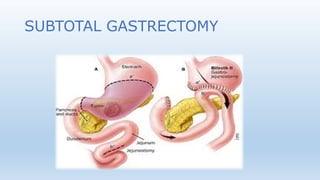
RECONSTRUCTION PROCEDURES AFTER SUBTOTAL GASTRECTOMY
• Bill Roth I
Gastroduodenal anastomosis
Mobilization of 1st part of duodenum (Kocherisation)
Only advantage is maintenance of anatomical continuity.
• Bill Roth II
Gastrojejunal anastomosis (anterior to transverse colon)
Close the proximal stump.
End-to-side anastomosis.
Adverse effect: Hypocalcaemia because calcium in diet is absorbed in the 1st part of
duodenum and food is by passed.
Disadvantage: Bile reflux gastritis, stump carcinoma.
SUBTOTAL GASTRECTOMY
TOTAL GASTRECTOMY
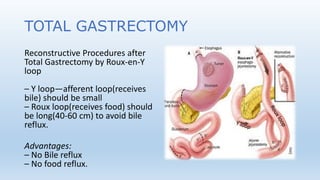
Reconstructive Procedures after
Total Gastrectomy by Roux-en-Y
loop
– Y loop—afferent loop(receives
bile) should be small
– Roux loop(receives food) should
be long(40-60 cm) to avoid bile
reflux.
Advantages:
– No Bile reflux
– No food reflux.
PALLIATIVE SURGERY
Palliative procedures are done to relieve outlet obstructive symptoms
or in cases of bleeding from lesions
I. Pyloric end:
Tanner’s anterior gastrojejunostomy (GJ)
Anterior GJ is preferred to posterior because:
1. Easier to do and redo the surgery.
2. Posteriorly, if done, nodes when get enlarged may compress the
jejunum.
3. If we want to do posterior GJ, we have to open the transverse
mesocolon;thereby connecting supra-and infracolic compartments,
hence transperitoneal spread becomes easier.
PALLIATIVE SURGERY
II. Cardiac end
1. Stent can be kept
2. Laser luminization
3. Souttar’s tube
III. Ultimately inoperable:
Linitis plastica—feeding jejunostomy
SUMMARY
1.Ultimately inoperable tumors: Feeding jejunostomy
2. Inoperable tumors in:
Cardiac end: Souttar’s tube; stent;laser luminisation.
Pylorus end—Tanner’s anterior GJ.
3. Growth in pyloric and antrum: Subtotal radical gastrectomy with Bill
Roth II
4. Growth in Cardiac end: Total gastrectomy with Roux-en-Y loop
reconstruction
5. Distant mets: Chemotherapy only.
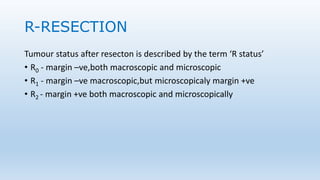
R-RESECTION
Tumour status after resecton is described by the term ‘R status’
• R0 - margin –ve,both macroscopic and microscopic
• R1 - margin –ve macroscopic,but microscopicaly margin +ve
• R2 - margin +ve both macroscopic and microscopically
THANK YOU

Surgery for gastric ca

  • 1.
  • 2.
    SURGERY FOR GASTRICCA CURATIVE EMR(Endoscopic Mucosal Resection) ESD(Endoscopic Submucosal Dissection) Gastrectomy: • Total gastrectomy • Subtotal gastrectomy PALLIATIVE Anterior GJ for carcinoma of pyloric antrum(obstruction). Gastrectomy to combat bleeding.
  • 3.
    CURATIVE SURGERY: It isnot possible when there is - • Metastatic disease - haematogenous or nodal (N3) • 𝑇3 and 𝑇4 tumours(involvement of serosa or subserosa tissue)
  • 4.
    ENDOSCOPIC MUCOSAL RESECTION Indications: •T1a tumours(Early Gastric Carcinoma) • No tumours • Size<2cm • Differentiated adenocarcinoma • No endoscopic findings of ulceration  Excised with 1 cm margin up to muscularis propria.
  • 5.
    ENDOSCOPIC SUBMUCOSAL DISSECTION Extended indicationsof EMR • Size > 2 cm • Non intestinal in type
  • 6.
    GASTRECTOMY Subtotal radical gastrectomy:Antral growth. Total radical gastrectomy: Body, fundus growth. Oncology Clearance • Proximal clearance: 5 cm from growth • Distal clearance: Up to gastroduodenal junction Subtotal gastrectomy—about 80 percent of distal stomach removed— done for cancers. Partial gastrectomy—about 60–75 percent stomach removed distally— done for benign conditions.
  • 7.
    SUBTOTAL GASTRECTOMY Structures removed- •Entire greater and lesser omentum and the superior layer of transverse mesocolon • Distal stomach along with the growth, proximal clearance of 6 cm proximal to the growth and distal line of resection taking up to 2 cm of proximal duodenum • D1/D2/D3 resection depending upon LN involvement
  • 8.
    LYMPH NODE DISSECTION Dependingon extent of lymph node dissection,the gastric surgery can be classified as D1,D2 and D3 resection. D resection exceeds the nodal involvement by one level- • N0 – D1 resection is curative. • N1 – D2 resection is curative. • N2 – D3 resection is curative.
  • 9.
    LYMPH NODE DISSECTION D1resection – removal of perigastric lymph nodes within 3 cm of tumour(station 1 to 6) D2 resection – D1+removal of second tier of lymph nodes along main arterial trunk(station 7 to 11),i.e., hepatic and splenic arteries etc. D3 resection – D2+removal of third tier of nodes,i.e., para aortic nodes etc. Now it is recommended that at least 15 lymph nodes to be removed for adequate staging. To achieve this, a D2 dissection should be the standard of care.
  • 10.
    REGIONAL LYMPH NODES •No. 1 Right paracardial LN • No. 2 Left paracardial LN • No. 3 LN along the lesser curvature • No. 4sa LN along the short gastric vessels • No. 4sb LN along the left gastroepiploic vessels • No. 4d LN along the right gastroepiploic vessels • No. 5 Suprapyloric LN • No. 6 Infrapyloric LN
  • 11.
    REGIONAL LYMPH NODES •No. 7 LN along the left gastric artery • No. 8a LN along the common hepatic artery (Anterosuperior group) • No. 8p LN along the common hepatic artery (Posterior group) • No. 9 LN around the celiac artery • No. 10 LN at the splenic hilum • No. 11p LN along the proximal splenic artery • No. 11d LN along the distal splenic artery • No. 12a LN in the hepatoduodenal ligament (along the hepatic artery)
  • 12.
    REGIONAL LYMPH NODES •No. 12b LN in the hepatoduodenal ligament (along the bile duct) • No. 12p LN in the hepatoduodenal ligament (behind the portal vein) • No. 13 LN on the posterior surface of the pancreatic head • No. 14v LN along the superior mesenteric vein • No. 14a LN along the superior mesenteric artery • No. 15 LN along the middle colic vessels • No. 16a1 LN in the aortic hiatus • No. 16a2 LN around the abdominal aorta (from the upper margin of the celiac trunk to the lower margin of the left renal vein)
  • 13.
    REGIONAL LYMPH NODES •No. 16b1 LN around the abdominal aorta (from the lower margin of the left renal vein to the upper margin of the inferior mesenteric artery) • No. 16b2 LN around the abdominal aorta (from the upper margin of the inferior mesenteric artery to the aortic bifurcation) • No. 17 LN on the anterior surface of the pancreatic head • No. 18 LN along the inferior margin of the pancreas • No. 19 Infradiaphragmatic LN • No. 20 LN in the oesophageal hiatus of the diaphragm • No. 110 Paraesophageal LN in the lower thorax • No. 111 Supradiaphragmatic LN • No. 112 Posterior mediastinal LN
  • 14.
    SUBTOTAL GASTRECTOMY RECONSTRUCTION PROCEDURESAFTER SUBTOTAL GASTRECTOMY • Bill Roth I Gastroduodenal anastomosis Mobilization of 1st part of duodenum (Kocherisation) Only advantage is maintenance of anatomical continuity. • Bill Roth II Gastrojejunal anastomosis (anterior to transverse colon) Close the proximal stump. End-to-side anastomosis. Adverse effect: Hypocalcaemia because calcium in diet is absorbed in the 1st part of duodenum and food is by passed. Disadvantage: Bile reflux gastritis, stump carcinoma.
  • 15.
  • 16.
    TOTAL GASTRECTOMY Reconstructive Proceduresafter Total Gastrectomy by Roux-en-Y loop – Y loop—afferent loop(receives bile) should be small – Roux loop(receives food) should be long(40-60 cm) to avoid bile reflux. Advantages: – No Bile reflux – No food reflux.
  • 17.
    PALLIATIVE SURGERY Palliative proceduresare done to relieve outlet obstructive symptoms or in cases of bleeding from lesions I. Pyloric end: Tanner’s anterior gastrojejunostomy (GJ) Anterior GJ is preferred to posterior because: 1. Easier to do and redo the surgery. 2. Posteriorly, if done, nodes when get enlarged may compress the jejunum. 3. If we want to do posterior GJ, we have to open the transverse mesocolon;thereby connecting supra-and infracolic compartments, hence transperitoneal spread becomes easier.
  • 18.
    PALLIATIVE SURGERY II. Cardiacend 1. Stent can be kept 2. Laser luminization 3. Souttar’s tube III. Ultimately inoperable: Linitis plastica—feeding jejunostomy
  • 19.
    SUMMARY 1.Ultimately inoperable tumors:Feeding jejunostomy 2. Inoperable tumors in: Cardiac end: Souttar’s tube; stent;laser luminisation. Pylorus end—Tanner’s anterior GJ. 3. Growth in pyloric and antrum: Subtotal radical gastrectomy with Bill Roth II 4. Growth in Cardiac end: Total gastrectomy with Roux-en-Y loop reconstruction 5. Distant mets: Chemotherapy only.
  • 20.
    R-RESECTION Tumour status afterresecton is described by the term ‘R status’ • R0 - margin –ve,both macroscopic and microscopic • R1 - margin –ve macroscopic,but microscopicaly margin +ve • R2 - margin +ve both macroscopic and microscopically
  • 21.