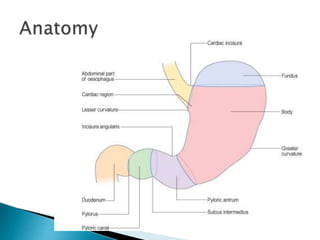
 2nd leading cause of cancer related death after lung cancer.
 The highest incidences are found in East Asia (Japan and China)>
South America > Eastern Europe
RISK FACTORS
ACQUIRED FACTORS
 H. Pylori infection ( 3-6 times)- distal gastric cancer and
intestinal type
 High intake of smoked and salted foods
 Nitrates
 Diet low in fruits and vegetables
 Smoking
 Obesity proximal gastric lesions
 Barrett esophagus/GERD
 Prior subtotal gastrectomy (25%)
 RT exposure
GENETIC FACTORS
 E- cadherin (CDH-1 gene)
 Type A blood group
 Pernicious anemia (5-10%)
 HNPCC
 Li-Fraumeni syndrome
 Adenocarcinoma- 90 to 95%
OTHERS
Lymphoma
GIST
Adenocanthoma
Squamous cell carcinoma
Carcinoid tumours etc….
 Borrman’s classification
 Broder s classification
 Lauren’s classification
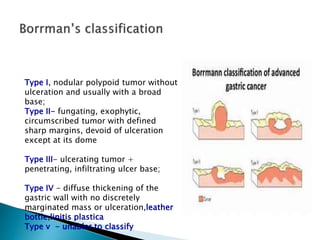
Type I, nodular polypoid tumor without
ulceration and usually with a broad
base;
Type II- fungating, exophytic,
circumscribed tumor with defined
sharp margins, devoid of ulceration
except at its dome
Type III- ulcerating tumor +
penetrating, infiltrating ulcer base;
Type IV - diffuse thickening of the
gastric wall with no discretely
marginated mass or ulceration,leather
bottle,linitis plastica
Type v - unabler to classify
 4 groups
 Well differentiated (1) to anaplastic (4)
Intestinal Diffuse
 Environmental
 Gastric atrophy and
intestinal metaplasia
 M>F
 Increase incidence with
age
 Gland formation
 Haematogenous spread
 Epidemic
 Distal part of stopmach
Familial
Blood group A
F>M
Younger age
Poorly differentiated
signet ring cells
Transmural/lymphatic
Endemic
Proximal part of stomach
 Abdominal discomfort
 weight loss
 Loss of appetite
 Early satiety
 Nausea and vomiting
 Black Tarry stool
 Duration of symptom is <3 months in almost 40% of patients
and > 1 year in 20%.
PHYSICAL EXAMINATION
Can reveal advanced disease
- Abdominal mass
-Epigastric or liver mass, periumbilical node (Sister Mary
Joseph node)
- Palpable left supraclavicular node (Virchow’s node)
- Rectal shelf (Blumer’s shelf)
- Left axilla lymphnode (Irish nodes)
TEST
ENDOSCOP
Y
Direct visualization /cytology. Biopsy usual in 90% cases
But linitis plastica & small<3 cm & cardia lesion is difficult to diagnose
DOUBLE
CONTRAST
STUDY
: small lesion limited to inner layer of stomach wall.
CECT SCAN: For both extent of spread & radiation portal (abdomen)
Mediastinal LN ( in case of distal esophageal junction and thoracic
mets.)
HELICAL
CT:
More useful In detection of smaller LN
LAPAROSC
OPIC
STUDY:
Helps in detection in metastatic disease in case of operable lesion in
preoperative imaging. Peritoneal fluid should be sampled in case of
+ve is considered as M1 disease.
• T staging is accurate enough in 86 % case by EUS. Whereas 43% by CT.
• EUS is 1st line imaging modality in T category
• Diffuse /mucinous tumors – pet has lower detection rate. As FDG accumulation is
lower in this cases
 AJCC – TNM staging
 Japanese gastric cancer staging
 Staging for E G junction cancer
Primary Tumor (T)
T1 Tumor invades lamina propria,
muscularis mucosae, or submucosa
T1a Tumor invades lamina propria or
muscularis mucosae
T1b Tumor invades submucosa
T2 Tumor invades muscularis propria*
T3 Tumor penetrates subserosa
T4 Tumor invades serosa (visceral
peritoneum) or adjacent structures
T4a Tumor invades serosa (visceral
peritoneum)
T4b Tumor invades adjacent
structures
Regional Lymph Nodes (N)*
 N1 Metastasis in 1-2 regional lymph nodes
 N2 Metastasis in 3-6 regional lymph nodes
 N3 Metastasis in 7 or more regional lymph nodes
N3a Metastasis in 7-15 regional lymph nodes
N3b Metastasis in 16 or more regional lymph nodes
 Distant Metastasis (M)
 M0 No distant metastasis
 M1 Distant metastasis
 Correction of anemia
 Correction of nutritional status
 Fluid and electrolytes
 Cardiac, respiratory and renal status
 Adequate blood
 Pre operative stomach wash
 Prophylactic antibiotics
Stage 1 T1 N0
EMR
Limited surgicalm resesction
Gastrectomy
 Early gastric cancer
 Tumor less than 2cm
 Elevated well differentiated tumors
 Without nodal involvement
 Tumour less than 1cm in diffuse
lesion
 Limited surgical resection < 3cm
 Gastrectomy >3cm
 Surgery
 Chemotherapy
 Radiotherapy
Target –R0 resection
GASTRECTOMY
Partial total
• 5 cm margin on both side to have a R0 resection
indicated
for
resectable
stage IB–III
Disease.
SURGERY
 Primary treatment of gastric cancer
 OPTIONS-
 Radical Total Gastrectomy –
 Diffuse involvement
 Proximal involvement.
 Radical Subtotal Gastrectomy –
 Distal cancers,
 Equivalent survival
 Lesser complications
 In proximal cancer, total
gastrectomy is not necessary when
subtotal gastrectomy will provide a
5 cm clearance of the gross tumour.
• Ligation of left and
right gastric and
gastro epiploic arteries
• En bloc removal of
75% of stomach
• Pylorus
• 2cm of duodenum
• Greater and lesser
omentum
• All associated
lymphatic tissue
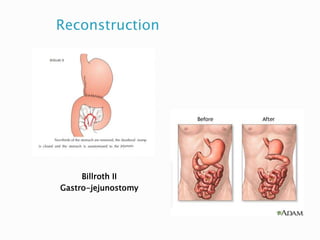
Reconstruction
Billroth II
Gastro-jejunostomy
 Proximal gastric adenocarcinoma, linitis
plastica
 stomach removed en bloc + greater and
lesser omentum
 Same survival results compared to
 Higher complication rate subtotal
 Reconstruction :
• Roux-en-Y esophago-jejunostomy
• At least 50 cm long loop
*
Cesar Roux
 Leakage of oesophago-jejunostomy
 Leakage from duodenal stump
 Para-duodenal collections
 Biliary peritonitis
 Secondary hemorrhage
 LATE COMPLICATIONS:
 Reduced capacity
 Dumping
 Diarrhea
 Nutritional deficiencies
• Adherent to pancreas or colon or mesocolon
• Ascites
• Para-aortic lymph nodes
• Secondaries in liver
• Palpable mass is incurable but can be resectable
surgically
• Blumer shelf
• Left supraclavicular nodes
• Sister Mary Joseph nodule
• Irish node (Left axillary lymph node secon daries)
Lymphadenectomy:
1. Adequate staging
2.Adequate therapy
At least 15 LN need to be retrieved.
Total gastrectomy
D0: Lymphadenectomy less than
D1
D1: Nos. 1–7
D1+:D1, Nos. 8a, 9, 11p
D2: D1+Nos. 8a, 9, 10, 11p, 11d,
12a.
Distal gastrectomy
D0: Lymphadenectomy less than
D1
D1: Nos. 1, 3, 4sb, 4d, 5, 6, 7
D1+:D1,Nos. 8a, 9
D2: D1+Nos. 8a, 9, 11p, 12a.
Japanese gastric cancer treatment guidelines 2010
Pylorus-preserving gastrectomy
D0: Lymphadenectomy less than
D1
D1: Nos. 1, 3, 4sb, 4d, 6, 7
D1+:D1,Nos. 8a, 9.
Proximal gastrectomy
D0: Lymphadenectomy less than D1
D1: Nos. 1, 2, 3a, 4sa, 4sb, 7
D1+:D1,Nos. 8a, 9, 11p
Japanese gastric cancer treatment guidelines 2010
Type Descriptions
D1 lymphadenectomy  T1a tumors that do not meet the criteria for
EMR
 cT1bN0 tumors that are differentiated type
and <1.5 cm
D1+lymphadenectomy  cT1N0 tumors other than the above
D2 lymphadenectomy  potentially curable T2-T4 tumors, &
cT1N+tumors.
 complete clearance of No. 10 nodes by
splenectomy should be considered for
potentially curable T2-T4 tumors invading the
greater curvature of the upper stomach.
D2+lymphadenectomy  Non standard
 prophylactic para-aortic lymphadenectomy
 Denied by jcog 9501
 prognosis of this population is poor.
Japanese gastric cancer treatment guidelines 2010
A recent meta-analysisof 12 randomised, controlled trials (RCTs) confirmed
no overall
survival (OS) benefit for D2 lymphadenectomy, although a benefit was seen
among patients who had resection without a splenectomy and/or
pancreatectomy
 Gastric cancer responds well to
combination cytotoxic
chemotherapy
 Neo adjuvant therapy improves
outcome
 First line treatment in inoperable
disease
 Palliative in advanced disease
 Trantuzumab – in HER2 positive
gastric cancer
 Down staging of disease --- increase
resectability
 Determine sensitivity to chemotherapy
 Decreases micro-metastatic burden
 Epirubicin + cis-platinum+ infusional
5-FU/ capecitabine
 Post op XRT
 Pre op XRT
 Intraoperative RT
 Palliative RT
Indications-
 T3-4 resectable disease
 Margins positive
 Residual disease
 LN +ve disease
 Inoperable
 Idealized portals from patterns of failure data need
modification individually for patient's initial extent of disease.
 Gastric/tumor bed, anastomosis and gastric remnant, and
regional lymphatics should be included in most patients.
 Major nodal chains at risk include
lesser and greater curvature;
celiac axis;
pancreaticoduodenal,
splenic,
suprapancreatic,
porta hepatis groups;
para-aortics to the level of L3.
Any tumor originating in the stomach has a high propensity of spread to
nodes along the greater and lesser curvature, although they are most
likely to spread to those sites in close anatomic proximity to the primary
tumor mass.
 Palliative partial gastrectomy
 Palliative anterior gastro-
jejunostomy with jj
 Palliative chemotherapy
 Endoscopic stenting/dilatation
 Laser recanalization

Carcinoma stomach presentation

  • 6.
     2nd leadingcause of cancer related death after lung cancer.  The highest incidences are found in East Asia (Japan and China)> South America > Eastern Europe RISK FACTORS ACQUIRED FACTORS  H. Pylori infection ( 3-6 times)- distal gastric cancer and intestinal type  High intake of smoked and salted foods  Nitrates  Diet low in fruits and vegetables  Smoking  Obesity proximal gastric lesions  Barrett esophagus/GERD  Prior subtotal gastrectomy (25%)  RT exposure
  • 7.
    GENETIC FACTORS  E-cadherin (CDH-1 gene)  Type A blood group  Pernicious anemia (5-10%)  HNPCC  Li-Fraumeni syndrome
  • 8.
     Adenocarcinoma- 90to 95% OTHERS Lymphoma GIST Adenocanthoma Squamous cell carcinoma Carcinoid tumours etc….
  • 9.
     Borrman’s classification Broder s classification  Lauren’s classification
  • 10.
    Type I, nodularpolypoid tumor without ulceration and usually with a broad base; Type II- fungating, exophytic, circumscribed tumor with defined sharp margins, devoid of ulceration except at its dome Type III- ulcerating tumor + penetrating, infiltrating ulcer base; Type IV - diffuse thickening of the gastric wall with no discretely marginated mass or ulceration,leather bottle,linitis plastica Type v - unabler to classify
  • 11.
     4 groups Well differentiated (1) to anaplastic (4)
  • 12.
    Intestinal Diffuse  Environmental Gastric atrophy and intestinal metaplasia  M>F  Increase incidence with age  Gland formation  Haematogenous spread  Epidemic  Distal part of stopmach Familial Blood group A F>M Younger age Poorly differentiated signet ring cells Transmural/lymphatic Endemic Proximal part of stomach
  • 13.
     Abdominal discomfort weight loss  Loss of appetite  Early satiety  Nausea and vomiting  Black Tarry stool  Duration of symptom is <3 months in almost 40% of patients and > 1 year in 20%. PHYSICAL EXAMINATION Can reveal advanced disease - Abdominal mass -Epigastric or liver mass, periumbilical node (Sister Mary Joseph node) - Palpable left supraclavicular node (Virchow’s node) - Rectal shelf (Blumer’s shelf) - Left axilla lymphnode (Irish nodes)
  • 14.
    TEST ENDOSCOP Y Direct visualization /cytology.Biopsy usual in 90% cases But linitis plastica & small<3 cm & cardia lesion is difficult to diagnose DOUBLE CONTRAST STUDY : small lesion limited to inner layer of stomach wall. CECT SCAN: For both extent of spread & radiation portal (abdomen) Mediastinal LN ( in case of distal esophageal junction and thoracic mets.) HELICAL CT: More useful In detection of smaller LN LAPAROSC OPIC STUDY: Helps in detection in metastatic disease in case of operable lesion in preoperative imaging. Peritoneal fluid should be sampled in case of +ve is considered as M1 disease. • T staging is accurate enough in 86 % case by EUS. Whereas 43% by CT. • EUS is 1st line imaging modality in T category • Diffuse /mucinous tumors – pet has lower detection rate. As FDG accumulation is lower in this cases
  • 15.
     AJCC –TNM staging  Japanese gastric cancer staging  Staging for E G junction cancer
  • 16.
    Primary Tumor (T) T1Tumor invades lamina propria, muscularis mucosae, or submucosa T1a Tumor invades lamina propria or muscularis mucosae T1b Tumor invades submucosa T2 Tumor invades muscularis propria* T3 Tumor penetrates subserosa T4 Tumor invades serosa (visceral peritoneum) or adjacent structures T4a Tumor invades serosa (visceral peritoneum) T4b Tumor invades adjacent structures
  • 17.
    Regional Lymph Nodes(N)*  N1 Metastasis in 1-2 regional lymph nodes  N2 Metastasis in 3-6 regional lymph nodes  N3 Metastasis in 7 or more regional lymph nodes N3a Metastasis in 7-15 regional lymph nodes N3b Metastasis in 16 or more regional lymph nodes  Distant Metastasis (M)  M0 No distant metastasis  M1 Distant metastasis
  • 21.
     Correction ofanemia  Correction of nutritional status  Fluid and electrolytes  Cardiac, respiratory and renal status  Adequate blood  Pre operative stomach wash  Prophylactic antibiotics
  • 22.
    Stage 1 T1N0 EMR Limited surgicalm resesction Gastrectomy
  • 23.
     Early gastriccancer  Tumor less than 2cm  Elevated well differentiated tumors  Without nodal involvement  Tumour less than 1cm in diffuse lesion
  • 25.
     Limited surgicalresection < 3cm  Gastrectomy >3cm
  • 26.
  • 27.
    Target –R0 resection GASTRECTOMY Partialtotal • 5 cm margin on both side to have a R0 resection indicated for resectable stage IB–III Disease.
  • 28.
    SURGERY  Primary treatmentof gastric cancer  OPTIONS-  Radical Total Gastrectomy –  Diffuse involvement  Proximal involvement.  Radical Subtotal Gastrectomy –  Distal cancers,  Equivalent survival  Lesser complications  In proximal cancer, total gastrectomy is not necessary when subtotal gastrectomy will provide a 5 cm clearance of the gross tumour.
  • 29.
    • Ligation ofleft and right gastric and gastro epiploic arteries • En bloc removal of 75% of stomach • Pylorus • 2cm of duodenum • Greater and lesser omentum • All associated lymphatic tissue
  • 30.
  • 31.
     Proximal gastricadenocarcinoma, linitis plastica  stomach removed en bloc + greater and lesser omentum  Same survival results compared to  Higher complication rate subtotal  Reconstruction : • Roux-en-Y esophago-jejunostomy • At least 50 cm long loop
  • 32.
  • 34.
     Leakage ofoesophago-jejunostomy  Leakage from duodenal stump  Para-duodenal collections  Biliary peritonitis  Secondary hemorrhage  LATE COMPLICATIONS:  Reduced capacity  Dumping  Diarrhea  Nutritional deficiencies
  • 35.
    • Adherent topancreas or colon or mesocolon • Ascites • Para-aortic lymph nodes • Secondaries in liver • Palpable mass is incurable but can be resectable surgically • Blumer shelf • Left supraclavicular nodes • Sister Mary Joseph nodule • Irish node (Left axillary lymph node secon daries)
  • 36.
    Lymphadenectomy: 1. Adequate staging 2.Adequatetherapy At least 15 LN need to be retrieved. Total gastrectomy D0: Lymphadenectomy less than D1 D1: Nos. 1–7 D1+:D1, Nos. 8a, 9, 11p D2: D1+Nos. 8a, 9, 10, 11p, 11d, 12a. Distal gastrectomy D0: Lymphadenectomy less than D1 D1: Nos. 1, 3, 4sb, 4d, 5, 6, 7 D1+:D1,Nos. 8a, 9 D2: D1+Nos. 8a, 9, 11p, 12a. Japanese gastric cancer treatment guidelines 2010
  • 37.
    Pylorus-preserving gastrectomy D0: Lymphadenectomyless than D1 D1: Nos. 1, 3, 4sb, 4d, 6, 7 D1+:D1,Nos. 8a, 9. Proximal gastrectomy D0: Lymphadenectomy less than D1 D1: Nos. 1, 2, 3a, 4sa, 4sb, 7 D1+:D1,Nos. 8a, 9, 11p Japanese gastric cancer treatment guidelines 2010
  • 38.
    Type Descriptions D1 lymphadenectomy T1a tumors that do not meet the criteria for EMR  cT1bN0 tumors that are differentiated type and <1.5 cm D1+lymphadenectomy  cT1N0 tumors other than the above D2 lymphadenectomy  potentially curable T2-T4 tumors, & cT1N+tumors.  complete clearance of No. 10 nodes by splenectomy should be considered for potentially curable T2-T4 tumors invading the greater curvature of the upper stomach. D2+lymphadenectomy  Non standard  prophylactic para-aortic lymphadenectomy  Denied by jcog 9501  prognosis of this population is poor. Japanese gastric cancer treatment guidelines 2010 A recent meta-analysisof 12 randomised, controlled trials (RCTs) confirmed no overall survival (OS) benefit for D2 lymphadenectomy, although a benefit was seen among patients who had resection without a splenectomy and/or pancreatectomy
  • 39.
     Gastric cancerresponds well to combination cytotoxic chemotherapy  Neo adjuvant therapy improves outcome  First line treatment in inoperable disease  Palliative in advanced disease  Trantuzumab – in HER2 positive gastric cancer
  • 40.
     Down stagingof disease --- increase resectability  Determine sensitivity to chemotherapy  Decreases micro-metastatic burden  Epirubicin + cis-platinum+ infusional 5-FU/ capecitabine
  • 41.
     Post opXRT  Pre op XRT  Intraoperative RT  Palliative RT Indications-  T3-4 resectable disease  Margins positive  Residual disease  LN +ve disease  Inoperable
  • 42.
     Idealized portalsfrom patterns of failure data need modification individually for patient's initial extent of disease.  Gastric/tumor bed, anastomosis and gastric remnant, and regional lymphatics should be included in most patients.  Major nodal chains at risk include lesser and greater curvature; celiac axis; pancreaticoduodenal, splenic, suprapancreatic, porta hepatis groups; para-aortics to the level of L3. Any tumor originating in the stomach has a high propensity of spread to nodes along the greater and lesser curvature, although they are most likely to spread to those sites in close anatomic proximity to the primary tumor mass.
  • 43.
     Palliative partialgastrectomy  Palliative anterior gastro- jejunostomy with jj  Palliative chemotherapy  Endoscopic stenting/dilatation  Laser recanalization