Created by: Katherine L. Laud, SN
INCIDENCE
• According to the National
  Cancer Institute (NCI, 2008),
  approximately 760,000 cases of
  stomach cancer are diagnosed
  worldwide.
• New cases: 21,000 in United
  States (NCI, 2010); 13,000 men
  and 8,000 women
        Created by: Katherine L. Laud, SN
INCIDENCE
• In Philippines, cancer of
  the stomach is the 8th
  leading site of cancer
  overall. According to
  Department of Health
  (DOH), it is 6th among
  males and 10th among
  females
 Created by: Katherine L. Laud, SN
INCIDENCE
• New cases: 2,563 in
  Philippines; 1,511
  among males and
  1,052 among
  females (DOH, 1998)

     Created by: Katherine L. Laud, SN
INCIDENCE
• Most (85%) cases of gastric cancer are
  adenocarcinomas that occur in the
  lining of the stomach (mucosa).
  Approximately 40% of cases develop
  in the lower part of the stomach
  (pylorus); 40% develop in the middle
  part (body); and 15% develop in the
  upper part (cardia). In about 10% of
  cases, cancer develops in more than
  one part of by: Katherine L. Laud, SN
           Created the organ.
Created by: Katherine L. Laud, SN
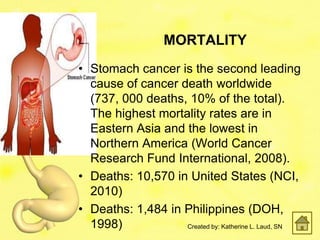
MORTALITY
• Stomach cancer is the second leading
  cause of cancer death worldwide
  (737, 000 deaths, 10% of the total).
  The highest mortality rates are in
  Eastern Asia and the lowest in
  Northern America (World Cancer
  Research Fund International, 2008).
• Deaths: 10,570 in United States (NCI,
  2010)
• Deaths: 1,484 in Philippines (DOH,
  1998)            Created by: Katherine L. Laud, SN
Created by: Katherine L. Laud, SN
ETIOLOGY/RISK FACTORS
• Family history of gastric cancer
• Helicobacter pylori infection (a
  common bacteria that can also
  cause stomach ulcers)
• History of an adenomatous gastric
  polyp larger than 2 centimeters
• Common in men
• Smoking
        Created by: Katherine L. Laud, SN
ETIOLOGY/RISK FACTORS

•   Risk increases after age 50
•   History of chronic atrophic gastritis
•   Previous stomach injury
•   History of pernicious anemia
•   Evidence suggest that gastric cancer may
    be linked to diet, such as salty food,
    smoked fish, preserved meats, and low in
    fresh fruits and vegetables.
            Created by: Katherine L. Laud, SN
ETIOLOGY/RISK FACTORS
• Some studies have found that a diet
  high in red meat is another possible
  risk factor. Eating red meat an
  average of about twice a day seems
  to raise the risk of stomach cancer.
  This risk is increased even more if the
  meat is barbecued and well done.
• Workers in the coal, metal, and
  rubber industries
        Created by: Katherine L. Laud, SN
Created by: Katherine L. Laud, SN
PREVENTION, SCREENING,
           DETECTION

• Changing lifestyle or eating
  habits (balanced diet)
• Avoiding things known to
  cause cancer
• Taking medicines to treat a
  precancerous condition or to
  keep cancer from starting
      Created by: Katherine L. Laud, SN
PREVENTION, SCREENING,
         DETECTION

• There is no standard or
  routine screening test for
  stomach cancer. However,
  upper endoscopy has been
  studied as a screening test
  to find stomach cancer at an
  early stage.
    Created by: Katherine L. Laud, SN
PREVENTION, SCREENING,
            DETECTION
• Scans - these may include
  ultrasound, MRI or CT scans
• Complete blood count (CBC) to
  check for anemia
• Esophagogastroduodenoscopy
  (EGD) with biopsy
• Stool test to check for blood in
  the stools
       Created by: Katherine L. Laud, SN
Created by: Katherine L. Laud, SN
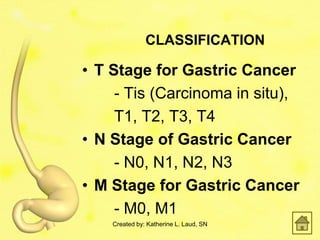
CLASSIFICATION

• T Stage for Gastric Cancer
     - Tis (Carcinoma in situ),
     T1, T2, T3, T4
• N Stage of Gastric Cancer
     - N0, N1, N2, N3
• M Stage for Gastric Cancer
     - M0, M1
    Created by: Katherine L. Laud, SN
Created by: Katherine L. Laud, SN
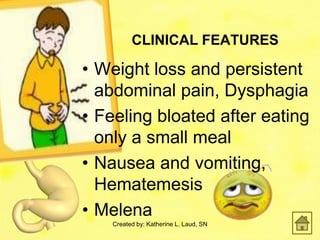
CLINICAL FEATURES

• Weight loss and persistent
  abdominal pain, Dysphagia
• Feeling bloated after eating
  only a small meal
• Nausea and vomiting,
  Hematemesis
• Melena
    Created by: Katherine L. Laud, SN
Created by: Katherine L. Laud, SN
DIAGNOSIS AND STAGING

• Thorough history and
  physical examination
• MRI, CT Scan, Upper
  Endoscopy
• Biopsies


    Created by: Katherine L. Laud, SN
DIAGNOSIS AND STAGING
*STAGING
• Stage 0: Tis, N0, M0
• Stage IA: T1, N0, M0
• Stage IB: Any of the ff: T1,N1,M0;
  T2,N0,M0
• Stage IIA: Any of the ff: T1,N2,M0;
  T2,N1,M0; T3,N0,M0
• Stage IIB: Any of the ff: T1,N3,M0;
  T2,N2,M0; T3,N1 SN T4a,N0,M0
      Created by: Katherine L. Laud, M0;
DIAGNOSIS AND STAGING
• Stage IIIA: Any of the ff:
  T2,N3,M0; T3,N2,M0; T4a,N1,M0
• Stage IIIB: Any of the ff:
  T3,N3,M0; T4a,N2,M0; T4b,N0 or
  N1,M0
• Stage IIIC: Any of the ff:
  T4a,N3,M0; T4b,N2 or N3,M0
• Stage IV: Any T,any N,M1
     Created by: Katherine L. Laud, SN
Created by: Katherine L. Laud, SN
METASTASIS
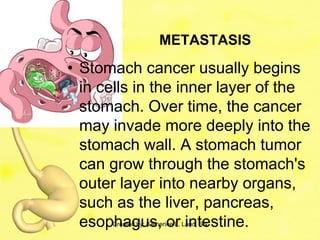
• Stomach cancer usually begins
  in cells in the inner layer of the
  stomach. Over time, the cancer
  may invade more deeply into the
  stomach wall. A stomach tumor
  can grow through the stomach's
  outer layer into nearby organs,
  such as the liver, pancreas,
  esophagus, or intestine.
      Created by: Katherine L. Laud, SN
METASTASIS
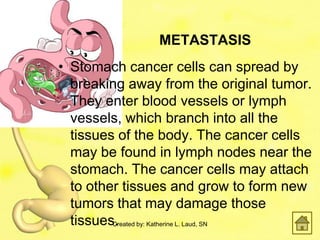
• Stomach cancer cells can spread by
  breaking away from the original tumor.
  They enter blood vessels or lymph
  vessels, which branch into all the
  tissues of the body. The cancer cells
  may be found in lymph nodes near the
  stomach. The cancer cells may attach
  to other tissues and grow to form new
  tumors that may damage those
  tissues. by: Katherine L. Laud, SN
         Created
Created by: Katherine L. Laud, SN
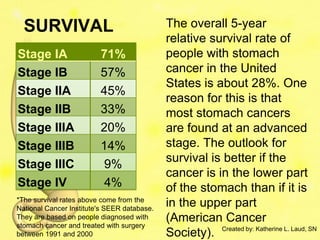
SURVIVAL                                   The overall 5-year
                                             relative survival rate of
Stage IA                 71%                 people with stomach
Stage IB                 57%                 cancer in the United
                                             States is about 28%. One
Stage IIA                45%
                                             reason for this is that
Stage IIB                33%                 most stomach cancers
Stage IIIA               20%                 are found at an advanced
Stage IIIB               14%                 stage. The outlook for
                                             survival is better if the
Stage IIIC                9%
                                             cancer is in the lower part
Stage IV                  4%                 of the stomach than if it is
*The survival rates above come from the
National Cancer Institute's SEER database.
                                             in the upper part
They are based on people diagnosed with      (American Cancer
stomach cancer and treated with surgery                 Created by: Katherine L. Laud, SN
between 1991 and 2000                        Society).
Created by: Katherine L. Laud, SN

Gastric Cancer PPT

  • 1.
  • 2.
  • 3.
  • 4.
    INCIDENCE • According tothe National Cancer Institute (NCI, 2008), approximately 760,000 cases of stomach cancer are diagnosed worldwide. • New cases: 21,000 in United States (NCI, 2010); 13,000 men and 8,000 women Created by: Katherine L. Laud, SN
  • 5.
    INCIDENCE • In Philippines,cancer of the stomach is the 8th leading site of cancer overall. According to Department of Health (DOH), it is 6th among males and 10th among females Created by: Katherine L. Laud, SN
  • 6.
    INCIDENCE • New cases:2,563 in Philippines; 1,511 among males and 1,052 among females (DOH, 1998) Created by: Katherine L. Laud, SN
  • 7.
    INCIDENCE • Most (85%)cases of gastric cancer are adenocarcinomas that occur in the lining of the stomach (mucosa). Approximately 40% of cases develop in the lower part of the stomach (pylorus); 40% develop in the middle part (body); and 15% develop in the upper part (cardia). In about 10% of cases, cancer develops in more than one part of by: Katherine L. Laud, SN Created the organ.
  • 8.
  • 9.
    MORTALITY • Stomach canceris the second leading cause of cancer death worldwide (737, 000 deaths, 10% of the total). The highest mortality rates are in Eastern Asia and the lowest in Northern America (World Cancer Research Fund International, 2008). • Deaths: 10,570 in United States (NCI, 2010) • Deaths: 1,484 in Philippines (DOH, 1998) Created by: Katherine L. Laud, SN
  • 10.
  • 11.
    ETIOLOGY/RISK FACTORS • Familyhistory of gastric cancer • Helicobacter pylori infection (a common bacteria that can also cause stomach ulcers) • History of an adenomatous gastric polyp larger than 2 centimeters • Common in men • Smoking Created by: Katherine L. Laud, SN
  • 12.
    ETIOLOGY/RISK FACTORS • Risk increases after age 50 • History of chronic atrophic gastritis • Previous stomach injury • History of pernicious anemia • Evidence suggest that gastric cancer may be linked to diet, such as salty food, smoked fish, preserved meats, and low in fresh fruits and vegetables. Created by: Katherine L. Laud, SN
  • 13.
    ETIOLOGY/RISK FACTORS • Somestudies have found that a diet high in red meat is another possible risk factor. Eating red meat an average of about twice a day seems to raise the risk of stomach cancer. This risk is increased even more if the meat is barbecued and well done. • Workers in the coal, metal, and rubber industries Created by: Katherine L. Laud, SN
  • 14.
  • 15.
    PREVENTION, SCREENING, DETECTION • Changing lifestyle or eating habits (balanced diet) • Avoiding things known to cause cancer • Taking medicines to treat a precancerous condition or to keep cancer from starting Created by: Katherine L. Laud, SN
  • 16.
    PREVENTION, SCREENING, DETECTION • There is no standard or routine screening test for stomach cancer. However, upper endoscopy has been studied as a screening test to find stomach cancer at an early stage. Created by: Katherine L. Laud, SN
  • 17.
    PREVENTION, SCREENING, DETECTION • Scans - these may include ultrasound, MRI or CT scans • Complete blood count (CBC) to check for anemia • Esophagogastroduodenoscopy (EGD) with biopsy • Stool test to check for blood in the stools Created by: Katherine L. Laud, SN
  • 18.
  • 19.
    CLASSIFICATION • T Stagefor Gastric Cancer - Tis (Carcinoma in situ), T1, T2, T3, T4 • N Stage of Gastric Cancer - N0, N1, N2, N3 • M Stage for Gastric Cancer - M0, M1 Created by: Katherine L. Laud, SN
  • 20.
  • 21.
    CLINICAL FEATURES • Weightloss and persistent abdominal pain, Dysphagia • Feeling bloated after eating only a small meal • Nausea and vomiting, Hematemesis • Melena Created by: Katherine L. Laud, SN
  • 22.
  • 23.
    DIAGNOSIS AND STAGING •Thorough history and physical examination • MRI, CT Scan, Upper Endoscopy • Biopsies Created by: Katherine L. Laud, SN
  • 24.
    DIAGNOSIS AND STAGING *STAGING •Stage 0: Tis, N0, M0 • Stage IA: T1, N0, M0 • Stage IB: Any of the ff: T1,N1,M0; T2,N0,M0 • Stage IIA: Any of the ff: T1,N2,M0; T2,N1,M0; T3,N0,M0 • Stage IIB: Any of the ff: T1,N3,M0; T2,N2,M0; T3,N1 SN T4a,N0,M0 Created by: Katherine L. Laud, M0;
  • 25.
    DIAGNOSIS AND STAGING •Stage IIIA: Any of the ff: T2,N3,M0; T3,N2,M0; T4a,N1,M0 • Stage IIIB: Any of the ff: T3,N3,M0; T4a,N2,M0; T4b,N0 or N1,M0 • Stage IIIC: Any of the ff: T4a,N3,M0; T4b,N2 or N3,M0 • Stage IV: Any T,any N,M1 Created by: Katherine L. Laud, SN
  • 26.
  • 27.
    METASTASIS • Stomach cancerusually begins in cells in the inner layer of the stomach. Over time, the cancer may invade more deeply into the stomach wall. A stomach tumor can grow through the stomach's outer layer into nearby organs, such as the liver, pancreas, esophagus, or intestine. Created by: Katherine L. Laud, SN
  • 28.
    METASTASIS • Stomach cancercells can spread by breaking away from the original tumor. They enter blood vessels or lymph vessels, which branch into all the tissues of the body. The cancer cells may be found in lymph nodes near the stomach. The cancer cells may attach to other tissues and grow to form new tumors that may damage those tissues. by: Katherine L. Laud, SN Created
  • 29.
  • 30.
    SURVIVAL The overall 5-year relative survival rate of Stage IA 71% people with stomach Stage IB 57% cancer in the United States is about 28%. One Stage IIA 45% reason for this is that Stage IIB 33% most stomach cancers Stage IIIA 20% are found at an advanced Stage IIIB 14% stage. The outlook for survival is better if the Stage IIIC 9% cancer is in the lower part Stage IV 4% of the stomach than if it is *The survival rates above come from the National Cancer Institute's SEER database. in the upper part They are based on people diagnosed with (American Cancer stomach cancer and treated with surgery Created by: Katherine L. Laud, SN between 1991 and 2000 Society).
  • 31.