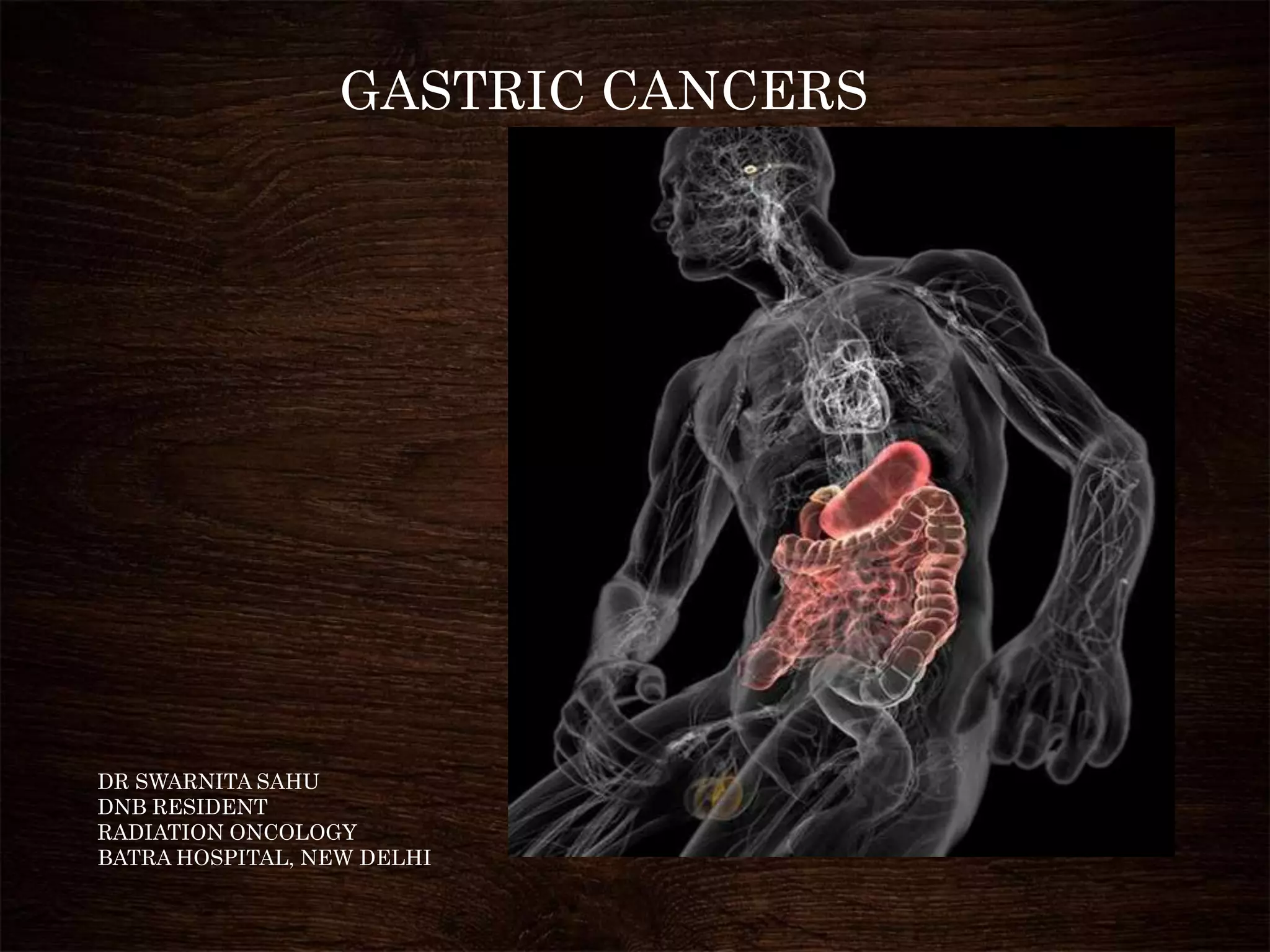
GASTRIC CANCERS
DR SWARNITA SAHU
DNB RESIDENT
RADIATION ONCOLOGY
BATRA HOSPITAL, NEW DELHI
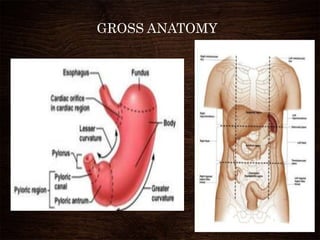
GROSS ANATOMY
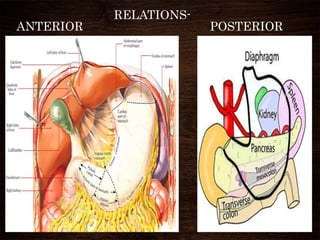
RELATIONS-
ANTERIOR POSTERIOR
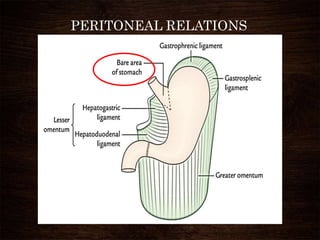
PERITONEAL RELATIONS
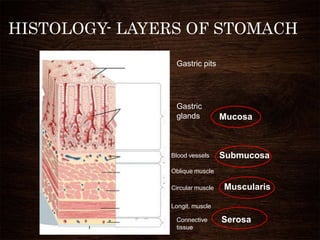
HISTOLOGY- LAYERS OF STOMACH
Gastric pits
Gastric
glands
Blood vessels
Oblique muscle
Circular muscle
Longit. muscle
Connective
tissue
Mucosa
Serosa
Submucosa
Muscularis
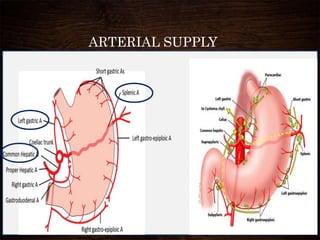
ARTERIAL SUPPLY
EPIDEMIOLOGY
• Significant decrease in incidence
• Highest incidence of distal(40%) followed by proximal (25%) followed by body.
RISK FACTORS:
• H pylori (DISTAL OR INTESTINAL TYPE).
• Advanced age.
• Male gender.
• Diet low in fruits and vegetables.
• Smoking
• Decreased use of refrigeration.
• Diet high in salted, smoked, or preserved food.
• Chronic atrophic gastritis.
• Intestinal metaplasia.
• Pernicious anemia.
• Gastric adenomatous polyps-VILLOUS (hyperplastic n hamartomatous are benign).
• Family history of gastric cancer & adenomatous polyposis.
• Menetrier disease (giant hypertrophic gastritis).
• E cadherin mutation (DIFFUSE OR LINITIS PLASTICA)
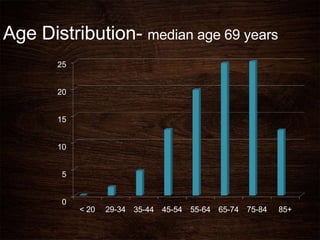
Age Distribution- median age 69 years
25
20
15
10
5
0
< 20 29-34 35-44 45-54 55-64 65-74 75-84 85+
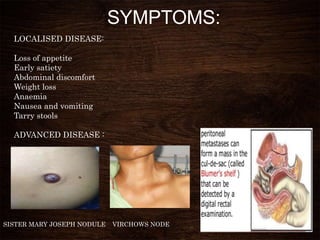
SYMPTOMS:
LOCALISED DISEASE:
Loss of appetite
Early satiety
Abdominal discomfort
Weight loss
Anaemia
Nausea and vomiting
Tarry stools
ADVANCED DISEASE :
SISTER MARY JOSEPH NODULE VIRCHOWS NODE
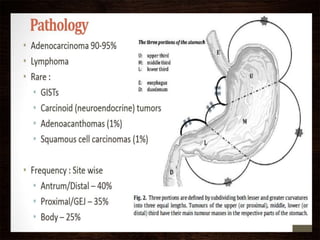
Pathology
• Adenocarcinoma (90-95%)
• Lymphomas (2nd most common)
• Leiomyosarcoma
• Carcinoid
• Adenoacanthomas
• Squamous cell
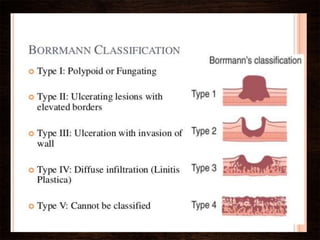
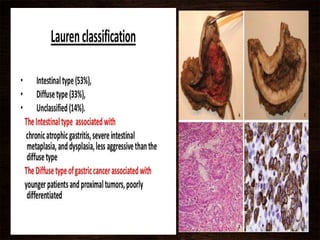
Lauren’s classification
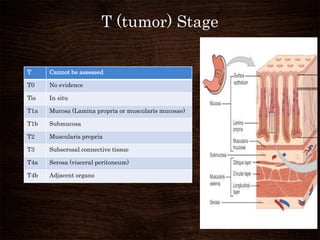
T (tumor) Stage
T Cannot be assessed
T0 No evidence
Tis In situ
T1a Mucosa (Lamina propria or muscularis mucosae)
T1b Submucosa
T2 Muscularis propria
T3 Subserosal connective tissue
T4a Serosa (visceral peritoneum)
T4b Adjacent organs
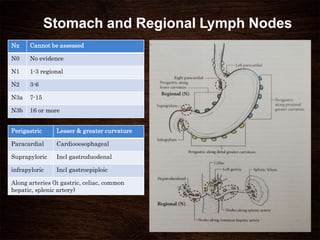
Stomach and Regional Lymph Nodes
Nx Cannot be assessed
N0 No evidence
N1 1-3 regional
N2 3-6
N3a 7-15
N3b 16 or more
Perigastric Lesser & greater curvature
Paracardial Cardiooesophageal
Suprapyloric Incl gastroduodenal
infrapyloric Incl gastroepiploic
Along arteries (lt gastric, celiac, common
hepatic, splenic artery)
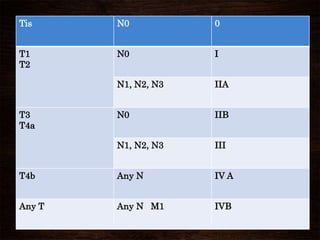
Tis N0 0
T1
T2
N0 I
N1, N2, N3 IIA
T3
T4a
N0 IIB
N1, N2, N3 III
T4b Any N IV A
Any T Any N M1 IVB
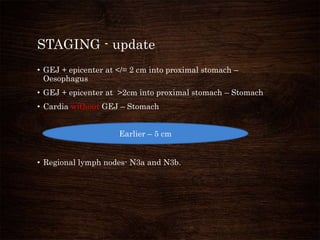
STAGING - update
• GEJ + epicenter at </= 2 cm into proximal stomach –
Oesophagus
• GEJ + epicenter at >2cm into proximal stomach – Stomach
• Cardia without GEJ – Stomach
• Regional lymph nodes- N3a and N3b.
Earlier – 5 cm
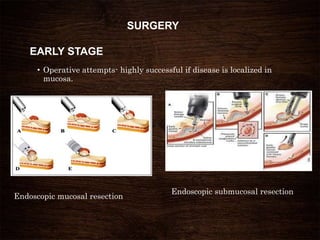
SURGERY
EARLY STAGE
• Operative attempts- highly successful if disease is localized in
mucosa.
Endoscopic mucosal resection
Endoscopic submucosal resection
INTERMEDIATE STAGE
• Proximal (cardia) : total or proximal gastrectomy
• Distal (body & antrum) : subtotal gastrectomy.
Note:
• Avoid splenectomy unless spleen/hilum involved
• >/= 5 cm proximal and distal margins of resection
• Minimum of 15 LNs to be removed
• D2 resection is preferred.
LYMPH NODE RESECTION
• D0 – incomplete removal of LN along lesser & greater curvature.
• D1 – gastrectomy as applicable
+ rt/lt cardiac LNs + lesser & greater curvature + supra & infra pyloric
• D2 – D1 + celiac trunk along with its 3 arteries (left gastric, common
hepatic, splenic artery.) + splenic hilum.
• D3- D2 + hepatoduodenal ligament +superior mesenteric vein &
retropancreatic
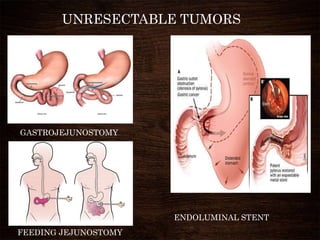
UNRESECTABLE TUMORS
ENDOLUMINAL STENT
GASTROJEJUNOSTOMY
FEEDING JEJUNOSTOMY
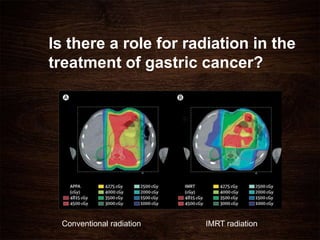
Is there a role for radiation in the
treatment of gastric cancer?
Conventional radiation IMRT radiation
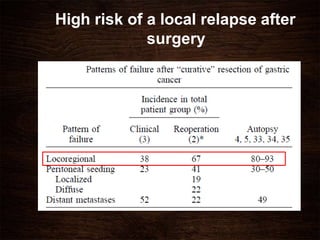
High risk of a local relapse after
surgery
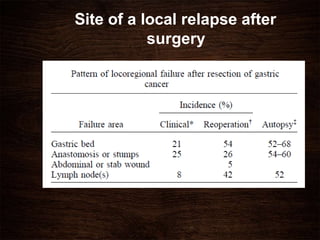
Site of a local relapse after
surgery
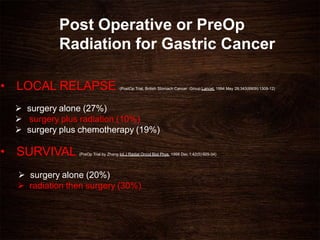
Post Operative or PreOp
Radiation for Gastric Cancer
• LOCAL RELAPSE (PostOp Trial, British Stomach Cancer Group,Lancet. 1994 May 28;343(8909):1309-12)
 surgery alone (27%)
 surgery plus radiation (10%)
 surgery plus chemotherapy (19%)
• SURVIVAL (PreOp Trial by Zhang Int J Radiat Oncol Biol Phys. 1998 Dec 1;42(5):929-34)
 surgery alone (20%)
 radiation then surgery (30%)
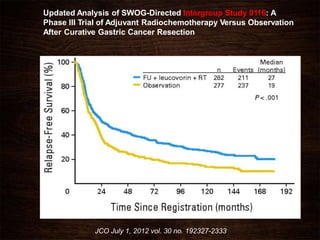
Updated Analysis of SWOG-Directed Intergroup Study 0116: A
Phase III Trial of Adjuvant Radiochemotherapy Versus Observation
After Curative Gastric Cancer Resection
JCO July 1, 2012 vol. 30 no. 192327-2333
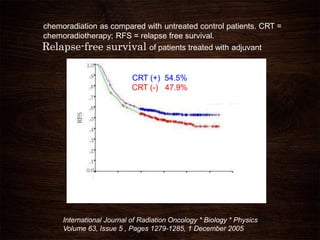
Relapse-free survival of patients treated with adjuvant
International Journal of Radiation Oncology * Biology * Physics
Volume 63, Issue 5 , Pages 1279-1285, 1 December 2005
chemoradiation as compared with untreated control patients. CRT =
chemoradiotherapy; RFS = relapse free survival.
5yr RFS
CRT (+) 54.5%
CRT (-) 47.9%
0 20 40 60 80
Months
100 120
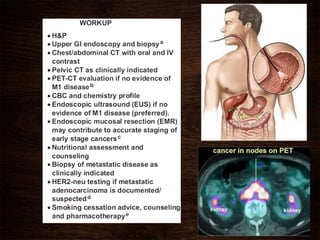
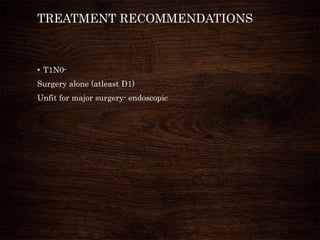
TREATMENT RECOMMENDATIONS
• T1N0-
Surgery alone (atleast D1)
Unfit for major surgery- endoscopic
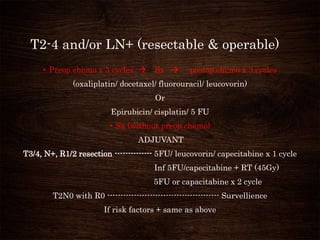
T2-4 and/or LN+ (resectable & operable)
• Preop chemo x 3 cycles - Sx  postop chemo x 3 cycles
(oxaliplatin/ docetaxel/ fluorouracil/ leucovorin)
Or
Epirubicin/ cisplatin/ 5 FU
• Sx (without preop chemo)
ADJUVANT
T3/4, N+, R1/2 resection -------------- 5FU/ leucovorin/ capecitabine x 1 cycle
Inf 5FU/capecitabine + RT (45Gy)
5FU or capacitabine x 2 cycle
T2N0 with R0 ------------------------------------------ Survellience
If risk factors + same as above
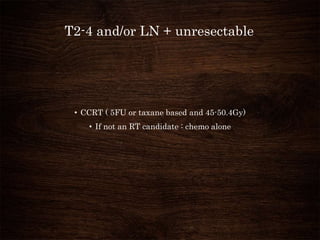
T2-4 and/or LN + unresectable
• CCRT ( 5FU or taxane based and 45-50.4Gy)
• If not an RT candidate : chemo alone
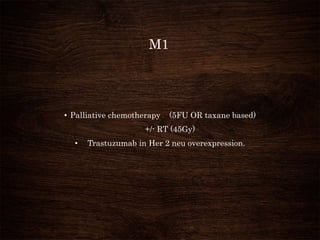
M1
• Palliative chemotherapy (5FU OR taxane based)
+/- RT (45Gy)
• Trastuzumab in Her 2 neu overexpression.
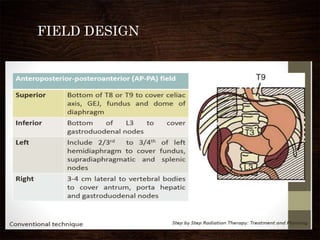
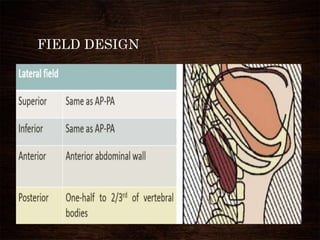
FIELD DESIGN
FIELD DESIGN
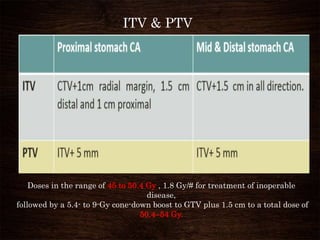
ITV & PTV
Doses in the range of 45 to 50.4 Gy , 1.8 Gy/# for treatment of inoperable
disease,
followed by a 5.4- to 9-Gy cone-down boost to GTV plus 1.5 cm to a total dose of
50.4–54 Gy.
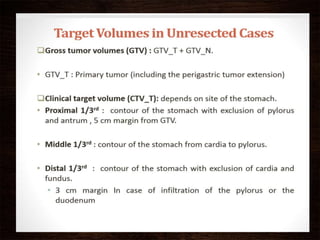
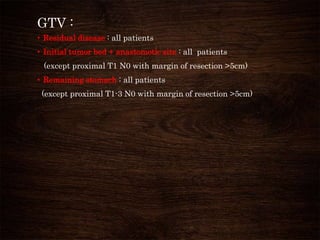
GTV :
• Residual disease : all patients
• Initial tumor bed + anastomotic site : all patients
(except proximal T1 N0 with margin of resection >5cm)
• Remaining stomach : all patients
(except proximal T1-3 N0 with margin of resection >5cm)
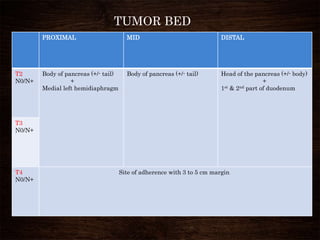
TUMOR BED
PROXIMAL MID DISTAL
T2
N0/N+
Body of pancreas (+/- tail)
+
Medial left hemidiaphragm
Body of pancreas (+/- tail) Head of the pancreas (+/- body)
+
1st & 2nd part of duodenum
T3
N0/N+
T4
N0/N+
Site of adherence with 3 to 5 cm margin
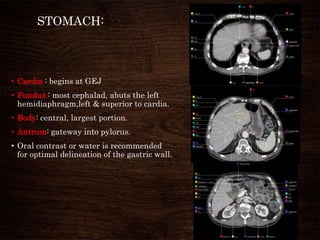
STOMACH:
• Cardia : begins at GEJ
• Fundus : most cephalad, abuts the left
hemidiaphragm,left & superior to cardia.
• Body: central, largest portion.
• Antrum: gateway into pylorus.
• Oral contrast or water is recommended
for optimal delineation of the gastric wall.
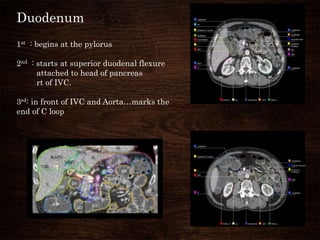
Duodenum
1st : begins at the pylorus
2nd : starts at superior duodenal flexure
attached to head of pancreas
rt of IVC.
3rd: in front of IVC and Aorta…marks the
end of C loop
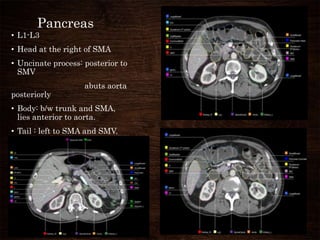
Pancreas
• L1-L3
• Head at the right of SMA
• Uncinate process: posterior to
SMV
abuts aorta
posteriorly
• Body: b/w trunk and SMA,
lies anterior to aorta.
• Tail : left to SMA and SMV.
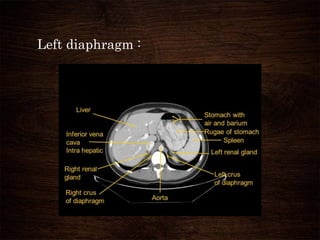
Left diaphragm :
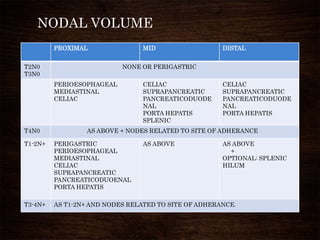
NODAL VOLUME
PROXIMAL MID DISTAL
T2N0
T3N0
NONE OR PERIGASTRIC
PERIOESOPHAGEAL
MEDIASTINAL
CELIAC
CELIAC
SUPRAPANCREATIC
PANCREATICODUODE
NAL
PORTA HEPATIS
SPLENIC
CELIAC
SUPRAPANCREATIC
PANCREATICODUODE
NAL
PORTA HEPATIS
T4N0 AS ABOVE + NODES RELATED TO SITE OF ADHERANCE
T1-2N+ PERIGASTRIC
PERIOESOPHAGEAL
MEDIASTINAL
CELIAC
SUPRAPANCREATIC
PANCREATICODUOENAL
PORTA HEPATIS
AS ABOVE AS ABOVE
+
OPTIONAL: SPLENIC
HILUM
T3-4N+ AS T1-2N+ AND NODES RELATED TO SITE OF ADHERANCE.
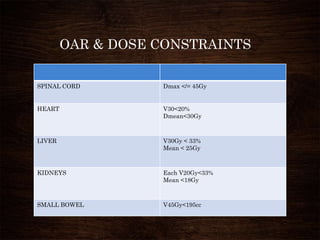
OAR & DOSE CONSTRAINTS
SPINAL CORD Dmax </= 45Gy
HEART V30<20%
Dmean<30Gy
LIVER V30Gy < 33%
Mean < 25Gy
KIDNEYS Each V20Gy<33%
Mean <18Gy
SMALL BOWEL V45Gy<195cc
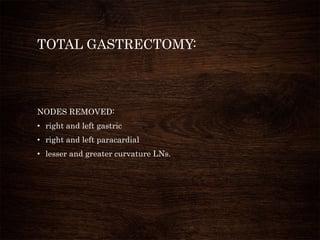
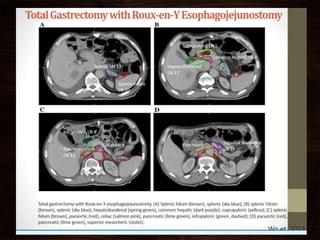
TOTAL GASTRECTOMY:
NODES REMOVED:
• right and left gastric
• right and left paracardial
• lesser and greater curvature LNs.
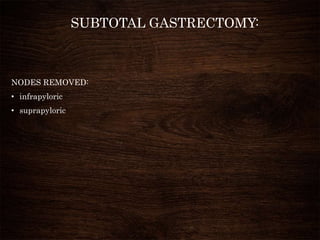
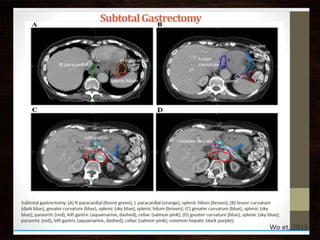
SUBTOTAL GASTRECTOMY:
NODES REMOVED:
• infrapyloric
• suprapyloric
THANK YOU

Gastric cancers

  • 1.
    GASTRIC CANCERS DR SWARNITASAHU DNB RESIDENT RADIATION ONCOLOGY BATRA HOSPITAL, NEW DELHI
  • 2.
  • 3.
  • 4.
  • 5.
    HISTOLOGY- LAYERS OFSTOMACH Gastric pits Gastric glands Blood vessels Oblique muscle Circular muscle Longit. muscle Connective tissue Mucosa Serosa Submucosa Muscularis
  • 6.
  • 7.
    EPIDEMIOLOGY • Significant decreasein incidence • Highest incidence of distal(40%) followed by proximal (25%) followed by body. RISK FACTORS: • H pylori (DISTAL OR INTESTINAL TYPE). • Advanced age. • Male gender. • Diet low in fruits and vegetables. • Smoking • Decreased use of refrigeration. • Diet high in salted, smoked, or preserved food. • Chronic atrophic gastritis. • Intestinal metaplasia. • Pernicious anemia. • Gastric adenomatous polyps-VILLOUS (hyperplastic n hamartomatous are benign). • Family history of gastric cancer & adenomatous polyposis. • Menetrier disease (giant hypertrophic gastritis). • E cadherin mutation (DIFFUSE OR LINITIS PLASTICA)
  • 8.
    Age Distribution- medianage 69 years 25 20 15 10 5 0 < 20 29-34 35-44 45-54 55-64 65-74 75-84 85+
  • 9.
    SYMPTOMS: LOCALISED DISEASE: Loss ofappetite Early satiety Abdominal discomfort Weight loss Anaemia Nausea and vomiting Tarry stools ADVANCED DISEASE : SISTER MARY JOSEPH NODULE VIRCHOWS NODE
  • 11.
    Pathology • Adenocarcinoma (90-95%) •Lymphomas (2nd most common) • Leiomyosarcoma • Carcinoid • Adenoacanthomas • Squamous cell
  • 13.
  • 14.
    T (tumor) Stage TCannot be assessed T0 No evidence Tis In situ T1a Mucosa (Lamina propria or muscularis mucosae) T1b Submucosa T2 Muscularis propria T3 Subserosal connective tissue T4a Serosa (visceral peritoneum) T4b Adjacent organs
  • 15.
    Stomach and RegionalLymph Nodes Nx Cannot be assessed N0 No evidence N1 1-3 regional N2 3-6 N3a 7-15 N3b 16 or more Perigastric Lesser & greater curvature Paracardial Cardiooesophageal Suprapyloric Incl gastroduodenal infrapyloric Incl gastroepiploic Along arteries (lt gastric, celiac, common hepatic, splenic artery)
  • 16.
    Tis N0 0 T1 T2 N0I N1, N2, N3 IIA T3 T4a N0 IIB N1, N2, N3 III T4b Any N IV A Any T Any N M1 IVB
  • 17.
    STAGING - update •GEJ + epicenter at </= 2 cm into proximal stomach – Oesophagus • GEJ + epicenter at >2cm into proximal stomach – Stomach • Cardia without GEJ – Stomach • Regional lymph nodes- N3a and N3b. Earlier – 5 cm
  • 18.
    SURGERY EARLY STAGE • Operativeattempts- highly successful if disease is localized in mucosa. Endoscopic mucosal resection Endoscopic submucosal resection
  • 19.
    INTERMEDIATE STAGE • Proximal(cardia) : total or proximal gastrectomy • Distal (body & antrum) : subtotal gastrectomy. Note: • Avoid splenectomy unless spleen/hilum involved • >/= 5 cm proximal and distal margins of resection • Minimum of 15 LNs to be removed • D2 resection is preferred.
  • 20.
    LYMPH NODE RESECTION •D0 – incomplete removal of LN along lesser & greater curvature. • D1 – gastrectomy as applicable + rt/lt cardiac LNs + lesser & greater curvature + supra & infra pyloric • D2 – D1 + celiac trunk along with its 3 arteries (left gastric, common hepatic, splenic artery.) + splenic hilum. • D3- D2 + hepatoduodenal ligament +superior mesenteric vein & retropancreatic
  • 21.
  • 22.
    Is there arole for radiation in the treatment of gastric cancer? Conventional radiation IMRT radiation
  • 23.
    High risk ofa local relapse after surgery
  • 24.
    Site of alocal relapse after surgery
  • 25.
    Post Operative orPreOp Radiation for Gastric Cancer • LOCAL RELAPSE (PostOp Trial, British Stomach Cancer Group,Lancet. 1994 May 28;343(8909):1309-12)  surgery alone (27%)  surgery plus radiation (10%)  surgery plus chemotherapy (19%) • SURVIVAL (PreOp Trial by Zhang Int J Radiat Oncol Biol Phys. 1998 Dec 1;42(5):929-34)  surgery alone (20%)  radiation then surgery (30%)
  • 26.
    Updated Analysis ofSWOG-Directed Intergroup Study 0116: A Phase III Trial of Adjuvant Radiochemotherapy Versus Observation After Curative Gastric Cancer Resection JCO July 1, 2012 vol. 30 no. 192327-2333
  • 27.
    Relapse-free survival ofpatients treated with adjuvant International Journal of Radiation Oncology * Biology * Physics Volume 63, Issue 5 , Pages 1279-1285, 1 December 2005 chemoradiation as compared with untreated control patients. CRT = chemoradiotherapy; RFS = relapse free survival. 5yr RFS CRT (+) 54.5% CRT (-) 47.9% 0 20 40 60 80 Months 100 120
  • 28.
    TREATMENT RECOMMENDATIONS • T1N0- Surgeryalone (atleast D1) Unfit for major surgery- endoscopic
  • 29.
    T2-4 and/or LN+(resectable & operable) • Preop chemo x 3 cycles - Sx  postop chemo x 3 cycles (oxaliplatin/ docetaxel/ fluorouracil/ leucovorin) Or Epirubicin/ cisplatin/ 5 FU • Sx (without preop chemo) ADJUVANT T3/4, N+, R1/2 resection -------------- 5FU/ leucovorin/ capecitabine x 1 cycle Inf 5FU/capecitabine + RT (45Gy) 5FU or capacitabine x 2 cycle T2N0 with R0 ------------------------------------------ Survellience If risk factors + same as above
  • 30.
    T2-4 and/or LN+ unresectable • CCRT ( 5FU or taxane based and 45-50.4Gy) • If not an RT candidate : chemo alone
  • 31.
    M1 • Palliative chemotherapy(5FU OR taxane based) +/- RT (45Gy) • Trastuzumab in Her 2 neu overexpression.
  • 32.
  • 33.
  • 36.
    ITV & PTV Dosesin the range of 45 to 50.4 Gy , 1.8 Gy/# for treatment of inoperable disease, followed by a 5.4- to 9-Gy cone-down boost to GTV plus 1.5 cm to a total dose of 50.4–54 Gy.
  • 37.
    GTV : • Residualdisease : all patients • Initial tumor bed + anastomotic site : all patients (except proximal T1 N0 with margin of resection >5cm) • Remaining stomach : all patients (except proximal T1-3 N0 with margin of resection >5cm)
  • 38.
    TUMOR BED PROXIMAL MIDDISTAL T2 N0/N+ Body of pancreas (+/- tail) + Medial left hemidiaphragm Body of pancreas (+/- tail) Head of the pancreas (+/- body) + 1st & 2nd part of duodenum T3 N0/N+ T4 N0/N+ Site of adherence with 3 to 5 cm margin
  • 39.
    STOMACH: • Cardia :begins at GEJ • Fundus : most cephalad, abuts the left hemidiaphragm,left & superior to cardia. • Body: central, largest portion. • Antrum: gateway into pylorus. • Oral contrast or water is recommended for optimal delineation of the gastric wall.
  • 40.
    Duodenum 1st : beginsat the pylorus 2nd : starts at superior duodenal flexure attached to head of pancreas rt of IVC. 3rd: in front of IVC and Aorta…marks the end of C loop
  • 41.
    Pancreas • L1-L3 • Headat the right of SMA • Uncinate process: posterior to SMV abuts aorta posteriorly • Body: b/w trunk and SMA, lies anterior to aorta. • Tail : left to SMA and SMV.
  • 42.
  • 43.
    NODAL VOLUME PROXIMAL MIDDISTAL T2N0 T3N0 NONE OR PERIGASTRIC PERIOESOPHAGEAL MEDIASTINAL CELIAC CELIAC SUPRAPANCREATIC PANCREATICODUODE NAL PORTA HEPATIS SPLENIC CELIAC SUPRAPANCREATIC PANCREATICODUODE NAL PORTA HEPATIS T4N0 AS ABOVE + NODES RELATED TO SITE OF ADHERANCE T1-2N+ PERIGASTRIC PERIOESOPHAGEAL MEDIASTINAL CELIAC SUPRAPANCREATIC PANCREATICODUOENAL PORTA HEPATIS AS ABOVE AS ABOVE + OPTIONAL: SPLENIC HILUM T3-4N+ AS T1-2N+ AND NODES RELATED TO SITE OF ADHERANCE.
  • 46.
    OAR & DOSECONSTRAINTS SPINAL CORD Dmax </= 45Gy HEART V30<20% Dmean<30Gy LIVER V30Gy < 33% Mean < 25Gy KIDNEYS Each V20Gy<33% Mean <18Gy SMALL BOWEL V45Gy<195cc
  • 47.
    TOTAL GASTRECTOMY: NODES REMOVED: •right and left gastric • right and left paracardial • lesser and greater curvature LNs.
  • 49.
    SUBTOTAL GASTRECTOMY: NODES REMOVED: •infrapyloric • suprapyloric
  • 51.